Accountability:
Definition and Relationship to Verifiability
Ralf Küsters
University of Trier, Germany
Tomasz Truderung
University of Trier, Germany
Andreas Vogt
University of Trier, Germany
ABSTRACT
Many cryptographic tasks and protocols, such as non-repudiation, contract-signing, voting, auction, identity-based encryption, and certain forms of secure multi-party computation, involve the use of (semi-)trusted parties, such as notaries and authorities. It is crucial that such parties can be held accountable in case they misbehave as this is a strong incentive for such parties to follow the proto-col. Unfortunately, there does not exist a general and convincing definition of accountability that would allow to assess the level of accountability a protocol provides.
In this paper, we therefore propose a new, widely applicable def-inition of accountability, with interpretations both in symbolic and computational models. Our definition reveals that accountability is closely related to verifiability, for which we also propose a new definition. We prove that verifiability can be interpreted as a re-stricted form of accountability. Our findings on verifiability are of independent interest.
As a proof of concept, we apply our definitions to the analy-sis of protocols for three different tasks: contract-signing, voting, and auctions. Our analysis unveils some subtleties and unexpected weaknesses, showing in one case that the protocol is unusable in practice. However, for this protocol we propose a fix to establish a reasonable level of accountability.
1.
INTRODUCTION
Many cryptographic tasks and protocols, such as non-repudiation [48], contract-signing [4], voting [16, 10], auctions [38], identity-based encryption [19, 20], and certain forms of secure multi-party computation [24], involve the use of (semi-)trusted parties, such as notaries and authorities. It is crucial that such parties can be held accountable in case they misbehave as this is a strong, in some cases maybe the main incentive for such parties to follow the pro-tocol. Unfortunately, there does not exist a general and convincing definition of accountability that would allow to assess the level of accountability a protocol provides. The few existing formulations of accountability are, for the most part, quite ad hoc and protocol specific (see Section 4 for the related work).
The main goal of this paper is therefore to propose a new, general definition of accountability and to demonstrate its applicability to a wide range of cryptographic tasks and protocols. Jumping ahead, it turns out that accountability is closely related to verifiability. This motivated us to also propose a new definition for this prominent security requirement. More precisely, our contributions are as fol-lows.
This work was partially supported by Deutsche
Forschungsge-meinschaft(DFG) under Grant KU 1434/5-1. An abridged version
was published in [34].
Contribution of this Paper. In this paper, we propose a general, model-independent definition of accountability. We provide inter-pretations of our definition both in symbolic (Dolev-Yao style) and computational (cryptographic) models. While, as usual, analysis in the symbolic model is simpler and more amenable to tool-support, the computational definition gives stronger security guarantees, as it does not abstract from cryptographic details and allows for a more-fine grained measure of accountability. As for the symbolic definition, we discuss and illustrate how existing analysis tools can be used to check accountability in some cases.
Our definition of accountability is applicable to a wide range of cryptographic tasks and protocols, yet it allows to precisely cap-ture the level of accountability a protocol provides. This is demon-strated in three case studies, in which we apply our definition to protocols for three important cryptographic tasks: contract-signing, voting, and auctions. Our analysis of these protocols reveals some subtleties and unexpected, partly severe weaknesses. For example, in the auction protocol that we analyze [38], which was explicitly designed to be of practical use, our analysis shows that if two bid-ders with two different bids claim to be the winner of the auction, then, even if it is clear that one of the two bidders misbehaved, a judge cannot blame a specific bidder. It even remains open whether the auctioneer was honest and who actually won the auction. We propose a fix for this problem and prove that it in fact solves the problem.
As mentioned, it turns out that accountability is closely related to verifiability. Therefore, we also introduce a new definition of ver-ifiability, again with a symbolic and computational interpretation. This definition is interesting in its own right: It is again applicable to a wide range of cryptographic tasks and protocols. Also, unlike other definitions and informal descriptions, our definition takes a global view on verifiability, centered around the overall goal of a protocol, rather than focussing on what, in the context of e-voting, is called individual and universal verifiability; although these forms of verifiability can also be captured by our definition (see Sections 3 and 4).
dispute.
Structure of the Paper. Accountability is defined in Section 2. In Section 3 we provide our definition of verifiability, along with the proposition that shows that verifiability is implied by account-ability. Related work is discussed in Section 4. Our case studies are presented in Sections 5 (voting), 6 (auction), and 7 (contract signing). More details can be found in the appendix.
2.
ACCOUNTABILITY
In this section, we provide our definition of accountability. As mentioned in the introduction, we present two variants: a symbolic and a computational one, which conceptually are closely related. We start with a definition of protocols.
2.1
Protocols
In this section, we present a generic definition of a protocol, suit-able for the definition of accountability (and verifiability).
We do not fix any specific symbolic or computational model as our definitions do not depend on details of such models. We only require that the model provides us with a notion of aprocesswhich can perform internal computation and can communicate with other processes by sending messages via(external) input/output chan-nels. We also assume that processes can be composed to form new processes; however, the composition may be subject to certain con-ditions. Ifπand π0 are processes, then we writeπkπ0for the composition ofπandπ0. Moreover, in the symbolic setting, we assume that a process defines a set of runs; we assume a set of runs, rather than a single run, as processes may be nondetermin-istic. In the computational setting, a process defines a family of probability distributions over runs, indexed by the security parame-ter. The representation of a single run should contain a description of the corresponding process. In the computational setting, a single run also contains the security parameter and all random coins. We will consider onlycompleteruns that cannot be extended, which in the symbolic setting can include infinite runs. Possible sym-bolic instances of our framework include the appliedπ-calculus [2] and models based on I/O-automata, see, e.g., [28]. In a computa-tional model, processes would typically be modeled as probabilistic polynomial-time systems of probabilistic polynomial-time interac-tive Turing machines (ppt ITMs), see, e.g., [18]. Our case studies provide concrete examples (see Sections 5 to 7).
For setsI andOof channel names, we denote byΠ(I,O)the set of all processes with external input channels inIand external output channels inO.
DEFINITION1 (PROTOCOL). A protocol is a tuple P =
(Σ,Ch,In,Out,{Πa}a∈Σ,{Πˆa}a∈Σ), where:
– Σ={a1, . . . ,an}andChare finite sets, called the set ofagents
andchannelsofP, respectively.
– In and Out are functions fromΣto 2Chsuch that Out(a)and Out(b)are disjoint for alla6=band In(a)and In(b)are disjoint for alla6=b. The sets In(a) and Out(a)are called the set of (external)inputandoutput channels of agent a, respectively. We assume that a special channeldecisiona∈Chis an element of Out(a), for everya∈Σ, but that it is not an input channel for any agent.
– Πa⊆Π(In(a),Out(a)), for everya∈Σ, is called the set of
pro-grams of a. This set contains all propro-gramsacan possibly run,
modeling both honest and potential dishonest behavior. – ˆΠa⊆Πa, for everya∈Σ, is called the set ofhonest programs
of a, i.e., the set of programs thataruns ifais honest. Often
this set is a singleton, but sometimes it is convenient to consider non-singleton sets.
LetP= (Σ,Ch,In,Out,{Πa}a∈Σ,{Πˆa}a∈Σ)be a protocol. An
instance of Pis a process of the formπ= (πa1k. . .kπan)with
πai∈Πai. We say thataiishonestin such an instance, ifπai∈Πˆai.
Arun of Pis a run of some instance ofP. We say thataiis honest
in a runr, ifris a run of an instance ofPwith honestai. Aproperty γof Pis a subset of the set of all runs ofP. By¬γwe denote the complement ofγ.
2.2
Symbolic and Computational
Account-ability
We now provide a symbolic and a computational definition of accountability.
Our definition of accountability is w.r.t. an agentJof the proto-col who is supposed to blame protoproto-col participants in case of mis-behavior. The agentJ, which we sometimes refer to as ajudge, can be a “regular” protocol participant or an (external) judge, pos-sibly provided with additional information by other protocol par-ticipants; however,Jmay not necessarily trust these other protocol participants since they may be dishonest and may provideJwith bogus information.
In order to understand the subtleness of accountability, it is in-structive to look at a first (flawed) definition of accountability and its possible interpretations, inspired by informal statements about accountability in the literature.
(i) (fairness)J(almost) never blames protocol participants who are honest, i.e., run their honest program.
(ii) (completeness) If in a protocol run participants “misbehave”, thenJblames those participants.
While the fairness condition is convincing and clear, this is not the case for the completeness condition. First, the question is what “misbehavior” means. It could be interpreted as a behavior that does not correspond to any honest behavior. However, this inter-pretation is much too strong. No protocol would satisfy it, because this includes misbehavior that is impossible to be observed by any other party and misbehavior that is completely “harmless” and “ir-relevant”. For example, if, in addition to the messages a partyA is supposed to send to another partyB, Aalso sends some harm-less message “hello”, say, thenBcan observe this misbehavior, but cannot convinceJof any misbehavior. This example also shows that interpreting “misbehavior” as dishonest behavior observable by honest parties, and hence, misbehavior that, at least to some ex-tent, affects these parties, does not work either. In fact, a complete-ness condition based on this notion of “misbehavior” would again deem basically all non-trivial protocols insecure w.r.t. accountabil-ity. More importantly, this completeness condition misses the main point: Misbehavior that cannot be observed by any honest party may still be very relevant and harmful. We therefore advocate an interpretation that circles around the desired goals of a protocol.
Informally speaking, our definition of accountability reads as follows:
(i) (fairness)J(almost) never blames protocol participants who are honest, i.e., run their honest program.
in a run of the protocol this is not the case (a fact that must be due to the misbehavior of one or more protocol participants), then one or more participants are held accountable byJ; by the fairness condition they arerightlyheld accountable. In case of auctions, a desired goal could be that the announced winner is in fact the winner of the auction; if this is not so in a run, by the completeness condition some participant(s), who misbehaved, will be blamed. Desired goals, as the above, will be a parameter of our definition.
The informal completeness condition above leaves open who ex-actly should be blamed. This could be fixed in a specific way. However, this would merely provide a black and white picture, and either set the bar too high or too low for many protocols. For exam-ple, it is desirable that the judge, whenever a desired goal of a pro-tocol is not met, blamesallmisbehaving parties. This, as explained above, is usually not possible (e.g., if for a dishonest party the de-viation from the protocol consists in sending a harmless “hello” message). So, this sets the bar too high for practically every proto-col. Alternatively, one could require that at least some misbehaving parties can be blamed individually (individual accountability). Be-ing able to rightly blame individual parties, rather than, say, just a group of parties among which at least one misbehaved, is impor-tant in practice, since only this might have actual consequences for a misbehaving party. However, as illustrated by our case studies, protocols often fail to achieve individual accountability. One could set the bar lower and only require that a group of parties is blamed among which at least one misbehaved. But this is often unsatisfying in practice. Altogether, rather than fixing the level of accountabil-ity protocols are supposed to provide up front, it is more reasonable to have a language in which this can be described precisely, allow-ing to compare protocols and tell apart weak protocols from strong ones.
To this end, below we introduce what we call accountability properties, which are sets of what we call accountability con-straints. We also allow the judge to state quite detailed “verdicts”.
Formally, averdictis a positive boolean formulaψbuilt from propositions of the formdis(a), for an agent a, wheredis(a)is intended to express thatamisbehaved (behaved dishonestly), i.e., did not follow the prescribed protocol. Let us look at some ex-amples. If the judge states dis(a)∨dis(b), then this expresses the judge’s belief that a or b misbehaved. (In case of a fair judge, this implies that at least one of the two parties indeed mis-behaved.) Another example: In a voting protocol, with a vot-ing machineM and auditors A1, . . . ,Ar, if the judge states, say,
dis(M)∧dis(A1)∧. . .∧dis(Ar), then this expresses the judge’s be-lief that the voting machine and all auditors misbehaved; the judge would statedis(M)∨(dis(A1)∧. . .∧dis(Ar)) if she is not sure whether the voting machine or all auditors misbehaved. Our case studies demonstrate the usefulness of such expressive forms of ver-dicts. We will denote byFdis the set of all verdicts. A partyJ
canstate a verdictψ, by sendingψon its dedicated output channel
decisionJ. Note that, in one run,Jmay state many different verdicts
ψ1, . . . ,ψk, which is equivalent to stating the verdictψ1∧ · · · ∧ψk. Formally, for a protocolPand an instanceπofP, a verdictψis
true inπ, writtenπ|=ψ, iff the formulaψevaluates to true with
the propositiondis(a)set to false, ifais honest inπ, and set to true otherwise.
We now introduce accountability constraints and accountability properties which allow to precisely describe the level of account-ability a protocol provides.
Anaccountability constraintof a protocolPis a tuple(α,ψ1, . . . ,
ψk), written(α⇒ψ1| · · · |ψk), whereαis a property ofPand ψ1, . . . ,ψk∈Fdis. We say that a constraint(α⇒ϕ1| · · · |ϕk)
coversa runr, ifr∈α.
Intuitively, in a constraintC= (α⇒ψ1| · · · |ψk), the setα con-tains runs in which some desired goal of the protocol is not met (due to the misbehavior of some protocol participant). The formu-lasψ1, . . . ,ψkare the possible (minimal) verdicts that are supposed to be stated byJin such a case;Jis free to state stronger verdicts (by the fairness condition these verdicts will be true). Formally, for a runr, we say thatJ ensures C in r, if eitherr∈/αorJstates inr a verdictψthat implies one ofψ1, . . . ,ψk(in the sense of proposi-tional logic).
EXAMPLE 1. To illustrate the notion of accountability con-straints, let us consider the following examples, where, say,J is supposed to blame misbehaving parties, M is a voting machine,
A1, . . . ,Arare auditors, andαcontains all runs in which the
pub-lished result of the election is incorrect:
C1ex = α⇒dis(M)|dis(A1)| · · · |dis(Ar) (1) C2ex = α⇒dis(M)∨(dis(A1)∧ · · · ∧dis(Ar)) (2) C3ex = α⇒dis(M)|dis(A1)∧ · · · ∧dis(Ar). (3) ConstraintCex1 requires that if in a run the published result of the election is incorrect, then at least one (individual) party amongM, A1, . . . ,Arcan be held accountable byJ; note that different parties can be blamed in different runs. PartyJensuresC1exin a runr∈α, if, for example,Jstatesdis(A1)orJstatesdis(M)∧dis(Ar), but not ifJonly statesdis(M)∨dis(A1). ConstraintCex3 is stronger than
C1exas it requires that it is possible to holddis(M)orallauditors accountable. In this case, forJit does not suffice to statedis(A1), but statingdis(M)∧dis(Ar)ordis(A1)∧ · · · ∧dis(Ar)does. Con-straintC2exis weaker thanCex3, and incomparable toC1ex. It states that if the published result of the election is incorrect, thenJcan leave it open whetherdis(M)or all auditors misbehaved.
As mentioned before, we think that in practice, individual account-ability is highly desirable to deter parties from misbehaving. So ideally, protocols should satisfy accountability constraints where in case a desired goal is not met, at least one misbehaving party is blamed individually. Formally, we say that(α⇒ψ1| · · · |ψk) providesindividual accountability, if for everyi∈ {1, . . . ,k}, there exists a partyasuch thatψkimpliesdis(a). In other words, each
ψ1, . . . ,ψk determines at least one misbehaving party. In
Exam-ple 1,C1exandC3exprovide individual accountability, butCex2 does not.
A setΦof constraints for protocolPis called an
accountabil-ity propertyofP. Typically, an accountability propertyΦcovers
all relevant cases in which desired goals forP are not met, i.e., whenever some desired goal ofPis not satisfied in a given runr due to some misbehavior of some protocol participant, then there exists a constraint inΦwhich coversr. We note that considering sets of accountability constraints rather than just a single constraint provides more expressiveness: A set of constraints allows to more precisely link the participants to be blamed with specific violations, and hence, captures more precisely the kind of accountability pro-vided by a protocol (see our case studies for examples.
We are now ready to provide precise symbolic and computational definitions of accountability. As already mentioned, conceptually these two definitions share the same basic idea outlined above.
Symbolic Accountability. LetPbe a protocol andJbe an agent of
P. We say thatJisfair, if his/her verdicts are never false. Formally,
Jisfair in P, if, for every instanceπofPand every runrofπ,
wheneverJstates a verdictψinr, thenπ|=ψ. For instance, if in some run with honestMandA1, an agentJstatesdis(M)∨dis(A1),
DEFINITION2 (Symbolic accountability). LetPbe a proto-col with the set of agentsΣ, letJ∈Σ, andΦbe an accountability property ofP. We say thatJ ensuresΦ-accountability for protocol P(orP isΦ-accountable w.r.t. J) if
(i) (fairness)Jis fair inPand
(ii) (completeness) for every constraintCinΦand every runrof P,JensuresCinr.
While the completeness condition requiresJ’s verdicts to be suffi-ciently strict, i.e., at least as strict as the constraints require, fairness guarantees thatJ’s verdicts are correct. Note that the fairness dition does not depend on the accountability property under con-sideration.
REMARK1 (AUTOMATIC ANALYSIS). The fairness
condi-tion can often be checked automatically by tools for cryptographic protocol analysis since it is a reachability property: For allB⊆Σ, one considers systems in which the agents inBrun their honest pro-grams. Then, one checks whether a state can be reached, whereJ statesψsuch thatψdoes not evaluate to true ifdis(b)is set to false
iffb∈B. This can often be done automatically, provided that the
cryptographic primitives used and the communication model the protocol builds on can be handled by the analysis tool and provided that the sets ˆΠcandΠcof programs of agentsc, as specified in the protocolP, are either finite or as powerful as a Dolev-Yao intruder. Whether or not the completeness condition can be checked au-tomatically heavily depends on the accountability property under consideration.
Our analysis of the contract-signing protocol considered in Sec-tion 7 illustrates how the fairness condiSec-tion can be checked au-tomatically; in this case, the completeness condition can also be checked automatically, but it is quite trivial.
Computational Accountability As usual, a function f from the natural numbers to the interval[0,1]isnegligibleif, for everyc>0, there exists`0such that f(`)≤ `1c, for all` > `0. The function f
isoverwhelmingif the function 1−fis negligible. A functionfis
δ-boundedif, for everyc>0 there exists`0such thatf(`)≤δ+`1c,
for all` > `0.
LetP be a protocol with the setΣ of agents. Since we now consider the computational setting, we assume that the programs agents run are ppt ITMs. LetΦbe an accountability property ofP. Letπbe an instance ofPandJ∈Σbe an agent ofP. For a setVof verdicts, we writePr[π(1`)7→ {(J:ψ)|ψ∈V}]for the probability thatπproduces a run in whichJstatesψfor someψ∈V, where the probability is taken over the random coins of the ITMs inπand 1`is the security parameter given to the ITMs. Similarly, we write
Pr[π(1`)7→ ¬(J:Φ)]to denote the probability thatπ, with security parameter 1`, produces a run such thatJdoes not ensureCin this run, for someC∈Φ.
An agentJis computationally fair, if he states false verdicts only with negligible probability. Formally,Jiscomputationally fairin a protocolP, ifPr[π(1`)7→ {(J:ψ)|π6|=ψ}]is negligible as a function of`, for all instancesπofP.
DEFINITION3 (Computational accountability). LetPbe a protocol with the set of agents Σ, J∈Σ, Φ be an accountabil-ity property ofP, andδ∈[0,1]. We say thatJ ensures(Φ,δ)
-accountability for protocol P(orP is(Φ,δ)-accountable w.r.t. J)
if
(i) (fairness)Jis computationally fair inPand
(ii) (completeness) for every instance π of P, the probability
Pr
π(1`)7→ ¬(J:Φ)
isδ-bounded as a function of`.
In the completeness condition, it is of course desirable thatδ=0, i.e., the probably thatJ fails to ensure a constraint is negligible. However, as we will illustrate in Section 5, this is often too de-manding. Instead of giving up in such cases, by introducing the parameterδ, we can measure the level of completeness a protocol provides.
3.
VERIFIABILITY
In this section, we provide a symbolic and a computational defi-nition of verifiability and show that verifiability is a restricted form of accountability. We use the terminology and notation introduced in Section 2.
Symbolic and Computational Verifiability. LetPbe a protocol andγbe a property ofP, called thegoal of P. We say that an agent
J accepts a run r, if in this runJ sends the messageaccepton
channeldecisionJ. Intuitively,Jaccepts a run if she believes that the goal has been achieved in this run.
The agentJmay be a regular protocol participant (voter, bidder, authority, etc.) or an external judge, who is provided with informa-tion by (possibly untrusted) protocol participants.
Expressing goals as properties of a protocol is, as in case of ac-countability, a powerful and flexible tool, which for voting proto-cols, for example, allows to capture several forms of verifiability considered in the literature: The goal of an agent (a voter, in this case)Jcould, for example, include all runs in which her vote is counted as cast; this goal aims at what is calledindividual
verifia-bility[42]. Another goal could include all runs in which the ballots
shown on a bulletin board are counted correctly; this goal aims at what is calleduniversal verifiability[42]. In [44], another type of verifiability is considered, namelyeligibility verifiability. This is captured by the goalγthat includes those runs where only eligi-ble voters vote at most once. However, the bottom line should be a goal, which we callglobal verifiability, that contains all runs in which the published result exactly corresponds to the votes cast by eligible voters (see Section 5 for a more precise formulation and a more in depth discussion). This goal has not formally been consid-ered in the literature so far, at most implicitly as a conjunction of all the above mentioned goals. Analogously, goals for other kinds of protocols, such as auction protocols, can be formulated (see Sec-tion 6).
For an instance πof Pand ψ∈Fhon, we writeπ|=ψ if ψ evaluates to true with the propositionhon(a) set to true, ifais honest inπ, and set to false otherwise.
We can now provide symbolic and computational definitions of verifiability.
DEFINITION4 (Symbolic verifiability). LetPbe a protocol with the set of agentsΣ. LetJ∈Σ,ψ∈Fhon, andγbe a property
ofP. Then, we say thatthe goalγis guaranteed in P byψand
verifiable by Jif the following conditions are satisfied:
(i) For every runrof an instanceπofPsuch thatπ|=ψ, the agentJacceptsr.
(ii) For every runrof an instance ofPin whichJacceptsr, it holds thatr∈γ.
Condition (ii) guarantees thatJonly accepts a run if the goal is in fact achieved. Condition (i) says that the protocol is sound in the sense that ifψholds, i.e. certain participants are honest, as de-scribed byψ, then indeedJaccepts, which by Condition (ii) implies that the goal is achieved.
This definition can easily be turned into a computational defi-nition of verifiability. For this, byPr[π(1`)7→(J:accept)]we denote the probability thatπ, with security parameter 1`, produces a run which is accepted byJ. Analogously, byPr[π(1`)7→ ¬γ,(J:
accept)]we denote the probability thatπ, with security parameter
1`, produces a run which is not inγbut nevertheless accepted byJ.
DEFINITION5 (Computational verifiability). Let P be a protocol with the set of agentsΣ. Letδ∈[0,1], J∈Σ,ψ∈Fhon,
andγbe a property of P. Then, we say thatthe goalγis
guaran-teed inPbyψandδ-verifiable byJ if for every instanceπof P the following conditions are satisfied:
(i) Ifπ|=ψ, thenPr[π(1`)7→(J:accept)]is overwhelming as a function of`.
(ii) Pr[π(1`)7→ ¬γ,(J:accept)]isδ-bounded as a function of`.
Just as in case of accountability, assuming negligibility in Condi-tion (ii), i.e.,δ=0, is too strong for many reasonable protocols.
Relationship to Accountability. The following proposition shows that verifiability can be considered to be a special case of account-ability. While, given our definitions, this relationship is easy to prove, in the literature, accountability and verifiability have not been formally connected before.
Letϕ∈Fhon. We denote byϕ∈Fdisthe negation normal form ofϕ, where¬hon(b)is replaced bydis(b). For example, forϕexas above, we haveϕex=dis(M)∨(dis(A1)∧ · · · ∧dis(Ar)).
LetPbe a protocol andJ be an agent such thatJ states only formulasψthat implyϕ. Furthermore, assume thatJ accepts a run iff it does not output a formulaψ. Now, the proposition is as follows (see Appendix C for the proof):
PROPOSITION 1. Letϕ, P and J be defined as above. Letγbe a property of P. Then the statement
J ensures{¬γ⇒ϕ}-accountability for P (4)
implies the statement
γis guaranteed byϕin P and verifiable by J. (5)
If we additionally assume that, in P, J blames onlyϕ(i.e. if J
out-putsψ, thenψ=ϕ), then we also have that(5)implies(4). This holds for both the symbolic and the computational
defini-tions, where in the latter case the sameδ∈[0,1]can be used for
accountability and verifiability.
So, verifiability is implied by a restricted form of accountabil-ity. As our case studies show (see Sections 5 and 6),ϕtypically does not provide individual accountability, and hence, verifiability is merely a weak form of accountability, and as argued before, of-ten too weak in practice, since in case something goes wrong, it is not possible to held individual parties accountable.
4.
RELATED WORK
As already mentioned in the introduction, accountability and ver-ifiability play a crucial role for many cryptographic tasks and pro-tocols. However, in most works, accountability and verifiability or related notions are merely described informally or are tailored to specific protocols and security aspects (see, e.g., [4, 5, 17, 47, 45, 14, 13, 41, 3, 11, 40, 37, 10, 12]).
The only work which tried to deal with the general notion of accountability (and which illustrates that coming up with a con-vincing definition for accountability is non-trivial) is the one by Jagadessan et al. [23]. Based on an abstract labeled transition sys-tem, Jagadessan et al. proposed several candidate definitions for accountability. However, the authors themselves pointed out se-vere problems with all these candidates. None of these candidates captures the central intuition behind our definition that if a de-sired goal of the protocol is not met then some misbehaving par-ties are (rightly) blamed. Moreover, the framework proposed by Jagadessan et al. inherently cannot deal with (even symbolic) cryp-tography, as, for example, one of their propositions (Proposition 5) capturing properties of the framework would fail in presence of digital signatures.
In [1, 9], tool-supported analysis of specific properties related to accountability have been carried out for a certified email protocol and a non-repudiation protocol, respectively.
In [6], a notion related to accountability is considered in the set-ting of simulation-based security and tailored specifically to the problem of secure multi-party computation.
In [21], a weaker notion related to accountability, namely,
au-ditabilityis formalized in RCF. The approach is model specific and
tailored towards automatic analysis by type checking. It assumes that honest parties trigger audit actions. Also, the properties to be audited are not expressed in relation to the actual traces, but with re-spect toassumestatements that honest and dishonest agents make, where dishonest agents may make false statements.
Auditability based on log files is considered in many papers, with various applications, including network file systems and peer-to-peer email [22], network storage services [46], and business pro-cesses [8].
In [44], three types of verifiability, namelyeligibility
verifiabil-ity,universal verifiability, andindividual verifiabilityare
formal-ized within the appliedπ-calculus (see also Section 3). These defi-nitions are tailored to an automatic analysis and are, as the authors say, merely sufficient conditions for verifiability. Moreover, these definitions are applicable only to e-voting protocols and assume some particular structure of these protocols.
Juels, Catalano and Jakobson [26] present a cryptographic defi-nition of verifiability, which is specifically tailored to their voting protocol [25, 26].
5.
ANALYZING BINGO VOTING
does not depend on the random number generator used in the voting booth being honest; the numbers it produces may be predictable. Our analysis also illustrates the necessity of the parameterδin our computational definitions of accountability and verifiability.
5.1
Informal Description of the Protocol
We denote the Bingo Voting System by PBingo(n,qnum,qrec, s,~p), wherenis the number of voters,qnumandqrecare the prob-abilities that an honest voter performs the required checks (see below),sis the number of rounds in the zero-knowledge proofs, and~p= (p0, . . . ,pl)is the probability distribution on the possible choices that a voter has, withp0being the probability that an honestvoter abstains from voting andpi,i∈ {1, . . . ,l}, being the proba-bility that she votes for candidatei.
In addition to the voters, the participants in this system are: (i)
Avoting machine (M), which is the main component in the voting
process. The machine uses abulletin board, that everybody has read-access to, for broadcasting messages. (ii) Arandom number
generator (RNG)which is an independent source of randomness,
with its own display, and which is connected to the voting machine. (iii) Some number ofauditorswho will contribute randomness in a distributed way used for randomized partial checking (RPC) in the zero-knowledge proofs provided by the voting machine.
The election consists of three phases described below: initializa-tion, voting, and tallying.
Initialization phase. In this phase, the voting machine, for
ev-ery candidatej, generatesnrandom numbersx1j, . . . ,xnj, along with an unconditionally hiding commitmentcomm(j,xij)for each pair
(j,xij); more precisely, Pedersen commitments are used. All com-mitments are then shuffled and published on the bulletin board. Moreover, zero-knowledge proofs are published to guarantee that the same numbernof commitments is created for every candidate (see Appendix A.1).
Voting phase. In this phase, a voter can enter the voting booth to
indicate the candidate of her choice, say j, to the voting machine, by pressing a button corresponding to j. Note that a voter can of course also abstain from voting. Then, the RNG creates a fresh random number which is displayed to the voter and transfered to the voting machine. The machine then prints a receipt consisting of the candidate names along with the following numbers next to them: The number next to the chosen candidate is the fresh random number, where the voter is expected to check that this number is the same as the one displayed by the RNG. Next to every other candidate j0, the machine prints a so far unused numberxij0, for
somei. We assume that an honest voter checks with probability
qnumwhether the receipt shows the number displayed by the RNG at the correct position and complains publicly if this is not the case.
Tallying phase. In this phase, the voting machine first publishes
the result of the election as well as all the receipts given to voters (in a lexicographical order). A voter is supposed to check whether her receipt appears on the bulletin board. We assume that a voter checks her receipt on the bulletin board with probabilityqrec.
The machine also opens the commitments to all pairs (j,xij)
where the numberxij is unused, i.e., xij has not been printed on any receipt.
Moreover, the machine provides zero-knowledge proofs to show that the commitments that it has not opened yet can be correctly as-signed to the receipts, i.e., for every receipt,l−1 commitments (be-longing tol−1 different candidates and different for every receipt) can be assigned tol−1 different candidates so that the number next to a candidate coincides with the number in the corresponding
com-mitment. These zero-knowledge proofs are described in Appendix A.1.
Now every observer can determine the result of the election: the number of votes for candidate jis the number of opened commit-ments of the formcomm(j,xij), for somei, minus the number of abstaining voters.
The probability distributions~pandqnum/qrecon the choices and the checks, respectively, could be generalized to model that the probabilitiesqnumandqrecare not necessarily independent and, fur-thermore, the voters do not necessarily act independently of each other; however, we stick to the simpler case above.
5.2
Properties of the Protocol
Goal. Ideally, one might expect the system to provide individual accountability whenever the goalγoptis violated, whereγopt con-tains all runs in which the result the machine outputs corresponds exactly to the input of all the voters. However, this goal is too strong for almost all real voting system: It is typically impossible to give any guarantees concerning dishonest voters. In fact, a dishonest voter may, for example, ignore the fact that her receipt is invalid or is not posted on the bulletin board, and she might indicate this to dishonest voting authorities/machines. Hence, the voting machine can potentially alter the dishonest voter’s vote without the risk of being detected.
Therefore, the best goalγwe can hope for, in general, is that the result is correct up to the votes of dishonest voters. More formally, γis satisfied in a run if the published result equals the actual votes of the honest voters in this run and votes of dishonest voters are distributed in some way on the candidates, possibly differently to the actual votes of the dishonest voters. This goal seems realistic and we believe that it is the goal every voting system should aim for. In particular, in the case of verifiability, if this goal is achieved, one can be sure that the votes of the honest voters are counted correctly and that every dishonest voter votes at most once.
For the analysis of voting systems it is instructive to also con-sider a family of goalsγk, whereγkcoincides withγexcept that up tokof the votes ofhonestvoters (rather than only dishonest voters) may be altered as well; obviouslyγ=γ0. Note that since honest
voters check their receipts only with a certain probability (qnumand qrecin our setting), undetected altering of votes by voting authori-ties/machines may occur, but hopefully only with a small probabil-ity.
We will define this family of goals formally below, after we have described some modeling details. Before that, however, we dis-cuss problems with accountability that the Bingo voting system displays, which can be easily understood without the detailed defi-nition of the goal.
process. In this case, one has, however, to weaken the goalγone aims for: The published result of the election can only be accurate up to honest voters who didnotcomplain and, as before, dishonest voters. We discuss variant I) in more detail below; variant II) is discussed in Appendix A.4.
Problem 2. It is problematic if a number occurs twice on two
different receipts, which, if parties are honest, should happen with only negligible probability: Consider the case that both the ma-chine and the RNG are dishonest (and cooperate). The mama-chine then can know upfront the values that the RNG will produce. As-sume that the RNG will produce the numberrfor voterv. In this case, the voting machine could create commitments on(c,r)for allcandidatesc. Now, ifvvotes for some candidatec0, the
ma-chine can printrnext toc0on the receipt and print a fresh random
number next to a different candidate. The machine can then per-form correctly the ZK-proof, although it changed the vote ofv. As the machine has to open all commitments (possibly after shuffling and re-randomization) it is visible that two times the same num-ber occurs. However, the following cases could hold true: (i) the machine and the RNG are dishonest (as in the case above), (ii) the machine is honest but the RNG produced several times the same number, and (iii) the RNG is honest and the machine produced sev-eral times the same number. Hence it is not clear which individual party misbehaved. SinceMand theRNGare considered to be part of the authorities, not knowing which specific device to blame is not as problematic as in the previous case.
Judging Procedure. In order to be able to formally state and prove the level of accountability the protocol provides, we first de-fine a judging procedure, which decides whether to accept a run or whether to blame (groups of) parties. Such a procedure should, in fact, be part of the protocol specification.
The judging procedure is based solely on publicly available in-formation, and hence, can be carried out both by an external judge and a regular protocol participant. The procedure consists of the following steps, where we assume that the procedure is run hon-estly by some partya. In the following, we describe the behavior of the agenta:
J1. If a participantbdeviates from the protocol in an obvious way, e.g., the RNG does not display a number or the voting machine does not publish the commitments in the initialization phase,a blames the respective participant by stating the trivial formula
dis(b). The voting machine is also blamed if a zero-knowledge proof is not correct or a voter rightly complains about her re-ceipt, i.e., she has a receipt that is not shown on the bulletin board.
J2. If a voter v complains in the booth, a states the formula
dis(M)∨dis(RNG)∨dis(v) as explained above (Problem 1). We denote the set of runs in which some voter complains in the booth byαcompl.
J3. We denote the event that a number occurs twice on two dif-ferent receipts withαtwice. In this case, the agent astates
dis(M)∨dis(RNG), as explained above (Problem 2).
J4. The agentastatesdis(M)if a number occurs twice onone re-ceipt or the machine opens a commitment to a number that al-ready appears on a receipt.
J5. If none of the above happens,aaccepts the run.
Modeling. The Bingo Voting system can easily be modeled as a protocol in the sense of Definition 1, where in addition to the participants mentioned in Section 5.1, we also consider a sched-uler and a voting booth (see Appendix A.2 for details). We denote this protocol byPaBingo1(n,qnum,qrec,s,~p), where the agenta
car-ries out the above judging procedure. We list some crucial security assumptions reflected in our modeling:
A1. There is only an unidirectional connection from the RNG to the machine, i.e., the machine cannot send messages to the RNG (see below for the justification).
A2. One of the auditors that contribute to the randomness used for the randomized partial checking of the zero-knowledge proofs is honest. (Clearly, if all auditors were dishonest, the machine could change the result of the election by faking the zero-knowledge proofs without being detected.)
A3. It is not feasible to forge a receipt (see below for the justifi-cation). This could be achieved by using special paper for the receipts or by means of digital signatures.
A4. The voters that enter the voting booth are counted correctly (by the voting booth); otherwise, nothing would prevent the voting machine from voting on behalf of the abstaining voters, which would further weaken the goal that can be achieved. Note that we neither assume that the machine nor the RNG are honest. The RNG can, for example, output some predetermined sequence of numbers instead of random numbers. But then to prove accountability/verifiability for a reasonable goal, assumption A1 is crucial: If it were possible for the machine to send instructions to the RNG, both devices could cooperate to change a voter’s vote, see Appendix A.2 for details.
Without assumption A3, the following problem would occur: In case a voter provides a receipt and claims that it does not appear on the bulletin board, it would not be clear whether the machine is dishonest (has not posted the legitimate receipt) or the voter is dishonest (has forged the receipt). Hence, a judge could only blame both parties, resulting in a lower level of accountability. Note that A3 is a standard and reasonable assumption.
In order to formally define the goalγkof the protocol, we use the following modeling detail. The only honest program of a voter (that is the only program in ˆΠvi, wherevirepresents a voter) is of
the following form. It first determines the voter’s choicec. In this case, this choice is picked according to the probability distribution
~p. (However, we could also let the adversary determinec,
indepen-dently of any distribution. Theorem 1 would still be true.) Oncec is picked, the voter runs the procedureVote(c), which submits the choicecto the voting machine, as specified by the protocol (see Appendix A.2 for the details ofVote).
Formal definition of the goalγkfor e-voting. Letvi∈Σbe a voter (recall thatΣis the set of agents of the protocol) andrbe a run of an instance π(see Section 2.1). Recall thatπis of the formπ= (πv1k. . .kπvnkπ
0), whereπ
vi is the program run by
the voterviand the processπ0contains the programs of all other participants.1Recall also from Section 2.1 that we say that the voter viis honest in a runrof the instanceπifπvi∈Πˆvi, i.e., if this voter
runs its honest program; similarly for the other participants. Recall that, in this case,vifirst picks a choicecand then runsVote(c). We will say thatc is the choice of the honest voter viin the run r. By this, the choice of an honest voter in a runris defined precisely. Note that the choice of an honest voter in a run directly expresses
1For Bingo voting, we have thatπ0=π
MkπA1k · · · kπAr0kπRNGk
πjudgekπboothkπscheduler, whereπM,πAi,πRNG,πjudge,πbooth,
theintentionof the voter. Clearly, this does not imply that this choice is actually counted. Whether or not it is counted depends on the correctness of the voting procedureVoteand the behavior of the remaining parties in a run. For example, dishonest authorities might try to drop or alter the vote. Also, in the case of remote electronic voting,Vote(c)might simply model a human actor, who indicates her choicecto a client program. This client program, which formally would be a different agent, may be malicious and try to cast a vote different to (the voter’s intention)c.
Letρbe a counting function, that is, a function which for a mul-tiset of valid choices returns the (ideal) election result. In our case ρsimply counts and returns the number of votes for each candidate. Now, we are ready to formally define the goalγk. This is a very generic and general goal, which applies to any e-voting protocol.
DEFINITION 6. Letrbe a run of (some instance of) the proto-col. Letnhbe the number of honest voters inrandnd=n−nhbe the number of dishonest voters inr. Letc1, . . . ,cnhbe the choices
of the honest voters in this run, as defined above.
We say thatγkis satisfied in r(orrbelongs toγk, i.e.,r∈γk), if there exist valid choices ˜c1, . . .c˜nsuch that the multiset{c˜1, . . .c˜n} contains at leastnh−kelements of the multiset{c1, . . .cnh}and
the result of the election as published in r (if any) is equal to ρ({c˜1, . . .c˜n}); if no election result is published inr, thenγkis not satisfied inr.
EXAMPLE 2. Let us consider an example with 5 voters. Letr be a run with three honest and two dishonest voters such thatA, A,Bare the choices of the honest voters inr, respectively, and the published election result inris the following: one vote forAand four votes forB. Then, the goalγ1is satisfied, i.e.,r∈γ1. This
is because the result is equal toρ(A,B,B,B,B)and the multiset S={A,B,B,B,B}containsnh−1=2 choices of the honest voters, namely,Scontains{A,B}. However, the goalγ0is not satisfied in
r, because there does not exist a multisetS0such thatρ(S0)equals the result published inrand such thatS0contains all the choices
{A,A,B}of honest voters.
REMARK 2. We emphasize that in the above definition, the multiset{c˜1, . . .c˜n}of choices is simply quantified existentially, in-dependently of the specific runr. We only require that this multiset containsnh−kactual choices of the honest voters inr and that ρ({c˜1, . . .c˜n})equals the published result inr. The other k+nd choices in{c˜1, . . .c˜n}can be chosen arbitrarily, and independently ofr, as long asρ({c˜1, . . .c˜n})equals the published result inr. In particular, we do not require that choices made by dishonest voters inrneed to be extracted fromrand that these extracted choices need to be reflected in{c˜1, . . .c˜n}. This is because, in general, one cannot provide any guarantees for dishonest voters, since, for ex-ample, their ballots might be altered or ignored by dishonest au-thorities without the dishonest voters complaining. Dishonest vot-ers might even encourage dishonest authorities to do so in order to manipulate the election.2
2For specific protocols, in some cases, one could provide slightly
stronger guarantees than what is required byγk, though. If, for example, we assume an e-voting system with a bulletin board to which voters submit their ballots along with zero-knowledge proofs of knowledge of the submitted (valid) votes, we could, in addition to what is required byγk, also require that the published results equals (possibly again up to a certain number of votes) the result that can be extracted from the (valid) ballots on the bulletin board; the latter is typically referred to as universal verifiability (see also Section 3). Note that a ballot which appears on the bulletin board but which has not been submitted by an honest voter might not
ac-REMARK 3. We also note that our definition of a goal makes only very minimal assumptions about the structure of a voting pro-tocol. Namely, it requires only that, given a runr, it is possible to determine the actual choice (intention) of an honest voter (the parameter of the procedureVote) and the actual election result as output by the voting authorities inr. Clearly, this should be pos-sible for any reasonable voting protocol. We do not assume here anything more: we do not assume any specific phases of the pro-tocol, nor any specific voting authorities and system components, such as a bulletin board.
Accountability. We now state the level of accountability the Bingo voting system provides. The parameterδin the computational def-inition of accountability (Defdef-inition 3) will be the following:
δkBingo=max
1
2s,max((1−qnum),(1−qrec),j=max1,...,lpj) k+1
,
wherekis the parameter for the tolerated number of incorrectly counted votes of honest voters, as used for the goalγk, ands,qnum, qrec, andp1, . . . ,plare as introduced in Section 5.1.
We show (in Appendix A.3) that the protocol is accountable for Φ1, whereΦ1consists of the following constraints:
αcompl⇒dis(M)∨dis(RNG)∨dis(v1)|. . . · · · |dis(M)∨dis(RNG)∨dis(vn) αtwice⇒dis(M)∨dis(RNG),
¬γk∩ ¬αcompl∩ ¬αtwice⇒dis(M)|dis(RNG).
THEOREM 1. Let a be an external judge or a voter. Under
the DLOG-assumption3, the agent a ensures(Φ1,δBingok )
-account-ability forPaBingo1(n,qnum,qrec,s,~p). This theorem says that, inPa
Bingo1, the probability that the goalγk is not achieved andadoes not blame anybody is at mostδkBingo, up to some negligible value. Moreover, a single agent can be held accountable (and because of fairness rightly so) if, in the case the goal is not achieved, no voter complains in the booth and no number occurs twice on receipts.
We emphasize that the above theorem includes the case where the RNG produces a totally predictable sequence of random num-bers. If we had assumed an honest RNG, we could have omitted the term maxj=1,...,lpjin the definition ofδBingok in the above the-orems. Also, we note that from the proof of Theorem 1 it follows that the parameterδBingok is optimal, i.e., there is a (misbehaving) voting machine which changesk+1 votes but is detected only with probabilityδkBingo.
Verifiability. Let us observe that, sinceJensures (Φ1,δkBingo) -accountability,Jalso ensures(¬γ⇒ψ)-accountability, whereψ=
W
a∈Σdis(a). Also, wheneverJstatesψ0, thenψ0impliesψ. There-fore, due to the fact that the judging procedure is constructed in such a way thatJaccepts the run if and only ifJdoes not blame anybody, by Proposition 1, we immediately obtain the following result.
COROLLARY 1. Let a be an external judge or a voter. Under the DLOG-assumption, inPaBingo1(n,qnum,qrec,s,~p), the goalγkis
guaranteed byV
a∈Σhon(a)andδkBingo-verifiable by a.
tually have been submitted by a dishonest voter either but might have been placed on the bulletin board by a dishonest voting au-thority, say, possibly replacing a ballot submitted by a dishonest voter.
3From this assumption, it follows that it is infeasible to open a
This corollary says that, inPa
Bingo1, correctness of the result (up to votes of dishonest voters) is guaranteed only ifallparticipants are honest and isδk
Bingo-verifiable bya(recall thatauses only public information). This means thata, with overwhelming probability, accepts a run ifeverybodyis honest, but he/she accepts a run only with probability at mostδkBingoif the result is not correct (up to votes of dishonest voters).
This verifiability property reflects the weakness of the system
PaBingo1(n,qnum,qrec,s,~p) already revealed by Theorem 1: By wrongly complaining, every single dishonest voter can spoil the election process. This weakness is not present in the version men-tioned above, that we study in Appendix A.4, which, however, comes at a price of a weaker goal.
6.
THE PRST PROTOCOL
In this section, we study the auction protocol proposed by Parkes, Rabin, Shieber, and Thorpe [38]. More precisely, we study here one of a few variants of the protocol proposed in [38], namely the variant for Vickrey auctions with one item and without so-called delayed decryption key revelation services; our definition also ap-plies to the other variants, though. We carry out our analysis in a symbolic (Dolev-Yao style) model.
While applying our definition of accountability to this protocol, we identified some quite serious problems that allow parties to mis-behave and spoil the complete auction process, without facing the risk of being held individually accountable. We propose fixes to the original protocol in order to establish individual accountability and make the protocol useable.
6.1
Informal Description of the Protocol
The protocol assumes a public key infrastructure. In particular, only bidders with registered signature keys can participate in the protocol. The protocol uses digital signatures, a hash function (used to produce commitments4), homomorphic randomized encryption (more specifically, Paillier encryption), and non-interactive zero-knowledge proofs for proving correctness of the result (see below). By sigA[m] we abbreviate the message hm,sigA(m)i, wheresigA(m)is a term representing the signature ofAon the message
m. ByEA(m,r)we will denote encryption of a messagemunder
the public key ofAwith random coinsr. Byhash(m)we denote the hash ofm.
The parties of the protocol are the following: the bidders B1, . . . ,Bn, the auctioneerA, and the notariesN1, . . . ,Nl. The auc-tioneer maintains a bulletin board, where he posts all public in-formation about the auction. All posts to the bulletin board carry appropriate digital signatures.
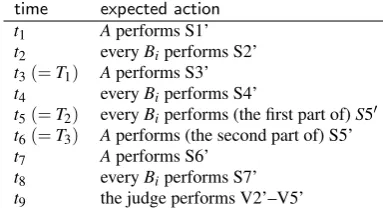
The protocol consists of the following steps. For simplicity of presentation, in the description of the protocol given below, we as-sume that all the entitled biddersB1, . . . ,Bnparticipate in the auc-tion and that all their bids are different; this convenauc-tion is not es-sential and can easily be dropped. Also, for simplicity, we have left out some additional input provided by the parties for the zero-knowledge proof, since in our symbolic modeling of zero-know-ledge proofs this input is not needed (see [38] for details). S1. Aposts (on the bulletin board) basic information about the
auc-tion: the terms of the auction, an identifierId, the deadlines T1,T2,T3for different stages of the auction, and his public
en-cryption key.
S2. To participate in the auction, a bidderBichooses her bidbi and encrypts it asCi=EA(bi,ri)using a random coinri. Bi
4A hash function is used to commit on values with high entropy.
then commits toCi, computingComi=hhash(Ci),Idi, signs this commitment, and sends sigBi[Comi] to A and her
no-taries, if used, before timeT1. The notaries forward the signed
commitments to A. A replies by sending a signed receipt Ri=sigA[Comi,Id,T1]toBi. IfBidoes not obtain her receipt, she complains.
S3. At timeT1, the auctioneerAposts all the received
commit-ments in a random order:Comπ(1), . . . ,Comπ(n), whereπis a randomly chosen permutation of the indices of submitted com-mitments.
S4. Between timeT1andT2any bidderBiwho has a receiptRifor a commitment which is not posted can appeal her non-inclusion (by providing her receipt).
S5. After timeT2, everyBisends toAher encrypted bidCi. After timeT3,ApostsCπ(1), . . . ,Cπ(n). Anybody can verify whether all the commitments posted in S3 have been correctly opened. S6. Arecovers the bidsb1, . . . ,bn, by decrypting the encrypted bids with his private decryption key, and determines the winnerBw of the auction and the pricebu the winner has to pay, which is supposed to be the second highest bid. He also constructs a (universally verifiable) zero-knowledge proofPthat the re-sult is correct, i.e.Cwcontains the biggest bid andCucontains the second biggest bidbu: This is done by proving appropri-ate inequalities between the bids in the ciphertextsC1, . . . ,Cn, without revealing these bids, and by revealing the random coin used inCu, which he can recover using his private key. The auctioneer posts
Bw,bu,sigBw[Comw],P. (6)
6.2
Properties of the Protocol
In this section, we state accountability and verifiability properties of the protocol.
Goal. The protocol should satisfy the goalγ which, informally, is achieved in a run if the protocol successfully produces a result which is correct with respect to the committed bids. Note that in a run the committed bids are (computationally) determined by the commitments to the encrypted bidsC1, . . . ,Cn. Now, more pre-cisely,γ requires that (i) all the submitted commitments are dif-ferent, (ii) the result is published and the published pricebuis the second highest bid amongst the bids encrypted inC1, . . . ,Cn, and (iii) an honest bidder is declared to be the winner if and only if her bid is the highest inC1, . . . ,Cn.
Conditions (ii) and (iii) capture that the announced result corre-sponds to the bids committed by the bidders. In addition, condition (i) prevents that a dishonest bidderBjwho somehow got to know the commitment of another bidderBi(e.g., a dishonest auctioneer revealed the commitment toBj) can place the same bid asBi, with-out even knowing it. This problem was not considered in [38].
Ideally, we would hope that the protocol satisfies individual ac-countability, i.e., if the goal is not achieved, then individual parties can be (rightly) blamed for this. Unfortunately, as our analysis re-veals, the protocol does not guarantee this strong level of account-ability, due to the following problems, which will be reflected in the accountability property we prove for this protocol.
Problems. In the following, for a set of agentsA, letψ∗X be the verdict stating that all but possibly one agent inXmisbehaved. For instance,ψ∗{a,b,c}= (dis(a)∧dis(b))∨(dis(a)∧dis(c))∨(dis(b)∧
dis(c)).
Problem 1. This problem boils down to the fact that the protocol
commu-nication, even though the notaries were introduced for this purpose: If (a) a bidderBiclaims that she did not obtain her receipt after she had sent her signed commitment to the auctioneer in Step S2 and (b) the auctioneer claims that he did not obtain the signed commit-ment from the bidder, then it is impossible to resolve the dispute. Therefore, in such a case, the judge can only statedis(A)∨dis(Bi). A similar problem occurs if, after Step S5, a bidderBiclaims that her encrypted bidCihas not been posted on the bulletin board and Aclaims that he has not received this bid. Again, it is impossible to resolve the dispute. This problem is more serious than the previous one, as at this point the auctioneer knows all the values of the bids and the corresponding bidders, and he may have an interest in ma-nipulating the auction. It is also a good opportunity for a dishonest bidder to disturb the auction process.
Problem 2. If two (or more) commitments posted in Step S3 have
the same value, then it is not clear who is to be blamed, even if the auctioneer provided the signatures of the bidders on these com-mitments. In fact, it is possible that one of the these biddersBi honestly followed the protocol, but the auctioneer forwarded her commitment to the other bidders who submitted this commitment with their own signatures. It may, however, as well be the case thatAis honest, but all the mentioned bidders are dishonest and submitted the same commitment.
Problem 3. A quite serious problem occurs at the end of the
auc-tion. Suppose that the auctioneer posts a result as in (6), for some
w,u, with a correct zero-knowledge proofP. Suppose also that
some bidderBj6=Bwclaims thatCw isherencrypted bid. Then, even if we assume that the judge requests bothBwandBjto send him their receipts and to prove their knowledge of the random coin rwused inCw, the judge is not able to blame a specific party. In fact, all the following scenarios are possible: (1)Ais honest and Bw,Bjare dishonest:Bwsubmits the commitment forCwand then forwards toBjher receipt and the random coinrw. (2)Bwis honest andA,Bjare dishonest:AprovidesBjwith the receiptRwof bidder Bwand her random coinrw; note thatAcan extract the random coin fromCw. (3)Bjis honest andA,Bware dishonest:Bjsubmits her commitment, obtains her receipt, butAdeclares thatBwis the win-ner, providingBw, as above, with the receipt ofBjand her random coin.
This is a serious problem, since a judge cannot blame a specific party among the partiesA,Bw, andBj; he can only state the verdict ψ∗{A,B
w,Bj}and cannot determine who actually won the auction.
Judging Procedure. In order to be able to formally state and prove the level of accountability the protocol provides, we first de-fine a judging procedure, which decides whether to accept a run or whether to blame (groups of) parties. Such a procedure should, in fact, be part of the protocol specification.
The judging procedure is based solely on publicly available in-formation, and hence, can be carried out both by an external judge and a regular protocol participant. The procedure consists of the following steps, where we assume that the procedure is run by some partyV.
V1. If a bidderBicomplains in Step S2, thenV statesdis(A)∨
dis(Bi)(Problem 1).
V2. IfAdoes not publish the list of commitments when expected (Step S3), thenV blames A(states dis(A)). If Aposts this list, but, forl>1,lcommitments have the same value (Prob-lem 2), thenAis requested to provide signatures oflbidders
Bi1, . . . ,Bil on these commitments. IfArefuses to do so,V
blamesA; otherwise,V statesψ∗{A,B
i1,...,Bil}.
V3. If, in Step S4,Biposts a receipt without a corresponding
com-mitment posted byAin the previous step,VblamesA. V4. In Step S5, if some previously posted commitmentComi is
not opened,A should provide the signature ofBi onComi. IfAdoes not provide the requested signature,V blames him. Otherwise,Vstatesdis(A)∨dis(Bi)(Problem 1).
V5. If, in Step S6 A, does not post a result with a valid zero-knowledge proof and a valid signaturesigw[Comw], thenV blamesA.
V6. If, after Step S6, some bidderBj with j6=wcomplains and provides a receipt ofAonComwas well as the random coins forComw, thenV states the verdictψ{∗A,B
w,Bj}(Problem 3).
V7. If none of the above happens, thenVaccepts the run.
Modeling. We consider a few variants of the protocol: ByPPRSTJ we denote the version of the protocol with an additional party, the judge. This party is assumed to be honest and run the judging pro-cedure described above. ByPPRSTX , forX∈ {B1, . . . ,Bn}, we denote the version of the protocol, whereXis assumed to be honest and his/her honest program isextendedby the judging procedure (i.e. X, in addition to his/her protocol steps, also carries out the judging procedure). In each of these systems, besidesX also the bulletin board is assumed to be honest. All the remaining parties are not assumed to be honest. For a detailed modeling of these systems (in a symbolic setting) see Appendix B.2.
Accountability Property. Now, we define the accountability property of the protocol. Letαirecbe the set of runs whereBiclaims that she has sent her signed commitment in Step S2, but has not ob-tained her receipt (Problem 1). Letαi
openbe the set of runs where some commitmentComiis not opened in Step S5 andAprovides the signature ofBion this commitment (Problem 2). LetαreuseX , whereXis a set of at least two bidders, be the set of runs whereA, as described in Step V2, reveals signatures of all the bidders inX on the same commitment. Finally, letαwwin,jbe the set of runs where the auctioneer posts a result of the form (6), for somew,u, with a correct zero-knowledge proofPand some bidderBj6=Bwclaims thatCwis her bid and provides the receipt ofAonComwas well as the random coins ofCw(Problem 3). Let¬αdenotes the set of runs which are not inαi
rec,αiopen,αXreuse, andα w,j
win, for anyi,j,w,X. We will show that the protocol is accountable forΦ, whereΦ consists of the following constraints:
αirec⇒dis(Bi)∨dis(A) for alli∈ {1, . . . ,n}, (7) αiopen⇒dis(Bi)∨dis(A) for alli∈ {1, . . . ,n}, (8) αXreuse⇒ψ∗X∪{A} for allX⊆ {B1, . . . ,Bn},|X|>1 (9)
αwwin,j⇒ψ∗{A,B
w,Bj} for allw,j∈ {1, . . . ,n}, (10)
¬α∩ ¬γ⇒dis(A). (11)
Note that, amongst the above accountability constraints, only (11) provides individual accountability.
THEOREM 2. Let V∈ {J,B1, . . . ,Bn}. V ensures Φ-account-ability for PPRSTV .
The proof of this theorem is given in Appendix B.5. This the-orem guarantees that whenever the goalγis not satisfied, agentV states some verdict, where the agentAis held accountable individ-ually if none of the casesαirec,αiopen,αXreuse, andαwwin,j occurs. As explained, occurrence ofαwwin,j is very problematic.
COROLLARY 2. The goal γ is guaranteed in PPRSTV by
hon(A)∧hon(B1)∧ · · · ∧hon(Bn) and verifiable by V , for any V∈ {J,B1, . . . ,Bn}.
6.3
Our Improved Version
We now propose fixes to the original auction protocol in order to establish individual accountability and make the protocol use-able. In this section, we only briefly sketch these fixes, with the detailed description of our version of the protocol presented in the Appendix B.1.
For our protocol, we assume anindependent and honest bulletin
board(replacing the bulletin board controlled by the auctioneer),
where the auctioneer and the bidders can post messages. Now, ev-ery bidder, instead of sending her signed commitmentsigBi[Comi]
to the auctioneer in Step S2, posts the messageEA(sigBi[Comi],r
0 i) (for some random coinr0i) on the bulletin board. Similarly, instead of sending the encrypted bid toAin Step S5, a bidder posts her encrypted bid on the bulletin board. One can show that this enables the judge to resolve the disputes described in Problems 1 and 2.
To prevent Problem 3, we modify the commitmentComiofBi: In our version,Comi=hhash(Ci),hash(qi),Idi, whereqiis a ran-dom nonce generated byBi. The bidder is supposed to keep the nonceqisecret, except for using it to resolve the dispute described in Problem 3: IfBjnotices that the commitment signed byBwin (6) is her own commitment,Bjpostsqjon the bulletin board; resulting inBwbeing blamed.
We prove that our version PPRSTV 0 of the protocol provides a high level of accountability: individual parties are held account-able whenever in a protocol run the goalγis not achieved, where γis defined as in Section 6.2. LetΦ0consist of only one individual accountability constraint:¬γ⇒dis(A)|dis(B1)| · · · |dis(Bn). We have the following result (see Appendix B.4 for the proof).
THEOREM 3. Let V ∈ {J,A,B1, . . . ,Bn}. V ensures Φ0 -accountability for protocol PPRSTV 0.
As in the case of the original version of the protocol, the ac-countability property stated in Theorem 3 allows us to immediately obtain the corresponding verifiability property of our version of the protocol. It is interesting to observe that, even though the two ver-sions of the protocol enjoy very different levels of accountability, the verifiability properties for both of them are exactly the same. In fact, in both protocols, any dishonest bidder can spoil the auction procedure and, therefore, the goal needs to be guaranteed by all the participants. This, again, illustrates that verifiability is too coarse a notion and is not able to distinguish between protocols that provide strong incentives for the participants to behave honestly from those that do not provide such incentives.
7.
ASW PROTOCOL
In this section, we study accountability properties of the ASW optimistic contract-signing protocol [4] in the symbolic setting. We only sketch the protocol and our results (see Appendix D for de-tails).
Description of the Protocol. The objective of the ASW protocol is to enable two parties,A(the originator) andB(the responder), to obtain each other’s signature on a previously agreed contractual text with the help of a trusted third partyT, who, however, is only invoked in case of a problem. In the intended run of the protocol,A first indicates her willingness to sign the contract toB, by sending a messagem1. ThenBsends his willingness to sign the contract to
B(m2). Next,Asends a messagem3that together withm1forms a
valid signature. Finally,Bsends a messagem4that, again, together
withm2forms a valid signature toA. If afterAhas sentm1,Bdoes
not respond,Amay contactT to obtain anabort token aT. If after Ahas sentm3, she does not obtain the signature fromB,Amay ask
T for areplacement contract rT; analogously forB. OnceTissued aT(rT),T should never issuerT(aT) afterwards.
Properties of the Protocol. We are interested in the accountability ofT. Ideally, we would like to holdT accountable whenever it produces both aT and rT. However, this is unrealistic: T could produceaTandrT and never send these messages to anybody. We therefore consider only the case where there is a dispute in which the judge is faced with bothaT andrT. More precisely, byPASW we denote the protocol (in the sense of Definition 1) modeling the ASW protocol, where, in addition toA,BandT, we consider an additional party, thejudge J. The honest programs ofA, B, and T run each one instance of their role, as specified by the protocol, whereT can deal with up to three requests. The judge, who is assumed to be honest, blamesTif and only if he obtains a message of the formhaT,rTifor some contract. ForPASW, we defineαto be the set of runs whereJobtains a message of the formhaT,rTifor some contract, modeling thatJis faced with bothaTandrT. LetΦ consist of the accountability constraintα⇒dis(T). We obtain the following theorem:
THEOREM 4. J ensuresΦ-accountability for PASW.
Following Remark 1, we verified Theorem 4 automatically using the protocol analysis tool by Millen and Shmatikov [36] (see [33] for our formal modeling). As mentioned, the completeness condi-tion is rather trivial in this case.
8.
REFERENCES
[1] M. Abadi and B. Blanchet. Computer-assisted verification of a protocol for certified email.Sci. Comput. Program., 58(1-2):3–27, 2005.
[2] M. Abadi and C. Fournet. Mobile Values, New Names, and Secure Communication. InProceedings of the 28th ACM Symposium on Principles of Programming Languages (POPL 2001), pages 104–115. ACM Press, 2001. [3] B. Adida and R. L. Rivest. Scratch & vote: self-contained
paper-based cryptographic voting. InWorkshop on Privacy in the Electronic Society (WPES 2006), pages 29–40, 2006. [4] N. Asokan, V. Shoup, and M. Waidner. Asynchronous
protocols for optimistic fair exchange. InProceedings of the IEEE Symposium on Research in Security and Privacy, pages 86–99. IEEE Computer Society, 1998.
[5] N. Asokan, V. Shoup, and M. Waidner. Optimistic fair exchange of digital signatures.IEEE Journal on Selected Areas in Communications, 18(4):593–610, 2000. [6] Yonatan Aumann and Yehuda Lindell. Security against
covert adversaries: Efficient protocols for realistic
adversaries. In Salil P. Vadhan, editor,Proceedings of the 4th Theory of Cryptography Conference,(TCC 2007), volume 4392 ofLecture Notes in Computer Science, pages 137–156. Springer, 2007.
[7] M. Backes, M. Maffei, and D. Unruh. Zero-Knowledge in the Applied Pi-calculus and Automated Verification of the Direct Anonymous Attestation Protocol. In2008 IEEE Symposium on Security and Privacy (S&P 2008), pages 202–215. IEEE Computer Society, 2008.