Available Online at www.ijcsmc.com
International Journal of Computer Science and Mobile Computing
A Monthly Journal of Computer Science and Information Technology
ISSN 2320–088X
IMPACT FACTOR: 5.258
IJCSMC, Vol. 5, Issue. 3, March 2016, pg.452 – 460
NETWORK LIFETIME AND
ENERGY MAXIMIZATION USING
CMAC PROTOCOL DESIGN
Kiran J Patil, A.M.Kanthe
Department of Computer Engineering, Savitribai Phule Pune University Sinhgad Institute of Technology, Lonavala, Pune, Maharashtra, India
[email protected] [email protected]
Abstract: By using the relay based hand off schemes a new protocol design is introduced called Cooperative Medium Access Control (CMAC), which helps the entire network schema to improve its performance and lifetime. This protocol helps the relay nodes to move from one region to another region to provide the details for communication between two nodes from one region into another. This type of complicated medium access interactions induced by relaying and leverages the benefits of such cooperation we need this mentioned CMAC protocol design. In this system a novel cross-layer distributed energy-adaptive location-based CMAC protocol is proposed, namely DEL-CMAC, for Mobile Ad-hoc NETworks (MANETs), which helps the network to improve the performance of the MANETs in terms of network lifetime and energy efficiency. Efficient relay based methodology amplifies the transceiver’s (acts as source as well as destination) energy while communicating with destination, because the relay easily traverse between each regions and gets the shortest transmission range between one another and finds the destination node ability to receive the packets from source. A distributed utility-based best relay selection strategy is incorporated, which selects the best relay based on location information and residual energy. In the simulation, the proposed work shows that the proposed DEL-CMAC significantly prolongs the network lifetime under various circumstances even for high circuitry energy consumption.
Keywords— CMAC, DEL-CMAC, MANET, Multi-hop, CC
I. INTRODUCTION
Cooperative communication (CC) is a promising technique for conserving the energy consumption in MANETs. The broadcast nature of the wireless medium (the so-called wireless broadcast advantage) is exploited in cooperative fashion. The wireless transmission between a pair of terminals can be received and processed at other terminals for performance gain, rather than be considered as an interference traditionally. CC can provide gains in terms of the required transmitting power due to the spatial diversity achieved via user cooperation. However, if we take into account the extra processing and receiving energy consumption required for cooperation, CC is not always energy efficient compared to direct transmission?
There is a tradeoff between the gains in transmitting power and the losses in extra energy consumption overhead. CC has been researched extensively from the information theoretic perspective and on the issues of relay selection. Recently, the work on CC with regard to cross-layer design by considering cooperation in both physical layer and MAC layer attracts more and more attention. Without considering the MAC layer interactions and signaling overhead due to cooperation, the performance gain through physical layer cooperation may not improve end-to-end performance. Cooperative MAC (CMAC) protocol considering the practical aspect of CC is vital. Liu et al. have proposed a CMAC protocols named Coop MAC to exploit the multi-rate capability and aimed at mitigating the throughput bottleneck caused by the low data rate nodes, so that the throughput can be increased. With the similar goal, Zhu and Cao have proposed a CMAC protocol or wireless ad hoc network.
Cooperative However, beneficial cooperation considering signaling overhead is not addressed. A busy-tone-based cross-layer CMAC protocol has been designed to use busy tones to help avoiding collisions in the cooperative scenario at the cost on transmitting power, spectrum, and implementation complexity. A reactive network coding aware CMAC protocol has been proposed by Wang et al. in which the relay node can forward the data for the source node, while delivering its own data simultaneously. But the network lifetime is not addressed. A distributed CMAC protocol has been proposed to improve the lifetime of wireless sensor networks, but it is based on the assumption that every node can connect to the base station within one hop, which is impractical for most applications.
A CMAC protocol for vehicular networks, particularly for gateway downloading scenarios, has been designed by Zhang et al. A drawback in that it can only be utilized in the scenario that all the vehicles are interested in the same information. Moreover, Moh and Yu have designed a CMAC protocol named CD-MAC which lets the relay transmit simultaneously with the source using space-time coding technique. Shan et al. have explored a concept of cooperation region, whereby beneficial cooperative transmissions can be identified. However, energy consumption is not evaluated for both of them. The existing CMAC protocols mainly focus on the throughput enhancement while failing to investigate the energy efficiency or network lifetime.
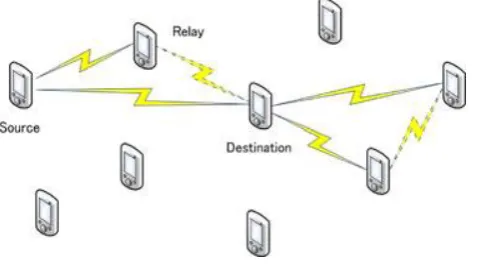
Fig. 1. Multi-hop MANET scenario.
While the works on energy efficiency and network lifetime generally fixates on physical layer or network layer. Our work focuses on the MAC layer, and is distinguished from previous protocols by considering a practical energy model (i.e., energy consumption on both transceiver circuitry and transmit amplifier), with the goal to enhance energy efficiency and extend network lifetime. The tradeoff between the gains promised by cooperation and extra overhead is taken into consideration in the proposed protocol. In addition, in the previous works, very little attention has been paid to the impact brought by varying transmitting power in CC on the interference ranges, since constant transmitting power is generally used. The interference ranges alteration in both space and time will significantly affect the overall network performance.
(NAV) setting. From the perspective of information theory, higher diversity gain can be obtained by increasing the number of relay terminals. From a MAC layer point of view, however, more relays lead to the enlarged interference ranges and additional control frame overheads. We employ single relay terminal in this paper to reduce the additional communication overhead. DEL-CMAC initiates the cooperation proactively, and utilizes the decode and forward (DF) protocol in the physical layer. We summarize our contributions as follows.
We propose DEL-CMAC that focuses on the network lifetime extension, which is a less explored aspect in the related work. By considering the overheads and interference due to cooperation, as well as the energy consumption on both transceiver circuitry and transmit amplifier, DEL-CMAC can significantly prolong the network lifetime.
A distributed energy-aware location-based best relay selection strategy is incorporated, which is more reasonable for MANETs comparing with the existing schemes based on channel condition.
For a desired outage probability requirement, a cross-layer optimal transmitting power allocation scheme is designed to conserve the energy while maintaining certain throughput level.
To deal with the presence of relay terminals and dynamic transmitting power, we provide an innovative NAV setting to avoid the collisions and enhance the spatial reuse.
Extensive simulation results reveal that DEL-CMAC can significantly extend the network lifetime under various scenarios at the cost of relatively low throughput and delay degradation, compared with IEEE standard DCF and throughput-aimed scheme CoopMAC.
II. LITERATURE SURVEY
J. Laneman, D. Tse, and G. Wornell identified Cooperative Diversity in Wireless Networks with Efficient Protocols and Outage Behavior. And here they developed and analyzed low-complexity cooperative diversity protocols that combat fading induced by multipath propagation in wireless networks.[2] The underlying techniques exploit space diversity available through cooperating terminals’ relaying signals for one another. They outlined several strategies employed by the cooperating radios, including fixed relaying schemes such as amplify-and-forward and decode-and-forward, selection relaying schemes that adapt based upon channel measurements between the cooperating terminals, and incremental relaying schemes that adapt based upon limited feedback from the destination terminal.
P. H. J. Chong et al., proposed the Technologies in Multihop Cellular Network and his co-authors identified that Most existing works on cooperative communications are focused on link - level physical layer issues such as topology control, routing and network capacity are largely ignored Although there have been extensive studies on applying cooperative networking in multi-hop ad hoc networks, most works are limited to the basic three - node relay scheme and single antenna systems. These two limitations are interconnected and both are due to a limited theoretical understanding of the optimal power allocation structure in MIMO cooperative networks (MIMO - CN) In Proposed system we use Cooperative diversity. It is a cooperative multiple antenna technique for improving or maximizing total network channel capacities for any given set of bandwidths which exploits user diversity by decoding the combined signal of the relayed signal and the direct signal in wireless multi hop networks.
III.EXISTING SYSTEM
In the past system the signaling between cross over regions are not yet considered, so that the bottleneck problem occurs and the data error rate between nodes are high. The existing CMAC protocols mainly focus on the throughput enhancement while failing to investigate the energy efficiency or network lifetime. While the works on energy efficiency and network lifetime generally fixates on physical layer or network layer. A CMAC protocol for vehicular networks, particularly for gateway downloading scenarios, has been designed by Zhang et al. A drawback in the system is that can only be utilized in the scenario that all the vehicles are interested in the same information. Moreover, Moh and Yu have designed a CMAC protocol named CD-MAC which lets the relay transmit simultaneously with the source using space-time coding technique. Shan et al. have explored a concept of cooperation region, whereby beneficial cooperative transmissions can be identified. However, energy consumption is not evaluated for both of them.
3.1 Disadvantages:
Network lifetime is low.
Energy consumption is high.
No crossover mutations and hand offs between regions.
Communication time is high and the problem of bottleneck occurs while transmission.
IV.PROPOSED SYSTEM
Our work focuses on the MAC layer, and is distinguished from previous protocols by considering a practical energy model (i.e., energy consumption on both transceiver circuitry and transmit amplifier), with the goal to enhance energy efficiency and extend network lifetime. The tradeoff between the gains promised by cooperation and extra overhead is taken into consideration in the proposed protocol. In addition, in the previous works, very little attention has been paid to the impact brought by varying transmitting power in CC on the interference ranges, since constant transmitting power is generally used.
The interference ranges alteration in both space and time will significantly affect the overall network performance. We also address the issue of effective coordination over multiple concurrent cooperative connections with dynamical transmitting power in this system. We propose a novel distributed energy adaptive location-based CMAC protocol, namely DELCMAC, for MANETs. DEL-CMAC is designed based on the IEEE 802.11 distributed coordination function (DCF), which is a widely used standard protocol for most of wireless networks. DEL-CMAC comprises a relay-involved handshaking process, a cross-layer power allocation scheme, a distributed utility-based best relay selection strategy, and an innovative Network Allocation Vector (NAV) setting.
From the perspective of information theory, higher diversity gain can be obtained by increasing the number of relay terminals. From a MAC layer point of view, however, more relays lead to the enlarged interference ranges and additional control frame overheads. We employ single relay terminal in this paper to reduce the additional communication overhead. DEL-CMAC initiates the cooperation proactively, and utilizes decode and forward (DF) protocol in the physical layer.
4.1 Advantages:
Network lifetime is increased and low Energy consumption rate.
Crossover mutations and hand offs between regions occurs using relays to identify the shortest path and the node availability to receive packets from source.
Communication time is low and good in performance.
4.2 Mathematical Model:
Input Set (T,E, Er, _) :
E: Initial energy of relay.
Er: Current residual energy of relay r _ : thresholdvalueofenergyconsumption T: the constant unit time t
Process Set (T,E, Er, _) :
Output Set (BUr):
Backo_ Utility Function BUr :
BUr1=T*min(E=Er; _) :::::::::::::::::::::::::::::(1) BUr= BUr1 * rPC/sPD*2...(2)
Equation(2) shows the Backo_ Utility Function BUr.
4.3 Algorithm of Proposed System:
Below are the algorithm stages for the Proposed System:
Stage I: Start Transmitting the packages from Source node.
Stage II: Wait for receiving CTS (Clear To Send) control frame.
Stage IIII: Check whether you receive CTS control frame or not.
Stage IV: If CTS is received, make the packets are successfully sent with the best relay BUr.
* Stage V: If CTS is not received, retransmit data packets to destination.
* Stage VI: If CTS is received after retransmission, data is transmitted to destination.
4.4 Flow Diagram of Proposed System :
V. DEL-CMAC PROTOCOL
The objective of prolonging the network lifetime and increasing the energy efficiency, we present a novel CMAC protocol, namely DEL-CMAC, for multi-hop MANETs. When cooperative relaying is involved, the channel reservation needs to be extended in both space and time in order to coordinate transmissions at the relay.
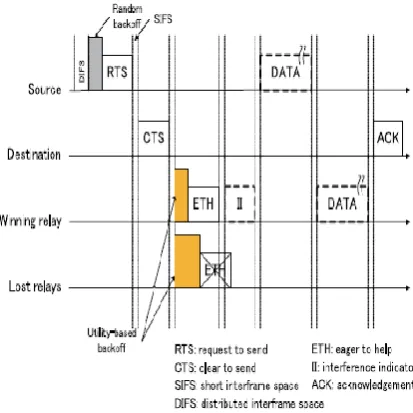
To deal with the relaying and dynamic transmitting power, besides the conventional control frames RTS, CTS and ACK, additional control frames are required. DEL-CMAC. Introduces two new control frames to facilitate the cooperation, i.e., Eager-To-Help (ETH) and Interference-Indicator (II). The ETH frame is used for selecting the best relay in a distributed and lightweight manner, which is sent by the winning relay to inform the source, destination and lost relays.
Fig. 2. The frame exchanging process of DEL-CMAC.
VI.DETAIL AND SUPPLIMENT OF DEL-CMAC
6.1 Utility-Based Best Relay Selection:
Selecting the best relay distributed and efficiently affects the performance of the CMAC protocol significantly. The existing relay selection schemes that incorporated into the CMAC protocols, largely depend on the instantaneous channel condition, which based on the assumption that the channel condition is invariant during one transmit session. For MANETS that deployed in heavily built-up urban environments or heavy traffic environments, this assumption is hard to guarantee. This implies that the best selected relay terminal according to channel condition during the route construction or handshaking period, may not be the best one in the actual data transmission period.
Backoff Utility Function BUr :
BUr= BUr1 * rPC/sPD*2...(2)
Equation(2) shows the Backoff Utility Function BUr.where Er is the current residual energy of relay r, PCr is the transmitting power at relay r in cooperative mode, and PD s is the transmitting power at source s in direct mode (both obtained through the equations in Section 4.2). The parameters in Eq. (2) include the energy consumption threshold d, the constant unit time t, and the initial energy E. Intuitively, the terminal with high residual energy and low transmitting power (i.e., small BUr value), has a comparatively short back off time. The terminal whose backoff expires first will be selected as the winning relay. The threshold d is to restrict the maximum backoff time within an acceptable range. We observe that there is a tradeoff between the probability of collision (due to extremely close utility value) and the time spent in the relay selection process.
Different from the existing best relay selection schemes, the proposed strategy utilizes the location information and takes the residual energy into considerations. Besides, it is completely distributed and every terminal makes the decision independently. Using the proposed relay selection strategy, the energy consumption rate among the terminals can be balanced, and the total energy consumption can be reduced.
6.2 Spatial Reuse Enhancement:
on how long they must defer from accessing the medium. Taking IEEE 802.11 DCF for instance, the NAV is set using RTS/CTS frames. No medium access is permitted during the blocked NAV durations.
Comparing with the simple NAV setting in DCF, the setting in DEL- CMAC needs to be considerably modified. The presence of relays will enlarge the interference ranges and the dynamic transmitting power makes the interference ranges vary during one transmit session. Impropriate NAV setting induces energy waste and collisions. Specifically, setting the NAV duration too short will wake up the terminal too soon, which results in energy waste due to medium sensing. On the other hand, setting it too long will reduce the spatial efficiency, which results to the performance degradation in terms of throughput and delay. Thus, effective NAV setting is necessary and critical.
Fig. 3. NAV setting for DEL-CMAC.
VII. PERFORMANCE EVALUATION
In this section, we evaluate DEL-CMAC via extensive simulations comparing with IEEE 802.11 DCF and CoopMAC.The evaluation metrics in this paper are the transmitting power, total energy consumption, network lifetime, aggregated throughput and average delay. The transmitting power denotes the power consumed at transmit amplifier (without the power consumed at transmit circuitry). The total energy consumption is the summation of the transmitting (including both transmit amplifier and circuitry) and receiving energy cost at the source, destination and relay. The lifetime is defined as the duration from the network initialization to the time that the first terminal runs out of power.
We first compare our DEL-CMAC with the IEEE 802.11 DCF in a single-hop scenario that only consists of three terminals (one source, one destination and one relay), to show the differences between cooperative and non-cooperative communication on energy consumption. As shown in Fig 6, the distance between source and destination changes from 5 to 30 m, and angles ffSDR and ffDSR keep at arcos (2/3).
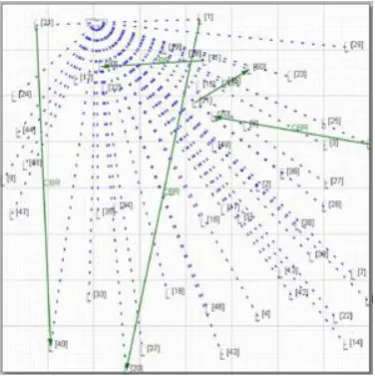
Figure below shows the snapshot of multi-hop network:
Fig. 5. A snapshot of the multi-hop network.
VIII. CONCLUSIONS AND FUTURE WORK
By introducing DEL-CMAC, both energy advantage and location advantage can be exploited thus the network lifetime is extended significantly. We have also proposed an effective relay selection strategy to choose the best relay terminal and a cross-layer optimal power allocation scheme to set the transmitting power. Moreover, we have enhanced the spatial reuse to minimize the interference among different connections by using novel NAV settings. We have demonstrated that DEL-CMAC can significantly prolong the network lifetime comparing with the IEEE 802.11 DCF and CoopMAC, at relatively low throughput and delay degradation cost. As a future work, we will investigate our DEL-CMAC for larger scale network size and with high mobility.
REFERENCES
[1] J.N. Laneman, D.N.C. Tse, and G.W. Wornell, “Cooperative Diversity in Wireless Networks: Efficient Protocols and Outage Behaviour,” IEEE Trans. Information Theory, vol. 50, no. 12, pp. 3062-3080, Dec. 2004.
[2] A. Sendonaris, E. Erkip, and B. Aazhang, “User Cooperation Diversity-Part I: System Description,” IEEE Trans. Comm., vol. 51, no. 11, pp. 1927-1938, Nov. 2003.
[3] J.N. Laneman and G.W. Wornell, “Distributed Space-Time-Coded Protocols for Exploiting Cooperative Diversity in Wireless Networks,” IEEE Trans. Information Theory, vol. 49, no. 10, pp. 2415-2425, Oct. 2003.
[4] J. Wu, M. Cardei, F. Dai, and S. Yang, “Extended Dominating Set and Its Applications in Ad Hoc Networks Using Cooperative Communication,” IEEE Trans. Parallel and Distributed Systems, vol. 17, no. 8, pp. 851-864, Aug. 2006.
[5] Y. Zhu, M. Huang, S. Chen, and Y. Wang, “Energy-Efficient Topology Control in Cooperative Ad Hoc Networks,” IEEE Trans. Parallel and Distributed Systems, vol. 23, no. 8, pp. 1480-1491, Aug. 2011.
[6] S. Cui, A.J. Goldsmith, and A. Bahai, “Energy-Efficiency of MIMO and Cooperative MIMO in Sensor Networks,” IEEE J. Selected Areas in Comm., vol. 22, no. 6, pp. 1089-1098, Aug. 2004.
[8] H. Zhu and G. Cao, “rDCF: A Relay-Enabled Medium Access Control Protocol for Wireless Ad Hoc Networks,” IEEE Trans. Mobile Computing, vol. 5, no. 9, pp. 1201-1214, Sept. 2006.
[9] Quansheng Guan, F. Richard Yu, Ottawa Shengming Jiang Victor C. M. Leung” Topology Control In Mobile Ad Hoc Networks With Cooperative Communications” Ieee 2012 Transactions on Wireless Communications, Volume: 9 , Issue: 2
[10] J. Laneman, D. Tse, and G. Wornell, “Cooperative Diversityin Wireless Networks: Efficient protocols and OutageBehavior,” IEEE Trans. Info. Theory, vol. 50, no. 12,2004, pp. 3062–80.