Review
Energy consumption prediction using machine
learning; a review
Amir Mosavi 1,2,3*, Abdullah Bahmani 1,
1 Department of Computer Science, Norwegian University of Science and Technology, Trondheim, Norway;
2 Kando Kalman Faculty of Electrical Engineering, Obuda University, Budapest; Hungary 3 School of the Built Environment, Oxford Brookes University, Oxford, UK
Abstract: Machine learning (ML) methods has recently contributed very well in the advancement of the prediction models used for energy consumption. Such models highly improve the accuracy, robustness, and precision and the generalization ability of the conventional time series forecasting tools. This article reviews the state of the art of machine learning models used in the general application of energy consumption. Through a novel search and taxonomy the most relevant literature in the field are classified according to the ML modeling technique, energy type, perdition type, and the application area. A comprehensive review of the literature identifies the major ML methods, their application and a discussion on the evaluation of their effectiveness in energy consumption prediction. This paper further makes a conclusion on the trend and the effectiveness of the ML models. As the result, this research reports an outstanding rise in the accuracy and an ever increasing performance of the prediction technologies using the novel hybrid and ensemble prediction models.
Keywords: energy consumption; prediction; machine learning models; deep learning models; artificial intelligence (AI); computational intelligence (CI); forecasting; soft computing (SC);
1. Introduction
Energy consumption is among one of the essential topics of energy systems. Energy consumption came under the consideration after the energy crisis in 1970s[1]. Also, It is shown that energy consumption throughout the world is rapidly increasing [2]. Therefore, each country tries to use as less energy as possible in their country in different areas from building to farms, from industrial process to vehicles [3]. As energy comes from three different resources like fossil fuels, renewable and nuclear resources [4], it need so much effort to keep tracking of energy consumption of these types in different area. However by doing so, we can predict the amount of energy, which is consumed in different areas and try to make plans, specialized for a specific usage and area.
For all energy types mentioned above, estimating the usage is useful for decision and policy makers. By knowing how much energy will be used for their process or work, they can be able to think of some changes in them to reduce the amount energy usage. Predicting future energy usage both in Short-term and Long-term manner will help us even to know, that in which type energy is used mostly and try to change the trend, as it is happed in the recent years for fossil fuels and now we have renewable energy. The amount of energy used in different areas is influenced by diffent factors such as water, wind, temperature. Having multiple factors, predicting the energy consumption is a complex problem[5].
Nowadays ML models are being used in different areas because they are useful and the way ML works is like a function which best maps the input data to output. Machine learning models can produce prediction for enery consumption with high accuracy. So they can be used by governments to implement enery-saving policies. For instance, ML models can predict the amount enery used in
building [6]. They can also be used to predict the future use of different types of energy like electricity or natural gas[6].
This research work has been conducted in the prediction of different enery type usage. Predictions can be done on the usage of energy in a specific procedure in industry [7] or the total amout of energu used in a coutry [8]. This study tries to review the recent studies related to modeling and estimating of energy consumption in different area.
The organization of this paper is in a way to review different ML models for energy prediction like: ANFIS, ANN, DT, ELM, MLP, SVM/SVR, WNN, ENSEMBLE, HYBRID, and DEEP LEARNING. In each section related to each model we try to review the latest studies which uses ML models for forecasting energy usage in different applications.
2. Research Methodology
The database is created using the following search keywords to identify the manuscripts on energy consumption prediction using machine learning models. ISI and Scopus databases had been
explored using the essential search keywords, i.e., ( TITLE-ABS-KEY ( "energy consumption" ) AND TITLE-ABS-KEY ( "machine learning" OR "Deep learning" OR "ANN" OR "MLP" OR "ELM" OR "neural network" OR "ANFIS" OR "decision tree" OR wnn ) ).
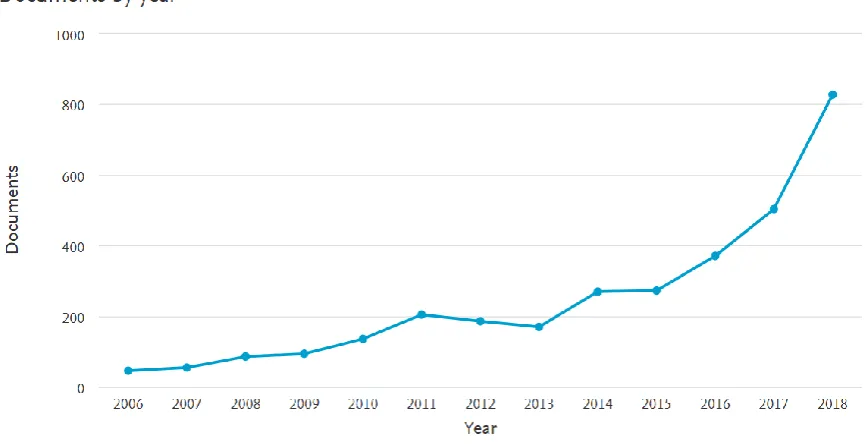
Figure 1. The progress of ML models for energy consumption prediction
Study the database shoes a dramatic increase in the number of papers from 2006 to 2018. The database include 4300 papers. The most relevant and original works have been revised in this state-of-the-art.
3. Machine learning models
Figure 2. The taxonomy of research
3.1. ANFIS
Table 1. This is a table. Tables should be placed in the main text near to the first time they are cited.
Reference Year energy
type application
prediction
type region
Y. H. Gao, J.; Cai, L.; Chen, G.; Jia,
N.; Zhu, L.; Wang, H. 2018 energy
MDF
medium-density fiberboard
Long-term U.S.
H. N.-P. Hosseinzadeh-Bandbafha,
A.; Shamshirband, S. 2017 energy
fattening farms
Short-term Iran
S. H. A. F. Kaboli, A.; Selvaraj, J.;
Rahim, N. A. 2017 electricity
the whole
country Long-term
ASEAN-5 countries
O. M. Popoola 2016 electricity
lighting in residential houses
Short-term
South Africa
R. L. Maachou, A.; Khouider, A.;
Bermad, A. 2016 energy
nitrate production
in the
wastewater treatment
S. S. Naji, S.; Basser, H.; Alengaram, U. J.; Jumaat, M. Z.; Amirmojahedi, M.
2016 energy buildings Long-term Iran
S. S. Naji, S.; Basser, H.; Keivani, A.; Alengaram, U. J.; Jumaat, M. Z.;
Petković, D.
2016 energy building Long-term iran
S. S. Naji, S.; Basser, H.; Alengaram, U. J.; Jumaat, M. Z.; Amirmojahedi, M.
2015 energy
bulilding with different envelope parameters
Long-term Iran
B. R. Khoshnevisan, S.; Omid, M.;
Mousazadeh, H. 2014 energy agriculture Long-term Iran
V. N. A. Majazi Dalfard, M.; Nazari-Shirkouhi, S.; Sajadi, S. M.;
Asadzadeh, S. M.
2013 Natural GAS
power
generation Long-term IRAN
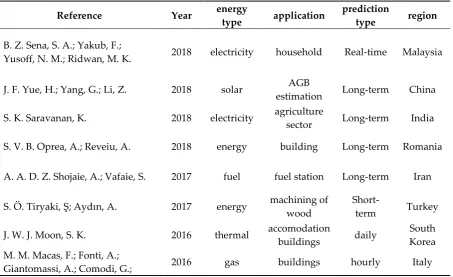
3.2. ANNs
Table 1. This is a table. Tables should be placed in the main text near to the first time they are cited.
Reference Year energy
type application
prediction
type region
B. Z. Sena, S. A.; Yakub, F.;
Yusoff, N. M.; Ridwan, M. K. 2018 electricity household Real-time Malaysia
J. F. Yue, H.; Yang, G.; Li, Z. 2018 solar AGB
estimation Long-term China
S. K. Saravanan, K. 2018 electricity agriculture
sector Long-term India
S. V. B. Oprea, A.; Reveiu, A. 2018 energy building Long-term Romania
A. A. D. Z. Shojaie, A.; Vafaie, S. 2017 fuel fuel station Long-term Iran
S. Ö. Tiryaki, Ş; Aydın, A. 2017 energy machining of
wood
Short-term Turkey
J. W. J. Moon, S. K. 2016 thermal accomodation
buildings daily
South Korea M. M. Macas, F.; Fonti, A.;
Annunziato, M.; Pizzuti, S.; Capra, A.
E. D. Siami-Irdemoosa, S. R. 2015 fuel mini dump
trucks Long-term U.S.
M. S. Gunduz, H. B. 2015 hydro energy
hydroelectric power plant (renewable)
Long-term Turkey
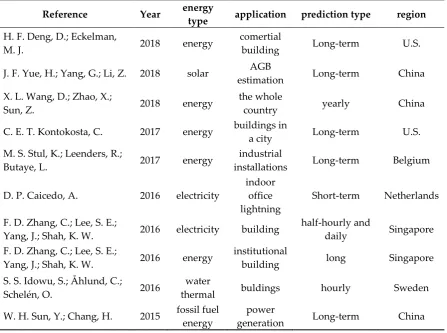
3.2. SVMs
Table 1. This is a table. Tables should be placed in the main text near to the first time they are cited.
Reference Year energy
type application prediction type region
H. F. Deng, D.; Eckelman,
M. J. 2018 energy
comertial
building Long-term U.S.
J. F. Yue, H.; Yang, G.; Li, Z. 2018 solar AGB
estimation Long-term China
X. L. Wang, D.; Zhao, X.;
Sun, Z. 2018 energy
the whole
country yearly China
C. E. T. Kontokosta, C. 2017 energy buildings in
a city Long-term U.S. M. S. Stul, K.; Leenders, R.;
Butaye, L. 2017 energy
industrial
installations Long-term Belgium
D. P. Caicedo, A. 2016 electricity
indoor office lightning
Short-term Netherlands
F. D. Zhang, C.; Lee, S. E.;
Yang, J.; Shah, K. W. 2016 electricity building
half-hourly and
daily Singapore F. D. Zhang, C.; Lee, S. E.;
Yang, J.; Shah, K. W. 2016 energy
institutional
building long Singapore
S. S. Idowu, S.; Åhlund, C.;
Schelén, O. 2016
water
thermal buldings hourly Sweden
W. H. Sun, Y.; Chang, H. 2015 fossil fuel energy
power
generation Long-term China
Here comes the review
3.2. WNNs
Table 1. This is a table. Tables should be placed in the main text near to the first time they are cited.
Reference Year energy
type application
prediction
type region
J. G. Zhao, S.; Ren, D.;
Li, Z.; Xue, L. 2015 energy
smart residential
homes Long-term China H Chitsaz, N amjady, H
Zareipour 2014 wind wind farms hourly Iran
Hui Zhao ; Rong Liu ; Zhuoqun Zhao ; Chuanli Fan
2011 energy energy
consumption Long-term China
Eynard, Julien, Stéphane Grieu, and Monique Polit
2011 thermal multi-energy
district boiler Short-term France
C Chenm, S Duan, T cai,
B Liu 2011 solar
solar power
prediction daily China Z. A. Bashir ; M. E.
El-Hawary 2009 electricity load demand hourly Canada H Esen, F Ozgen, M
Esen, A sengur 2009 solar solar air heater Long-term Turkey
A. Oonsivilai ; M.E.
El-Hawary 2002 electricity
electric power system comercial
load
daily Mexico
R Goa, L H Tsoukalas 2001 electricity power
consumption Short-term USA
Here comes the review
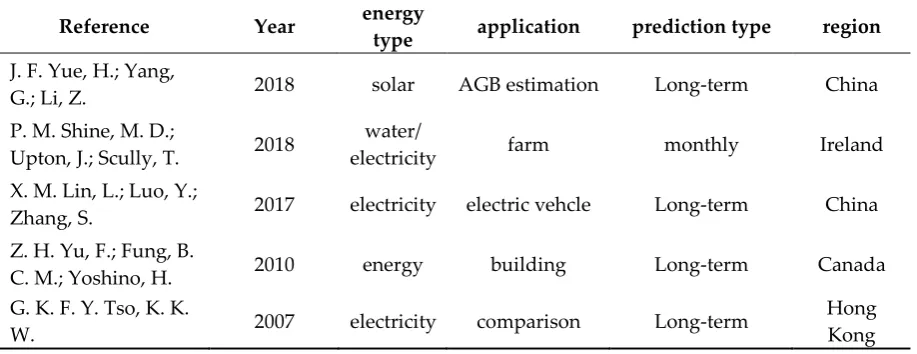
3.2. DTs
Table 1. This is a table. Tables should be placed in the main text near to the first time they are cited.
Reference Year energy
type application prediction type region
J. F. Yue, H.; Yang,
G.; Li, Z. 2018 solar AGB estimation Long-term China
P. M. Shine, M. D.;
Upton, J.; Scully, T. 2018
water/
electricity farm monthly Ireland
X. M. Lin, L.; Luo, Y.;
Zhang, S. 2017 electricity electric vehcle Long-term China
Z. H. Yu, F.; Fung, B.
C. M.; Yoshino, H. 2010 energy building Long-term Canada G. K. F. Y. Tso, K. K.
W. 2007 electricity comparison Long-term
Hong Kong
Here comes the review.
3.2. DTs
Table 1. This is a table. Tables should be placed in the main text near to the first time they are cited.
Reference Year energy type application prediction
type region
H. F. Deng, D.;
Eckelman, M. J. 2018 energy
comertial
building U.S.
J. F. Yue, H.; Yang,
G.; Li, Z. 2018 solar
AGB
estimation Long-term China
P. M. Shine, M. D.;
Upton, J.; Scully, T. 2018 electricity/water
pasture based dairy
farms
Z. W. Wang, Y.; Zeng, R.; Srinivasan, R. S.; Ahrentzen, S.
2018 energy educational buildings
hourly U.S.
C. E. T. Kontokosta,
C. 2017 energy
city scale energy use
in buildings
yearly U.S.
H. F. Deng, D.;
Eckelman, M. J. 2017 energy
commertial building
energy
long U.S.
M. W. M. Ahmad,
M.; Rezgui, Y. 2017 energy building hourly Spain
SVM 2017 themporal
appliances in low-energy house
Short-term Belgium
S. S. Idowu, S.; Åhlund, C.; Schelén, O.
2016 water thermal buldings hourly Sweden
Greek Long-term energy consumption prediction using artificial neural networks
2010 energy the whole
country Long-term Greece
Here comes the review
3.2. ELMs
Table 1. This is a table. Tables should be placed in the main text near to the first time they are cited.
Reference Year energy
type application
prediction
type region
N. O. Izadyar, H. C.; Shamshirband, S.; Ghadamian, H.; Tong, C. W.
2015 thermal residential
heading demand monthly Iran
H. F. C. Gong, Z. S.; Zhu,
Q. X.; He, Y. L. 2017 energy petrochenical Long-term China X. K. Lin, W. 2016 energy cement industry Long-term China
S. K. Naji, A.; Shamshirband, S.; Alengaram, U. J.; Jumaat, M. Z.; Mansor, Z.; Lee, M.
2016 energy building material
construction Long-term Iran
J. Q. Wang, F.; Zhao, F.;
Sutherland, J. W. 2016 energy sintering process yearly U.S.
N. O. Izadyar, H. C.; Shamshirband, S.; Ghadamian, H.; Tong, C. W.
2015 natural gas residential
D. S. Zhai, Y. C. 2017 energy ACMV systems Long-term Singapore
Y. Z. Han, Q.; Geng, Z.;
Zhu, Q. 2018 energy
energy management optimization
Long-term China
Here comes the review.
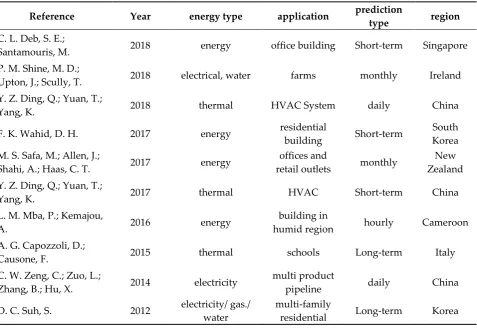
3.2. MLPs
Table 1. This is a table. Tables should be placed in the main text near to the first time they are cited.
Reference Year energy type application prediction
type region
C. L. Deb, S. E.;
Santamouris, M. 2018 energy office building Short-term Singapore
P. M. Shine, M. D.;
Upton, J.; Scully, T. 2018 electrical, water farms monthly Ireland
Y. Z. Ding, Q.; Yuan, T.;
Yang, K. 2018 thermal HVAC System daily China
F. K. Wahid, D. H. 2017 energy residential
building Short-term
South Korea M. S. Safa, M.; Allen, J.;
Shahi, A.; Haas, C. T. 2017 energy
offices and
retail outlets monthly
New Zealand
Y. Z. Ding, Q.; Yuan, T.;
Yang, K. 2017 thermal HVAC Short-term China
L. M. Mba, P.; Kemajou,
A. 2016 energy
building in
humid region hourly Cameroon
A. G. Capozzoli, D.;
Causone, F. 2015 thermal schools Long-term Italy
C. W. Zeng, C.; Zuo, L.;
Zhang, B.; Hu, X. 2014 electricity
multi product
pipeline daily China
D. C. Suh, S. 2012 electricity/ gas./ water
multi-family
residential Long-term Korea
Here comes the review
3.2. ENSEMBLEs
Table 1. This is a table. Tables should be placed in the main text near to the first time they are cited.
Reference Year energy type application prediction
type region
P. M. Shine, M. D.; Upton, J.;
Scully, T. 2018 electricity/water
pasture based
dairy farms monthly Irland S. A. Papadopoulos, E.; Woon,
W. L.; Kontokosta, C. E. 2018 energy buildings UAE S. N. Dai, D.; Li, Y. 2018 energy Country level Long-term china Z. W. Wang, Y.; Zeng, R.;
Srinivasan, R. S.; Ahrentzen, S. 2018 electricity
educational
M. H. C. Alobaidi, F.; Meguid,
M. A. 2018 energy
Individual
hosehold Daily France
M. W. M. Ahmad, M.; Rezgui, Y. 2017 energy buildings Hourly Spain
L. W. Tang, S.; He, K.; Wang, S. 2015 nuclear energy
nuclear energy consumption
in china
Long-term China
R. Ž. S. Jovanović, A. A.;
Živković, B. D. 2015 thermal
heating energy consumption
Short-term Serbia
R. S. Jovanović, A. 2015 thermal
heating energy consumption
Long-term Serbia
R. Ž. S. Jovanović, A. A.;
Živković, B. D. 2015 thermal
energy consumption in a university campus
Short-term Serbia
Here comes the review
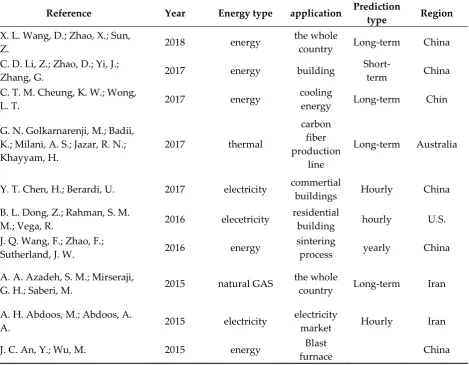
3.2. HYBRIDs
Table 1. This is a table. Tables should be placed in the main text near to the first time they are cited.
Reference Year Energy type application Prediction
type Region
X. L. Wang, D.; Zhao, X.; Sun,
Z. 2018 energy
the whole
country Long-term China C. D. Li, Z.; Zhao, D.; Yi, J.;
Zhang, G. 2017 energy building
Short-term China C. T. M. Cheung, K. W.; Wong,
L. T. 2017 energy
cooling
energy Long-term Chin
G. N. Golkarnarenji, M.; Badii, K.; Milani, A. S.; Jazar, R. N.; Khayyam, H.
2017 thermal
carbon fiber production
line
Long-term Australia
Y. T. Chen, H.; Berardi, U. 2017 electricity commertial
buildings Hourly China
B. L. Dong, Z.; Rahman, S. M.
M.; Vega, R. 2016 elecetricity
residential
building hourly U.S. J. Q. Wang, F.; Zhao, F.;
Sutherland, J. W. 2016 energy
sintering
process yearly China
A. A. Azadeh, S. M.; Mirseraji,
G. H.; Saberi, M. 2015 natural GAS
the whole
country Long-term Iran
A. H. Abdoos, M.; Abdoos, A.
A. 2015 electricity
electricity
market Hourly Iran
J. C. An, Y.; Wu, M. 2015 energy Blast
Here comes the review
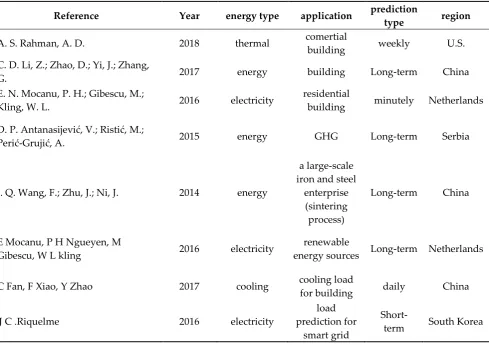
DEEP LEARNINGs
Table 1. This is a table. Tables should be placed in the main text near to the first time they are cited.
Reference Year energy type application prediction
type region
A. S. Rahman, A. D. 2018 thermal comertial
building weekly U.S. C. D. Li, Z.; Zhao, D.; Yi, J.; Zhang,
G. 2017 energy building Long-term China
E. N. Mocanu, P. H.; Gibescu, M.;
Kling, W. L. 2016 electricity
residential
building minutely Netherlands
D. P. Antanasijević, V.; Ristić, M.;
Perić-Grujić, A. 2015 energy GHG Long-term Serbia
J. Q. Wang, F.; Zhu, J.; Ni, J. 2014 energy
a large-scale iron and steel
enterprise (sintering process)
Long-term China
E Mocanu, P H Ngueyen, M
Gibescu, W L kling 2016 electricity
renewable
energy sources Long-term Netherlands
C Fan, F Xiao, Y Zhao 2017 cooling cooling load
for building daily China
ـJ C .Riquelme 2016 electricity
load prediction for
smart grid
Short-term South Korea
[9-258], [7, 259-489], [490-739]
4. Discussion
The use of ML models have been increased during the last decade. Along with the conventional ML methods, e.g., ANNs and MLP, DTs, the application of hybrids and Ensemble methods has been dramatically increased. Through hybrid methods the researcher aim at higher accuracy and efficiency. The future direction of the research is to develop hybrid models with higher accuracy and higher speeds.
5. Conclusions
Author Contributions: Authors have made equal contributions.
Conflicts of Interest: The authors declare no conflict of interest References
1. Oluklulu, Ç., A research on the photovoltaic modules that are being used actively in utilizing solar energy, sizing of the modules and architectural using means of the
modules. MSc, Gazi University, Ankara, Turkey, 2001.
2. Pérez-Lombard, L., J. Ortiz, and C. Pout, A review on buildings energy consumption
information. Energy and buildings, 2008. 40(3): p. 394-398.
3. Barak, S. and S.S. Sadegh, Forecasting energy consumption using ensemble ARIMA–
ANFIS hybrid algorithm. International Journal of Electrical Power & Energy
Systems, 2016. 82: p. 92-104.
4. Demirbas, A., Potential applications of renewable energy sources, biomass
combustion problems in boiler power systems and combustion related environmental
issues. Progress in energy and combustion science, 2005. 31(2): p. 171-192.
5. Zhao, H.-x. and F. Magoulès, A review on the prediction of building energy
consumption. Renewable and Sustainable Energy Reviews, 2012. 16(6): p.
3586-3592.
6. Ekici, B.B. and U.T. Aksoy, Prediction of building energy consumption by using
artificial neural networks. Advances in Engineering Software, 2009. 40(5): p.
356-362.
7. Yilmazkaya, E., et al., Prediction of mono-wire cutting machine performance
parameters using artificial neural network and regression models. Engineering
Geology, 2018. 239: p. 96-108.
8. Zhang, W. and J. Yang, Forecasting natural gas consumption in China by Bayesian
model averaging. Energy Reports, 2015. 1: p. 216-220.
9. Abdoli, B., et al., Evaluation of the air-borne ultrasound on fluidized bed drying of
shelled corn: Effectiveness, grain quality, and energy consumption. Drying
Technology, 2018. 36(14): p. 1749-1766.
10. Abramovich, B.N. and I.S. Babanova, Development of neural network models to
predict and control power consumption in mineral mining industry. Mining
Informational and Analytical Bulletin, 2018. 2018(5): p. 206-213.
11. Abtahi, T., et al., Accelerating Convolutional Neural Network with FFT on Embedded
Hardware. IEEE Transactions on Very Large Scale Integration (VLSI) Systems,
2018. 26(9): p. 1737-1749.
12. Abu Sharkh, M. and A. Shami, An evergreen cloud: Optimizing energy efficiency in
heterogeneous cloud computing architectures. Vehicular Communications, 2017. 9:
p. 199-210.
13. Acharya, S. and D.A. D’Mello, Energy and cost efficient dynamic load balancing
mechanism for resource provisioning in cloud computing. International Journal of
Applied Engineering Research, 2017. 12(24): p. 15782-15790.
14. Acharya, S. and C.R. Tripathy, An ANFIS estimator based data aggregation scheme
for fault tolerant Wireless Sensor Networks. Journal of King Saud University -
15. Adamović, V.M., et al., An artificial neural network approach for the estimation of the primary production of energy from municipal solid waste and its application to
the Balkan countries. Waste Management, 2018. 78: p. 955-968.
16. Adnan, W.N.W.M., N.Y. Dahlan, and I. Musirin, Development of hybrid artificial neural network for quantifying energy saving using measurement and verification.
Indonesian Journal of Electrical Engineering and Computer Science, 2017. 8(1): p. 137-145.
17. Aftab, M., et al., Automatic HVAC control with real-time occupancy recognition and
simulation-guided model predictive control in low-cost embedded system. Energy and
Buildings, 2017. 154: p. 141-156.
18. Aghbashlo, M., et al., Fuzzy modeling and optimization of the synthesis of biodiesel from waste cooking oil (WCO) by a low power, high frequency piezo-ultrasonic
reactor. Energy, 2017. 132: p. 65-78.
19. Aghbashlo, M., et al., Multi-objective exergetic and technical optimization of a piezoelectric ultrasonic reactor applied to synthesize biodiesel from waste cooking
oil (WCO) using soft computing techniques. Fuel, 2019. 235: p. 100-112.
20. Aghbashlo, M., M. Tabatabaei, and S. Hosseinpour, On the exergoeconomic and exergoenvironmental evaluation and optimization of biodiesel synthesis from waste
cooking oil (WCO) using a low power, high frequency ultrasonic reactor. Energy
Conversion and Management, 2018. 164: p. 385-398.
21. Ahmad, M.W., et al., Deep highway networks and tree-based ensemble for predicting
short-term building energy consumption. Energies, 2018. 11(12).
22. Ahmad, M.W., M. Mourshed, and Y. Rezgui, Trees vs Neurons: Comparison between
random forest and ANN for high-resolution prediction of building energy
consumption. Energy and Buildings, 2017. 147: p. 77-89.
23. Ahmad, M.W., J. Reynolds, and Y. Rezgui, Predictive modelling for solar thermal
energy systems: A comparison of support vector regression, random forest, extra
trees and regression trees. Journal of Cleaner Production, 2018. 203: p. 810-821.
24. Ahmad, T. and H. Chen, Potential of three variant machine-learning models for forecasting district level medium-term and long-term energy demand in smart grid
environment. Energy, 2018. 160: p. 1008-1020.
25. Ahmad, T. and H. Chen, Nonlinear autoregressive and random forest approaches to
forecasting electricity load for utility energy management systems. Sustainable Cities
and Society, 2019. 45: p. 460-473.
26. Ahmad, T., et al., Supervised based machine learning models for short, medium and
long-term energy prediction in distinct building environment. Energy, 2018. 158: p.
17-32.
27. Ahmad, T., H. Chen, and W.A. Shah, Effective bulk energy consumption control and management for power utilities using artificial intelligence techniques under
conventional and renewable energy resources. International Journal of Electrical
Power and Energy Systems, 2019. 109: p. 242-258.
28. Ahn, J. and S. Cho, Dead-band vs. machine-learning control systems: Analysis of
control benefits and energy efficiency. Journal of Building Engineering, 2017. 12: p.
29. Ahn, J., S. Cho, and D.H. Chung, Analysis of energy and control efficiencies of fuzzy logic and artificial neural network technologies in the heating energy supply system
responding to the changes of user demands. Applied Energy, 2017. 190: p. 222-231.
30. Ahn, J., D.H. Chung, and S. Cho, Performance analysis of space heating smart control models for energy and control effectiveness in five different climate zones.
Building and Environment, 2017. 115: p. 316-331.
31. Ahn, J., D.H. Chung, and S. Cho, Network-based energy supply optimal system in the condition where both heating and cooling are required simultaneously in a swing
season. Intelligent Buildings International, 2018. 10(1): p. 42-57.
32. Ahn, J., et al., Convolutional neural network-based classification system design with
compressed wireless sensor network images. PLoS ONE, 2018. 13(5).
33. Ak, R., O. Fink, and E. Zio, Two Machine Learning Approaches for Short-Term Wind
Speed Time-Series Prediction. IEEE Transactions on Neural Networks and Learning
Systems, 2016. 27(8): p. 1734-1747.
34. Akila, V. and T. Sheela, An efficient TDMA technique with priority queues in wireless
sensor networks. International Journal of Pharmacy and Technology, 2016. 8(4): p.
21690-21700.
35. Akmandor, A.O., H. Yin, and N.K. Jha, Smart, Secure, Yet Energy-Efficient,
Internet-of-Things Sensors. IEEE Transactions on Multi-Scale Computing Systems, 2018.
4(4): p. 914-930.
36. Akpinar, M., M.F. Adak, and N. Yumusak, Day-ahead natural gas demand
forecasting using optimized ABC-based neural network with sliding window
technique: The case study of regional basis in Turkey. Energies, 2017. 10(6).
37. Alam, M.A.U., et al., A smart segmentation technique towards improved infrequent
non-speech gestural activity recognition model. Pervasive and Mobile Computing,
2017. 34: p. 25-45.
38. Alani, A.Y. and I.O. Osunmakinde, Short-term multiple forecasting of electric energy
loads for sustainable demand planning in smart grids for smart homes. Sustainability
(Switzerland), 2017. 9(11).
39. Alarfaj, O. and K. Bhattacharya, A controlled load estimator-based energy
management system for water pumping systems. IEEE Transactions on Smart Grid,
2018. 9(6): p. 6307-6317.
40. Al-Hamed, S.A. and M.F. Wahby, Prediction of potato yield based on energy inputs using artificial neural networks and c-sharp under Saudi Arabia Conditions.
Biosciences Biotechnology Research Asia, 2016. 13(2): p. 631-644.
41. Ali, A., et al., Enhancement of RWSN lifetime via firework clustering algorithm
validated by ANN. Information (Switzerland), 2018. 9(3).
42. Ali Mirza, Q.K., I. Awan, and M. Younas, CloudIntell: An intelligent malware
detection system. Future Generation Computer Systems, 2018. 86: p. 1042-1053.
43. Al-Kaseem, B.R., et al., A new intelligent approach for optimizing 6LoWPAN MAC
layer parameters. IEEE Access, 2017. 5: p. 16229-16240.
44. Allami, R., Premature ventricular contraction analysis for real-time patient
45. Almalaq, A. and J.J. Zhang, Evolutionary Deep Learning-Based Energy
Consumption Prediction for Buildings. IEEE Access, 2019. 7: p. 1520-1531.
46. Alobaidi, M.H., F. Chebana, and M.A. Meguid, Robust ensemble learning framework
for day-ahead forecasting of household based energy consumption. Applied Energy,
2018. 212: p. 997-1012.
47. Alshinina, R.A. and K.M. Elleithy, A Highly Accurate Deep Learning Based
Approach for Developing Wireless Sensor Network Middleware. IEEE Access, 2018.
6: p. 29885-29898.
48. Alsidairi, Z.H., The prediction of energy consumption using multivariate regression
and artificial neural network models: Transport in the GCC. International Journal of
Engineering and Technology(UAE), 2018. 7(4): p. 98-106.
49. Alvarado-Iniesta, A., et al., Multi-objective optimization of an injection molding
process, in Studies in Computational Intelligence. 2017. p. 391-407.
50. Álvarez, J.A., et al., Modeling of Energy Efficiency for Residential Buildings Using
Artificial Neuronal Networks. Advances in Civil Engineering, 2018. 2018.
51. Alwisy, A., et al., Energy-based target cost modelling for construction projects.
Journal of Building Engineering, 2018. 20: p. 387-399.
52. Alzoubi, I., et al., Integrating artificial neural network and imperialist competitive
algorithm (ICA), to predict the energy consumption for land leveling. International
Journal of Energy Sector Management, 2017. 11(4): p. 522-540.
53. Alzoubi, I., et al., Prediction of environmental indicators in land leveling using
artificial intelligence techniques. Journal of Environmental Health Science and
Engineering, 2018. 16(1): p. 65-80.
54. Alzoubi, I., et al., Comparing ANFIS and integrating algorithm models (ICA-ANN,
PSO-ANN, and GA-ANN) for prediction of energy consumption for irrigation land
leveling. Geosystem Engineering, 2018. 21(2): p. 81-94.
55. Amber, K.P., et al., Intelligent techniques for forecasting electricity consumption of
buildings. Energy, 2018. 157: p. 886-893.
56. Amedi, H.R., A. Baghban, and M.A. Ahmadi, Evolving machine learning models to
predict hydrogen sulfide solubility in the presence of various ionic liquids. Journal of
Molecular Liquids, 2016. 216: p. 411-422.
57. Ameer, K., et al., Optimization and modeling for heat reflux extraction of total yield,
stevioside and rebaudioside-A from Stevia rebaudiana (Bertoni) leaves. Separation
Science and Technology (Philadelphia), 2017. 52(7): p. 1193-1205.
58. Ammendola, R., et al., The Brain on Low Power Architectures: Efficient Simulation
of Cortical Slow Waves and Asynchronous States, in Advances in Parallel
Computing. 2018. p. 760-769.
59. Anarado, I., et al., Mitigating Silent Data Corruptions in Integer Matrix Products:
Toward Reliable Multimedia Computing on Unreliable Hardware. IEEE
Transactions on Circuits and Systems for Video Technology, 2017. 27(11): p. 2476-2489.
60. Andri, R., et al., Yoda NN: An architecture for ultralow power binary-weight CNN
acceleration. IEEE Transactions on Computer-Aided Design of Integrated Circuits
61. Androjić, I. and Z. Dolaček-Alduk, Artificial neural network model for forecasting
energy consumption in hot mix asphalt (HMA) production. Construction and Building
Materials, 2018. 170: p. 424-432.
62. Androjić, I., et al., Achieving sustainability through the temperature prediction of
aggregate stockpiles. Journal of Cleaner Production, 2019. 219: p. 451-460.
63. Araújo, J.P.C., et al., Estimation of energy consumption on the tire-pavement interaction for asphalt mixtures with different surface properties using data mining
techniques. Transportation Research Part D: Transport and Environment, 2019. 67:
p. 421-432.
64. Araya, D.B., et al., An ensemble learning framework for anomaly detection in
building energy consumption. Energy and Buildings, 2017. 144: p. 191-206.
65. Ardakani, A., et al., VLSI Implementation of Deep Neural Network Using Integral
Stochastic Computing. IEEE Transactions on Very Large Scale Integration (VLSI)
Systems, 2017. 25(10): p. 2688-2699.
66. Ardakani, S.R., S.M. Hossein, and A. Aslani, Statistical Approaches to Forecasting Domestic Energy Consumption and Assessing Determinants: The Case of Nordic
Countries. Strategic Planning for Energy and the Environment, 2018. 38(1): p.
26-71.
67. Arriandiaga, A., et al., A new approach for dynamic modelling of energy consumption
in the grinding process using recurrent neural networks. Neural Computing and
Applications, 2016. 27(6): p. 1577-1592.
68. Arslan, E., et al., Event-triggered H<inf>∞</inf> filtering for delayed neural
networks via sampled-data. Neural Networks, 2017. 91: p. 11-21.
69. Ascione, F., et al., CASA, cost-optimal analysis by multi-objective optimisation and artificial neural networks: A new framework for the robust assessment of cost-optimal
energy retrofit, feasible for any building. Energy and Buildings, 2017. 146: p.
200-219.
70. Ascione, F., et al., Artificial neural networks to predict energy performance and
retrofit scenarios for any member of a building category: A novel approach. Energy,
2017. 118: p. 999-1017.
71. Ashouri, M., et al., Development of a ranking procedure for energy performance
evaluation of buildings based on occupant behavior. Energy and Buildings, 2019.
183: p. 659-671.
72. Assareh, E. and M. Nedaei, A metaheuristic approach to forecast the global carbon
dioxide emissions. International Journal of Environmental Studies, 2018. 75(1): p.
99-120.
73. Ateeq, M., et al., Multi-parametric analysis of reliability and energy consumption in
IoT: A deep learning approach. Sensors (Switzerland), 2019. 19(2).
74. Attoue, N., I. Shahrour, and R. Younes, Smart building: Use of the artificial neural
network approach for indoor temperature forecasting. Energies, 2018. 11(2).
75. Auffenberg, F., et al., A comfort-based approach to smart heating and air
76. Avci, H., et al., Optimisation of the design parameters of a domestic refrigerator
using CFD and artificial neural networks. International Journal of Refrigeration,
2016. 67: p. 227-238.
77. Ayala-Romero, J.A., J.J. Alcaraz, and J. Vales-Alonso, Energy saving and
interference coordination in HetNets using dynamic programming and CEC. IEEE
Access, 2018. 6: p. 71110-71121.
78. Aydin, G., H. Jang, and E. Topal, Energy consumption modeling using artificial
neural networks: The case of the world’s highest consumers. Energy Sources, Part B:
Economics, Planning and Policy, 2016. 11(3): p. 212-219.
79. Azadeh, A., et al., A novel performance measurement approach based on trust context using fuzzy T-norm and S-norm operators: The case study of energy consumption.
Energy Exploration and Exploitation, 2016. 34(4): p. 561-585.
80. Azar, J., et al., An energy efficient IoT data compression approach for edge machine
learning. Future Generation Computer Systems, 2019. 96: p. 168-175.
81. Azmoodeh, A., et al., Detecting crypto-ransomware in IoT networks based on energy
consumption footprint. Journal of Ambient Intelligence and Humanized Computing,
2018. 9(4): p. 1141-1152.
82. Aznar, F., et al., Modelling the thermal behaviour of a building facade using deep
learning. PLoS ONE, 2018. 13(12).
83. Bachraty, M., et al., Neural network modeling of cutting fluid impact on energy
consumption during turning. Tribology in Industry, 2016. 38(2): p. 149-155.
84. Badalians Gholikandi, G., M. Nili Ardakani, and F. Moradi, Fered-Fenton technology for efficient waste-activated sludge stabilization: Determination of the main
specifications and optimization of the energy consumption. Journal of Environmental
Chemical Engineering, 2018. 6(1): p. 1546-1557.
85. Bagiorgas, H.S. and G. Mihalakakou, On the influence of the urban heat island on
the cooling load of a school building in Athens, Greece. Journal of Atmospheric and
Solar-Terrestrial Physics, 2016. 138-139: p. 179-186.
86. Bagloee, S.A., M. Asadi, and M. Patriksson, Minimization of water pumps’ electricity
usage: A hybrid approach of regression models with optimization. Expert Systems
with Applications, 2018. 107: p. 222-242.
87. Bai, X., et al., Understanding and leveraging the impact of response latency on user
behaviour inweb search. ACM Transactions on Information Systems, 2017. 36(2).
88. Bai, Y., D. Fan, and M. Lin, Stochastic-based synapse and soft-limiting neuron with
spintronic devices for low power and robust artificial neural networks. IEEE
Transactions on Multi-Scale Computing Systems, 2018. 4(3): p. 463-476.
89. Bakošová, M., et al., Neural-network-based and robust model-based predictive
control of a tubular heat exchanger. Chemical Engineering Transactions, 2017. 61:
p. 301-306.
90. Balouchestani, M. and S. Krishnan, Advanced K-means clustering algorithm for large ECG data sets based on a collaboration of compressed sensing theory and K-SVD
91. Baptista, D., et al., Implementation strategy of convolution neural networks on field programmable gate arrays for appliance classification using the voltage and current
(V-I) trajectory. Energies, 2018. 11(9).
92. Barak, S. and S.S. Sadegh, Forecasting energy consumption using ensemble
ARIMA-ANFIS hybrid algorithm. International Journal of Electrical Power and Energy
Systems, 2016. 82: p. 92-104.
93. Barroso-Maldonado, J.M., et al., Predicting the energy performance of a
reciprocating compressor using artificial neural networks and probabilistic neural
networks. Revista Mexicana de Ingeniera Quimica, 2017. 16(2): p. 679-690.
94. Basagni, S., et al., MARLIN-Q: Multi-modal communications for reliable and
low-latency underwater data delivery. Ad Hoc Networks, 2019. 82: p. 134-145.
95. Bassamzadeh, N. and R. Ghanem, Multiscale stochastic prediction of electricity
demand in smart grids using Bayesian networks. Applied Energy, 2017. 193: p.
369-380.
96. Bazan-Krzywoszańska, A., et al., Economic conditions for the development of energy efficient civil engineering using RES in the policy of cohesion of the European Union
(2014-2020). Case study: The town of Zielona Gora. Energy and Buildings, 2016.
118: p. 170-180.
97. Beccali, M., et al., Artificial neural network decision support tool for assessment of the energy performance and the refurbishment actions for the non-residential
building stock in Southern Italy. Energy, 2017. 137: p. 1201-1218.
98. Bedogni, L., M. Di Felice, and L. Bononi, Context-aware Android applications
through transportation mode detection techniques. Wireless Communications and
Mobile Computing, 2016. 16(16): p. 2523-2541.
99. Beghoura, M.A., A. Boubetra, and A. Boukerram, Green software requirements and
measurement: random decision forests-based software energy consumption profiling.
Requirements Engineering, 2017. 22(1): p. 27-40.
100. Beigi, M., M. Torki-Harchegani, and M. Tohidi, Experimental and ANN modeling
investigations of energy traits for rough rice drying. Energy, 2017. 141: p.
2196-2205.
101. Belkacem, S., S. Bouafia, and M. Chabani, Study of oxytetracycline degradation by means of anodic oxidation process using platinized titanium (Ti/Pt) anode and
modeling by artificial neural networks. Process Safety and Environmental Protection,
2017. 111: p. 170-179.
102. Belmonte-Fernández, Ó., et al., An indoor positioning system based on wearables for
ambient-assisted living. Sensors (Switzerland), 2017. 17(1).
103. Ben Rached, N., et al., A time-varied probabilistic ON/OFF switching algorithm for
cellular networks. IEEE Communications Letters, 2018. 22(3): p. 634-637.
104. Benalcazar, P., M. Krawczyk, and J. Kamiński, Forecasting global coal
consumption: An artificial neural network approach. Gospodarka Surowcami
Mineralnymi / Mineral Resources Management, 2017. 33(4): p. 29-44.
105. Benedetti, M., et al., Energy consumption control automation using Artificial Neural Networks and adaptive algorithms: Proposal of a new methodology and case study.
106. Benedict, S., SCALE-EA: A scalability aware performance tuning framework for
OpenMP applications. Scalable Computing, 2018. 19(1): p. 15-29.
107. Berco, D., et al., Nanoscale Conductive Filament with Alternating Rectification as an
Artificial Synapse Building Block. ACS Nano, 2018. 12(6): p. 5946-5955.
108. Bharti, S. and K.K. Pattanaik, Gravitational outlier detection for wireless sensor
networks. International Journal of Communication Systems, 2016. 29(13): p.
2015-2027.
109. Bhinge, R., et al., Toward a Generalized Energy Prediction Model for Machine Tools.
Journal of Manufacturing Science and Engineering, Transactions of the ASME, 2017.
139(4).
110. Bhowmik, S., et al., A comparative study of artificial intelligence based models to predict performance and emission characteristics of a single cylinder diesel engine
fueled with diesosenol. Journal of Thermal Science and Engineering Applications,
2018. 10(4).
111. Bhowmik, S., et al., Prediction of performance and exhaust emissions of diesel engine fuelled with adulterated diesel: An artificial neural network assisted fuzzy-based
topology optimization. Energy and Environment, 2018. 29(8): p. 1413-1437.
112. Bhowmik, S., et al., Performance-exhaust emission prediction of diesosenol fueled
diesel engine: An ANN coupled MORSM based optimization. Energy, 2018. 153: p.
212-222.
113. Bin Altaf, M.A. and J. Yoo, A 1.83 μj/Classification, 8-Channel, Patient-Specific
Epileptic Seizure Classification SoC Using a Non-Linear Support Vector Machine.
IEEE Transactions on Biomedical Circuits and Systems, 2016. 10(1): p. 49-60. 114. Bisen, D. and S. Sharma, An Energy-Efficient Routing Approach for Performance
Enhancement of MANET Through Adaptive Neuro-Fuzzy Inference System.
International Journal of Fuzzy Systems, 2018. 20(8): p. 2693-2708.
115. Biswas, M.A.R., M.D. Robinson, and N. Fumo, Prediction of residential building
energy consumption: A neural network approach. Energy, 2016. 117: p. 84-92.
116. Blumberga, A., et al., System dynamics model of a biotechonomy. Journal of Cleaner Production, 2018. 172: p. 4018-4032.
117. Boga, K., et al., A Generalized Stochastic Implementation of the Disparity Energy
Model for Depth Perception. Journal of Signal Processing Systems, 2018. 90(5): p.
709-725.
118. Bogomolov, A., et al., Energy consumption prediction using people dynamics derived
from cellular network data. EPJ Data Science, 2016. 5(1).
119. Boguslawski, B., et al., Energy-Efficient Associative Memory Based on Neural
Cliques. IEEE Transactions on Circuits and Systems II: Express Briefs, 2016. 63(4):
p. 376-380.
120. Bolanča, T., et al., Modeling of policies for reduction of GHG emissions in energy
sector using ANN: case study—Croatia (EU). Environmental Science and Pollution
Research, 2017. 24(19): p. 16172-16185.
121. Boulmaiz, A., et al., Robust acoustic bird recognition for habitat monitoring with
wireless sensor networks. International Journal of Speech Technology, 2016. 19(3):
122. Bozic, M., et al., Optimization of wheg robot running with simulation of neuro-fuzzy
control. International Journal of Simulation Modelling, 2017. 16(1): p. 19-30.
123. Burroni, J., et al., Energetic constraints produce self-sustained oscillatory dynamics
in neuronal networks. Frontiers in Neuroscience, 2017. 11(FEB).
124. Ça≳layan, M.U., EROL GELENBE: A CAREER in MULTI-DISCIPLINARY
PROBABILITY MODELS. Probability in the Engineering and Informational Sciences,
2016. 30(3): p. 308-325.
125. Cai, E., et al., Learning-Based Power/Performance Optimization for Many-Core
Systems with Extended-Range Voltage/Frequency Scaling. IEEE Transactions on
Computer-Aided Design of Integrated Circuits and Systems, 2016. 35(8): p. 1318-1331.
126. Cai, L., et al., Treatment of Styrene-Contaminated Air Using Combined Process of
Microelectrolysis and Biotrickling Filter. Environmental Engineering Science, 2018.
35(12): p. 1302-1308.
127. Cao, S.J. and C. Ren, Ventilation control strategy using low-dimensional linear
ventilation models and artificial neural network. Building and Environment, 2018.
144: p. 316-333.
128. Cao, X. and A.L. Yu, Multi-AUV Cooperative Target Search Algorithm in 3-D
Underwater Workspace. Journal of Navigation, 2017. 70(6): p. 1293-1311.
129. Carlucho, I., et al., Adaptive low-level control of autonomous underwater vehicles
using deep reinforcement learning. Robotics and Autonomous Systems, 2018. 107:
p. 71-86.
130. Carreira, P., et al., Can HVAC really learn from users? A simulation-based study on
the effectiveness of voting for comfort and energy use optimization. Sustainable Cities
and Society, 2018. 41: p. 275-285.
131. Carvalho, S.A.L., D.C. Cunha, and A.G. Silva-Filho, Autonomous power
management in mobile devices using dynamic frequency scaling and reinforcement
learning for energy minimization. Microprocessors and Microsystems, 2019. 64: p.
205-220.
132. Casado-Mansilla, D., et al., Embedding intelligent eco-aware systems within
everyday things to increase people’s energy awareness. Soft Computing, 2016. 20(5):
p. 1695-1711.
133. Caviglione, L., et al., Seeing the unseen: Revealing mobile malware hidden
communications via energy consumption and artificial intelligence. IEEE
Transactions on Information Forensics and Security, 2016. 11(4): p. 799-810.
134. Chaabouni, S., Modeling and forecasting 3E in Eastern Asia: a comparison of linear
and nonlinear models. Quality and Quantity, 2016. 50(5): p. 1993-2008.
135. Chae, Y.T., et al., Artificial neural network model for forecasting sub-hourly
electricity usage in commercial buildings. Energy and Buildings, 2016. 111: p.
184-194.
136. Chaib Draa, I., et al., Sensing user context and habits for run-time energy
137. Chakraborty, D. and H. Elzarka, Advanced machine learning techniques for building
performance simulation: a comparative analysis. Journal of Building Performance
Simulation, 2019. 12(2): p. 193-207.
138. Chalbi, N., M. Boubaker, and M.H. Bedoui, Implementation of a low-power LVQ
architecture on FPGA. IET Circuits, Devices and Systems, 2017. 11(6): p. 597-604.
139. Chandanapalli, S.B., E.S. Reddy, and D.R. Lakshmi, DFTDT: distributed functional tangent decision tree for aqua status prediction in wireless sensor networks.
International Journal of Machine Learning and Cybernetics, 2018. 9(9): p. 1419-1434.
140. Chander, B. and Kumaravelan, One class SVMs outlier detection for wireless sensor
networks in harsh environments: Analysis. International Journal of Recent
Technology and Engineering, 2018. 7(4): p. 294-301.
141. Chandra, S., S. Agrawal, and D.S. Chauhan, Soft computing based approach to evaluate the performance of solar PV module considering wind effect in laboratory
condition. Energy Reports, 2018. 4: p. 252-259.
142. Chang, S., et al., An NNwC MPPT-Based energy supply solution for sensor nodes in
buildings and its feasibility study. Energies, 2019. 12(1).
143. Chantrapornchai, C. and P. Nusawat, Two machine learning models for mobile phone
battery discharge rate prediction based on usage patterns. Journal of Information
Processing Systems, 2016. 12(3): p. 436-454.
144. Chari, A. and S. Christodoulou, Building energy performance prediction using neural
networks. Energy Efficiency, 2017. 10(5): p. 1315-1327.
145. Chaudhari, S.S. and R.C. Biradar, Resource prediction-based routing using agents in
mobile ad hoc networks. International Journal of Communication Networks and
Distributed Systems, 2018. 20(4): p. 413-445.
146. Chayjan, R.A. and M. Kaveh, Drying characteristics of eggplant (Solanum
melongena L.) slices under microwave-convective drying. Research in Agricultural
Engineering, 2016. 62(4): p. 170-178.
147. Chen, G.P., Optimized control for attitude variable structure of UAV based on
recurrent wavelet neural networks. Shenyang Gongye Daxue Xuebao/Journal of
Shenyang University of Technology, 2018. 40(1): p. 94-98.
148. Chen, L., et al., Ultra-low power Hf <inf>0.5</inf> Zr <inf>0.5</inf> O <inf>2</inf> based ferroelectric tunnel junction synapses for hardware neural
network applications. Nanoscale, 2018. 10(33): p. 15826-15833.
149. Chen, L., et al., Deep mobile traffic forecast and complementary base station
clustering for C-RAN optimization. Journal of Network and Computer Applications,
2018. 121: p. 59-69.
150. Chen, L.M., et al., Cooperative impulsive formation control for networked uncertain
Euler-Lagrange systems with communication delays. Chinese Physics B, 2017. 26(6).
151. Chen, M.C., A. Sengupta, and K. Roy, Magnetic Skyrmion as a Spintronic Deep
Learning Spiking Neuron Processor. IEEE Transactions on Magnetics, 2018. 54(8).
152. Chen, Q., et al., Improvement of envelope design through multilayer feed-forward
153. Chen, S., T.T. Ren, and Z.C. Wu, Research on neural network optimization algorithm
for building energy consumption prediction. Journal of Computational Methods in
Sciences and Engineering, 2018. 18(3): p. 695-707.
154. Chen, X., et al., Hybrid multistep modeling for calculation of carbon efficiency of
iron ore sintering process based on yield prediction. Neural Computing and
Applications, 2017. 28(6): p. 1193-1207.
155. Chen, X., et al., A hybrid just-in-time soft sensor for carbon efficiency of iron ore sintering process based on feature extraction of cross-sectional frames at discharge end. Journal of Process Control, 2017. 54: p. 14-24.
156. Chen, X. and T.T. Öpöz, Effect of different parameters on grinding efficiency and its
monitoring by acoustic emission. Production and Manufacturing Research, 2016.
4(1): p. 190-208.
157. Chen, Y., et al., Forecasting traction energy consumption of metro based on support
vector regression. Xitong Gongcheng Lilun yu Shijian/System Engineering Theory
and Practice, 2016. 36(8): p. 2101-2107.
158. Chen, Y., H. Tan, and U. Berardi, Day-ahead prediction of hourly electric demand in non-stationary operated commercial buildings: A clustering-based hybrid approach.
Energy and Buildings, 2017. 148: p. 228-237.
159. Chen, Y., et al., Artificial synapses based on nanomaterials. Nanotechnology, 2019.
30(1).
160. Cheng, M.Y., J.S. Chou, and M.T. Cao, Nature-inspired metaheuristic multivariate
adaptive regression splines for predicting refrigeration system performance. Soft
Computing, 2017. 21(2): p. 477-489.
161. Cheng, S., et al., Rural household energy consumption behavior with neural network
approach: A case study. International Journal of Heat and Technology, 2018. 36(4):
p. 1482-1492.
162. Cheng, Z., et al., Satisfaction based Q-learning for integrated lighting and blind
control. Energy and Buildings, 2016. 127: p. 43-55.
163. Chereshnev, R. and A. Kertész-Farkas, RapidHARe: A computationally inexpensive
method for real-time human activity recognition from wearable sensors. Journal of
Ambient Intelligence and Smart Environments, 2018. 10(5): p. 377-391.
164. Chincoli, M. and A. Liotta, Self-learning power control in wireless sensor networks.
Sensors (Switzerland), 2018. 18(2).
165. Choi, K.B., et al., A split-gate positive feedback device with an integrate-and-fire
capability for a high-density low-power neuron circuit. Frontiers in Neuroscience,
2018. 12(OCT).
166. Choi, Y., Y. Jang, and S. Lee, Prediction of silica fouling using mathematical model
and artificial neural network in a direct contact membrane distillation. Desalination
and Water Treatment, 2017. 90: p. 16-22.
167. Chou, J.S. and N.T. Ngo, Time series analytics using sliding window metaheuristic optimization-based machine learning system for identifying building energy
168. Chou, J.S. and D.S. Tran, Forecasting energy consumption time series using machine
learning techniques based on usage patterns of residential householders. Energy,
2018: p. 709-726.
169. Christoforidis, E.I., S. Xydis, and D. Soudris, CF-TUNE: Collaborative Filtering
Auto-Tuning for Energy Efficient Many-Core Processors. IEEE Computer
Architecture Letters, 2018. 17(1): p. 25-28.
170. Chu, X., et al., Distributed formation tracking of multi-robot systems with
nonholonomic constraint via event-triggered approach. Neurocomputing, 2018. 275:
p. 121-131.
171. Chung, M.H., et al., Application of artificial neural networks for determining
energy-efficient operating set-points of the VRF cooling system. Building and Environment,
2017. 125: p. 77-87.
172. Ciman, M., et al., Stairstep recognition and counting in a serious Game for increasing
users’ physical activity. Personal and Ubiquitous Computing, 2016. 20(6): p.
1015-1033.
173. Coelho, I.M., et al., A GPU deep learning metaheuristic based model for time series
forecasting. Applied Energy, 2017. 201: p. 412-418.
174. Comito, C. and D. Talia, Energy consumption of data mining algorithms on mobile
phones: Evaluation and prediction. Pervasive and Mobile Computing, 2017. 42: p.
248-264.
175. Conde-Gutiérrez, R.A., et al., Optimal multivariable conditions in the operation of an absorption heat transformer with energy recycling solved by the genetic algorithm
in artificial neural network inverse. Applied Soft Computing Journal, 2018. 72: p.
218-234.
176. Conti, F., et al., Accelerated Visual Context Classification on a Low-Power
Smartwatch. IEEE Transactions on Human-Machine Systems, 2017. 47(1): p. 19-30.
177. Conti, F., et al., PULP: A Ultra-Low Power Parallel Accelerator for Energy-Efficient
and Flexible Embedded Vision. Journal of Signal Processing Systems, 2016. 84(3):
p. 339-354.
178. Cui, C., et al., Short-term building energy model recommendation system: A
meta-learning approach. Applied Energy, 2016. 172: p. 251-263.
179. Curado, L.F.A., et al., Modeling the reflection of Photosynthetically active radiation in a monodominant floodable forest in the Pantanal of Mato Grosso State using
multivariate statistics and neural networks. Anais da Academia Brasileira de
Ciencias, 2016. 88(3): p. 1387-1395.
180. D'Agostino, D., et al., SoC-based computing infrastructures for scientific applications and commercial services: Performance and economic evaluations.
Future Generation Computer Systems, 2019. 96: p. 11-22.
181. Dai, S., D. Niu, and Y. Li, Forecasting of energy consumption in China based on Ensemble Empirical Mode Decomposition and Least Squares Support Vector
Machine Optimized by Improved Shuffled Frog Leaping Algorithm. Applied Sciences
(Switzerland), 2018. 8(5).
182. Danassis, P., et al., A low-complexity control mechanism targeting smart thermostats.
183. Das, B., J. Schulze, and U. Ganguly, Ultra-low energy LIF neuron using Si NIPIN
diode for spiking neural networks. IEEE Electron Device Letters, 2018. 39(12): p.
1832-1835.
184. Davie, K., et al., A Single-Cell Transcriptome Atlas of the Aging Drosophila Brain.
Cell, 2018. 174(4): p. 982-998.e20.
185. Davis, N.F., et al., Carbon footprint in flexible ureteroscopy: A comparative study on
the environmental impact of reusable and single-use ureteroscopes. Journal of
Endourology, 2018. 32(3): p. 214-217.
186. De Baets, L., et al., On the Bayesian optimization and robustness of event detection
methods in NILM. Energy and Buildings, 2017. 145: p. 57-66.
187. De Cauwer, C., et al., A data-driven method for energy consumption prediction and
energy-efficient routing of electric vehicles in real-world conditions. Energies, 2017.
10(5).
188. De, G. and W. Gao, Forecasting China's natural gas consumption based on adaboost-particle swarm optimization-extreme learning machine integrated learning
method. Energies, 2018. 11(11).
189. De Graaff, M.S., et al., Full-Scale Highly-Loaded Wastewater Treatment Processes (A-Stage) to Increase Energy Production from Wastewater: Performance and Design
Guidelines. Environmental Engineering Science, 2016. 33(8): p. 571-577.
190. De Kok, R., A. Mauri, and A. Bozzon, Automatic processing of user-generated content for the description of energy-consuming activities at individual and group
level. Energies, 2019. 12(1).
191. De Paz, J.F., et al., Intelligent system for lighting control in smart cities. Information Sciences, 2016. 372: p. 241-255.
192. Deb, C., et al., Forecasting diurnal cooling energy load for institutional buildings
using Artificial Neural Networks. Energy and Buildings, 2016. 121: p. 284-297.
193. Deb, C., S.E. Lee, and M. Santamouris, Using artificial neural networks to assess
HVAC related energy saving in retrofitted office buildings. Solar Energy, 2018. 163:
p. 32-44.
194. Deb, M. and T.K. Chakrabarty, A wavelet based hybrid SARIMA-ETS model to
forecast electricity consumption. Electronic Journal of Applied Statistical Analysis,
2017. 10(2): p. 408-431.
195. Deb, S., et al., Domain Wall Motion-Based Dual-Threshold Activation Unit for
Low-Power Classification of Non-Linearly Separable Functions. IEEE Transactions on
Biomedical Circuits and Systems, 2018. 12(6): p. 1410-1421.
196. Debrunner, T., S. Saeedi, and P.H.J. Kelly, AUKE: Automatic kernel code generation
for an analogue SIMD focal-plane sensor-processor array. ACM Transactions on
Architecture and Code Optimization, 2019. 15(4).
197. Dega Rajaji, V. and K. Chandra Sekhar, ANFIS forecast model for predicting wind
energy generation based on historical data. Journal of Advanced Research in
Dynamical and Control Systems, 2018. 10(12): p. 183-190.
198. Dehghani, F. and N. Movahhedinia, CCN Energy-Delay Aware Cache Management
Using Quantized Hopfield. Journal of Network and Systems Management, 2018.
199. Dehghani, H., B. Vahidi, and S.H. Hosseinian, Wind farms participation in electricity
markets considering uncertainties. Renewable Energy, 2017. 101: p. 907-918.
200. Deng, H., D. Fannon, and M.J. Eckelman, Predictive modeling for US commercial
building energy use: A comparison of existing statistical and machine learning
algorithms using CBECS microdata. Energy and Buildings, 2018. 163: p. 34-43.
201. Deng, L., et al., Energy consumption analysis for various memristive networks under
different learning strategies. Physics Letters, Section A: General, Atomic and Solid
State Physics, 2016. 380(7-8): p. 903-909.
202. Derakhshan, S. and M. Bashiri, Investigation of an efficient shape optimization procedure for centrifugal pump impeller using eagle strategy algorithm and ANN
(case study: slurry flow). Structural and Multidisciplinary Optimization, 2018. 58(2):
p. 459-473.
203. Di Corso, E., T. Cerquitelli, and D. Apiletti, METATECH: METeorological data analysis for thermal energy characterization by means of self-learning transparent
models. Energies, 2018. 11(6).
204. Di Pascale, E., et al., The Network As a Computer: A Framework for Distributed
Computing over IoT Mesh Networks. IEEE Internet of Things Journal, 2018. 5(3): p.
2107-2119.
205. Di Piazza, M.C., et al., A two-stage Energy Management System for smart buildings
reducing the impact of demand uncertainty. Energy and Buildings, 2017. 139: p. 1-9.
206. Diamond, A., T. Nowotny, and M. Schmuker, Comparing neuromorphic solutions in
action: Implementing a bio-inspired solution to a benchmark classification task on
three parallel-computing platforms. Frontiers in Neuroscience, 2016. 9(JAN).
207. Diao, L., et al., Modeling energy consumption in residential buildings: A bottom-up analysis based on occupant behavior pattern clustering and stochastic simulation.
Energy and Buildings, 2017. 147: p. 47-66.
208. Ding, C., S. Yang, and C. Gan, Dynamic behavior and its optimization of robot under
randomly uncertain disturbance. Nongye Jixie Xuebao/Transactions of the Chinese
Society for Agricultural Machinery, 2016. 47(8): p. 356-363 and 398.
209. Ding, R., et al., Lightening the load with highly accurate storage- and energy-efficient
lightnns. ACM Transactions on Reconfigurable Technology and Systems, 2018.
11(3).
210. Ding, W., J. Zhang, and Y. Leung, Prediction of air pollutant concentration based on sparse response back-propagation training feedforward neural networks.
Environmental Science and Pollution Research, 2016. 23(19): p. 19481-19494. 211. Ding, Y., et al., Model input selection for building heating load prediction: A case
study for an office building in Tianjin. Energy and Buildings, 2018. 159: p. 254-270.
212. Dinh, N.T. and Y. Kim, An energy efficient integration model for sensor cloud
systems. IEEE Access, 2019. 7: p. 3018-3030.
213. Divina, F., et al., Stacking ensemble learning for short-term electricity consumption
forecasting. Energies, 2018. 11(4).
214. Doblander, C., et al., Poster Abstract: Real-time load prediction with high velocity
smart home data stream. Computer Science - Research and Development, 2018.