EFFICIENT SNR ESTIMATION IN OFDM SYSTEM
BY USING DECISION DIRECTED
Paturi Sankara Rao
1, N Ganesh
2 1PG Student,
2HOD, Dept of E.C.E, TPIST, Komatipalli, Bobbili, Andhra Pradesh, (India)
ABSTRACT
Existing SNR estimators can be classified according to a number of criteria. Data-aided (DA) estimators can be
used when the receiver has knowledge of the transmitted symbols, in contrast to non-data-aided (NDA)
estimators, which do not require such knowledge. Decision directed (DD) can be used by substituting the true
transmitted symbols by the outputs of the decoder. It is very important to estimate the signal to noise ratio (SNR)
of received signal and to transmit the signal effectively for the modern communication system. The performance
of existing non-data-aided (NDA) SNR estimation methods are substantially degraded for high level modulation
scheme such as M-ary amplitude and phase shift keying (APSK) or quadrature amplitude modulation (QAM). In
this paper, we propose a SNR estimation method which uses zero point auto-correlation of received signal per
block and auto/cross- correlation of decision feedback signal in orthogonal frequency division multiplexing
(OFDM) system. Proposed method can be studied into two types; Type 1 can estimate SNR by zero point
correlation of decision feedback signal based on the second moment property. Type uses both zero point
auto-correlation and cross-auto-correlation based on the fourth moment property. In block-by-block reception of OFDM
system, these two SNR estimation methods can be possible for the practical implementation due to correlation
based the estimation method and they show more stable estimation performance than the previous SNR
estimation methods.
Keywords: OFDM, Data Aided Estimator, Non Data Aided Estimator, SNR, APSK.
I.
INTRODUCTION
The demand for high data rate services has been increasing very rapidly and there is no slow down insight. Almost every existing physical medium capable of supporting broad band data transmission to our homes, offices and schools has been or will be used in the future. This includes both wired (digital subscriber lines, cable modems, power lines) and wireless media. Often these services require very reliable data transmission over very harsh environments.
Most of these transmission systems experience many degradations, such as large attenuation, noise, multipath, interference, time variation, non-linearity and must meet many constraints, such as finite transmitter power and most importantly finite cost. One physical layer technique that has recently gained much popularity due to its robustness in dealing with these impairments is multi-carrier modulation.
communications. Due to the recent advancement in digital signal processing (DSP) and very large scale integrated circuits (VLSI) technologies, the initial obstacles of OFDM implementations do not exist anymore. Meanwhile, the use of Fast Fourier Transform (FFT) algorithms eliminates array of sinusoidal generators and coherent demodulation required in parallel data systems and makes the implementation of the technology cost.
In recent years OFDM has gained a lot of interest in diverse digital communication applications. This has been due to its favorable properties like high spectral efficiency, robustness to channel fading,
immunity to impulse interference, uniform average spectral density, capability of handling very strong echoes and less non linear distortion.
OFDM is the modulation technique used many new broad band communication schemes including digital television, digital radio, ADSL and wireless LANS and many other wireless communication systems. It is used in the IEEE 802.1la and IEEE 802.11g standards, and has also been adopted as the European digital audio broadcasting (DAB) standard, and for the terrestrial digital video broadcasting (DVB-T) system. The concept of using parallel data transmission by means of frequency division multiplexing (FDM) was published in mid 60’s.Some early development can be tracked back in 50’s.A US patent was filled and issued in January 1970. The idea was to use parallel data streams and FDM with overlapping sub channels to avoid the use of high speed equalization and to combat impulsive noise, and multipath distortion as well as to fully use the available band width. The initial applications were in military communications. Weinstein and Ebert applied the discrete Fourier transform (DFT) to parallel data transmission system as part of the modulation and demodulation process.
practical applications where, to minimize the overhead, the cyclic prefix is made only just greater than the length of the channel impulse response (CIR).Frequency and timing recovery for single-user OFDM has received much attention in the last few years, and several solutions are available in the technical literature (see [2]–[6]and references therein). Unfortunately, they are only suited for a broad-cast (downlink) scenario and cannot be directly used in the up-link of a multiuser system, because each user must be separated from the others at the base station (BS) before his synchronization parameters can be estimated. A possible separation method is to assign a group of adjacent subcarriers to each user and then pick them up through a filter bank at the BS. However, grouping the subcarriers together prevents the possibility of optimally exploiting the channel diversity. A deep fade might hit a substantial number of subcarriers of a given user if they are close together.
II. PROPOSED METHOD AND EXISTED METHOD
2.1 Existing Method
Maximum likelihood estimator is one of DA estimator, and squared signal-to-noise variance (SNV), second and fourth order moment (M2M4)-based and signal-to variance ratio (SVR) has been proposed. Although ML estimators provide good statistical performance, they tend to be computationally intensive. Under a different classification, I/Q-based estimators make use of both the in-phase and quadrature components of the received signal, and thus require coherent detection; in contrast, envelope based (EVB) estimators only make use of the received signal magnitude, and thus can be applied even if the carrier phase has not been completely acquired. The more signal has high modulation level, therefore, the more SNR estimation is difficult when we compare simple modulation signal such as binary phase shift keying (BPSK) with M-ary amplitude and phase shift keying (APSK) or quadrature amplitude modulation (QAM) modulation signal. Even if SNR estimation algorithm could apply efficiently to BPSK signal, there is much difficulty just as it is about high dimensional signal.
2.2 Proposed Method
We propose a SNR estimation method based on decision feedback that amenable to practical implementation and significantly improves on previous estimation methods for high level modulation signal. Proposed method uses zero point auto-correlation of received signal per block and auto/cross- correlation of decision feedback signal in OFDM system.
III. SNR ESTIMATION BASED ON CORRELATION
The received signal at the front end of receiver is
………..(1)
Where x(n) and y(n) are transmitted and received signal, respectively. w(n) is additive noise which is assumed to be zero mean AWGN and uncorrelated with the signal. In this case, the autocorrelation of the measured data, y (n), is Given as.
……….(2)
Assuming y(n), a wide-sense stationary random process, the autocorrelation ry (k,l) depends only on the difference,
w
(m) = (m)+ (m) ………...(3)
Because a zero-mean AGWN w(n) models the nondeterministic part of (1), this process is uncorrelated with itself for all lags, except at m = 0, and its autocorrelation sequence (ACS) has the following form.
r (m) 2(m) ……….(4)
IV. RESULT
Firstly, we use the MSE (mean squared error) to evaluate the performance of SNR estimation algorithm. The best SNR estimator is unbiased (or exhibits the smallest bias) and has the smallest variance. The statistical MSE reflects both the bias and the variance of an SNR estimate and is given by
MSE =E ……….. (5) Where ρˆ is an estimate of the SNR, and ρ is the true SNR.
And we compare estimated performance and MSE with existing considerable NDA estimators; moment-based SNR estimation method of second and fourth moment (M2M4)[2-5], and six moment (M6)[6]. These methods belong to the class of NDA envelope based (EVB) estimators, requiring neither accurate carrier recovery, nor knowledge of the transmitted symbols. This flexibility, together with implementation simplicity, makes these estimators attractive for practical applications.
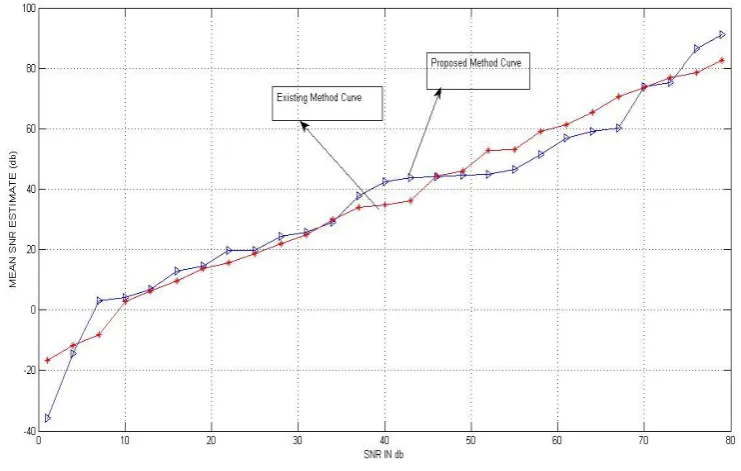
Fig. 2 shows mean SNR estimate performance of ideal and experimental value for proposed SNR estimation method in 16QAM-OFDM system. In 4QAM or QPSK, proposed method is the same performance between ideal and experimental results because correlation relation of decision feedback signal doesn’t change from transmit signal’s one. But the higher modulation level, estimation error is bigger. In Fig. 2, i.e. in case of 16QAM, proposed method shows about 0.5dB difference from ideal case because of correlation value with errors of decision feedback signal.
V. CONCLUSION
We proposed a correlation relation-based approach that is amenable to practical implementation and significantly improves on previous estimators. Proposed method of this paper showed stable performance than previous SNR estimation method because this estimation method uses zero point auto-correlation of received signal per block and auto-/cross- correlation of decision feedback signal in OFDM system. Proposed SNR estimation method had similar performance with CRLB for QPSK and QAM and had NMSE under 0.005 in wide SNR range of from -10dB to 30dB. Especially, Type 1 method had an estimation error under 2dB even though the signal for less than 0dB and NMSE performance of CRLB. Type 2 method has a NSER performance under 0.005 for more than 10dB SNR. Due to its simplicity and practicality, therefore, proposed method is an attractive choice, which recently proved competitive for high level modulation.
REFERENCES
[1] G. Albertazzi, S. Cioni, G. Corazza, M. Neri, R. Pedone, P. Salmi, A. Vanelli-Coralli, and M. Villanti, “On the adaptive DVB-S2 physical layer: Design and performance,” IEEE Wireless Commun. Mag., vol. 12, no. 6, pp. 62–68, Dec. 2005.
[2] David R. Pauluzzi and Norman C. Beaulieu, “Comparison of Four SNR Estimators for QPSK Modulations,” IEEE Communication Letters, vol. 4, no. 2, pp. 43.45, Feb. 2000.
[3] D.R. Pauluzzi and N.C. Beaulieu, “A Comparison of SNR Estimation Techniques for the AWGN Channel,” IEEE Trans. on Comm., vol. 48, no. 10, pp. 1680-1691, Oct. 2000.
[4] R. Matzner and F. Engleberger, “An SNR Estimation Algorithm using Fourth-Order Moments,” Proc. IEEE Int. Symp. Information Theory, Trondheim, Norway, p. 119, June 1994.
[5] R. López-Valcarce and C. Mosquera, “Sixth-order statistics-based nondata-aided SNR estimation,” IEEE Commun. Lett., vol. 11, no. 4, pp. 351–353, Apr. 2007.
[6] M. Álvarez-Díaz, R. López-Valcarce & C. Mosquera, "SNR Estimation for Multilevel Constellations Using Higher-Order Moments," IEEE Transactions on Signal Processing, vol. 58, no. 3 Part 2, March 2010, pp. 1515-1526.
[7] W. Gappmair, R. López-Valcarce, and C. Mosquera, “Cramer-Rao lower bound and EM algorithm for envelope-based SNR estimation of nonconstant modulus constellations,” IEEE Trans. Commun., vol. 57, no. 6, pp. 1622–1627, Jun. 2009.
[8] Feng Rice, Bill Cowley, Bill Moran, and Mark Rice, “Cramer-Rao Lower Bounds for QAM Phase and Frequency estimation,” IEEE Trans. On Comm, vol. 49, no. 9, Sept. 2001, pp. 1582-1591.