Drug Design, Development and Therapy 2017:11 2551–2564
Drug Design, Development and Therapy
Dovepress
submit your manuscript | www.dovepress.com
2551
R e v i e w
open access to scientific and medical research
Open Access Full Text Article
Quantum mechanics implementation in
drug-design workflows: does it really help?
Olayide A Arodola
1Mahmoud eS Soliman
1,21Department of Pharmaceutical Chemistry, University of KwaZulu-Natal, Durban, South Africa; 2Department of Pharmaceutical Organic Chemistry, Faculty of Pharmacy, Zagazig University, egypt
Abstract: The pharmaceutical industry is progressively operating in an era where development costs are constantly under pressure, higher percentages of drugs are demanded, and the drug-discovery process is a trial-and-error run. The profit that flows in with the drug-discovery of new drugs has always been the motivation for the industry to keep up the pace and keep abreast with the endless demand for medicines. The process of finding a molecule that binds to the target protein using in silico tools has made computational chemistry a valuable tool in drug discovery in both academic research and pharmaceutical industry. However, the complexity of many protein–ligand interactions challenges the accuracy and efficiency of the commonly used empirical methods. The usefulness of quantum mechanics (QM) in drug–protein interaction cannot be overemphasized; however, this approach has little significance in some empirical methods. In this review, we discuss recent developments in, and application of, QM to medically relevant biomolecules. We critically discuss the different types of QM-based methods and their proposed application to incorporating them into drug-design and -discovery workflows while trying to answer a critical question: are QM-based methods of real help in drug-design and -discovery research and industry?
Keywords: quantum mechanics, drug discovery, drug design, molecular mechanics, molecular dynamics, in silico tools
Introduction
Drug discovery plays an important role in the growth of any pharmaceutical company
and society, as newer and safer drugs are launched in the market with the sole objective
of improving the therapeutic value and safety of drugs. The pharmaceutical industry
has consistently shown that it can discover and develop innovative medicines for a
wide range of diseases.
1Drug research, as it is called today, began when chemistry had reached the peak of
its career, allowing chemical principles and theories to be applied to problems outside
the scope of chemistry, and when pharmacology became an independent scientific
discipline on its own. By 1870, some of the important foundations of chemistry theory
had been laid.
2,3In the twentieth century, biochemistry had remarkable influence on
drug research in numerous ways (Table 1). It was during this period that the concept
of targeting enzymes and designing drugs as inhibitors came into existence.
4However,
the current drug-discovery process is very time consuming and expensive and can take
up to 12–16 years of exhaustive research, huge financial investment, and clinical trials
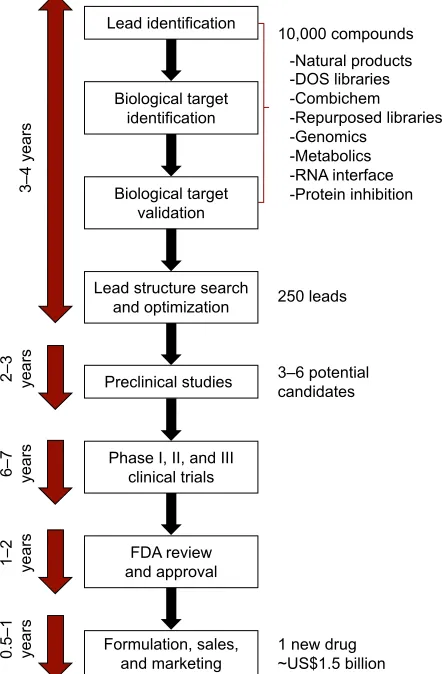
before a molecule can be recognized as a drug (Figure 1).
5Despite the diverse research and development (R&D) approaches adopted by
pharmaceutical companies, the attrition rate is inadmissibly high. One of the factors
contributing to the high attrition rates is an active compound with unacceptable
Correspondence: Mahmoud eS Soliman Department of Pharmaceutical Chemistry, University of KwaZulu-Natal, 1 University Road, westville,
Durban 4000, South Africa Tel +27 31 260 7413 email [email protected]
Journal name: Drug Design, Development and Therapy Article Designation: Review
Year: 2017 Volume: 11
Running head verso: Arodola and Soliman
Running head recto: Quantum mechanics in drug design DOI: http://dx.doi.org/10.2147/DDDT.S126344
Drug Design, Development and Therapy downloaded from https://www.dovepress.com/ by 118.70.13.36 on 21-Aug-2020
For personal use only.
Number of times this article has been viewed
This article was published in the following Dove Press journal: Drug Design, Development and Therapy
Dovepress
Arodola and Soliman
absorption, distribution, metabolism, excretion, and toxicity
(ADMET) adverse effects that thus needs to be withdrawn
from development. This factor represents approximately 50%
of all costly failures in drug development,
6and it has become
widely appreciated that these areas should be considered as
early as possible in the drug-discovery process.
7,8It is evident
that the pitfall in the current drug-discovery process urges an
unconventional approach, which would not only truncate the
R&D time but also reduce the cost involved.
9The process of finding a molecule that binds to the
target protein has now moved from the laboratory to the
computer.
10Years ago, drug design (DD) substantially
extended its range of applications from target identification
to clinical trials.
11Computer-generated models, which serve
as good predictive models for the evaluation of biological
activities, have had numerous successes predicting the
pos-sible structures of biological targets, thus reducing fruitless
effort using nuclear magnetic resonance and
spectroscopy-structure elucidations.
12With in silico tools, it is possible
to accelerate the drug-discovery process by modeling the
most relevant ADMET properties.
12A molecule could
be too toxic, too quickly eliminated from the body,
pos-sess fast metabolic reaction, unstable, too challenging to
synthesize in large volume, or too expensive to produce.
Therefore, many promising compounds will regrettably
have to be rejected once they are found to show unacceptable
adverse effects in humans. Furthermore, compared to the
status a decade ago, protein structure-based DD is swiftly
gathering energy, and results have shown a remarkable
increase in the structural knowledge of medically relevant
proteins through various methods,
13–18as well as
computer-aided programs. The large number of structural studies on
medically relevant proteins suggests that the structure of
a potential drug target is treasurable knowledge for any
pharmaceutical company, not only for lead discovery and
lead optimization but also in the later stages of drug
devel-opment, where such concerns as toxicity, bioavailability,
and binding modes of potential drug candidates to the target
protein are extremely important.
A drug reveals its action when it binds to its
biological target (enzyme, nucleic acid, or antibody),
typically receptors. Receptors possess the active sites for
the binding of a drug. Therefore, it is important to know
the structure of the target, in order to design a good drug
and identify an accurate binding site. In DD, predicting
drug–receptor interactions involves the development of
pharmacophore-based and molecular docking/scoring
tech-niques. However, some biologically relevant biomolecules
lack X-ray crystal structures. To resolve this, homology
modeling has been implemented,
19and modeled proteins
behave somewhat like the real proteins in their native
biological environment when simulated.
20Recently, many
computer-assisted models have been developed, and several
thousand candidates are being screened for various
activi-ties using these models. The methods of choice for activity
Table 1 Some of the important discoveries in medicine in the last two centuries
Year of discovery
Drug name Category 1 1806 Morphine Hypnotic agent
2 1899 Aspirin Analgesic and antipyretic agent 3 1922 insulin Antidiabetic agent
4 1928 Penicillin Antibiotic 5 1960 Chlordiazepoxide Tranquilizer 6 1971 l-Dopa Anti-Parkinson agent 7 1987 Artemisinin Antimalaria agent
8 1998 Sildenafil erectile dysfunctional treatment 9 1999 Celecoxib, rofecoxib Selective COX-2 inhibitors 10 1999 Zanamivir, oseltamivir Anti-influenza drugs 11 2001 imatinib Leukemia treatment
Figure 1 Flowchart of drug-discovery and -development process.
Abbreviations: DOS, diversity-oriented synthesis; combichem, combinatorial
±\HDUV
± \HDUV
± \HDUV
± \HDUV
± \HDUV
OHDGV
±SRWHQWLDO FDQGLGDWHV
1DWXUDOSURGXFWV '26OLEUDULHV &RPELFKHP 5HSXUSRVHGOLEUDULHV *HQRPLFV
0HWDEROLFV 51$LQWHUIDFH 3URWHLQLQKLELWLRQ FRPSRXQGV
QHZGUXJ a86ELOOLRQ /HDGVWUXFWXUHVHDUFK
DQGRSWLPL]DWLRQ %LRORJLFDOWDUJHW
YDOLGDWLRQ
3UHFOLQLFDOVWXGLHV
3KDVH,,,DQG,,, FOLQLFDOWULDOV
)'$UHYLHZ DQGDSSURYDO
)RUPXODWLRQVDOHV DQGPDUNHWLQJ %LRORJLFDOWDUJHW
LGHQWLILFDWLRQ /HDGLGHQWLILFDWLRQ
Drug Design, Development and Therapy downloaded from https://www.dovepress.com/ by 118.70.13.36 on 21-Aug-2020
Dovepress Quantum mechanics in drug design
screening using these models are computer programs that
superimpose molecules with flexible alignment to develop
pharmacophoric patterns and/or quantitative structure–
activity relationships (QSARs), dock molecules to the
receptor or a pseudoreceptor, or construct new drugs within
a predefined active site.
21,22Different molecular properties
(eg, electrostatic, steric, and hydrophobic) and hydrogen
bond-acceptor and donor fields have been used to achieve
this purpose.
23Computational studies of biological targets
allow the study of their structure, function, and dynamics at
molecular and atomic levels. The entire process is about the
simulation of the biological targets using quantum
mechan-ics (QM) calculation, which is based on the principles of
chemistry and physics.
In this review, we discuss how the implementation of
QM methods in academic and pharmaceutical companies’
research can be a useful tool in the elucidation of drug–target
interactions, which will help DD and drug development with
respect to accuracy, time, and cost.
Computer-aided drug-design
(CADD) approaches
CADD is aimed at improving the development and efficacy
of drugs using modern computational tools that are fast and
cost-effective compared to conventional methods.
24–26The
development of drugs that bind to specific targets has been
recognized by the pharmaceutical industry as an important
foundation that provides it with the necessary return on
investment to invest in further R&D, leading to a
discovery-and-development cycle.
27Broadly speaking, DD is divided
into two areas: structure-based DD (SBDD) and ligand-based
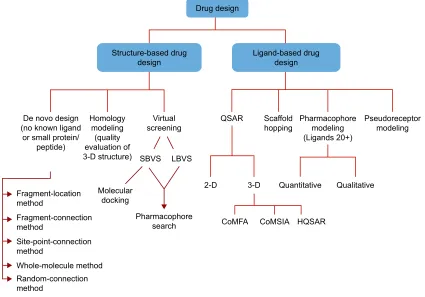
DD (Figure 2).
The CADD approach has been applied to various
suc-cessful drugs, some of which are in use in the market.
Examples include imatinib
28and nilotinib.
29Several other
targets include ER,
30,31EGFR,
32,33PKC
β
2
,
34and BCR-Abl.
35A biomolecular system can be simulated using molecular
mechanics (MM), QM, or a hybrid method (QM/MM),
depending on the research problem to be answered.
Molecular mechanics
MM is commonly applied in large systems to calculate
molecular structures and relative potential energies of a
molecular conformation or atom arrangement.
36–38The
electrons in the studied system are not explicitly considered,
but instead each atom – specifically, the atomic nucleus
and the associated electrons – is treated as a single particle.
The exclusion of electrons in MM is justified on the basis
Figure 2 Different in silico tools used in drug design.
Abbreviations: QSAR, quantitative structure–activity relationship; SBvS, structure-based virtual screening; LBvS, ligand-based virtual screening; CoMFA, comparative molecular field analysis; CoMSIA, comparative molecular similarity index analysis; HQSAR, hologram quantitative structure–activity relationship.
'UXJGHVLJQ
6WUXFWXUHEDVHGGUXJ GHVLJQ
'HQRYRGHVLJQ QRNQRZQOLJDQG
RUVPDOOSURWHLQ SHSWLGH
+RPRORJ\ PRGHOLQJ
TXDOLW\ HYDOXDWLRQRI 'VWUXFWXUH
9LUWXDO
VFUHHQLQJ 46$5 6FDIIROGKRSSLQJ 3KDUPDFRSKRUHPRGHOLQJ
/LJDQGV
3VHXGRUHFHSWRU PRGHOLQJ
4XDOLWDWLYH 4XDQWLWDWLYH
' '
3KDUPDFRSKRUH VHDUFK
/%96 6%96
0ROHFXODU GRFNLQJ )UDJPHQWORFDWLRQ
PHWKRG
)UDJPHQWFRQQHFWLRQ PHWKRG
6LWHSRLQWFRQQHFWLRQ PHWKRG
:KROHPROHFXOHPHWKRG 5DQGRPFRQQHFWLRQ PHWKRG
&R0)$ &R06,$ +46$5
/LJDQGEDVHGGUXJ GHVLJQ
Drug Design, Development and Therapy downloaded from https://www.dovepress.com/ by 118.70.13.36 on 21-Aug-2020
Dovepress
Arodola and Soliman
of Born–Oppenheimer approximation,
39which states that
electronic and nuclear motions can be uncoupled from each
other and considered separately. Energy differences between
conformations are significant in such calculations, rather than
absolute values of potential energies.
MM can simply be viewed as a ball-and-spring model of
atoms and molecules with classical forces between them.
40Such forces are accounted by potential energy functions
with respect to such structural features as bond length, bond
angles, and torsional angles. Potential energy functions are
equipped with parameters designed to reproduce experimental
properties.
37The MM or rather the total potential energy of a
molecule is described as the sum of bond-stretching energy
(E
str), bond angle-bending energy (E
bend), torsion energy
(E
tor), and energy of interactions among unbound atoms (E
nb).
Energy contributions of the latter constitute van der Waals
and electrostatic interactions:
E
tot=
E
str+
E
bend+
E
tor+
E
vdw+
E
elecE
k r r
k
v
cos n
r
r eq eq
angles bonds
n
tot
(
)
2(
)
22
[1
(
)]
=
−
+
−
+
+
−
+
θθ θ
∅
∑
∑
A
A
r
B
r
q q
r
ij rj ij ij i j ij i jdihedrals 12 6
−
+
<ε
∑
∑
where E
totis total potential energy, stretch terms refer to E
str,
bend terms refer to bond angle-bending energy E
bend, torsional
terms refer to E
toror twisting energy, and unbound interactions
are van der Waals forces and electrostatic forces between
atoms that are not chemically bonded. Energy contributions
from special treatment of hydrogen bonding and stretch–bend
coupling interactions may also be seen in MM.
Quantum mechanics
The QM method treats molecules as collections of nuclei
and electrons without any reference to “chemical bonds”.
QM is important in understanding the behavior of systems
at the atomic level. QM methods apply the laws of QM to
approximate the wave function and to solve the Schrödinger
equation.
36,41The solution to the Schrödinger equation is in
terms of the motions of electrons, which in turn lead directly
to molecular structure and energy among other observables,
as well as to information about bonding. However, the
Schrödinger equation cannot actually be solved for any but
a one-electron system (the hydrogen atom), and
approxi-mations need to be made. According to QM, an electron
bound to an atom cannot possess any arbitrary energy or
occupy any position in space. These characteristics can be
determined by solving the time-independent Schrödinger
equation:
42,43H
=
T
+
V
where H is the Hamiltonian operator (sum of kinetic energy),
T the potential energy, and V the operator. H can also be
defined as:
H
= −
+
∂
∂
+
∂
+
h
mj
x
y
z
e e
r
i i i ij 2 2 28
1
π
∂
∂
∂
∑
2 2 2 2 2 <<j i∑
∑
QM methods include ab initio
44density functional theory
(DFT)
45–47and semiempirical calculations.
48–50For more
accu-rate QM calculations, electron correlation methods, namely,
CCSDT and MP2, etc, are necessary.
46DFT methods conduct
calculations by electron correlation approximation.
46,47,51These methods can be employed to calculate crucial
proper-ties of a system such as vibrational frequencies, equilibrium
molecular structure, dipole moments and free energy of
reac-tion, which cannot be achieved by experimental methods.
36They also help to identify the activated complex when applied
to reacting chemical species and therefore in the identification
of a reaction pathway. Since the Schrödinger equation cannot
be solved for complex molecular systems, semiempirical
ab initio DFT methods were developed to approximate the
precise QM solution to the problem.
36,46,52QM models are the
most accurate, but also the most expensive methods in terms
of time and computational resources, and are thus applied
on small systems.
Classical mechanics or QM – which
to choose?
Classical mechanics, also called MM, is the alternative to
QM when chemical reactions do not need to be considered
in a simulation. MM does not start from an “exact theory”
(the Schrödinger equation), but rather describes molecules
in terms of “bonded atoms”, which have been distorted from
some idealized geometry due to unbound van der Waals
and Columbic interactions. Though MM does not solve the
Schrödinger equation for electron motions, it requires an
explicit description of chemical bonding and lots of
infor-mation about the structures of molecules. It is the use and
extent of this information that distinguishes different MM
models.
53–56While many of the details of mechanical and
biochemical interactions in enzymes are currently unclear,
MM can rely on force fields with fixed parameters to provide
better understanding of conformational analysis between
Drug Design, Development and Therapy downloaded from https://www.dovepress.com/ by 118.70.13.36 on 21-Aug-2020
Dovepress Quantum mechanics in drug design
conformers,
57mechanical deformation of DNA, RNA,
and proteins, and changes in cellular structure, response,
and function.
58This understanding can offer new prognoses
of diseases, as MM calculations are used to provide
qualita-tive descriptions of molecular interactions.
QM has been said to succeed outstandingly in the area
where MM failed. In contrast to QM, MM ignores electrons,
fails to illustrate reality, and also computes the energy
of a system as only a function of the nuclear positions.
Generally, QM incorporates four phenomena for which
MM cannot justify. These include quantization of some
physical properties, quantum entanglement, the principle
of uncertainty, and wave–particle duality. QM is applied
in the determination of interactions between possible drugs
and enzyme active sites.
59–65It is slow but accurate with
respect to DD. In spite of the advantages of MM, it has
some setbacks, such as inappropriate parameterization,
inability to predict chemical reactions, or explain bond
breaking/formation.
66–70QM in CADD arena
In answering research questions, computational chemists
have a vast selection of methodologies at their disposal. The
key tools available belong to six all-encompassing classes:
molecular dynamic (MD) simulation, MM, QM, ab initio
calcu-lations, DFT, and semiempirical calculations. MM can be used
to study very large molecules, because other QM methods, such
as semiempirical calculations, ab initio, and DFT are relatively
slow and would exhaust computational resources. However,
MM methods are unable to address interactions between the
ligand and the receptor in metal-containing systems.
Such algorithms as hybrid QM/MM, which combine
QM and MM, have been developed to limit issues brought
about by the individual application of these methods.
71–74QM methods are the most accurate, but also computationally
expensive and time-consuming calculations.
75QM
calcula-tions are employed in semiempirical methods (eg, AM1,
PM3) only for valence electrons in the system, whereas for
other electrons and atomic nuclei behavior of other atoms,
approximations are made.
75Combined QM-MM methods
provide the accuracy of a QM description with low
compu-tational cost of MM.
71,76Even though QM-MM may not be
applicable in every SBDD project, the majority of important
systems cannot be well addressed by any other computational
methods. QM-MM is thus the crucial component in
compu-tational drug discovery.
Five key facets are imperative in planning a QM-MM
cal-culation on an enzyme: choice of the QM method, choice of
MM force field, segregation of the system into QM and MM
regions, simulation type (eg, MD simulation or calculation
of potential energy profiles), and whether advanced
confor-mational sampling will be performed. The choice of QM
method is crucial. A plethora of different QM methods exists,
ranging from fast, semiempirical methods (eg, AM1, PM3,
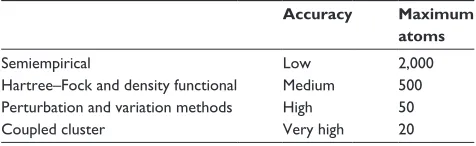
SCC-DFTB; low accuracy and maximum of 2,000 atoms)
to more accurate but more computationally expensive
Hartree–Fock and density-functional (eg, B3LYP; medium
accuracy and maximum of 500 atoms), and molecular orbital
ab initio (eg, MP2, coupled cluster; very high accuracy and
maximum of 20 atoms) methods. Not all methods are
appli-cable to all systems, for reasons of accuracy, practicality, or
lack of parameters (eg, for semiempirical methods) (Table 2).
Generally, but not always, improved accuracy comes at the
price of increased calculation expenses.
Typical applications of QM in DD include calculation
of energies and structure optimization of ligand and/or
protein–ligand complexes,
77especially for docking studies
to obtain the correct binding mode of a ligand.
78QM-MM
methods have shown promise for their accurate predictions
when employed in the calculation of binding energies;
however, this approach still requires further sampling of
ligand–target conformations through MD simulations.
79QM methods have proved useful in the study of some target
proteins, including HIV1 integrase,
77trypsin,
78West Nile
virus NS3 serine protease, HIV1PR, and CDK2.
79The use of supercomputing to calculate QM has been
attributed to expensive calculations for small systems.
How-ever, the use of Hadoop
80could make QM faster and more
scalable and efficient. Hadoop could allow for better cluster
utilization as well to accommodate larger jobs, which will
help QM, as it needs more computational resources to run
calculations for larger systems.
Recent QM developments in drug
discovery
Tangible advances in the use of QM to solve relevant
pharma-ceutical problems have been seen in the last decade, eg, the use
of the hybrid QM-MM approach to determine the free-energy
Table 2 Accuracy of different quantum mechanics methods
Accuracy Maximum atoms
Semiempirical Low 2,000
Hartree–Fock and density functional Medium 500 Perturbation and variation methods High 50
Coupled cluster very high 20
Drug Design, Development and Therapy downloaded from https://www.dovepress.com/ by 118.70.13.36 on 21-Aug-2020
Dovepress
Arodola and Soliman
landscape of the enzymatic reaction mechanism.
81,82The next
step in the evolution of drug discovery is the routine use of
QM in all levels of in silico DD.
SBDD is an important factor in the drug-discovery
process, and designs more potent molecules with few
altera-tions made, ie, derivatives of “lead” molecules.
83–86In silico
tools can be used to design molecules to investigate existing
protein–ligand interactions, as well as explore the active site
for any supplementary hydrophilic or hydrophobic
interac-tions that can increase binding affinity.
87–89The use of in silico
tools allows the testing of a theory in a short time frame, using
high-throughput empirical methods. However, there are
con-cerns regarding the accuracy of these methods, particularly
in the area of docking and scoring
90–93and QSAR.
94,95The in silico approach is fast and environmentally
friendly, but it does not replace experimentation. Regardless,
failures encountered in the pharmaceutical industry at the
drug-discovery stage can be attributed to a number of factors
that are not limited to wrong force-field parameters,
espe-cially for metals,
96disregard for protein flexibility
97,98or
domain of applicability,
99or nonrigorous validation of the
QSAR model.
100,101QM, a method used to replicate an experimental work
accurately, proffers a potential solution to the failures
mentioned.
88,102Increasingly, QM-MM methods are being
applied to enzymes that are drug targets, often with the aim
of providing information for DD.
103–115Examples include the
HIV1-replication enzymes: reverse transcriptase, protease,
and integrase. The reaction mechanisms of these enzymes
have been studied using the QM-MM approach.
116–126Other
examples are G-protein-coupled receptors,
127–1295-HT
4receptors,
130,131design and evaluation of a novel class
of FKBP12 ligands,
132,133and novel inhibitors of human
DHFR.
134–136The number of accidental discoveries in
drug history is also legion.
83,137–141Another development
in DD research is the hybrid QM-MM method, developed
to improve the accuracy of biomolecular simulations,
71–75QM docking, QM virtual screening, and QM-QSAR.
142,143The QM approach has been successfully applied in
drug discovery in pharmaceutical companies, eg, in the
combination of artificial intelligence and cloud
comput-ing to search molecular entities and aid in the design of
novel drugs.
144QM in DD research: time vs accuracy
In spite of growing computational resources, simulations of
complex biosystems at the atomic/molecular level remain
a challenge. The application of QM is limited to relatively
small systems (Table 2). On the other hand, MM methods
can treat millions of atoms or more. The hybrid QM-MM
method, which combines the accuracy of QM descriptions
with the low computational cost of MM modeling, and other
QM-based methods (QM docking, QM virtual screening,
QM-QSAR) can thus offer a promising solution to the
computational challenge in DD. In addition, a recent article
implicitly explained that the need for suitable computational
approaches or tools could enhance success rates in the
drug-discovery process.
145QM/MM docking method
The process of docking involves the correct prediction of
ligand conformation and orientation within a targeted
bind-ing site, while scorbind-ing predicts the bindbind-ing free energy of a
complex formation.
146There are numerous molecular docking
programs,
147such as Dock,
148AutoDock,
149Gold,
150Flexx,
151Glide,
152,153ICM,
147PhDock,
154and Surflex.
154However, some
problems have been reported in docking,
155,156which could
be due to either posing or scoring. Each docking program is
ideal for precise docking problems;
157however, combining
different computational methods can improve the reliability
and accuracy of results.
158QM is specifically useful in DD
when the interaction of the drug involves a chemical reaction.
As such, implementation of QM docking would
systemati-cally improve the accuracy of description of enzyme–ligand
interactions, as well as binding affinity. Limitations in scoring
functions are being increasingly exposed, particularly as
more challenging and electronically complex pockets are
being probed, eg, systems with metals.
159Cho et al
160obtained
ligand atomic charges using a QM-MM calculation.
Calcu-lations indicated generally improved poses after docking.
The ability of QM-MM docking has been further evaluated
in other studies to predict the poses of metalloproteins.
161,162Another study
163employed full QM calculation rather than
QM-MM calculations to obtain partial charges for the
ligand and receptor. Therefore, there appears to be evidence
that QM-based models provide scoring functions that can
improve the quality of predicted docking poses for
chal-lenging receptors.
QM virtual screening method
Virtual screening has become a powerful tool in the
drug-discovery process to search for novel compounds with desired
properties.
164,165This method has found its application in
screening of combinatorial chemistry, genomics, protein, and
peptide libraries.
166Virtual screening involves the docking of
selected lead molecules against a specific biological target.
Drug Design, Development and Therapy downloaded from https://www.dovepress.com/ by 118.70.13.36 on 21-Aug-2020
Dovepress Quantum mechanics in drug design
This is followed by a scoring function.
167Virtual screening,
which can be ligand-based
168,169or structure-based,
168,170,171screens the library by applying Lipinski’s rule of five before
further evaluation.
172Pharmaceutical companies rely on this
method when searching for new novel compounds.
Con-sidering today’s computational resources, several million
compounds can be screened in a few days on supercomputers,
and QM could be used to evaluate binding for further drug
development.
QM-QSAR method
QSAR is a mathematical representation that attempts to
cor-relate a set of compounds with dependent variables (activity
values, eg, K
i, EC
50, ED
50, IC
50) and a set of independent
variables called descriptors.
173There are various statistical
models that are used to derive a QSAR equation,
174–176and a
QSAR model can be 2-D, 3-D, or 4-D.
177–179Using the QSAR
method, predicted chemical structures that possess good
activity values need only be synthesized.
180–182QM-QSAR
uses QM methods to develop quantum-based QSAR models.
183Studies have provided details of QM-based descriptors used
in QSAR programs, such as Codessa-, AM1-, and DFT-based
descriptors, to understand the relationship between
physico-chemical properties and their descriptors.
184–186QM implementation in the
pharmaceutical industry:
time vs accuracy
As the ADMET properties of a drug determine its activity, the
development of a new drug with reasonable ADMET makes
drug discovery a more difficult and challenging process in
the pharmaceutical industry. The pharmaceutical industry is
progressively operating in an era where development costs
are constantly under pressure, higher percentages of drugs
are demanded, and the drug-discovery process is a
trial-and-error run. The profits that flow in with the discovery of new
drugs have always been the motivation for the industry to
keep up the pace and keep abreast with the endless demand
for medicines.
187,188In recent years, the use of CADD to simulate drug–
receptor interactions has made rational DD feasible and
cost-effective. in silico tools, such as docking, virtual
screening, QSAR, molecular simulation, MM, and QM, use
their respective mathematical equation to predict rapidly the
binding affinities of a large library of compounds, as well
as analyze homolytic or heterolytic fission/fusion before
undergoing chemical (synthesis) and biological (activity)
evaluation as a novel compound.
However, more attention should be paid to the way
phar-maceutical companies use in silico tools. While docking,
virtual screening, QSAR, and MM manage computational
resources and allow rapid scans of large libraries, the accuracy
of the results is in question when it comes to experimental
data correlation. Compared to those used in pharmaceutical
companies, there are more efficient methods, but the cost
with respect to computer time/resources is high when one
has to scan a really large library of compounds. Therefore,
using a combination of QM to parameterize the molecules
and MM to describe and solvate the protein, a more
accu-rate understanding of binding affinity and protein–molecule
interaction could be gained (Figure 3). If this method was
implemented in pharmaceutical companies’ R&D, it would
give correct binding affinities and free binding energy using
different ligand geometries in QM-MM energy calculations.
Figure 3 Implementation of QM in pharmaceutical companies’ drug design workflow.
Abbreviations: ADMeT, absorption, distribution, metabolism, excretion, toxicity; QM, quantum mechanics.
6WHS
7DUJHWVHOHFWLRQ
6WHS 3UHSURFHVVLQJ
SDUDPHWHUL]DWLRQ 6WHS,QYHUVHGHVLJQ
6WHS 3UHFOLQLFDO RSWLPL]DWLRQ
7UDLQLQJVHW
3URWHLQ'
%LQGLQJDIILQLW\ HTXDWLRQ
6\QWKHVLVDQG FHOOEDVHG
DVVD\
3RVWSURFHVV SURSHUW\ILOWHUV 0ROHFXOH
0ROHFXOH
0ROHFXOH
0ROHFXOH
0ROHFXOH; 3UHSURFHVV
SURSHUW\ILOWHUV HJ$'0(7 /LSLQVNL¶VUXOH
RI
3URSHUW\ILOWHUV 'DWDDQDO\VLV
Drug Design, Development and Therapy downloaded from https://www.dovepress.com/ by 118.70.13.36 on 21-Aug-2020
Dovepress
Arodola and Soliman
Furthermore, using QSAR to predict the activity of an
exis-tent molecule may lead to remarkable savings with respect
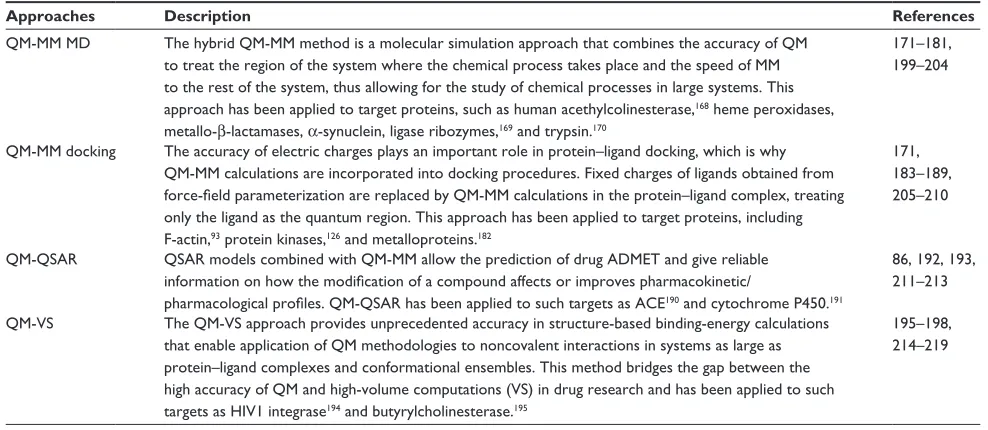
to development time and cost (Table 3).
Probably, most pharmaceutical companies today follow
common technology processes for discovering drugs. These
include cloning and expression of human receptors and
enzymes using high-throughput, automated screening and
the application of combinatorial chemistry.
189The field of
combinatorial chemistry is in constant evolution. We believe
that pharmaceutical companies rarely use accurate DD tools,
eg, QM, in their DD, owing to the fast pace of their work.
The use of QM is not limited to creating a computational
model of a drug, but can also be applied to proteins, DNA,
carbohydrates, and lipids, as well as solvent molecules that
are involved in drug transportation, binding, and signaling.
Future perspectives
The application of QM-based approaches in guiding SBDD
is not new. QM has featured in some medicinally relevant
chemistry calculations in providing informative descriptors
for QSAR and 3-D conformation for ligands. QM methods
offer the ability to provide an accurate representation of
ligands and proteins where MM parameterization struggles.
QM approaches hold promise in addressing pharmacological
problems on the time scale demanded by drug-discovery
research. After ups and downs in the perception of CADD
and perhaps some overhyping of its promises in drug
devel-opment, it could be said that CADD is becoming a routinely
used component of drug discovery.
Currently, sophisticated CADD tools are typically applied
by modeling experts, but are increasingly spreading to the
desktops of medicinal chemists as well. Ligand poses
pre-dicted from docking to receptors, such as metalloproteins,
have been shown to resemble experiments more closely
when partial charges are derived from QM or QM-MM
calculations. The use of QM and QM-MM approaches in
computation of protein–ligand binding affinities has met with
mixed success. However, the QM-MM approach appears
to be of most benefit for low-resolution X-ray structures,
where an incorrectly assigned ligand structure due to its MM
force field is more likely. Studies demonstrate that the use
of accurate charges, in many cases, leads to improvement
in docking accuracy in a wide range of Protein Data Bank
complexes. The principal uncertainty at this point is whether
this improved performance in docking can be noticed in other
in silico methods.
In this review, we have discussed how the
implementa-tion of QM-based methods could help the drug-discovery
and DD process in the pharmaceutical industry. This review
outlines the major roles played by QM in the DD workflow
and its importance in the drug-discovery process to avoid
“dead-end” lead compounds. This method could have strong
impact in future drug development, because of the endless
demand for new drugs and the short time frame
pharmaceu-tical companies have in developing them. Pharmaceupharmaceu-tical
companies have to reach a compromise between accuracy and
productivity by applying QM in their research. The selection
of the most appropriate method (MM, QM, or QM-MM)
Table 3 Description of various QM-based methods
Approaches Description References
QM-MM MD The hybrid QM-MM method is a molecular simulation approach that combines the accuracy of QM to treat the region of the system where the chemical process takes place and the speed of MM to the rest of the system, thus allowing for the study of chemical processes in large systems. This approach has been applied to target proteins, such as human acethylcolinesterase,168 heme peroxidases, metallo-β-lactamases, α-synuclein, ligase ribozymes,169 and trypsin.170
171–181, 199–204
QM-MM docking The accuracy of electric charges plays an important role in protein–ligand docking, which is why QM-MM calculations are incorporated into docking procedures. Fixed charges of ligands obtained from force-field parameterization are replaced by QM-MM calculations in the protein–ligand complex, treating only the ligand as the quantum region. This approach has been applied to target proteins, including F-actin,93 protein kinases,126 and metalloproteins.182
171, 183–189, 205–210
QM-QSAR QSAR models combined with QM-MM allow the prediction of drug ADMeT and give reliable information on how the modification of a compound affects or improves pharmacokinetic/
pharmacological profiles. QM-QSAR has been applied to such targets as ACE190 and cytochrome P450.191
86, 192, 193, 211–213 QM-vS The QM-vS approach provides unprecedented accuracy in structure-based binding-energy calculations
that enable application of QM methodologies to noncovalent interactions in systems as large as protein–ligand complexes and conformational ensembles. This method bridges the gap between the high accuracy of QM and high-volume computations (vS) in drug research and has been applied to such targets as Hiv1 integrase194 and butyrylcholinesterase.195
195–198, 214–219
Abbreviations: QM, quantum mechanics; MM, molecular mechanics; MD, molecular dynamics; QSAR, quantitative structure–activity relationship; ADMeT, absorption, distribution, metabolism, excretion, toxicity; vS, virtual screening.
Drug Design, Development and Therapy downloaded from https://www.dovepress.com/ by 118.70.13.36 on 21-Aug-2020
Dovepress Quantum mechanics in drug design
during drug development is of extreme importance. QM
should be applied to “lead” compounds to provide insight
into the free-energy landscape. Most importantly, before
embarking on CADD, it is appropriate to evaluate the
diver-sity and demand of accuracy of molecules to be designed
in the project, which in turn dictates the most appropriate
approach to select. It is also possible to reparameterize
approximate methods in order to improve the accuracy of
results in specific reactions that require numerous energy
evaluations. A number of studies have sought to
incorpo-rate QM and QM-MM into their approaches for
calculat-ing ligand–receptor bindcalculat-ing affinities. These approaches
show promising results, but require further development to
be broadly applicable. Finally, QM methods have proved
valuable in quantitative analysis of the energetics of ligand
deformation on binding. Although computation of binding
energies remain a challenging and evolving area, current QM
approaches could offer detailed information on the nature
and relative strengths of complex active-site interaction,
which is valuable in molecular design. It is likely that QM
will become a more prominent tool in the repertoire of the
computational medicinal chemist. Therefore, modern QM
approaches will play a more direct role in informing and
streamlining the drug-discovery process. The insight gained
from this review could serve as a cornerstone for medicinal
chemists, industry R&D and clinicians. This could provide
better understanding of the in silico tools in drug design and
development with improved ADMET, pharmacokinetics and
the timely assessment of property profiles.
Acknowledgments
The authors acknowledge the College of Health Sciences,
University of KwaZulu-Natal and the National Research
Foundation (NRF) NRF-DST Centre of Excellence in HIV
Prevention for financial support.
Disclosure
The authors report no conflicts of interest in this work.
References
1. Ratti E, Trist D. Continuing evolution of the drug discovery process in the pharmaceutical industry. Pure Appl Chem. 2011;73:67–75. 2. Drews J. Drug discovery: a historical perspective. Science. 2000;287:
1960–1964.
3. Drews J. In Quest of Tomorrow’s Medicine. New York: Springer-Verlag; 1999.
4. Meldrum NU, Roughton FJ. Carbonic anhydrase: its preparation and properties. J Physiol. 1933;80:113–142.
5. Kuhlmann J. Drug research: from the idea to the product. Int J Clin
Pharmacol Ther. 1997;35:541–552.
6. Bharath EN, Manjula SN, Vijaychand A. In silico drug design: tool for overcoming the innovation deficit in the drug discovery process. Int J
Pharm Pharm Sci. 2011;3:8–12.
7. Parasuraman S. Toxicological screening. J Pharmacol Pharmacother. 2011;2:74–79.
8. Alomar MJ. Factors affecting the development of adverse drug reactions (review article). Saudi Pharm J. 2014;22:83–94.
9. Jochum C, Gasteiger J. Canonical numbering and constitutional sym-metry. J Chem Inf Comput Sci. 1977;17:113–117.
10. Balaban AT, Basak SC, Colburn T, Grunwald GD. Correlation between structure and normal boiling points of haloalkanes C1-C4 using neural networks. J Chem Inf Comput Sci. 1994;34:1118–1121.
11. Rucker C, Meringer M, Kerber A. QSPR using MolGen-QSPR: the example of haloalkane boiling points. J Chem Inf Comput Sci. 2004;44: 2070–2076.
12. Augen J. The evolving role of information technology in the drug discovery process. Drug Discov Today. 2002;7:315–323.
13. Schertler GF. Overproduction of membrane proteins. Curr Opin Struct
Biol. 1992;2:534–544.
14. [No authors listed]. Guide to protein purification. Methods Enzymol. 1990;182:1–818.
15. Pardi A. Isotope labelling for NMR studies of biomolecules. Curr Opin
Struct Biol. 1992;2:832–835.
16. Pflugrath JW. Developments in X-ray detectors. Curr Opin Struct Biol. 1992;2:811–815.
17. Ealick SE, Walter RL. Synchrotron beamlines for macromolecular crystallography. Curr Opin Struct Biol. 1993;3:725–736.
18. Watenpaugh KD. Macromolecular crystallography at cryogenic temperatures. Curr Opin Struct Biol. 1991;1:1012–1015.
19. Pitman MR, Menz RI. Methods for protein homology modelling.
Bioinformatics. 2006;6:37–59.
20. Taft C, Da Silva V, Da Silva C. Current topics in computer-aided drug design. J Pharm Sci. 2008;97:1089–1098.
21. Klebe G. Toward a more efficient handling of conformational flexibility in computer-assisted modelling of drug molecules. Perspect Drug
Discov Des. 1995;3:85–105.
22. Kubinyi H. Combinatorial and computational approaches in structure-based drug design. Curr Opin Drug Discov Devel. 1998;1:16–27. 23. Mestres J, Rohrer DC, Maggiora GM. MIMIC – a molecular-field
matching program: exploiting applicability of molecular similarity approaches. J Comput Chem. 1997;18:934–954.
24. Mandal S, Moudgil M, Mandal SK. Rational drug design. Eur J
Pharmacol. 2009;625:90–100.
25. Hao GF, Yang GF, Zhan CG. Structure-based methods for predicting target mutation-induced drug resistance and rational drug design to overcome the problem. Drug Discov Today. 2012;17:1121–1126. 26. Hedvat M, Emdad L, Das SK, et al. Selected approaches for rational
drug design and high throughput screening to identify anti-cancer molecules. Anticancer Agents Med Chem. 2012;12:1143–1155. 27. Szymkowski DE. Creating the next generation of protein therapeutics
through rational drug design. Curr Opin Drug Discov Devel. 2005;8: 590–600.
28. Druker BJ, Lydon NB. Lessons learned from the development of an Abl tyrosine kinase inhibitor for chronic myelogenous leukemia. J Clin
Invest. 2000;105:3–7.
29. Weisberg E, Manley PW, Breitenstein W, et al. Characterization of AMN107, a selective inhibitor of native and mutant Bcr-Abl. Cancer
Cell. 2005;7:129–141.
30. Bazer FW, Spencer TE, Johnson GA. Interferons and uterine receptivity.
Semin Reprod Med. 2009;27:90–102.
31. Gupta A, Mandal SK, Leblanc V, Descôteaux C, Asselin E, Bérubé G. Synthesis and cytotoxic activity of benzopyran-based platinum(II) complexes. Bioorg Med Chem Lett. 2008;18:3982–3987.
32. Mandal S, Davie JR. An integrated analysis of genes and pathways exhibiting metabolic differences between estrogen receptor positive breast cancer cells. BMC Cancer. 2007;7:181.
Drug Design, Development and Therapy downloaded from https://www.dovepress.com/ by 118.70.13.36 on 21-Aug-2020
Dovepress
Arodola and Soliman
33. Sharma PS, Sharma R, Tyagi T. Receptor tyrosine kinase inhibitors as potent weapons in war against cancers. Curr Pharm Des. 2009;15: 758–776.
34. Grodsky N, Li Y, Bouzida D, et al. Structure of the catalytic domain of human protein kinase C beta II complexed with a bisindolylmaleimide inhibitor. Biochemistry. 2006;45:13970–13981.
35. Patwardhan B, Bodeker G. Ayurvedic genomics: establishing a genetic basis for mind-body typologies. J Altern Complement Med. 2008;14: 571–576.
36. Atkins P, de Paula J. Atkins’ Physical Chemistry. 8th ed. New York: Macmillan; 2006.
37. Rogers DW. Computational Chemistry Using the PC. 3rd ed. Hoboken (NJ): Wiley; 2003.
38. Lewars, EG. Computational Chemistry: Introduction to the Theory and
Applications of Molecular and Quantum Mechanics. 2nd ed. Alphen
aan den Rijn, Netherlands; Kluwer; 2004.
39. Tully JC. Perspective on “Zur Quantentheorie der Molekeln”. Theor
Chem Acc. 2000;103:173–176.
40. Hotokka M. Calculation of vibrational frequencies by molecular mechanics. In: Chalmers JM, Griffiths PR, editors. Handbook of
Vibrational Spectroscopy. Hoboken (NJ): Wiley; 2006.
41. Tannor DJ. Introduction to Quantum Mechanics: A Time-Dependent
Perspective. Sausalito (CA): University Science Books; 2008.
42. Mortimer R. Physical Chemistry. 3rd ed. Cambridge (MA): Academic Press; 2008.
43. Lewars EG. Computational Chemistry: Introduction to the Theory
and Applications of Molecular and Quantum Mechanics. Heidelberg:
Springer; 2011.
44. Jensen F. Introduction to Computational Chemistry. 2nd ed. Hoboken (NJ): Wiley; 1999.
45. Perdew JP, Ruzsinszky A. Fourteen easy lessons in density functional theory. Int J Quantum Chem. 2010;110:2801–2807.
46. Burke KJ. Perspective on density functional theory. J Chem Phys. 2012; 136:150901.
47. Grimme S, Antony J, Schwabe T, Mück-Lichtenfeld C. Density func-tional theory with dispersion corrections for supramolecular structures, aggregates, and complexes of (bio)organic molecules. Org Biomol
Chem. 2007;5:741–758.
48. Hehre WJ. A Guide to Molecular Mechanics and Quantum Chemical
Calculations. Irvine (CA): Wavefunction; 2003.
49. Dewar MJ, Zoebisch EG, Healy EF, Stewart JJ. AM1: a new general purpose quantum mechanical molecular model. J Am Chem Soc. 1985; 107:3902–3909.
50. Zerner M. Reviews of Computational Chemistry. Weinheim, Germany: Wiley-VCH; 1991.
51. Car R. Introduction to density-functional theory and ab initio molecular dynamics. QSAR Comb Sci. 2002;21:97–104.
52. Atkins PW, Friedman RS. Molecular Quantum Mechanics. 4th ed. Oxford: Oxford University Press; 2005.
53. Atkins PW, Friedman RS. Molecular Quantum Mechanics. 3rd ed. Oxford: Oxford University Press; 2005.
54. Levine IN. Quantum Chemistry. 5th ed. Upper Saddle River (NJ): Prentice Hall; 1999.
55. Roothaan CC. New developments in molecular orbital theory. Rev Mod
Phys. 1951;23:69–89.
56. Hehre WJ, Radom L, Schleyer P, Pople J. Ab Initio Molecular Orbital
Theory. Hoboken (NJ): Wiley; 1986.
57. Lewars EG. Computational Chemistry. Heidelberg: Springer; 2011. 58. Bao G, Suresh S. Cell and molecular mechanics of biological materials.
Nat Mater. 2003;2:715–725.
59. Lipkowitz KB. Abuses of molecular mechanics: pitfalls to avoid. J Chem
Educ. 1995;72:1070–1075.
60. Nagase S. Polyhedral compounds of the heavier group 14 elements: silicon, germanium, tin, and lead. Acc Chem Res. 1995;28:469–476. 61. Sella A, Basch H, Hoz S. Reactivity of strained compounds: is ground
state destabilization the major cause for rate enhancement? J Am Chem
Soc. 1996;118:416–420.
62. Balaji V, Michl J. New strained organic molecules: theory guides experiment. Pure Appl Chem. 1988;60:189–194.
63. Chakraborty S, Saha C. The Curtin-Hammett principle: a qualitative understanding. Reson J Sci Educ. 2016;21:151–171.
64. Morgan J, Greenberg A. Curtin-Hammett principle: application to benzene oxide-oxepin tautomers. Struct Chem. 2013;24:1945–1956. 65. Seeman JI. The Curtin-Hammett principle and the Winstein-Holness
equation: new definition and recent extensions to classical concepts.
J Chem Educ. 1986;63:42–48.
66. Clark M, Cramer RD, Van Opdenbosch N. Validation of the general purpose Tripos 5.2 force field. J Comput Chem. 1989;10:982–1012. 67. Burkert U, Allinger NL. Molecular Mechanics. Washington: American
Chemical Society; 1982.
68. Rappé AK, Casewit CJ. Molecular Mechanics Across Chemistry. Sausalito (CA): University Science Books; 1999.
69. Halgren TA. Merck molecular force field – I: basis, form, scope, param-eterization, and performance of MMFF94. J Comput Chem. 1996;17: 490–519.
70. Senn HM, Thiel W. QM/MM methods for biomolecular systems. Angew
Chem Int Ed Engl. 1996;48:1198–1229.
71. Lin H, Truhlar DG. QM/MM: what have we learned, where are we, and where do we go from here? Theor Chem Acc. 2007;117:185–199. 72. Garcia-Vela A, Gerber RB. Hybrid quantum/semiclassical wave packet
method for molecular dynamics: application to photolysis of Ar···HCl.
J Chem Phys. 1993;98:427–436.
73. Sauer J, Sierka M. Combining quantum mechanics and interatomic potential functions in ab initio studies of extended systems, J Comput
Chem. 2000;21:1470–1493.
74. Monard G, Prat-Resina X, Gonzalez-Lafont A, Lluch JM. Determination of enzymatic reaction pathways using QM/MM methods. Int J Quantum
Chem. 2003;93:229–244.
75. Honarparvar B, Kruger HG, Maguire GE, Govender T, Soliman ME. Integrated approach to structure-based enzymatic drug design: molecular modeling, spectroscopy, and experimental bioactivity. Chem Rev. 2014; 114(1):493–537.
76. Menikarachchi LC, Gascon JA. QM/MM approaches in medicinal chemistry research. Curr Top Med Chem. 2010;10:46–54.
77. Liao C, Nicklaus MC. Tautomerism and magnesium chelation of HIV-1 integrase inhibitors: a theoretical study. ChemMedChem. 2010; 5:1053–1066.
78. Cho AE, Guallar V, Berne BJ, Friesner R. Importance of accurate charges in molecular docking: quantum mechanical/molecular mechanical (QM/MM) approach. J Comput Chem. 2005;26:915–931. 79. Zhou T, Huang D, Caflisch A. Is quantum mechanics necessary for
predicting binding free energy? J Med Chem. 2008;51:4280–4288. 80. Cloudera. The Hadoop ecosystem. 2016. Available from: http://www.
cloudera.com/training/library/hadoop-ecosystem.html. Accessed November 28, 2016.
81. Chu WT, Wang J. Energy landscape topography reveals the underly-ing link between bindunderly-ing specificity and activity of enzymes. Sci Rep. 2016;6:27808.
82. Ribeiro AJ, Santos-Martins D, Russo N, Ramos MJ, Fernandes PA. Enzymatic flexibility and reaction rate: a QM/MM study of HIV-1 protease. ACS Catal. 2015;5:5617–5626.
83. Greer J, Erickson JW, Baldwin JJ, Varney MD. Application of the 3-dimensional structures of protein target molecules in structure-based drug design. J Med Chem. 1994;37:1035–1054.
84. Kubinyi H. Structure-based design of enzyme inhibitors and receptor ligands. Curr Opin Drug Discov Devel. 1998;1:4–15.
85. Babine RE, Bender SL. Molecular recognition of protein-ligand com-plexes: applications to drug design. Chem Rev. 1997;97:1359–1472. 86. Anderson AC. The process of structure-based drug design. Chem Biol.
2003;10:787–797.
87. Marrone TJ, Briggs JM, McCammon JA. Structure-based drug design: computational advances. Annu Rev Pharmacol Toxicol. 1997;37:71–90. 88. Raha K, Peters MB, Wang B, et al. The role of quantum mechanics in
structure-based drug design. Drug Discov Today. 2007;12:725–731.
Drug Design, Development and Therapy downloaded from https://www.dovepress.com/ by 118.70.13.36 on 21-Aug-2020
Dovepress Quantum mechanics in drug design
89. Davis AM, Teague SJ, Kleywegt GJ. Application and limitations of X-ray crystallographic data in structure-based ligand and drug design.
Angew Chem Int Ed Engl. 2003;42:2718–2736.
90. Tame JR. Scoring functions: a view from the bench. J Comput Aided
Mol Des. 1999;13:99–108.
91. Warren GL, Andrews CW, Capelli AM, et al. A critical assessment of docking programs and scoring functions. J Med Chem. 2006;49: 5912–5931.
92. Enyedy IJ, Egan WJ. Can we use docking and scoring for hit-to-lead optimization? J Comput Aided Mol Des. 2008;22:161–168. 93. Kim R, Skolnick J. Assessment of programs for ligand binding affinity
prediction. J Comput Chem. 2008;29:1316–1331.
94. Johnson SR. The trouble with QSAR (or How I learned to stop wor-rying and embrace fallacy). J Chem Inf Model. 2008;48:25–26. 95. Hawkins DM. The problem of overfitting. J Chem Inf Comput Sci.
2004;44:1–12.
96. Halgren TA, Damm W. Polarizable force fields. Curr Opin Struct Biol. 2001;11:236–242.
97. Teague SJ. Implications of protein flexibility for drug discovery.
Nat Rev Drug Discov. 2003;2:527–541.
98. Davis AM, Teague SJ. Hydrogen bonding, hydrophobic interactions, and failure of the rigid receptor hypothesis. Angew Chem Int Ed Engl. 1999;38:737–749.
99. Weaver S, Gleeson NP. The importance of the domain of applicability in QSAR modeling. J Mol Graph Model. 2008;26:1315–1326. 100. Stouch TR, Kenyon JR, Johnson SR, Chen XQ, Doweyko A, Li Y.
In silico ADME/Tox: why models fail. J Comput Aided Mol Des. 2003;17:83–92.
101. Barril X, Hubbard RE, Morley SD. Virtual screening in structure-based drug discovery. Mini Rev Med Chem. 2004;4:779–791.
102. Peters MB, Raha K, Merz KM. Quantum mechanics in structure-based drug design. Curr Opin Drug Discov Devel. 2006;9:370–379. 103. Zhang, YK, Kua, J, McCammon, JA. Role of the catalytic triad and
oxyanion hole in acetylcholinesterase catalysis: an ab initio QM/MM study. J Am Chem Soc. 2002;124:10572–10577.
104. Zhou Y, Wang S, Zhang Y. Catalytic reaction mechanism of acetylcholinesterase determined by Born-Oppenheimer ab initio QM/MM molecular dynamics simulations. J Phys Chem B. 2010;114: 8817–8825.
105. Topf M, Varnai P, Richards WG. Ab initio QM/MM dynamics simula-tion of the tetrahedral intermediate of serine proteases: insights into the active site hydrogen-bonding network. J Am Chem Soc. 2002;124: 14780–14788.
106. Ishida T. Low-barrier hydrogen bond hypothesis in the catalytic triad residue of serine proteases: correlation between structural rearrange-ment and chemical shifts in the acylation process. Biochemistry. 2006; 45:5413–5420.
107. Schutz CN, Warshel A. The low barrier hydrogen bond (LBHB) proposal revisited: the case of the Asp···His pair in serine proteases.
Proteins. 2004;55:711–723.
108. Chen X, Fang L, Liu J, Zhan CG. Reaction pathway and free energy profile for butyrylcholinesterase-catalyzed hydrolysis of acetylcholine.
J Phys Chem B. 2011;115:1315–1322.
109. Boeck AT, Schopfer LM, Lockridge O. DNA sequence of butyrylcho-linesterase from the rat: expression of the protein and characterization of the properties of rat butyrylcholinesterase. Biochem Pharmacol. 2002;63:2101–2110.
110. Chen X, Fang L, Liu J, Zhan CG. Reaction pathway and free energy profiles for butyrylcholinesterase-catalyzed hydrolysis of acetylthio-choline. Biochemistry. 2012;51:1297–1305.
111. Bourne Y, Kolb HC, Radic´ Z, Sharpless KB, Taylor P, Marchot P. Freeze-frame inhibitor captures acetylcholinesterase in a unique con-formation. Proc Natl Acad Sci U S A. 2004;101:1449–1454. 112. Senapati S, Cheng Y, McCammon JA. In-situ synthesis of a
tacrine-triazole-based inhibitor of acetylcholinesterase: configura-tional selection imposed by steric interactions. J Med Chem. 2006;49: 6222–6230.
113. Cheng Y, Cheng X, Radic´ Z, McCammon JA. Acetylcholinesterase: mechanisms of covalent inhibition of wild-type and H447I mutant determined by computational analyses. J Am Chem Soc. 2007;129: 6562–6570.
114. Liu J, Zhang Y, Zhan CG. Reaction pathway and free-energy barrier for reactivation of dimethylphosphoryl-inhibited human acetylcho-linesterase. J Phys Chem B. 2009;113:16226–16236.
115. Kwasnieski O, Verdier L, Malacria M, Derat E. Fixation of the two tabun isomers in acetylcholinesterase: a QM/MM study. J Phys
Chem B. 2009;113:10001–10007.
116. Piana S, Bucher D, Carloni P, Rothlisberger U. Reaction mechanism of HIV-1 protease by hybrid Car-Parrinello/classical MD simulations.
J Phys Chem B. 2004;108:11139–11149.
117. Rungrotmongkol T, Hannongbua S, Mulholland A. Mechanistic study of HIV-1 reverse transcriptase at the active site based on QM/MM method. J Theor Comput Chem. 2004;3:491–500.
118. Rungrotmongkol T, Mulholland AJ, Hannongbua S. Active site dynamics and combined quantum mechanics/molecular mechanics (QM/MM) modelling of a HIV-1 reverse transcriptase/DNA/dTTP complex. J Mol Graph Model. 2007;26:1–13.
119. Carnevale V, Raugei S, Piana S, Carloni P. On the nature of the reac-tion intermediate in the HIV-1 protease: a quantum chemical study.
Comput Phys Commun. 2008;179:120–123.
120. Ruiz-Pernia JJ, Alves CN, Moliner V, Silla E, Tunon I. A QM/MM study of the reaction mechanism for the 3′-processing step catalyzed by HIV-1 integrase. Theochem. 2009;898:115–120.
121. Das A, Mahale S, Prashar V, Bihani S, Ferrer JL, Hosur MV. X-ray snapshot of HIV-1 protease in action: observation of tetrahedral inter-mediate and short ionic hydrogen bond SIHB with catalytic aspartate.
J Am Chem Soc. 2010;132:6366–6373.
122. Garrec J, Sautet P, Fleurat-Lessard P. Understanding the HIV-1 pro-tease reactivity with DFT: what do we gain from recent functionals?
J Phys Chem B. 2011;115:8545–8558.
123. Suresh CH, Vargheese AM, Vijayalakshmi KP, Mohan N, Koga N. Role of structural water molecule in HIV protease-inhibitor complexes: a QM/MM study. J Comput Chem. 2008;29:1840–1849.
124. Hensen C, Hermann JC, Nam KH, Ma SH, Gao JL, Holtje HD. A combined QM/MM approach to protein-ligand interactions: polar-ization effects of the HIV-1 protease on selected high affinity inhibitors.
J Med Chem. 2004;47:6673–6680.
125. Garrec J, Cascella M, Rothlisberger U, Fleurat-Lessard P. Low inhibit-ing power of N···CO based peptidomimetic compounds against HIV-1 protease: insights from a QM/MM study. J Chem Theory Comput. 2010; 6:1369–1379.
126. Gautier A, Pitrat D, Hasserodt J. An unusual functional group inter-action and its potential to reproduce steric and electrostatic features of the transition states of peptidolysis. Bioorg Med Chem. 2006;14: 3835–3847.
127. Yeagle PL, Choi G, Albert AD. Studies on the structure of the G-protein-coupled receptor rhodopsin including the putative G-protein binding site in unactivated and activated forms. Biochemistry. 2001; 40:11932–11937.
128. Grossfield A. Recent progress in the study of G protein-coupled recep-tors with molecular dynamics computer simulations. Biochim Biophys
Acta. 2011;1808:1868–1878.
129. Tikhonova IG, Sum CS, Neumann S, et al. A bi-directional, iterative approach to the structural delineation of the functional “chemoprint” in GPR40 for agonist recognition. J Med Chem. 2007;50:2981–2989. 130. Tack J, Camilleri M, Chang L, et al. Systematic review:
cardiovas-cular safety profile of 5-HT4 agonists developed for gastrointestinal disorders. Aliment Pharmacol Ther. 2012;35:745–767.
131. Sun H, Scott DO. Metabolism of 4-aminopiperidine drugs by cyto-chrome P450s: molecular and quantum mechanical insights into drug design. ACS Med Chem Lett. 2011;2:638–643.
132. Wu X, Wang L, Han Y, et al. Creating diverse target-binding surfaces on FKBP12: synthesis and evaluation of a rapamycin analogue library.
ACS Comb Sci. 2011;13:486–495.
Drug Design, Development and Therapy downloaded from https://www.dovepress.com/ by 118.70.13.36 on 21-Aug-2020