Scaling Verifiable Computation
Using Efficient Set Accumulators
Alex Ozdemir
Stanford
Riad S. Wahby
Stanford
Barry Whitehat
No Affiliation
Dan Boneh
Stanford
{aozdemir,rsw,dabo}@cs.stanford.edu
[email protected]
Abstract
Verifiable outsourcing systems offload a large computation to a remote server, but require that the remote server provide a succinct proof, called a SNARK, that proves that the server carried out the computation correctly. Real-world applications of this approach can be found in several blockchain systems that employ verifiable outsourcing to process a large number of transactions off-chain. This reduces the on-chain work to simply verifying a succinct proof that transaction process-ing was done correctly. In practice, verifiable outsourcprocess-ing of state updates is done by updating the leaves of a Merkle tree, recomputing the resulting Merkle root, and proving using a SNARK that the state update was done correctly.
In this work, we use a combination of existing and novel techniques to implement an RSA accumulator inside of a SNARK, and use it as a replacement for a Merkle tree. We specifically optimize the accumulator for compatibility with SNARKs. Our experiments show that the resulting system re-duces costs compared to existing approaches that use Merkle trees for committing to the current state. These results apply broadly to any system that needs to offload batches of state updates to an untrusted server.
1
Introduction
Verifiable outsourcing [4,13,15,16,21,32,45,47,49,52, 56,61,78,79,96,106–108,111–115,121,123,124] is a technique that enables a weak client to outsource a compu-tation to a powerful server. The server returns the result of the computation along with a proof that the computation was done correctly. The proof must be succinct, which means that it must be short and cheap to verify. Verifiable outsourcing is relevant in a number of scenarios, including weak IoT devices, wearables, and low-power devices.
More recently, verifiable outsourcing has been deployed in blockchain environments, because on-chain work is expensive—literally. Here, a batch of k transactions, say k=1000, is outsourced to an untrusted server, called an ag-gregator, for processing. The aggregator (1) verifies that the transactions are valid (e.g., properly signed), (2) computes the updated global state resulting from these transactions, and
(3) generates a succinct proof that the aggregator correctly executed steps (1) and (2). The updated state and the succinct proof are then sent to the blockchain. In this approach, the (expensive) on-chain work is reduced to only verifying the proof—which is fast, taking time independent of the num-ber of transactionsk—and then recording the updated state. Example systems that operate this way include Rollup [7], Coda [89], Matter [86], and Zexe [29].
The process described above is calledverifiable outsourc-ing of state update[32]. In more detail, the state is a set of elements S={x1, . . . ,xM} from some universe
X
. The blockchain (or a low-power device) stores only a succinct digest ofS, e.g., the root of a Merkle tree whose leaves com-prise the elements ofS. The untrusted but powerful aggregator stores the full setS, in the clear. (Note that we treatSas public data—privacy is orthogonal to our goal, which is scalability). When processing a batch of transactions as described above, the aggregator updatesSto produce a new setS0, then com-putes a new Merkle digest forS0that it sends to the blockchain to be verified and recorded. The aggregator’s proof establishes that its starting stateSis consistent with the current digest, that correctly applying transactions yields the ending stateS0, and that the new digest is consistent withS0.This state of affairs has motivated a large body of work on computational primitives that yield efficient proofs. Examples include arithmetic [79,96,108], control flow [96,108,116], persistent state [4,32,49,56,105], and random-access mem-ory [12, 13,16, 32, 79,116]. Our work continues in this vein, with a focus on reducing proving costs for computations involving persistent state or random-access memory.
Our work. A Merkle tree [90] is an example of an accu-mulator[17], a cryptographic primitive that lets one commit to a setS, and later prove that an elementxis a member ofS. Although Merkle trees are used pervasively in today’s general-purpose verifiable state update applications, in this work we show that a Merkle tree is not the best choice for large batches of state updates whenSis moderately to very large, say|S| ≥210. In particular, we show that replacing Merkle trees with RSA-based accumulators [24,40,81] significantly improves proving time and/or reachable computation size. Our contributions are:
• We define a new operation for RSA accumulators, which we callMultiSwap, that provides a precise sequential se-mantics for batched verifiable state updates (§3).
• We synthesize existing and novel techniques for efficiently implementingMultiSwap(and, more generally, RSA accu-mulators) in the context of SNARKs (§4). These techniques include a hash function that outputs provable prime num-bers, and a new division-intractable hash function. Our approach makes use of very recent advances in manipulat-ing RSA accumulators [24].
• We apply our techniques in two contexts (§5). The first, called Rollup [7,65,94], is a technique for batching cryp-tocurrency transactions off-chain in order to save on-chain work. The second is a general-purpose RAM abstraction with long-lived state (i.e., over many proofs), which builds upon and improves prior work [12,13,16,32,116].
• We implement and evaluate (§6, §7). In particular, we com-pare our RSA accumulator implementation to Merkle trees in two benchmarks: one that measures only set operations, and one that implements a Rollup-style distributed payment application. We also compare our RAM abstraction with existing work via a cost model analysis.
In the set operations benchmark, we find that RSA accu-mulators surpass 220-element Merkle trees for batches of ≈1,300 operations, and allow for 3.3×more operations to be performed in the largest proof sizes we consider. In the Rollup application, RSA accumulators surpass 220-element Merkle trees for≈600 transactions, and allow 1.9×more transactions in the largest proofs. For RAM, we find that for a RAM of size 220, RSA accumulators surpass Merkle trees for≈1000–4000 accesses, depending on write load.
2
Background and definitions
Multisets. Amultisetis an unordered collection that may contain multiple copies of any element.S1]S2denotes the union of multisetsS1andS2, i.e., the multisetS3where each elementx∈S3has multiplicity equal to the sum of the multi-plicities ofxinS1andS2.S1S2denotes the strict difference of multisetsS1andS2, i.e., the multisetS3where each element x∈S3has multiplicity equal to the difference of multiplicities ofxinS1andS2. Note thatS1S2is only defined ifS2⊆S1.
RSA groups. AnRSA groupis the groupZ×N, i.e., the mul-tiplicative group of invertible integers moduloN, whereN is the product of two secret primes. We define theRSA quo-tient groupforNas the groupZ×N/{±1}. In this group, the elementsxandN−xare the same, meaning that all elements can be represented by integers in the interval[1,bN/2c]. It is believed that this group has no element of known order, other than the identity.
Proofs and arguments. Informally, aproof is a protocol between a prover
P
and a PPT verifierV
by whichP
con-vincesV
that∃υ:R(ι,υ) =1, for a relationR,ιan input fromV
, andυa (possibly empty)witnessfromP
. A proof satisfies the following properties:• Completeness: If∃υ:R(ι,υ) =1, then an honest
P
con-vincesV
except with probability at mostεc1/2.• Soundness: If6 ∃υ:R(ι,υ) =1, no cheating prover
P
?convinces
V
except with probability at mostεs1/2. If soundness holds only against PPTP
?, this protocol isin-stead called anargument. When the witnessυexists, one may
also require the proof system to provideknowledge sound-ness. Informally this means that whenever
P
convincesV
that ∃υ:R(ι,υ) =1,υexistsandP
“knows” a witnessυ(slightly more formally, there exists a PPT algorithm, anextractor, that can produce a witness via oracle access toP
).Proof of exponentiation. LetG be a finite group of
un-known order. Wesolowski [120] describes a protocol that al-lows
P
to convinceV
thaty=xninG, namely a protocol forthe relationRgiven byR (n,x,y),·
=1 ⇐⇒ y=xn∈G.
The protocol is: on input(n,x,y),
V
sends toP
a random` chosen from the first 2λprimes.1P
sends backQ=xbn/`c∈G,
and
V
accepts only ifQ`·xnmod`=y∈Gholds.This protocol is complete by inspection. Wesolowski shows that it is sound if the group Gsatisfies the adaptive root assumption, roughly, it is infeasible for an adversary to find a random root of an element ofGchosen by the adversary. The
RSA quotient groupZ×N/{±1}is conjectured to satisfy this assumption when
P
cannot factorN[23].Division-intractable hashing. Recall that a hash function H:
X
→D
is collision resistant if it is infeasible for a PPT1When this protocol is made non-interactive via the Fiat-Shamir heuristic,
adversary to find distinctx0,x1such thatH(x0) =H(x1). In-formally,Hisdivision intractableif the range ofHisZ, and
it is infeasible for a PPT adversary to find ˆxand a set{xi}in
X
such that ˆx6∈ {xi}andH(x)ˆ divides∏iH(xi). A collision-resistant hash function that outputs prime numbers is division intractable. We construct a different division intractable hash function in Section4.2.Pocklington primality certificates. Letpbe a prime, and r<pandabe positive integers. Definep0=p·r+1. Pock-lington’s criterion [34] states that ifap·r ≡1 modp0 and gcd(ar−1,p0) =1, thenp0is prime. In this case, we say that (p,r,a)is aPocklington witnessforp0.
Pocklington’s criterion is useful for constructing primality certificates. For a primepn, this certificate comprises
p0,{(ri,ai)}0<i≤n
where pi=pi−1·ri+1. To check this certificate, first ver-ify the primality of the small prime p0(e.g., using a deter-ministic primality test), then verify the Pocklington witness (pi−1,ri,ai)forpi, 0<i≤n. If eachriis nearly as large as pi, the bit lengths double at each step, meaning that the total verification cost is dominated by the cost of the final step.
2.1
Accumulators
Acryptographic accumulator[17] commits to a collection of values (e.g., a vector, set, or multiset) as a succinct digest. This digest isbinding, meaning informally that it is computation-ally infeasible to equivocate about the collection represented by the digest. In addition, accumulators admit succinct proofs of membership and, in some cases, non-membership.
Merkle trees. The best-known vector accumulator is the Merkle tree [90]. To review, this is a binary tree that stores a vector in the labels of its leaves; the label associated with an internal node of this tree is the result of applying a collision-resistant hashHto the concatenation of the children’s labels; and the digest representing the collection is the label of the root node.
A membership proof for the leaf at indexiis a path through the tree, i.e., the labels of the siblings of all nodes between the purported leaf and the root. Verifying the proof requires computing the node labels along the path and comparing the final value to the digest (the bits ofiindicate whether each node is the right or left child of its parent). Updating a leaf’s label is closely related: given a membership proof for the old value, the new digest is computed by swapping the old leaf for the new one, then computing the hashes along the path. Merkle trees do not support succinct non-membership proofs. The cost of verifyingkmembership proofs for a vector comprising 2mvalues isk·mevaluations ofH. The cost ofk leaf updates is 2·k·mevaluations. Membership proofs and updates cannot be batched for savings.
RSA accumulators. The RSA multiset accumulator [40, 81] represents a multisetSwith the digest
JSK=g
∏s∈SH(s)∈
G,
wheregis a fixed member of an RSA quotient groupGand
His a division-intractable hash function (§2). Inserting a new elementsintoSthus requires computingJSKH(s).
To prove membership ofs∈S, the prover furnishes the valueπ=JSK
1/H(s)
, i.e., aH(s)’th root ofJSK. This proof is verified by checking thatπH(s)=JSK.
Non-membership proofs are also possible [81], leveraging the fact thats06∈S if and only if gcd(H(s0),∏s∈SH(s)) = 1. This means that the Bézout coefficientsa,b, i.e., integers satisfying
a·H(s0) +b·
∏
s∈SH(s) =1
are a non-membership witness, since the above implies that
JSK
b·(ga)H(s0) =g
Becauseais large andbis small, the proof(ga,b)is succinct. Insertions, membership proofs, and non-membership proofs can all be batched [24] via Wesolowski proofs (§2). For example, sinceJS] {si}K=JSK
∏isi, computing an updated
digest directly requires an exponentiation by∏isi. In contrast, checking the corresponding proof only requires computing and then exponentiating by∏isimod`, for`a prime of less than 200 bits. This means that the exponentiation (but not the multiplication) to verify a batch proof has constant size.
2.2
Verifiable computation and SNARKs
Several lines of built systems [13,15,16,21,32,47,49,61, 79,96,106–108,112,113,124] enable the following high-level model.2A verifier
V
asks a proverP
to convince it that y=Ψ(x), whereΨis a program taking inputxand returning outputy. To do so,P
produces a short certificate that the claimed output is correct. Completeness holds withεc=0; soundness holds as long asP
is computationally bounded, withεsnegligible in a security parameter (§2).Roughly speaking, these systems comprise two parts. In the front-end,
V
compiles Ψ into a system of equationsC
(X,Y,Z), whereX,Y, andZare (vectors of) formal variables.V
constructsC
such thatzsatisfyingC
(X=x,Y =y,Z=z) exists (that is, the formal variableXis bound to the valuex, and so on) if and only ify=Ψ(x). Theback-endcomprisescryptographic and complexity-theoretic machinery by which
P
convincesV
that a witnesszexists forX=xandY=y.This paper focuses on compilation in the front-end. We target back-ends derived from GGPR [64] via Pinocchio [96] (including [15,16, 70]), which we briefly describe below.
2The description in this section owes a textual and notational debt to the
Our work is also compatible with other back-ends, e.g., Za-atar [106], Ligero [2], Bulletproofs [36], Sonic [85], and Au-rora [14].3
GGPR, Pinocchio and their derivatives instantiate zero-knowledge Succinct Non-interactive ARguments of Knowl-edge with preprocessing(zkSNARKs), which are argument protocols satisfying completeness, knowledge soundness, and zero knowledge (§2),4where knowledge soundness and zero knowledge apply to the assignment toZ. In addition, these protocols satisfysuccinctness: informally, proof length and verification time are both sublinear in|
C
|(here, proofs are of constant size, whileV
’s work isO(|X|+|Y|)). These proto-cols include a preprocessing phase, in whichV
(or someone thatV
trusts) processesC
to produce astructured reference string(SRS), which is used byP
to prove andV
to verify. The cost of the preprocessing phase and the length of the SRS areO(|C
|). The cost of the proving phase isO(|C
|log|C
|)in time andO(|C
|)in space (i.e., prover RAM).The system of equations
C
(X,Y,Z)is arank-1 constraint system(R1CS) over a large finite fieldFp. An R1CS is definedby three matrices,A,B,C∈F|pC|×(1+|X|+|Y|+|Z|). Its satisfiabil-ity is defined as follows: forW the column vector of formal variables[1,X,Y,Z]|,
C
(X,Y,Z)is the system of|C
| equa-tions(A·W)◦(B·W) =C·W, where◦denotes the Hadamard (element-wise) product. In other words, an R1CSC
is a con-junction of|C
|constraints in|X|+|Y|+|Z|variables, where each constraint has the form “linear combination times linear combination equals linear combination.”These facts outline a computational setting whose costs differ significantly from those of CPUs. On a CPU, bit oper-ations are cheap and word-level arithmetic is slightly more costly. In an R1CS, addition is free, word-level multiplication has unit cost, and bitwise manipulation and many inequality operations are expensive; details are given below.
Compiling programs to constraints. A large body of prior work [13, 16, 32, 79, 96, 106–108, 115, 116] deals with efficiently compiling from programming languages to con-straints.
An important technique for non-arithmetic operations is the use ofadvice, variables inZwhose values are provided by the prover. For example, consider the program fragment
x != 0, which cannot be concisely expressed in terms of
rank-1 constraints. Since constraints are defined overFp, this assertion might be rewritten asXp−1=1, which is true just whenX6=0 by Fermat’s little theorem. But this is costly: it requiresO(logp)multiplications. A less expensive way to express this constraint isZ·X=1; the satisfying assignment
3We do not target STARK [11] (which uses a differentCrepresentation)
or systems built on GKR [67] and CMT [47], e.g., vRAM [124], Hyrax [117], and Libra [122] (which restrictCin ways this work does not comprehend).
4We do not target zero-knowledge applications in this work, but our
techniques may be applicable in that setting when combined with prior zero-knowledge approaches for RSA accumulators [40]; this is future work.
toZisX−1∈Fp. Since every element ofFpother than 0 has a multiplicative inverse, this is satisfiable just whenX6=0.
Comparisons, modular reductions, and bitwise operations make heavy use of advice from
P
. For example, the program fragmenty = x1 & x2, wherex1andx2have bit widthband&is bitwise AND, is represented by the following constraints:
Z1,0+2·Z1,1+. . .+2b−1·Z1,b−1=X1 Z2,0+2·Z2,1+. . .+2b−1·Z2,b−1=X2 Z3,0+2·Z3,1+. . .+2b−1·Z3,b−1=Y
Z1,0·(1−Z1,0) =0 . . .
Z1,b−1·(1−Z1,b−1) =0 Z2,0·(1−Z2,0) =0
. . .
Z2,b−1·(1−Z2,b−1) =0 Z1,0·Z2,0=Z3,0
. . .
Z1,b−1·Z2,b−1=Z3,b−1
Here, the variablesZ1,0. . .Z1,b−1contain a purported bitwise expansion ofX1, and likewiseZ2,0. . .Z2,b−1andZ3,0. . .Z3,b−1 forX2andY, respectively. The first three constraints ensure that the assignment toZmeets this requirement provided that eachZi,jis assigned either 0 or 1; the remaining constraints ensure the latter. This operation is known asbit splitting; its cost for ab-bit value isb+1, so the above program fragment costs 3·b+3 constraints in total. Comparisons and modular reductions also require bit splitting.
Compiling conditionals to constraints requires expanding all branches into their corresponding constraints and selecting the correct result. Loops are similar; loop bounds must be statically known. For example, the program fragment
if (x1 != 0) { y = x2 + 1 } else { y = x2 * 3 }
compiles to the constraints
Z1·X1=Z2 (1)
Z3·(Z2−1) =0 (2)
(1−Z3)·X1=0 (3)
(1−Z3)·(Y−X2−1) =0 (4)
Z3·(Y−3·X2) =0 (5)
This works as follows: ifX1=0,Z2=0 by (1), soZ3=0 by (2) andY =X2+1 by (4). Otherwise,Z3=1 by (3), so Z2=1 by (2),Z1=X1−1by (1), andY=3·X2by (5).
that ab-bit numberais represented asη=db/blelimbs{aˆi}, wherea=∑η−1i=0 aˆi·2bl·i. For correctness, the compiler must track the maximum value of each number and ensure that
C
contains constraints that encode a sufficient number of limbs.Multiprecision operations rely heavily on advice from
P
. At a high level,P
supplies the result of a multiplication or addition, and the compiler emits constraints to check that re-sult. Subtractions and divisions are checked by verifying the inverse addition or multiplication, respectively. xJsnark de-scribes a range of optimizations that reduce the required num-ber of constraints. We leave details to [79], because they are not necessary to understand our further optimizations (§4.3).Random-access memory
Programs that make use of RAM—in particular, programs whose memory accesses depend on the input, and thus cannot be statically analyzed—present a challenge for compiling to constraints. Prior work demonstrates three solutions. We now describe each, and compare costs and functionality below.
Linear scan. The most direct approach to emulating RAM in constraints is to perform a linear scan [79,96]. Concretely, Y =LOAD(Z)compiles to a loop that scans through an array, comparing the loop index toZand, if they match, settingY to the corresponding value. (STOREis analogous.)
The Pantry approach. In Pantry [32], the authors borrow a technique from the memory-checking literature [20] based on Merkle trees [90] (see also §2.1). In particular, Pantry stores the contents of RAM in the leaves of a Merkle tree whose root serves as ground truth for the state of memory.
For aLOAD,
P
furnishes advice comprising a purported value from memory, plus a Merkle path authenticating that value. The corresponding constraints encode verification of the Merkle path, i.e., a sequence of hash function invocations and an equality check against the Merkle root. For aSTORE,P
furnishes, and the constraints verify, the same values as for aLOAD. In addition, the constraints encode a second sequence of hash function invocations that compute a new Merkle root corresponding to the updated memory state.The BCGT approach. Ben-Sasson et al. [12] introduce, and other work [13,16,79,116] refines, an approach build-ing on the observation [3] that one can check a sequence of RAM operations using anaddress-ordered transcript, i.e., the sequence of RAM operations sorted by address accessed, breaking ties by execution order. In such a transcript, each
LOADis preceded either by the correspondingSTOREor by anotherLOADfrom the same address; correctness of RAM dictates that thisLOADshould return the same value as the preceding operation. (ALOADfrom an address to which no value was previously stored returns a default value, say, 0.)
Leveraging this observation, correctness of memory opera-tions is compiled to constraints as follows. First, every access to memory appends a tuple(IDXi,OPi,ADDRi,DATAi)to an
execution-ordered transcript; here,IDXi=iis the index of the memory operation andOPiis eitherLOADorSTORE. Then
P
furnishes a purported address-ordered transcriptT
, and the constraints check its correctness by ensuring that (1) tran-scriptT
is a permutation of the execution-ordered transcript, (2) each sequential pair of entries in transcriptT
is indeed correctly ordered, and (3) each sequential pair of entries in transcriptT
iscoherent, i.e., eachLOADreturns the value of the previousSTORE(or the default if no suchSTOREexists). Check (1) is implemented with arouting network[18,118].Costs and functionality. Roughly speaking, for tiny mem-ories linear scan is cheapest; otherwise, BCGT-style RAM is.5In more detail, assume a memory of size 2m, accessed ktimes. For a linear scan, each RAM operation costsO(2m) constraints. (i.e., 2m copies of constraints encoding condi-tional assignment). For Pantry, eachLOADentailsmcopies of constraints encoding a collision-resistant hash function and eachSTOREentails 2msuch copies, where such hash functions entail a few hundred to a few thousand constraints (§6; [15,32, 79]). For BCGT, each RAM operation costs O(logk)constraints for the routing network,O(m)constraints for address comparison, andO(1)constraints for coherence checking, all with good constants [116, Fig. 5].
Although Pantry-style RAM is costly, it offers functionality that the other two do not: the ability to pass the full state of a large RAM from one computation to another. Pantry accom-plishes this by including inXthe Merkle root corresponding to the initial RAM state; this has constant size (usually one element ofFp). In contrast, BCGT and linear scan would both require 2m values inX for a 2m-sized RAM; as discussed above, this would incur 2mcost for
V
in verification. (Prior work [15,16] uses this approach topartiallyinitialize RAM.)3
Swap sequences via batched operations
In this section, we define a new primitive, which we call
MultiSwap, that exposes a sequential update semantics for RSA accumulators (§2.1).MultiSwaptakes an accumulator and a list of pairs of elements, removing the first element from each pair and inserting the second. The key property of this primitive is that it is defined in terms ofbatchedinsertions and removals. In Section4, we show how these batched operations are efficiently implemented as a system of constraints (§2.2).
In more detail, let S and S0 be multisets, and let (x1,y1), . . . ,(xn,yn)be a sequence of operations, calledswaps, that replaces eachxibyyiin order:(x1,y1)applied toS pro-duces some new setS1=S{x1} ] {y1}; then(x2,y2) ap-plied toS1producesS2=S1{x2} ] {y2}, etc. Our goal is to verify that when the above sequence is applied toS, the result
5An exception is a computation with an enormous number of memory
isS0=Sn. Recall from Section2.1that RSA accumulators ad-mit efficientbatchedinsertions (deletions are analogous; §4). Our question is: how can we use thisun-orderedprimitive to implement one withorderedsemantics?
Consider the following naïve solution: first verify the deletions, then verify the insertions. In other words, verify that there exists some Smid such that S{xi}=Smid and Smid] {yi}=S0. The problem with this approach is that it does not permit certain valid sequences, i.e., those in which a later swap deletes an item inserted by an earlier swap. (To see why, notice thatSmidonly exists if allxi∈S.)
Instead, our solution first verifies all the insertions, and then verifies all the deletions, irrespective of the order in which the operations are listed. In other words, it verifies the predicate
∃Smid: S] {yi}=Smid ∧ Smid{xi}=S0 (6)
(Note thatSmid{xi}=S0is equivalent toS0] {xi}=Smid.) Intuitively, Equation (6) holds just when each element of an unordered multiset of swaps{(xi,yi)}can be applied toS in some orderto produceS0. As we discuss below, this multiset may includecycles, subsets of swaps that have no net effect. We now give a precise semantics for MultiSwap. Let
MultiSwap(S,σ,S0)denote the predicate that holds just when
Equation (6) is satisfied. Letσdenote an unordered multiset
of swaps{(xi,yi)}. A swap(xi,yi)isvalid forS?ifxi∈S?. We say thatσissequentially consistentwith respect toSif
there exists some ordering onσsuch that all swaps are valid
when applied in that order starting fromS. Furthermore, we say that σproduces S0 from S ifS0 is the product of such an application order toS, and we say thatσcis acycleif it comprises{(c0,c1),(c1,c2), . . . ,(cn,c0)}.
Lemma 1. MultiSwap(S,σ,S0)holds if and only if there exist any number of cycles σci and cycle-free σ0⊆σ such that
σ=σ0]Uiσci,σ0is sequentially consistent with respect to S, andσ0produces S0from S.
The proof of Lemma1is in AppendixA. Section5applies
MultiSwapto problems that need sequential semantics for batched verifiable state updates.
4
Batched operations from constraints
In the previous section we described how the MultiSwap
primitive is built from batched insertions and removals. In this section we describe these batched operations, the prim-itives that they are built on, and how those primprim-itives are implemented as a set of constraints
C
(§2.2).Recall (§2.1) that RSA accumulators support batched in-sertions through an interactive protocol whose final check is
Q`·JSK
∏iH∆(yi)mod`=
JS] {yi}K (7)
whereJ·Kdenotes a digest;S, the initial multiset;`, a random prime challenge;{yi}, the inserted elements;H∆, a division-intractable hash function; andQ, a witness from
P
. Removing1
..
. ... ... ...
H∆ × mod
y1
H∆ × mod
y2
H∆ × mod
yk
expG
expG
×G Hp
JSK
JS
0
K
/
k `
Q =?
Figure 1: Insertion proof verification procedure (§4), which checks thatQis a valid Wesolowski proof (§2) for the ex-ponentiationJS0K=JSK
∏iH∆(yi)on challenge`. To do so, it
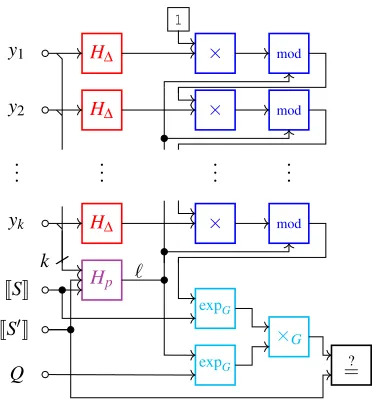
computes`=Hp(y1, . . . ,yk)(purple box, bottom left), com-putes∏iH∆(yi)mod`(red and blue boxes, top), computes the LHS of the verification equation (cyan boxes, bottom right), and checks that equation (black box, bottom right).H∆ is a division-intractable hash function (§4.2),Hpis a hash to a prime (§4.1), andGis an RSA quotient group (§2).
elements{xi}is similar, except thatS{xi}is regarded as the initial multiset andSthe final one.6
To instantiate this interactive protocol in constraints, we apply the Fiat-Shamir heuristic [55], i.e.,
C
computes the challenge ` by hashing all of the inputs to the protocol.7Figure1illustrates the insertion proof’s verification procedure.
MultiSwaprequires two proofs (one for insertion and one for removal); for this purpose, we hash all inputs to both proofs to derive a common challenge, as is standard [50].
In the rest of this section we explain how to efficiently implement the blocks of Figure1in constraints. In particular, we explain how to implementHp, the prime hash function used to compute`(§4.1) andH∆, the division-intractable hash function used to hash each element (§4.2). We also describe optimizations for multiprecision operations (§4.3). Finally, we discuss
P
’s cost for generating the witness input Z toC
(§2.2), notably, the digestsS] {yi}andS{xi}and the corresponding witnessesQfor insertion and removal (§4.4).6Proofs of non-membership (§2.1) use similar primitives; we do not
discuss them in detail because they are not necessary forMultiSwap.
7This requires that we model the concrete hash function that outputs`as
4.1
Hashing to primes
The hash functionHp(Fig.1) generates the challenge`used in the Wesolowski proofs of batch insertion and removal. These proofs are sound when
P
has negligible probability of guessing the factors of`before evaluatingHp[120]. In the non-interactive setting, one way to ensure this is by choosing` at random from the first 22λprimes (Fn.1, §2). In our context, however, a more efficient approach is forHpto output slightly larger primes that are guaranteed by construction to have 2λbits of entropy.8Soundness is identical.
In standard settings (i.e., outside of constraints), a typical approach (§8) for hashing to a random prime is rejection sampling. Here, the input is fed to a collision-resistant hash whose output seeds a pseudorandom generator (PRG), then the PRG’s outputs are tested in sequence until a prime is found. Verifying correct execution requires, at the very least, testing primality of the purported output. This is typically done with a probabilistic primality test like Miller-Rabin [98]. Such tests, however, generally require many iterations for soundness, where each iteration involves an exponentiation modulo the prime being tested. This would be far too costly if implemented directly in constraints.
Instead, we take advantage of advice from
P
(§2.2). At a high level,P
helps to recursively construct a Pocklington cer-tificate (§2) forHp’s output, where each intermediate prime piis the result of hashingHp’s input. (This is related to prior approaches; see §8.) This strategy is economical when imple-mented in constraints, because it uses very little pseudoran-domness and requires onlyoneexponentiation modulo the resulting prime, plus a few smaller exponentiations.We now describe the recursive step used to construct pi frompi−1. Further below, we describe the base case and give implementation details. Recall (§2) that a Pocklington witness forpicomprises(pi−1,ri,ai)such thatpi=pi−1·ri+1. (Ifpi is prime, someaimust exist.) Notice that, givenpi−1, one can findpiby testing candidaterivalues untilpi−1·ri+1 is prime. To implement this in constraints, we letri=2bni·hi+ni, where ni is a bni-bit number provided by
P
as advice andhiis abhi-bit pseudorandom number (we discuss its
genera-tion below).
P
furnishes a correspondingaiandC
includes constraints that computepiandri, and check the witness.The base case isp0=2bn0·h0+n0, forh0a pseudorandom
number andn0 supplied by
P
. We fixbn0+bh0 = 32, i.e.,p0<232, and the constraints test primality ofp0using a de-terministic 3-round Miller-Rabin test that works for all values up to 232[73]. This test requires 3 exponentiations modulo p0with exponents less than 32 bits; these are inexpensive.
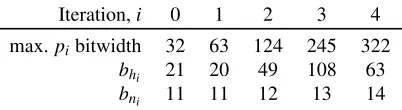
We choose bit widthsbni such that a validniexists with overwhelming probability, then choosebhi subject to the
con-straint thatbhi+bni <logpi−1, which ensures thatri<pi−1
as required (§2). The entropy of each pi is∑ij=0bhj; four
8In this section, we use entropy to mean (the negative logarithm of)P’s
probability of guessing the correct value, i.e., the guessing entropy.
Iteration,i 0 1 2 3 4
max.pibitwidth 32 63 124 245 322 bhi 21 20 49 108 63
bni 11 11 12 13 14
Figure 2: Bitwidths for recursive primality proofs in our sys-tem. While the bhi sum to 261, there are only 256 bits of
entropy because eachhihas its high bit fixed to 1 (§4.1).
rounds suffice for 256 bits of entropy using the parameters listed in Figure2.
C
generateshiby hashing the input toHp with a hash functionHmodeled as a random oracle.Each iteration yields a prime approximately twice as wide as the prior iteration’s; meanwhile, the cost of each iteration is dominated by an exponentiation. This means that our ap-proach has cost less that that of two exponentiations modulo the final prime. In contrast, using Miller-Rabin to check a 264-bit prime (which has roughly 256 bits of entropy) would require 80 exponentiations modulo that prime to give≈2−80 probability of outputting a composite (because Miller-Rabin is a probabilistic primality test). Our approach thus saves more than an order of magnitude and provably outputs a prime.
One final optimization is to force the most significant bit of eachhito 1; this establishes a lower bound on eachpiand on `(which is the finalpi). As we discuss in Section4.3, having this lower bound reduces the cost of modular reductions. The tradeoff is a small loss in entropy, namely, 1 bit per iteration. Even so, four rounds suffice to produce a 322-bit prime9with
256 bits of entropy.
4.2
Division-intractable hashing
Coron and Naccache show [48] that a hash functionHthat outputs sufficiently large integers is division intractable when modeled as a random oracle. Informally, this is because in any randomly-selected set of large (say, 2000 bit) numbers, each element has adistinct, moderately sized (say, 200 bit) prime factor with high probability.
Security of this hash function rests on the fact that the density of integers in the interval[0,α)with factors all less
thanµapproachesβ−β+o(1)asα→∞, whereβ=logαlogµ. We
conjecture that this density also holds for a large interval aroundα, namely,α,α+α1/8. (This is closely related to a
conjecture on which the elliptic curve factorization method relies; there, the interval isα−√α,α+√α[71].)
Our hash function is defined as follows: let∆be a pub-lic 2048-bit integer chosen at random, and letH be a hash function with codomain0,2256with 128-bit collision resis-tance. ThenH∆(x) =H(x) +∆. Security of this construction follows from the analysis of [48] in the random oracle model,
9Even though the prime`comprises only 322 bits,Crepresents it with
assuming the conjecture stated above. Concretely, we conjec-ture that an adversary makingqqueries toH∆has probability roughlyq·2−128of breaking division intractability.
H∆’s advantage over prior work is that its implementation in constraints is much smaller. The system parameter∆is baked into the constraints, and the only dynamic values to compute are the base hashH(x)and the sumH(x) +∆; using known techniques [79], this sum is inexpensive. Moreover, since all hashes must be reduced modulo the challenge` (Eq. (7)) andH∆(x)mod`= (H(x) + (∆mod`))mod`, the (costly) reduction∆mod`can be checked once in the constraints
and the result can be re-used for eachH∆(x). We note that while this approach gives smaller
C
than hashing to primes (becauseH∆and modular reductions are cheaper), it increasesP
’s work (becauseH∆’s bit length is longer; §4.4).4.3
Multiprecision arithmetic optimizations
We describe two optimizations for multiprecision arithmetic in constraints, building on ideas described in Section2.2.
Computing greatest common divisor. We observe that ad-dition and multiplication checks can be leveraged to verify a statement gcd(x,y) =dby checking three equations overZ:
∃a,b a·x+b·y=d (8)
∃x0 x0·d=x
∃y0 y0·d=y
In constraints, the existential variables above correspond to advice provided by
P
. Verifying coprimality (gcd(x,y) =1) reduces to condition (8), i.e., materializing the multiplicative inverse ofxmoduloy. We use this simplification in Section4.1 to verify a Pocklington witness (§2).Optimizing division and modular reduction. Prior work implements division and modular reduction for a dividendx and divisordby having the prover provide, as advice, the quo-tientqand remainderr<dsuch thatx=q·d+r; this equality is then checked with multiprecision arithmetic (§2.2). For cor-rectness,
C
must enforce upper bounds on the bit widths of qandrvia bit splitting (§2.2), which requires as many con-straints as the sum of the bit widths ofqandr.Sincercan range from 0 tod−1, its width is just that of d. The width ofq, however, is slightly more subtle. Since q’s value isbx/dc, a conservative choice is to assumeqis as wide asx. But this choice is imprecise:q is only as wide asdlog2(bxmax/dminc)e, wherexmaxdenotesx’s maximum
pos-sible value, anddmin denotesd’s minimum possible value. (Intuitively, this is becauseqis small whendis large.)
As in prior work [79], our system uses a dataflow analysis to track the maximum value of each number, in order to de-termine the required representation size. To boundq’s width more tightly using the above expression, we augment this dataflow analysis to also trackminimumvalues.
4.4
Optimizing the cost of advice generation
The prior sections have treated
P
as an advice oracle. We now discussP
’s cost in computing this advice. Prior work [116, 121] shows thatP
’s (single-threaded) cost per constraint is ≈100µsor more (this includes, e.g., an elliptic curve point multiplication per constraint [16,64,70,96]). Computing most advice values—including for multiprecision operations and prime hashing—is negligible by comparison. Possible exceptions are the witnesses for Wesolowski proofs (§2) used by batch insertion and removal operations (§2.1). (Recall that one of each operation is required for aMultiSwap; §3.)The witness for a batch insertionJS] {yi}K=JSK
∏iH∆(yi)is
the valueJSK
b(∏iH∆(yi))/`c. This exponent has length≈2048·k
bits forkelements inserted. In microbenchmarks, GMP [66] computes a 2048-bit exponentiation modulo a 2048-bitN in≈2.5 milliseconds (i.e., roughly 25×
P
’s per-constraint proving cost), so computing this value costs roughly the same as 25·kconstraints, which is inconsequential (§5, Fig.3).Batch removal is much more expensive. To prove that re-moving the elements{xi}from the multisetSyields a new multisetS0,
P
must prove thatJSK=JS0
K
∏iH∆(xi), where
q
S0y=JS{xi}K=g
∏s∈S{xi}H∆(s) (9)
No known method for computingJS
0
Kis faster than directly
evaluating this expression because the order ofGis unknown
(recall that this computation is inG=Z×N/{±1}whereNhas unknown factorization; §2). Meanwhile, this exponent has bit length≈2048·M, forMthetotal sizeof the multisetS0, i.e., it costs roughly the same as 25·Mconstraints. (As discussed in the prior paragraph, givenJS0Kit is inexpensive to compute the witness for batch removal, namely,JS0Kb(∏iH∆(xi))/`c).
Even for large accumulators, this cost may be reasonable: as we show in Section7,MultiSwapcan easily save tens of millions of constraints compared to Merkle trees. On the other hand, proof generation can be parallelized [121], whereas at first glance the exponentiation in (9) appears to be strictly serial [22,101]. We observe, however, that sincegis fixed, a pre-computation phase can be used to sidestep this issue [33]. Specifically, for some upper bound 2mon the maximum size of the accumulator, the above exponent is at most 22048·2m, so pre-computing the valuesgi=g2
i·2m
, 0≤i<2048 (via successive squaring) turns the above exponentiation into a 2048-way multi-exponentiation [91] (which can be computed in parallel): for eachgi, the exponent is a 2m-bit chunk of the value∏s∈S{xi}H∆(s). Further parallelism is possible simply by computing moregiwith closer spacing.
rea-sonable, and reduces the cost of computing the exponentiation in (9) to roughly the equivalent of 1.25·Mconstraints.
The above pre-computation is a serial process that requires ≈2048·2m squarings inG. Assuming that 2048 squarings
takes≈2.5 milliseconds (i.e., the same amount of time as a general 2048-bit exponentiation; this is pessimistic), this precomputation takes≈2m·2.5 milliseconds. Form=20, this is≈45 minutes; form=25, it is≈1 day. Note, however, that this pre-computation is entirely untrusted, so it can be done once by anyone and reused indefinitely for the sameg.
Finally, the above precomputation requires materializing
∏s∈S{xi}H∆(s), which is 231bits whenM=220. This prod-uct can be expressed as a highly parallel computation; the final step is a multiplication of two, 230-bit values, which can itself be parallelized via a Karatsuba-like approach.
We evaluate
P
’s witness generation costs in Section7.1.5
Applications of
MultiSwap
In this section we discuss two applications ofMultiSwap
and compare constraint costs for these applications when implemented using Merkle swaps andMultiSwaps.
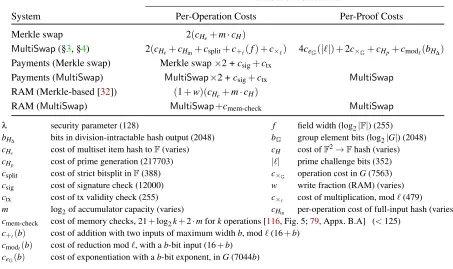
MultiSwapCosts. The first two rows of Figure3model the costs of Merkle swaps and swaps computed viaMultiSwap.
A Merkle swap requires hashing the old and new values and Merkle path verifications for each (§2.1), so the number of hash invocations is logarithmic in the number of leaves.
For a MultiSwap, each swap requires a H∆ invoca-tion (§4.2), which comprises an invocation of the underlying hashHand multiprecision arithmetic to compute the result and multiply it mod`(§4, Fig.1). In addition, each swap is an input toHp, which requires another hash invocation. All of these costs are independent of the number of elements in the accumulator.MultiSwapalso costs a large constant over-head, however; this is to generate` (§4.1) and check two Wesolowski proofs via modular exponentiations (§2, §4).
5.1
Verifiable outsourcing for smart contracts
Blockchain systems [26] like Ethereum [53] enablesmart contracts: computations defined by a blockchain’s users and executed as part of the block validation procedure. One appli-cation of smart contracts is implementing a form of verifiable state update (§1): for global stateΓ(stored on the blockchain)
and a transactionγ(submitted by a user), the computation
(1) checks thatγis valid according to some predicate, and if
so (2) updates the global state to a new valueΓ0.
Consider, for example, a distributed payment system where
Γcomprises a list of users and their public keys and balances.
Transactions let users send payments to one another. When Alice wishes to send a payment, she constructs a transaction
γthat includes (1) the target user; (2) the amount to send; and
(3) a digital signature over the prior two items; she submits this to the smart contract, which verifies it and updatesΓ.
A major practical limitation of this approach is that com-putation, storage, and network traffic are extremely expensive for smart contracts.10One solution to this issue,Rollup[7,65, 94], is an instance of verifiable computation (§2.2): the smart contract delegates the work of checking transactions to an untrustedaggregator, and then checks a proof that this work was done correctly.11To effect this, users submit transactions γito the aggregator rather than directly to the smart contract. The aggregator assembles these transactions into a batch{γi}, then generates a proofπcertifying the correct execution of a
computationΨthat verifies the batch and updates the global
state fromΓtoΓ0. Finally, the aggregator submitsπandΓ0
to the smart contract, which verifies the proof and stores the updated state. Checking this proof is substantially cheaper for the smart contract than verifying each transaction individually, and the exorbitant cost of smart contract execution justifies the aggregator’s cost in generating the proof [115].
In more detail, the constraints
C
corresponding toΨ(§2.2) take the current stateΓas the inputX and the updated stateΓ0as the outputY.
P
(i.e., the aggregator) supplies the batch {γi}as part of the witness (i.e., the advice vectorZ), meaning that the smart contract can verify the proof without reading {γi}. This saves both computation and network traffic.Notably, though, even readingΓandΓ0is too expensive for the smart contract, as is storingΓon the blockchain. (Recall that verifying a proof requires work proportional to the size of the inputs and outputs; §2.2.) The original Rollup design [7] addresses this by storingΓin a Merkle tree (§2.1). The inputs
and outputs of
C
are just Merkle roots, and only this root is stored on the blockchain. Each leaf of this tree contains a tuple(pk,bal,#tx)comprising a user’s public key, their bal-ance, and a transaction count (which prevents replaying past transactions). The constraints that verify a transaction inC
thus require two Merkle tree updates, one each for payer and payee. (Each update comprises two Merkle paths; §2.1).We observe that a singleMultiSwap(§3) can replace all of the Merkle tree updates for a batch of transactions. In particu-lar,MultiSwap’s semantics guarantee sequential consistency of the transactions with respect toΓandΓ0. And whereas the per-swap cost of Merkle swaps increase logarithmically with the number of accounts stored inΓ, the per-swap cost ofMultiSwapis essentially independent of the number of users. This means that for large batches of transactions and/or large numbers of users, aMultiSwap-based Rollup requires far fewer constraints than a Merkle-based one.
Costs. The middle two rows of Figure3show costs for Rollup using Merkle andMultiSwap. Both cases pay to
ver-10Anecdotally, recent Ethereum prices [54] result in storage costs of more
than $1 per kilobyte. Similarly, per-transaction costs are frequently in the $0.25 to $1 range even when executing minimal computation.
11Rollup is distinct fromOptimistic Rollup[58], which does not use
Number of constraints
System Per-Operation Costs Per-Proof Costs
Merkle swap 2(cHe+m·cH)
MultiSwap(§3, §4) 2(cHe+cHin+csplit+c+`(f) +c×`) 4ceG(|`|) +2c×G+cHp+cmod`(bH∆)
Payments (Merkle swap) Merkle swap×2 +csig+ctx
Payments (MultiSwap) MultiSwap×2 +csig+ctx MultiSwap
RAM (Merkle-based [32]) (1+w)(cHe+m·cH)
RAM (MultiSwap) MultiSwap+cmem-check MultiSwap
λ security parameter (128) f field width (log2|F|) (255)
bH∆ bits in division-intractable hash output (2048) bG group element bits (log2|G|) (2048) cHe cost of multiset item hash toF(varies) cH cost ofF
2→
Fhash (varies)
cHp cost of prime generation (217703) |`| prime challenge bits (352)
csplit cost of strict bitsplit inF(388) c×G operation cost inG(7563)
csig cost of signature check (12000) w write fraction (RAM) (varies)
ctx cost of tx validity check (255) c×` cost of multiplication, mod`(479)
m log2of accumulator capacity (varies) cHin per-operation cost of full-input hash (varies)
cmem-check cost of memory checks, 21+log2k+2·mforkoperations [116, Fig. 5;79, Appx. B.A] (<125) c+`(b) cost of addition with two inputs of maximum widthb, mod`(16+b)
cmod`(b) cost of reduction mod`, with ab-bit input (16+b)
ceG(b) cost of exponentiation with ab-bit exponent, inG(7044b)
Figure 3: Constraint count models for Merkle swaps (§2.1),MultiSwap(§3, §4), Payments (§5.1), and Persistent RAM (§5.2). The approximate value of each parameter in our implementation (§6, §7) is given in parentheses. See Section5for discussion.
ify the payer’s signature and ensure that the payer’s balance is sufficient. The difference is in the swap costs, which are dis-cussed above (§5); Rollup requires two swaps per transaction, one each to update the payer’s and payee’s accounts.
5.2
Efficient persistent RAM
Recall from Section2.2that Pantry-style RAM, while expen-sive, offers unique functionality: the ability to pass the full state of RAM from one proof to another. This enables compu-tations over persistent state [32], recursively verifiable state machine execution [15,89], and other useful applications.
Unfortunately, the high cost (in constraints) of hash func-tions (§6) limits the number of Pantry-style RAM opera-tions that can be used in a computation—especially for large RAMs [32,79,116]. In this section, we show how to use the batched RSA accumulator construction of Section4to address this issue. Our design yields a persistent RAM abstraction whose per-access constraint cost is lower than Pantry’s even at modest RAM sizes, and is nearly insensitive to RAM size.
To begin, notice that Pantry’s RAM abstraction essentially stores memory values in a fixed-size Merkle tree, executing a membership proof for each LOAD and a swap for each STORE. Moreover, since our goal is efficiency, our design will ideally check all memory operations using a small number of batched accumulator operations (§4).
This seems to suggest the following (incorrect) approach.
First, replace the Merkle tree with an RSA accumulator, representing memory locations ashaddr,dataituples. Then, verify all LOAD and STORE operations in a batch using
MultiSwap (§3) as follows. For eachLOAD from address
δ,
P
supplies as advice the valueνpurportedly stored atδ,and the constraints encode a swap that replaces the tuplehδ,νi
with itself. For eachSTOREof the valueν0to addressδ,
P
supplies as advice the valueνpurportedly being overwritten, and the constraints encode the swap(hδ,νi,hδ,ν0i).The reason this approach is incorrect is that it does not en-force the consistency ofLOADoperations with program exe-cution. In particular, recall (§3) thatMultiSwap(S,σ,S0)only guarantees thatS0is produced by a sequentially-consistent cycle-free subsequence σ0 ⊆σ. Since LOAD operations
are self-cycles, they are not included in σ0. This use of MultiSwap thus only guarantees that σ correctly encodes STOREoperations—LOADs can returnanyvalue.
We might attempt to fix this issue by checkingLOAD oper-ations using membership proofs. But this is inefficient: check-ing such a proof requires the constraints to materialize an accumulator that contains the value being loaded; meanwhile, theLOADmight correspond to a priorSTORE, in which case the accumulator against which the proof must be checked would first have to be computed. In other words, this strategy makes batching accumulator operations impossible.
the correctness ofLOADandSTORE operations using an address-ordered transcript (§2.2) while ensuring that this tran-script is consistent with the initial and final state of RAM us-ing batched accumulator operations. As above, each memory location is stored in the accumulator as anhaddr,dataituple. As in BCGT-style RAM, the constraints build an execution-ordered transcript,
P
supplies an address-ordered transcriptT
, and the constraints ensure thatT
is correctly ordered, co-herent, and a permutation of the execution-ordered transcript. For the initial state of RAM, the constraints enforce consis-tency by ensuring that the first time an addressδis accessedin
T
, the tuplehδ,νiis removed from the accumulator. If thefirst access is aLOAD,νis the correspondingDATAvalue
from
T
. Otherwise,P
supplies as advice a claimedνvaluesuch thathδ,νiis in the accumulator. (For now, we assume
that memory locationδhassomecorresponding tuple in the
accumulator; we discuss uninitialized memory below.) Ob-serve that this ensures consistency, because a removal is only possible ifhδ,νiis indeed in the accumulator.
For the final state of RAM, the constraints enforce consis-tency by ensuring that the last time an addressδis accessed in
T
, the tuplehδ,ν0iis inserted into the accumulator. The valueν0is the correspondingDATAvalue fromT
. Together with the above, this ensures that all of the accesses to addressδcollectively result in the swap(hδ,νi,hδ,ν0i).
Constraints for the above checks work as follows. First, for entryiin
T
, the constraints computehi,del=H∆(hADDRi,νi)andhi,ins=H∆(hADDRi,ν0i)(§4.2). Then, for each
sequen-tial pair of entriesi,i+1 in
T
, ifADDRi6=ADDRi+1, then entryimust be the last access toADDRiand entryi+1 must be the first access toADDRi+1. Finally, the constraints com-pute∏i∈Fhi,delmod`and∏i∈Lhi,insmod`(§4), the values inserted into and removed from the accumulator, respectively, forF
the first-accessor set andL
the last-accessor set.Handling uninitialized memory. A remaining issue is how to handle the case where memory is uninitialized. Re-call that in the BCGT approach, aLOADnot preceded by a STOREto the same address is serviced with a default value, say, 0. That does not work here, because this approach re-lies crucially on swapping old values for new ones, to ensure consistency with both the initial and final accumulators.
A straightforward solution is to ensure that every mem-ory location is initialized, by executing a setup phase that constructs an accumulator containing the tuplehδ,0ifor
ev-ery addressδ. The cost of constructing this accumulator is
high when the address space is large, since it amounts to one exponentiation per entry in RAM. Note, however, that this computation can be parallelized using the pre-computed val-ues described in Section4.4, and admits the same time-space tradeoff described in that section.12
12An alternative solution is to implement, in essence, a shadow
mem-ory [92] indicating which addresses are valid. This is effected by storing a canary valuevalid[δ]in the accumulator for each addressδfor which some tuplehδ,·iexists. IfΨattempts toLOADorSTOREfrom a memory location
Costs. The constraint costs of memory accesses are shown in the bottom two rows of Figure3. The Merkle-based RAM requires two proofs of membership for eachSTORE, but only only one for eachLOAD[32], so it is slightly cheaper than a Merkle swap—but logarithmic in RAM size.
The RSA accumulator–based RAM uses oneMultiSwap
for all LOADs and STOREs, with attendant per-operation costs (which are independent of RAM size; §5). It also incurs extra per-operation costs to check
T
as described above; these are logarithmic in the number of accesses but concretely very inexpensive (§2.2, [116, Fig. 5;79, Appx. B-A]).6
Implementation
We implement a library comprising multiprecision arith-metic, Pocklington prime certification, RSA accumulators, and Merkle trees. This library extendsBellman[9], a library for building constraint systems and generating proofs using the pairing-based argument due to Groth [70]. Based on this library, we implement two end-to-end applications: one that verifies a sequence of swaps, and one that verifies a batch of transactions for a distributed payment system (§5.1).
We also implement or adapt four hash functions: MiMC [1], which costs 731 constraints (91 rounds of thex7permutation); Poseidon [69], which costs 316 constraints; Pedersen [72,97], which costs 2753 constraints (based on the JubJub elliptic curve [28]), and SHA-256 [57], which costs 45567 constraints. We adapt the latter three hashes from Sapling [104].13
Finally, we implement custom Bellman constraint synthe-sizers (ConstraintSystems, in the jargon of Bellman) that allow us to quickly measure a constraint system’s size and
P
’s cost computing a corresponding witness.We use a 2048-bit RSA quotient group (§2) modulo the RSA-2048 challenge number [76,102], and choose a random 2048-bit∆to define the division-intractable hash function H∆(§4.2); we give concrete values in AppendixB. We syn-thesize all constraints over the BLS12-381 [27] curve.
In total, our implementation comprises≈11,300 lines of Rust. We have released it under an open-source license [10].
7
Evaluation
We evaluate ourMultiSwapimplementation, comparing it to Merkle trees by answering the following questions:
δfor which no value exists,Psupplies a proof of non-membership (§2.1) forvalid[δ], plus a default value. This obviates the setup phase, but requires additional constraints to (1) computeH∆(valid[ADDRi])for each entry inT,
(2) check a batched non-membership proof, (3) check a batched insertion of valid[·]values (which can be combined with the swap check), and (4) enforce correctness of the default value. Further exploration is future work.
13The costs of MiMC, Poseidon, and JubJub depend on the underlying
(1) How does the cost of aMultiSwapcompare to the cost of Merkle swaps for a batch of swaps? In particular, what is thebreak-even point(i.e., the number of operations beyond whichMultiSwapis cheaper), and how do costs compare for a fixed (large) constraint budget?
(2) What is the effect of hash function cost on the tradeoff between RSA accumulators and Merkle trees?
We answer the first question by synthesizing constraint systems for bothMultiSwapand Merkle swaps, at varying set and batch sizes (§7.1). We also synthesize constraints for the Rollup application (§7.2) and compare the persistent RAM application using a cost model (§7.3). Our cost metric is number of constraints; to validate this metric, we measure end-to-end times forMultiSwapand Merkle swaps (§7.1).
For the second question, we evaluate the break-even point forMultiSwapversus the cost of the underlying hash function, for four different hash functions (§7.1).
In sum, we find thatMultiSwapbreaks even for batch sizes of at most several thousand operations; for large sets, this value is several hundred. We also find thatMultiSwap’s ad-vantage is greater when hashing is more expensive.
Baseline. Our baselines are constraint systems (§2.2) that use Merkle trees (§2.1) to store state. For each baseline, we fix capacity to beM=2m, for a range ofmvalues. In all experiments except persistent RAM, the basic Merkle tree operation is a swap (§5, Fig.3). Merkle-based RAMs use a mix of membership proofs and swaps (§2.1, §2.2); we discuss further in Section7.3.
Setup. Except in the hash cost experiment (§7.1), both Merkle andMultiSwapfix the hash functionH(§4.1, §4.2) as our Poseidon [69] implementation (§6). As we show in Section7.1, this is the most favorable choice for the Merkle baseline, because Poseidon is inexpensive in constraints.
For execution time (§7.1), our testbed has two Intel Xeon E5-2687Wv4 CPUs (12 physical cores per socket, 48 threads total) and 128 GiB of RAM, and runs Ubuntu 18.04. We com-pile with Rust 1.41-nightly (c9290dcee 2020-02-04) [103].
Method. Our primary cost metric is number of constraints, which we measure with a custom Bellman synthesizer (§6). We use this metric because
P
’s costs (both time and space) are dominated by constraint count in the back-ends we tar-get (§2.2).V
’s costs are small and essentially constant.To validate this metric, in Section7.1we measure
P
’s andV
’s time forMultiSwapand Merkle swaps, for 220-element sets. Limitations of the underlying Bellman and Sapling li-braries (§6) cause ourMultiSwapand Merkle implementa-tions to unnecessarily resynthesize all constraints when gen-erating proofs. To sidestep this, for each experiment we mea-sure total proving time (synthesis, witness computation, and proof generation), separately measure just synthesis time, and report the difference. Fixing this issue (by rewriting Bell-man/Sapling) is future work.Figure 4: Constraint count v. number of swaps (§7.1). “Merkle m” denotes a Merkle tree with 2mleaves.
Accumulator Swaps
Merkle 5 263 713 Merkle 10 143 843 Merkle 15 98 892 Merkle 20 75 346 RSA 250 201
(a) Swaps (§7.1).
Accumulator Transactions
Merkle 5 48 463 Merkle 10 37 100 Merkle 15 30 053 Merkle 20 25 256
RSA 47 203
(b) Payments (§7.2).
Figure 5: Number of operations verifiable in 109constraints (higher is better).
7.1
MultiSwap
versus Merkle swaps
Benchmark. This experiment compares the costs of
MultiSwapand Merkle trees for a computation comprising only swaps, varying the number of swaps and set size.
Constraint costs. Figure4shows the results. The cost of Merkle trees varies with set size, because the number of hash invocations depends on this value (§2.1; §5, Fig.3). In con-trast, the constraint cost ofMultiSwapis independent of the number of elements in the set; for moderately sized sets (≈210 elements), the per-swap cost is less than for Merkle trees.
On the other hand, MultiSwap pays a large overhead (≈11 million constraints) to evaluate Hp and verify two Wesolowski proofs (§4; §5, Fig.3). Thus,MultiSwaprequires some minimum batch size before it breaks even. For small sets (say, 25elements) there is no break-even point; for sets with 210or more elements, the break-even point is at most a few thousand swaps, and decreases with set size.
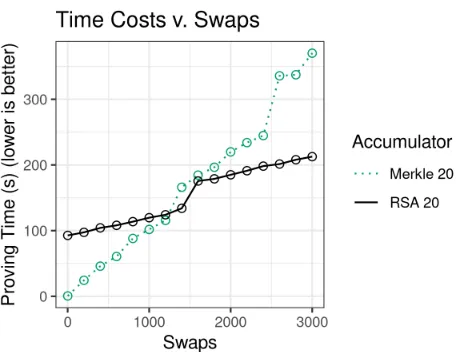
Figure 6: Witness computation plus proof generation time v. number of swaps, for accumulators with 220elements (§7.1).
Figure 7: Constraint count v. number of swaps, varying hash function (§7.1). Merkle trees are all of depth 20.
Proving and verifying time. Figure6shows proving times (witness computation plus proof generation) forMultiSwap
and Merkle with sets having 220elements, for varying batch sizes. Verification costs≈7 ms in all cases.MultiSwaphas longer proving times for small batches but shorter times for large batches, and the break-even point between 1200 and 1600 swaps. This is slightly larger than in Figure4because of the added cost of computing the new accumulator digest (§4.4).
For an accumulator with 220elements, computing a new di-gest after batch removal takes≈43 seconds and uses≈4 GiB of RAM via the preprocessing approach described in Sec-tion4.4. For smaller accumulators this cost is correspondingly smaller. Larger accumulators have slower witness generation, which affects break-even batch size; we discuss in Section9.
Effect of hash cost. Figure7shows the effect of hash cost on MultiSwap’s break-even point for sets of 220 elements
Figure 8: Constraint count v. number of transactions (§7.2). “Merklem” denotes a Merkle tree with 2mleaves.
(other set sizes are analogous; note that the axes are loga-rithmic). We measure MiMC, Poseidon, Pedersen/Jubjub,14 and SHA-256 (§6). As expected, in all cases Merkle trees are cheaper for small numbers of operations. For the least expensive hash (Poseidon),MultiSwap’s break-even point is the highest; as hash cost increases, so doesMultiSwap’s advantage. (We report results in all other experiments with Poseidon, which is the worst case forMultiSwap.)
7.2
Application: payment system
Benchmark. This experiment compares the costs of
MultiSwapand Merkle trees for the Rollup application de-scribed in Section5.1. We measure cost versus the number oftransactions(a signature verification, a validity check, and two swaps). Signatures use the scheme from ZCash [72].
Results. Figure8shows the results. In contrast with the previous experiment, here all accumulator types pay a fixed overhead per transaction (this is dominated by signature veri-fication), which reducesMultiSwap’s per-transaction advan-tage. In this application, set size corresponds to the number of accounts. As in Section7.1,MultiSwapdoes not break even for the smallest set size. The break-even point for 210 accounts is≈2000 transactions, and≈600 for 220accounts.
Figure5bshows the number of transactions that fit in 109 constraints, for different accumulators.MultiSwap’s advan-tage is as large as≈1.9×, depending on set size.
14Our design (§4) models the underlying hash function as a random oracle.
Figure 9: Constraint count v. number of accesses (§7.3). “Merklem” denotes a Merkle tree with 2mleaves. Ribbons indicate variation according to write load, from 0 to 100%.
7.3
Application: persistent RAM
Benchmark. This experiment compares the costs of
MultiSwap-based and Pantry’s [32] Merkle-based persistent RAM5.2. We compare using the cost model of Figure3(§5), which is derived from prior work [79,116]; future work is to port Buffet’s RAM compiler to Bellman and synthesize. We report cost versus RAM size.
Results. Figure 9 shows the results. For Merkle-based RAM, bands in the figure represent varying write loads, from 0 (lowest cost) to 100% (highest cost). As in prior experi-ments,MultiSwap’s cheaper per-operation cost yields a break-even point of several thousand operations for a large RAM. This model includes the cost of memory consistency checks (§2.2, §5.2, Fig.3); these cost fewer than 100 constraints per operation and are thus negligible.
8
Related work
Verifiable computation. The literature on verifiable com-putation is both broad and deep; a somewhat recent sur-vey [119] gives a thorough treatment of the area’s beginnings. Our work builds most directly on xJsnark’s [79] multipreci-sion arithmetic and on the RAM primitives first described by Ben-Sasson et al. [12] and further refined by Ben-Sasson et al. [13,16], in Buffet [116], and in xJsnark. Buffet and xJsnark both extend lines of work concerned with efficiently compiling high-level programs to constraints, including Pep-per [107], Ginger [108], Pinocchio [96], and Pantry [32].
Several other works in this area deal with persistent state. Pantry [32] was the first to use Merkle trees for stateful compu-tations, and its persistent RAM primitive inspired ours (§5.2). vSQL [123] builds a verifiable subset of SQL, building on
the interactive proofs of Goldwasser et al. [67], Cormode et al. [47], and Thaler [111], and on the polynomial commit-ments of Papamanthou et al. [95], which build on the work of Kate et al. [77]. In contrast to the persistent RAM and multiset abstractions we develop, vSQL exposes a database abstraction; queries operate on all rows in parallel.
ADSNARK [4] extends the Pinocchio [96] SNARK to sup-port operations on authenticated data provided by a third party. Geppetto [49] also extends Pinocchio, allowing the verifier to commit to inputs for a specific computation and later verify a proof against that commitment, and also enabling data transfer between separate constraint systems bundled into one proof. Fiore et al. [56] take Geppetto’s commitments to inputs a step further, making them computation independent. In contrast to a multiset or persistent RAM abstraction, however, all of these systems require a number of constraints sufficient to readeveryinput value—in other words, a multiset of sizeM implies at leastMconstraints. Further, they do not efficiently support programs whose multiset or RAM accesses depend on inputs and thus cannot be statically analyzed (§2.2).
Spice [105] aims to enable zero-knowledge auditing of concurrent services. Spice’s amortized cost per state operation is≈2×lower than ours for large batches, but its approach differs from ours in two key ways. First, Spice’s core state verification primitive requires a number of constraints linear in thetotal sizeof the state; this cost is amortized over a batch ofrequests, each containing one or more state operations. In contrast,MultiSwapoperations (§3) have constraint costs that depend only on the number of stateupdates, not on total state size. Second, verification costs in Spice scale with the number of requests in a batch; in our work, verification cost is independent of batch size. Piperine [80] optimizes Spice’s state verification primitive and saves verification work by combining all requests from a batch into one proof; this yields verification cost independent of batch size.
Accumulators. Cryptographic accumulators [17] based on RSA have a long history [5,40,81,84]. The recent work of Boneh et al. [24] builds upon work by Wesolowski [120] to constructbatchedmembership and non-membership proofs for these accumulators. Our work builds directly on this line.
Merkle-based accumulators have also seen extensive study [38,90], and related structures have seen applications, e.g., in the blockchain [99] and PKI contexts [100]. These works all rely crucially on collision-resistant hashing, which is expensive when expressed as constraints (§6, §7).
Two other lines of work build accumulators [39,42,51,93] and vector commitments [41,82,83] from bilinear maps. El-liptic curve operations and pairings appear to be very expen-sive when compiled to constraints [15], but these lines may nevertheless be an interesting direction for further study.