Available Online atwww.ijcsmc.com
International Journal of Computer Science and Mobile Computing
A Monthly Journal of Computer Science and Information Technology
ISSN 2320–088X
IMPACT FACTOR: 6.017
IJCSMC, Vol. 7, Issue. 7, July 2018, pg.1 – 10
Secured Universal Remote Control
System for Home Electrical
Appliances Using Point-n-Press
GURUPRASAD HEGDE
M.Tech – Scholar, Department of CSE, R.V. College of Engineering, Bangalore, Karnataka, India
Abstract: With different related contraptions and machines, the robotization of Home Electrical Appliances is one of the prospering area of Internet of Things (IoT). As the multifaceted idea of contraptions/machines increase, different gets (from time to time modest bunches) are moved toward the remote controller in electrical spaces paying little respect to whether a couple of them are once in a while used. A customer may be confused for the controller paying little heed to whether he or she just plans to play out a fundamental undertaking. This confusion moreover prompts a higher probability of mal-exercises. In addition, home electrical gadgets/appliances for correspondence between remote controllers and related contraptions, for instance, extensible Markup Language (XML) messages, are ordinarily exchange speed damaging. This as well as the security is one of the principle issue with XML information exchange. To address these issues, a computerization of comprehensive safely point based control structure for electrical devices named Secured based Point-n-Press is derived. Directionality feature is very critical feature in Point-n-Press, which empowers essential and regular control by showing the objective gadget to exhibit the objective's user action interface of the mobile application as remote controller. By building up the state information of electrical gadget undertakings, this is the valuable information to perform the future action on the gadgets. Two veritable models are completed to affirm the credibility of the proposed contrive. The first one is basic pont-n-press without any security where directionality feature is included and Face recognizes advances the security related issues, this is the enhancement to basic point-n-press.
Introduction
:This work introduces a keen general point based control framework for electrical machines using advance
security option like face recognition for user and for admin it would be simple password based authentication. A
propelled universal remote controller can be easily achieved using android phone which has with or without IR
is called as PPRC (Pont-n-Press Remote Controller), Alternative approach is Something unique, some IR across the
board serial transport (USB) dongles that can give reinforce for Android errand structure are can be used[1], but in
this option we cannot achieve the security criteria. Like this manner, we can use many open source based
frameworks can be used to achieve this. At last, the system will be equipped with IR sensors can be used for
execution of the Point-n-Press control box (PPCB). As appeared by the format of this part, as they say one device
can be meanwhile directioned and perform action by the proposed control framework. Thusly, the general point
based control framework for electrical machines always shows one user action interface (UI) of an electrical device.
These purposes of intrigue assist us with accomplishing the explanations behind the sharp comprehensive remote
control system for home electrical mechanical assemblies. Shows the objective's user action interface on the screen
of the android mobile application or remote controller. By utilizing the state information of electrical
gadget/apparatus tasks, just practical catches that are significant to the present setting are used. Two genuine models
are executed to check the plausibility of the proposed conspire. The assessment comes about demonstrate that
Point-n-Press Control Box and Point-Point-n-Press Remote Controller.
Different issues with respect to computerization/automation of electrical devices and direct APKs have
been demonstrated in various fields. For example, in the early experiments three-dimensional (3-D) user action
interface is being developed. The three-dimensional (3-D) interface is very easy to use, clients can without a
considerable amount of an expand control the objective gadget. Regardless, the highlights of the directionality
features of the IR sensors and the current state conditions are not considered when performing the action on the
electrical device. Like past examinations, a simple to-perform action interface is given an extremely technical
interface for client electronic machines, in which an already populated menu should be readied and the user
interfaces should be facilitated going before bring up of the control framework. Thusly, the framework for control
system needs very agility.
Then again, with senseless, nonfunctional, and even futile points of confinement or gets show up on the screen of
the controller, a higher likelihood of off course activities might be conveyed while controlling mechanical
gatherings. Starting now and into the foreseeable future, the state conditions of the electrical machine actions are
given. So that not related (that are unessential to the present state) are not showed up. For instance, when a
ventilation system (may be Air conditioner or Air Cooler) is controlled off, the essential key (or utilitarian) get is the
"Power-on" get. Precisely when the ventilation system works in de-humidification mode, the gets "Humidity Set"
and "Air Swing" are sit out of gear (remote controller).
It is moreover observed that frustrated setups and limits used for controlling electrical machines may make
huge sized exchange of information, like eXtensible Markup Language (XML) information. For these sort of control
systems based on XML, the joining with Universal Point-n-press devices by an open Service Gateway Initiative
(OSGi) Gateway and a comprehensive remote user action console are developed to grow the easiness of the splendid
electrical user action structure [1]. This system provides a straightforward user interface yet does not give a natural
user action interface. Based on the previous study, above arrangement eats up a bigger number of information
exchange limit than the proposed (security based) Point-n-Press since XML-based information exchanges are
instinctive User Interface is acquainted with lessen the bandwidth limit use [18]. In spite of the way that the RF4CE
approach normally develops the protocol for transmission between a remote controller and electrical devices,
described method may eat up high transmission limit than the proposed (security based) Point-n-Press user action
system with Infra-Red directionality and the current state conditions of the device actions are not used.
The objective of this paper is to build up a keen widespread security based remote control framework for
electrical apparatuses called Point-n-Press. The gadget/apparatus are naturally identified in Point-n-Press when a
client focuses the controller at it. Likewise, a User Interface (UI) for performing action on this electrical gadget is
quickly shown on the display of the remote controller. Just the relevant user actions (buttons) that are show up on
the User Interface which are purely with respect to current state of the device. The User Interface gives actions
(buttons) and easy to perform the actions, this empowers clients to just to perform the action on the devices among
the inexorably complex functionalities of home electrical gadgets/devices in a shared big space for smart homes
based on IoT. To show every single operational condition of a gadget and relations among these states a finite state
machine (FSM) is utilized. To limit or reduce the bandwidth various bit strings or various simple alphabets are used
to represent the current and future status of the electrical gadget/apparatus. To achieve the possibility of the
proposed conspire, Two genuine model (POC) are developed in home automation: 1. Android mobile phone is used
for Point-n-Press Remote Controller (PPRC); Client can perform the action on ―bulb‖ by indicating an outer
control box close to the ―bulb‖. In the experimental results section, the prototype actions are depicted where android
mobile phone was acting like PPRC. 2. Outer Control box is called Point-n-Press Control Box (PPCB) which is
near to the bulb. When user points PPRC to the PPCB of bulb, Now PPCB collects the status of the bulb which is in ―off‖ state. So PPRC collects the information of future action and displays on PPRC which is ―On‖ state. When user clicks on the ―On‖ button, PPCB executes the action on the bulb. Bulb will be switched ―On‖ and the next action ―Off‖ will be displayed on the PPRC.
In proposed Secured UPnp Framework, first step is Face recognition: User’s or Client’s face must be identified
to provide the security to private home appliances, this can be achieved by extracting the data of the user’s face to
perform the further analysis and save the data for identification. The robust face identification algorithm is much
needed to achieve robustness and security in the system. Based on the previous study, there are basically following
robust methods for face identification: Correlation, Eigenfaces, Linear Subspace, Fisherfaces. Each methods
performs differently in various circumstances [2].
The ―Correlation‖ based face recognition is easy and simple algorithm but problem is its performance
efficiency go for toss due to high vulnerable for various light situation and it consumes lot of memory. ―Linear
Subspace‖ algorithm is robust to light condition, so better algorithm over Correlation. But problem with ―Linear
Subspace‖ is computationally costly. Next is method has less memory consumption, which is ―Eigen face‖, because
this will not use extraction of geometry and reflectance characteristics of faces. But the problem with Eigen face is
lower accuracy when it is compared with Correlation approach, so it is not robust algorithm. Last one is, ―Fisherfaces algorithm‖ is better algorithm in terms of efficiency and accuracy when it compared with others [2].
efficient. This is achieved by combining the Eigen faces and Fisherfaces approaches we improve the performance of
facial recognition module.
Proposed Architecture:
The framework of n-Press consists of two parts: 1) the Secured universal remote controller for Point-n-Press (PPRC) and 2) The Point-Point-n-Press control box (PPCB) for various electrical gadget/apparatus, as appeared in Fig. 1.
PPRC Pi-Camera
PPCB Appliance
PPCB Appliance Admin
User
Fig 1: System architecture for Secured UPnP Framework
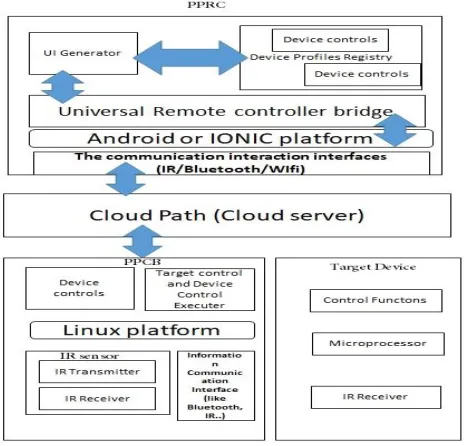
The detailed architectures of the Pont-n-Press Remote controller (PPRC) with Pont-n-Press Control Box (PPCB) are illustrated in Fig.2.
Fig. 2. Various parts of Press Remote controller (PPRC) and Pont-n-Press Control Box (PPCB) and interactions with cloudpath Following are the various parts of PPRC:
• UI Generator: As per properties and depictions of the objective gadget and its present state, it prepares the User Interface
• Device Profile Registry: Currentlypointed device’s status is saved in this registry and it also maintain the status relation between current and future of target device.
• URC Bridge: PPRC’sfundamental segment, its responsibility is getting Device Profile Registries from Currently pointed device. This breaks down the DC (Device Controls) and the present condition of the objective gadget to play out extra control activities.
• Android platform / Ionic platform: Which is Linux-based, where PPRC application will run.
• The communication interaction interfaces: This is the interaction interfaces between the PPRC and the objective gadgets, here there communication protocols can be used: IR, ZigBee, Wi-Fi, and Bluetooth.
means of the PPCB instrument. The elements of the parts in the PPCB are:
• Device Controls: A file that specifies the properties and particular things of an objective gadget, this is basically a text file in cloud path to be updated.
• Target Control and Device Control Executor: This will creates Device Controlsand exchanges respective Device Control Profiles to the Universal Remote Control of the PPRC. Device Control Executor speaks with the URC Bridge of the Point-n-Press Remote Controller and executes on the device [1].
• Linux platform: PPCB works on linux platform.
• Information Communication Interface: Information Communication Interface uses an Infra-Red sensors to get an identification motion from the PPRC. When the PPRC is pointed at the PPCB of target device. Here following protocols can be used: ZigBee, Wi-Fi, and Bluetooth
Methodology:
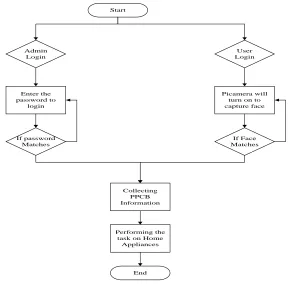
The working of proposed method is described in detailed manner in a flow chart given below fig 3.
Start
Admin Login
User Login
Enter the password to
login
Picamera will turn on to capture face
If password Matches
If Face Matches
Collecting PPCB Information
Performing the task on Home
Appliances
End
Fig 3: Flowchart of Proposed method
With the mobile application in android mobile (PPRC), client has to be identified or recognized whether
he/she is Admin user or other User. If the person is admin user, he can login to PPRC application using secured ―admin password‖ and later person can perform the action using following sequences. If the person is normal user
(apart from admin), user should be get authenticated based on the face recognition. This is achieved using previously captured user face characteristics using ―Haarcascade‖ face recognition algorithm. After authentication, user can
perform the following sequences:
The framework should be able to distinguish that the PPRC has been distracted the IR sensors of PPCB which
is located in target device/home electrical appliances. The PPRC at that point sends a "Be Ready with User flag"
present status at cloud path, the PPRC will keep monitoring this status, based on the status at cloud path, the PPRC
shows the future action on the device. This is achieved based on the DCP.
Once user performs / clicks on the action button on PPRC. The PPRC will update the current action at cloud
path. Since cloud path is directly connected using different protocols (WIFI) with PPCB. PPCB should be able to execute the current user’s action on the target device. Now PPCB will again update the current device’s status at
cloud path. Above procedure will continue in loop.
RESULTS & DISCUSSIONS:
This section depicts the results with respect to bulb as target device and user performing the actions on
it. Initially the PPRC is in off state indicating that the PPRC is not pointing any PPCB. So all PPCB devices are in
off state which is indicating that it is not able to collect the status of the devices so it is not active and PPRC will
also gets the empty information ―Be Ready with User flag".
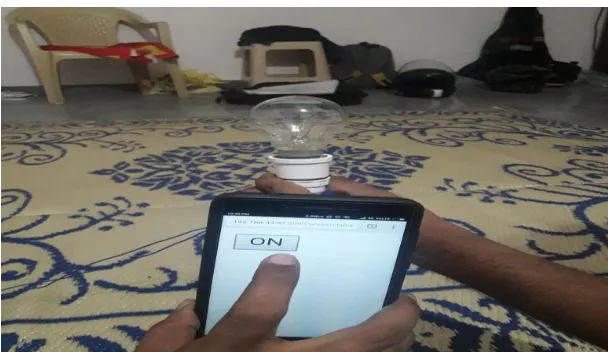
Fig 4: PPCB is in off state
When user points PPRC to the PPCB of bulb, Now PPCB collects the status of the bulb which is in off state.
So PPRC collects the information of future action and displays on PPRC
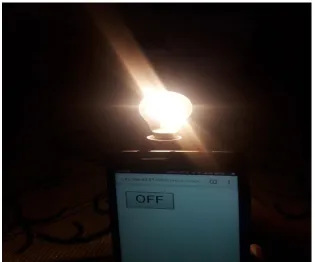
Now user select the option visible in the PPRC, based on that itself, the target device is active and updated the
future action to be performed in PPRC
Fig 6. Logic for Electrical Appliances
Fig 7: Bulb is ON state and future option is OFF
CONCLUSION:
In propped framework one of the main concern in IoT framework is resolved, which is real time processing and
efficient. This is achieved by combining the Eigen faces and Fisherfaces approaches we improve the performance of
facial recognition module. Here we are using ―Haarcascade‖ algorithm. This has provided us to achieve the security
to home appliance and also here we have used simple user friendly straightforward control framework being
devices/devices in IoT-based mechanization for electrical devices. In this POC we have achieved: To point the
specific device and control the operations devices (directionality feature), Single remote controller to operate all
type of devices, Based on the current state of the device and user can perform the future operations using user
friendly remote controller(UI) and Secured wireless communication throughout the device.
Also in eXtensible Markup Language (XML) sort of control systems, the joining with Universal
Point-n-press devices by an open Service Gateway Initiative (OSGi) Gateway and a comprehensive remote user action
console are developed to grow the easiness of the splendid electrical user action structure. This system provides a
straightforward user interface yet does not give a natural user action interface. Based on the previous study, above
arrangement eats up a bigger number of information exchange limit than the proposed (security based) Point-n-Press
since XML-based information exchanges are involved. Additionally, a Radio Frequency for Customer Electronics
(RF4CE) approach based simple to use and instinctive User Interface is acquainted with lessen the bandwidth limit
use [18]. In spite of the way that the RF4CE approach normally develops the protocol for transmission between a
remote controller and electrical devices, described method may eat up high transmission limit than the proposed
(security based) Point-n-Press user action system with Infra-Red directionality and the current state conditions of the
device actions are not used. So with the Secured Universal Pont-n-Press system we have also achieved the less
bandwidth consumption system.
References:
[1]. Kuen-Min Lee, Wei-Guang Teng, and Ting-Wei Hou,- “Point-n-Press: An Intelligent Universal Remote Control System for Home Appliances‖, 1545-5955 © 2017 IEEE.
[2].T. Mita, T. Kaneko, O. Hori, Joint Haar-like Features for Face Detection, ―Proceedings of the Tenth IEEE International Conference on Computer Vision‖, 1550- 5499/05 ©2005IEEE.
[3]. SonawaneShamal,Khandave Monika, Nemade Neha- ―Secure Authenticating for Online Banking Using Face Recognition-ISSN 2250-2459, Volume 4,Issue 3,March 2014
[4]. Dr AP Adsul, GayatriKumbhar,Vrundachincholkar, YogeshKamble,AnujaBankar-―Automated Exam Attendance Process using Haarcascade Technology‖- volume3,Issue 4,April 2014 ISSN 2319-4847
[5] F. Wang, L. Hu, J. Zhou, and K. Zhao, ―A survey from the perspective of evolutionary process in the Internet of Things,‖ Int. J. Distrib. Sens.Netw., vol. 2015, no. 9, pp. 1–9, Jan. 2015.
[6] M. Javier et al., ―From the internet of things to the internet of people,‖IEEE Int. Comput., vol. 19, no. 2, pp. 40– 47, Mar. 2015.
[7] L. Zhang, L. Zheng, H. Yang, and T. J. Pan, ―Research of the key technologiesof the smart electrical based on IOT,‖ Appl. Mech. Mater., vol.713–715, pp. 2304–2307, Jan. 2015.
[8] M. R. Alam, M. B. I. Reaz, and M. A. M. Ali, ―A review of smartelectricals—past, present, and future,‖ IEEE Trans. Syst., Man, Cyber., vol.42, no. 6, pp. 1190–1203, Nov. 2012.
[9] K. Ben, P. Sachin, A. Pieter, and G. Ken, ―A survey of research oncloud robotics and automation,‖ IEEE Trans. Autom. Sci. Eng., vol.12, no. 2, pp. 398–409, Apr. 2015.
[10] C.-H. Lu et al., ―Energy-responsive aggregate context for energysaving in a multi-resident environment,‖ IEEE Trans. Autom. Sci.Eng., vol. 11, no. 3, pp. 715–729, Jul. 2014.
[11] H. C. Tadimeti and M. Pulipati, ―Overview of automation systems andelectrical appliances control using PC and microcontroller,‖ Int. J. Sci.Res., vol. 2, no. 4, pp. 127–131, Apr. 2013.
[12] T. Kim, H. Lee, and Y. Chung, ―Advanced universal remote controllerforelectrical automation and security,‖ IEEE Trans. Consumer Electron.,vol. 56, no. 4, pp. 2537–2542, Nov. 2010.
[13] J. Han, H. Lee, and K.-R. Park, ―Remote-controllable and en- ergysavingroom architecture based on ZigBee communication,‖ IEEETrans. Consumer Electron., vol. 55, no. 1, pp. 264–268, Feb. 2009.
Electron., vol. 55, no. 2, pp.422–430, May 2009.
[15] H. Erdem and A. Uner, ―A multi-channel remote controller for electricaland office appliances,‖ IEEE Trans. Consumer Electron., vol. 55, no.4, pp. 2184–2189, Nov. 2009.
[16] M. Tezuka, Y. Honda, and M. Kato, ―Development of bi-directionalremote controller protocol and systems for domestic appliances,‖ IEEE
Trans. Consumer Electron., vol. 46, no. 3, pp. 802–811, Aug. 2000.
[17] P. Palanisamy, ―A universal device controller (UDC),‖ Int. J. Comput.Appl., vol. 82, no. 10, pp. 24–29, Nov. 2013.
[18] C.-F. Lai, M. Chen, M. Qiu, A. V. Vasilakos, and J. H. Park, ―ARF4CE-based remote controller with interactive graphical user interfaceapplied to electrical automation system,‖ ACM Trans. Embed.Comput. Syst., vol. 12, no. 2, pp. 1–19, Feb. 2013.
[19] W.-P. Sung, C.-M. Kao, and R. Chen, ―Research and design of touchscreendomestic universal remote controller with self-learning function,‖Appl. Mech. Mater., vol. 599–611, pp. 1028–1031, Aug. 2014.
[20] Y.-Y. FanJiang and T.-F. Chueh, ―Adaptive user interface for universalremote controller,‖ Int. J. Comput. Sci. Eng., vol. 10, no. 1–2,pp. 90–97, Feb. 2015.
[21] M. S. Alamgir, S. M. A. Z. Chowdhury, and K. T. Ahmmed, ―Developmentof a PoE switch based remote control system for controllingelectrical and office appliances with data communication facility,‖ Int. J.ControlAutom., vol. 8, no. 1, pp. 103–110, Jan. 2015.
[22] Y.-H. Sheng, W.-W. Lin, C.-S. Tu, and K.-M. Lee, ―Integrate Lon Works and UPnP devices by OSGi gateway and universal remote console,‖in Proc. 8th Int. Conf. Adv. Commun. Technol., Phoenix Park,Korea, Feb. 2006, pp. 1848–1850.
[23] G.-J. Horng, C.-K. Lin, C.-H. Tseng, C.-H. Wang, and J.-F. Yang, ―Anagent-based smart electrical system and its service-scheduling mechanism:Design and implementation,‖ Wireless Pers. Commun., vol. 78, no. 1,pp. 521– 542, Sep. 2014.
[24] S. Pradeep and V. Padmajothi, ―Brain controlled smart electricalnetworkbased on cognitive state,‖ Int. J. Emerg. Tech. Comput. Sci. Electron.(IJETCSE), vol. 13, no. 2, pp. 59–62, Mar. 2015.
[25] P. Kabilan, H. N. Askar, P. N. Anand, S. Manimaran, and G.Venkatesh, ―Facebook based electrical appliances security control and monitoring using microcontroller,‖ Asia Pac. J. Res., vol. 1, no. XXV,pp. 19–25, Mar. 2015. [26] M. Miyakawa, Y. Maeda, and N. Koyama, ―Relationships betweenusability and number of buttons of a universal remote console -preliminaryexperimental result-,‖ in Proc. IEEE Int. Conf. Syst., ManCybner., Singapore, Oct. 2008, pp. 424–428.
[27] J. Haines and J. M. Winters, ―Evaluating automatically generated personalizedinterfaces on an ergometer for people with diverse abilities,‖in Proc. IEEE Int. Conf. Eng. Med. Biol. Soc., Vancouver, BC, Canada,Aug. 2008, pp. 5632–5635.
[28] J. H. Andrews and F. Hussain, ―Johar: A framework for developingaccessible applications,‖ in Proc. 11th Internat. ACM SIGACCESSConf. on Computers and Accessibility, Pittsburgh, USA, Oct. 2009,pp. 243–244. [29] H. Y. Tung, K. F. Tsang, H. C. Tung, K. T. Chui, and H. R. Chi, ―Thedesign of dual radio ZigBee electricalcare gateway for remote patient monitoring,‖IEEE Trans. Consumer Electron., vol. 59, no. 4, pp. 756–764,Nov. 2013. [30] C. I. Penaloza, Y. Mae, F. F. Cuellar, M. Kojima, and T. Arai, ―Brainmachine interface system automation considering user preferences and error perception feedback,‖ IEEE Trans. Autom. Sci. Eng., vol. 11, no.4, pp. 1275– 1281, Oct. 2014.
[31] K. Lee, Y. S. Kim, Y. Wang, S. Kim, and K.-H. Baek, ―A remotepointing device by using modulated IR signals with a 2-D striped pattern,‖IEEE Trans. Consumer Electron., vol. 59, no. 3, pp. 699–704,
Author Details
Mr. GURUPRASAD HEGDE studied BE (ISE) in AIT chikmagalur, pursing M.Tech