Beyond words:
On the role of nonverbal behavior in social influence settings
Master’s thesis
Katharina Lürken
University of Twente, the Netherlands Applied Communication Studies
Abstract
After an encounter with a sales representative or a fundraiser, people sometimes find
themselves committed to buying or doing something they would not have done or bought on second thought, such as donating to a charitable organization, or buying a product they don’t really need. In many of these situations, people have been targeted by a clever technique widely used for all kinds of persuasion purposes, a so-called social influence technique (Cialdini, 1993).
Social influence techniques
Social influence techniques (SIT) are a well-known phenomenon that have been extensively investigated by different researchers in the past decade (e.g., Freedman & Fraser, 1966; Burger & Petty, 1981; Cialdini et al., 1975, 1996, 1999; Cialdini, 1993). These influence techniques rely on the use of a scripted process that consists of multiple sequential requests. In the first stage of the process, an initial request is posed. In the second stage, the target request is posed, which is the real aim of the encounter. Research has shown that compliance rates with a request are considerably higher when people are confronted with such a scripted sequential request process than when the target request is done without the scripted initial request preceding it (Burger, 1999; Cialdini & Goldstein, 2004).
1974). The door-in-the-face technique (Cialdini et al., 1975) confronts people with an extreme request that is very likely to be rejected. This extreme request is then followed by a smaller, more moderate request. Again, research has shown that compliance rates with the target request are higher when the sequential request technique was used than when only the target request was done (Cialdini et al., 1975). Cialdini et al. (1975), for instance, found that students were far more willing to accompany juvenile delinquents to a trip to the zoo when this request was preceded by a request to council juvenile delinquents two hours a week over the next two years. When the target request (the trip to the zoo) was made without the
preceding, unreasonably large request, a larger amount of students rejected the request. Lastly, the low-ball technique (Burger & Petty, 1981) proceeds by gaining commitment to an action and then increasing the costs of this action. Cialdini, Cacioppo, Bassett, and Miller (1978), for instance, confronted students with this technique by asking them to agree to participate in a psychology experiment. They informed them of the very early starting time of this experiment only after having gained their commitment. Students who had agreed to participate in the experiment and had only later learned of the starting time remained more willing to participate when given the chance to cancel than students who had been informed of the starting time of the experiment from the outset.
Mindlessness and automatic behavior
The term mindlessness was first introduced by Langer (1992). In a state of mindlessness, people are either unwilling or unable to invest their cognitive resources in the critical
processing of information. Instead, they switch to “autopilot” and rely on automatic behavior patterns instead. That is, people employ simple heuristics to make decisions and control their behavior. These rule-of-thumb strategies shorten decision-making time and allow people to function without constantly stopping to think about the next course of action. The use of heuristics is an equipment necessary to be able to deal with the extraordinary amount of information people are confronted with every day. Because it is simply impossible and too effortful to continuously process all this information consciously, people rely on their automatic behavior patterns instead (Cialdini, 1993).
Cialdini and Goldstein (2004) identified several of the heuristics that act as behavioral guides for individuals in a social influence setting. For instance, the door-in-the face-technique works with the principle of reciprocal concessions. Because the requester seemingly makes a
she is an expert on a certain field. The concept of mindlessness gives a credible explanation for why social influence techniques enhance compliance so effectively. However, the concept of mindlessness gives no clue as to why this state comes about.
The limited- resource model of self- control
The limited-resource model of self-control (Baumeister, Bratslavsky, Muraven & Tice, 1998; Baumeister & Vohs, 2003) expands on the concept of mindlessness and links mindlessness to social influence techniques. In essence, it states that every person has a limited capacity of self-regulatory resources that resemble strength or energy, which are expended when people deliberately and consciously regulate their responses or their behavior. Since the source for these regulatory resources is limited, it is prone to depletion. Consequently, similar to muscle failure after repeated straining, several acts of self-regulation will deplete the resource up to the point of self-regulatory failure (Baumeister, Schmeichel & Vohs, 2007). Once this state of self-regulatory failure has been reached, individuals are less able to function effectively and have to rely on their automatic behavior patterns, habits and routines instead (Baumeister, Muraven, & Tice, 2000, Vohs, Baumeister & Ciarocco, 2005), just as in the state of mindlessness (Langer, 1992).
For instance, Baumeister et al. (1998) showed in an experiment that participants who were requested to eat radishes persisted less on a subsequent unsolvable figure-tracing task than did participants who were requested to eat chocolate cookies or no food at all. That is, because participants in the first condition had to exert self-control over themselves to make them eat the radishes, they had less self-control left to persist on the figure tracing task. However, asserting self-control by accomplishing undesirable tasks is not the only manner in which regulatory resource depletion can occur. Active decision-making requires the use of self- regulatory resources as well, as has been shown by Vohs et al. (in prep.). Moreover, completing cognitively demanding tasks such as the figure tracing task (Baumeister et al., 1998) or answering a series of cognitively demanding questions (Seligman et al., 1976) can have an impact on resource depletion.
A two stage model of social influence techniques
Based on the findings above, Fennis, Janssen & Vohs (in prep.) proposed and in a series of experiments tested their two-stage model of social influence techniques, which combines the idea of mindlessness and limited resources to a comprehensive model of the effectiveness of social influence techniques (see figure 1). They hypothesize that the effectiveness of social-influence techniques lies in the multiple decision moments, or sequential requests embedded in the method (Fern, Monroe & Avila, 1986). As can be deduced from figure 1, they argue that in the first stage of a sequential request technique, yielding to an initial request leads to self-regulatory resource depletion, or a state of mindlessness. This state comes about by answering a series of cognitively demanding questions, completing a difficult task, or answering a series of questions that are revealing in nature and require active
had to answer a series of self- disclosing questions produced significantly less
counterarguments for the raise of tuition fees at their university than students who did not have to answer these questions (Fennis, Janssen & Vohs, under review). Thus, active self-presentation had depleted the students’ self-regulatory resources that subsequently impaired their ability to produce counterarguments. In the second stage of the model, this depletion of self-regulatory resources in turn fosters the use of decisional heuristics that are imbedded in the influence situation, which increase the chances of compliance with the target request. That is, mindlessness or self-regulatory depletion mediates compliance through the reliance on heuristics. In another experiment, for example, students who were depleted of their self-regulatory resources after having completed a figure-tracing task with their non-dominant hand (Quinn et al., 1996) and who were given a compliment on their accomplishment on this task as a means of making the likeability heuristic salient were more willing to join a fictional society than students who were not depleted and who had not been complimented on their performance of the task (Fennis, Janssen & Vohs, in press). Thus, depleted students were more susceptible to the likeability heuristic than non-depleted students, and in consequence were more compliant with the target request than non-depleted students or students who had not been exposed to the likeability heuristic.
Stage 1 Stage 2
Initial
request(s) Depletion Compliance
Heuristics
The reflective impulsive model of social behavior
Automatic behavior and the use of heuristics as a decision-making aid under the
circumstances of self-regulatory depletion can also be interpreted from the perspective of the Reflective Impulsive Model of social behavior (RIM) (Strack & Deutsch, 2004). The RIM proposes the existence of two cognitive processes operating simultaneously in humans, which are rule-based reflective processes on the one hand, and associative, impulsive processes on the other hand. Whenever the functioning of the rule-based, reflective processes is impeded, impulsive processes take over. Applying this to the context of social influence techniques, Vohs et al. (in press) argue that when self-regulatory resources are depleted, individuals will rely less on their cognitive processes and turn on their automatic behavior patterns instead and apply heuristics as decisional cues. Consequently, when an individual is confronted with a sequential request technique, and is depleted of his self-regulatory resources after having completed the initial stage of a social influence technique, the likelihood of compliance increases through the individual’s reliance on heuristics and his impaired ability of reasoned cognitive processing.
Impression management
Bratslavsky and Muraven (1995), who revealed norms of self- presentational manners that require individuals to behave in a typical rather than in a modest way in front of friends, whereas self-presentation in front of strangers allows for a more boastful style. Vohs et al. were able to show that counter-normative behavior, that is, boasting in front of friends and being modest in the presence of strangers, depleted participants self-regulatory resources. Participants whose mode of self-presentation was counter-normative performed worse on a subsequent mathematical task than participants who presented themselves in accordance with the norms (Vohs et al., 2005). Hence, actively trying to control one’s behavior with the ultimate goal of creating a certain image in others has been shown to be a depleting task. Conversely, Vohs et al. (2005) were also able to show that under reversed conditions, under which depletion of self-regulatory resources was induced, impression-management skills are impaired.
Surprisingly, other research revealed that it is not only the impression manager (i.e., the person who tries to make an impression on others) itself who is engaging in active self-regulation but the observer of this behavior as well (Nordstrom, Hall & Bartels, 1998). Hence, actively processing information about someone else requires self-regulation, as well. In line with these findings, several authors (Ekman, 2001; Vrij, 2000; DePaulo, Lindsay, Malone, Muhlenbruck, Charlton & Cooper, 2003) hypothesized about a three-phase process of person perception. This process consists of the categorization of another person’s behavior, a characterization of the person based on inferences drawn from his behavior, and a correction phase, where this characterization can be corrected or adapted. Whereas categorization does not require many cognitive resources as it occurs in a natural and automatic fashion,
is the process that is most impaired under conditions of low self-regulatory resources. Thus, if a person has been targeted by a social influence technique and is therefore prone to regulatory resource depletion, an impression manager may be able to convey a desirable image without risking an unwanted correction of this image.
Importantly, as much research on impression formation revealed (for instance, Montepare, 2004, Mc Culloch et al., 2007), most impressions are not only based on someone else’s verbal behavior. Nonverbal expressions play a much bigger and much more important role in
impression formation than verbal behavior (e.g., Sabatelli & Rubin, 1986). For example, first impressions on someone have usually already been made even before one word was spoken (e.g., Willis & Todorov, 2006). Thus, someone who is trying to invoke a certain impression in someone else needs to guard his verbal as well as his nonverbal behavior carefully. However, as literature on deception revealed, consciously controlling one’s own nonverbal behavior can be difficult.
Deception
Closely related to the concept of impression management and yet another important aspect of social influence situations is that of deception. In trying to convey a particular impression on individuals, applicants of social influence techniques have to control their verbal and
Under conditions of self-regulatory resource depletion, the recipient will be likely to become vulnerable to these deception attempts and will then allow his behavior be guided by the cues the agent actively expresses in order to mislead the target.
Distressed deception and duping delight
Deception has been found to evoke certain processes within the person who is deceiving someone else (DePaulo, Lindsay, Malone, Muhlenbruck, Charlton & Cooper, 2003; Ekman, 2001). Cognitive processes occur when someone is trying to come up with a lie that sounds credible. Control processes occur when the liar is trying to appear to be honest although he is not. Lastly, emotional processes occur as a consequence of deceiving.
When trying to convey a certain impression that is not necessarily congruent with one’s own views, a person may experience different emotions such as the fear of being detected, or guilt (DePaulo, Lindsay, Malone, Muhlenbruck, Charlton & Cooper, 2003). However, as Ekman (1992) pointed out, liars can also experience positive emotions while deceiving someone, such as excitement about the challenge of lying or contentment about having successfully betrayed someone. As research has shown, these emotions, positive or negative, will inescapably and unwillingly shape the persons’ nonverbal behavior (Ekman, 1992). The concept of experiencing negative emotions while lying and the inevitable behavioral pattern that arises from these emotions was referred to by Ekman (1992) as distressed deception, while the behavioral pattern that stems from experiencing positive emotions during attempted conceit is referred to as duping delight (Ekman, (1992). Furthermore, research has shown that someone who is trying to persuade an individual who is skeptical of him and provides
cues are forced, less authentic smiles (non-Duchenne smiles), a lower and softer voice, less eye-contact with the conversation partner, frequent posture shifts and engagement in self-touching, and a tendency to hide one’s face (Ekman, 1992; DePaulo et al., 2003).
In contrast, someone with a persuasion goal who is receiving positive feedback and support on his behavior from his target may experience positive emotions that are associated with an anticipated goal attainment. He may therefore subsequently express according nonverbal behavioral cues. Amongst these cues are a higher pitch, a more authentic smile (Duchenne), faster and louder speech and the use of more gestures (Ekman, 1992; DePaulo et al., 2003). The present research
Much research has been conducted on the field of social influence in general and on social influence techniques in particular in the last decade (for instance, Fennis, Janssen, Vohs & Pruyn, in press; Fennis, in press; Cialdini, 1993). This research revealed not only several different social influence techniques but it was also able to show that mindlessness or self-regulatory resource depletion mediates compliance with a target request through the reliance on heuristics (e.g., Cialdini & Goldstein, 2004). However, research has almost exclusively concentrated on the verbal aspects of social influence techniques in this context. The role of nonverbal behavior has so far been almost completely neglected, although it findings from other domains (e.g. deception literature) make it evident that it is very likely to play an important role in social influence settings. Also, earlier research showed that verbal social influence techniques can not totally account for the effects found on compliance (Burger, 1999) and that nonverbal behaviors are probably playing a role in compliance, too (Hale & Stiff, 1990). Therefore, the present research aims to place the notions of nonverbal
Stage 1 Stage 2
Figure 2: The present research applied to the two-stage model of social influence techniques
Method Set-up and participants
The hypotheses were tested in a 2 (technique: depletion- versus non-depletion condition) x2 (cues: “strong” nonverbal behavior versus “weak” nonverbal behavior) between- subjects factorial design.
A total of 81 individuals (41 women and 40 men; mean age: 31, SD= 10,45) voluntarily participated in the experiment.
Overview of the study
The study took place in a naturalistic setting, in a busy shopping street in the centre of the city Münster in Germany. A naturalistic setting was chosen because it most resembles a natural situation in which persuasion attempts occur. Moreover, a naturalistic setting is assumed to enhance peoples’ impression management behaviors. That is, people may have been more inclined to present themselves in a desirable light because they are asked to answer questions in the open. The presence of other people is presumed to induce a greater need for
Two agents, of which one was male and one was a female agent, randomly accosted people in the street. The agents introduced themselves as members of the fictitious non-governmental environmental organization “Grünes Deutschland” (“Green Germany”). Both agents applied a social influence technique. Participants were then arbitrarily exposed to a depletion- or to a non-depletion condition. Within these conditions, participants were randomly either exposed to nonverbal behavior of the influence agent that is expressive of “duping delight”, or
nonverbal behavior that is expressive of “distressed deception”. After having completed the first stage of the experiment, all participants were asked to try to solve a number of
mathematical exercises as a measure of their capacity of self-regulatory resources. Moreover, they were requested to fill in a mood questionnaire. Lastly, the target request was made, in which the agent explained that the organization was planning to conduct more studies in the near future, and asked whether the participants would be willing to participate in them. Compliance was measured by the amount of time participants were willing to invest in future studies.
Dependent and independent variables in the study Independent variables
Technique
Depletion induction
Following the introduction of the agent, the initial stage of the foot-in-the-door script was staged. Individuals were randomly assigned to a depletion condition or a no-depletion condition. In the depletion condition, the agent explained that the organization was
conducting a study on environmental protection and proceeded asking whether he could pose some questions on this topic. In total, five questions were asked. All the questions were open questions and were designed to be self-disclosing in nature and to induce peoples’ tendency for impression management. In addition to that, due to the open-ended nature of the questions, they were also designed to be cognitively demanding. The questions were designed to allow individuals to point out their beneficial behavior and present themselves in a desirable manner. According to Vohs, Baumeister and Ciarocco (2005), answering to these kinds of questions that induce impression management behaviors requires self-regulatory resources and can de depleting in nature. For an overview of all questions posed in the depletion-condition, see Appendix B.
Nonverbal behavioral cues
In addition to the depletion conditions, the agent expressed himself nonverbally within each of these conditions in a manner that spoke of anticipated success or anticipated failure, respectively (DePaulo et al., 2003). That is, in the distressed deception (anticipated failure) condition, the agent spoke in a lower and softer voice, made less use of hand gestures,
maintained little eye-contact to the participants, entertained a false (non-Duchenne) smile and had an averted body posture. In contrast, in the duping delight (anticipated success) condition, the agent spoke in a loud and clear voice, smiled earnestly (Duchenne smile), made frequent use of hands gestures, held a lot of eye-contact with the individuals and turned his body towards them.
Mood
Dependent variables
Self-regulatory resources
Depletion was measured by asking participants to try to solve five different mathematical exercises of moderate difficulty, apparently as a part of the study. All participants were told that they could stop trying at any time. Four different measures were taken: whether or not participants were willing to try to solve the mathematical exercises, the number of exercises the participants tried to solve, the number of correct answers, and the time each participant spent on trying to solve the exercises. Consistent with findings from earlier studies (Fennis et al., in press), it was expected that participants who had been exposed to the depletion
condition would be less willing to try to solve the exercises, would be less persistent on the task, and would solve fewer exercises correctly. For an overview of the mathematical exercises participants were asked to complete, see Appendix D.
Compliance
The participants were told that the same organization was planning to conduct more studies on related topics in the near future and were asked whether they would be willing to
participate in these studies. Compliance was measured by the amount of time in minutes participants were willing to invest in future studies.
Procedure of the study
always the same. The agent introduced himself as a member of the fictitious governmental organization “Grünes Deutschland”, and explained that this is a
visit as a part of his study. The locations people were asked to give directions to were the train station, the next postal station, and the next bank (here, the “Sparkasse” was chosen, because it is the biggest German bank and lies in closest proximity to the city centre). For an overview of the questions in the landmark condition, see Appendix C. In addition to that, in each
condition (depletion versus no depletion), individuals were assigned to either a “weak” nonverbal behavior- condition or a “strong” nonverbal behavior-condition (i.e., deception cues) in equal numbers. That is, the agents either behaved themselves nonverbally in a manner that expresses emotions of duping delight or distressed deception. In the “weak”– condition, the agents spoke in a low and soft voice, made little use of hand gestures,
maintained little eye-contact to the participants, entertained a false (non-Duchenne) smile and had an averted body posture. In the “strong”-condition, the agent spoke in a loud and clear voice, smiled earnestly (Duchenne smile), made frequent use of hands gestures, held a lot of eye-contact with the individuals and turned his body toward them.
After having completed the first stage of the experiment, the agents conducted the
measurement of self-regulatory resource depletion. To give participants a credible explanation for this measurement in the depletion condition, the agents explained that it was important for their organization to know under which circumstances such studies as the present could be conducted. They explained that recent studies revealed that results from such field studies in the open, such as in their situation, might be invalid due to a distracting influence of other people and the general level of noise on the street. The agent explained that their organization therefore wanted to test peoples’ ability to concentrate by asking them to try to solve a
few minutes and help with the study, after all. All participants were then given a sheet of paper on which five mathematical exercises were printed. The mathematical exercises consisted of a sequence of numbers which the participants were asked to complete. For example, one sequence of numbers contained the numbers 8; 12; 10; 14; 12; 16; 14. Participants had to complete the sequences by adding the following two numbers to each sequence. In the present example, the next two numbers would have been gained by adding 4 to 14, thus 18, and subtracting 2 from 18, thus 16. For a complete overview of all sequences, see Appendix D. As a measure of self-regulatory resource depletion, the participants’ general willingness to try to solve the sequences, the number of attempted sequences, the number of correctly solved sequences, and the amount of time each participant spent trying to solve the sequences was recorded for each participant. Next, all participants were asked to fill in a mood-questionnaire to control for possible effects of mood on the results of the study. Again, to offer a credible explanation for this questionnaire, the agents explained that the
organization feared that asking people to solve mathematical exercises might influence their mood, and that the organization wanted to test whether this is indeed the case to either include or exclude such mathematical exercises in future studies. Lastly, all participants were told that the same organization was planning to conduct further studies in the near future. Each
Results
The results of the study are presented in four different parts.
First of all, the results of analyses on the mood scale (PANAS) are presented.
Then, congruent with the logic of the two-stage model of social influence techniques, the second part presents the results concerning the first stage of the model. In this part, effects of the initial request on the participants’ regulatory resource depletion are discussed (hypothesis 1). In the second part, the effects of nonverbal behavior on compliance and the role of
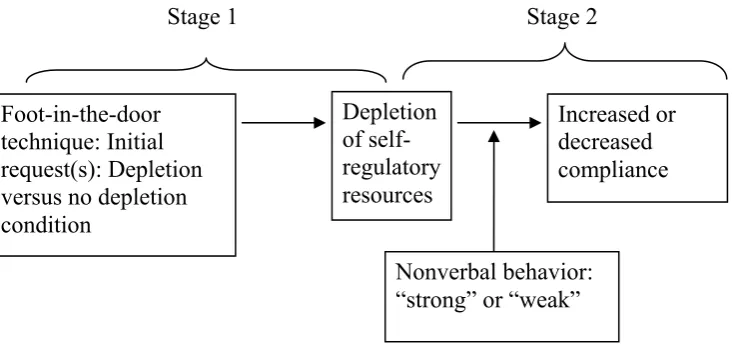
resource depletion are presented (hypothesis 2). Lastly, a model of moderated mediation is tested (hypothesis 3), with depletion functioning as a mediator and nonverbal behavior functioning as a moderator. That is, in line with the two-step model of social influence situations, we assume that the effects of the initial request (depletion) condition on
compliance are mediated by self-regulatory resource depletion, which in turn is moderated by the type of nonverbal behavior that is displayed by the agents (see figure 2).
In total, 13 participants were excluded from all analyses due to their extreme answers and the resulting values which qualified as outliers.
Mood
To test whether mood had any effect on the results, two indexes of participants’ answers on the PANAS were computed. One index contained the participants’ answers on the positive affect items of the scale (PA), and the other index contained the participants’ answers on the negative affect items of the scale (NA). To test whether either of the two independent variables (i.e., type of nonverbal behavior or depletion condition) had any effect on
no significant effect on participants’ mood (F/positive affect (1, 66) = 3.32, p = n.s.;
F/negative affect (1, 66) = 3.36, p = n.s.). Moreover, the depletion condition had no effect on participants’ mood (F/positive affect (1, 66) = .004, p = n.s. ; F/negative affect (1, 66) = .77, p = n.s.). Thus, mood did evidently not play a role in the experiment and will be excluded as a relevant variable from further analyses.
Stage one: The effects of the initial request on regulatory resource depletion
To test the hypothesis that yielding to an initial request that induces impression management and is cognitively demanding in nature reduces participants’ self-regulatory resources—as opposed to an initial request that is cognitively less demanding in nature—a multivariate analysis of variance was conducted, which included all different measures (i.e., whether the participant was willing to try to solve the mathematical exercises, the number of exercises attempted, the number of correctly solved exercises, and the amount of time spent with trying to solve the exercises) of self-regulatory resource depletion at the same time.
Although this last result is not significant, it is evident from the results of the other three analyses that answering to a series of open-ended questions that invite impression management and are cognitively demanding depleted individuals of their self-regulatory resources and made them less willing and less capable to solve the mathematical exercises. In addition to the findings on the multivariate analysis of variance, a correlational analysis revealed significant correlations between the initial request (depletion) condition and the number of correctly solved exercises (r = .29, p = .02), the number of math assignments the participants attempted to solve (r = .36, p = .002), and the participants’ general willingness to try to solve the mathematical exercises (r = .47, p = .00). Hence, these results provide support for our first hypothesis that yielding to a series of questions that activate individuals’ active impression management behavior will deplete these individuals of their self- regulatory resources.
Stage two: The effects of nonverbal behavior on compliance and the role of resource depletion
An analysis of variance on compliance with the target request with nonverbal behavior as an independent variable revealed a significant main effect of nonverbal behavior on compliance. Participants who were exposed to the strong nonverbal behavior condition were willing to invest more time in future studies (M = 15.12, SD = 16.34) than participants who were
exposed to the weak nonverbal behavior condition (M = 2.78, SD = 5.03), F(1, 66) = 20.91, p = .00. Variance analysis on compliance with the target request with depletion induction (depletion versus no depletion) as an independent variable showed no significant main effect of the depletion condition on compliance. Participants who were depleted of their
66)= .80, p = .37). However, further analysis of the results revealed an interaction effect between the depletion condition and the type of nonverbal behavior displayed. Participants who had been depleted of their self-regulatory resources and were exposed to the strong nonverbal behavior script were willing to spend more time on future studies (M = 12.69, SD = 12.35) than participants who had been depleted of their self-regulatory resources and were exposed to the weak nonverbal behavior condition (M = 2.22, SD = 4.28), F(1, 66) = 11.20, p = .02 (see figure 3). In addition to that, the analyses revealed that participants who had not been depleted of their self-regulatory resources (no-depletion condition) before being exposed to the strong nonverbal behavior condition were willing to spend more time with future studies (M = 6.47, SD = 7.02) than participants in the non-depletion condition who were exposed to the weak nonverbal behavior condition (M = 3.40, SD = 5.86), but the effect found was small and not significant (F(1, 66) = 2.10, p = n.s.) (see figure 3). Hence, in line with hypothesis 2, participants who had not been depleted of their self-regulatory resources were not as easily influenced by the type of nonverbal behavior the agent expressed than
depletion
Figure 3: Comparison of the effect of nonverbal behavior on compliance between depletion- and non-depletion conditions
A model of moderated mediation
We assume that there is a relationship of moderated mediation underlying the two-stage model that explains the effects found above. Formally, a model of moderated mediation occurs when the strength of an indirect effect depends on the level of some variable. In other words, it occurs when mediation relations are contingent on the level of a moderator
which in turn induces the use of heuristics as decisional aids, in this case of nonverbal
behavioral cues, which influence compliance. To test these assumptions, a procedure outlined by Muller, Judd and Yzerbyt (2005) succeeded. According to this method, moderated
mediation is demonstrated when three conditions are met: In a first equation, there must be a significant effect of the independent variable X (i.e. the depletion condition) on the outcome variable Y (i.e. compliance). Moreover, in a second equation, there must be a significant main effect of the independent variable on the mediator ME (i.e. depletion of self-regulatory
As expected, the second equation revealed significant results of the depletion condition on self-regulatory resource depletion on three of four measures: A significant effect was found for the participants’ general willingness to try to solve the mathematical exercises (ß = .52, p = .00, for the number of rows participants were attempting to solve (ß = -.49, p = .00) and the number of correctly solved rows (ß = -.36, p = .05). No significant effect could be found for the regression of the depletion condition on the time participants attempted to solve the mathematical exercises (ß = -.31, p = n.s.). However, as the p-value (p = .07) suggests, this result is on the verge of significance. In addition to that, the second equation did not reveal any significant effect of the interaction between the depletion condition and the type of
nonverbal behavior on self-regulatory resource depletion (ß = -.09, p = n.s.; ß = .65, p = n.s.; ß = -.37, p = n.s.; ß = -25.80, p = n.s., respectively). The third equation was conducted on all four measures of self-regulatory resource depletion separately. That is, in each regression analysis, only one measure of self-regulatory resource depletion was included. However, the analyses of equation 3 failed to produce significant results for either of the mediator variables on compliance (ß = -1.47, p = n.s.; ß = -.26, p = n.s.; ß = -.17, p = n.s.; ß = .01, p = n.s., respectively). Moreover, no significant results of the mediator-moderator interaction on compliance could be found (ß = 3.52, p = n.s.; ß = 3.11, p = n.s.; ß = 2.88, p = n.s.; ß = -2.47, p = n.s.). However, equation 3 did produce a significant result of the moderator on compliance. For each different measure of regulatory resource depletion, the type of
measure of participants’ self-regulatory resource depletion, and that hence each variable alone does not have enough impact on depletion to produce significant results. However, when all variables are taken into account, a significant result is found on regression equation 3 on compliance.
Due to these results our model of moderated mediation could not be confirmed. It is clear from the results, however, that the different variables are interrelated and interact to produce the results on compliance we found in these and in earlier analyses. Moreover, due to the results found in the different interaction analyses (ANOVA and regression analysis) between the depletion condition and nonverbal behavior, it is clear that nonverbal behavior is
moderating the effects of the initial request (depletion condition) on compliance.
Discussion General discussion
In line with recent findings from many different studies (e.g. Fennis et al., in press;
Baumeister et al., 1998; Vohs et al., in press), it was expected that yielding to the initial stage of a sequential request technique, if it is designed to be cognitively demanding and induces patterns of self-presentation in individuals, depletes individuals of their self-regulatory resources (Baumeister et al., 1998), which in turn leads to a state of mindlessness (Langer, 1992). Indeed, the results of the present study confirm earlier findings in that they point to the fact that participating in a cognitively demanding initial stage of the foot-in-the-door
technique that is designed to induce impression management behavioral patterns in individuals depleted these individuals of their self-regulatory resources. This stands in
contrast to an initial stage that is less demanding and does not induce such self-presentational modes of behavior.
Moreover, it was expected to find that strong nonverbal behavior that is expressive of emotions of confidence and anticipated success as in the concept of duping delight, raises compliance rates, and that, contrary to this, weak nonverbal behavior, which speaks of emotions associated with anticipated failure as in the concept of distressed deception, will decrease compliance rates. The findings from the present study were able to confirm these assumptions. Individuals confronted with strong nonverbal behavior patterns of duping delight were significantly more compliant with a target request than individuals confronted with a weak nonverbal behavior pattern of distressed deception. The hypothesis that
nonverbal behavior can function as a cue to compliance was confirmed by these results. In addition to that, the relationship between the state of self-regulatory resource depletion in an individual and the exposure to nonverbal behavioral patterns was examined. It was
expressions of emotions. Indeed, results showed that depleted individuals were influenced significantly more by the patterns of nonverbal behavior they were exposed to than non-depleted participants. Moreover, an interaction effect between nonverbal behavioral patterns and the initial stage of the foot-in-the-door technique (the depletion condition) was found. This interaction points to the moderating role of nonverbal behavior. That is, nonverbal behavior seems to moderate the effect of the initial stage of a social influence technique on compliance. Combining these findings, it was assumed that the depletion of self-regulatory resources mediates the effect of the initial stage of a social influence technique on
compliance, and that the influence of depletion is moderated by nonverbal behavior cues in turn. Taking these assumptions together, a model of moderated mediation was proposed. Unfortunately, regression analyses did not confirm this model. The conditions for moderated mediation were not met by the results of the analyses. However, although the exact
relationship between the depletion of self-regulatory resources and nonverbal behavior on compliance could not be figured out, it is clear from the results of the analyses of the data that nonverbal behavior patterns indeed play an important role in social influence settings, and that this influence is even the greater when depletion of self-regulatory resource depletion is induced in individuals. Part of the next section will be dedicated to the discussion of why the present measures of the mediator may have been insufficient to yield the expected results. Limitations and future directions
approachable to them. On the other hand, it is also possible that only those people who possess certain character traits, such as assertiveness or a high degree of sociability agreed to participate in the study. Seen in this light, it may be desirable to replicate the study in a laboratory setting, where selection procedures can be randomized.
Furthermore, it is important to emphasize that the naturalistic setting puts limitations to research in that it is much more difficult to find people in the street who are willing to stop for fifteen minutes or more although quite apparently they are on their way to some place or activity. This may distract people’s concentration and exert an influence on their reactions. Although this must not necessarily be the case, a replication of the study in a laboratory setting is advisable to account for such occurrences.
In addition to that, taking the study to the field may have imposed some limitations on our measures of self-regulatory resource depletion. That is, asking people to try to solve some mathematical exercises in a noisy and crowded street is likely to have impaired their ability to concentrate. This may have influenced the results of the measures of self-regulatory resource depletion. Again, it is recommended to replicate the study in a laboratory setting so that any kind of distraction can be avoided.
However, it may also be recommendable to apply a different measure of self-regulatory resource depletion. The present method of measuring participants’ degree of depletion by asking them to solve a number of mathematical exercises may not have been reliable enough. It can be assumed that people are generally rather unwilling to voluntarily do some
mathematical exercises, which might have influenced the results because their general
(Baumeister et al., 1998) that have been applied in many studies before and that have proven to be effective measures could be applied.
It is also suggested that, in line with recent research (e.g., Fennis, in press), the role of the agents’ perceived credibility is taken into account in future studies. Some research points to the fact that the agents display of verbal and nonverbal behavior may influence individuals’ perception of his credibility (DePaulo et al., 2003; Burgoon et al., 1990). Recent studies were able to show that perceived credibility plays a mediating role between the display of
nonverbal behavior and compliance rates (e.g., Fennis et al., in press).
Moreover, due to practical limitations, this study employed only one agent per person. Other studies (e.g., Fennis, in press) have employed two agents or more to avoid individuals feeling that the agent is asking too much of them by posing multiple request without returning the individuals something for their cooperation. People may have been more hesitant than usual to cooperate with a subsequent request after the initial stage was completed because they felt they were being asked too much. A future study could experiment with randomly employing one or two agents in order to be able to assess the impact it has on participants’ general willingness to continue with the study.
One last aspect to consider would be the length of the total interaction between the individual and the persuasion agent. Due to the natural limitations of the study, the interaction length was comparably short in all conditions. A lengthier interaction between the agent and an individual might have pronounced the found effects even more clearly, e.g. due to enhanced perceived credibility, believability or trustworthiness of the agent.
From this discussion it becomes evident that there are many aspects of social influence situations that have yet to be examined further. Especially the role of the individuals’
not been investigated thoroughly. It is conceivable that other variables besides perceived credibility, such as physical attractiveness, could act as a heuristic and play a role in compliance, as earlier studies on social influence techniques have shown (Cialdini et al., 1999). However, there has never been an attempt to assess the combined influence of different variables or heuristics, such as physical attractiveness and nonverbal behavior on compliance. After all, nonverbal behavior might influence the agent’s perceived physical attractiveness and other heuristics available in the same way that it influences his perceived credibility. Moreover, the role of the different character traits of the individuals in persuasion processes has to be examined further. Recent research (Fennis, in press) points to the fact that the individuals’ personal need for structure (PNS) (Neuberg et al., 1993) plays a crucial role in compliance gaining processes by influencing the manner in which people form an opinion of other people and of the situation they are in (Gordon, 1997; Neuberg et al., 1993; Verplanken et al., 2001). Other possible variables such as the need for cognition could be examined in future research. People high in the need for cognition, for example, might be less reliant on the use of heuristics because they enjoy cognitively processing the information they receive during an interaction. These people might therefore be less easily influenced by nonverbal persuasion attempts. However, because field studies are naturally limited in their time frame and hence their capacity to administer several different questionnaires, it is again proposed to take these studies to the laboratory. A comprehensive study that is taking all these
Alternative explanations
In addition to what was mentioned above, future research might also investigate the processes underlying social influence techniques from a different angle. The Reflective-Impulsive Model (RIM) (Strack & Deutsch, 2004) offers an interesting perspective. When social
influence situations are interpreted from the view of this model, it can be argued that yielding to a cognitively demanding initial stage of a social influence technique impairs the
individuals’ ability for reflective processing. This impairment of reflective processing in turn would lead to a state where impulsive processes would dominate the individuals’ mental processes. Under these circumstances, the individuals’ mental processes work via a spreading activation of a network of associations. These associations ultimately lead to an orientation of the impulsive system toward approach or avoidance. Several processes can elicit these
individual who is confronted with this behavior. This positive or negative affect would in turn influence the individuals’ motivational orientation towards approach or avoidance. Lastly, it could be hypothesized that witnessing someone else executing a nonverbal behavior style associated with duping delight or distressed deception might induce individuals to copy this behavior to some extent due to an inherent social process that makes an individual copy the behavior of his or her interaction partner (i.e., modeling). By acting out nonverbal behavioral patterns that are typical of duping delight or distressed deception, individuals could then orient themselves toward approach or avoidance reactions.
Research that is taking the RIM model as a theoretical basis for understanding the processes underlying social influence techniques should first of all measure the participants’ degree of reflective versus impulsive processes. Measures such as the STROOP color-word task could be used to assess participants’ impulsive reactions. Moreover, such research should employ some measure of the participants’ motivational orientation, e.g. by the Barratt Impulsiveness Scale (Barratt et al., 1995). Importantly, the role of affect must also be examined in such a research project. Contrary to the present study, a study that is designed based on the
assumptions of the RIM would hypothesize that there is an effect of affect on compliance that is mediated by the motivational orientation. In sum, the RIM offers an interesting perspective for the interpretation of social influence situations. Future studies might reveal interesting findings that highlight aspects of persuasion processes which have so far been undetected. Practical implications
persuasion expert is trying to persuade someone else to buy his product, donate for his company, or do something in favor of him, he should be aware of the nonverbal signs by which he is expressing his own emotions about the course of the interaction. He should not only have carefully scripted his verbal expressions before, but, to the extent that this is possible, consciously try to control his nonverbal behavior. By trying to adopt a nonverbal behavioral pattern that expresses confidence and anticipated success, the persuasion agent may have a great impact on his own success at gaining the individual’s compliance.
Within a marketing context, this means that persuasion agents, be it salespeople, fundraisers, or marketing specialists, should be trained to be more alert about their own expressions of nonverbal behavior. If by training and careful monitoring they could be enabled to recognize patterns of distressed deception in their own behavior, they could learn to avoid or oppress these patterns, at least to a certain extent. Conversely, training and monitoring their own nonverbal behavior might also enable them to further enhance their persuasion effectiveness by willingly adopting patterns of duping delight. Besides carefully preparing a verbal script, taking nonverbal behavior into account in a persuasion setting may be an important step in trying to further enhance persuasion strategies. Certainly, knowing about the influence of nonverbal behavior will help to try to predict, explain and influence individuals’ reactions to persuasion attempts.
On the other hand, consumers can also draw conclusions from the findings above. Clearly, persuasion attempts are not easily resistible because they do not only rely on verbal
techniques. Such verbal attempts at persuasion can most often be easily detected. However, persuasion agents also exert great influence on consumers through the kind of nonverbal behavior they display. This nonverbal behavior has a much more subtle influence on
References
Baron, R.M., & Kenny, D.A. (1986). The moderator-mediator variable distinction in
social psychological research: Conceptual, strategic and statistical considerations. Journal of Personality and Social Psychology, 2 (4), 303-325.
Barrat, E.S., Patton, J.H., & Stanford, M.S. (1995). Factor Structure of the Barratt Impulsiveness Scale. Journal of Clinical Psychology, 51 (6), 768-774.
Baumeister, R.F. (2002). Ego depletion and self-control failure: an energy model of the self’s executive function. Self & Identity, 1 (2), 129-136.
Baumeister, R.F. (2002). Reflections and review. Yielding to temptation: self-control failure, impulsive purchasing, and consumer behaviour. Journal of Consumer Research, 28, 670-676.
Baumeister, R.F. & Vohs, K.D. (2003). Self-regulation and the executive function of the self. In M.R. Leary & J.P. Tangney (Eds.), Handbook of self and identity (pp. 197-217). New York: Guildford Press.
Baumeister, R.F., Muraven, M., Tice, D.M. (2000). Ego depletion: A resource model of volition, self-regulation, and controlled processing. Social Cognition, 18, 130-150. Baumeister, R.F., Schmeichel, Β.J., Vohs, K.D. (2007). Self-regulation and the executive
function: The self as controlling agent. In A.W. Kruglanski & E.T. Higgins (Eds.), Social Psychology: Handbook of basic principles (2nd Edition) (pp. 516-539). New York: Guilford.
Burger, J.M. (1999). The foot-in-the-door procedure. A multiple-process analysis and review. Personality and Social Psychology Review, 3 (4), 303-325.
Burger, J.M. & Guadagno, R.E. (2003). Self-concept clarity and the foot-in-the-door procedure. Basic and Applied Social Psychology, 25 (1), 79-86.
Burger, J.M. & Petty, R.E. (1981). The low-ball compliance technique: Task or person commitment? Journal of personality and Social Psychology, 40, 492-500.
Burgoon, J.K., Birk, T. & Pfau, M. (1990). Nonverbal behaviours, persuasion, and credibility. Human Communication Research, 17, 140-169.
Cialdini, R.B. (1993). Influence: The psychology of persuasion. New York: Morow. Cialdini, R.B. & Goldstein, N.J. (2004). Social influence: Compliance and conformity.
Annual Review of Psychology, 55, 591–621.
Cialdini, R.B., Cacioppo, J.T., Basset, R., & Miller, J.A. (1978). Low-ball procedure for inducing compliance: Commitment then cost. Journal of Personality and Social Psychology, 36, 463-476.
Cialdini, R.B., Vincent, J.E., Lewis, S.K., Catalan, J., Wheeler, D. & Darby, B.L. (1975). Reciprocal concessions procedure for inducing compliance: The door-in-the-face technique. Journal of Personality and Social Psychology, 31, 206-215.
DePaulo, B.M. (1992). Nonverbal behaviour and self-presentation. Psychological Bulletin, 111, 203-243.
DePaulo, B.M., Lindsay, J.L., Malone, B.E., Muhlenbruck, L., Charlton, K. & Cooper, H. (2003). Cues to deception. Psychological Bulletin, 129, 74-118.
Ekman, P. (2001). Telling Lies: Clues to deceit in the marketplace, politics, and marriage (3rd ed.). New York: W.W. Norton.
Ekman, P. (1992). Telling lies. New York: Norton.
Fennis, B. M. (under review). The pain and pleasure of persuasion: The role of nonverbal communications in social influence settings.
Fennis, B.M., Janssen, L., Vohs, K.D. (under review). Why do people fall prey to Social Influence Techniques? A Limited-Resource Account of Compliance without Pressure. Fennis, B.M., Janssen, L., Vohs, K.D., & Pruyn, A.T.H. (under review). Straining the mental
muscle: A Resource Depletion Account of the Impact of Social Influence Techniques. Fern, E.F., Monroe, K.B., Avila, R.A. (1986). Effectiveness of multiple request strategies: A
synthesis of research results. Journal of Marketing Research, 23 (2), 144-152. Freedman, J., & Fraser, S. (1966). Compliance without pressure: The foot-in-the-door technique. Journal of Personality and Social Psychology, 4, 195-202.
Gilbert, D.L., Pelham, B.W., & Krull, D.S. (1988). On cognitive busyness: When person perceivers meet persons perceived. Journal of Personality and Social Psychology, 54, 733-740.
Gordon R.A. (1997). The moderation of distinctiveness-based illusory correlation: The impact of circadian variations and personal need for structure. Journal of Social Psychology, 137, 514-526.
Hale, J.L. & Stiff, J.B. (1990). Nonverbal primacy in veracity judgments. Communication Reports, 3, 75-83.
Langer, E.J. (1989). Minding matters: the consequences of mindlessness-mindfulness. Advances in Experimental Social Psychology, 22, 137-173.
Langer, E.J., & Piper, A.I. (1987). The prevention of mindlessness. Journal of Personality and Social Psychology, 53 (2), 280-287.
Langer, E.J. (1992). Matters of mind: Mindfulness/Mindlessness in perspective. Consciousness and cognition, 1, 289-305.
Mc Culloch, K.C., Ferguson, M.J., Kawada, C.C., Bargh, J.A. (2007). Taking a closer look: On the operation of nonconscious impression formation. Journal of experimental social psychology, 44, 614-623.
Montepare, J.M. (2004). Introduction: Exploring interpersonal sensitivity: what, who, why, and to what end? Journal of nonverbal behavior, 28 (3), 134-144.
Muller, D., Judd, C.M., & Yzerbyt, V.Y. (2005). When moderation is mediated and mediation is moderated. Journal of Personality and Social Psychology, 89, 852-863.
Muraven, M., Tice, D.M., & Baumeister, R.F. (1998). Self-control as limited resource: Regulatory depletion patterns. Journal of Personality and Social Psychology, 74 (3),
774-789.
Neuberg, S. L., & Newsom, J. T. (1993). Personal need for structure: individual differences in the desire for simple structure. Journal of Personality and Social Psychology, 65, 113– 131.
Pliner, P., Hart, H., Kohl, J. & Saari, D. (1974). Compliance without pressure: Some further data on the foot-in-the-door technique. Journal of Experimental Social Psychology, 10 (1), 17-22.
Pollock, C.L., Smith, S.D., Knowles, E.S., & Bruce, H.J. (1998). Mindfulness limits
compliance with the that’s-not-all technique. Personality and Social Psychology Bulletin, 24 (11), 1153-1157.
Preacher, K.J., Rucker, D.D. & Hayes, A.F. (2006). Addressing moderated mediation hypotheses: theory, methods, and prescriptions. Retrieved from http://www.comm.ohio-state.edu/ahayes/SPSS%20programs/modmed.htm, June 29, 2006
Quinn, E.P., Brandon, T.H., Copeland, A.L. (1996). Is task persistence related to smoking and substance abuse? The application of learned industriousness theory to addictive
behaviours. Experimental and Clinical Psychopharmacology, 4, 186-190.
Sabatelli, R.M. & Rubin, M. (1986). Nonverbal expressiveness and physical attractiveness as mediators of interpersonal perceptions. Journal of nonverbal behavior, 10 (2), 120-133. Schmeichel, B.J., Baumeister, R.F., & Vohs, K.D. (2003). Intellectual performance and ego depletion: Role of the self in logical reasoning and other information processing. Journal of Personality and Social Psychology, 85, 33-46.
Seligman, C., Busch, M., Kirsch, K. (1976). Relationship between complince in the foot-in-the-door paradigm and size of first request. Journal of Personality and Social Psychology, 33, 517-520.
Strack, F. & Deutsch, R. (2004). Reflective and Impulsive Determinants of Social Behavior. Personality and Social Psychology Review, 8 (3), 220-247.
Vohs, K.D., Baumeister, R.F., & Ciarocco, N.J. (2005). Self-regulation and self-presentation: Regulatory resource depletion impairs impression management and effortful
self-presentation depletes regulatory resources. Journal of Personality and Social Psychology, 88, 632-657.
Vohs, K.D., & Heatherthon, T.F. (2000). Self-regulatory failure: A resource-depletion approach. Psychological Science, 11, 249-254.
Vohs, K.D., Lasaleta, J.D., & Fennis, B.M. (in press). Self-regulation in the interpersonal sphere.
Vrij, A. (2000). Detecting lies and deceit: The psychology of lying and implications for professional practice. Chichester: John Wiley & Sons.
Watson, D., Clarke, L.A., & Tellegen, A. (1998). Development and validation of brief
measaures of positive and negative affect: The PANAS scales. Journal of Personality and Social Psychology, 54, 1063-1070.
Appendix A
Scripts used for the study
Script depletion condition; duping delight Anleitung zum Führen der Interviews
(Kondition: Mit Umweltfragebogen; nonverbales Verhalten: „stark“)
Bitte halte dich so genau wie möglich an die hier beschriebenen Schritte, da sonst die Validität der Untersuchungen gefährdet ist.
1. Bevor du eine Testperson auswählst, betätige bitte deine Stoppuhr oder schaue auf die Sekundenanzeige deiner Uhr, damit du am Ende des Interviews aufschreiben kannst, wie lange es gedauert hat.
Gehe auf die Testperson zu und stelle dich vor als ein Mitarbeiter der
Umweltorganisation „Grünes Deutschland“ (fiktiv!). Frage, ob die Person einige wenige Minuten Zeit hätte, um dir bei einer Studie zum Thema Umweltschutz behilflich zu sein.
Wichtig: Wenn die Person von vornherein ablehnt, bitte notiere dies auf einer Strichliste! Die Anzahl der Personen, die nicht teilnehmen wollten, muss nachvollzogen werden können.
Willigt die Person ein, notiere bitte die Nummer der Testperson auf deinem
Antwortzettel als auch auf dem Rechenzettel, damit die Zettel nachher entsprechend zugeordnet werden können. Stelle ihr dann bitte die auf einem separaten Zettel notierten Fragen zum Thema Umweltschutz mündlich. Tu dabei so, als würdest du Notizen zu den Antworten der Person machen (die Person soll ja denken, dass du sie ernst nimmst). Hat die Person die Fragen beantwortet, stoppe deine Stoppuhr oder schaue auf deinen Sekundenanzeiger und notiere, wie lange das Interview gedauert hat.
2. Erkläre, dass die Umweltorganisation Bedenken habe, die Interviews von oben auf offener Straße durchzuführen, da die Menschen sich dort möglicherweise schlecht konzentrieren können. Frage, ob sie bereit sei, zu versuchen, ein paar mathematische Reihen zu lösen, um dies zu ergründen. Wenn sie einwilligt, reiche ihr den Zettel mit den Aufgaben und einen Stift und erkläre dabei, dass sie die Aufgabe jederzeit abbrechen kann, wenn sie sich nicht dazu in der Lage sieht, die Lösungen zu finden. Schaue erneut auf deine Uhr oder drücke auf die Stoppuhr, um festzuhalten, wie lange sich die Testperson mit den Aufgaben aufhält. Notiere dies auf dem Zettel mit den Rechenaufgaben, nachdem du ihn von der Person zurückerhalten hast.
3. Danke der Person und frage Sie, ob sie zuletzt bereit wäre, noch einige wenige Fragen zu ihrer Tageslaune zu beantworten. Fragt sie nach weshalb, kannst du erklären, dass wir herausfinden wollen, ob die Rechenaufgaben ihre Laune beeinflusst haben. Reiche dann der Person den Zettel mit den Fragen. Hier brauchst du keine Zeit zu notieren! 4. Danke der Person herzlich für ihre Mithilfe und erkläre, dass deine
könnten. Falls sie einwilligt, frage, wie viel Zeit (in halbstündigen Intervallen, d.h. 0.5 h; 1h; 1.5 usw.) sie investieren würde und notiere die Email-Adresse der Person. Teile der Testperson mit, dies sei, um sie über anstehende Studien zu informieren. Möchte die Person dies nicht, notiere bitte trotzdem die Anzahl der Stunden, die sie bereit wäre, teilzunehmen!
5. Bedanke dich noch einmal und verabschiede dich.
6. Wichtig: Bitte vergiss nicht, während der gesamten Interaktion mit der Testperson dein Verhalten bewusst zu steuern: Spreche laut und deutlich und in angemessenem Tempo, d.h., nicht zu langsam. Halte dich aufrecht, auch deinen Kopf. Unterbaue was du sagst mit vielen Gesten. Lächle viel und möglichst aufrichtig (!). Vielleicht
erleichtert es dir diese Aufgabe, dir vorzustellen, du wärest sehr erfolgreich und überzeugend mit deinen Interviews, genau so sollst du nämlich auch rüberkommen. Sei selbstsicher!
Script depletion condition; distressed deception Anleitung zum Führen der Interviews
(Kondition: Mit Umweltfragebogen; nonverbales Verhalten: „schwach“)
Bitte halte dich so genau wie möglich an die hier beschriebenen Schritte, da sonst die Validität der Untersuchungen gefährdet ist.
1. Bevor du eine Testperson auswählst, betätige bitte deine Stoppuhr oder schaue auf die Sekundenanzeige deiner Uhr, damit du am Ende des Interviews aufschreiben kannst, wie lange es gedauert hat.
Gehe auf die Testperson zu und stelle dich vor als ein Mitarbeiter der
Umweltorganisation „Grünes Deutschland“ (fiktiv!). Frage, ob die Person einige wenige Minuten Zeit hätte, um dir bei einer Studie zum Thema Umweltschutz behilflich zu sein.
Wichtig: Wenn die Person von vornherein ablehnt, bitte notiere dies auf einer Strichliste! Die Anzahl der Personen, die nicht teilnehmen wollten, muss nachvollzogen werden können.
Willigt die Person ein, notiere bitte die Nummer der Testperson auf deinem
Antwortzettel als auch auf dem Rechenzettel, damit die Zettel nachher entsprechend zugeordnet werden können. Stelle ihr dann bitte die auf einem separaten Zettel notierten Fragen zum Thema Umweltschutz mündlich. Tu dabei so, als würdest du Notizen zu den Antworten der Person machen (die Person soll ja denken, dass du sie ernst nimmst). Hat die Person die Fragen beantwortet, stoppe deine Stoppuhr oder schaue auf deinen Sekundenanzeiger und notiere, wie lange das Interview gedauert hat.
sich die Testperson mit den Aufgaben aufhält. Notiere dies auf dem Zettel mit den Rechenaufgaben, nachdem du ihn von der Person zurückerhalten hast.
3. Danke der Person und frage sie, ob sie zuletzt bereit wäre, noch einige wenige Fragen zu ihrer Tageslaune zu beantworten. Fragt sie nach weshalb, kannst du erklären, dass wir herausfinden wollen, ob die Rechenaufgaben ihre Laune beeinflusst haben. Reiche dann der Person den Zettel mit den Fragen. Hier brauchst du keine Zeit zu notieren! 4. Danke der Person herzlich für ihre Mithilfe und erkläre, dass deine
Umweltorganisation auch in Zukunft weitere Studien durchführen möchte und frage sie, ob sie bereit wäre, ein wenig Zeit zu investieren. Dies sei mit keinerlei Aufwand für die Testperson verbunden, da diese Studien auch per Internet durchgeführt werden könnten. Falls sie einwilligt, frage, wie viel Zeit (in halbstündigen Intervallen, d.h. 0.5 h; 1h; 1.5 usw.) sie investieren würde und notiere die Email-Adresse der Person. Teile der Testperson mit, dies sei, um sie über anstehende Studien zu informieren. Möchte die Person dies nicht, notiere bitte trotzdem die Anzahl der Stunden, die sie bereit wäre, teilzunehmen!
5. Bedanke dich noch einmal und verabschiede dich.
6. Wichtig: Bitte vergiss nicht, während der gesamten Interaktion mit der Testperson dein Verhalten bewusst zu steuern: Spreche bewusst leiser und langsamer als gewöhnlich (aber nicht so, dass die Leute denken, du hast ´nen Schaden;), lasse die Schultern hängen, vermeide Augenkontakt so gut wie möglich, dreh dich ein ab und zu wenig von den Testpersonen weg und fasse dir wiederholt ins Gesicht oder in die Haare. Achte auch darauf, nicht mit deinen Händen und Armen zu gestikulieren! (Verschränke sie ggf. vor deiner Brust). Vielleicht fällt dir diese Aufgabe leichter, wenn du dir vorstellst, du wärest sehr schüchtern und nicht besonders erfolgreich mit dem Durchführen der Interviews, das heißt, du würdest erwarten, dass die Leute am Ende nicht einwilligen, an weiteren Studien teilzunehmen. Genau so sollst du nämlich auch rüberkommen!
Script no depletion condition; duping delight Anleitung zum Führen der Interviews
(Kondition: Mit Wegbeschreibung; nonverbales Verhalten: „stark“)
Bitte halte dich so genau wie möglich an die hier beschriebenen Schritte, da sonst die Validität der Untersuchungen gefährdet ist.
1. Bevor du eine Testperson auswählst, betätige bitte deine Stoppuhr oder schaue auf die Sekundenanzeige deiner Uhr, damit du am Ende der Wegbeschreibung aufschreiben kannst, wie lange es gedauert hat.
Gehe auf die Testperson zu und stelle dich vor als ein Mitarbeiter der
Wichtig: Wenn die Person von vornherein ablehnt, bitte notiere dies auf einer Strichliste! Die Anzahl der Personen, die nicht teilnehmen wollten, muss nachvollzogen werden können.
Willigt die Person ein, notiere bitte die Nummer der Testperson auf deinem Antwortzettel als auch auf dem Rechen- und Stimmungszettel, damit die Zettel nachher entsprechend zugeordnet werden können.
2. Erkläre, dass du ja bereits erwähnt hättest, dass du hier wärst, um für deine Organisation einige Studien durchzuführen, und frage, ob die Person nicht auch zufällig einige wenige Minuten Zeit hat, um dir dabei behilflich zu sein. Erkläre, dass sich deine Organisation plant, Interviews auf der Straße durchzuführen, sich aber nicht sicher ist, ob dies eine gute Idee ist, da die Menschen sich dort möglicherweise
schlecht konzentrieren können. Frage, ob sie bereit sei, zu versuchen, ein paar
mathematische Reihen zu lösen, um dies zu ergründen. Wenn sie einwilligt, reiche ihr den Zettel mit den Aufgaben und einen Stift und erkläre dabei, dass sie die Aufgabe jederzeit abbrechen kann, wenn sie sich nicht dazu in der Lage sieht, die Lösungen zu finden. Schaue erneut auf deine Uhr oder drücke auf die Stoppuhr, um festzuhalten, wie lange sich die Testperson mit den Aufgaben aufhält. Notiere dies auf dem Zettel mit den Rechenaufgaben, nachdem du ihn von der Person zurückerhalten hast.
3. Danke der Person und frage Sie, ob sie zuletzt bereit wäre, noch einige wenige Fragen zu ihrer Tageslaune zu beantworten. Fragt sie nach weshalb, kannst du erklären, dass wir herausfinden wollen, ob die Rechenaufgaben ihre Laune beeinflusst haben. Reiche dann der Person den Zettel mit den Fragen. Hier brauchst du keine Zeit zu notieren! 4. Danke der Person herzlich für ihre Mithilfe und erkläre, dass deine
Umweltorganisation auch in Zukunft weitere Studien durchführen möchte und frage sie, ob sie bereit wäre, ein wenig Zeit zu investieren. Dies sei mit keinerlei Aufwand für die Testperson verbunden, da diese Studien auch per Internet durchgeführt werden könnten. Falls sie einwilligt, frage, wie viel Zeit (in halbstündigen Intervallen, d.h. 0.5 h; 1h; 1.5 usw.) sie investieren würde und notiere die Email-Adresse der Person. Teile der Testperson mit, dies sei, um sie über anstehende Studien zu informieren. Möchte die Person dies nicht, notiere bitte trotzdem die Anzahl der Stunden, die sie bereit wäre, teilzunehmen!
5. Bedanke dich noch einmal und verabschiede dich.
6. Wichtig: Bitte vergiss nicht, während der gesamten Interaktion mit der Testperson dein Verhalten bewusst zu steuern: Spreche laut und deutlich und in angemessenem Tempo, d.h., nicht zu langsam. Halte dich aufrecht, auch deinen Kopf. Unterbaue was du sagst mit vielen Gesten. Lächle viel und möglichst aufrichtig (!). Vielleicht
erleichtert es dir diese Aufgabe, dir vorzustellen, du wärest sehr erfolgreich und überzeugend mit deinen Interviews, genau so sollst du nämlich auch rüberkommen. Sei selbstsicher!
Script no depletion condition; distressed deception Anleitung zum Führen der Interviews
(Kondition: Mit Wegbeschreibung; nonverbales Verhalten: „schwach“)