Shuffled Tables Recomputation
Nicolas BRUNEAU1,2, Sylvain GUILLEY1,3, Zakaria NAJM1, Yannick TEGLIA2,
1 TELECOM-ParisTech,Crypto Group, Paris, FRANCE 2
STMicroelectronics, AST division, Rousset, FRANCE 3 Secure-IC S.A.S., Rennes, FRANCE
Abstract. Masking schemes based on tables recomputation are
classi-cal countermeasures against high-order side-channel attacks. Still, they are known to be attackable at orderd in the case the masking involves
dshares. In this work, we mathematically show that an attack of order strictly greater thand can be more successful than an attack at order
d. To do so, we leverage the idea presented by Tunstall, Whitnall and Oswald at FSE 2013: we exhibit attacks which exploit the multiple leak-ages linked to one mask during the recomputation of tables. Specifically, regarding first-order table recomputation, improved by a shuffled execu-tion, we show that there is a window of opportunity, in terms of noise variance, where a novel highly multivariate third-order attack is more ef-ficient than a classical bivariate second-order attack. Moreover, we show on the example of the high-order secure table computation presented by Coron at EUROCRYPT 2014 that the window of opportunity enlarges linearly with the security orderd.
Keywords: Shuffled table recomputation, highly multivariate high-order at-tacks, signal-to-noise ratio.
1
Introduction
For several years now Side-Channel Attacks (SCA [13]) have been a threat against cryptographic algorithms in embedded systems. To protect cryptographic implementations against these attacks several countermeasures and protection techniques have been developed. Data masking schemes [12] are widely used since their security can be formally grounded.
n bits ton bits). To solve this difficulty different methods have been proposed which can be classified in three categories [15].
– Algebraic methods [2,23]. The outputs of the S-Box will be computed using the algebraic representation of the S-box.
– Global Look-up Table [21,25] method. A table is precomputed off-line for each possible input and output masks.
– Table recomputation methods which precompute a masked S-Box stored in a table [5,16,1]; such tables can be recomputed only once per encryption to reach first-order security. More recently, Coron presented at EUROCRYPT 2014 [7] a table recomputation scheme secure againstdth-order attacks. Since this countermeasure aims at high-order security (d >1), it requires one table recomputation at each S-Box call.
These methods provide security against Differential Power Analysis [14] (DPA) or Higher-Order DPA (HODPA). Still, whatever the protection order, there isat least one leakage associated to each share: in practice, shares (typically masks) can leakmore than once. For example attacks exploiting the multiplicity of leak-ages of the same mask during the table recomputation have been presented by Pan et al. in [20] and more recently by Tunstall et al. in [26]. Such attacks consist in guessing the mask in a first order horizontal Correlation Power Analy-sis [3] (CPA) and then conducting a first-order vertical CPA knowing the mask. Variants consist in using a machine learning technique to extract the mask [9]. Globally, we refer to these attacks as Horizontal-Vertical attacks (HV attacks).
Shuffling the table recomputation makes the HV attacks more difficult. Still shuffling can be bypassed if the random permutation is generated from a seed with low entropy, since both the mask and the shuffling seed can be guessed [26].
Our contributions. Our first contribution is to describe a new HODPA tai-lored to target the table recomputation despite a highly entropic masking (unex-ploitable by exhaustive search). More precisely, we propose an innovative com-bination function, which has the specificity to be highly multivariate. We relate the combination function of HODPA attacks to their expected signal-to-noise ratio, which allows for a straightforward comparison the attacks based on their success rate. In particular, we compare the success rates of our highly multi-variate HODPA (exploiting leakages in the table recomputation as well as in the masked algorithm, where the secret key is used) and of a state-of-the-art HODPA (exploiting only the leakages within the masked algorithm). Our analysis reveals that there is a window of opportunity, when the noise variance is smaller than a threshold, where our new HODPA is more successful than a straightforward HODPA, despite it is of higher-order.
non intuitive result arises from a relevant selection of leaking samples — this question is seldom addressed in the side-channel literature. We generalize our attack to a higher-order masking scheme based on tables recomputation (Coron, EUROCRYPT 2014), and prove that it remains better than a classical attack, with a window of opportunity that actually grows linearly with the masking orderd.
Outline of the paper. The rest of the paper is organized as follows. Sec.2 introduce the notations used in this article. Sec.3provides a reminder on table recomputation algorithms and on the way to defeat and protect this algorithm using random permutations. In Sec. 4 we propose a new attack against the “protected” implementation of the table recomputation, prove theoretically the soundness of the attack and validate these results by simulation. In Sec. 5 we apply this attack on a higher-order masking scheme. Sec. 6 extends our results to the case where the leakage function is affine. Finally in Sec.7we validate our results on real traces.
2
Preliminary and notations
In this article capital letters (e.g., U) denote random variables and lowercase letters denote their realizations (e.g.,u).
Letk?be the secret key of the cryptographic algorithm.T denotes the input or the ciphertext. We suppose that the computations are done on n-bit words which means that these words can be seen as elements ofFn2. As a consequence bothk?andT are expected to be elements ofFn2. Moreover as we study protected implementations of cryptographic algorithms these algorithms also take as input a set of uniform independent random variables (not known by an attacker). Let denote byRthis set.
Let g be a mapping which maps the input data to a sensitive variable. A sensitive variable is an internal variable proceeded by the cryptographic algo-rithm which depends on a subset of the inputs not known by the attacker (e.g. the secret key but also the secret random value). A measured leakage could be defined by:
X =Ψ(g(k?, T,R)) +N, (1)
where Ψ : Fn2 → R denotes the leakage function. This leakage function is a specific characteristic of the target device. The leakage function could be for example the Hamming Weight (denoted by HW in this article). The random variable N denotes an independent additive noise. In order to conduct a dth-order attack an attacker should combine the leakages of dshares. To combine these leakages an attacker will use acombination function [5,18,19]. The degree of this combination function must be at least dfor the attack to succeed. The combination function will then be applied both on the measured leakages and on the model (this is the optimal HODPA). As a consequence, an HODPA is completely defined by thecombination function used.
Definition 1 (Signal to noise ratio) The Signal to Noise Ratio of a leakage denoted by a random variable L depending on informative part denoted I is given by:
SNR [L, I] = Var[E[L|I]] E[Var[L|I]]
. (2)
An attack is saidsoundwhen it allows to recover the keyk?with success proba-bility which tends to one when the number of measurements tends to the infinity.
3
Masking scheme with table recomputation
3.1 Algorithm
In this article we consider Boolean masking schemes. In particular, we focus on schemes based on table recomputation where the masked S-Box is stored in a table and recomputed each time.
This algorithm begins by a key addition phase where one word of the plaintext t, one word the keykand a random mask wordm, are Xored together.
Then, these values are passed through a non linear part stored in a table. The output of this operation could be masked by a different mask m0. Some linear operations could be done after the non linear part. Of course, in the whole algorithm, all the data are masked (exclusive-ored) with a random mask, to ensure the protection against first order attacks.
Masking the linear parts is straightforward but passing through the non linear one is less obvious. To realize this operation the table is recomputed. For all the elements of Fn2 the input mask is removed and then the output is masked by the output mask. In this step the key is never manipulated so all the leakages concern the mask. It can also be noticed that a new tableS0 of size 2n×nbits,
is required for this step.
3.2 Classical attacks
As the other masking schemes, masking schemes based on table recomputation can be defeated without the leakage of the table recomputation. Indeed an at-tacker can use:
– Second order attacks [5,17] such as second-order CPA (2O-CPA). It can be noticed that for such attacks, the adversary can also exploit the leakage of the mask during the table recomputation.
– Collisions attacks. If several S-Boxes are masked by the same mask the Col-lisions attacks may be practicable [6].
However these attacks do not take into account all the leakages due to table recomputation stage. An approach to exploit these leakages is to combine all of them with a leakage depending on the key. This method has been presented in [26] where an “horizontal” attack is performed on the table recomputation to recover the mask.
– An attacker could try to recover the output masks. In this case he should first recover the address in the table. In this case it is not necessary to recover the input mask but only the address value.
– An attacker could also try to recover the input masks.
The second step consists in a vertical attack which recover the key. In this second step the mask is now a known value. It can be noticed that the exact knowledge of the mask is not required to recover the key. Indeed if the probability to recover the mask is higher than 1
2n then a first order attack is possible. Recently, the optimal distinguisher in the case of masking has been studied in [4]: it is applied to the precomputation phase of masked table without shuffling in section 5. This attack can be extended to the case of shuffled table recompu-tation but would require an enumeration of all shuffles, which is compurecompu-tationally unfeasible.
3.3 Classical countermeasure
The strategy to protect the table recomputation against HV attacks and the distinguisher presented in [4] is to shuffle the recomputation, i.e do the recom-putation in a random order Alg. 1.
Different methods to randomize the order are presented in [26]. One of the methods presented is based on a random permutation on a subset ofFn2.
If the random permutation overFn2 is randomly drawn from a set of permuta-tionS⊂S2n, wherecard(S)card(S2n), it is still possible to take advantage of the table recomputation. Indeed as it is shown in [26]attacks could be built by including all the possible permutations in the key hypothesis. If the permu-tation is drawn over allS2n the number of added hypothesis is 2n! which can be too much for attacks.
By generating permutation, such as defined in [26] or any pseudo random permutation generator (RC4 key scheduler...), a designer could protect table recomputation against HV attacks. Indeed using for example five or six bytes of entropy as seed for the permutation generator could be enough to prevent an attacker to guess all the possible permutations.
4
Totally random permutation and attack
Algorithm 1: Shuffled Table recomputation
input : Genuine SubBytesS:Fn2 →Fn2 bijection
output: Masked SubBytesS0:Fn2 →F
n
2 bijection 1 m←RFn2,m
0
←RFn2 // Draw of random input and output masks;
2 ϕ←RFn2 →Fn2 // Draw of random permutation of Fn2 ;
3 forϕ(ω)∈ {ϕ(0), ϕ(1), . . . , ϕ(2n−1)} do// S-Box masking
4 z←ϕ(ω)⊕m// Masked input;
5 z0←S[ϕ(ω)]⊕m0 // Masked output;
6 S0[z] =z0 // Creating the masked S-Box entry;
7 end
8 returnS’
4.1 Defeating the countermeasure
As the permutation ϕis completely random, the value of the current index in the loop for (line3to line7) is unknown. But it can be noticed that this current index is manipulated twice at each step of the loop (line 4, line5):
z←ϕ(ω)⊕m , (3)
z0←S[ϕ(ω)]⊕m0 . (4)
It can be noticed that [22] ifU is a random variable uniformly drawn over Fn2 andm∈Fn2 then:
E[(HW[U]−E[HW[U]])×(HW[U ⊕m]−E[HW[U⊕m]])] =−HW[m]
2 +
n 4 .
(5) As a consequence, it may be possible for an attacker to exploit the leakage depending on the two (3, 4) manipulations of the current random index in the loop. Indeed, at each of the 2n steps of the loop of the table recomputation,
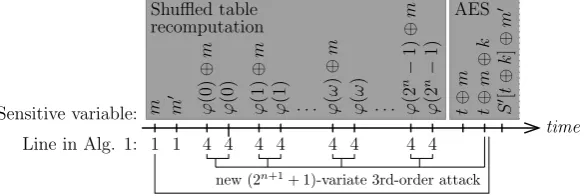
the leakage of the ϕ(ω) in Eq. 3 and Eq. 4 which plays the role of U in Eq. 5 will be combined (by a centered product) to recover a variable depending on the mask. Then these 2n variables will be combined together (by a sum) before being combined (again by a centered product) with a leakage depending on the key. This gives us a rough idea of the attack. We illustrate it on Fig. 1, which represents the “trace” corresponding to thedynamic executionof Alg.1, followed by the masked AES AddRoundKey & SubBytes steps).
new (2n+1+ 1)-variate 3rd-order attack
1 1 4 4 4 4 4 4
state-of-the-art bivariate 2nd-order attack
Sensitive variable:
Line in Alg. 1: 4 4 time
m ′m ϕ(0
) ⊕ m ϕ (0 ) ϕ (1 ) ⊕ m ϕ (1 ) t ⊕ m t ⊕ m ⊕ k S
′[t
⊕ k ] ⊕ m ′ ϕ ( ω ) ⊕ m ϕ ( ω )
. . . ϕ(2
n− 1) ϕ (2 n− 1) ⊕ m Shuffled table recomputation AES
Fig. 1: State-of-the-art attack and new attack investigated in this article
4.2 Multivariate attacks against table recomputation
In the previous section, it is shown that at each turn of the loop of the table recomputation, it is possible to extract a value depending on the mask. As a consequence it is possible to use all of these values to perform a multivariate attack. In this subsection we give the formal formula of this new attack. Let us define the leakages of the table recomputation. The leakage of the masked random index in the loop is given by:HW[Φ(ω)⊕M] +Nω(1). The leakage of the
random index is given by:HW[Φ(ω)] +Nω(2).
Depending on the knowledge about the model, the leakage could be cen-tered by the “true” expectation or by the estimation of this expectation. We assume this expectation is a known value given by:EHW[Φ(ω)⊕m] +Nω1
= EHW[Φ(ω)] +Nω2
= n
2. Then let us denote by: Xω(1) =HW[Φ(ω)⊕M] +Nω(1)−n
2 , (6)
Xω(2) =HW[Φ(ω)] +Nω(2)−n
2 . (7)
Let us denote the leakage of the maskedAddRoundKey:
X?=HW[T⊕M⊕k?] +N−n
2 . (8)
To use all the leakages of the table recomputation an original combination function could be defined.
Definition 2 The combination function exploiting the leakage of the table re-computationCtr is given by:
Ctr: R2 n+1
×R −→ R
Xω(1), Xω(2)
ω, X
?
7−→−2× 1 2n
P2n−1
ω=0 X
(1)
ω ×Xω(2)
Following the Fig. 1 it can be noticed that Ctr is in fact the combination
of two sub-combination functions. Indeed first the leakages of the table recom-putation are combined, the results of this combination is the following value:
Xtr=−2×
1 2n
2n−1
X
ω=0
Xω(1)×Xω(2) . (9)
Then this value is combined withX?.
Based on the combination functionCtr, a multivariate attack can be built.
Definition 3 The MultiVariate Attack exploiting the leakage of the table recom-putation is given by the function :
MVAtr: R2 n+1
×R×R −→ Fn2
Xω(1), Xω(2)
ω, X
?, Y
7−→argmax
K∈Fn2 ρhCtr
Xω(1), Xω(2)
ω, X
?, Yi ,
whereY =E HW[T ⊕M⊕K]−n2
· HW[M]−n
2
|T, Kandρthe Pear-son coefficient.
Proposition 1. MVAtr is sound.
Remark 1 The attack presented in Def.3is a2n+1+ 1multivariate third order attack.
Let us denote the leakage of the mask by:
X(3) =HW[M] +N(3)−n
2 . (10)
In the rest of the paper we denote by 2O-CPA the CPA using the centered product as combination function.
2O-CPA : R×R×R −→ Fn2
X(3), X?, Y
7−→argmax
K∈Fn2
ρhX(3)×X?, Yi .
Using the Def.2, Def.3and Eq.9, it can be noticed that the only difference between the MVAtr and the 2O-CPA is the use ofXtr instead ofX(3).Xtr will
act as the leakage of the mask. Let us callXtr thesecond order leakage.
Remark 2 The informative part of the second order leakage is the same as the informative part of the leakage mask i.e.
E[Xtr|M =m] =E
h
X(3)|M =mi .
4.3 Leakage analysis
By using the formula of the theoretical success rate we show that as the same operations are targeted by the MVAtr and the 2O-CPA then it is equivalent to
compare the SNR and compare the SR of the attacks. Based on this fact we can theoretically establish the conditions in which the MVAtr outperforms the
2O-CPA. This conditions are given in Theorem2.
Recently A.A Ding et al. [10,§3.4] give the following formula to establish the Success Rate (SR) of second-order attacks:
SR =ΦNk−1 √
bδ0δ1
4 K
−1/2κ
!
.
In this formula:
– δ0 denotes the SNR of the first share andδ1denotes the SNR of the second one;
– ΦNk−1denotes the cumulative distribution function of (Nk−1)-dimensional standard Gaussian distribution; as underlined by the authors in [10], if the noise distribution is not multi-variate Gaussian, thenΦNkis to be understood as its cumulative distribution function.
– Nk denotes the number of key candidates.
– Kdenotes the confusion matrix andκthe confusion coefficient.
– bdenotes the number of traces.
This formula allows to establish the link between the SNR and SR of second order attacks against Boolean masking schemes.
Let us apply the A.A Ding et al. formula in the case of our two attacks:
SR2O-CPA=Φ2n−1 √
bSNR
X(3), M
SNR [X?,(T, M)]
4 K
−1/2
κ
!
,
SRMVAtr =Φ2n−1
√
bSNR [Xtr, M] SNR [X
?,(T, M)]
4 K
−1/2κ
.
We target the same operation for the share that leaks the secret key (X?).
Moreover by remark 2 the informative parts of the leakages depending on the mask (Xtr andX(3) ) is the same in the two leakages. As a consequence theK
andκare the same in the two attacks.
It can be noticed that the only difference in the formulas of the success rate is the use of SNR [Xtr, M] instead of SNRX(3), M. Then it is equivalent to
compare these values and compare the SR of the attacks.
Theorem 2. The SNR of the “second-order leakage” is greater than the SNR of the leakage of the mask if and only if
σ262n−2−n 2 ,
whereσ denotes the standard deviation of the Gaussian noise.
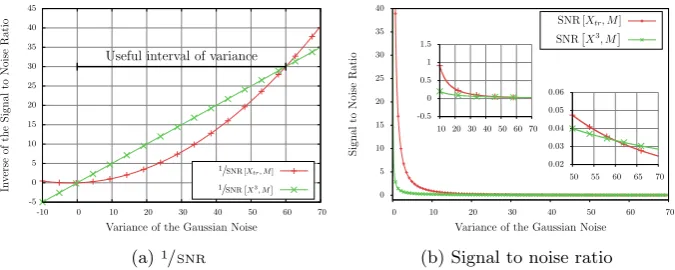
Theorem2gives us the cases where exploiting the second-order leakage will give better results than exploiting the classical leakage of the mask. For example ifn= 8 (the case of AES) the second-order leakage is better untilσ2660.
Fig.2 shows when the SNR ofXtr is greater than the SNR ofX3. In order
to have a better representation of this interval1/SNRis also plotted in Fig.2a. It is easy to observe that the largest difference in Fig.2aoccurs at1
2 2
n−2
−n
2
, i.e., in the middle of theuseful interval of variance.
-5 0 5 10 15 20 25 30 35 40 45
-10 0 10 20 30 40 50 60 70
In
verse
of
the
Sign
al
to
Noise
Ratio
Variance of the Gaussian Noise Useful interval of variance
1/SNR [Xtr, M] 1/SNR
X3, M
(a)1/SNR
0 5 10 15 20 25 30 35 40
0 10 20 30 40 50 60 70
Signal
to
Noise
Ratio
Variance of the Gaussian Noise
-0.5 0 0.5 1 1.5
10 20 30 40 50 60 70
0.02 0.03 0.04 0.05 0.06
50 55 60 65 70
SNR [Xtr, M]
SNR
X3, M
(b) Signal to noise ratio
Fig. 2: Comparison between the variance of the noise for the classical leakage and the second-order and the impact of these noises on the SNR.
4.4 Simulation results
In order to validate empirically the results of the section4, we test the method presented on simulated data. The target is a first order protected AES with table recomputation. To simulate the leakages we assume that each value leaks its Hamming weight with a Gaussian noise of standard deviation σ. The 512 leakages of the table recomputation are those given in Subsect.4.2.
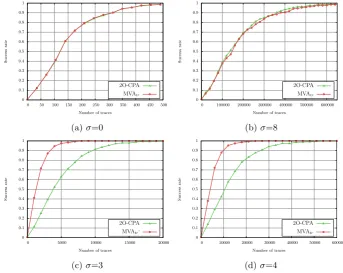
1000 attacks are realized to compute the success rate of each experiment. In this part, the comparisons are done on the number of traces needed to reach 80% of success.
It can be seen in Fig.3aand in In Fig.3bthat the difference between the two attacks is null forσ= 0 andσ= 8. It confirms the bound of the interval shown in Fig.2. This also confirms that comparing the SNR is equivalent to comparing the SR.
It can be seen in Fig.3 that in presence of noise the MVAtr outperforms
the 2O-CPA. The highest difference between the MVAtr and 2O-CPA is reached
when σ = 3. In this case, the MVAtr needs 2500 traces to mount the attack
0 0.1 0.2 0.3 0.4 0.5 0.6 0.7 0.8 0.9 1
0 50 100 150 200 250 300 350 400 450 500
Success
rate
Number of traces
2O-CPA MVAtr
(a)σ=0
0 0.1 0.2 0.3 0.4 0.5 0.6 0.7 0.8 0.9 1
0 100000 200000 300000 400000 500000 600000
Success
rat
e
Number of traces
2O-CPA MVAtr
(b)σ=8
0 0.1 0.2 0.3 0.4 0.5 0.6 0.7 0.8 0.9 1
0 5000 10000 15000 20000
Success
rate
Number of traces
2O-CPA MVAtr’
(c)σ=3
0 0.1 0.2 0.3 0.4 0.5 0.6 0.7 0.8 0.9 1
0 10000 20000 30000 40000 50000 60000
Success
rate
Number of traces
2O-CPA MVAtr
(d)σ=4
Fig. 3: Comparison between 2O-CPA and MVAtr.
5
An example on high-order countermeasure
The result of the previous section could be extended to any masking scheme based on table recomputation. In particular the MVAtr could be extended to
High-Order masking schemes.
5.1 Coron masking scheme attack and countermeasure
The use of table recomputation could be extended to High-Order masking schemes. An approach has been proposed by Schramm and Paar [24]. However this mask-ing scheme can be defeated by a third order attack [8]. To avoid this vulnera-bility Coron recently presented [7] a new method based on table recomputation. This method provides a high-order masking (see Alg. 2). The core idea of this method is to mask each output of the S-Box by different mask and refresh the set of masks between each shift of the table. HV attacks are still a threat against such schemes. Indeed iteratively an attacker will recover each input maskxi.
is possible. It can be noticed that the entropy needed to build the permutation could be low compare to the entropy needed for the masking scheme.
Algorithm 2: Masked computation ofy=S(x)
input :x1, . . . , xd, such thatx=x1⊕. . .⊕xd
output:y1, . . . , yd, such thaty=y1⊕. . .⊕yd=S(x) 1 forω∈Fn2 do
2 T(ω)←(S(ω),0, . . . ,0)∈(Fn2) d
// ⊕(T(ω)) =S(u) 3 end
4 fori= 1 toi=d−1do// ⊕(T(ϕ(ω))) =S(ϕ(ω)⊕x1, . . . ,⊕xd−1)∀ω∈Fn2 5 forω∈Fn2 do
6 forj= 1toddo
7 T0(ϕ(ω)) [j]←T(ϕ(ω)⊕xi) [j]// T0(ϕ(ω))←T(ϕ(ω)⊕xi) 8 end
9 end
10 forω∈Fn2 do
11 T(ϕ(ω))←RefreshMasks(T(ϕ(ω)))
// ⊕(T(ϕ(ω))) =S(ϕ(ω)⊕x1, . . . ,⊕xi) 12 end
13 end
14 (y1, . . . , yd)←RefreshMasks(T(xn))// ⊕(T(xd)) =S(x) 15 returny1, . . . , yn
5.2 Attack on the countermeasure
Similarly to the definitions in Subsect.4.2let us define the leakages of the table recomputation of the masking scheme of Coron where the order of the masking
isd−1 : X((1)ω,i,j)=HW[Φi(ω)⊕Mi] +N((1)ω,i,j)−n2 andX((2)ω,i,j)=HW[Φi(ω)] +
N((2)ω,i,j)−n2. wherei∈J1, d−1Kwill index the d−1 masks. The d-th share is
the masked sensitive value. And j ∈ J1, dK denotes the index of the loop from
lines6 to lines9 of the Alg.2.
The leakage of the masks is given byXi(3)=HW[Mi] +Ni(3)−n2 And let us denote by:X?=HW[Ld−1
i=0(Mi)⊕k?⊕T] +N−n2 the leakages
of the masked value.
Definition 4 The combination function exploiting the leakage of the table re-computationCtr is given by:
Ccsd : Rd×(d−1)×2 n+1
×R → R
X((1)ω,i,j), X((2)ω,i,j) ω∈F2n
i∈J1,d−1K
j∈J1,dK
, X?
7→
d−1
Y
i=1
−2 d2n
X
ω∈F2n
j∈J1,dK
X((1)ω,i,j)×X((2)ω,i,j)
×
Similarly to Subsection4.3we could define:
XCSi(d) = −2 d2n
X
ω∈F2n
j∈J1,dK
X((1)ω,i,j)×X((2)ω,i,j) .
This value is the combination of all the leaking values of the table recomputation depending of one share. Based on the combination function a multivariate attack can be built.
Definition 5 The MultiVariate Attack exploiting the leakage of the table recom-putation of the d−1 order Coron masking Scheme is given by:
MVAdcs: Rd×(d−1)×2 n+1
×R×R → Fn2
X((1)ω,i,j), X((2)ω,i,j) ω∈F2n
i∈J1,d−1K
j∈J1,dK
, X?, Y
7→argmax
K∈Fn2 ρ
"d−1
Y
i=1
(XCSi(d))×X
?, Y
#
,
whereY =HW[T⊕K]−n
2
Proposition 3. MVAcs is sound.
Remark 3 The attack presented in Def.3is ad×(d−1)×2n+1+1multivariate 2×(d−1) + 1order attack.
HOCPA can be built by combining the d shares using the centered prod-uct combination function. In the rest of this article we denote such attacks by “classical” dO-CPA.
dO-CPA : Rd−1×R×R −→ Fn2
Xi(3)
i∈J1,d−1K
, X?, Y
7−→argmax
K∈Fn2 ρ
"
X?×
d−1
Y
i=1 Xi(3), Y
#
.
5.3 Leakage analysis
The difference between the two attacks is the use ofXCSi(d) instead ofX (3)
i as
the leakage of thed−1 shares which do not leak the secret key. A.A Ding et al. also provides a formula to compute the SR of HOCPA[10,§3.4].
Similarly to Sect. 4 the only differences in the formula are the SNR of the shares which do not leak the key. Then by comparing the SNR [XCSi(d), Mi] and SNRhXi(3), Mi
i
Theorem 4. The SNR of the “second-order leakage” is greater than the SNR of the leakage of the mask if and only if
σ26d×2n−2−n2 , (11) whereσ denotes the standard deviation of the Gaussian noise.
As a consequence MVAtr will be better than 2O-CPA when the noise is in
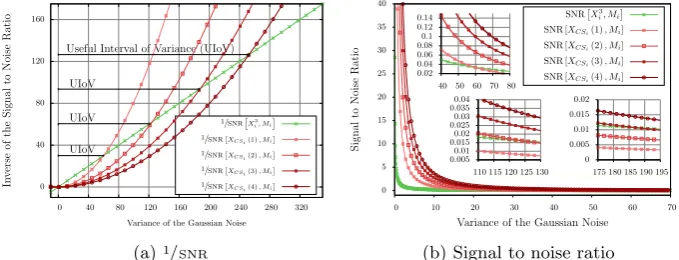
this interval. We can immediately deduce that the size of the Useful Interval of Variance increases linearly with the order of the masking scheme.
Fig.4aand Fig.4bshow the impact of the orderdof the attack on the interval of noise where the MVAd
CS outperfomsdO-CPA (let us called this interval the
Useful Interval of Variance). We can see that the size of these intervals increases with the order. For example ford= 3 the useful interval of variance is [0,124]. It is almost impossible to perform a second order attack with a noise variance of 124. 0 40 80 120 160
0 40 80 120 160 200 240 280 320
In verse of the Sign al to Noise Ratio
Variance of the Gaussian Noise
UIoV UIoV UIoV
Useful Interval of Variance (UIoV)
1/SNRh X3
i, Mi
i 1/SNR
XCSi(1), Mi
1/SNR
XCSi(2), Mi
1/SNR
XCSi(3), Mi
1/SNRX
CSi(4), Mi
(a)1/SNR
0 5 10 15 20 25 30 35 40
0 10 20 30 40 50 60 70
Signal
to
Noise
Ratio
Variance of the Gaussian Noise
0.02 0.04 0.06 0.08 0.1 0.12 0.14
40 5060 70 80
0.005 0.01 0.015 0.02 0.025 0.03 0.035 0.04
110 115 120 125 130 0 0.005 0.01 0.015 0.02
175 180 185 190 195
SNR
X3 i, Mi
SNR [XCSi(1), Mi]
SNR [XCSi(2), Mi]
SNR [XCSi(3), Mi]
SNR [XCSi(4), Mi]
(b) Signal to noise ratio
Fig. 4: Comparison between the signal to noise ratio of Xi3 and signal to noise ratio ofXCS(d−1) (wheredis the order of the attack)
5.4 Simulation results on Coron Masking Scheme
In order to validate the theoretical results of the Subsect.5.3 the MVACS was
tested on simulated data and compared todO-CPA. The simulations have been done with the Hamming weight model and Gaussian noise such as the leakages defined in Subsect.5.2. We test these attacks against a second and a third order masking scheme.
To compute the success rate the attacks are redone 500 times for the second order masking and 100 times for the third order masking.
In Fig.5a it can be seen that MVA3
cs reaches 80% of success rate for less
the 20000 traces while the 3O-CPA does not reach 30% for 100000. In Fig.5bit can be seen that MVA4
csreaches 80% of success rate for less than 200000 traces
0 0.1 0.2 0.3 0.4 0.5 0.6 0.7 0.8 0.9 1
0 20000 40000 60000 80000 100000 120000
Success
rate
Number of traces
3O-CPA MVA3
cs
(a)σ=3
0 0.1 0.2 0.3 0.4 0.5 0.6 0.7 0.8 0.9 1
0 100000 200000 300000
Success
rate
Number of traces
4O-CPA MVA4
cs
(b)σ=3
Fig. 5: Comparison between the 4O-CPA and the MVA4
cs
6
A note on affine model
In Section4 the leakage function was expected to be the Hamming weight. Let us now study the impact of the leakage function on the MVAtr. We suppose that
the leakage function is affine.
6.1 Properties of the affine model
A leakage function is said affine if this function is a weighted sum of the bit of the leaking value. As a consequence the leakage function could be rewritten as Ψα(V) =α·V, whereV is the leaking value,αthe weight of the leakage of each
bit and· the inner product.
Assumption 1 In order to compare the results in case of an affine model and the Hamming weight model let us assume that the variance is the same in the two cases i.e. Var[L(α, V)] =Var[HW[V]] this is equivalent tokαk2
2=n . Let us also assume that all the values manipulated during the algorithm leak in the same way i.e. the weight vector α of the sum is the same for all the variablesV of the algorithm.
Let us redefine the leakage of the table recomputation the (centered) leakage of the random index: Xω(1) =α·(Φ(ω)⊕M) +Nω(1)−12(α·1) , the (centered)
leakage of the mask random index: Xω(2) = α·(Φ(ω)) +Nω(2)−12(α·1). And
the (centered) leakage of the mask:X(3)=α·M−1
2(α·1). And letX? be the leakage of a sensitive value depending on the key.
6.2 Theoretical analysis
Similarly to the subsection 4.3 let us study the impact of the affine model on the success of the MVAtr compared to the 2O-CPA.
As motivated in Sec.4.1, we can modify the MVAtr in order to target the
Theorem 5. The SNR of the “second-order leakage” is greater than the SNR of the leakage of the mask if and only if
σ26kαk44×2
n−2
n −
n 2 ,
whereσdenotes the standard deviation of the Gaussian noise.
As a consequence MVAtr will be better than 2O-CPA when the noise is in
this interval.
Corollary 6. The minkαk2 2=nkαk
4
4 is reached when all the component of αare equal. This means that the worst case for the MVAtr compare to the 2O-CPA is
when the leakage is in Hamming Weight.
6.3 Simulation results
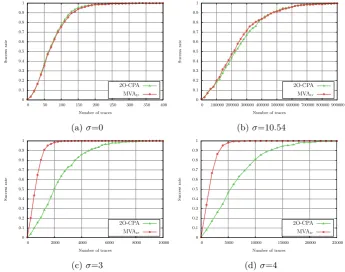
In order to validate the results of the theoretical study of the previous section some simulations have been done.
The target considered is the input of the S-Box of the last round; as a con-sequence we considerX?=α· Sbox−1[T⊕k?]⊕M
+N−12(α·1).
The maskM and the plain textT are randomly drawn fromF82. The noises are drawn from a Gaussian distribution with different variance σ2. The results of the attacks are expressed using the Success rate. To compute the success rates the experiments have been redone 1000 times. For each experiment the secret keyk?are randomly drawn overF82. To compare the efficiency of the two attacks we compare the number of traces needed to reach 80% of success.
For the first experiment let us choiceαsuch asαi=
r
1 + (−1)i mod 2×ε with ε= 0,9. In this casekαk4
4 = 14.480 and following the result of the Theo-rem 5, the MVAtr should outperform the classical success rate in the interval:
[0,111]. It can be seen in Fig.6aand 6bthat in such case whenσ2= 0 or when σ2= 111 the MVAtr and the 2O-CPA need the same number of traces to reach
80% of success. This confirms first of all the soundness of our model and also that in case of affine model when the target is proceeded in a non linear part of the cryptographic algorithm, the main difference between the two attacks is the SNR. When the standard deviation of the Gaussian noise σ = 3 the 2O-CPA needs around 3800 traces to reach 80% of success whereas the MVAtr needs
around 1000 traces (Fig.6c). This represents a gain of 280%. Compared to the gain observed in case of the Hamming weight model this confirm that the MVAtr
performs better compare to the 2O-CPA in case of an affine model. It can be seen in Fig.6d, when the σ= 4, the number of traces needed to reach 80% of success is around 2500 for the MVAtr and around 10000 for the 2O-CPA; this
represents a gain of 300%.
7
Practical validation
0 0.1 0.2 0.3 0.4 0.5 0.6 0.7 0.8 0.9 1
0 50 100 150 200 250 300 350 400
Success
rate
Number of traces
2O-CPA MVAtr
(a)σ=0
0 0.1 0.2 0.3 0.4 0.5 0.6 0.7 0.8 0.9 1
0 100000 200000 300000 400000 500000 600000 700000 800000 900000
Success
rat
e
Number of traces
2O-CPA MVAtr
(b)σ=10.54
0 0.1 0.2 0.3 0.4 0.5 0.6 0.7 0.8 0.9 1
0 2000 4000 6000 8000 10000
Success
rate
Number of traces
2O-CPA MVAtr
(c)σ=3
0 0.1 0.2 0.3 0.4 0.5 0.6 0.7 0.8 0.9 1
0 5000 10000 15000 20000 25000
Success
rate
Number of traces
2O-CPA MVAtr
(d)σ=4
Fig. 6: Comparison between 2O-CPA and MVAtr forε= 0.9.
the execution of an AES with table recomputation executed on an ATMega163 8-bit smartcard which is known to be leaky. To build our experiments 13000 traces have been acquired.
Let us first study the results of the attack. They are expressed using the suc-cess rate. The leakage function as been recovered using a linear regression. Both the MVAtr and the 2O-CPA target:Sbox[T⊕k?]⊕M as in our implementation
the input and output masks are the same.
It can be seen in Fig.7athat the results of the two attacks are similar. Both attacks perform similarly because the curves are not noisy.
Indeed the average values of the SNR of the 256 leakages of the masked random index (Φ(ω)⊕M) and the SNR of the 256 leakages of the random index (Φ(ω)) is 5. If we assume that the variance of the signal is equal to two (such as HW on 8 bit CPU) then the variance of the noise is less than 0.5. The mask (M) and the key-dependent share Sbox[T ⊕k?]⊕M) leak with a SNR of 14 which corresponds to a noise variance of 0.1, which is very low (compared to the upper bound of the useful interval of variance given in Theorem2, namely 60).
This two results are specific to the implementation and a clear disadvantage for the MVAtr. But even in this case the MVAtr works as well as the 2O-CPA,
In order to confirm these results let us verify that when the noise increases the MVAtr outperforms the 2O-CPA. Let us add a Gaussian noise with a standard
deviation of 0.040. Then it can be seen in Fig7b that in this case the MVAtr
outperforms the 2O-CPA. This confirms that the gain is in the SNR.
0 0.1 0.2 0.3 0.4 0.5 0.6 0.7 0.8 0.9 1
0 50 100 150 200 250
Success
rate
Number of traces
2O-CPA MVAtr
(a) Comparison on raw traces
0 0.1 0.2 0.3 0.4 0.5 0.6 0.7 0.8 0.9 1
50 100 150 200 250 300 350 400
Success
rat
e
Number of traces
2O-CPA MVAtr
(b) Comparison with noise addition
Fig. 7: Comparison of the SR of the MVAtr and the 2O-CPA
8
Conclusions and Perspectives
The table recomputation is a known weakness of masking schemes. We have re-called that practical countermeasures could be built to protect the table recom-putation. In this article, we have presented a new multivariate attack exploiting the leakage of the protected table that outperformed classical HODPA even if a large amount of entropy is used to generate the countermeasure. This multivari-ate attack gives an example of an HOSCA of non-minimal order which is more efficient than the corresponding minimal order HODPA. We have theoretically expressed the bound of noise in which this attack outperforms HOCPA using the SNR. Then we have empirically validated this bound. Moreover, we have shown that the gain to use the multivariate attack grows linearly with the order of the masking schemes. This result highlights the fact that the study of masking scheme should take into account as second parameter the number of variables exploitable by theses attacks. Indeed we have shown in this article that when the number of variables used to perform the attacks increases, the order does not alone provide a criterion to evaluate the security of the countermeasure, and that theSNR is a better security metric to consider.
References
1. Mehdi-Laurent Akkar and Christophe Giraud. An Implementation of DES and AES Secure against Some Attacks. In LNCS, editor, Proceedings of CHES’01, volume 2162 ofLNCS, pages 309–318. Springer, May 2001. Paris, France. 2. Johannes Bl¨omer, Jorge Guajardo, and Volker Krummel. Provably Secure Masking
of AES. In Helena Handschuh and M. Anwar Hasan, editors, Selected Areas in Cryptography, volume 3357 of Lecture Notes in Computer Science, pages 69–83. Springer, 2004.
3. ´Eric Brier, Christophe Clavier, and Francis Olivier. Correlation Power Analysis with a Leakage Model. In CHES, volume 3156 ofLNCS, pages 16–29. Springer, August 11–13 2004. Cambridge, MA, USA.
4. Nicolas Bruneau, Sylvain Guilley, Annelie Heuser, and Olivier Rioul. Masks Will Fall Off – Higher-Order Optimal Distinguishers. In Palash Sarkar and Tetsu Iwata, editors, Advances in Cryptology – ASIACRYPT 2014 - 20th International Con-ference on the Theory and Application of Cryptology and Information Security, Kaoshiung, Taiwan, R.O.C., December 7-11, 2014, Proceedings, Part II, volume 8874 ofLecture Notes in Computer Science, pages 344–365. Springer, 2014. 5. Suresh Chari, Charanjit S. Jutla, Josyula R. Rao, and Pankaj Rohatgi. Towards
Sound Approaches to Counteract Power-Analysis Attacks. In CRYPTO, volume 1666 of LNCS. Springer, August 15-19 1999. Santa Barbara, CA, USA. ISBN: 3-540-66347-9.
6. Christophe Clavier, Benoit Feix, Georges Gagnerot, Myl`ene Roussellet, and Vin-cent Verneuil. Improved Collision-Correlation Power Analysis on First Order Pro-tected AES. In Bart Preneel and Tsuyoshi Takagi, editors,CHES, volume 6917 of
LNCS, pages 49–62. Springer, 2011.
7. Jean-S´ebastien Coron. Higher order masking of look-up tables. In Phong Q. Nguyen and Elisabeth Oswald, editors, Advances in Cryptology - EUROCRYPT 2014 - 33rd Annual International Conference on the Theory and Applications of Cryptographic Techniques, Copenhagen, Denmark, May 11-15, 2014. Proceedings, volume 8441 ofLecture Notes in Computer Science, pages 441–458. Springer, 2014. 8. Jean-S´ebastien Coron, Emmanuel Prouff, and Matthieu Rivain. Side Channel Cryptanalysis of a Higher Order Masking Scheme. In Pascal Paillier and Ingrid Verbauwhede, editors,CHES, volume 4727 ofLNCS, pages 28–44. Springer, 2007. 9. Alexander DeTrano, Sylvain Guilley, Xiaofei Guo, Naghmeh Karimi, and Ramesh Karri. Exploiting small leakages in masks to turn a second-order attack into a first-order attack. InProceedings of the Fourth Workshop on Hardware and Architectural Support for Security and Privacy, HASP ’15, pages 7:1–7:5, New York, NY, USA, 2015. ACM.
10. A. Adam Ding, Liwei Zhang, Yunsi Fei, and Pei Luo. A statistical model for higher order DPA on masked devices. In Lejla Batina and Matthew Robshaw, editors,
Cryptographic Hardware and Embedded Systems - CHES 2014 - 16th International Workshop, Busan, South Korea, September 23-26, 2014. Proceedings, volume 8731 ofLecture Notes in Computer Science, pages 147–169. Springer, 2014.
11. Yunsi Fei, Qiasi Luo, and A. Adam Ding. A Statistical Model for DPA with Novel Algorithmic Confusion Analysis. In Emmanuel Prouff and Patrick Schaumont, editors,CHES, volume 7428 ofLNCS, pages 233–250. Springer, 2012.
13. Paul C. Kocher, Joshua Jaffe, and Benjamin Jun. Differential power analysis. In Michael J. Wiener, editor, CRYPTO, volume 1666 ofLecture Notes in Computer Science, pages 388–397. Springer, 1999.
14. Paul C. Kocher, Joshua Jaffe, and Benjamin Jun. Differential Power Analysis. In Proceedings of CRYPTO’99, volume 1666 ofLNCS, pages 388–397. Springer-Verlag, 1999.
15. Houssem Maghrebi, Emmanuel Prouff, Sylvain Guilley, and Jean-Luc Danger. A First-Order Leak-Free Masking Countermeasure. Cryptology ePrint Archive, Re-port 2012/028, 2012. http://eprint.iacr.org/2012/028.
16. Thomas S. Messerges. Securing the AES Finalists Against Power Analysis Attacks. InFast Software Encryption’00, pages 150–164. Springer-Verlag, April 2000. New York.
17. Thomas S. Messerges. Using second-Order Power Analysis to Attack DPA resistant Software. In CHES, volume 1965 of LNCS, pages 71–77. Springer, August 17-18 2000. Worcester, MA, USA.
18. Thomas S. Messerges. Using Second-Order Power Analysis to Attack DPA Resis-tant Software. In CHES, volume 1965 ofLNCS, pages 238–251. Springer-Verlag, August 17-18 2000. Worcester, MA, USA.
19. Elisabeth Oswald and Stefan Mangard. Template Attacks on Masking — Resis-tance Is Futile. In Masayuki Abe, editor,CT-RSA, volume 4377 ofLecture Notes in Computer Science, pages 243–256. Springer, 2007.
20. Jing Pan, J. I. den Hartog, and Jiqiang Lu. You cannot hide behind the mask: Power analysis on a provably secure s-box implementation. In Heung Youl Youm and Moti Yung, editors,WISA, volume 5932 ofLecture Notes in Computer Science, pages 178–192. Springer, 2009.
21. Emmanuel Prouff and Matthieu Rivain. A Generic Method for Secure SBox Imple-mentation. In Sehun Kim, Moti Yung, and Hyung-Woo Lee, editors,WISA, volume 4867 ofLecture Notes in Computer Science, pages 227–244. Springer, 2007. 22. Emmanuel Prouff, Matthieu Rivain, and R´egis Bevan. Statistical Analysis of
Sec-ond Order Differential Power Analysis. IEEE Trans. Computers, 58(6):799–811, 2009.
23. Matthieu Rivain and Emmanuel Prouff. Provably Secure Higher-Order Masking of AES. In Stefan Mangard and Fran¸cois-Xavier Standaert, editors,CHES, volume 6225 ofLNCS, pages 413–427. Springer, 2010.
24. Kai Schramm and Christof Paar. Higher Order Masking of the AES. In David Pointcheval, editor,CT-RSA, volume 3860 ofLNCS, pages 208–225. Springer, 2006. 25. Fran¸cois-Xavier Standaert, Nicolas Veyrat-Charvillon, Elisabeth Oswald, Benedikt Gierlichs, Marcel Medwed, Markus Kasper, and Stefan Mangard. The World is Not Enough: Another Look on Second-Order DPA. InASIACRYPT, volume 6477 of
LNCS, pages 112–129. Springer, December 5-9 2010. Singapore.http://www.dice. ucl.ac.be/~fstandae/PUBLIS/88.pdf.
26. Michael Tunstall, Carolyn Whitnall, and Elisabeth Oswald. Masking Tables - An Underestimated Security Risk. IACR Cryptology ePrint Archive, 2013:735, 2013. 27. Jason Waddle and David Wagner. Towards Efficient Second-Order Power Analysis.