Comparison of CdZnTe neutron detector models
using MCNP6 and Geant4
Emma Wilson
∗, Mike Anderson
∗†, David Prendergast
†and David Cheneler
∗∗
Department of Engineering, Lancaster University, Lancaster, LA1 4YW, UK. E-mail: [email protected]
†Innovative Physics Ltd., Shanklin, Isle of Wight, PO37 7JB, UK.
Abstract
—The production of accurate detector models is of
high importance in the development and use of detectors.
Initially, MCNP and Geant were developed to specialise in
neutral particle models and accelerator models, respectively;
there is now a greater overlap of the capabilities of both, and
it is therefore useful to produce comparative models to evaluate
detector characteristics. In a collaboration between Lancaster
University, UK, and Innovative Physics Ltd., UK, models have
been developed in both MCNP6 and Geant4 of Cadmium Zinc
Telluride (CdZnTe) detectors developed by Innovative Physics
Ltd. Herein, a comparison is made of the relative strengths of
MCNP6 and Geant4 for modelling neutron flux and secondary
γ
-ray emission. Given the increasing overlap of the modelling
capabilities of MCNP6 and Geant4, it is worthwhile to comment
on differences in results for simulations which have similarities
in terms of geometries and source configurations.
I. I
NTRODUCTIONIn order to maintain and improve safety standards within
the nuclear sector, more emphasis is placed on novel detector
materials and configurations for use in nuclear power,
decom-missioning, and security, as well as for other applications. It is
for this reason that the capability to accurately mathematically
model detector response is essential; in the first instance this
would be a check of the applicability of the detector for the
planned purpose.
Both MCNP6 [1] and Geant4 [2] are widely used nuclear
and radiation simulation tools, and both have their
specialisa-tions which arise from the background and purpose of their
development. An understanding of the difference capabilities
and, where appropriate, direct comparisons of these tools is
essential, as it give an indication of which is more appropriate
in a given circumstance. Previous work in this field has
compared the capabilities of MCNP and Geant4 in areas
including medicine [3], nuclear power [4], and security [5],
although the development of both MCNP and Geant4, and
the associated cross-section data, is on-going such that the
individual capabilities of the codes vary.
Cadmium zinc telluride (CdZnTe, or CZT) radiation
de-tectors are widely used in
γ-ray spectroscopy as a
room-temperature, semiconductor-based detector. This is of
partic-ular use as CdZnTe detectors possess an improved energy
resolution, when compared to scintillation-based radiation
de-tectors, and, unlike high-purity germanium, has a sufficiently
wide band-gap to significantly reduce thermal excitation of
electrons across the gap, and therefore CdZnTe detectors do
TABLE I
THE HIGHEST INTENSITY PROMPT SECONDARYγ-RAYS PRODUCED AS A RESULT OF NEUTRON CAPTURE ON ACDZNTE DETECTOR.
Reaction Eγ(keV) Reaction Eγ (keV)
112Cd(n,nγ) 617.5 110Cd(n,nγ) 657.8 114Cd(n,nγ) 558.5 111Cd(n,nγ) 245.4 128Te(n,nγ) 743.2 126Te(n,nγ) 666.3 130Te(n,nγ) 839.4 64Zn(n,nγ) 991.6 112Cd(n,nγ) 606.9 113Cd(n,nγ) 558.3 114Cd(n,nγ) 576.1 113Cd(n,nγ) 651.2 128Te(n,nγ) 753.8 111Cd(n,nγ) 245.3 130Te(n,nγ) 748.8
not require liquid nitrogen cooling [6].The mechanism for the
detection of neutrons with CdZnTe detectors is via thermal
neutron capture on
113Cd, resulting in a series of
γ-rays which
can then be detected in the same manner as with standard
γ-ray spectroscopy. CdZnTe neutron detection has been used in
a variety of areas, including around medical accelerators [7]
and for the detection of special nuclear materials [8].
II. M
ATERIALS ANDM
ETHODOLOGYBoth models use a
252Cf neutron source and a CdZnTe
detector, in this instance composed of 48% Cd, 2% Zn, and
the remainder comprised of Te. Of particular interest is the
production of secondary particles within the detector.
The mechanism by which CdZnTe detects neutrons is via
neutron capture and the emission of secondary
γ-rays from
the resulting excited nucleus, which will then result in the
production of photoelectrons [9], [10].
113Cd has an
excep-tionally high neutron capture cross-section of 20 615 barns at
thermal neutron energies [11] [12] and such an event results
in characteristic
γ-rays of the following energies [13]:
113
Cd
+
n
→
114Cd
∗→
γ
1(558.6 keV)
+
γ
2(651.3 keV)
+
further
γ
Further characteristic
γ-rays emitted from CdZnTe from
thermal neutron capture are shown in Table I [7], [13], [14].
Most of these
γ-ray transitions decay through the first excited
state in
114Cd.
CZT
Neutrons
252
Cf Source
x mm
5 cm
Fig. 1. A simplified sketch of the set-up used in both MCNP and Geant4 simuations.
Figure 1 shows a basic version of the setup used. The
neutron source emits either a range of energies from a
252Cf
source, which are describes in reference [16]. The
252Cf
Lancaster University neutron source may be used in order to
best compare theoretical models with experimental results. The
thickness of a CdZnTe detector varies, but the value of 1 mm
is within the thickness range commonly used [17], [18], [19].
A. MCNP
MCNP6 is a combination of the capabilities of MCNP5 and
MCNPX, as well as the further development of both of these
codes by groups at Los Alamos National Laboratory, where
neutron transport codes have been developed since the 1950s
[20]. Later development of photon transport codes, and the
merger of the two lead to the release of the MCNP3 (originally
Monte Carlo Neutron Photon, now Monte Carlo N-Particle) in
1983.
Figure 2 shows cross-section comparisons of the
ENDF/B-VII.1 and JENDL-3.3 cross section files. The cross-sections
used in MCNP6 are selected while building the input file,
with the cross-section data being selected as the isotopes, or
ZAID, of each material are built.
The neutron discrete energy cross section libraries for most
nuclei are from the ENDF/B-VII.0 or ENDF/B-VII.1, the latter
of which is the most recent. There are various cross-section
libraries for reactions taking place at different temperatures
[23], [24]. In these simulations, the cross-sections used for
each material are listed in table II.
B. Geant4
Geant4 is a Monte Carlo simulation toolkit for the
sim-ulation of particles travelling through and interacting with
matter. It is a C++ implemented open-source code, developed
by a worldwide collaboration of physicists. Geant4 is used
within a wide variety of scientific fields, in topics as diverse as
high-energy particle physics, nuclear physics, medical science,
1e-08 1e-04 1e+00
Incident Energy (MeV)
1100 10000 1e+06
Cross Section (barns)
ENDF/B-VIII.b4 JENDL-3.3
Fig. 2. The cross-section libraries ENDF/B-VII.1 [23] and JENDL-3.3 [25] available for the 114Cd(n,total) reaction. Data extracted from International
Atomic Energy Authority database [21].
Fig. 3. A simple model produced in MCNP6, where the detector is in the centre, and on either side are pixellated slices of air, the number of which varied, used to produce the radiation flux on the front and rear of the detector.
TABLE II
THEMCNP6MATERIALS USED TO MODEL THE DETECTOR,AND THEIR RESPECTIVE CROSS-SECTION INFORMATION. ALSO INCLUDING THE
RATIO OF EACH MATERIAL USED IN THESE SIMULATIONS.
Material Cross-section source Temperature (K) Ratio (%)
Zn ENDF/B-VII.0 293.6 5
Cd ENDF/B-V 300 45
Te ENDF/B-VII.1 293.6 50
1 mm CdZnTe
Fig. 4. The simulation of neutron captures using MCNP6, in various thickness of CdZnTe detector. For the purpose of this simulation, the detector was split into 10x10 pixels.
and accelerator physics. The version used in the simulations
described here is Geant4-10.3, released December 2016, patch
1, released February 2017.
Geant4 allows for the modelling of secondary particles.
Various physics lists are available for elastic and inelastic
hadron scattering; for the relatively low-energy neutrons used
here the BERT (Bertini cascade) and BIC (Binary cascade)
models are applicable. These both allow for the modelling of
protons, neutrons and pions, with BERT also being able to
model kaons and hyperons. The energy ranges are 0 - 15 GeV
for BERT, and 0 - 5 GeV for BIC [26]. The PhysicsList() used
in this instance uses a combination of high precision neutron
physics (HP), for the neutron interactions, and electromagnetic
physics, for the electrons, and
γ-rays within the simulation.
The cross-section data for the simulation comes from a
variety of sources, depending on the interaction of interest. For
the neutron interactions, this comes from G4NDL4.5, which
is mainly based on the ENSDF/B-VII library. Also of use is
the TENDL1.3 cross-section data set, which is used in Geant4
for the sections of incident particles. TENDL1.5
cross-sections for neutron capture, and subsequent
γ-ray emission,
on
113Cd are illustrated in figure 2.
III. R
ESULTS ANDA
NALYSISA. MCNP
Figure 4 shows the capture of neutrons from a
252Cf neutron
source in various thickness of CdZnTe detector material. This
is the results of the simulation of 10
10iniital neutrons. The
expectation would be that the thicker a shield or detector is,
the more neutron capture events occur. The simulation agrees
with this expectation.
Figure 5 shows the fluxes of neutrons from
252Cf source
in various thickness of CdZnTe. This is the results of the
1 mm CdZnTe
Fig. 5. The simulation of neutron fluxes using MCNP6, on the rear of 1 mm, 2 mm, 5mm, and 10mm CZT blocks. For the purpose of this simulation,the region at the rear of the detector was split into 10x10 pixels.
TABLE III
DETAILING THE MAJOR PEAKS OBSERVED IN THEγ-RAY SPECTRUM PRODUCED AS A RESULT OF THE NEUTRON CAPTURE ON ACDZNTE DETECTOR. PEAK FITTING OF THE THEORETICAL RESULTS WAS PERFORMED USINGROOT,WITH THE ENERGIES AND THE ERROR MEASUREMENTS ON THE ENERGIES COMING FROM THIS PEAK FITTING.
Eγ(keV) Reaction Experimental Energy (keV)
245.473(4) 111Cd(n,nγ) 245.395(20) [27]
558.334(3) 114Cd(n,nγ) 558.456(2) [13]
606.931(1) 112Cd(n,nγ) 606.821 (6) [29]
617.651(3) 112Cd(n,nγ) 617.518(3) [29]
650.978(1) 114Cd(n,nγ) 651.256(5) [13]
657.607(8) 110Cd(n,nγ) 657.7600(11) [30]
666.255(30) 126Te(n,nγ) 666.331(12) [31]
742.966(8) 128Te(n,nγ) 743.22(2) [32]
748.968(8) 130Te(n,nγ) 748.76(2) [33]
753.654(9) 128Te(n,nγ) 753.82(2) [32]
839.429(1) 130Te(n,nγ) 839.49(2) [33]
991.853(16) 64Zn(n,nγ) 991.56(5) [34]
simulation of 10
10iniital neutrons. As would be expected,
a greater neutron flux is observed on the rear of the detector
when the detector thickness is smaller.
B. Geant4
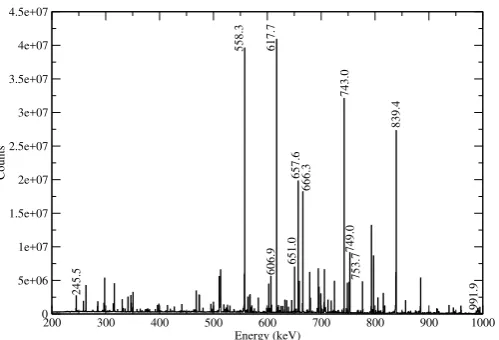
Figure 6 shows the
γ-spectrum resulting from the interaction
of neutrons from a
252Cf source and a CdZnTe detector.
CZT
Neutrons
252
Cf Source
x mm
5 cm
Fig. 1. A simplified sketch of the set-up used in both MCNP and Geant4 simuations.
Figure 1 shows a basic version of the setup used. The
neutron source emits either a range of energies from a
252Cf
source, which are describes in reference [16]. The
252Cf
Lancaster University neutron source may be used in order to
best compare theoretical models with experimental results. The
thickness of a CdZnTe detector varies, but the value of 1 mm
is within the thickness range commonly used [17], [18], [19].
A. MCNP
MCNP6 is a combination of the capabilities of MCNP5 and
MCNPX, as well as the further development of both of these
codes by groups at Los Alamos National Laboratory, where
neutron transport codes have been developed since the 1950s
[20]. Later development of photon transport codes, and the
merger of the two lead to the release of the MCNP3 (originally
Monte Carlo Neutron Photon, now Monte Carlo N-Particle) in
1983.
Figure 2 shows cross-section comparisons of the
ENDF/B-VII.1 and JENDL-3.3 cross section files. The cross-sections
used in MCNP6 are selected while building the input file,
with the cross-section data being selected as the isotopes, or
ZAID, of each material are built.
The neutron discrete energy cross section libraries for most
nuclei are from the ENDF/B-VII.0 or ENDF/B-VII.1, the latter
of which is the most recent. There are various cross-section
libraries for reactions taking place at different temperatures
[23], [24]. In these simulations, the cross-sections used for
each material are listed in table II.
B. Geant4
Geant4 is a Monte Carlo simulation toolkit for the
sim-ulation of particles travelling through and interacting with
matter. It is a C++ implemented open-source code, developed
by a worldwide collaboration of physicists. Geant4 is used
within a wide variety of scientific fields, in topics as diverse as
high-energy particle physics, nuclear physics, medical science,
1e-08 1e-04 1e+00
Incident Energy (MeV)
1100 10000 1e+06
Cross Section (barns)
ENDF/B-VIII.b4 JENDL-3.3
Fig. 2. The cross-section libraries ENDF/B-VII.1 [23] and JENDL-3.3 [25] available for the114Cd(n,total) reaction. Data extracted from International
Atomic Energy Authority database [21].
Fig. 3. A simple model produced in MCNP6, where the detector is in the centre, and on either side are pixellated slices of air, the number of which varied, used to produce the radiation flux on the front and rear of the detector.
TABLE II
THEMCNP6MATERIALS USED TO MODEL THE DETECTOR,AND THEIR RESPECTIVE CROSS-SECTION INFORMATION. ALSO INCLUDING THE
RATIO OF EACH MATERIAL USED IN THESE SIMULATIONS.
Material Cross-section source Temperature (K) Ratio (%)
Zn ENDF/B-VII.0 293.6 5
Cd ENDF/B-V 300 45
Te ENDF/B-VII.1 293.6 50
1 mm CdZnTe
Fig. 4. The simulation of neutron captures using MCNP6, in various thickness of CdZnTe detector. For the purpose of this simulation, the detector was split into 10x10 pixels.
and accelerator physics. The version used in the simulations
described here is Geant4-10.3, released December 2016, patch
1, released February 2017.
Geant4 allows for the modelling of secondary particles.
Various physics lists are available for elastic and inelastic
hadron scattering; for the relatively low-energy neutrons used
here the BERT (Bertini cascade) and BIC (Binary cascade)
models are applicable. These both allow for the modelling of
protons, neutrons and pions, with BERT also being able to
model kaons and hyperons. The energy ranges are 0 - 15 GeV
for BERT, and 0 - 5 GeV for BIC [26]. The PhysicsList() used
in this instance uses a combination of high precision neutron
physics (HP), for the neutron interactions, and electromagnetic
physics, for the electrons, and
γ-rays within the simulation.
The cross-section data for the simulation comes from a
variety of sources, depending on the interaction of interest. For
the neutron interactions, this comes from G4NDL4.5, which
is mainly based on the ENSDF/B-VII library. Also of use is
the TENDL1.3 cross-section data set, which is used in Geant4
for the sections of incident particles. TENDL1.5
cross-sections for neutron capture, and subsequent
γ-ray emission,
on
113Cd are illustrated in figure 2.
III. R
ESULTS ANDA
NALYSISA. MCNP
Figure 4 shows the capture of neutrons from a
252Cf neutron
source in various thickness of CdZnTe detector material. This
is the results of the simulation of 10
10iniital neutrons. The
expectation would be that the thicker a shield or detector is,
the more neutron capture events occur. The simulation agrees
with this expectation.
Figure 5 shows the fluxes of neutrons from
252Cf source
in various thickness of CdZnTe. This is the results of the
1 mm CdZnTe
Fig. 5. The simulation of neutron fluxes using MCNP6, on the rear of 1 mm, 2 mm, 5mm, and 10mm CZT blocks. For the purpose of this simulation,the region at the rear of the detector was split into 10x10 pixels.
TABLE III
DETAILING THE MAJOR PEAKS OBSERVED IN THEγ-RAY SPECTRUM PRODUCED AS A RESULT OF THE NEUTRON CAPTURE ON ACDZNTE DETECTOR. PEAK FITTING OF THE THEORETICAL RESULTS WAS PERFORMED USINGROOT,WITH THE ENERGIES AND THE ERROR MEASUREMENTS ON THE ENERGIES COMING FROM THIS PEAK FITTING.
Eγ(keV) Reaction Experimental Energy (keV)
245.473(4) 111Cd(n,nγ) 245.395(20) [27]
558.334(3) 114Cd(n,nγ) 558.456(2) [13]
606.931(1) 112Cd(n,nγ) 606.821 (6) [29]
617.651(3) 112Cd(n,nγ) 617.518(3) [29]
650.978(1) 114Cd(n,nγ) 651.256(5) [13]
657.607(8) 110Cd(n,nγ) 657.7600(11) [30]
666.255(30) 126Te(n,nγ) 666.331(12) [31]
742.966(8) 128Te(n,nγ) 743.22(2) [32]
748.968(8) 130Te(n,nγ) 748.76(2) [33]
753.654(9) 128Te(n,nγ) 753.82(2) [32]
839.429(1) 130Te(n,nγ) 839.49(2) [33]
991.853(16) 64Zn(n,nγ) 991.56(5) [34]
simulation of 10
10iniital neutrons. As would be expected,
a greater neutron flux is observed on the rear of the detector
when the detector thickness is smaller.
B. Geant4
Figure 6 shows the
γ-spectrum resulting from the interaction
of neutrons from a
252Cf source and a CdZnTe detector.
200 300 400 500 600 700 800 900 1000 Energy (keV)
0 5e+06 1e+07 1.5e+07 2e+07 2.5e+07 3e+07 3.5e+07 4e+07 4.5e+07
Counts
617.7
558.3
245.5
606.9
657.6
651.0
666.3
743.0
749.0
753.7
839.4
991.9
Fig. 6. The truncated γ-ray spectrum produced in Geant4 from a252Cf
neutron source and a 1.5 cm thick CdZnTe detector.
IV. C
ONCLUSIONMCNP6 is useful for modelling what reactions are induced
by the neutrons, and produces reasonable results for the
neutron capture and neutron fluxes. Future work in MCNP
may model which other neutron-induced reactions occur in
such an experiment. The modelling of secondary radiation is
possible with Geant4, and a spectrum which is in line with the
experimental data has been produced. In future, the modelling
of the electrons produced by the secondary
γ-rays, in a realistic
electric field, in possible. In addition, a comparison between
these theoretical results and experiment may be undertaken,
using the
252Cf neutron source at Lancaster University.
A
CKNOWLEDGMENTThis work is supported by the Engineering and Physical
Sciences Research Council (EPSRC), UK, via the Impact
Acceleration Account (IAA), in a collaboration between
Lan-caster University and Innovative Physics Ltd. The
contribu-tions of the Lancaster University technical staff are gratefully
acknowledged.
R
EFERENCES[1] T. Goorley, MCNP6.1.1-Beta Release Notes, LA-UR-14-24680, 2014. [2] S. Agostinelli, J. Allison, K. Amako, J. Apostolakis, H. Araujo, P. Arce,
M. Asai, D. Axen, S. Banerjee, G. Barrand, F. Behner, L. Bellagamba, J. Boudreau, L. Broglia, A. Brunengo, H. Burkhardt, S. Chauvie, J. Chuma, R. Chytracek, G. Cooperman, G. Cosmo, P. Degtyarenko, A. Dell’Acqua, G. Depaola, D. Dietrich, R. Enami, A. Feliciello, C. Ferguson, H. Fesefeldt, G. Folger, F. Foppiano, A. Forti, S. Garelli, S. Giani, R. Giannitrapani, D. Gibin, J.J. Gmez Cadenas, I. Gonzlez, G. Gracia Abril, G. Greeniaus, W. Greiner, V. Grichine, A. Grossheim, S. Guatelli, P. Gumplinger, R. Hamatsu, K. Hashimoto, H. Hasui, A. Heikkinen, A. Howard, V. Ivanchenko, A. Johnson, F.W. Jones, J. Kallenbach, N. Kanaya, M. Kawabata, Y. Kawabata, M. Kawaguti, S. Kelner, P. Kent, A. Kimura, T. Kodama, R. Kokoulin, M. Kossov, H. Kurashige, E. Lamanna, T. Lampn, V. Lara, V. Lefebure, F. Lei, M. Liendl, W. Lockman, F. Longo, S. Magni, M. Maire, E. Medernach, K. Minamimoto, P. Mora de Freitas, Y. Morita, K. Murakami, M. Nagamatu, R. Nartallo, P. Nieminen, T. Nishimura, K. Ohtsubo, M. Okamura, S. O’Neale, Y. Oohata, K. Paech, J. Perl, A. Pfeiffer, M.G. Pia, F. Ranjard, A. Rybin, S. Sadilov, E. Di Salvo, G. Santin, T. Sasaki, N. Savvas, Y. Sawada, S. Scherer, S. Sei, V.
Sirotenko, D. Smith, N. Starkov, H. Stoecker, J. Sulkimo, M. Takahata, S. Tanaka, E. Tcherniaev, E. Safai Tehrani, M. Tropeano, P. Truscott, H. Uno, L. Urban, P. Urban, M. Verderi, A. Walkden, W. Wander, H. Weber, J.P. Wellisch, T. Wenaus, D.C. Williams, D. Wright, T. Yamada, H. Yoshida, and D. Zschiesche, Geant4 - a simulation toolkit, Nucl. Instru. Meth. A 506, 250-303, 2003.
[3] L. Maigne, Y. Perrot, D. R. Schaart, D. Donnarieix, and V. Breton, Comparison of GATE/GEANT4 with EGSnrc and MCNP for electron dose calculations at energies between 15 keV and 20 MeV, Phys. Med. Biol., 56, 811-827, 2011.
[4] A.A. Hecht, R.E. Blakeley, W.J. Martin, and E. Leonard, Comparison of Geant4 and MCNP6 for use in delayed fission radiation simulation, Ann. Nucl. Energy, 69, 134-138, 2014.
[5] H. Yang, X. Yang, S. Xiao, N. Satvat and T. Jevremovic, Detection of hidden materials using Nuclear Resonance Fluorescence technique: Simulation and measurements, IEEE Nuclear Science Symposuim & Medical Imaging Conference, Knoxville, TN, 2010, pp. 531-533. [6] T.E. Schlesinger, J.E. Toney, H. Yoon, E.Y. Lee, B.A. Brunett, L. Franks,
and R.B. James, Cadmium zinc telluride and its use as a nuclear radiation detector material, Mater. Sci. Eng. R., 32, 103-189, 2001.
[7] A. Mart´ın-Mart´ın, M. P. I˜niguez, P. N. Luke, R. Barquero, A. Lorente, J. Morch´on, E. Gallego, G. Quincoces, J. M. Mart´ı-Climent, Evaluation of CdZnTe as neutron detector around medical accelerators. Radiat. Prot. Dosimetry, 133, 193-199, 2009.
[8] M. Streicher, S. Brown, Y. Zhu, D. Goodman and Z. He, ”Special Nuclear Material Characterization Using Digital 3-D Position Sensitive CdZnTe Detectors and High Purity Germanium Spectrometers,” in IEEE Transactions on Nuclear Science, vol. 63, no. 5, pp. 2649-2656, Oct. 2016.
[9] D.S. McGregor, J.T. Lindsay, R.W. Olsen, Thermal neutron detection with cadmium1x zincx telluride semiconductor detectors, Nuclear Instruments and Methods in Physics Research Section A: Accelerators, Spectrometers, Detectors and Associated Equipment, 381, 498-501, 1996.
[10] S. T. Brown, Time-Encoded Thermal Neutron Imaging Using Large-Volume Pixelated CdZnTe Detectors, PhD Thesis, University of Michi-gan, USA, 2017.
[11] S.F. Mughabghab, Atlas of Neutron Resonances: Resonance Parameters and Thermal Cross Sections. Z= 1-100, Elsevier, 2006.
[12] K. A. Nelson, N. Edwards, M. J. Harrison, A. Kargar, W. J. McNeil, R. A. Rojeski, and D. S. McGregor, Investigation of CdZnTe and LiNbO3
as electro-optic neutron detectors, Nucl. Instru. Meth. A 620, 363-367, 2010.
[13] J. Blachot, Nuclear Data Sheets for A = 114, Nucl. Data Sheets, 113, 515-714, 2012.
[14] R. C. Reedy, T. H. Prettyman and N. Yamashita, Backgrounds in cadmium zinc telluride (CZT) gamma-ray spectrometers for planetary science, Abstracts for 43rd Lunar & Planetary Science Conference (Houston, 19-23 Mar. 2012), #1284.
[15] M. Chu, S. Terterian, and D. Ting, Role of Zinc in CdZnTe Radiation Detectors, IEEE Transactions on Nuclear Science, 51, 2405-2411, Oct. 2004.
[16] A. B. Smith, P. R. Fields, and J. H. Roberts, Spontaneous Fission Neutron Spectrum of Cf252, Physical Review, 108, 411-413, 1957.
[17] D. Gagnon, G. L. Zeng, J. M. Links, J. J. Griesmer, and F. C. Valentino, Design considerations for a new solid-state gamma-camera: SOLSTICE, IEEE Nuclear Science Symposium and Medical Imaging Conference (Vol. 2, pp. 1156-1160), 2001.
[18] K. B. Parnham, J. Grosholz, R. K. Davis, S. Vydrin, and C. A. Cupec, Development of a CdZnTe-based small field-of-view gamma camera. Proc. SPIE 4508, Penetrating Radiation Systems and Applications III, 134, 2001.
[19] M. Prokesch, D. S. Bale and C. Szeles, Fast High-Flux Response of CdZnTe X-Ray Detectors by Optical Manipulation of Deep Level Defect Occupations, IEEE Transactions on Nuclear Science, 57, 2397-2399, Aug. 2010.
[20] T. Goorley, M. James, T. Booth, F. Brown, J. Bull, L.J. Cox, J. Durkee, J. Elson, M. Fensin, R.A. Forster, J. Hendricks, H.G. Hughes, R. Johns, B. Kiedrowski, R. Martz, S. Mashnik, G. McKinney, D. Pelowitz, R. Prael, J. Sweezy, L. Waters, T. Wilcox, and T. Zukaitis, Initial MCNP6 Release Overview, LA-UR 13-22934, 2013.
[21] V. Zerkin, Evaluated Nuclear Data File (ENDF) Database, Internet: https://www-nds.iaea.org/exfor/endf.htm, Mar. 10th, 2017 [May 23rd, 2017].
[22] M.B. Chadwick, M. Herman, P. Oblo˘zinsk´y, M.E. Dunn, Y. Danon, A.C. Kahler, D.L. Smith, B. Pritychenko, G. Arbanas, R. Arcilla, R. Brewer, D.A. Brown, R. Capote, A.D. Carlson, Y.S. Cho, H. Derrien, K. Guber, G.M. Hale, S. Hoblit, S. Holloway, T.D. Johnson, T. Kawano, B.C. Kiedrowski, H. Kim, S. Kunieda, N.M. Larson, L. Leal, J.P. Lestone, R.C. Little, E.A. McCutchan, R.E. MacFarlane, M. MacInnes, C.M. Mattoon, R.D. McKnight, S.F. Mughabghab, G.P.A. Nobre, G. Palmiotti, A. Palumbo, M.T. Pigni, V.G. Pronyaev, R.O. Sayer, A.A. Sonzogni, N.C. Summers, P. Talou, I.J. Thompson, A. Trkov, R.L. Vogt, S.C. van der Marck, A. Wallner, M.C. White, D. Wiarda, P.G. Young, ENDF/B-VII.1 Nuclear Data for Science and Technology: Cross Sections, Covariances, Fission Product Yields and Decay Data, Nuclear Data Sheets, 112, 2011, 2887-2996.
[23] M.B. Chadwick, M. Herman, P. Obloinsk, M.E. Dunn, Y. Danon, A.C. Kahler, D.L. Smith, B. Pritychenko, G. Arbanas, R. Arcilla, R. Brewer, D.A. Brown, R. Capote, A.D. Carlson, Y.S. Cho, H. Derrien, K. Guber, G.M. Hale, S. Hoblit, S. Holloway, T.D. Johnson, T. Kawano, B.C. Kiedrowski, H. Kim, S. Kunieda, N.M. Larson, L. Leal, J.P. Lestone, R.C. Little, E.A. McCutchan, R.E. MacFarlane, M. MacInnes, C.M. Mattoon, R.D. McKnight, S.F. Mughabghab, G.P.A. Nobre, G. Palmiotti, A. Palumbo, M.T. Pigni, V.G. Pronyaev, R.O. Sayer, A.A. Sonzogni, N.C. Summers, P. Talou, I.J. Thompson, A. Trkov, R.L. Vogt, S.C. van der Marck, A. Wallner, M.C. White, D. Wiarda, and P.G. Young, ENDF/B-VII.1 Nuclear Data for Science and Technology: Cross Sections, Covariances, Fission Product Yields and Decay Data, Nuclear Data Sheets, 112, 2887-2996, 2011.
[24] J. L. Conlin (ed.) and Nuclear Data Team XCP-5, Listing of Available ACE Data Tables, LA-UR-17-20709, 2017.
[25] K. Shibata, T. Kawano, T. Nakagawa, O. Iwamoto, J. Katakura, T. Fukahori, S. Chiba, A. Hasegawa, T. Murata, H. Matsunobu, T. Ohsawa, Y. Nakajima, T. Yoshida, A. Zukeran, M. Kawai, M. Baba, M. Ishikawa, T. Asami, T. Watanabe, Y. Watanabe, M. Igashira, N. Yamamuro, H. Kitazawa, N. Yamano and H. Takano, Japanese Evaluated Nuclear Data Library Version 3 Revision-3: JENDL-3.3, Journal of Nuclear Science and Technology, 39, 1125-1136, 2002.
[26] A. V. Ivantchenko, V. N. Ivanchenko, J-M. Quesada Molina and S. L. Incerti, Geant4 hadronic physics for space radiation environment, Int. J. Radiat. Biol., 88, 171-175, 2012.
[27] J. Blachot, Nuclear Data Sheet for A=111, Nuclear Data Sheets 110, 1239-1407, 2009.
[28] J. Blachot, Nuclear Data Sheet for A=114, Nuclear Data Sheets 113, 515-714, 2012.
[29] S. Lalkovski and F. G. Kondev, Nuclear Data Sheet for A=112, Nuclear Data Sheets 124, 157-412, 2015.
[30] G. G˜urdal and F. G. Kondev, Nuclear Data Sheet for A=110, Nuclear Data Sheets 113, 1315-1561, 2012.
[31] J. Katakura and K. Kitao, Nuclear Data Sheet for A=126, Nuclear Data Sheets 97, 765-926, 2002.
[32] Z. Elekes and J. Timar, Nuclear Data Sheet for A=1328, Nuclear Data Sheets 129, 191-436, 2015.
[33] B. Singh, Nuclear Data Sheet for A=130, Nuclear Data Sheets 93, 33-242, 2001.
200 300 400 500 600 700 800 900 1000 Energy (keV)
0 5e+06 1e+07 1.5e+07 2e+07 2.5e+07 3e+07 3.5e+07 4e+07 4.5e+07
Counts
617.7
558.3
245.5
606.9
657.6
651.0
666.3
743.0
749.0
753.7
839.4
991.9
Fig. 6. The truncated γ-ray spectrum produced in Geant4 from a252Cf
neutron source and a 1.5 cm thick CdZnTe detector.
IV. C
ONCLUSIONMCNP6 is useful for modelling what reactions are induced
by the neutrons, and produces reasonable results for the
neutron capture and neutron fluxes. Future work in MCNP
may model which other neutron-induced reactions occur in
such an experiment. The modelling of secondary radiation is
possible with Geant4, and a spectrum which is in line with the
experimental data has been produced. In future, the modelling
of the electrons produced by the secondary
γ-rays, in a realistic
electric field, in possible. In addition, a comparison between
these theoretical results and experiment may be undertaken,
using the
252Cf neutron source at Lancaster University.
A
CKNOWLEDGMENTThis work is supported by the Engineering and Physical
Sciences Research Council (EPSRC), UK, via the Impact
Acceleration Account (IAA), in a collaboration between
Lan-caster University and Innovative Physics Ltd. The
contribu-tions of the Lancaster University technical staff are gratefully
acknowledged.
R
EFERENCES[1] T. Goorley, MCNP6.1.1-Beta Release Notes, LA-UR-14-24680, 2014. [2] S. Agostinelli, J. Allison, K. Amako, J. Apostolakis, H. Araujo, P. Arce,
M. Asai, D. Axen, S. Banerjee, G. Barrand, F. Behner, L. Bellagamba, J. Boudreau, L. Broglia, A. Brunengo, H. Burkhardt, S. Chauvie, J. Chuma, R. Chytracek, G. Cooperman, G. Cosmo, P. Degtyarenko, A. Dell’Acqua, G. Depaola, D. Dietrich, R. Enami, A. Feliciello, C. Ferguson, H. Fesefeldt, G. Folger, F. Foppiano, A. Forti, S. Garelli, S. Giani, R. Giannitrapani, D. Gibin, J.J. Gmez Cadenas, I. Gonzlez, G. Gracia Abril, G. Greeniaus, W. Greiner, V. Grichine, A. Grossheim, S. Guatelli, P. Gumplinger, R. Hamatsu, K. Hashimoto, H. Hasui, A. Heikkinen, A. Howard, V. Ivanchenko, A. Johnson, F.W. Jones, J. Kallenbach, N. Kanaya, M. Kawabata, Y. Kawabata, M. Kawaguti, S. Kelner, P. Kent, A. Kimura, T. Kodama, R. Kokoulin, M. Kossov, H. Kurashige, E. Lamanna, T. Lampn, V. Lara, V. Lefebure, F. Lei, M. Liendl, W. Lockman, F. Longo, S. Magni, M. Maire, E. Medernach, K. Minamimoto, P. Mora de Freitas, Y. Morita, K. Murakami, M. Nagamatu, R. Nartallo, P. Nieminen, T. Nishimura, K. Ohtsubo, M. Okamura, S. O’Neale, Y. Oohata, K. Paech, J. Perl, A. Pfeiffer, M.G. Pia, F. Ranjard, A. Rybin, S. Sadilov, E. Di Salvo, G. Santin, T. Sasaki, N. Savvas, Y. Sawada, S. Scherer, S. Sei, V.
Sirotenko, D. Smith, N. Starkov, H. Stoecker, J. Sulkimo, M. Takahata, S. Tanaka, E. Tcherniaev, E. Safai Tehrani, M. Tropeano, P. Truscott, H. Uno, L. Urban, P. Urban, M. Verderi, A. Walkden, W. Wander, H. Weber, J.P. Wellisch, T. Wenaus, D.C. Williams, D. Wright, T. Yamada, H. Yoshida, and D. Zschiesche, Geant4 - a simulation toolkit, Nucl. Instru. Meth. A 506, 250-303, 2003.
[3] L. Maigne, Y. Perrot, D. R. Schaart, D. Donnarieix, and V. Breton, Comparison of GATE/GEANT4 with EGSnrc and MCNP for electron dose calculations at energies between 15 keV and 20 MeV, Phys. Med. Biol., 56, 811-827, 2011.
[4] A.A. Hecht, R.E. Blakeley, W.J. Martin, and E. Leonard, Comparison of Geant4 and MCNP6 for use in delayed fission radiation simulation, Ann. Nucl. Energy, 69, 134-138, 2014.
[5] H. Yang, X. Yang, S. Xiao, N. Satvat and T. Jevremovic, Detection of hidden materials using Nuclear Resonance Fluorescence technique: Simulation and measurements, IEEE Nuclear Science Symposuim & Medical Imaging Conference, Knoxville, TN, 2010, pp. 531-533. [6] T.E. Schlesinger, J.E. Toney, H. Yoon, E.Y. Lee, B.A. Brunett, L. Franks,
and R.B. James, Cadmium zinc telluride and its use as a nuclear radiation detector material, Mater. Sci. Eng. R., 32, 103-189, 2001.
[7] A. Mart´ın-Mart´ın, M. P. I˜niguez, P. N. Luke, R. Barquero, A. Lorente, J. Morch´on, E. Gallego, G. Quincoces, J. M. Mart´ı-Climent, Evaluation of CdZnTe as neutron detector around medical accelerators. Radiat. Prot. Dosimetry, 133, 193-199, 2009.
[8] M. Streicher, S. Brown, Y. Zhu, D. Goodman and Z. He, ”Special Nuclear Material Characterization Using Digital 3-D Position Sensitive CdZnTe Detectors and High Purity Germanium Spectrometers,” in IEEE Transactions on Nuclear Science, vol. 63, no. 5, pp. 2649-2656, Oct. 2016.
[9] D.S. McGregor, J.T. Lindsay, R.W. Olsen, Thermal neutron detection with cadmium1x zincx telluride semiconductor detectors, Nuclear Instruments and Methods in Physics Research Section A: Accelerators, Spectrometers, Detectors and Associated Equipment, 381, 498-501, 1996.
[10] S. T. Brown, Time-Encoded Thermal Neutron Imaging Using Large-Volume Pixelated CdZnTe Detectors, PhD Thesis, University of Michi-gan, USA, 2017.
[11] S.F. Mughabghab, Atlas of Neutron Resonances: Resonance Parameters and Thermal Cross Sections. Z= 1-100, Elsevier, 2006.
[12] K. A. Nelson, N. Edwards, M. J. Harrison, A. Kargar, W. J. McNeil, R. A. Rojeski, and D. S. McGregor, Investigation of CdZnTe and LiNbO3
as electro-optic neutron detectors, Nucl. Instru. Meth. A 620, 363-367, 2010.
[13] J. Blachot, Nuclear Data Sheets for A = 114, Nucl. Data Sheets, 113, 515-714, 2012.
[14] R. C. Reedy, T. H. Prettyman and N. Yamashita, Backgrounds in cadmium zinc telluride (CZT) gamma-ray spectrometers for planetary science, Abstracts for 43rd Lunar & Planetary Science Conference (Houston, 19-23 Mar. 2012), #1284.
[15] M. Chu, S. Terterian, and D. Ting, Role of Zinc in CdZnTe Radiation Detectors, IEEE Transactions on Nuclear Science, 51, 2405-2411, Oct. 2004.
[16] A. B. Smith, P. R. Fields, and J. H. Roberts, Spontaneous Fission Neutron Spectrum of Cf252, Physical Review, 108, 411-413, 1957.
[17] D. Gagnon, G. L. Zeng, J. M. Links, J. J. Griesmer, and F. C. Valentino, Design considerations for a new solid-state gamma-camera: SOLSTICE, IEEE Nuclear Science Symposium and Medical Imaging Conference (Vol. 2, pp. 1156-1160), 2001.
[18] K. B. Parnham, J. Grosholz, R. K. Davis, S. Vydrin, and C. A. Cupec, Development of a CdZnTe-based small field-of-view gamma camera. Proc. SPIE 4508, Penetrating Radiation Systems and Applications III, 134, 2001.
[19] M. Prokesch, D. S. Bale and C. Szeles, Fast High-Flux Response of CdZnTe X-Ray Detectors by Optical Manipulation of Deep Level Defect Occupations, IEEE Transactions on Nuclear Science, 57, 2397-2399, Aug. 2010.
[20] T. Goorley, M. James, T. Booth, F. Brown, J. Bull, L.J. Cox, J. Durkee, J. Elson, M. Fensin, R.A. Forster, J. Hendricks, H.G. Hughes, R. Johns, B. Kiedrowski, R. Martz, S. Mashnik, G. McKinney, D. Pelowitz, R. Prael, J. Sweezy, L. Waters, T. Wilcox, and T. Zukaitis, Initial MCNP6 Release Overview, LA-UR 13-22934, 2013.
[21] V. Zerkin, Evaluated Nuclear Data File (ENDF) Database, Internet: https://www-nds.iaea.org/exfor/endf.htm, Mar. 10th, 2017 [May 23rd, 2017].
[22] M.B. Chadwick, M. Herman, P. Oblo˘zinsk´y, M.E. Dunn, Y. Danon, A.C. Kahler, D.L. Smith, B. Pritychenko, G. Arbanas, R. Arcilla, R. Brewer, D.A. Brown, R. Capote, A.D. Carlson, Y.S. Cho, H. Derrien, K. Guber, G.M. Hale, S. Hoblit, S. Holloway, T.D. Johnson, T. Kawano, B.C. Kiedrowski, H. Kim, S. Kunieda, N.M. Larson, L. Leal, J.P. Lestone, R.C. Little, E.A. McCutchan, R.E. MacFarlane, M. MacInnes, C.M. Mattoon, R.D. McKnight, S.F. Mughabghab, G.P.A. Nobre, G. Palmiotti, A. Palumbo, M.T. Pigni, V.G. Pronyaev, R.O. Sayer, A.A. Sonzogni, N.C. Summers, P. Talou, I.J. Thompson, A. Trkov, R.L. Vogt, S.C. van der Marck, A. Wallner, M.C. White, D. Wiarda, P.G. Young, ENDF/B-VII.1 Nuclear Data for Science and Technology: Cross Sections, Covariances, Fission Product Yields and Decay Data, Nuclear Data Sheets, 112, 2011, 2887-2996.
[23] M.B. Chadwick, M. Herman, P. Obloinsk, M.E. Dunn, Y. Danon, A.C. Kahler, D.L. Smith, B. Pritychenko, G. Arbanas, R. Arcilla, R. Brewer, D.A. Brown, R. Capote, A.D. Carlson, Y.S. Cho, H. Derrien, K. Guber, G.M. Hale, S. Hoblit, S. Holloway, T.D. Johnson, T. Kawano, B.C. Kiedrowski, H. Kim, S. Kunieda, N.M. Larson, L. Leal, J.P. Lestone, R.C. Little, E.A. McCutchan, R.E. MacFarlane, M. MacInnes, C.M. Mattoon, R.D. McKnight, S.F. Mughabghab, G.P.A. Nobre, G. Palmiotti, A. Palumbo, M.T. Pigni, V.G. Pronyaev, R.O. Sayer, A.A. Sonzogni, N.C. Summers, P. Talou, I.J. Thompson, A. Trkov, R.L. Vogt, S.C. van der Marck, A. Wallner, M.C. White, D. Wiarda, and P.G. Young, ENDF/B-VII.1 Nuclear Data for Science and Technology: Cross Sections, Covariances, Fission Product Yields and Decay Data, Nuclear Data Sheets, 112, 2887-2996, 2011.
[24] J. L. Conlin (ed.) and Nuclear Data Team XCP-5, Listing of Available ACE Data Tables, LA-UR-17-20709, 2017.
[25] K. Shibata, T. Kawano, T. Nakagawa, O. Iwamoto, J. Katakura, T. Fukahori, S. Chiba, A. Hasegawa, T. Murata, H. Matsunobu, T. Ohsawa, Y. Nakajima, T. Yoshida, A. Zukeran, M. Kawai, M. Baba, M. Ishikawa, T. Asami, T. Watanabe, Y. Watanabe, M. Igashira, N. Yamamuro, H. Kitazawa, N. Yamano and H. Takano, Japanese Evaluated Nuclear Data Library Version 3 Revision-3: JENDL-3.3, Journal of Nuclear Science and Technology, 39, 1125-1136, 2002.
[26] A. V. Ivantchenko, V. N. Ivanchenko, J-M. Quesada Molina and S. L. Incerti, Geant4 hadronic physics for space radiation environment, Int. J. Radiat. Biol., 88, 171-175, 2012.
[27] J. Blachot, Nuclear Data Sheet for A=111, Nuclear Data Sheets 110, 1239-1407, 2009.
[28] J. Blachot, Nuclear Data Sheet for A=114, Nuclear Data Sheets 113, 515-714, 2012.
[29] S. Lalkovski and F. G. Kondev, Nuclear Data Sheet for A=112, Nuclear Data Sheets 124, 157-412, 2015.
[30] G. G˜urdal and F. G. Kondev, Nuclear Data Sheet for A=110, Nuclear Data Sheets 113, 1315-1561, 2012.
[31] J. Katakura and K. Kitao, Nuclear Data Sheet for A=126, Nuclear Data Sheets 97, 765-926, 2002.
[32] Z. Elekes and J. Timar, Nuclear Data Sheet for A=1328, Nuclear Data Sheets 129, 191-436, 2015.
[33] B. Singh, Nuclear Data Sheet for A=130, Nuclear Data Sheets 93, 33-242, 2001.