© 2014, IJCSMC All Rights Reserved 807 Available Online atwww.ijcsmc.com
International Journal of Computer Science and Mobile Computing
A Monthly Journal of Computer Science and Information Technology
ISSN 2320–088X
IJCSMC, Vol. 3, Issue. 3, March 2014, pg.807 – 814
RESEARCH ARTICLE
A Fuzzy Based Model for Software Quality
Estimation Using Risk Parameter Assessment
Anjali Kinra
Department of Computer Sciences, ITM University, Gurgaon, India
[email protected]
Abstract—Software Cost Estimation is the challenging factor in project management. Accurate cost estimation helps to complete project with in time and budget. Due to this behavior of the project it is considered as a risky project .Under these conditions risk management is mandatory. Large numbers of estimation models have been proposed over the last 30 years. Constructive Cost Model (COCOMO) is one of existing model, which is used for estimation and also for fuzzy based analysis. In this paper, we are using fuzzy based approach which is used for software quality estimation. Fuzzy Logic was primarily bestowed in to check however rule based system can solve the software effort estimation drawback. The aim of this paper is to analyze the process, product and platform based attribute by applying rule based system. Analysis is divided in to two stages; the fuzzification of individual risk and a collaborative analysis with fuzzy modeling. These will be performed to conclude the software quality.
Keywords- Fuzzification; COCOMO; SLIM, Function Point; Risk; Risk attribute
I. INTRODUCTION
© 2014, IJCSMC All Rights Reserved 808
Estimation and Software Risk Assessment. The most significant effort estimation models[1] that have been utilized within the programming development projects will be the Constructive Cost Model (COCOMO), the System Evaluation and Estimation of Resource Software Evaluation Model (SEER-SEM) ,and the Software Life Management (SLIM) model[2]. Barry Boehm developed COCOMO model in 1980’s, is the most widely used estimation model for software project. Even though the risk assessment (identification and analysis) is conducted together with the software estimation in the Project Planning phase, risk identification and analysis is usually done separately from cost estimation. The Expert-COCOMO model improves on this process by utilizing the information taken from the effort estimation step to establish a risk assessment for a particular software project. The cost factors in the form of scale factors and effort multipliers in the COCOMO model become the inputs for the Expert-COCOMO model. The output for the model is a list of software risks that are related to the Expert-COCOMO price variables, such as: Schedule Risk, Product Risk, Platform Risk, Personnel Risk, Process Risk, and Reuse Risk[3]. The software risk taxonomy within the Expert-COCOMO model is presented in Fig 1.1. In second and third section of the paper we have a tendency to discuss regarding COCOMO, and in fourth section, we describe the proposed work based on fuzzy technique.
Fig 1.1 Risk Attributes [4] II. COCOMO
The term COCOMO means “Constructive Cost Model”. It helps to calculate effort, cost and schedule for software project [4]. This model was proposed by Barry W. Boehm. COCOMO first version named as “COCOMO81” and it became one of the popular cost estimation models of 1980’s.COCOMO Model may apply to three different modes of software project [5]. These modes are as follows:-
1) Organic: In this mode, a small software team is conducted for software development in an extremely acquainted environment.
2) Semi-detached: This mode is sounds like a bridge between the organic and embedded modes. It will either be seen as a combination of characteristics of both modes or a middle level of project characteristic.
3) Embedded: In which, the product is developed inside an extremely coupled complex of hardware, Software and operational constraints. Now , we will discuss the three different levels of COCOMO in detail:
A. Basic COCOMO
© 2014, IJCSMC All Rights Reserved 809
Effort=X× (Size) y,
Where;
X, Y: Constants (depend upon the software project mode).
Size: Size of the software (in KLOCs).
Effort: Estimated effort in units of PMs).
When calculating the evaluated development time in this level, the measure of the estimated effort is utilized as the main parameter. The following equation is used to calculate the development time:
The point when ascertaining the evaluated advancement time in this level, the measure of the assessed exertion is utilized as the fundamental parameter. The accompanying equation is utilized to ascertain the improvement time:
Time dev = S ×(Effort) T
Where,
S, T: Constants (depend upon the software project mode).
Effort: Previously calculated estimated effort (expressed in PMs).
Timedev: Estimated development time (expressed in Months)
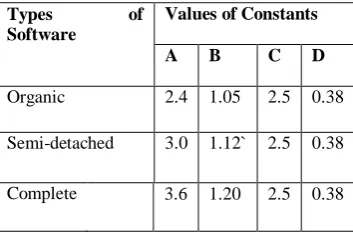
Table 2.1
Constant values for different classes
B. Intermediate COCOMO
The intermediate COCOMO is sort of a wrapper level for the basic COCOMO and it uses the calculable values from the basic COCOMO adds some additional parameters to the estimation formula and recalculates the estimation. This estimation is claimed to be more realistic as it contains numerous aspects that have effect on the amount of needed effort and time to comprehend a software project rather than one aspect.
In the perspective of intermediate COCOMO, there are 15 different factors that influence a software project. These factors are arranged in 4- different classes:
Software Product
Reliability Requirement
Database Size
Product Complexity
Types of Software
Values of Constants A B C D
Organic 2.4 1.05 2.5 0.38
Semi-detached 3.0 1.12` 2.5 0.38
© 2014, IJCSMC All Rights Reserved 810
Computer System
Execution Time Constraints
Main Storage Constraints
Virtual Machine Volatility
Computer Turnaround Time
Hardware Resources
Analyst Capability
Virtual Machine Experience
Programmer Capability
Programming Language Experience
Application Experience
Software Project
Use of Modern Programming Practices
Use of Software Tools
Required development Schedule
C. Complete COCOMO
Most programming frameworks, particularly the large ones, consist of distinctive parts or subsystems. The intricacy for each of these parts or subsystems is doubtlessly not quite the same as others. Considering this substance, the complete COCOMO recognizes the framework as heterogeneous in nature. As stated by the complete COCOMO, a product framework is made out of different segments or subsystems where each of these components or subsystems has diverse characteristics from one another.
III. COCOMO II
COCOMO faced a ton of issues to evaluating the costs of software that created new life cycle process for example, rapid development process model and object-oriented approaches. Therefore, COCOMO-II was provided in 1995 having three sub models; an application-composition model, an early design model and a post-architecture model. COCOMO-II has, a set of seventeen Effort Multipliers (EM) or cost drivers as an input, which are used to conform the nominal effort (PM) to reflect the software product being produced.
IV. Fuzzy Logic
The concept of fuzzy logic (FL) is not a bearing methodology, however could be a means of process knowledge by permitting partial set membership rather than crisp set membership or non-membership. It supports fuzzy set theory and introduced in 1965 by Prof. L.A Zadeh in the paper fuzzy sets [6]. If feedback controllers may well be programmed just to accept noisy and imprecise input, they may be far more effective and perhaps easier to implement. FL is a problem-solving control system methodology that lends itself to implementation within the system ranging from simple, small, embedded micro-controllers to large, networked, multi-channel PC or workstation-based knowledge acquisition and management systems. It can be enforced in hardware, software, or a mixture of both.
A. Fuzzy Systems
© 2014, IJCSMC All Rights Reserved 811
as input and wants crisp data as output, the last sort is the most generally utilized fuzzy logic system with fuzzifier and defuzzifier. It was initially proposed by Mamdani [7]. It has been successfully applied to a variety of industrial processes and consumer products as show in Fig3.1 below:
1) Fuzzifier - It converts the crisp input into a fuzzy set, and to describe situation graphically, membership functions are used [8].
2) Fuzzy Rule Base- It uses “if-then rules” formulae.
3) Fuzzy Inference Engine- A collection of if -then rules put away in fuzzy rule base will be referred as inference engine. It performs two functions i.e., aggregation and composition.
4) Defuzzification - It converts fuzzy output into crisp output.
V. Proposed Work
A. Flow of Work
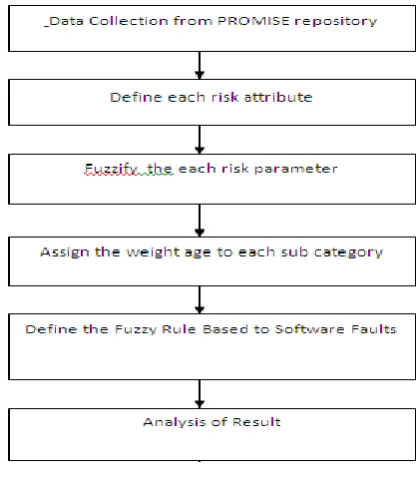
The proposedFuzzy based model will estimate software quality using Risk Parameter. Initially, collect the database from PROMISE repository [9]. This repository data set made openly accessible keeping in mind the end goal to support repeatable,verifiable, refutable and improvable predictive models of software engineering. It includes large number of risk attributes. Each attribute is described according to their category. Basically, it has four risk category, which are personal, platform, process and reuse. These categories are further split in to different sub categories as shown in Fig 4.1 Now apply the fuzzification on each risk attribute. Assign weight to each sub category. At last apply the rule based system on each software risk attribute. This store information set made openly accessible keeping in mind the end goal to support repeatable, certain
B. Fuzzy Rule Based System
Recognizing the data parameter x from the universe X, and the yield parameter y from the universe Y, the statement of a framework might be described with a rule base (RB) system in the following structure:
Rule1: IF x=A1 THEN y= B1
Rule2: IF x=A2 THEN y= B2
Rule n: IF x=An THEN y= Bn
This is indicated as a single input, single output (SISO) framework
If there is more than one rule proposition, i.e. the ith rule has the following form
Rule i: IF x1=A1i AND x2= A2i…THEN y=bi
© 2014, IJCSMC All Rights Reserved 812
Fig 4.1 Flow of work
After applying the rule based system to each category, we perform analysis on the basis of results occurred. Proposed Model as shown in Fig 4.2 above explains number of risk attributes which are individually fuzzified with the help of fuzzification method. There are large numbers of risk attributes that generally occur in any software project. Here, we simply name them as A1… A5.
Every risk attribute belongs to particular risk category. Basically, there are 4-categories of risk which are personal, process, reuse and platform. These all categories make the complete system.
Fig 4.2 Proposed Model
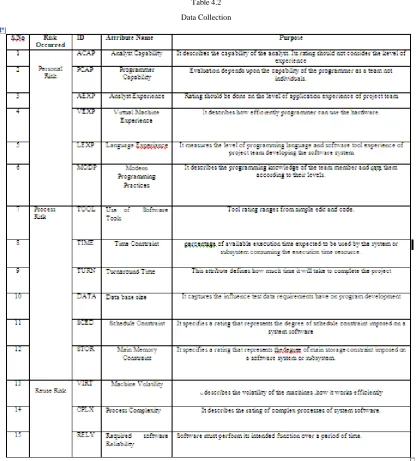
C. Data Collection
© 2014, IJCSMC All Rights Reserved 813 Table 4.2
© 2014, IJCSMC All Rights Reserved 814
Here, we describe the different risk attributes which are extracted from NASA repository [9]. The value of these risk attributes vary from “very low to extra high”. These Attributes value are identified according to the effort calculated on the different effort multiplier. There are large numbers of effort multipliers in the existing COCOMO Model. The effort multiplier used in the model helps to maintain and manage any software project. The range of each multiplier depends on the capability of programmer or the technician. Fuzzy is best approach for risk assessment and identification. It gives the accurate risk assessment on the basis of different risk attribute. We apply a fuzzification approach on every risk parameter for risk identification and then categorize them. A complete software system contains various risk categories. Now every parameter is distributed according to their category. One risk attribute may belong to two different categories. Now we apply the fuzzy rule based system on each category. It gives accurate software quality estimation of different risk parameters. In this way a fuzzy based model has been developed for software quality estimation on the basis of risk parameter.
VI. Conclusion
In this present work, a fuzzy based model is presented for software quality assessment using risk attributes. In all these approaches fuzzy logic techniques are applied on risk parameters for quality estimation of any software. This paper has presented the conceptual model of the presented work with detailed exploration of each stage.
VII.ACKNOWLEDGEMENT
I take this chance to express my earnest much obliged and profound appreciation to those individuals who enlarged their wholehearted co-operation and have helped me in completing this paper.
My deepest thanks to Dr. SUPRIYA PANDA, for guiding and rectifying various documents of mine with consideration and care. She has taken the ache to go through the complete paper again and again andmake important revisions as and when needed.
I also extended my heartfelt thanks to my family and well-wishers.
References
[1] Ekananta Manalif, Luiz Fernando Capretz and Danny Ho, Development of Integrated Software Project Planning Model based on Cost Factors and Fuzzy Technique.
[2] Galorath D. D. and Evans M. W., Software Sizing, Estimation, and Risk Management, Auerbach Publication, 2006. [3] Heldman K. and Heldman W., CompTIA Project+: Study Guide, Wiley Publishing Inc., 2010, pp.34.
[4] B.W. Boehm, “Software risk management: Principles and practice,” IEEE Software, Vol.8, Issue.1, Jan 1991, pp. 32-41.
[5] A Survey on COCOMO, Onur Yaman, SWE578 2011F
[6] Zadeh. L. A., Fuzzy Sets, Information and Control, 1965, Vol. 8, pp. 338-353
[7] Mamdani, E., H., Assilian, S. (1975), An experiment in linguistic synthesis with a fuzzy logic controller, Intern.,. J. Man-Machine Stud. 7. 1-13
![Fig 1.1 Risk Attributes [4]](https://thumb-us.123doks.com/thumbv2/123dok_us/1990324.1263303/2.595.211.437.237.494/fig-risk-attributes.webp)