ISSN(Online): 2319-8753 ISSN (Print): 2347-6710
I
nternational
J
ournal of
I
nnovative
R
esearch in
S
cience,
E
ngineering and
T
echnology
(An ISO 3297: 2007 Certified Organization)
Website: www.ijirset.com
Vol. 6, Issue 9, September 2017
Effect on Properties of Concrete by Using Saw
Dust Ash as Partial Replacement of Cement
Hardik Dhull
M.Tech Student, Dept. of CIVIL, M.D. University, Rohtak, Haryana, India
ABSTRACT : Saw dust is also known as wooden dust. It is the remains of cutting & drilling wood. It is composed of fine particles of wood, certain inserts which live in wood such as carpenter out. It is produced as small irregular chips or small garbage of wood during sowing the logs of wood into different sizes. In this study, saw dust ash prepared from uncontrolled burning of saw dust is evaluated for it suit ability as partial cement replacement in concrete. The strength parameters i.e. compressive strength of concrete with blended saw dust ash cement are evaluated & studied by replacing cement by 5%, 10%, 15%, 20% by wt. to OPC Slump Test was carried out on fresh concrete & compressive strength test was carried out on hardened concrete. Several cubes were tested at 7 and 28 day. The result showed that
saw dust ash is good replacement material for cement with Si02, Al2O3 & Fe2O3 of 72%. The slump value decreased
with increase in saw dust ash. The compressive strength increased up to 10% SDA content and then decreased with further increase of SDA content.
KEYWORDS: Concrete, cement, saw dust ash, compressive strength, workability.
I. INTRODUCTION
Generally concrete is composite construction material composed of cement and other filler material like coarse aggregates, fine aggregates, chemical admixtures & water for mixing. Depending upon nature of work the cement, fine aggregates, coarse aggregates & water on mixed in specific proportion to produce fresh & plain concrete. The aim of mix design is to achieve max. durability, workability and compressive strength as for as possible without compromising with quality. Engineers on trying to increase the limits of concrete with help of some innovative chemical admixture along with modified manufacturing technique
The use of concrete is increased & the rate of construction is increased. Concrete is used in construction of different structures with long life. In a survey consulted few years ago it was found that million tons of waste material is produced & burned every year like saw dust ash. Appropriate utilization of such waste materials brings ecological & economical benefits.
Saw dust ash is a waste material produced by timber industry. It is produced as timber is sown into planks at saw mills. This causes heaps of saw dust to be generated each day. So to use this waste material as replacement of cement is the focus of study. This study examined the use of saw dust ash as partial replacement for Ordinary Portland Cement (OPC) in concrete. It was observed that when fine aggregates were partially replaced with to 10%, 15%, 20%, 25% waste material there was some effect on workability and comprehensive strength of concrete. It involved determination of workability comprehensive strength of concrete.
II. LITERATURE REVIEW
ISSN(Online): 2319-8753 ISSN (Print): 2347-6710
I
nternational
J
ournal of
I
nnovative
R
esearch in
S
cience,
E
ngineering and
T
echnology
(An ISO 3297: 2007 Certified Organization)
Website: www.ijirset.com
Vol. 6, Issue 9, September 2017
III. OBJECTIVES
The main objective of this study is proper utilization of waste material (saw dust ash) as fine aggregates whichis mixed with OPC to investigate the effect of this saw dust ash on properties of concrete of M25 grade.
To evaluate and compare the result of workability and compressive strength of M25 grade concrete by usingwooden dust ash with standard concrete.
To ensure optimum use of domestic and industrial waste & reduce carbon footprints.
To generalize the properties of concrete with use of saw dust ash.IV. MATERIALS USED AND METHODOLOGY (i). Saw dust ash
A waste material from timber industry having following characteristics:-
Oxide % (by wt.)
SiO2 68.30
Al2O3 3.5
Fe2O3 2.23
MgO 5.4
CaO 5.0
(ii). Cement
Cement, ordinary Portland cement of grade 43 was used (Jaypee cement), with following physical properties :-
Characteristics Value
Sp. Gravity 3.15
Consistency % 33%
I.S. Time 105 (min)
F.S. Time 260 (min)
(iii). Aggregates
20mm size of aggregates was used as coarse aggregates and 4.75mm size of aggregates was used fine
aggregates as per IS 383:1970.
(iv). Water
ISSN(Online): 2319-8753 ISSN (Print): 2347-6710
I
nternational
J
ournal of
I
nnovative
R
esearch in
S
cience,
E
ngineering and
T
echnology
(An ISO 3297: 2007 Certified Organization)
Website: www.ijirset.com
Vol. 6, Issue 9, September 2017
Methodology
V. SPECIMEN PREPARATION AND EXPERIMENTAL INVESTIGATION
Saw Dust ash was used to replace OPC at 5,10,15,20% by wt. of cement. The mix ratio used was 1:1:2 with
water to binder ratio of 0.45. Table shows the mix proportion for each category of saw dust ash concrete.
Sr. No. SDA (%) Cement
(kg/m3)
Fine aggregates
(Kg/m3)
Coarse Aggregate
(Kg/m3)
Water (Kg/m3)
1. 0% 420.6 601.51 1190 190
2. 5% 402.42 601.51 1190 190
3. 10% 381.24 601.51 1190 190
4. 15% 360.09 601.51 1190 190
ISSN(Online): 2319-8753 ISSN (Print): 2347-6710
I
nternational
J
ournal of
I
nnovative
R
esearch in
S
cience,
E
ngineering and
T
echnology
(An ISO 3297: 2007 Certified Organization)
Website: www.ijirset.com
Vol. 6, Issue 9, September 2017
(i). Slump Test and Values
To find consistency of concrete, slump test is the best method. It can be done in lab as well as in field. It is performed on fresh concrete. The result of slump indicates that workability of saw dust ash concrete decreases as saw dust ash content increases. The table shows slump value variation with percentage of SDA used.
% of SDA Slump (mm)
0% 110
5% 100
10% 98
15% 95
20% 90
From these result it was notified that concrete becomes less workable as SDA percentage is increased that means more water is required to make mix more workable.
This was due to increased amount of Silica in the mixture. The graph shows the variation of slump value.
0 20 40 60 80 100 120
0 5 10 15 20
Sl
u
m
p
Va
lu
e
% SDA
Slump Variation
Slump Variation
(a)
FIG. 1 : (A) VARIATION IN SLUMP VALUE
(ii). Compressive Strength Test and values
ISSN(Online): 2319-8753 ISSN (Print): 2347-6710
I
nternational
J
ournal of
I
nnovative
R
esearch in
S
cience,
E
ngineering and
T
echnology
(An ISO 3297: 2007 Certified Organization)
Website: www.ijirset.com
Vol. 6, Issue 9, September 2017
The result of compressive strength test are shown in these tables :-
Strength → M25 grade concrete
Days ↓
Compressive strength in MPa
7 22.30
28 27.90
Strength → 5% saw dust ash replacement
Days ↓
Compressive strength in MPa
7 25.06
28 32.44
22.3
27.9 25.06
32.44
0 5 10 15 20 25 30 35
7 Days 28 Days
C
o
m
p
re
ss
iv
e
s
tr
e
n
gt
h
in
M
p
a
5% SDA
Compressive strength of 5% replacement concrete
Compressive strength of M25 grade concrete
(a)
Strength → 10% saw dust ash replacement
Days ↓
Compressive strength in MPa
7 24.44
ISSN(Online): 2319-8753 ISSN (Print): 2347-6710
I
nternational
J
ournal of
I
nnovative
R
esearch in
S
cience,
E
ngineering and
T
echnology
(An ISO 3297: 2007 Certified Organization)
Website: www.ijirset.com
Vol. 6, Issue 9, September 2017
22.3 27.9 24.44 30.24 0 5 10 15 20 25 30 35
7 Days 28 Days
Co m pr es si ve s tr en gt h in M pa 10% SDA
Compressive strength of 5% replacement concrete
Compressive strength of M25 grade concrete
(b)
Strength → 15% saw dust ash replacement
Days ↓
Compressive strength in MPa
7 19.80
28 21.80
22.3 27.9 19.8 21.8 0 5 10 15 20 25 30 C o m p re ss iv e s tr e n gt h in M p a
Compressive strength of 5% replacement concrete
ISSN(Online): 2319-8753 ISSN (Print): 2347-6710
I
nternational
J
ournal of
I
nnovative
R
esearch in
S
cience,
E
ngineering and
T
echnology
(An ISO 3297: 2007 Certified Organization)
Website: www.ijirset.com
Vol. 6, Issue 9, September 2017
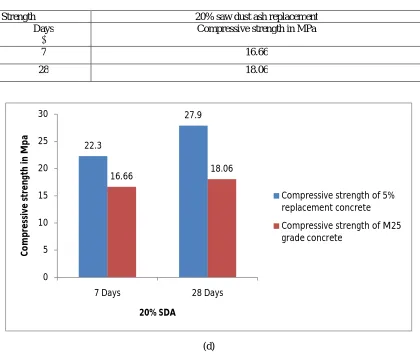
Strength → 20% saw dust ash replacement
Days ↓
Compressive strength in MPa
7 16.66
28 18.06
22.3
27.9
16.66 18.06
0 5 10 15 20 25 30
7 Days 28 Days
C
o
m
p
re
ss
iv
e
s
tr
e
n
gt
h
in
M
p
a
20% SDA
Compressive strength of 5% replacement concrete
Compressive strength of M25 grade concrete
(d)
FIG. 2 : COMPRESSIVE STRENGTH (A) AT 5% SDA (B) AT 10% SDA) (C) AT 15% SDA (D) AT 20% SDA
The Tables and Graphs show the variation in compressive strength of 5%, 10%, 15%, 20% replacement
concrete with M25 grade standard concrete.
VI. CONCLUSION
At 5% replacement of SDA gives 12.30% and 16.20% increase in compressive strength at 7 & 28 days
respectively.
At 10% replacement of SDA gives 9.59% & 8.38% increase in compressive strength at 7 & 28 days
respectively.
ISSN(Online): 2319-8753 ISSN (Print): 2347-6710
I
nternational
J
ournal of
I
nnovative
R
esearch in
S
cience,
E
ngineering and
T
echnology
(An ISO 3297: 2007 Certified Organization)
Website: www.ijirset.com
Vol. 6, Issue 9, September 2017
Concrete becomes less workable as SDA percent increases, that means more water is required to make mix
more workable i.e. SDA has high water demand.
Use of SDA can prove to be economical as it is a waste and free of cost
SDA will preserve the resources particularly cement and thus makes construction industry sustainable.
It will solve the problem of disposal of saw dust and will prove to be environmental friendly.
VII. ACKNOWLEDGEMENT
The author thankfully acknowledge to Er. Isha Verma, Assistant Professor, U.I.E.T., M.D. University, Rohtak
for her motivation and infrastructural support to carry out this research.
REFERENCES
[1]. Celik T. Merer K. (1996). “Effect of crushed stone dust on properties of concrete, cement concrete” Res. 26(7), 1121-1130. [2]. Method of Analysis & Sampling of Concrete IS 1199 : 1959, Bureau of Indian standards, New Delhi.
[3]. 43 Grade OPC, Specification IS 8112 : 1989, Bureau of Indian Standards, New Delhi.
[4]. Methods of Tests for strength of concrete, IS 516 : 1959, Bureau of Indian Standards, New Delhi. [5]. M.L. Gambhir “Concrete Technology.”
[6]. Rahul Bansal “Effect on Compressive Test with Partial Replacement of Fly ash”. [7]. Amit Mittal “Experimental study on use of fly ash in concrete”.
[8]. Mahmoodh (2002) “Ash from timber waste as cement replacement”.
[9]. A.V.S. Sai, Krishna Rao “A study on strength of concrete with partial replacement of cement with quarry dust, March 2014. [10]. IS 456 : 2000.