Parametric Optimization of Tungsten Inert
Gas (TIG) Welding by using Taguchi
Approach
Abhishek Prakash 1, Raj Kumar Bag 2, Siva Sankar Raju 3
Student, Department of Mechanical Engineering, Gandhi institute of Engineering and Technology, Gunupur, Odisha,
India1
Student, Department of Mechanical Engineering, Gandhi institute of Engineering and Technology, Gunupur, Odisha,
India2
Associate Professor, Department of Mechanical Engineering, Gandhi institute of Engineering and Technology,
Gunupur, Odisha, India3
ABSTRACT: The present work deals with the optimization of welding process variables by using Tungsten inert gas welding. In this process input variables are voltage (V), current (I) and welding speed (S) with tensile strength and hardness as responses of low carbon steel (ASTM A29). The investigation is based on Taguchi approach [L9], using
Analysis of variance (ANOVA) to determine the influence of parameters with the optimal condition. Finally, the confirmation test has been carried out to compare the predicted value of tensile strength and hardness with the experimental value.
KEYWORDS:TIG Welding, Mild Steel, Taguchi Approach, Hardness, Tensile strength.
I. INTRODUCTION
In the present world, welding is mostly used in manufacturing industries, aerospace industries, automobile industries etc. We know that there is various welding process are present, among the various welding process, Tungsten inert gas (TIG) welding plays a major role in the welding of mild steel or thin sections of non-ferrous metals such as copper alloys, aluminum alloys, magnesium and stainless steel. Tungsten inert gas (TIG) welding is also known as Gas tungsten arc welding (GTAW). It is a one of the most widely used methods in many manufacture industries. Tungsten inert gas (TIG) welding is an inert-gas shielding arc-welding process using non-consumable electrode. The electrodes may also contain 1 to 2% thoria (thorium oxide) mixed along with the core tungsten or tungsten with 0.15 to 0.40% zirconia (zirconium oxide). As pure tungsten electrode are less expensive but it will carry less current. The thoriated tungsten electrodes carry high currents and are more desirable because they can strike and maintain a stable arc with relative ease. The zirconia added tungsten electrode is better than pure tungsten but inferior to thoriated tungsten electrodes. We know that TIG welding has several advantage like joining of dissimilar metals, the absence of slag, low heat affected zone and etc. Since input parameters play a major role in determining the quality of a welded sample. So, welding parameters those are affecting the arc should be calculated and their variable conditions during the process must be known before, in order to get good or optimum results, in order to get a perfect arc, we have achieved stable parameters. We also know that the properties of the welded sample are affected by a greater number of welding parameters. Properties are Hardness, Impact force, Tensile strength etc.
steel it is very difficult to weld, as mild steel is easy to weld and most important fact that most of the people are not aware of this fact that certain types of high carbon steel, for example, stainless steel and special technique are used for welding due to that reason that, it is less brittle than high carbon steels. The mild steel is more flexible than other steel. The present experiment mainly focused on the weldability of low carbon steel ASTM A29 with the process of TIG welding. The work details of process parameters (welding voltage, welding current and wire speed) influence on the response (Tensile strength and Hardness) by using analysis of variance (ANOVA) with the help of Taguchi array [L9].
is 61.37 Mpa and S/N ratio is 16.45. Kuang-Hung Tseng et al. [15] conducted an experiment to optimize the delta ferrite content, angular distortion, weld morphology and hardness of stainless steel 316L using TIG welding process. Finally, conduct a test to get an optimal result. They use MoO3 and SiO2 fluxes weld depth is increase and bead width decrease. M. P. Chakravarthy et al. [16] conducted an experiment on 70/30 Cu-Ni Alloy using Taguchi approach. Finally, they conduct the test to predict the optimal values of tensile strength welded sample are 368.8 MPa. Dara Eshwar et al. [17] conducted an experiment on aluminum alloy Al-65032 using Taguchi approach. Finally, they conduct the test on the basis of L9 orthogonal array. A.Sivasankaran et al. [18] investigated an experiment on aluminum alloy (8011) using Taguchi approach (L16 orthogonal array). Finally, they conduct the test to compared the predicted value of ultimate tensile strength with the experimental value and finally conclude that the optimal parameters for ultimate tensile strength are 155.682 and the improvement in S/N ratio is 0.894. Mallikarjun Kallimath et al. [19] conducted an experiment on aluminum alloy Al6061 Taguchi and Regression analysis methods. Finally, they conduct the test and found that Gas flow rate is the major contributing factor and also gas flow rate and current are the most influencing factor with to bead length. Er. Parvinder Singh et al. [20] conducted an experiment on Stainless Steel (SS316) using Taguchi approach. Finally, they conduct the test and find out the optimal parameter are current is 120 Amp, gas flow rate is 5 liters/min and a number of passes are 2.
II. TAGUCHIMETHOD
A Japanese scientist i.e. Genichi Taguchi, develop a technique on an orthogonal array. This method is widely used in manufacturing industries. The main objective of this method is to provide a high-quality product at very low cost to the producer (manufacturer). Taguchi developed an array for predict how different parameters affect the mean and variance of the process parameters. He made the method in such a way that each factor have equally weighted because each factor is evaluated independently of other factors, so that’s why the effect of one factor does not affect the value of other factors [18] or we can it is statistically technique that allows us to improve the consistency of production. Taguchi method recognizes that not all factors that cause variability can be controlled. These uncontrollable factors are called noise. Taguchi designs try to identify controllable factors to evaluate variability that occurs and then determines optimal factor setting that minimize the process variability. A process designed with this goal will produce more consistent output and performance regardless of the environment in which it is used. The experimental steps are explained by using flow diagram as shown in Fig.1. In this flow chart, we can see that various step of Taguchi’s method and show how Taguchi method is applied in the problem.
III.EXPERIMENTALPROCEDURE
In this experimental work, the sample is welded at three different levels of welding parameter i.e. voltage, current and speed as shown in table 1.
Table-1: Welding parameter and their levels
Parameter Current(I) Voltage(V) Speed(S)
Unit Amp Volt Mm
Symbol I V S
Level 1 200 18 2.2
Level 2 215 22 2.7
Level 3 230 26 3.2
Table-2: Chemical Composition of Low Carbon Steel ASTM 29
Element %
Carbon 0.70-0.80
Iron, Fe 98
Manganese, Mn 0.40-0.70
Sulphur, S 0.05
Phosphorous, P 0.04
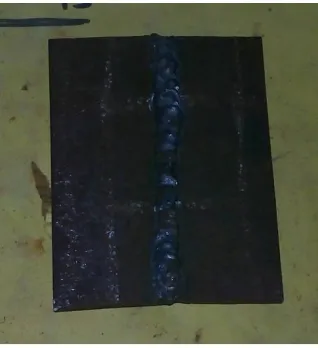
The dimension of work sample is length 200 mm, width 100 mm, thickness 80 mm. Now the setup has been ready and was prepared for doing TIG welding on given sample. The chemical composition of low carbon steel ASTM 29 is shown in table 2, in which it show the percentage of elements like carbon, iron, manganese, sulphur and phosphorous present in low carbon steel ASTM 29. Fig 2 shows the welded sample of low carbon steel ASTM 29 by using TIG welding.
Table-3: L9 Orthogonal Array Design matrix
Voltage Current Speed
18 200 2.2
18 215 2.7
18 230 3.2
22 200 2.2
22 215 2.7
22 230 3.2
26 200 2.2
26 215 2.7
26 230 3.2
Total nine experiments were performed based on L9 orthogonal array shown in Table 3. The effect of different parameters such as welding voltage, current and wire speed of low carbon steel ASTM A29 was analysed and observed the tensile strength and hardness of all nine welded sample and observed the value of tensile strength and hardness with its S/N ratios are shown in Table 4. For measuring micro-hardness they are first rubbed with emery paper size no. 1/0, 2/0 & 4/0and then clean with the help of acetone solution
.
Table- 4: Response of Tensile and Hardness with S/N ratio
Run
Tensile Strength
(Mpa)
S/N Ratio Hardness (HAZ)
S/N Ratio
1 380 51.59567 167.4 44.47511 2 350.5 50.89376 146.3 43.30489 3 330.7 50.38868 155.3 43.82343 4 490.8 53.81809 246 47.8187 5 400.5 52.05205 188 45.48316 6 350.6 50.89624 165.6 44.38121 7 450.8 53.07968 218 46.76913 8 380.1 51.59796 152.6 43.67109 9 370.2 51.36873 178.4 45.0279
IV.RESULTSANDDISCUSSION
We know that Analysis of variance (ANOVA) is a statistical tool used to analyse the S/N ratio. Here the term “signal” represents the desirable mean value and the “noise”- undesirable value. Hence, we can say that S/N ratio show the amount of variation, which is represented in the performance characteristics.
ANOVA OF TENSILE STRENGTH
In this paper, calculated the Tensile strength and applying Taguchi approach for the analysis with the help of ANOVA (L9). According to data are found, we get a graph of the signal-to-noise (S/N) ratio is shown in Fig 3. Calculated S/N
Fig-3: Main Effects plot of process parameters on tensile strength for S/N ratio
The ANOVA is one of the widely used methods for portioning variability into an identifiable source of variation and the associated DOF in an experiment. F-test used for analysing the significant effects of the process parameters, which form quality characteristics. In Table-5 show, the result of ANOVA analysis of S/N ratio of low carbon steel ASTM A29. The ANOVA obtained R2 and Radj2 as 98.35% and 93.01%. The ANOVA revealed the influence of process
parameters on a response. From Fig. 3 it was observed that the welding voltage (18 volts), welding current (230 amp), and wire speed (2.2) gives an optimal tensile strength.
Table-5:Analysis of Variance for Signal to Noise Ratio of tensile strength
Source DF Seq Ss Adj SS Adj MS F P PC V 2 2.8528 2.8528 1.4264 16.92 0.056 29.58%
I 2 5.9195 5.9195 2.9598 35.11 0.028 61.38% S 2 0.7026 0.7026 0.3513 4.17 0.194 7.29% Residual 2 0.1686 0.1686 0.0843 1.75% Total 8 9.6434 100.00%
The response table for S/N ratio for tensile strength is shown in Table-6 which shows their ranking and factors level values of each factor. From the response tables, the optimal condition for Tensile strength as the welding current (I3) is a dominant parameter on the tested specimens, followed by welding voltage (V1) and wire speed (S1). The ranking of the parameters is shown in Table 6. This refers the optimal condition of Tensile strength as V1A3S1. It is observed from Table-5, that current (I) is the most important factor which effects tensile strength maximum with percent contribution of 61.38% followed by welding voltage with percent contribution 29.58% then wire speed with percent contribution 7.29%.
Table-6: Response Table for S/N Ratio for Tensile Strength
Level V I S
1 50.93 52.83 51.36 2 52.26 51.51 52.03 3 52.02 50.88 51.84 Delta 1.3 1.95 0.66
ANOVA OF HARDNESS
Fig-4: Effects of process parameter on hardness S/N ratio
From Fig. 4 it was observed that the welding voltage (18 volts), welding current (215 amp), and wire speed (2.2) gives an optimal Hardness. We know that the S/N ratio for each parameter was determined by averaging the S/N ratios at the corresponding level. The effect of parameters such as welding voltage, current, and wire speed was analysed on Table-4. It is observed that the process parameters with the greatest S/N ratio have optimum quality with less variance. The ANOVA obtained R2 and Radj2 as 99.33 and 97.22%. The ANOVA revealed the influence of process parameters on
a response.
Table-7: Analysis of Variance for Signal to Noise Ratio of Hardness
Source DF Seq Ss Adj SS Adj MS F P PC (%) V 2 6.3115 6.3115 3.15577 50.49 0.019 35.09% I 2 8.6891 8.6891 4.34456 69.51 0.014 48.31% S 2 2.8589 2.8589 1.42946 22.87 0.042 15.90% Residual 2 0.125 0.125 0.0625 0.70%
Total 8 17.9846 100.00%
Table-8: Response Table for S/N Ratio for Hardness
Level V I S 1 43.87 46.35 44.18 2 45.89 44.15 45.38 3 45.16 44.41 45.36 Delta 2.03 2.2 1.21 Rank 2 1 3
MULTIPLE LINEAR REGRESSION MODELS:
Multiple linear regression equations are developing a relation between the process variables and response. The value of regression coefficient R2 (0.9825) is in good agreement with the adjusted R2 (0.9301) for the Tensile strength of the welded sample of ASTM A29. R2 (0.9930) is in good agreement with the adjusted R2 (0.9722) for the Hardness of the welded sample of ASTM A29. Considering that both values are very close to unity, this model gives a good result between the independent parameters and responses.
The regression equation developed for the surface roughness of the Tensile strength is as follows: Tensile Strength = 842 + 5.83 V - 3.00 I + 23.8 S --- (1)
The regression equation developed for the Hardness of ASTM A29 is as follows:
Hardness = 354 + 3.33 V - 1.47 I + 25.2 S --- (2)
We can predict from Equations. (1) & (2) that the Welding Current (I) plays a greater role on Tensile and Hardness, followed by welding voltage (V) and wire speed (S). The coefficient associated with welding current (I) is negative, thus indicating that the Tensile and hardness as decreases with increasing welding current. Conversely, the Tensile and hardness increase with increasing welding voltage and wire speed because the coefficients of these factors are positive. Wire speed has a greater effect on Tensile and hardness as compared with other parameters according to its coefficient value in the TIG welding.
CONFIRMATION TEST
The confirmation test is the last step in the experimental process. The confirmation test results are listed in Table 9. From the table listed the actual and predicted values with error. The % of error determined by the ratio of the difference between actual and predicted to actual once. The % of error has been less than (±5%) which is significant.
Table-9: Conformation Test
Tensile Strength Hardness
Exp Run Cal. Exp. Error Cal. Exp. Error
1 399.3 380 -5.078 175.38 167.4 4.55
3 333.1 330.7 -0.725 156.48 155.3 0.754
5 389.52 400.5 2.741 179.25 188 -4.881
6 356.42 350.6 -1.66 169.8 165.6 2.473
V. CONCLUSION
The investigation results show that
1. The present study on ASTM A29 using Tungsten inert gas welding process.
2. The Welding Current has the greatest influence on Tensile and Hardness in the welded sample of ASTM A29 followed by welding voltage and wire speed.
3. The optimal conditional for Tensile strength as the welding current (230) is a dominant parameter on the tested specimens, followed by welding voltage (18) and wire speed (2.2).
4. The optimal condition of Hardness, such as the welding voltage (18 volts), welding current (215 amp), and wire speed (2.2) can be used to achieve better hardness in ASTM A29.
REFERENCES
[1] Rajendra singh and Dr. SS Dhami, “Analysis of Defects in Metal Inert Gas Welding of A312tp316l Stainless Steel Pipe Using Taguchi
Optimization Method And Testing”, The International Journal Of Engineering And Science (IJES), Vol. 3, Issue 6, pp.11-22 , 2014.
[2] Nirmalendhu Choudhury, Ramesh Rudrapati and Asish Bandyopadhyay, “Design Optimization of Process Parameters for TIG Welding Based
on Taguchi Method”, International Journal of Current Engineering and Technology, Special Issue-2, February 2014.
[3] S.Amal Bosco Jude, G.R. Jinu, Mc Luret and P. Arul Franco, “Influence of Mg2 Si on the Grain Refinement of TIG Welded AA6082
Aluminum Alloy Using Taguchi Method”, International Journal of ChemTech Research, Vol. 8, No.7, pp.42-49, 2015.
[4] Ajit Khatter, Pawan Kumar and Manish Kumar, “Optimization of Process Parameter in TIG Welding Using Taguchi of Stainless Steel-304”,
International Journal of Research in Mechanical Engineering & Technology, Vol. 4, Issue 1, Nov 2013 - April 2014.
[5] Prashant S Lugade and Manish J Deshmukh, “Optimization of Process Parameters of Activated Tungsten Inert Gas (A-TIG) Welding for
Stainless Steel 304L using Taguchi Method”, International Journal of Engineering Research and General Science, Vol. 3, Issue 3, May-June, 2015.
[6] G. Magudeeswaran , Sreehari R. Nair , L. Sundar and N. Harikannan, “Optimization of process parameters of the activated tungsten inert gas
welding for aspect ratio of UNS S32205 duplex stainless steel welds”, Science Direct, 25 July 2014.
[7] Ugur Esme, Melih Bayramoglu, Yugut Kazancoglu and Sueda Ozgun, “Optimization of Weld Bead Geometry in Tig Welding Process Using
Grey Relation Analysis and Taguchi Method”, Materials and technology, Vol. 3, pp.143–149, 2009.
[8] Lalit S. Patel and Tejas C. Patel, “Optimization of Welding Parameters for TIG Welding of 304 L Stainless Steel Using Taguchi Approach,
“ International Journal of Engineering Development and Research, Vol. 2, Issue 1, 2014.
[9] Shekhar Rajendra Gulwade and R.R.Arakerimath, “Parameter Optimization of Tig Welding Using Austenitic Stainless Steel”, International
Journal of Innovative and Emerging Research in Engineering, Vol. 2, Special Issue 1, 2015.
[10] Dinesh Kumar.R, Elangovan.S and Siva Shanmugam.N, “Parametric Optimisation of Pulsed – Tig Welding Process in Butt Joining of 304l
Austenitic Stainless Steel Sheets”, International Journal of Research in Engineering and Technology, Vol. 3, Special Issue, Jun-2014.
[11] Sreejith S Nair, “Experimental Investigation Of Multipass Tig Welding Using Response Surface Methodology”, International Journal of
Mechanical Engineering and Robotics Research, Vol. 2, No. 3, July 2013.
[12] J. Pasupathy, V. Ravisankar and C. Senthilkumar, “Parametric Optimization of TIG Welding of Galvanized Steel with AA1050 using Taguchi
Method”, International Journal of Science and Research, Vol. 3, Issue 5, May 2014.
[13] Ravinder and S. K. Jarial, “Parametric Optimization of TIG Welding on Stainless Steel (202) & Mild Steel by using Taguchi Method”, International Journal of Enhanced Research in Science Technology & Engineering, Vol. 4, Issue 6, pp.484-494, June-2015.
[14] J.Pasupathy, V.Ravisankar, “Parametric Optimization of Tig Welding Parameters Using Taguchi Method for Dissimilar Joint (Low Carbon
Steel With Aa1050)”, International Journal of Scientific & Engineering Research, Vol. 4, Issue 11, Nov-2013.
[15] Kuang-Hung Tseng and Chih-Yu Hsu, “Performance of activated TIG process in austenitic stainless steel welds”, Journal of Materials
Processing Technology, pp.503–512, 2011.
[16] M. P. Chakravarthy, N. Ramanaiah, B. S. K.Sundara Siva Rao, “Process Parameters Optimization for Pulsed TIG Welding of 70/30 Cu-Ni
Alloy Welds Using Taguchi Technique”, International Journal of Mechanical, Aerospace, Industrial, Mechatronic and Manufacturing Engineering, Vol. 7, No 4, 2013.
[17] Dara Eshwar and Dr. A.C.S. Kumar, “Taguchi Based Mechanical Property Optimization of as Weld Al-65032 Alloy Using Tig Welding”,
IOSR Journal of Mechanical and Civil Engineering (IOSR-JMCE) Vol. 11, Issue 6, pp.56-62, Nov- Dec. 2014.
[18] A.Sivasankaran, “Taguchi Optimization of TIG Welding for Maximizing Weld Strength of Aluminium 8011”, International Journal of
Innovative Research in Science, Engeering and Technology, Vol. 4, Special Issue 6, May 2015.
[19] Mallikarjun Kallimath, G Rajendra and S. Sathish, “TIG Welding Al6061 using Taguchi and Regression analysis methods”, International
Journal of Engineering Research, Vol. 3 Issue No Special 1, pp.151-154, 22nd March 2014.
[20] Er. Parvinder Singh and Er. Vikram Singh, “Experimental Investigation of Weld Bead Hardness of Tig Welding of Grade SS316”, Global