DOI: 10.1534/genetics.109.110833
Ploidy and the Evolution of Endosperm of Flowering Plants
Aure´lie Cailleau,
1Pierre-Olivier Cheptou and Thomas Lenormand
Centre d’Ecologie Fonctionnelle et Evolutive, 34293 Montpellier, France
Manuscript received October 9, 2009 Accepted for publication November 16, 2009
ABSTRACT
In angiosperms, spermatozoa go by pair in each pollen grain and fertilize, in addition to the egg cell, one of its sister cells, called the central cell. This ‘‘double fertilization’’ leads to the embryo on the one hand and to its nutritive tissue, the endosperm, on the other hand. In addition, in most flowering plants, the endosperm is triploid because of a doubled maternal genetic contribution in the central cell. Most of the hypotheses trying to explain these eccentricities rest on the assumption of a male/female conflict over seed resource allocation. We investigate an alternative hypothesis on the basis of the masking of deleterious alleles. Using analytical methods, we show that a doubled maternal contribution and double fertilization tend to be favored in a wide range of conditions when deleterious mutations alter the function of the endosperm. Furthermore, we show that these conditions vary depending on whether these traits are under male or female control, which allows us to describe a new type of male/female conflict.
F
EMALES provision their offspring with resources. These resources can be accumulated before fertili-zation. When some of the gametes are not fertilized, this strategy is extremely wasteful. In a number of species, females have evolved conditional strategies avoiding this problem—in particular by providing most resources after fertilization [i.e., to diploid offspring instead of haploid gametes (Westoby and Rice1982;Baroux et al.2002)]. This postfertilization
provision-ing occurs, for instance, in viviparous animals, such as mammals, some reptiles (De Fraipont et al. 1996),
some sharks (Wourms1993), some scorpions (Brown
and Formanowicz1996), and velvet worms (Tuttet al.
2002). In plants, resource provisioning to offspring can also occur before or after fertilization.
The life cycle of plants typically alternates a sporo-phytic stage (2n) and a gametophytic stage (n) that are both multicellular. A newly formed sporophyte (the diploid zygote) will typically use the resources accumu-lated in tissues derived from the female haploid game-tophyte and not in tissues derived from the diploid sporophyte. For instance, in ferns and mosses, the new embryo develops ‘‘parasitically’’ on the free gameto-phyte. In gymnosperms, the embryo acquires its resource from a nonfree female gametophyte (it is encapsulated within sporophytic tissues). In some of them (cycads and ginkgoes) the resource is fully accumulated before fertilization, while in some others (Pinaceae) the re-source accumulates both before and after fertilization (Friedman2001b). The former situation is comparable
to what happens in many fish while the latter is com-parable to what happens in many bird species (egg formation before fertilization and incubation after fer-tilization). In angiosperms, resource provisioning to the seed really starts after fertilization (Friedman2001b), a
situation comparable to placental mammals (Figure 1). Compared to other seed plants, the case of angio-sperms is complicated by the occurrence of a ‘‘double fertilization’’ (Nawaschin1898; Guignard1899): two
identical (mitotically derived) spermatozoa from a sin-gle pollen grain fertilize in parallel two cells of the female gametophyte. The fertilization of the egg cell produces the embryo. The fertilization of the central cell produces the endosperm, a specific organ that serves as an interface for resource transfer between the diploid mother and its offspring (like the placenta in mammals). This tissue can either be transitory or serve as a storage tissue in the seed. In this article, we study the evolution of this nutritive tissue. More specifically, we focus on the evolution of its genetic constitution.
The diversity of endosperms reflects directly the diver-sity of female gametophytes (Friedman et al. 2008).
In some angiosperms [Austrobaileyales (Friedmanet al.
2003), Oenothera (Maheshwari 1963), and
Nym-pheales (Williamsand Friedman 2002)], the female
gametophyte is made of four haploid cells that are mitotically derived from a single spore. One of them is the central cell and contains one maternal contribu-tion (1m). This type of gametophyte is referred to as ‘‘Oenothera.’’ After double fertilization (which adds one paternal contribution, 1p), the central cell becomes a diploid endosperm (1m:1p). This endosperm is genet-ically identical to the embryo. In other angiosperms, the female gametophyte is eight-nucleated, but seven-celled
1Corresponding author:CEFE-CNRS UMR 5175, 1919 Route de Mende, 34293 Montpellier Cedex 05, France.
E-mail: [email protected]
because the central cell remains binucleate (2m). This type of gametophyte is referred to as ‘‘Polygonum.’’ Double fertilization again carries one paternal contri-bution (1p). Thus, the central cell becomes a triploid endosperm (2m:1p). Other types of female gameto-phytes can be found sporadically among angiosperms. They are characterized by an increased number of ma-ternal contributions in the central cell and/or by polyspory. These types are derived from the Polygonum type and we do not consider them further. As already mentioned, in gymnosperms and ferns the embryo feeds directly on the haploid female gametophyte (1m:0p), which can be considered as the ancestral state of the nutritive tissue.
In this article, we focus on the evolution of double fertilization (DF) (0p/1p) and maternal contribution doubling (MCD) (1m/2m) from this 1m:0p ancestral state. In principle, two scenarios can be considered (Figure 2). In the first scenario, DF evolves before MCD (1m:0p/1m:1p/2m:1p). In the second, MCD evolves first and DF second (1m:0p/2m:0p/2m:1p). The latter scenario involves an additional step (secondary loss of the second maternal contribution, 2m:1p / 1m:1p) to account for the occurrence of 1m:1p endo-sperms in Nympheales (Nuphar, Nymphea, Cabomba) and the Illiciales-Trimeniaceae-Austrobaileyaceae clade (Schisandra, Illicium). It is therefore less parsimonious. For this reason, we consider only the first scenario (1m:0p/1m:1p/2m:1p) in this article.
Three main theories have been proposed to explain the evolution of DF and MCD. They all rely on the fact that some resources are accumulated to the seed after
fertilization. The first theory proposes that postfertiliza-tion resource allocapostfertiliza-tion triggers a genetic conflict over resource allocation among parents and/or offspring. Indeed, an antagonistic coevolution can occur between the male, the female, and/or the embryos when their optimal seed sizes differ, to take control over resource allocation (Trivers1974; Haig2000). Because the
en-dosperm plays a pivotal role in the control of resource allocation, DF and MCD are considered in this theory to be adaptations allowing the father and the mother to take and take back the control over resource allocation, respectively (Charnov1979; Westobyand Rice1982;
Queller 1983; Willson and Burley 1983; Law and
Cannings 1984; Bulmer 1986; Shaanker et al. 1988;
Haig and Westoby 1989; Friedman1995; Shaanker
and Ganeshaiah1997; Hardlingand Nilsson 1999,
2001). These ‘‘allocation conflict theories’’ include the kinship theory of genomic imprinting (Haig 2000,
2004; DeJonget al.2005) and have received the most
extensive theoretical development.
A second theory (hereafter metabolic theory) pro-poses that DF and MCD evolve because of the metabolic properties of polyploid tissues (Stebbins1976; Donoghue
and Scheiner1992). More specifically, the idea is that
DF and MCD increase the endosperm ploidy level, which enhances its postfertilization metabolic efficiency (increased transcription rate, increased cell size, and resource storage). The problem with this view is that endomitosis would achieve the same effect and is very common at the beginning of gametophyte/endosperm development in both angiosperm and gymnosperm (Friedman 2001a,b): DF and MCD seem unnecessary
Figure1.—Timing of resource accumulation in the seed. All the resources are allocated before fertilization in cycads and ginkgoes. Resources are allocated both before and after fertilization in conifers and all the resources are allocated af-ter fertilization in angiosperms.
Figure 2.—Possible scenarios for the evolu-tion of the genetic makeup of the embryo nu-tritive tissue, modified from Friedman and Ryerson (2009). In the left scenario, there are one 1m:0p / 1m:1p transition and two 1m:1p/2m:1p transitions and thus three steps. In the right scenario, there are one 1m:0p /
to increase ploidy in the endosperm in the first place. Moreover, this theory does not account for the presence of a male nucleus specifically (Willsonand Burley1983).
A third theory proposes that DF and MCD evolve because of the genetic properties of polyploid tissues (Brinkand Cooper1940). More specifically, the idea is
that DF combines two different genomes (maternal and paternal) in the nutritive tissue, which masks the effect of recessive deleterious mutations and thus enhances the postfertilization metabolic efficiency of the nutritive tissue. Following Friedmanet al.(2008), we refer to this
theory as the ‘‘heterozygosity theory.’’ The heterozygos-ity theory explanation for endosperm’s genetic evolu-tion seems close to explanaevolu-tions for ploidy evoluevolu-tion. Several models have been worked out to understand the effect of the masking of deleterious mutations in the evolution of ploidy levels (Perrotet al.1991; Bengtsson
1992; Ottoand Goldstein1992). These models have
shown that masking protects diploid individuals from the effect of recessive deleterious mutations, but that it also reduces the elimination of these mutations from the population, creating genetic association favorable to haploidy (Ottoand Goldstein1992). The problem of
the evolution of the genetic constitution of the endo-sperm is, however, not directly comparable to the problem of life cycles evolution. First, the phenotype under selection (e.g., resource in the seed) is at least partly determined by the genotype of the nutritive tissue (the gametophyte or the endosperm), which can differ from the genotype of the diploid embryo. Second, double fertilization is not symmetrical with respect to sexes: it masks maternal alleles but reveals paternal alleles in the endosperm. Third, double fertilization can be under pollen and/or female gametophyte control, while the timing of meiosis in life cycle evolution is controlled by the diploid stage. In fact, no formal model has been created to explore specifically the heterozygosity theory. The aim of this article is to develop such models.
We build two models to study the evolution of DF and MCD. More explicitly, we study the evolution of a modifier locus that changes their probability of occur-rence. We show that masking deleterious mutations can favor both DF and MCD. However, unlike models for the evolution of ploidy, we find conditions where DF evolves in opposite directions depending on the sex where the modifier is expressed. In different conditions, the same scheme occurs for MCD. This situation reveals that male/female conflict extends well beyond the problem of resource allocation to embryos: a conflict can also occur over the genetic constitution of embryos’ nutri-tive tissues.
MODEL
We analyze the evolution of DF and MCD in two distinct deterministic models. Both involve two linked diallelic loci. The first one (the viability locus) is subject
to deleterious mutations and determines the survival of the embryo while the other one (the modifier locus) controls the probability of DF or MCD.
Life cycle: To build each model, we first write exact recursions of the frequency of the different haploid genotypes. We follow the different events in the life cycle over one generation, which alternates a gametophytic haploid with a sporophytic diploid stage (Figure 3). We start at the gametophytic stage. The male gametophyte (pollen) contains two identical sperm cells (they are mitotically derived). The female gametophyte (embryo sac) contains also a given number of genetically iden-tical cells, among which are the egg cell and the central cell. First, fertilization occurs in a panmictic way (pair-ing one pollen grain with one embryo sac). The genetic constitution of the endosperm is determined at this stage, but differently in the different models (see below). Second, the nutritive tissue and the embryo develop (seed formation). Selection occurs among seeds in the population, on the basis of the genotype of their nutri-tive tissue. Third, the surviving embryos become her-maphroditic sporophytes and produce haploid spores through meiosis (where the two loci recombine at a rateR). Finally, the spores undergo mutation and each produces a new gametophyte through mitosis. To de-scribe the different events in this life cycle, we introduce several parameters, specific to each locus. We present each locus in turn.
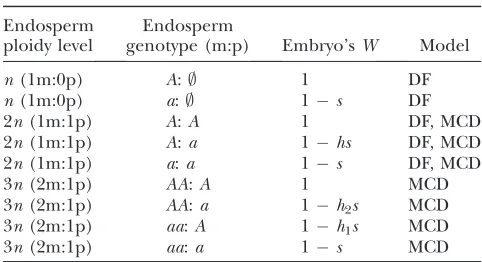
frequency of A (the wild-type allele). The embryos associated to a nutritive tissue that carries only the wild-type allele (A,AA,AAA) have a survival of 1. Those associated to a nutritive tissue that carries only the deleterious allele (a,aa,aaa) have a survival of 1s. The embryos associated to a heterozygous nutritive tissue have survival 1hs, 1h1s, and 1h2sforAa,aaA, and
AAa genotypes, respectively. The parameters h, h1,
and h2 are the coefficients of dominance of a on A.
We considerh1$h2(aalleles are more exposed inaaA
endosperms than in aAA endosperms). Because we assume thatWa¼Waa¼WaaaandWA¼WAA ¼WAAA, our model excludes potential effects of gene copy number (i.e., dosage effects in ‘‘metabolic theory’’). Because we do not introduce any competition between embryos or endosperms produced by the same sporo-phyte (the viability of a given embryo depends only on the genotype at the viability locus of its own endosperm), our model excludes any effect involved in the allocation conflict theories. In fact, our model can be understood as if there was a single female gametophyte produced by each sporophyte. Thus, by construction, our model focuses exclusively on the heterozygosity theory.
Modifier locus:The second locus controls the genetic constitution of the nutritive tissue. More specifically, it controls the rate of double fertilization (i.e., 1m:0p
vs. 1m:1p, in the DF model) or the rate of doubling
of maternal contribution (i.e., 1m:1pvs. 2m:1p, in the MCD model). We consider two alleles M and m with frequencyPMandPm, respectively. In each model, the modifier locus is expressed in the pollen (paternal control), the embryo sac (maternal control), or both (biparental control). In the first two cases, the expres-sion of the modifier locus is haploid. In these cases, we denotenMornmthe probability of double fertilization (or maternal contribution doubling) when the gameto-phyte controlling the trait carries theMor themallele, respectively. In the biparental case, we assume that the modifier effect is additive (i.e., the probabilities of DF and MCD arenM, (nM1nm)/2, andnmwhen the embryo isMM, Mm, and mm, respectively). To give a concrete example, in a DF model with a paternal control of the modifier locus, the mating between AMmale gameto-phytes (pollen) andamfemale gametophytes will pro-duce a proportionnMof embryos whose nutritive tissue is 1m:1p (Aa, with fitness 1hs) and a proportion 1
nM embryos whose nutritive tissue is 1m:0p (a, with fitness 1s). Tables 1 and 2 summarize all these nota-tions. Without loss of generality, we discuss the fate of modifier alleles that increase the probabilities of DF and MCD (nm.nM).
Recursion equations: The recursion equations de-scribing the dynamics of the model are given in
appendix afor the case of the evolution of DF with a
paternal control. These recursions can be written for the frequency of the four haplotypes (paM,pAm,pAM, and
pam). Equivalently, they can be expressed for the allele frequencies (pm and pa) and linkage disequilibrium (Cam¼pAMpampaMpAm¼pampapm). In this case, we define Cam such that it is positive when the modifier allele (m) is positively associated to the deleterious allele at the viability locus (a). To fully understand the model, we also describe the population during the dip-loid phase. In dipdip-loids, several genetic associationsCU,V analogous to Cam can be defined (as in,e.g., Barton and Turelli 1991), where U denotes a set of alleles
on the maternally inherited chromosome and Va set of alleles in the paternally inherited chromosome. In our case, we have two biallelic loci and we have there-fore 11 associations:Ca;m;Cm;a;Cam;;;C;;am;Ca;a;Cm;m;
TABLE 1
Genotypic control of selection
Endosperm ploidy level
Endosperm
genotype (m:p) Embryo’sW Model
n(1m:0p) A:; 1 DF
n(1m:0p) a:; 1s DF
2n(1m:1p) A:A 1 DF, MCD
2n(1m:1p) A:a 1hs DF, MCD
2n(1m:1p) a:a 1s DF, MCD
3n(2m:1p) AA:A 1 MCD
3n(2m:1p) AA:a 1h2s MCD 3n(2m:1p) aa:A 1h1s MCD
3n(2m:1p) aa:a 1s MCD
We assumeh2,handh2,h1, 0#h#1, 0#s#1.
TABLE 2
Genotypic control of the genetic makeup of the endosperm
Probability of
Control
Modifier locus genotype
DF: double fertilization (¼proportion of 1m:1p endosperms)
MCD: doubling (¼proportion of 1m:2p endosperms)
Biparental MM nM¼n nM¼n
Mm (nM1nm)/2¼n1dn/2 (nM1nm)/2¼n1dn/2
mm nm¼n1dn nm¼n1dn
Uniparental M nM¼n nM¼n
Ca;am; Cm;am;Cam;a;Cam;m;andCam;am. For instance, the
Ca,massociation measures the fact that the presence of the a allele on the maternally inherited chromosome covaries with the presence of the m allele on the pa-ternally inherited chromosome.
ANALYSIS
We analyze DF and MCD models with two comple-mentary methods: quasi-linkage equilibrium, (QLE) and stability analysis (see, e.g., Ottoand Day 2007).
In these two methods, we assume that the frequency of deleterious mutationspais close to its equilibrium value (noted pa*) and small (which entails that Cam is also small). This assumption requires thatm>s. This is the only common assumption to the two approaches. In the QLE approach, we also assume thatsis small,Ris large, and the modifier has a weak effect. In the stability analysis, the only additional assumption tom>sis that the modifier frequency is small. To easily define the orders of magnitude, we use a small parameterjas a scaling throughout.
The QLE analysis assumes that linkage disequilibrium equilibrates much faster than allele frequencies, so that it can be considered to always be at a ‘‘quasi-equilibrium.’’ This approach works best if the modifier effect is small and the recombination rate large (that is why we con-sidernM¼nandnm¼n1dn, wherednis proportional to
j; in the case of a modifier with a specifically maternal or paternal effect, we write dn,;andd;,ninstead of dn, respectively). With this approach, we focus on conver-gence stability. We perform the stability analysis to assess the robustness of this QLE analysis and to investigate what is going on for low recombination rate. This method considers the fate of the modifier introduced at a low frequency in a population at equilibrium at the viability locus. We first start by studying the DF model.
Mutation–selection at the viability locus in the DF model: To start, it is important to understand what is going on at the viability locus alone. According to the assumptions given above for the QLE approach, the change over one generation (noted withD) of the frequency of the deleterious allele at the viability locus is
Dpa ¼mpa
1
2ð1nÞ1hn
s1OðjÞ3; ð1Þ
and thus, at equilibrium (Dpa¼0), the frequency of the
aallele (noted with an asterisk) depends on the rate of double fertilization (n):
pa*¼
m
ð1=2Þð1nÞ1hn
ð Þs1OðjÞ
2: ð2Þ
The same equations are obtained under the assumption of the stability analysis, except that the orders of the two equations are OðjÞ2 and OðjÞ, respectively. With complete double fertilization (n¼1), the endosperm is diploid and we retrieve the equilibrium frequency
of a deleterious mutation under diploid selection (m/hs). However, with no double fertilization (n¼0),
pa*¼2m=s: the efficiency of selection is halved com-pared to the classic haploid selection situation (m/s). Indeed, half the alleles (the paternal ones) are not exposed to selection since they are in the embryo, but not in the endosperm. Interestingly, this result points out that having a haploid endosperm is not equivalent to haploidy. Note that the equilibrium described above is a good approximation only ifh.swhennis close to 1. A more complicated approximation can be found for small values of h and 1 n (see Chasnov2000 for a
similar treatment), but, as explained below, a better approximation is not necessary to accurately predict how DF and MCD evolve in our models.
QLE analysis of the DF model: We compute the overall frequency change at the modifier locusDpmas a sum of two terms. The first, Dpdirect
m , is proportional to pm(1 pm) and corresponds to direct selection. The second, Dpindirect
m , is proportional to Cam and corresponds to indirect selection. Under the QLE assumptions given above, we obtain at leading orders
Dpm¼Dpdirectm 1Dpindirectm
Dpmdirect¼sdn
1 2h
pmð1pmÞpað1paÞ1OðjÞ5
Dpmindirect¼ sCam
1
2ð1nÞ1hn
1Oðj2CamÞ: ð3Þ
We study these terms separately for two reasons. First they represent qualitatively different processes. Second, their relative magnitude varies in different ways throughout the parameter range (e.g., we expect in-direct selection to become increasingly important asR
decreases and direct selection to vanish whenhbecomes close to 1
2), and it is therefore quantitatively useful to combine their leading orders.
Direct selection:The sign ofDpdirect
m is given by the sign of 12 h. When mutations are recessive (h,12), direct selection favors the evolution of DF. In fact, h can be understood as the ‘‘exposition’’ (to selection) of the a
allele in a 1m:1p seed, while12 can be understood as its exposition in a 1m:0p seed. Indeed, as said before, only half the a alleles (the maternally inherited ones) are exposed to selection in 1m:0p endosperms. Direct selec-tion simply tends to minimize the exposiselec-tion of the deleterious alleles. This effect is quite different from the ‘‘masking effect’’ described in models of ploidy evolu-tion (Otto and Goldstein 1992). In these models,
deleterious mutation (i.e., whenh,1
2). In contrast, in our model, all individuals have the same risk to carry a deleterious mutation (all embryos are diploid), but the exposition of the deleterious alleles is greater with 1m:0p only ifh,1
2 (because only half the alleles, the maternal ones, are exposed to selection without DF).
Indirect selection:The sign ofDpindirect
m directly depends on the sign of the linkage disequilibrium Cam. To evaluate indirect selection more precisely, it is useful to express the value of Cam in terms of the model’s parameters. Under the QLE assumptions,Camreaches a pseudoequilibrium value (CQLE
am ) that is obtained by solvingDCam¼0, yielding
CamQLE¼dn
sðKhÞ
2R pmð1pmÞpað1paÞ1OðjÞ
4; ð4Þ
whereK¼1R,R, and1
2 for maternal, paternal, or biparental expression of the modifier locus, respec-tively. Thus, the sign ofCQLE
am depends entirely on the sign ofKh, that is, of 1Rh,Rh, and12 h, for maternal, paternal, and biparental expression of the modifier locus, respectively. This result can be inter-preted by following step by step how the linkage disequilibrium is built through selection and meiosis.
Building of genetic associations by selection: A lower exposition of deleterious alleles is immediately benefi-cial to an individual but leads to their accumulation. More specifically, in diploid embryos, deleterious muta-tions tend to become associated to modifier alleles that minimize exposition. A paternally acting modifier ex-poses the deleterious allele carried on the paternal chromosome (exposition is increased from 0 tohin the case of DF), which enhances the purge of these pater-nally inherited chromosomes. As a consequence, a paternally acting modifier tends to become associated to less loaded paternal chromosomes (C9;;amC;;am,0, where the prime indicates that the association is mea-sured after selection):
C9;;am¼C;;am1d;;nð0hÞs pmð1pmÞpað1paÞ1OðjÞ4: ð5Þ
On the contrary, a paternally acting modifier always reduces the exposition of the deleterious alleles carried on the maternal chromosome (from 1 tohwhen there is DF), which reduces purging on these chromosomes and generates more loaded maternal chromosomes (C9a;mCa;m.0):
Ca9;m¼Ca;m1d;;nð1hÞs pmð1pmÞpað1paÞ1OðjÞ4: ð6Þ
The exact opposite occurs for a maternally acting modi-fier (C9am;;Cam;;.0 andC9m;aCm;a,0):
Cam;9 ;¼Cam;;1dn;;ð1hÞs pmð1pmÞpað1paÞ1OðjÞ4 ð7Þ
Cm;a9 ¼Cm;a1dn;;ð0hÞs pmð1pmÞpað1paÞ1OðjÞ4: ð8Þ
All of these effects occur when the modifier has an effect in both male and female gametophytes (i.e., in the biparental case).
Effect of meiosis: The haploid linkage disequilibrium after meiosis (C9am) results from the diploid associations as
C9am¼C9am;;1C9;;am
2 ð1RÞ1
C9a;m1C9m;a
2 R ð9Þ
(Barton and Turelli 1991); i.e., the diploid cis
-associations are carried over at a rate 1R while the diploidtrans-associations are transformed intoCamat a rateR. In particular, as the recombination rate becomes lower,cis-associations contribute more to generatingCam. Combining Equations 5–9, one easily retrieves Equation 4. For example, with a paternally acting modifier, the
cis-association C;,am is proportional to h, while the
trans-associationCa,mis proportional to 1h. Because recombination breaks upcis-associations and transforms
trans-associations into haploidcis-associations (Equation 9), the modifier stays overall associated to purged genomes (and favored by indirect selection) when (1h)Rh(1R),0,i.e., whenR,h(Equation 4, Figure 4A). In the case of a maternally acting modifier, the roles of cis- and trans-associations (and thus the effect of recombination) are reversed. The modifier stays overall associated to purged genomes when (1h)(1R)hR,0,i.e., when 1R,h(Equation 4, Figure 4B). In the biparental case, the four associa-tionsCam;;;C;;am;Ca;m;Cm;aplay a role and the effect of recombination cancels out. The modifier stays overall as-sociated to purged genomes when (1R)(1h)hR1 R(1h)h(1R),0,i.e., whenh.1
2 (Equation 4).
Overall selection on the modifier: To obtain the selec-tion coefficient on the modifier [defined assm[Dpm=
pmð1pmÞ], we replace Cam by CamQLE in Equation 3, yielding
sm¼sdnpað1paÞ
3 1
2h
sðKhÞ
2R
1
2ð1nÞ1hn
1OðjÞ5:
ð10Þ
The sign ofsmdepends on the term within the brackets. In Figure 4, we illustrate the conditions where sm is positive. When R ¼1
2, jCamj is low: indirect selection is negligible and the sign ofsmis given by12 h. In this case two equilibria (n¼0 andn ¼1) exist, and DF is favored whenh,1
2. WhenRis lower, indirect selection can counterbalance direct selection. With a paternally acting modifier, DF is favored from h ¼ 0 up to
hpat*DF ¼121HcritDF, where
HcritDF¼1
2
sð12RÞ
4R 1O s R
2
: ð11Þ
On the contrary, with a maternally acting modifier, DF is favored fromh ¼0 up toh*DF
mat ¼
1 2 H
DF
crit. In other
words, DF is favored forh,1
2 whenR ¼ 1
2. Otherwise (R,1
0 , h,12 with a paternal expression of the modifier locus and for a range ofhvalues narrower than 0,h,12 with a maternal expression of the modifier locus. Note that in both the maternal and the paternal case, an intermediate unstable equilibrium (ndifferent from zero or one) exists in a very small portion of the parameter space when h is between h* and h*1DH, where
DH ¼s
2ð12RÞ2
32R2 1O s R
3
: ð12Þ
In this region, the evolutionary outcome depends on initial conditions. Above h*1DH, DF is disfavored. DF is selected in different conditions depending on whether the modifier locus is paternally or maternally expressed (h*matDF6¼h*patDF); it is a case of male/female
conflict. With a biparentally expressed modifier, direct and indirect selection has always opposite signs, but indirect selection is never strong enough to counterbal-ance direct selection. Thus, the critical value ofhbelow which DF is favored is1
2 regardless of other parameter values.
Stability analysis of the DF model: To check the QLE analysis for smallRvalues, we perform a stability analysis. To do so, we consider a population whereM
is fixed (pAm ¼ pam ¼ 0) and at mutation–selection equilibrium at the viability locus (paM ¼pa*, Equation 2). We then compute the frequency change of a rare modifier allele introduced in this population. Techni-cally, we linearize the exact recursions on theAm and
amhaplotypes, assuming they are rare. We then find the dominant eigenvalue of the transition matrix corre-sponding to these two equations, yielding
l¼11mðnMnmÞð4Rðh ð1=2ÞÞ1sK1K2Þ
ð1nM12hnMÞð2R1sð1RÞK1Þ
1OðjÞ2;
ð13Þ
where K1 andK2 depend on whether the modifier is
maternally, paternally, or biparentally expressed. Their values are given in Table 3. Assuming that mutations are rare, the rate of DF will evolve through successive fixations in the direction predicted by the sign ofl1. The results of the stability analysis are qualitatively com-parable to those of QLE. The critical value of hbelow which DF is favored predicted by this analysis is close to the critical value predicted under QLE assumptions (hpat* ,hmat* ). In fact, the absolute difference between the
critical h values predicted by the two approaches is
sdnð1=81=16RÞ1OðsÞ
2
, which is negligible whenRis large, as expected. In the stability analysis, as in the QLE, an intermediate unstable equilibrium exists in a small portion of the parameter space. In this region, both full and no DF are locally convergent stable states (the outcome depends on initial conditions). The area of this region is very small, s/32 (if one considers that the parameter space ish2 ½0;1andR 2 ½0;0:5). This small region is illustrated in Figure 5. In a slightly larger region of the parameter space around the latter, a single con-vergent stable state is present, but is not stable faced with mutations of large effects. In all cases, the results between QLE and stability analysis are very comparable and qualitatively identical. We now switch to the MCD model. MCD model analysis: We analyze this model in the same way as the DF model, using the same assumptions.
Mutation–selection at the viability locus:The mutation– selection equilibrium at the viability locus is
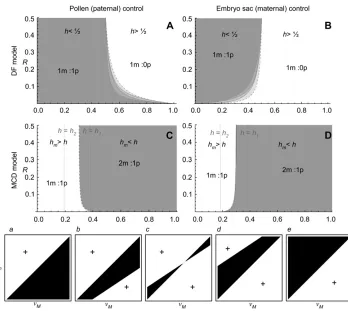
Figure 4.—Illustration of the QLE analysis of the DF and MCD models. The direction of selection at the mod-ifier locus is indicated for different
h (x-axis) and R(y-axis) values. In A and B (DF model), 1m:1p is favored in the shaded area whereas 1m:0p is fa-vored in the open area. In C and D (MCD model), 2m:1p is favored in the shaded area whereas 1m:1p is fa-vored in the open area. A, C and B, D illustrate paternal and maternal ex-pression of the modifier locus, respec-tively. In all panels, the dashed area corresponds to a negative linkage dis-equilibrium (the modifier is associated to the purged chromosome). Direct se-lection favors DF on the left-hand side of the dashed line (which is h¼1
2, A
and B), whereas it favors MCD on the right-hand side of the dashed line (which is h ¼ hm ¼ 0.3, C and D).
The QLE approximation becomes in-accurate whenRis very low (the points represent criticalhvalues obtained directly from exact simulations). Parameter values ares¼53102,m¼103,y¼0.1,d
pa*¼
m
ðhð1nÞ1hmnÞs
1OðjÞ2; ð14Þ
wherehm¼(h11h2)/2. This value is comparable to the
equilibrium frequency in the DF model (Equation 2). Indeed, in the DF model, the exposition of theaallele ranges fromh(full DF) to1
2 (no DF). Similarly, in the MCD model, the exposition of theaallele ranges from
hm(full MCD) toh(no MCD).
Frequency change at the modifer locus: The frequency change at the modifier locus is determined by direct and indirect selection, as in Equation 3:
Dpm¼Dpmdirect1Dpmindirect
Dpmdirect¼sdnðhhmÞpmð1pmÞpað1paÞ1OðjÞ5
Dpmindirect¼ sCamðhð1nÞ1hmnÞ1Oðj2CamÞ:
ð15Þ
The sign of direct selection is given by the sign ofhhm;
i.e., direct selection favors the state where the average exposition of deleterious alleles is maximal. This term favors MCD whenhm,h. The sign of indirect selection depends directly on the sign ofCam, whose QLE value has the same form as in Equation 4,
TABLE 3
Values ofK1andK2in the stability analysis for each model
Maternally acting modifier
Paternally acting modifier
Biparentally acting modifier
DF
K1 1 ð1hÞnm1hnM 1 ð1hÞnM1hnm 1 ð1hÞn1hn
K2 h ðh1Þ ðh1=2Þð12RÞ
MCD
K1 12ððh1h2Þ=2ÞðnMnmÞ 12ððh1h2Þ=2ÞðnMnmÞ 0
K2 ððh1h2Þ=2Þ ððh1h2Þ=2Þ 0
n¼ ðnM1nmÞ=2
Figure 5.—Illustration of the stability analysis of DF and MCD models. The direction of selec-tion at the modifier locus is indi-cated for different dominance (h,
CamQLE¼dn
sðK1hhmÞ
2R pmð1pmÞpað1paÞ1OðjÞ
4;
ð16Þ
whereK¼0,ð12RÞððh2h1Þ=2Þ, andð12RÞððh1
h2Þ=2Þfor biparental, paternal, and maternal expression
of the modifier locus, respectively. In the very likely situation whereh1. h2, Kis positive for a maternally
expressed modifier and negative for a paternally ex-pressed one. Because the sign ofCamdepends entirely on the sign ofK1 h hm, it is therefore more easily positive with a maternal expression of the modifier locus. The way cis- and trans-associations are built by selection is qualitatively the same as in the DF model:
C9;;am¼C;;am1d;;nðhh1Þs papmð1pmÞð1paÞ1OðjÞ4 ð17Þ
C9a;m¼Ca;m1d;;nðhh2Þs papmð1pmÞð1paÞ1OðjÞ4 ð18Þ
C9am;;¼Cam;;1dn;;ðhh1Þs papmð1pmÞð1paÞ1OðjÞ4 ð19Þ
C9m;a¼Cm;a1dn;;ðhh2Þs papmð1pmÞð1paÞ1OðjÞ4: ð20Þ
An important difference between DF and MCD is that MCD can increaseordecrease the exposition of mater-nally inherited deleterious alleles (depending on the value of h1, the exposition of the a allele in aaA
endosperms) and can increaseor decrease the exposi-tion of paternally inherited deleterious alleles (depend-ing on the value ofh2, the exposition of theaallele in
AAa endosperms). For instance, a paternally acting modifier increasing MCD decreases the exposition of the deleterious allele carried on the paternal chromo-some fromhtoh1, ifh.h1, but increases it ifh,h1. In
the first case, the paternally acting modifier tends to become associated to more loaded paternal chromo-somes (C9;;amC;;am . 0), while in the second case it tends to become associated to less loaded chromosomes (C9;;amC;;am , 0). Combining Equations 17–20 with Equation 9, one easily retrieves the value ofCQLE
am . With uniparental expression of the modifier locus, three configurations can occur. In the case whereh2,h,h1,
the situation is ‘‘reversed’’ compared to what happens in the DF model, because in these conditions MCD increases the maternal allele’s exposition and decreases the paternal allele’s one. For instance, for a paternally acting modifier, thecis-associationC;,amis proportional to h h2 (positive), while the trans-associationCa,m is proportional to h h1 (negative). The modifier stays
overall associated to purged genomes when (hh2)(1
R)(hh1)R,0,i.e., whenR,(hh2)/(2hh1
h2) (Figure 4C). For a maternally acting modifier, the
modifier stays overall associated to purged genomes when (hh1)(1R)(hh2)R,0,i.e., whenR,
(h h1)/(2h h1 h2) (Figure 4D). In the case of
biparental expression of the modifier locus, the effect of recombination cancels out as in the DF model, and the modifier stays overall associated to purged genomes whenhm.h. In the second case, whereh2,h1,h, both
maternal and paternal alleles have a better exposition at the 2m:1p state. The haploid linkage disequilibriumCam is always negative. On the contrary, in the third case, where h,h2,h1, both maternal and paternal alleles
have a better exposition at the 1m:1p state and Camis always positive.
Overall selection on the modifier: The selection coeffi-cient at the modifier locus at QLE is of the same form as Equation 10:
sm¼sdnpað1paÞ
3 ðhhmÞs
ðK1hhmÞ
2R ðhð1nÞ1hmnÞ
1OðjÞ5: ð21Þ
In Figure 4, we illustrate the conditions where smis positive. As in the DF model, there is in most cases only one convergent stable state (either full or no MCD). However, in a region of the parameter space full and no MCD may be both convergent stable states and their domain of attraction is determined by an unstable intermediate equilibrium. As in the DF model, this region is, however, very small. WhenR¼1
2, the sign ofsm simply depends on the sign ofhhm. WhenRis smaller, indirect selection can counterbalance direct selection: with a paternally acting modifier, MCD is favored from
h¼1 down tohpat*MCD¼hm1HcritMCD, where
HcritMCD¼hm
sð12RÞ
4R ðh1h2Þ1O s R
2
; ð22Þ
which is narrower than fromh¼1 down toh¼hm. On the contrary, with a maternally acting modifier, MCD is favored from h ¼ 1 to hmat*MCD¼hmHcritMCD, which is
wider than fromh¼1 toh¼hm. Like DF, MCD may be selected or counterselected depending on whether the modifier locus is paternally or maternally expressed. When the recombination rate is low, there is a male/ female conflict regarding MCD evolution. With a bi-parentally expressed modifier, indirect selection is never strong enough to oppose direct selection: MCD is favored whenhm,h.
Stability analysis:We make a stability analysis as for the DF model. The dominant eigenvalue of the matrix is
l¼11 nMnm
ð1nMÞh1nMhm
3RðhmhÞ1sð1=2RÞðhmð1nÞ1hn1K1Þðhmh1K2Þ
R1sð1RÞðhmð1nÞ1hn1K1Þ
m
1oðjÞ; ð23Þ
wheren¼ ðnM1nmÞ=2 and whereK1andK2depend on
The direction of selection is illustrated in Figure 4. As in the DF model, the QLE and the stability analysis yield comparable results. The absolute difference between the criticalhvalues predicted by the two approaches is
sdnðh1h2Þ2ð1=81=16RÞ1OðsÞ2, which is negligible
whenRis large, as expected. As in the DF model, there is also a small region of the parameter space with an intermediate unstable equilibrium, but it is so small that it can hardly be seen in Figure 5.
Combining the evolution of DF and MCD:So far, we have described the conditions favoring DF and MCD independently. We now consider how these conditions combine to give an overall picture of the evolution of the different types of endosperms (1m:0p, 1m:1p, and 2m:1p). There are a large number of possibilities depending on the relative values ofh1,h2, andh.
Con-sidering thath2,h,h1[as one would expect following
the classical metabolic theory of dominance (Kacser
and Burns 1981)] and that hm,1
2, we can delineate seven cases. They are illustrated in Figure 6. However, all seven cases are not equally plausible. In particular,his very likely to be ,1
2 since the deleterious mutations have always been found to be recessive on average in various diploid taxa (see, e.g., Garcı´a-Dorado and
Caballero 2000; Vassilieva et al. 2000; Szafraniec et al.2003). With this additional condition, only six cases are possible (all but case 7 in Figure 6). With a high recombination rate (i.e., from the conditions where a male/female conflict occurs), only two evolutionary
outcomes are possible: 1m:1p ifh,hmand 2m:1p ifh.
hm(cases 1 and 2 in Figure 6). For lower recombination rates, four other possibilities can also occur, including the 1m:0p case (see cases 3–6 in Figure 6).
Robustness of the results: These two-locus models are simplified ways to investigate the effect of masking on DF and MCD evolutions. Integrating the overall selection coefficient over a full genome with many viability loci might be achieved by summing the fre-quency change of the modifier caused independently by each of them (see,e.g., Otto2003). This approach is,
however, complicated by three factors. First, one would have to integrate over an explicit genetic map (to account for different Rvalues). Second, different loci may exhibit different parameter values (h,h1,h2,s,m)
and the distributions of these parameter values are not well known (including possible correlations between those parameters, for instance,sandh). Third, selective interactions may occur among viability loci and our models do not explore these effects. Finally, we do not incorporate departure from random mating that might affect the conclusions. Future work is required to account for these complications.
DISCUSSION
In this article we modeled the masking of deleterious mutations in the endosperm and its influence on the evolution of DF and MCD. More specifically, we followed the fate of alleles modifying the probability of occur-rence of DF or MCD at a modifier locus with a sex-limited expression. In our models, a second locus is expressed in the endosperm and controls the amount of resources available to the embryo. At this locus, delete-rious alleles diminish the ability to accumulate resour-ces, and the seeds inheriting this allele have therefore a lower survival rate. In these models, there is no resource reallocation between the different embryos produced by the same mother plant. Thus, all of our results are unrelated to theories based on competition between embryos or kin selection and are attributable only to masking and its possible side effects.
Our work is the first formal demonstration that the masking of deleterious mutations is sufficient for DF and MCD to evolve. In fact, two different effects combine in this theory: first, a direct effect of masking, which depends only on the dominance level of delete-rious mutations, and second, an indirect and side effect of masking, proportional to linkage disequilibrium, the value of which depends on whether the expression of the modifier locus is paternal or maternal. The latter effect depends mainly on the values of dominance (h1,
h2, andh) and recombination rate. When the
recombi-nation rate is high, the indirect effect is always negligible and evolution favors the state with highest masking. Contrary to what is suggested in the literature (Willson
and Burley1983), the 1m:1p state is not necessarily the
Figure6.—Combined evolution of DF and MCD. The dif-ferent possible scenarios for the combined evolution of DF and MCD are shown when hm,12. (h1 ¼ 0.6 and h2 ¼ 0.2 in this example, yieldinghm¼0.4). The solid lines indicate
the critical maternal and paternal h values for DF model. The dashed lines indicate the critical maternal and paternal
hvalues for MCD model. In area 1, DF is favored, and MCD is not (1m:1p is thus expected to evolve). In area 2, both DF and MCD are favored (2m:1p evolves). In area 3, DF is favored and MCD is favored only if under maternal control (thus either 1m:1p or 2m:1p may evolve depending on which sex predom-inantly controls MCD). In area 4, DF is favored only if under paternal control, and MCD is not favored (thus either 1m:0p or 1m:1p may evolve). In area 5 DF is favored only if under paternal control, while MCD is favored only if under maternal control, and thus 1m:0p, 1m:1p, or 2m:1p may be favored. In area 6 DF is favored only if under paternal control and MCD is always favored (either 1m:1p or 2m:1p may evolve). Eventu-ally, in area 7 neither DF nor MCD is favored, and 1m:0p evolves. The figure is drawn using the results of the stability analysis and withm¼103,s¼101,n
situation with the strongest masking: for instance, masking can be stronger in 2m:1p than in 1m:1p, when
hm,h. When recombination is low, the indirect effect can become predominant and the outcome depends on whether DF or MCD are paternally, maternally, or biparentally controlled.
A new type of male/female conflict: Our results indicate that for low recombination rates, there is a male/female conflict for the genetic constitution of the endosperm. This male/female conflict results from the fact that increasing the exposition of alleles inherited from a given parent diminishes the exposition of alleles inherited from the other one. In the case of paternal expression of the modifier locus, indirect selection increases the range ofhvalues where DF evolves, while it reduces the range of hm values where MCD evolves. Exactly the opposite occurs with maternal expression of the modifier locus. With biparental expression of the modifier locus, the indirect effect is always negligible even when recombination is low. For instance, with
R,1
2 and h ¼0.5, a paternal but not a maternal DF allele would spread (see Figures 4 and 5). Similarly, with
R,12 andh¼hm, a maternal but not a paternal MCD allele would spread (see Figures 4 and 5).
Evolutions of DF and MCD:Both 2m:1p and 1m:1p endosperms can be found in angiosperms. How can such a diversity be explained? Deleterious mutations tend to be recessive in diploids, with averagehranging between 0.1 and 0.4 depending on the studies (see,e.g., Garcı´a-Doradoand Caballero2000; Vassilievaet al.
2000; Szafraniec et al. 2003). As a consequence, we
would expect that paternally expressed genes favoring DF should always spread or be maintained. This is at least the case for the genes that determine the occur-rence of two mitotically derived spermatozoa, since this characteristic, which is a necessary condition for DF evolution, is maintained in all angiosperms (but in-triguingly also in gymnosperms). We would also expect that maternally expressed genes favoring DF should spread provided that the average recombination rate is not too low. In other words, for low recombination rates, we do not expect DF to be systematically maintained (depending on which sex controls the trait, see Figure 6). Among angiosperms with postfertilization resource allocation by the female sporophyte, few have lost DF or at least a functional endosperm, the only ones being Podostemaceae and Trapaceae (Chopra and Sachar
1963). These species exhibit high selfing rates (Haig
1988). Including selfing effects in our models will be the purpose of a future study. The Orchidaceae is the other important group where DF occurs but no functional endosperm is present (Chopraand Sachar1963). In
this group, however, there are virtually no resources allocated by the female sporophyte to the seed: the seedlings acquire resources through mycorrhiza. Thus, the degeneration of endosperm in orchids may be unrelated to DF or MCD evolution.
Compared to diploids, little is known about the typical dominance of deleterious mutations in triploids (i.e., the dominance h1 of the aaA genotype and the
dominanceh2of theAAagenotype). It seems, however,
likely the average dominance in triploids is close to that in diploids [i.e., (h11h2)/2¼hmh], so that we would expect to be often close to the situation where there is a male/female conflict over the evolution of MCD. In these conditions, we would expect to find both types of endosperm (1m:1p and 2m:1p, see Figure 6). Consis-tent with this prediction, some angiosperms [in Nym-pheaceae, Hydatellaceae, Cabombaceae, Illiciaceae, Schisandraceae, Austrobaileyaceae, and Oenothera (Maheshwari 1963; Friedman 2001a; Williams and
Friedman2002; Friedmanand Ryerson2009)] have a
1m:1p endosperm (DF, no MCD) and others a 2m:1p endosperm (other groups, both DF and MCD evolved). DF and diploidy: It is worth comparing our models of DF evolution with models for the evolution of diploid life cycles (in particular, the model of Otto
and Goldstein 1992, which is referred to hereafter as
OG92 and is reinvestigated inappendix b). Following the
OG92 model, the evolution toward diploid life cycles (2N) requires deleterious mutations to be recessive and recombination to be ‘‘sufficiently large.’’ In fact, these conditions are close to the conditions favoring DF when the expression of the modifier locus is maternal. We can compare these conditions in Figure 7: all other param-eter values being equal, the range ofRandhvalues in which DF evolves is slightly wider, but comparable with the range of R and h values favoring 2N. In the two models (DF and OG92), the selection coefficient acting on the modifier can be decomposed into two terms, a direct and an indirect effect that are, superficially at least, comparable. In both models, direct selection favors diploidy when h,1
2, but for different reasons. In the OG92 model, the exposition of the deleterious alleles is always higher with 1N (full exposition) than with 2N
Figure7.—Comparison of the conditions for the evolution of diploidy and DF. The overlap of the conditions ofhandR
is shown, where diploidy (2N) is favored by the conditions of
handRwhere DF is favored. Indeed, 2Nis favored on the left of the dashed line, while DF is favored on the left of the solid lines (the left solid line corresponds to the case of a maternal expression of the modifier locus and the right solid line cor-responds to the case of a paternal expression of the modifier locus). The figure is drawn using the results of the stability analysis and withs¼101,m¼103,n
(exposition at a levelh). In the DF model, only maternal alleles are exposed. Thus, the average exposition is greater with ‘‘haploidy’’ (1m:0p) only ifh,1
2. As we have already mentioned, this is compensated by the fact that, unlike in the DF model, 2N individuals have twice the chance to carry a deleterious mutation compared to 1N
individuals. A second important difference is that, in the DF but not in the OG92 model, the direction and strength of indirect selection differ for paternally or maternally expressed modifiers. In the OG92 model,cis -associations between 2Nmodifier and deleterious muta-tions are always positive (in other words, modifiers of haploidy are found more often on purged chromo-somes). In contrast, because of the asymmetry inherent to the DF model, where haploidy necessarily concerns maternally inherited alleles at the viability locus, purging of deleterious alleles causes positivecis-association only with maternally expressed modifiers. In other words, maternally acting modifiers of haploidy are found more often on purged chromosomes, while paternally acting modifiers of haploidy are found more often on non-purged chromosomes. Overall, 2Nand OG92 models are in fact quite different, in terms of both direct and indirect selection. In terms of parameter range, DF is necessarily favored if 2Nis favored (the reverse is not true). This is consistent with the view that angiosperms have both evolved DF and the shortest haploid phase.
DF and imprinting: Our model of DF evolution can also be closely compared to some models of imprinting evolution (Spencerand Williams1997). Indeed, the
evolution toward imprinting in animals can be viewed, at the level of a locus, as a transition from a diploid (1m:1p) to a functionally haploid state (0m:1p for maternal imprinting or 1m:0p for paternal imprinting). In the absence of double fertilization, only the maternally inherited haploid genome is expressed in the endo-sperm. This situation is therefore similar to a genome-wide paternal imprint. More specifically, Spencerand
Williams(1997) consider a two-locus model in which
the primary locus determines embryo survival and is exposed to deleterious mutations and the second, a modifier locus, is maternally expressed (e.g., during female meiosis) and determines whether the maternal copy of the primary locus is imprinted or not in the embryo. This model would be comparable to a DF model with a paternal expression of the modifier locus. Indeed, in both cases the modifier iscis-acting, meaning that the allele causing silencing is on the same chromo-some as the silenced allele (we define thetrans-acting modifier as the reverse situation, where the allele causing silencing is not on the same chromosome as the silenced allele). In the DF model with paternal expression, the silenced allele is paternal (as in all DF models) and the control is also paternal. In the Spencer
and Williams (1997) model, the silenced allele is
maternal and the modifier is also controlled maternally. The comparison of our model with this model of
imprinting highlights an important and possibly general feature of models for the evolution of gene expression. More than a maternalvs. paternal effect, the crucial issue is whether the modifier iscis-ortrans-acting. It is much more difficult to evolve acis-than atrans-acting silencing allele because indirect selection always benefits a modi-fier associated to purged chromosomes. In fact, for any given locus controlling the expression of genes exposed to deleterious mutations, there is a potential for conflict between its alleles. This conflict can occur if the modifier alleles do not have an additive effect (such as when there is a sex-limited expression of the modifier, but the phenomenon may be much more general).
Kin conflict vs. heterozygosity theory: A widespread view is that DF and MCD evolved in response to a kin conflict over resource allocation (Queller 1984;
Dominguez 1995; Friedman 1995; Shaanker and
Ganeshaiah1997; Hardlingand Nilsson1999). This
theory relies strongly on the idea that embryos com-pete for maternal resources. In fact, this theory is appealing because it claims to explain quite generally the evolution of traits involved in postfertilization resource allocation in both plants (DF, MCD, and imprinting) and animals (imprinting). It is, however, mostly supported from observations related to im-printing (see, e.g., Dominguez 1995). The central
argument is that the male/female conflict theory predicts a male–female coevolution, which can be detected by distinctive adaptations and counteradap-tations. There is, for instance, the well-known case of imprinting of the fetal growth factor Igf2 and its inhibitor Igf2r. Similarly, DF and MCD are viewed as steps in this male/female conflict in plants. There are two problems with this argument. First, what is inter-preted here as the signature of a male/female conflict does not necessarily support the kin conflict theory since any theory involving an escalation would be consistent with this interpretation. For instance, our model shows that a male/female conflict can occur over the genetic constitution of the endosperm even in the absence of problems of resource allocation among kin. Second, under a conflict theory, we would expect to see, at least in some cases, an escalation of adaptations and counteradaptations. This is clearly not the case for the evolution of the ploidy of the endosperm: no plants exhibit, for instance, 2m:2p or 3m:2p endosperms, while nothing seems to limit a priori such escalation (contrary to the Igf2 and Igf2r
Combining theories: The masking effects generated by DF and MCD could interfere with resource allocation to the seed. Willson and Burley (1983) proposed
that DF, by masking deleterious mutations in the endo-sperm, should increase resource allocation to the associ-ated seed (and favor the transmission of paternally inherited alleles). They viewed MCD as a return to a state closer to 1m:0p, which, by exposing deleterious muta-tions in the endosperm, should decrease resource allo-cation to the associated seed (and favor the transmission of maternally inherited alleles). This view attempts to bridge the different theories by linking heterosis in the endosperm with the amount of resource allocation to the seed. It may provide a mechanism explaining how DF and MCD could play a role in a male/female conflict over resource allocation. The first part of this argument holds, but could be stated more precisely. Providedh,1
2, DF increases transitorily the mean fitness in a 1m:0p pop-ulation. (It is, however, not true at equilibrium where the load is higher in a 1m:1p population ifh,1
2.) Similarly, the second part of the argument can hold, but only under specific conditions. MCD transitorily decreases the mean fitness in a 1m:1p population only ifh,hm. This latter condition may, however, not be systematically verified. Overall, combining these two theories would require including them in a proper model, to investigate the conditions where they predict different and distinguish-able outcomes. In any case, it seems necessary to include the impact of deleterious mutations because they neces-sarily occur and because they can produce similar patterns of genetic conflict.
Alternative nutritive tissues:Accumulating resources directly from an embryonic tissue (like cotyledons) or from a maternal or sporophytic tissue (like the seed coat) could be considered as an alternative to double fertilization. These tissues become predominant in the mature seed in some angiosperms, but the endosperm nearly always subsists, at least transitorily or as an interface. We may wonder why the endosperm is nearly always maintained in such cases. We can tentatively suggest two hypotheses. First, the endosperm can develop immediately after fertilization, while the de-velopment of a nutritive embryonic tissue would be constrained by the necessary steps of embryo develop-ment. Second, a sporophytic maternal tissue (1m1m9:0p) would confer a similar direct effect of masking but would lead to a very inefficient purge of deleterious mutations because it dissociates the genotype of the embryo from the phenotype on which selection occurs. Indeed, a deleterious m9 allele would decrease the survival of embryos not carrying the mutation, while a deleteriouspallele would not be purged (because it is not expressed in a 1m1m9:0p perisperm) although it is transmitted to the next generation. Thus, one can see that selection should be more efficient in purg-ing deleterious mutations with a 1m:1p than with a 1m1m9:0p nutritive tissue.
In some angiosperms, endosperms derived from poly-sporic gametophytes are alternatives to 1m:1p or 2m:1p endosperms. In a tetrasporic or a bisporic gametophyte, the endosperm can be made ofm,m9, andpcontributions (Friedmanet al.2008). As with the perisperm, polyspory
dissociates the genotype of the embryo from the pheno-type on which selection occurs, so that purging would be less efficient with polyspory. However, compared with a monosporic endosperm (2m:1p) where the two maternal alleles are mitotically derived, a polysporic endosperm (1m1m9:1p, for instance) is unlikely to carry two delete-rious maternal alleles, and aaA endosperms would be comparatively less frequent with polyspory. For this reason, masking of deleterious alleles would be more efficient with polyspory. A further development of our theory should therefore include a model to evaluate how these antagonistic direct (masking) and indirect (purg-ing) effects combine and to predict conditions when polyspory should evolve.
Conclusion: Double fertilization and maternal con-tribution doubling can both evolve because of the masking/exposition of deleterious mutations. This theory is consistent with the pattern seen in seed plants as well as with the theory of kin conflict. Interestingly, our model also predicts that conflicting selection pressures for DF and MCD may occur in male and female gametophytes. The effect of deleterious muta-tions cannot therefore be neglected in a comprehensive theory of DF and MCD evolution.
We thank E. Imbert for stimulating discussions and Dan Schoen, an anonymous reviewer, and Evolutionary Genetics and Ecology Group students, in particular, F. De´barre, for useful comments on the manuscript. This work was supported by a starting grant from the European Research Council to T.L. A.C. benefited from a fellowship from the French Ministry of Research.
LITERATURE CITED
Baroux, C., C. Spillaneand U. Grossniklaus, 2002 Evolutionary origins of the endosperm in flowering plants. Genome Biol.3:
1026.1021–1026.1025.
Barton, N. H., and M. Turelli, 1991 Natural and sexual selection on many loci. Genetics127:229–255.
Bengtsson, B. O., 1992 Deleterious mutations and the origin of the meiotic ploidy cycle. Genetics131:741–744.
Brink, R. A., and D. C. Cooper, 1940 Double fertilization and de-velopment of the seed in angiosperms. Bot. Gaz.102:1–25. Brown, C. A., and D. R. Formanowicz, 1996 Reproductive
invest-ment in two species of scorpion, Vaejovis waueri (Vaejovidae) and Diplocentrus linda (Diplocentridae), from West Texas. Ann. Entomol. Soc. Am.89:41–46.
Bulmer, M., 1986 Genetic models of endosperm evolution in high-er plants, pp. 743–763 inEvolutionary Process and Theory, edited by S. Karlinand E. Nevo. Academic Press, New York. Charnov, E. L., 1979 Simultaneous hermaphroditism and sexual
selection. Proc. Natl. Acad. Sci. USA76:2480–2484.
Chasnov, J. R., 2000 Mutation selection balance, dominance and the maintenance of sex. Genetics156:1419–1425.
Chopra, R., and R. Sachar, 1963 Endosperm, pp. 135–170 inNew Advances in the Embryology of Endosperm, edited by P. Maheshwari. International Society of Plant Morphologists, Delhi, India. DeFraipont, M., J. Clobertand R. Barbault, 1996 The evolution
De Jong, T. J., H. Van Dijk and P. G. L. Klinkhamer, 2005 Hamilton’s rule, imprinting and parent-offspring conflict over seed mass in partially selfing plants. J. Evol. Biol.18:676–682. Dominguez, C. A., 1995 Genetic conflicts-of-interest in plants.
Trends Ecol. Evol.10:412–416.
Donoghue, M. J., and S. M. Scheiner, 1992 The evolution of endo-sperm: a phylogenetic account, pp. 356–389 in In Ecology and Evolution of Plant Reproduction: New Approaches, edited by R. Wyatt. Chapman & Hall, New York.
Friedman, W. E., 1995 Organismal duplication, inclusive fitness the-ory, and altruism—understanding the evolution of endosperm and the angiosperm reproductive syndrome. Proc. Natl. Acad. Sci. USA92:3913–3917.
Friedman, W. E., 2001a Comparative embryology of basal angio-sperms. Curr. Opin. Plant Biol.4:14–20.
Friedman, W. E., 2001b Developmental and evolutionary hypothe-ses for the origin of double fertilization and endosperm. C. R. Acad. Sci. Ser. III Sci. Vie. Life Sci.324:559–567.
Friedman, W. E., and K. C. Ryerson, 2009 Reconstructing the an-cestral female gametophyte of angiosperms: insights from Am-borella and other ancient lineages of flowering plants. Am. J. Bot.96:129–143.
Friedman, W. E., W. N. Gallupand J. H. Williams, 2003 Female gametophyte development in Kadsura: implications for Schisan-draceae, Austrobaileyales, and the early evolution of flowering plants. Int. J. Plant Sci.164:S293–S305.
Friedman, W. E., E. N. Madridand J. H. Williams, 2008 Origin of the fittest and survival of the fittest: relating female gametophyte development to endosperm genetics. Int. J. Plant Sci.169:79–92. Garcı´a-Dorado, A., and A. Caballero, 2000 On the average coef-ficient of dominance of deleterious spontaneous mutations. Ge-netics155:1991–2001.
Guignard, L., 1899 Sur les anthe´rozoı¨des et la double copulation sexuelle chez les ve´ge´taux angiospermes. C. R. Acad. Sci. Paris
128:864–871.
Haig, D., 2000 The kinship theory of genomic imprinting. Annu. Rev. Ecol. Syst.31:9–32.
Haig, D., 2004 Genomic imprinting and kinship: How good is the evidence? Annu. Rev. Genet.38:553–585.
Haig, D., and M. Westoby, 1988 Inclusive fitness, seed resource and maternal care, pp. 60–79 inPlant Reproductive Ecology: Patterns and Strategies, edited by J. L. Doustand L. L. Doust. Oxford Uni-versity Press, Oxford.
Haig, D., and M. Westoby, 1989 Parent-specific gene-expression and the triploid endosperm. Am. Nat.134:147–155.
Hardling, R., and P. Nilsson, 1999 Parent-offspring and sexual conflicts in the evolution of angiosperm seeds. Oikos84:27–34. Hardling, R., and P. Nilsson, 2001 A model of triploid endosperm evolution driven by parent-offspring conflict. Oikos92:417–423. Kacser, H., and J. A. Burns, 1981 The molecular-basis of
domi-nance. Genetics97:639–666.
Law, R., and C. Cannings, 1984 Genetic analysis of conflicts arising during development of seeds in the Angiospermophyta. Proc. R. Soc. Lond. Ser. B Biol. Sci.221:53–70.
Maheshwari, P., 1963 Recent Advances in the Embryology of Angio-sperms.Ed. International Society of Plant Morphologists, Univer-sity of Delhi, Delhi, India.
Nawaschin, S. G., 1898 Resultate einer Revision der Befruchtungs-vorga¨nge bei Lilium Martagon und Fritillaria tenella. Bull. Acad. Sci. St. Petersburg9:377–382.
Otto, S. P., 2003 The advantages of segregation and the evolution of sex. Genetics164:1099–1118.
Otto, S. P., and T. Day, 2007 A Biologist’s Guide to Mathematical Modeling in Ecology and Evolution.Princeton University Press, Princeton, NJ. Otto, S. P., and D. B. Goldstein, 1992 Recombination and the
evo-lution of diploidy. Genetics131:745–751.
Perrot, V., S. Richerdand M. Valero, 1991 Transition from hap-loidy to diphap-loidy. Nature351:315–317.
Queller, D. C., 1983 Kin selection and conflict in seed maturation. J. Theor. Biol.100:153–172.
Queller, D. C., 1984 Models of kin selection on seed provisioning. Heredity53:151–165.
Shaanker, R. U., and K. N. Ganeshaiah, 1997 Conflict between parent and offspring in plants: predictions, processes and evolu-tionary consequences. Curr. Sci.72:932–939.
Shaanker, R. U., K. N. Ganeshaiahand K. S. Bawa, 1988 Parent-offspring conflict, sibling rivalry, and brood size patterns in plants. Annu. Rev. Ecol. Syst.19:177–205.
Spencer, H. G., and J. M. Williams, 1997 The evolution of genomic imprinting: two modifier-locus models. Theor. Popul. Biol.51:23–35. Stebbins, G. L., 1976 Seeds, seedlings, and the origin of angio-sperms, pp. 300–311 inOrigin and Early Evolution of Angiosperms, edited by C. B. Beck. Columbia University Press, New York. Szafraniec, K., D. M. Wloch, P. Sliwa, R. H. Bortsand R. Korona,
2003 Small fitness effects and weak genetic interactions between deleterious mutations in heterozygous loci of the yeast Saccharo-myces cerevisiae. Genet. Res.82:19–31.
Trivers, R. L., 1974 Parent-offspring conflict. Am. Zool.14:249–264. Tutt, K., C. H. Daughertyand G. W. Gibbs, 2002 Differential life-history characteristics of male and female Peripatoides novaezea-landiae (Onychophora: Peripatopsidae). J. Zool.258:257–267. Vassilieva, L. L., A. M. Hook and M. Lynch, 2000 The fitness
effects of spontaneous mutations in Caenorhabditis elegans. Evolution54:1234–1246.
Westoby, M., and B. Rice, 1982 Evolution of the seed plants and inclusive fitness of plant-tissues. Evolution36:713–724. Williams, J. H., and W. E. Friedman, 2002 Identification of diploid
endosperm in an early angiosperm lineage. Nature415:522–526. Willson, M., and N. Burley, 1983 Sporogenesis and double fertiliza-tion, pp. 75–93 inMate Choice in Plants: Tactics, Mechanisms, and Con-sequences, edited by R. May. Princeton University Press, Princeton, NJ. Wourms, J. P., 1993 Maximization of evolutionary trends for placen-tal viviparity in the spadenose shark, Scoliodon-laticaudus. Envi-ron. Biol. Fishes38:269–294.
Communicating editor: D. Charlesworth
APPENDIX A: RECURSIONS
The exact recursions of gamete frequencies (respectively,AM,aM,AM9, andaM9) are for the example of the DF model with a paternal expression of the modifier locus,
p9AM ¼
1 2T
2pAM2 12pAMpAm1pAMpaMð2 ð1 ð12hÞnMÞsÞ
1pAMpamð1RÞð2 ð1 ð12hÞnM1hðnM nmÞÞsÞ
1paMpAmRð2 ð1 ð12hÞnM1ðh1ÞðnM nmÞÞsÞ 0
@
1
Að1mÞ ðA1Þ
p9aM ¼
1 2T
2pAM2 m1pAMpaMð2s1nMs2hnMsÞð11mÞ12pAMpAmm
12paM2 ð1sÞ1pAMpamð2ð1ð12hÞnM1hðnM nmÞÞsÞðRð1mÞ1mÞ
1paMpAmð2 ð11hnM ð1hÞnmÞsÞð1Rð1mÞÞ12paMpamð1sÞ 0
@
1
A ðA2Þ
p9Am¼ 1
2T
2pAMpAm12pAm2 1pAMpamRð2 ð1 ð12hÞn1hðnM nmÞÞsÞ
1pAmpaMð1RÞð2 ð112hnM1nm2nM1hðnM nmÞÞsÞ
1pAmpamð2 ð12nM1nm12hnmÞsÞ 0
@
1
pam9 ¼ 1
2T
2p2amð1sÞ12p
2
Amm2pAMpAmm12paMpamð1sÞ
1paMpAmð2 ð11hnM ð1hÞnmÞsÞðRð1mÞ1mÞ
1pAmpamð2s1ð12hÞnmsÞð11mÞ
1pAMpamð2 ð1 ð12hÞnM1hðnMnmÞÞsÞð1Rð1mÞÞ 0
B B @
1 C C
A; ðA4Þ
where
T ¼ ðpaM1pamÞððpAM1pAmÞð12hÞnM 1Þ
1ðpAmðpaM1pamÞ ðpaMpAm1ðpAM12pAmÞpamÞhÞðnM nmÞ 0
@
1
As: ðA5Þ
APPENDIX B: QLE ANALYSIS OF THE OTTO AND GOLDSTEIN (1992) MODEL
Whatever the expression of the modifier locus (uniparental or biparental expression), the selection coefficient of diploidy (2N), calculated with QLE assumptions, is
sm¼sdnpað1paÞ h
1 2
1sðh1Þ
2R ½ð1nÞðR 1Þ nh
1oðjÞ5: ðB1Þ
The eigenvalue is given in their original article. [All parameters are used equivalently exceptd11¼nM,d12¼(nM1