A Comparative Study of Techniques Used in
Handwritten Character Recognition
Femin P D1, Dr. Vince Paul2
M.Tech Student, Department of Computer Science & Engineering, Sahrdaya College of Engineering & Technology,
Kodakara, Kerala, India1
Associate Professor, Department of Computer Science & Engineering, Sahrdaya College of Engineering &
Technology, Kodakara, Kerala, India2
ABSTRACT: Dueto the emergence of computer technology image processing technique have become increasingly important in a wide variety of application program. Image segmentation is a great subject in the region of image processing; furthermore it is a hotspot and centre of image processing methods. Character sectionalization has long been a critical area of character recognition process. The higher realization rates for isolated characters vs. those obtained for words and connected character strand well illustrate this fact. A decent piece of late advance in perusing unconstrained printed and composed content might be attributed to more insightful handling of segmentation. Here we summarizes the four robust segmentation methods: Maximally Stable ExtremalRegions(MSER), GrabCut, Region growing and Watershed Segmentation. The goal of this study is to give a brief introduction for new specialists to the segmentation research area, with the goal that they can take after a suitable methodology according to their particular requirements. This study gives us the overview of the various segmentation techniques.
KEYWORDS: MSER, GrabCut, Region growing, Watershed.
I. INTRODUCTION
Text recognition is an area of pattern identification that has been the subject of considerable during the recent decades. Handwritten text display wide stylistic variations. Handwriting is one of the most relevant mean in daily conversation. During the recent years, the vast majority of the prominent field of study and applications converged for bank check handling, mailed envelops address reading, and written by hand text identification in documents and videos [1]. Character identification is a process to identify mortal print symbol. These symbols may be alphabetic, numeric, punctuation etc. These symbols may be either printed or written by hand in a variety of different size and font. More precisely character recognition is the process of identifying and recognizing character from input image and change it into American Standard Code for Information Interchange or other corresponding machine editable form [2]. The chore of recognition broadly separated into two classes: written by hand and printed. The printed character reference is uniform and unique. While handwritten characters are not uniform and their size, shape may depends on the pen used by the writer. Handwriting of same mortal also may vary depending upon billet in which mortal writing. Various writing styles lead to the distortion in pattern from the standard patterns used to gearing the arrangement, giving fake results. So it is a difficult task to design system, which is capable of recognize the character with higher accuracy.
Character recognition system is classified into two categories:
Off-line character recognition
On-line character identification alludes to the way toward perceiving penmanship recorded with a digitizer as a period succession of pen directions. In the event of online written by hand character identification, the penmanship is caught and put away in advanced shape by means of various ways. Disconnected penmanship identification alludes to the way toward perceiving words that have been checked from a surface, (for example, a sheet of paper) and are put away carefully in dark scale organize. Subsequent to being put away, it is customary to perform encourage preparing to permit superioridentification.
The character realization can be partitioned into manually written character recognition and printed character recognition. Handwritten Character Recognition is harder to actualize than printed characterdue to diverse human handwriting styles and customs. In printed character realization, the images handled are in the category of standard fonts like Times New Roman, Arial,Courier, etc.
Character division is an operation that seeks to decompose an image of a grouping ofcharacters into sub images of individual symbolization. It is one of the choice processes in a framework forcharacter recognition. Its choice that a pattern separated from the image is that ofa character can be correct or false. It isn't right adequately regularly to make a noteworthy commitment to the mistake rate of the framework. In what may be known as the "classical"approach to character recognition, segmentation is the initial step in a three-stage method:
Given a start point in a written document image: 1. Find the next lineament image.
2. Extract recognizing characteristics of the character image.
3. Find the individual from a given image set whose properties best match those of the info, and yield its character.
A noteworthy issue in segmentation is the means by which classify methods. Tappert et al [3], forexample, talk about "external" vs. "internal" segmentation, contingent upon whether recognition is requiredin the process. Dunn and Wang [4] use "straight segmentation" and "segmentation-recognition" for acomparable dichotomization. The division according to utilize or non-utilization of recognition in the process neglects to clarify the essential distinctions among present-dayapproaches. For example, it is normal in content recognition to utilize a spelling corrector as a postprocessor. This stage recommends the substitution of two letters for a solitary letter yield by theclassifier. This is in
actuality a utilization of recognition to resegment the sub image involved. However, the procedure represents only a trivial advance on customary strategies that segment independent of recognition.
Paper is organized as follows. Section II describes about the related works. Section III about Segmentation Techniques. Section IV presents comparison of algorithms. Finally, Section V presents conclusion.
II. RELATEDWORK
Researchers have been investigating on the recognition of written by hand documents since 1960s. Considerable measures of papers were published on this territory from that point. A review on the handwritten document recognition by Mr. R. Plamondon and S. N. Srihari began in early 2000. In India, the Technology Development for Indian Languages (TDIL), under the Department of Information Technology, was the first who stepped up with regards to this search. Some practical use of character recognition include recognition of vehicle number plates for identifiable proof and security concern data, to sort sends as indicated by the postal code, in banks for preparing checks, for simple search of the scanned documents in data repository etc. Research papers on this have been published by the analysts since 1960s and the most recent one in 2015.
the vocabulary grows, the multifaceted nature of holistic based algorithms also increments and correspondingly the realization rate decrement rapidly. The segmentation based systems, on the other hand, employ bottom up strategies, beginning from the stroke or the character level and going towards delivering a significant word. After division the issue gets decreased to the identification of straightforward segregated characters or strokes and consequently the framework can be utilized for boundless vocabulary.
Here they have consolidating hidden Markov models, artificial neural network systems and statistical classifiers to concentrate segmentation based on numerical information. The segmentation is done utilizing a heuristic calculation. The segmentation is based on finding the minima or arcs between letters, basic in manually written cursive script. For this a histogram of vertical pixel densities is inspected which may show the area of possible segmentation focuses in the word. A multilayer feed forward neural network with the back propagation is used in training phase of the artificial neural network.Feature extraction is done utilizing the Fourier transform for the recognition of numerals and Gradient highlights have been widely used as a part of character recognition for machine and hand printed binary character images. But this strategy was not viewed the best because it stayed invariant to deformation in the character thus framing errors in the yield. So, in 2012 researchers in this field came up with a better method to dispose these confinements.
In the 2012 Neeta[7], Shabana [5] a Diagonal based feature extraction method was utilized along with the neural networks for the recognition of manually written documents. A feed forward artificial neural network is being utilized for character classification. Segmentation of words from content is depends on pixel density between upper and lower base line with various expert base validations for character recognition and classification.
In the Diagonal based Feature extraction, each character image of size 90x60 pixels is partitioned into 54 equal zones, each of size 10x10 pixels. The elements are separated from every zone pixels by moving along the diagonals of its corresponding 10x10 pixels. Every zone has 19 corner to corner lines and the foreground pixels show along everyinclining line is summed to get a solitary sub-feature, thus 19 sub-elements are arrived from every zone. These 19 sub highlight feature values are averaged to form a solitary element and set in the relating zone. This technique is solitary rehashed for everyone of the zones. At last, 54 highlight features are extricated for every character. Furthermore, 9 and 6 elements are gotten by averaging the qualitiesput in zones push astute and segment savvy, separately. Thus, each character is spoken to by 69 (i.e 54 + 15) highlighted feature elements. The confinement of this method was that these are fewsystemsutilized for segmentation and it is done in parts by parts. Additionally, for cursive penmanship full character separation is further more convoluted as the characters are mostlinked making perfect separation point detection very tough. So a more propelled technique must be embraced for the recognition of manually written document which was considered in the following years.
In 2013 Kandula[6], Takumi[9] two methods were used to distinguish the handwritten character and they are Active Character Disclosure and Contour Detection Algorithms. Contour detection is one of numerous pre-processing strategies performed on digital images keeping in mind the end goal to concentrate data about their generic shape. After the outline of a given pattern is elicit, its varied attributes will be analysed and used as factorwhich will later use in pattern analysis.
Dynamic Character Detection uses an active heuristic method. It uses littlearrangement of feature elements that can be processed from a pattern image. Feature elements are likewise figured from various sub-images. Sub-images are characterized by the quad tree regulation. The bounding box of a character image is isolated into four rectangular areas. The focal point of mass of the contour is first register. A vertical and flat line through the centre of mass decides the four locales.
contour of the pattern, each time we wind up remaining on a dark pixel, turn left, and each time we end upremaining on a white pixel, turns right, until we experience the begin pixel once more. The yield will be an arrangement of boundary pixels, ie, the contour.
The Moore neighborhood of a pixel, P, is the arrangement of 8 pixels which impart a vertex or edge to that pixel. These pixels are to be specific pixels P1, P2, P3, P4, P5, P6, P7 and P8. Each time you hit a dark pixel, P, backtrack i.e. retreat to the white pixel you were beforehand remaining on, then, circumvent pixel P in a clockwise heading, going by every pixel in its Moore neighborhood, until you hit a dark pixel. The methodends when the begin pixel is visited for a moment time.
These systems were observed to be great yet however there might be few mismatches if there is totally extraordinary style of written by hand character because ofunique region. The rate of accuracy level got in the identification was not extremely satisfactory. Hence improvements were made by receiving new methods and new innovations in order to get better results.
III.SEGMENTATION TECHNIQUES
There are three "pure" strategies forsegmentation, plus numerous hybrid approaches that are weighted combinations of these three [13] [14]. The elemental strategies are:
Classical approach: It is the process of cutting the word into individual sub image [10][12].The classical approach is also called explicit segmentation technique [11][12]. Example : Feature-based Heuristic Segmentation
Recognition based segmentation: The image components are matched across various classes [10] [11] [12].This segmentation technique is also called implicit segmentation technique [11][12]. Example : Hidden markov approaches,
Holistic segmentation: After segmentation the word is considered as a whole [11][12]. Example : White space and pitches
Hybrid method: This methods makes use of combination of the above any methods [12]. Example : Non-markov approaches
o Maximally Stable ExtremalRegions(MSER) : MSER is a strategy for blob detection in images. The MSER extricates from an image a various of co-variant locales, called MSERs: an MSER is a stable associated segment of some gray-level sets of the image .MSER is depends on the idea of taking areas which stay about the same through an extensivevariety ofthresholds.
All the pixels underneath a given threshold are white and all those above or equivalent are dark.
If we are demonstrated a grouping of thresholded images It with frame t corresponding to threshold It, we would see initial a dark image, then white spots relating to neighborhood intensity minima will seem then become bigger.
These white spots will in the long run converge, until the entire image is white.
The set of every associated component in the succession is the set of all extremal locales.
o Region growing: It is a basic locale -based image segmentation strategy. It is likewise classified as a pixel-based image segmentation technique since it includes the determination of starting seed focuses. This way to segmentation examines neighbouring pixels of introductory seed focuses and figures out whether the pixel neighbours should be added to the area. The procedure is iterated on, in an indistinguishable way as general information clustering techniques. The fundamental objective of segmentation is to segment an image into areas. Some segmentation strategies such as thresholdingaccomplish this objective by looking for the limits between locales based on discontinuities in gray scale or colorshading properties. Region-based segmentation is a strategy for deciding the region specifically.
o Watershed Segmentation: It is a notable image segmentation method. In topography, watershed implies the ridge that partitions ranges depleted by various stream systems. If image is seen as geographical scene, the watershed lines decide boundaries which isolate image areas. The watershed transform figures catchment basins and ridgelines, where catchment basins compare to image locales and ridgelines identifying to region boundaries.
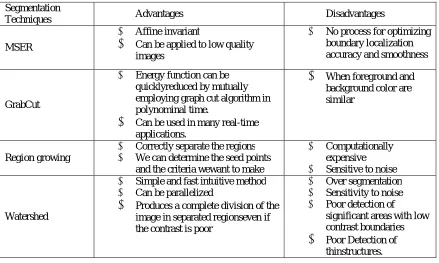
IV.COMPARISON OF DIFFERENT ALGORITHMS
Segmentation
Techniques Advantages Disadvantages
MSER
Affine invariant
Can be applied to low quality images No process for optimizing boundary localization accuracy and smoothness
GrabCut
Energy function can be quicklyreduced by mutually employing graph cut algorithm in polynominal time.
Can be used in many real-time applications.
When foreground and background color are similarRegion growing
Correctly separate the regions We can determine the seed points
and the criteria wewant to make
Computationally expensive Sensitive to noise
Watershed
Simple and fast intuitive method Can be parallelized
Produces a complete division of the image in separated regionseven if the contrast is poor Over segmentation Sensitivity to noise Poor detection of
significant areas with low contrast boundaries
Poor Detection ofthinstructures.
Table 1Advantages and Disadvantages of Segmentation Algorithms
Table shows the advantages and disadvantages of different segmentation algorithms.
V. CONCLUSION
involved, and maybe incite further propels in the range. The trouble of performing accurate segmentation is determined by the nature of the material tobe read and by its quality. By and large, missegmentation rates for unconstrained material increment logically from machine print to handprint to cursive writing. Thus simple procedures basedon white partitions between characters suffice for clean altered-pitch typewriting. For cursive scriptfrom numerous scholars and a substantial vocabulary, at the other outrageous, techniques of ever expanding refinement are being sought after. Current research employs models characters as well as wordsand phrases, and even whole documents, and capable tools, for example, HMM, Neural Networks, Contextual strategies are being conveyed to bear. While we have concentrated on the segmentation issue itis clear that segmentation and classification have to be dealt in a coordinated manner to acquire high unwaveringquality in complex cases. From hypothetical studies it is found that MSER is a superior strategy to for handwriting content recognition.
REFERENCES
[1] Siyang Qin, Roberto Manduchi , “A Fast and Robust Text Spotter”, IEEE Winter Conference on Applications of Computer Vision (WACV), pp.1-8,2016.
[2] Jay H. Bosamiya, PalashAgrawal, ParthaPratim Roy, R. Balasubramanian , “Script Independent Scene Text Segmentation using Fast Stroke Width Transform and GrabCut”, 3rd IAPR Asian Conference on Pattern Recognition (ACPR), 2015.
[3] C.C. Tappert, C.Y. Suen and T. Wakahara, “The State of the Art in On-line Handwriting Recognition”, IEEE Trans. on Pattern Analysis and Machine Intelligence, vol. 12, no. 8, page 787, Aug.199
[4] C.E. Dunn and P.S.P. Wang, “Character Segmenting Techniques for Handwritten Text - A Survey”,11th IAPR International Conference on Conference B: Pattern Recognition Methodology and Systems, Proceedings, vol. II, page 577, August 1992
[5] AnshulGupta,ManishaSrivastava, ChitralekhaMahanta “An Offline Handwritten Character Recognition Using Neural Network”, IEEE International Conference on Computer Applications and Industrial Electronics (ICCAIE), April 2011
[6] SoniChaturvedi, Neha R. Sondhiya, Rutika N. Titre, “Izhikevich Model Based Pattern Classifier for Hand Written Character Recognition -- A Review Analysis”, International Conference on Electronic Systems, Signal Processing and Computing Technologies (ICESC), pp.346-349, 9-11 Jan. 2014
[7] Neeta Nain SubhashPanwar, “Handwritten Text Recognition System Based on Neural Network”, Journal of computer and information technology, vol2, no-2, June 2012.
[8] AlirezaAlaei, P. Nagabhushan and Umapada Pal, “Fine Classification of Unconstrained Handwritten Persian/Arabic Numerals by Removing Confusion amongst Similar Classes”,10th International Conference on Document Analysis and Recognition, 2009.
[9] Takumi Kobayashi , “BoF meets HOG: Feature Extraction based on Histograms of Oriented p.d.f Gradients for Image Classification”, IEEE Conference on Computer Vision and Pattern Recognition (CVPR), 2013.
[10] Richard G. Casey, Eric Lecolinet, “Strategies in Character Segmentation: A Survey”, Proceedings of the Third International Conference on Document Analysis and Recognition IEEE, vol.2 , pp1028 – 1033, 1995
[11] AmitChoudhary, “A Review of Various Character Segmentation Techniques for Cursive Handwritten Words Recognition,” International Journal of Information & Computation Technology, Volume 4, Number 6 (2014).
[12] Magdalena Brodowska, “Oversegmentation methods for Character Segmentation in Off-line cursive handwritten word recognition-An Overview”, Schedae-Informaticae, Volume 20, 2011
[13] HetalAgravat, KiritRathod, “Classification of Different Segmentation Methods for Handwritten Words”, International Multidisciplinary Research Journal (RHIMRJ), Volume-2, Issue-3, March-2015