
Nonrelativistic Operators for Relativistic Transition Rates
Full text
Figure
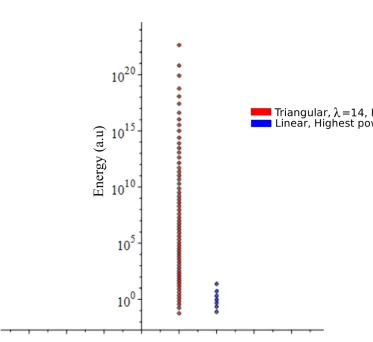
![Figure 4.1: This diagram illustrates the Hylleras-Undheim-MacDonald theorem [1, 2].The Ei are the exact eigenvalues of H, and the λi are the variational eigenvalues fora N-dimensional basis set.The previous N eigenvalues lie between the new N+1eigenvalues as N increases](https://thumb-us.123doks.com/thumbv2/123dok_us/1342816.1167168/47.612.106.476.142.583/illustrates-macdonald-eigenvalues-variational-eigenvalues-dimensional-eigenvalues-eigenvalues.webp)
Related documents
The boundedness properties of commutators of Riesz transforms associated with Schr¨ odinger operators and BMO A were investigated by Guo etc (in [9]) and Chu and Ma([2])2. By giving
Equation (2) casts the problem of the essential self-adjointness of Schr¨ odinger operators on domains with non-empty boundary in terms of a balancing act be- tween the
We study the asymptotic properties in forward directions of resolvent kernels with spectral parameters in the lower half plane (un- physical sheet) of the complex plane for
In the previous work [8], we have studied the asymptotic properties, par- ticularly along forward directions of resolvent kernels (the Green functions) with spectral parameters in
We end this section applying Corollary 2.8 to obtain the orthogonal Green kernel for the singular Schr¨odinger–like operators whose principal part is the signless Laplacian of
In x 5, the Schrodinger and polyharmonic operators (which, in applications, play the part of H 0 ) are introduced and some relevant statements on this operators are presented.
The primary goal of the Digital Music Notation Model and Prototype Delivery System project was to demonstrate the enhanced capabilities of the Music Encoding Initiative (MEI) data
Because it is assumed that the maximum transverse shear demand will not occur at the same time as the maximum relative longitudinal displacement, the existing concrete shear
