Scholarship at UWindsor
Scholarship at UWindsor
Electronic Theses and Dissertations Theses, Dissertations, and Major Papers
1968
I. Hydrodynamic model selection for counter diffusing systems: A
I. Hydrodynamic model selection for counter diffusing systems: A
selectivity study in mass transfer with non-linear chemical
selectivity study in mass transfer with non-linear chemical
kinetics. II. Effect of catalyst poisoning on selectivity: A modelless
kinetics. II. Effect of catalyst poisoning on selectivity: A modelless
approach. III. Selectivity optimisation for complex non-linear
approach. III. Selectivity optimisation for complex non-linear
reaction schemes. IV. Reactor simulation for the hydrogen fluoride
reaction schemes. IV. Reactor simulation for the hydrogen fluoride
reaction: Fluorspar + sulphuric acid products
reaction: Fluorspar + sulphuric acid products
R. Raman Sood
University of Windsor
Follow this and additional works at: https://scholar.uwindsor.ca/etd
Recommended Citation Recommended Citation
Sood, R. Raman, "I. Hydrodynamic model selection for counter diffusing systems: A selectivity study in mass transfer with non-linear chemical kinetics. II. Effect of catalyst poisoning on selectivity: A modelless approach. III. Selectivity optimisation for complex non-linear reaction schemes. IV. Reactor simulation for the hydrogen fluoride reaction: Fluorspar + sulphuric acid products" (1968). Electronic Theses and Dissertations. 8080.
https://scholar.uwindsor.ca/etd/8080
I HYDRODYNAMIC MODEL SELECTION FOR COUNTER DIFFUSING SYSTEMS--- A
SELECTIVITY STUDY IN MASS TRANSFER WITH NON-LINEAR CHEMICAL KINETICS. II EFFECT OF CATALYST POISONING ON
SELECTIVITY A MODELLESS APPROACH
III SELECTIVITY OPTIMISATION FOR COMPLEX NON-LINEAR REACTION
SCHEMES
IV REACTOR SIMULATION FOR THE HYDROGEN FLOURIDE REACTION--- FLOUR SPAR +
SULPHURIC ACID ►PRODUCTS.
A Thesis
Submitted to the Faculty of Graduate Studies Through the Department of Chemical Engineering in Partial Fulfilment
of the Requirements for the Degree of Doctor of Philosophy at the
University of Windsor
by
R. Raman Sood
Windsor, Ontario
1968
INFORMATION TO USERS
The quality of this reproduction is dependent upon the quality of the copy
submitted. Broken or indistinct print, colored or poor quality illustrations and
photographs, print bleed-through, substandard margins, and improper
alignment can adversely affect reproduction.
In the unlikely event that the author did not send a complete manuscript
and there are missing pages, these will be noted. Also, if unauthorized
copyright material had to be removed, a note will indicate the deletion.
®
UMI
UMI Microform DC52626Copyright 2008 by ProQuest LLC.
All rights reserved. This microform edition is protected against
unauthorized copying under Title 17, United States Code.
ProQuest LLC 789 E. Eisenhower Parkway
DEDICATED TO:
Leslie Dickirson my dear friend
/
ACKNOWLEDGMENTS
Academically, I owe a great deal to Dr. G.P.
Mathur. This is another occasion for the acknowledgment of that debt. During the period that this work was being
done, his sense of perspective was invaluable.
A large number of individuals have helped me
in my work; some even whose names I do not remember and others whom I know very well. I wish to thank Dr. M*
Bhatia, Dr. S. Srivastva and H. Toes, for helping me develop
a sense of quantified simplicity, and Dr, R. Stager for encouraging me to look at the problems from an outsider’s
point of view.
I want to take this opportunity to express my
gratitude to the staff of the computer centre for a
generous allotment of time, to D. Chambers and Mrs. E.
KcGaffey for help in the University Library, to R.K. Roongta
for help in the drawing work, and to my friends who put up with me during two years of a de-humanizing and alienating
nightmare.
The financial support from the National
Research Council of Canada in the form of Graduate
Fellowships is truly appreciated.
"Because of past studies chemical engineers are prone to accept, as a general rule the previous conclusion, that different theoretical models predict almost the same reaction effects on overall mass transfer rate... The selection of a correct model is indeed very important,.."
C.J. Huang and C.H. Kuo A.I.Ch.E.J. 11, 901
(1965) in a discussion on the effects of
diffusivities.
ABSTRACT
A two step non-linear complex reaction scheme 2M]--- ^2M2--- *~M3 has been used to establish the need for
a careful selection of a mass transfer model for counter
diffusing systems. By comparing the Penetration Theory and
Film Theory selectivity parameters, it is shown that the two fluid-mechanical models do not predict the same results.
It is also shown that the deviations between the results predicted by the two models do not appear to be directly
related to increasing complexity in the reaction kinectics.
In addition, the effect of reaction order on the selectivity parameter, has been examined by varying the order of the
second step reaction.
ii
ABSTRACT 11
TABLE OF CONTENTS 111
FIGURES v
TABLES vi
I. INTRODUCTION 1
II. REVIEW OF LITERATURE 4
III. THEORETICAL MODEL OF THE SYSTEM 8 IV. DIFFUSION EQUATION
A. General Diffusion Equation 10
B. Mathematical Statement of Penetration Theory 12 C. System Equations according to the Penetration
Theory 15
D. Solution of Penetration Model System Equation 20 E. Quantitative Aspects of the Film Theory 30 F. System Equations for Film Theory 31 G. Solution of Film Model System Equation 33
V. RESULTS 43
VI. DISCUSSION OF RESULTS 67
VII. CONCLUSIONS , 75
APPENDIX A 77
APPENDIX B 83
APPENDIX C . 8 5
APPENDIX D - .91
APPENDIX E 95
n o m e n c l a t u r e BIBLIOGRAPHY
iv
Figure
1.1 ' COMPARISON OF FILM AND PENETRATION MODELS FOR THE TWO STEP REACTION Ml— -M2— - M3 Ml— M2 1.0 ORDER, M2— -M3 1.0 ORDER.
1.2 COMPARISON OF FILM AND PENETRATION MODELS FOR THE TWO STEP REACTION Ml— -M2— -M3 Ml— —M2 1.0 ORDER, M2 -M3 1.5 ORDER.
1.3 COMPARISON OF FILM AND PENETRATION MODELS FOR THE TWO STEP REACTION Ml -M2— -M3 Ml— -M2 1.0 ORDER, M2— M3 2.0 ORDER.
TABLES
Tables
I— VIII °BAf/<rBAp
IX— XVI (BAf/<rBAp
XVI-XXIV BAf / °BAp
Tables for the case where the second step reaction is of 1.0
order **3-50
Tables for the case where the second step reaction is of 1.5
order 51-58
Tables for the case where the second step reaction of 2.0
order 59-66
vi
INTRODUCTION
The solution to the problem of predicting the
effect of a liquid phase chemical reaction on gas absorption
or vice versa, has been attempted by proposing a hydro-
dynamic model of the gas-liquid interface and the liquid flow pattern. Amongst the various models suggested, the so called film theory model‘postulated by Nernst (25),
Lewis and Whitman (24) and the penetration-surface renewal
theory model proposed by'Higbie (14), Kishineveskii (17) and
Danckwerts (9 ), are the two that are most commonly used.
When the diffusion coefficients of various reacting species are the same, the results predicted by the film theory and
LI
the laminar and turbulent boundry layer theories are found
to be in remarkable agreement with each other. This
interesting fact has been pointed out by Brian and
Beaverstock (4), Kishineveskii and Armash (18), Astarita
( 1 ), and a few others. Basing their conclusions on the
results available -in the literature, Brian et al ( 4) concluded, " This insensitivity to the fluid mechanical models used suggests that the theoratical predictions will be good approximations even for physical systems which
depart considerably from the idealised models." In a
2
the mass transfer model invoked has little influence on the
predicted ratio of the mass transfer coefficient with
chemical reaction to the physical mass transfer coefficient. Conclusions of this nature, have led in the past to
a rather indiscriminate selection of models for the prediction of the transfer coefficient ratio
[
mass transfer with chemical reaction --- *| , in heterogeneous. . mass transfer without chemical reactionjfluid-fluid systems. It is to be noted that the conclusion
regarding the insensitivity of predicted results to the hydrodynamic model used, is of fundamental importance; but,
it has been arrived at on the basis of results obtained
from studies dealing with relatively simple systems in which,
the products of chemical reaction can never cross the phase boundary. The lone exception is the work of Szekely and
Bridgewater (31.) . On the basis of their investigations of
a linear kinetic system with a volatile intermediate, they questioned this alleged insensitivity of predicted results
to the model selected. It was decided therefore, to undertake a detailed study with a view to determine, whether or not, the predicted transfer coefficient ratio
is always insensitive to the hydrodynamic models used. In order to do so, it was proposed to compare the film and
penetration model selectivity of an intermediate, Ivl2, formed during a complex reaction described below:
kl 2M1 + [3] --- 2 M2
k 2
2M2 +[g] M3 (ii)
(i)
(iii)
[ i r r ] = 2 k 2 [f° ' 2kl ^ 0
(iv)
The component Ml diffuses from a fluid 'a1
into another fluid 1 g* where it reacts to form an intermediate M2. It is further assumed that M2 can either react to form
M 3 or diffuse back into f l u i d ’a * . The stipulation that M2 can diffuse back across the interface makes this study
different from thi© ones conducted thus far. According to Bridgewater ( 5 ) systems of this type are encountered in the liquid phase oxidation of hydrocarbons by absorbed oxygen.
As mentioned before, the commonly used index for comparing
various hydrodynamic models is the transfer coefficient
ratio; but, in this case it was decided to use a n 'equivalent
CHAPTER II
REVIEW OF LITERATURE
Peaceman (27). in 1951. compared the film and penetration theory solutions for several kinds of chemical reactions and found that these solutions were in
close agreement with each other, as long as the diffusion coefficients of the various reacting species did not differ
significantly from each other. Similar results were reported
later by Danckwerts and Kennedy (11). The reactions treated
by these authors however, were one-step reactions. Brian and Beaverstock ( ^ ), analysed a two step reaction of the type:
A (gas) ^ .. A (liquid)
Liquid Phase:
A + C (already in liquid) ► B (nonvolatile)
B + C - ■ - ► D (nonvolatile),
and found that if the diffusion coefficients for various components were similar, the results from the penetration
theory and film theory would not differ significantly.
The components, 1B *,*C ' and 'D* were assumed to be
nonvolatile and thus could not cross the liquid-gas
phase boundary.
k
penetration - surface renewal theories, derived equations
for the ratio of interphase mass transfer accompanied by a first order reversible reaction. They found that when the
diffusivities of the reactants and the products are nearly
equal, the effect of chemical reaction on the overall mass transfer ratio is insensitive to the model adopted for calculations. Kishineveskii et al (18) and Astarita ( 1 )
reached similar conclusions from their analysis. It must be
emphasized again that in all these studies, the products of the chemical reaction could not cross the phase boundary.
Szekely and Bridgewater (31) investigated the
fluid - fluid system,
kn k2
A --- -— ► B --- ► C (1) dC
dr 1 A
dC ,
= k-p (2 )
= * 2 CB - k lCA (3) dr
in which, both A and B are volatile ( A diffuses from a fluid a into fluid 3, where it reacts to form B, which
in turn can either diffuse back into a or can get converted
to C ), Because the product of reaction fB ’ could cross the phase boundary, it was possible to compare the transfer
coefficient ratio for 'B' instead of- ’A'. Szekely et al (3D found that the selectivity of the intermediate B, as
6
models, differed by as much as 22%. .Th’e difference in the results obtained by Szekely et al (31) and Brian et al (4),
can be attributed to the different assumptions made in these
studies concerning the nature of the intermediate 'B'. Thus, whereas in Brian et al's ( ) investigation, 'B' could not cross the phase boundary, in Szekely et al's (31)
investigation, 'B' could diffuse through the fluid - fluid
phase boundary.
In reporting their results, Szekely et al (31) conjectured that other counter diffusing fluid - fluid
systems involving more complicated kinetics would display the effect of hydrodynamic patterns more severely. Since
the kinetic scheme they investigated involved only first order reactions, the resulting equations for both the film
theory model and the penetration models were linear and
hence quite easy to solve.
Useful as Szekely et al's (31) results are,
their conclusions have the following shortcomings:
i. Linear reactions are an exception rather than a rule in actual chemical engineering practice, and Szekely et al's
(31) conclusions are certainly not applicable to cases of nonlinear kinetics. They could only make conjectures
regarding the effects of " more complicated kinetics",
ii. Szekely et al (3D have investigated only one case and it can be thought of as an isolated example rather than
as a general conclusion.
It is obvious that in order to show the
relative importance of model selection for the prediction
of the transfer coefficient ratio in a counter diffusing heterogeneous fluid - fluid system, it is necessary to
undertake a much more extensive investigation. This study
was primarily undertaken with that purpose in mind. Its major objectives are listed below;
i. To establish the relative importance of model selection
for heterogeneous counter diffusing fluid - fluid : systems with nonlinear kinetics; that is, to
quantitatively establish the sensitivity of predicted
transfer coefficient ratio to the hydrodynamic model
used,
ii. To check Szekely et al's (31) conjectures about the effect of more complicated kinetics on the sensitivity
CHAPTER III
THEORETICAL MODEL OF THE SYSTEM
The system considered is one in which a fluid species Ml. present in a fluid medium 'a1, diffuses into a fluid »£•,
Ml( fluid a )- — ■ ^ mi ( fluid £ )
where it reacts with the fluid ’g 1,
2Ml + [p]---- ► 2M2 .
The fluid component M2 then either diffuses back into the
medium ’a 1 or undergoes another irreversible reaction :
2M2 + [g]--- ► M3 .
In this analysis Ml and M2 were treated as gases, whereas
(5 was assumed to be a liquid. However, this treatment is
equally valid for liquid - liquid systems. It was assumed that R was in such an excess that its concentration could be
considered constant. As Danckwerts (10) and Carberry (7 )
have shown, absorption into liquids can generally be regarded as an isothermal process. Physical and chemical properties of the system were assumed to be constant. It was also assumed that the diffusive fluxes of species Ml
and M2 did not interact. Some further simplifying
assumptions that were made in the course of this study are
listed below s
i. The diffusion coefficients of Ml and M2 are equal. This assumption is realistic in light of the fact that
8
depends only very slightly on the solute concentration, ii. There is no resistance to mass transfer in the gas phase.
Thus the concentration of species Ml at the gas liquid
interface, corresponds to the equilibrium partial
pressure of Ml in the bulk gas phase. This assumption does not in any way limit the scope of the problem.
The equilibrium assumption is also made for species M2 , iii. The back pressure of the species M2 in the gas phase
is zero. This assumption was made for the sake of
simplicity and standardisation,
iv. No appreciable change in volume takes place as a result
of the chemical reaction,
v. Fluxes of MU and M2 from the gas phase towards the
liquid phase are positive.
The assumptions listed above apply equally
well to gas liquid contacting, in packed towers, in wetted wall columns, and to gas absorption into stagnant liquids.
For the system under investigation,
selectivity was defined as the ratio of the rate of
formation of the intermediate M2, to the rate of depletion
of the reactant jvjq. Selectivity defined in this vray is
equivalent to the ratio of the surface flux of M2 to that of the surface flux of Ml. This definition has been used
CHAPTER IV
DIFFUSION EQUATION
A. General Diffusion Equation
For a reacting species i, the mass balance over a moving small element of liquid, near the gas liquid interface, is described by the partial differential
equation :
Molecular Transport = Convection + Accumulation
+ Reaction Rate.
The Lagrangian System of Coordinates is used for the derivation of this equation.
The diffusion equation as written above is of
very little practical value and is generally simplified by making one or more of the following assumptions t
i. D^ , the diffusivity is constant. This assumption is a good approximation except in the case of polymer
solutions, where D^ is strongly dependent on the concentration of various species,
ii. The velocity U is constant over the moving small element of the fluid under consideration.
Equation (4) can therefore be written as
(5) 10
. Each liquid element moves as a single whole with a
constant velocity, like a plug in a plug flow reactor.
It is implied that there is no motion in a direction perpendicular to the interface, or U=0. With U=0,
equation (5 ) is reduced to
Equation (6) is a mathematical statement of the penetration - surface renewal model.
. The concentration profile of a species i in the
element is independent of time. This assumption leads to the statement of the so-called film theory model.
Thus,
Equations (6 ) and (7) can he further simplified by assuming that the radius of curvature of the gas
liquid interface is very large in comparison to the
depth of the diffusion / penetration layer, and thus the diffusion process is one-dimensional. According to Levich (23), this condition is almost always fulfilled
in real cases. In Cartesian Coordinates, equations (6 ) and (7 ) can accordingly be written as
DiA ci = + r (6)
61
DiACi r (7)
B. Mathematical Statement of Penetration Theory
Equation (8 ) is a statement of mass balance over a small element of liquid in contact with the
interface. This equation has been derived under the
assumption of a zero velocity gradient in a direction
normal to the interface. If the chemical reaction term is dropped, equation (8 ) can be written as
If the element of liquid under consideration can be assumed to have :
i. the characteristics of a plug of an infinite depth
moving as a whole with a constant velocity, or can be treated as a stagnant element of infinite depth i.e.:
The d e r i v a t i o n of equation (12) is described in Appendix IA. 6Ci
6t •
(10)
0 < x < co (11a)
ii. a uniform initial concentration Ci :
Ci = C i ; t = 0 0 < x < oo
■ 0
(lib) Ci = Ci ; t > 0 X — >• oo
*
iii, an interfacial concentration Ci :
*
(llcc) Ci = Ci ; t > 0 x = 0
then, the flux X(t) at exposure time t and at the
interface can be expressed as
X(t) = - Di (12)
~ *
The average flux, X(t), for an exposure or penetration time of t* is given as
o (Dl^ l )x= 0 d t
X ( t )
I
(13)
where, K^p = 2
ilk)
\ TT t
J dt o
In accepted chemical engineering terminology ~/ o , * o .
X ( t # ) = KLp ( Ci - Ci ) (15)
(15a) T nt
Kj(p is the penetration theory liquid phase mass transfer coefficient without chemical reaction.
Equation (12) has been derived with the help of assumptions (11). These assumptions are very stringent
and are strictly true in rare cases only. Under the
conditions imposed by assumptions (11), equation (12) can
have only very limited applicability. Danckwerts (9 ) has listed the conditions under which equation (12) can be
applied as a close approximation to :
i. liquid layers of restricted depth, and
ii. liquid moving parallel to the surface with a velocity
14
The necessary condition for (i) is that the
time of exposure should be so short that the depth of
penetration is less than the depth of the liquid; for (ii), it must be so short that the depth of penetration is less
than the depth at which the velocity is appreciably
different from that at the surface. By the term depth of penetration is meant the distance from the interface over
o
which Ci is appreciably different from Ci. Danckwerts (9 )
has arbitrarily defined the penetration depth as the distance from the interface at which the rise in
concentration is 1/100 that at the surface.
Equation (12) has. been extensively used for
describing mass transfer for situations comparable to
conditions (i) and (ii). The resulting models are of great help in understanding the phenomena occuring in industrial equipment. Thus, Brian et al (3 )# have described the
phenomena of mass transfer in a packed absorption column by assuming that the liquid flows down over a piece of
absorber packing in slug laminar flow. Absorption is
thought to take place by unsteady molecular diffusion and
accumulation within a slug of liquid as it flows down the packing and is exposed to the gas phase for a given contact time interval. The liquid is assumed to be instantaneously
and completely mixed in flowing from one piece of packing
to the other, and to be free of velocity gradients and
transport process adjacent to the gas liquid interface.
Thus, each new contact time interval is begun in each slug with a flat concentration profile for all components. The
contact time between successive mixing points is so short that the absorbed species never penetrates deeply enough
to approach the wall of the piece of packing. Therefore, the liquid depth can be taken as infinite for the sake of mathematical simplicity. The descriptions for spray and
bubble absorbers as well as for wetted wall columns that
satisfy considerations (i) and/or (ii), have been given by
Higbie (14).
C. System Equations According to the Penetration Theory
1. Chemical Rate Equations :
Ml (gas) < Ml (liquid) (16)
Liquid Phase:
. kl
-(1?)
2 mi f a 2 M2
M2 (liquid)— i M2 (gas) (13)
Liquid Phase:
k2
(19)
2M2 + 0 M3
The rate equation for step (17) is,
If p is present in large excess, its concentration can
be assumed to be constant. Thus equations (20) and (21) can be written as
- ^ M l n
= 2 k ^ Cj q ( 2 2 )
d r
dC.jrx m u
' ~ & f = 2 M2 1 M1 (23)
2. Mass Balance Equations s
For the reacting system described by equations (16 - 23), the following mass balance can be written:
n 6 ^41 SCMi n ^
Ml
T T •
1
Ml
1
J
DM2 i f * * = ! ! k t Z ^ S z . k i C ^ ) (25)
6x^ 51
The appropriate initial and boundary conditions are
as follows :
t = 0 0 < x < 00 = 0 (26a)
t > 0 x = 0 CH1 = 4 ^ (26b) t > 0 x —*• 00 Cj^ —*. 0, bounded (26cc)
t = 0 0 < x < co q42 = 0 (27a)
t > 0 x . = 0 ~ 0 (2?b)
In equations (2^ - 27) 't* refers to the instantaneous time in the life of a liquid element. The boundary
conditions (26) and (27), are mathematical statements
of the underlying assumptions of the penetration theory.
Boundary conditions (26a, 27a) were chosen for
convenience only. Any other bulk concentration can be used. The boundary condition (27b) states that though 'M2’-can diffuse back into the gas, its concentration
at the interface is zero. This numerical value was chosen for convenience. It should be noted that this
boundary condition is different from the normally
The equations (2^ - 2?) were non-dlmensionalised to : 0 ¥9
assumed condition ( — — )x-0 = 0 ( which express the 6x
6C M2
nonvolatility of the species M2 ).
62a 6a
+ an (28)
6y2 60
(29)
e > o
e > o
0 = 0 0 < y < oc
y — oc a -► 0 bounded a = 1
a = 0 (30a)
(30b)
18
0 = 0 0 < y < oc b = 0
0 > 0 y = 0 b = 0
(31a) (31b) (31cc)
0 > 0 y -* oc b -►0 bounded.
The transformations used to obtained these dimensionless equations are listed under the mass transfer section of
t
the nomenclature ( Page 1Q0 ).
3. Reaction Diffusion Modulus :
Equations (2^ - 2?) have to be solved with a view
to determining the average value of the expression
time. One index of this predetermined time that is
often used in mass transfer literature is the reaction diffusion modulus ^ derived by making a suitable
, over a predetermined period of
substitution for t in the expression for Ko
Lip
In this . is chosen. ( See the transformation used for non dimensionlising t ).
LMlp (33)
TT
where % = / K?„LMlp
The definition of selectivity iBAp' leads to
6c
<r
B A p ' =
Average of _
D ( — *-2 )
M 2 6x x=° Average of r f ^ Ml \
- l m i^ 57 “ x=o
over
predetermined value of the exposure time 't'.
<r
BAp
v f ^ “ 6CM2 //6x ^x=0 dt
o________________________
£
f ( - 6^ / S x )X=Q dt
In non dimensional terms 6
BAp = v Jk
i / ( - 6b/6y ) d0
f ( - 6a/6y ) de
o Y=0
For v - 1, equation (37) is some times written as,
a
BAp =
/ ( - 6b/6y )y=Qd9
y[n/kQ J ( - 6a/6y )y=0A'
In this form,
(34)
(35)
(36)
(37)
20
<r
BAi
Mass Transfer Coefficient with chemical reaction „
for M2 Mass Transfer Coefficient without chemical reaction
Mass Transfer Coefficient with chemical reaction
for MlJ Mass Transfer Coefficient without chemical reaction
(3?b)
D. Solution of Penetration Model System Equations
<r
In order to evaluate ABp (equation 37) for various values of 9 ( or corresponding values of ) ,
it is necessary to solve equations (28) and. (29) along
with the Initial and boundary conditions (30) and (31). Closed solutions for these equations, except for the case
m = n = 1 , are not known. For mathematical simplicity and because of limitation on computer time, only the
following cases were considered ;
1 . v - 1, m = 1 , n = 1
2 . v = 1 , m = 1 ,5 . n = 1 3 . 1/ = 1 , m = 2 , n = 1 .
Detailed description of the methods used in
solving these .special cases of equations (28) and (29), follow on the succeeding pages.
** n = 1 was chosen because of limitation on computer time. The numerical methods described on the following pages
apply equally well to cases where n ^ 1 .
1 . v =1 , m=l, n=l.
Equations (28) and (29), with initial and
boundary conditions (30) and (31), were solved with the help of the Laplace Transform Tables (28), the step by step
procedure is given in Appendix (IA). Szekely et al (31) erlve the final solution as
a = 1
f
e yerfc / y - V1T\ + e^erfc/ v + Vtft] \2V T ) \2V ^ /J(38)
(A)
- y v TyVT
e ,>VAerfc / y - VT 0 j + e erfc^ y +
e ^erfc /_y - VfT\ + e^erfc/ y + V I H V
and
(39)
e
/ /-6a\ d9 = ^ \
fiyyy=o-(4o)
CD
erf'VtT” + ft)e 7T-0
/evT+ _ i \
\ 2VT/erf
22
BAp =
(i-x)
1-4 0 V T + 1 jerf (20
. 7T 2vry
•
/
i
) 42% (v»j V*-;
, 2 . v ,20V 2 0 /a0 + i\erf/ P\ + P
P [yfiT/ tt
. (k/n y
(42)
2 and 3* General Procedure for Numerical Solutions
For n=l, and */=l, equation (29) can be written as,
59 m
'b = 6b + Xb -1 6 Y 69
-y y \1
e erfc( y - + e erfc( y + ^ j j \2Ve
(43) An analytic solution of equation (43), is not known for when m / 1. However, numerical techniques employing finite
difference methods are available. Out of the two types of
finite difference schemes, explicit and implicit, an implicit
scheme was chosen. This was done because implicit schemes
2
are inherently stable for all values of A 9 / A y > 0
(see equation 1?C Appendix C). On the other hand explicit schemes are easier to operate, though they are time consuming
2
because of stability condition A 9 / A y <1/2 (see equation
13C Appendix C). The boundary condition (31C) is always a problem in numerical calculations as it involves the division
of a semi-infinite length into a finite number of mesh
divisions. As mentioned by Secor et al (29) this difficulty can be dealt with in several ways, A practical infinity can
be defined and the region 0 < y < oo practicai can be
divided into a uniform mesh. This approach results in a coarse grid in the region of interest (close to the
interface i.e. y = 0 ) and results in a corresponding lack
of accuracy. However, by using a non-uniform mesh (fine mesh in the region of rapid change and a coarse grid far
away from the surface), or a very fine mesh, this difficulty can be overcome. The latter method is time consuming; whereas
lack of precise knowledge about the location of the regions of rapid change makes the method of non-uniform grids unwork able .
The space "0 < y < oo , 0 < 6 " was there
fore mapped onto a semi-infinite ( in 0 ) rectangle
”0 < z < 1 , 0 < 0", by the transformation
y = cz
1—z ( W .
Thus at y=0, z=0 and at y=oo, z=l. The constant, c is used
to distribute the grid according to the experimenter's needs.
A larger c means a finer grid near the interface and a coarser
grid at the other end of the space coordinate. A proper value -of c can be selected only after experimentation. A value of
c = 0.98 was chosen, after comparing the analytical and numerical results for the case of m = 1 .
24
m 6 /6b dz \ 6b + Xb -1 6 ^ 6 - dy' = § 9 2
-cz/(l-z) .
e erfc / cz _vo (t u
cz 1-z + e erfc
z)2vo- )
+ VeT" / cz + V&i \TlTzT2Vf /
6Jb dz = 6_b (1-z) 5z dy §z c
(45)
(46)
2
6 /6b dz \ = 6 dz (6b dz\ = 6^'b /dz\ + 6b dz 6 Idz\ fiyVfiz dy/ 6^ dy \62 dy/. 5z2 \d3y $z dy 6"z \dy/
Equation (47) leads to,
(Z{ 1-z) \
6ZV c2
)
? 2 4 3
6 b = 6 b (1-z) --- - 6b/2 (l-z) ‘ 6y oz c
(47)
(48)
With these transformations, equation (43) is changed to,
m 3 2 4
6b = a - Xb - 26b (1-z) + 6 b (1-z) (49) 69
where,
a = 1
2
iz c2
Oz C
-cz,/(l-z)
erfc( cz - v r
z)2Vd
)
+ e
cz/(l-z)
erfc ^ cz + Ve“
(i-z)2va
)
with the boundary and the initial conditions:
9 > 0
6 = 0
z = 0 b=0
0 > z > 1 b=0
(50a) (50b)
9 > 0 z — ► 1 b = 0 (5Occ) The implicit finite difference approximation for the equation
(49) can he written as,
m
b b a lb
i. .1+1 - i, .1 = i,j+l - i» j A 0
-b b \ . 3
1*3+1/ " l+l,
j+1__-A Z
(1 - Az(i-l) )'
„2
b 2b b
+ I i+1,3+1 - i, .1+1+ 1-1, .1+1 A Z
where,
(l-(i-l) A z ) , ,
i=l,2,..,N-1
3=1,2, , ,M-1 (51a)
a
1*3+1 V ( l - ( i - l ) A z ' y T ^
c( (i-l)Az)/(l-(i-l)Az)
erfc / c( ic( i-1 )Az + i/jA9 l)Az ) 2.fT^Q
i=2,3, .. . N-l
3=1,2,...M-l
(51b).
26
The equations (50a, 50b, 50cc), in the form useful for digital computations, are:
b ^ ^ j j = 0,0 j = 1,2,.., M (52a )
b(i = 0.0 i = 1,2,... N (52b)
k(N,j) = ^ = ^ (52cc)
where,
M = A0 + 1 (53)
0
N = _1 + 1 (54)
Az
The following values of A 9 a n d A z were used:
0 < 0.02 A 6 = 0.0001
6 > 0.02 A 6 = 0.018
Az = 0.02
Equation (51a) can be written as,
r 3
b i+l,j+l 1 2(1-( 1-1 )a z) A9 - (l-(i-l)Az) A 0
[ A z ° 2 a z 2c2
J
. _ ... . 3. . ^
+ b , . .V ri-2(l-(i-l)AZ)A0 + 2(l-(i-l)Az) A9 1 i,j+l --- — ---
2-2---L A Z c A Z C
J
= AQa. . _ - A0Xb“ . + b. . 1,0+1 i,0 i,j
i = 2,3,... N-l
j = 1,2,3,... M-i (55)
Equation (55) has the following triangular form,
SB2pb2,j+l + SC2pb3,j+l = SD2p
SA3pb2,j+l + SB3pb 3,j+l + SC3pb4,j+i = sD3p
SA^pb 3, j+1 + W \ j +i + Sc^Pb5,j+l = SD3p
!AN-2pbN-3, 3+1 + SBN-2pbN-2, i+1 + SCN-2pbN-l, j+1 “ SDN-2
SAN-lpbN_2, j+1 + SBN-lpbN-l,J+l“ SDN-lp
(56)
w h e r e ,
sA l p =
A z c
i = 3,4,;.. N-l (57a)
3-n. = 1 ■2(l-(i-l)Az)"Ae +' 2(l-(i-l)Az) A0
jjlp x--- p---
p-p---2 2 2
A Z c A Z c
i = 2,3,...N-l (57b)
3 - 4
_ 2 (1- ( i-1 )a z ) A9 - (l-(i-l)Az) A9
U J-P — p 9 9
28 N-2 (5?cc) N-l M-l (57d) Equations (56), and hence, (55), can be solved by Gaussian elimination to obtain the values of b on the line j + 1
(for details of the method, see Appendix D).
Douglas (12) has shown that the round-off error for this numerical method is less than the discretisation
error for the usual choice of A z and A0 . It is to m
be noted that the term, (X b ) was evaluated on the line •j1 instead of 1 j + 1*. This was suggested by Lees (22),
who showed that equally accurate results can be obtained m
if terms such as, (b ), are evaluated on the line 1j1
instead of the line ’j + l 1. This modification of the
usual implicit finite difference scheme, however, results
in a linear triangular system of equations, instead of m
- the non linear ones that would result if (b ) was
evaluated on the line ’ j + l 1, Lees (22) has indicated that there vrould be a five to six fold reduction in machine tine as a consequence of this modification. As an
/ m
experimental check, the results for (b .), were compared
i * .1 i = 2 ,3 * * •«
SCN-lp “ 0
m
S = A9a - A0Xb. . + b. .
Dip i ,j+1 i.J i,j
i = 2,3,... j = 1 ,2 ,.,, and m = 1 .5 ,2 ...
improvement was found, and all further calculations, were ' m
therefore done for (bi j). As a test of convergence for the solution, calculations were repeated, with half the
normal values of time and space increments. The improvemen
was found to be less than 1 fa. In order to calculate ?r
BAp according to equation (3?)» the values of the term
e
6b\ d 0 and / (- d 0 are needed.
by)y=o o \ fly/y=°
0
f (- ^a i 80 » was by using equation (^4-0), whereas
JQ \ 6y/y=o
0
6b\ d 0 , was evaluated as follows 6y/ y=o
0 / 2 \ 0
f6 /_ 6b\ d© = f (_ 6b\ f-(l-z) ) d© = l / / 6b\
s ^ fiy/y=0 o \ fiz/ \ O / z=0 c o ^ $z/z=0
(58) The integration for (58), was done by Simpson’s rule.
(see Appendix A).
Knowing,
6 <r
f
L
80 and C ( _6b\ d 0 , BAp was calculated forJ ^ i y ) y = o J0 V by )y= o
various values of m,\, and ^ (or the corresponding 0). The P
results are tabulated in Tables (1-2/0.
30
E. Quantitative Aspects of the Film Theory:
The Nernst (25), Lewis and Whitman (2^) film
theory, although earlier in its origin, can be treated as a
special case of Higbie’s (l^) penetration theory, if it is assumed that the small element of liquid referred to in
Higbie’s model attains its final concentration profile instantaneously. This amounts to a stagnant film of
thickness, b^ , next to the gas liquid interface. A similar film can be visualised on the gas side of the interface.
The other assumptions of Higbie’s theory are retained. In
the context of the film theory, the assumptions made can be
stated ass
. . i. Outside the two films, the concentration of reactants in the bulk of the two phases is uniform.
ii. The velocity profile in the film is flat. This
corresponds to the penetration theory assumption of zero velocity gradient in a direction normal to the interface.
Stagnant liquids and liquids moving under laminar flow
conditions approximate this situation closely.
iii. The resistence to mass transfer is totally within the film, wherein molecular transport takes place by Pick’s law.
If the term ’r ' is neglected in the equation (9)> the resulting equation can be written as
D, d C 1 = 0 dx2
= C^ ; X=0
; X =
/ d C \ D /•» o \ o /* o \
X ■ X = (- V ) , 0 = i p - ^ i0 ^ ) « ° > ’
where, §Lf = D ^ f (6l)
is the liquid side mass transfer coefficient without
chemical reaction.
F. System Equations for Film Theory:
- Equations (16-23) which describe the chemical processes occuring in the gas liquid system are valid for the film theory as well. The mass balance equations for the film theory are however different. These will now be
enumerated:
1. Mass Balance Equations According to the Film Theory
For a reacting species i
2
d C n . . .
Mi— = l Ml (62)
dx
2
d C m n
% 2 ---= 2k C 2k c • dx2
32
The boundary conditions chosen are
*
x = 0 CM1 = CM1 (64a)
x = *f CM1 = 0 (64b)
x = 0 CM2 = 0 (65a)
x = ^ cM2 = ° (65b)
x > ^ a - b = 0 (65cc) Boundary conditions (65a) is a suitable boundary condition
for a volatile substance. The value (x = 0 = 0) for (65a) was chosen for convenience. These boundary
conditons match the boundary conditions for the penetration
model. Equations (62-65) can be non dimensionalised to
2 2 n
d a _ </> a (66)
, 2 ^
dy
2 2 m 2 n
d b i / A ^ b V & a (67) . 2 “ f " f
dy
y = 0 a = 1 (68a)
y = 1 a = 0 (68b)
y = 0 b = 0 (69a)
y = 1 b = 0 (69b)
The selectivity £ according to film theory is defined as i5A
dC -D M2
M2
----O' r] y
BAf = ax
x=0
(70)
- DMldCMl dx In non-dimensional form,
x=0
BAf = 1 (-db/dy) y=0 (71)
v (-da/dy) y=0
For if = 1, equation (71) can also be written as
<r
BAf
(
mass transfer coefficient mass transfer coefficient with chemical reaction 'without chemical reaction • for M2]' j(
mass transfer coefficient raass transfer coefficient with chemical reaction without chemical reaction for Ml]/ (71a) G. Solution of Film Model System EquationsLike the penetration model equations, equationss (66- 69) can be solved analytically only for the special /
case of i = n = 1, Solutions for cases corresponding to (a, b, c) of the penetration theory were attempted.
1 , v = 1 , m - n - 1
The solution of equations (66, 68a,b) is,
( i l f - \ b y\ / \ ^ C o s h ^
a = Sinh I f 1 ) , (da\ f f
3^
b =
' ' tanh 3inh (73)
,-D dC .
_ M2__M2 / \
BAf = J dx I = \-db/dy/y=Q "DMldCMl /-da/dy \y=0
✓3 T T \ /
3x
aBAf = - / 1 Vl- VjT tanh#f
tanh 0 VT -- f
(7*0.
2, and 3• Numerical Solutions for
v — l,n = 1 , m = 1 .5 * 2.0
Like it's counterpart in the penetration equation,
equation (67) when written as,
2 m 2
2 b - \p Sinh ib -\b y
d b = f _f_____ f f (75),
, 2 Sinh \Jj
f
has not been solved analytically for the boundary conditions
(69a and 69b) unless m = 1. As equation (75), (69a and 69b)
pose a two point non linear boundary value problem j they cannot be solved by any of the usual numerical techniques involving superposition of two solutions. The
Quasilineurisation technique due to Bellman ( 2 ) and
Kalaba (l6 ) was selected. This technique coupled with the
✓
fourth order Runge-Kutta integration method has been used
by Lee (20) for the solution of the axial diffusion model
iT = 1 was adopted to save computer t i m e . Quasilinearisation * can take care of any n/ 1 .
0.3 ) for optimisation and control problems. Instead of
directly solving the non linear differential equation, the
solution, when it exists, is obtained as a limit of a
sequence of functions representing solutions of linear
differential equations. Quasilinearisation provides a technique for the construction of this monotone sequence
of functions which converge to the solution of the non linear equation. This representation is achieved by the
use of the ’maximum operation’ . The linear differential equations, whose solutions constitute the elements of the
monotone sequence, can be easily solved with the help of
the principle of superposition. The progress towards convergence is quadratic in the sense that each iteration
doubles the number of digits of accuracy. The method is
briefly outlined in the Appendix (XC) and its application
to equation (75) is given in the following pages. .a, Quasillnearisation
The right hand side of equation (75) is a continuous function of b and y for all y € D (0 < y < 1 ).
It is twice differentiable with respect to b over the
domain of interest and has a bounded second partial
derivative with respect to b. It is also clear that this expression is a strictly convex function of b over the
36
solution of equation (75) can be obtained as the least
upperbound of the sequence generated by the recursion
relations
l M - x* f ( V 7,) B '
L ° J \ / Sinh ^
+ ^bQ (y ) - vQ (y)^ (y)j (76)
where,
l [ ] = V [ ]
L J dy2 <??>
2
r . r\ ,2 m - \l> SinhU - j)
L |b, (y)| = 0.Xb (y) - f V'f /+
L 1 J f 0 — nTTvny;---Sinh^>
^ ( y ) - bQ (y)\ ^ '|b” _1 (y)^ (78)
and,
r t 2 m 2 / \
L [bn+l(y^j = ^fXbn(y ) " ^ S i n h ^ f-^fyJ Sinh \b
*f
+
(bn+l <y) -
Vy
)
)
(
1
(
y
)
)
El = 1.5, 2 (79)
The boundary conditions for both (7 6 ) and (78) are
bn ( 0 ) = ° bn ( l j = °
n - 0 , l,,,,n
vo ( 0 ) = ° vo (1) = 0 (80)
Equation (76) and (79)1 with boundary conditions (80)
are second order linear differential equations with
variable coefficients. In order to start the generation of the sequence, all that is heeded is a guess at the
function v (y) . From a knowledege of the physical situation, and for the purpose of computational
convenience, v (y) was assumed to be
0 = vQ (y)j 0 < y< 1 (81) With the assumption stated in equation (81), equation
(76) can be solved analytically to give
bo (y);0<y < 1. Two methods the fourth order
Runge-Kutta technique and the finite difference formulations
are available for the solution of equation (78) and similar equations that follow. Since b (y) is found
analytically it is possible to store values of
bQ (y),0 < y < l , in the computer memory, but the same is
not true for b^(y). Values of b^(y) can be calculated and stored at discrete intervals of A y only. If the Runge-Kutta integration procedure is adopted for the evaluation of
b2 (y), the step size has to be increased to 2 Ay, as the values of b^(y) at points halfway between b^(y) and
"b^(y + A y ) are required. Thus, if no interpolation polynomial is used, each iteration doubles the step size
for a Runge-Kutta integration method. Therefore, without
interpolation in five iterations, an eighty division mesh
gross errors. Other stability problems commonly associated
with marching integration techniques also reduce the
efficacy of the Runge-Kutta method. During computations for this problem, for example, it was found that for
X > 0 . 1 , the Runge-Kutta technique yielded unstable results for m = 1.5 and 2. Despite these difficulties
encountered in the use of the Runge-Kutta method, the
marching technique has been used by Bellman ( 2),
Kalaba (1 6 ), and Lee (20).
Sylvester et al (30) were the first to use the finite difference scheme in conjunction with
quasilinearisation. Lee (21) has recently solved his old axial diffusion model tubular reactor problem using the
finite difference method. The finite difference formulation being less accurate than the Runge-Kutta techniques, it
(the finite difference scheme) must use a smaller step size for integration. This in turn results in the use of
more computer time. Equations (76-80) can be described
in the finite difference form as follows:
A y2
,\p Sinh ^ - ^ ( i ~ l ) Ayj
S i n h ^
( b 0(i) - ',„ ( i ) ) ( m l ^ o ( S ) '
i = 2,3,... N-l (82)
bo ( i r ° 5 bo(N)=0 and N= ~Ay + 1 (82a)
Equation (82) can also be written as
(
2 + A y mi K ( i ) j bo(i)+bo(i+l) = (1"m)(A y X V o ( i ) j “2 2 m-1 \ . J 2 2 m \A y ^ S i n h ^ (i- 1)av ^
Sinh^
1=2,3,... N-l (83),
l(i-l) “ l(i) + l(i+1) _ x J hm
--- ^ ~ X ^fbo(i)
Ay
^ S i n h V^( i-l)Ay^
('
Sinh^
2 m-1 ’K l ) “bo(i)j^ ^ *fb° 0 ) ' ■
ko
51 o r bl(N)= bo(l)= bo(N)= 0 (8^a)
and, b
n-HO-l) n-fl(l) n+l(n-l) _ ^2\ b ^ .j-0 Sinh 0„(i-l)Ayj
A y 2 f n i 1--- /
Sinh 0 f
+ (bn+l(l)-bn d ) ) 4 \ T i ) t
i=2,3,... N-l (85)
bn+l(l)=bn + l ( N r bn(l)=bn(N)=0 (85a)
Equation (85) can also be written as
/ 2 2 m-1 \
b - ( 2+ Ay mX 0■ b , . . lb , 4 +b , n+l(i-1) V ^f n(i)/ n+1(1) n+l(i+l;
(l-m)^Ay2 0 \ b“ (i)j- A y 202sinh | 0 f- ^ ( i - l ) Ayj ,
Sinh "0
i = 2,3,... N-l (86)
Equations (83, 84, and 86), along with the boundary conditions (82a, 84a, and 85a), represent a triangular system of
equations of the form:
SB 2 f b n(2) + SC2fbn(3) = SD2f
SA3fbn(2) + SB3fbn(3) + SC3fbn(4) = SD3f
SA^fbn (3) + SB4fbn(4) + Sc4fbn(5) = sD4f
SA(^-2)fbn(N-3) + SB(M-2)fbn(N-2) + SC(N-2)fbn(N-l)“ SD(N-2)f
SA(N-l)fbn(N-2) + SB(N-l)f.bn(N-l) = SD(M_l)f (87) with,
SA . = 1, i = 3,4,... n-l (88)
/ 2 2 m-1 \
SBif = ~(2 + A y mX^ bn(i)) ’ 1 = 2 «3.... N-l (89) Sc ,f = 1 , i = 2,3,... N-2 (90)
(
A y 2 2 m % Xbn(i)) “ Ay ^fSinh( \ 2 2 /, (i“1 ) A y) \ t- ' s Sinh $
i= 2,3,... N-l (91) These equations can be solved by Gaussian elimination (see
Appendix D ) . In calculating the concentration profile of ' b', the interval 0 < y < 1 was divided into two-hundred
2
parts. For X < 10 , with seven iterations (n = 6), five
2 4
digit accuracy could be obtained. For 10 < X < 10 , in order to obtain the same accuracy, ten iterations were
needed. Experiments were made with A y = .0025, but no
improvement in accuracy could be made. Knowing (da/^y)y = 0 f
calculated for various values of m,\ and ip. The results
are presented in tables (1-2*0,
RESULTS
TABLE I
Reaction Ml *~M2 is of 1.0 order and M2 ► M3 is also of
1.0 order.
^ (the reaction diffusion modulus) = 0.100000E+00
$ (the time)=
X
0.100000E-05
0.100000E-03 0.100000E-01
0.100000E+03
0.100000E+05
0.127272E-01
FILM MODEL
- % k f
-0.331990E-02
-0.327012E-02 -0.331848E-02 -0.3H793E-02
-O.896769E-O3
PENETRATION MODEL
a
BAp -0.421910E-02 -0.421902E-02 -0.^21919E-02
-0.376804E-02.
- 0 .899782E-03
RATIO
aBAf/?Ap
0.786873E+00 0.775091B+00
0.786521E+00 0 .827467E+00
2ji|
TABLE II
M2 is of 1.0 order and M2 *-M3 is also of
reaction diffusion modulus) - O.931358E+OO Reaction Ml
1.0 order.
ip (the
6 (the time) =
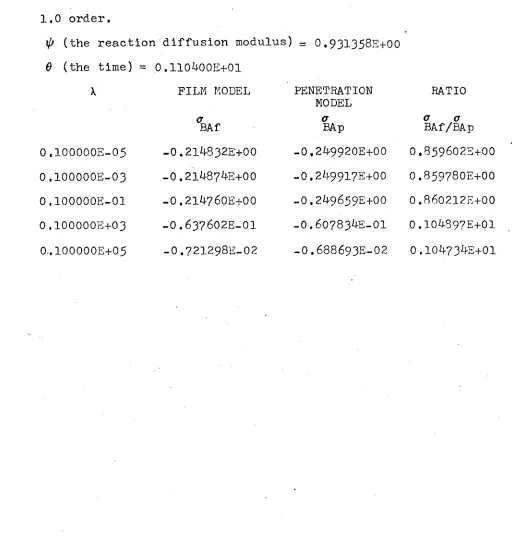
\ 0 .100000E-05 0 .100000E-03 0 .100000E-01 0 .100000E+03 0..100000E+05 0.110400E+01 FILM MODEL a BAf -0.21^832E'+00 -0.21^-87^E+00 -0.21^760E+00 -0.637602E-01 -0 .721298E-02 PENETRATION MODEL a BAp -0.2i|-9920E+00 -0.2^9917E+00 _o.2^9659E-}-oo -0 ,60783^-E-oi -0 .688693E-02 RATIO
a a
BAf/BAp 0.859602E+00 O.85978OE+OO 0.860212E+00 0.104897E+01 0 .10^73^2+01
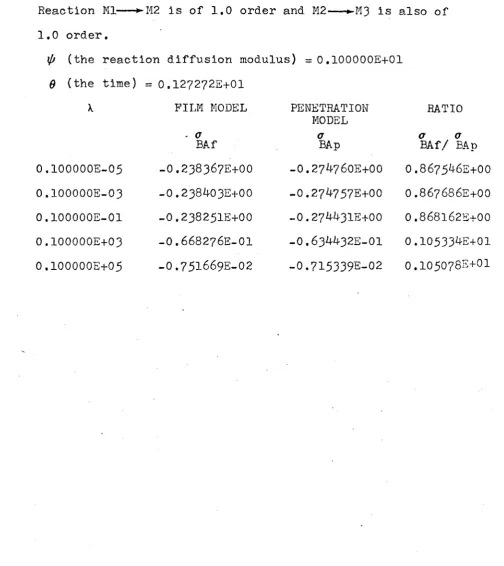
■M2 is of 1.0 order and M2-Reaction Ml—
1.0 order.
(the reaction diffusion modulus) = 0.100000E+01
9 (the time) = 0.1272?23+01
M3 is also of
0.100000E-05
0.100000E-03 0.lOOOOOE-Ol 0.100000E+03
0.100000E+05
FILM MODEL
- a
BAf
-0.238367E+00 -0.238403E+00
-0.238251E+00 -0.668276E-01
-0.751669E-02
PENETRATION MODEL
a
BAp
-0.274760E+00 -0.274757E+00
-0.274431E+00 -0.634432E-01 -0.715339E-02
RATIO
a a
BAf/ BAp
4-6
Reaction Ml-
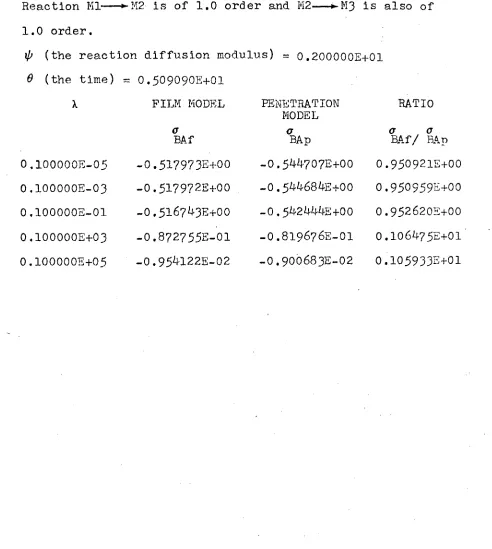
1.0 order.
TABLE IV
■M2 is of 1.0 order and M2- •M3 is also of
ip (the reaction diffusion modulus) = 0.200000E+01
0 (the time) = 0.509090E+01
0.100000E-05 0.100000E-03 0.100000E-01 0.100000E+03 0,100000E+0 5 FILM MODEL a BAf -0.5179735+00 -0.517972E+00 -0.5l67^3E+00 -0 .8727552-01 -0.95^122E-02 PENETRATION MODEL a BAp -0.5^7075+00 -0.5^684E+00 -0.5A2^4E+00 -O.8I9676E-OI -0 .900683E-02 RATIO
a a
BAf/ BAp 0.9509215+00 0.9509595+00 0.952620E+00
0.106A75E+01
0.1059335+01
-M2 is of 1.0 order and M2-Reaction Mi
lt 0 order.
ip (the reaction diffusion modulus) = 0.206439E+01
6 (the time) = 0.542400E+01
M3 is also of
0.100000E-05 0.100000E-03 0,100000E-01
0.100000E+03
0.100000E+05
FILM MODEL
a
BAf
-0.530950E+00 -0.53093^E+00
-0 .529600E+00
-0 .877076E -.01 -0.95840IE-02
PENETRATION MODEL
a
BAp
-0.556475E+00 -0.556451E+00
-0.554040E+00
- 0 .824698E-01 -0.905706E-02
RATIO
a a
BAf/ BAp
0.954130E+00 0.954143E+00
48
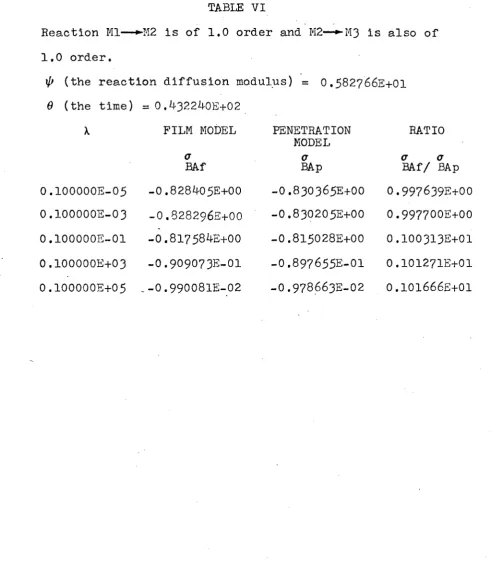
TABLE VI
Reaction Ml— ►M2 is of 1.0 order and M2— ^M3 is
1.0 order.
(the reaction diffusion modulus) = 0.582766s
6 (the time) = 0.432240E+02
0.100000E-05
0
.
100000E
-030.100000E-01 0.100000E+03 FILM MODEL a BAf -0.828405E+00 -0.828296E+00 -0.817584E+00 -0.909073E-01
0.100000E+05 .-0.990081E-02
PENETRATION MODEL a BAp -0.830365E+00 -0.830205E+00 -0.815028E+00 -0.897655E-01 -0.978663E-02
also of
+01
RATIO
a a
BAf/ BAp 0.997639E+00 0.997700E+00 0.100313E+01 0.101271E+01 0.101666E+01
TABLE VII
-M2 is of 1.0 order and M2- -M3 is also of Reaction Mi
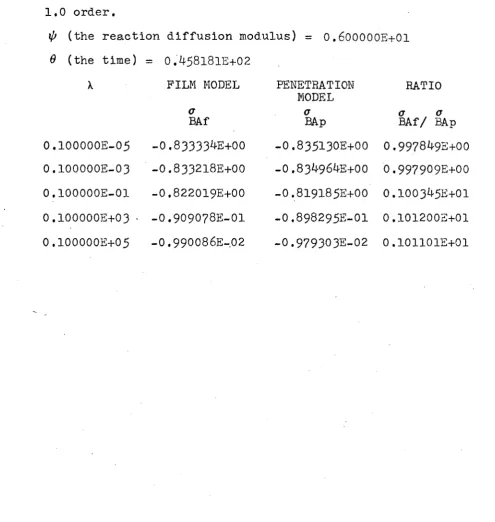
lt 0 order.
\l> (the reaction diffusion modulus) = 0.600000E+01
6 (the time) = 0.458181E+02
0.100000E-05
0.100000E-03 0,100000E-01
0.100000E+03
0.100000E+05
FILM MODEL
a
BAf
-0.833334E+00 -0.833218E+00
-0.822019E+00
-0.909078E-01 -O.99OO86E-.O2
PENETRATION MODEL
a
BAp
RATIO
a t a
BAf/ BAp -0.835130E+00 0.997849E+00 -0.834964E+00 0 .997909E+00 -0.819185E+00 0.100345E+01
-0.898295E-01 0.101200E+01
50
TABLE VIII
•M2 is of 1.0 order and M2- M3 is also of Reaction Ml
1.0 order.
ip (the reaction diffusion modulus) = 0 .100000E+02
9 (the time) = 0.127272E+03 FILM MODEL
a
BAf
PENETRATION MODEL
a
BAp
RATIO
a a
BAf/ BAp
0 .100000E-05 -o.899997E+00 0.100000E-03 -0.89^756e+00
0.100000E-01 -0.877^71E+00
0.100000E+03 -O.9O9O9OE-OI 0.100000E+05 -0.990098E-02
-0.900388E+00 0.999566E+00 -0.900059E+00 0.99^108E+00 -0.871367E+00 0.100700E+01
-0.905177E-01 0.100432E+01 -0.986185E-02 0.100396E+01
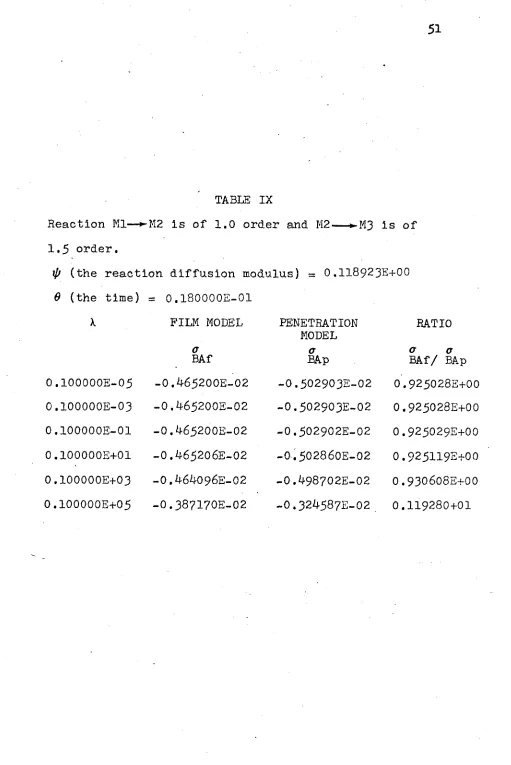
TABLE IX
Reaction Ml— ►M2 is of 1.0 order and M2 *-M3 is of
1.5 order.
ip (the reaction diffusion modulus) = O.II8923E+OO
0 (the time) = 0.180000E-01
X FILM MODEL PENETRATION
MODEL
RATIO
a a 0 0
BAf BAp BAf/ BAp
0.100000E-05 -0.if65200E-.02 -0.502903E-02 0.925028E+00
0.100000E-03 -0.465200E-02 -0.502903E-02 0.925028E+00 0.100000E-01 -0.465200E-02 -0.502902E-02 0.925029E+00
0.100000E+01 -0.465206E-02 -0.502860E-02 0.925H9E+00
0.100000E+03 -0.464096E-02 -0.498702E-02 0.930608E+00
52
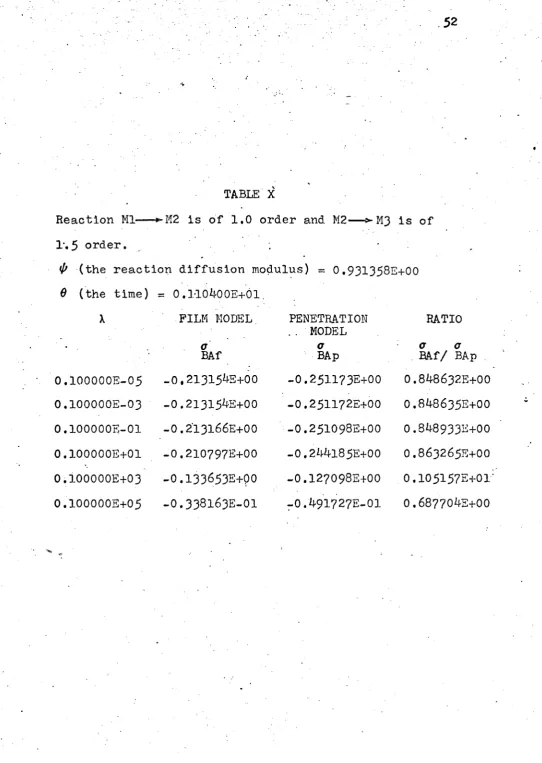
TABLE X
Reaction Ml *-M2 is of 1.0 order and M2— >- M3 is of
r. $ order.
^ (the reaction diffusion modulus) = O.931358E+OO
6 (the time) = 0 .1-lO^OOE+Ol.
0.100000E-05 0.100000E-03 0.100000E-01 0.100000E+01 0.100000E+03 O.IOOOOOE+O5 FILM MODEL. a BAf -0 ,21315^+60 -0 .21315^+00 -O.2I 3166E+OO -0 .210797E+00 -0.133653E+00 -0.338163E-01 PENETRATION . . MODEL
a BAp -0.251173E+00 -0.251172E+00 -0.251098E+00 -0.2^l85E+00 -0.127098E+00 -.0.491727E-01 RATIO
a a
. aAf/ bap .
0.8^8632E+00
0.848635E+00
0.848933E+00
O.863265E+OO
o . i 0 5 i 5 7 E + o r :
0.687704E+00
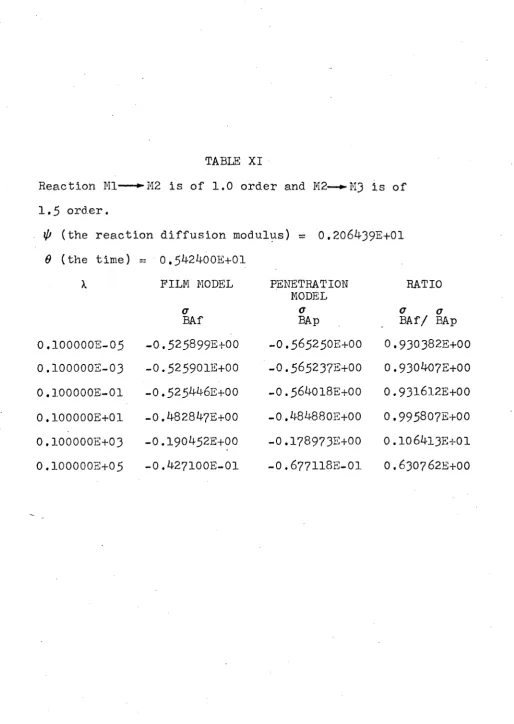
TABLE XI
Reaction Ml ► MB is of 1.0 order and M2— ► M 3 is of
1,5 order.
ip (the reaction diffusion modulus) = 0 .206^39E+01
6 (the time) = 0 ,5^2^-OOE+Ol
0.100000E-05 0.100000E-03 0.100000E-01 0.100000E+01 0.100000E+03 0.100000E+05 FILM MODEL a BAf -0.525899E+00 -0.525901E+00 -0 .525^ 6E+00
-0.^-828^?E+00 -0.190^52E+00 -0.^27100E-01 PENETRATION MODEL a BAp -O.56525OE+OO -O.565237E+OO -0.564018E+00 -0 ,^-8^880E+00 -0.178973E+00 -0.677118E-01 RATIO
o a
5 k
TABLE XII
Reaction Ml ►M2 is of 1.0 order and M2 ^M3
1.5 order.
4> (the reaction diffusion modulus) = 0.291625E+01
6 (the time) = 0.1082i|-0E+02 X 0.100000E-05 O.IOOOOOE-O3 0.100000E-01 0 ,100000E+01 0.100000E+03 0.100000E+05 FILM MODEL a BAf -0.651801E+00 -0.651808E+00 -0 .65036^+00 -0.554022E+00 -0.19^646E+00 -0.^19237E-01 PENETRATION MODEL a BAp -0.68^553E+00 -0.68^523E+00 -0 .68156^+00 -0 .541663E+00 -0.188601E+00 -0.711512E-01 is of RATIO
o a
BAf/ BAp 0 .95215^+00 0.952207E+00 0.95^222E+00 0.102281E+01 0 .103205E+01
0 .589219E +00
TABLE XIII
Reaction Ml ►M2 is of 1.0 order M2 ►M3 is of
1,5 order.
^ (the reaction diffusion modulus) = 0 .^12192E+01
6 (the time) = 0.2l62^0E+02
0.100000E-05 0.100000E-03 0,100000E-01 0.100000E+01 0.100000E+03 0.100000E+05 FILM MODEL a BAf -0.7^71932+00 >0.7^7211E+00 -0.7^37552+00 ■0.579572E+00 .0 .192977E+00 •0 .394591E-01 PENETRATION MODEL a BAp -0 .778^36e+00 -0.7783732+00 -0.772270E+00 -0.572484E+00 -0.193758E+00 -0.729936E-01 RATIO
a # a
56
TABLE XIV
Reaction Ml ►M2 is of 1.0 order and M2 ►M3 is of
1.5 order.
ip (the reaction diffusion modulus) = 0 .50^737E+01
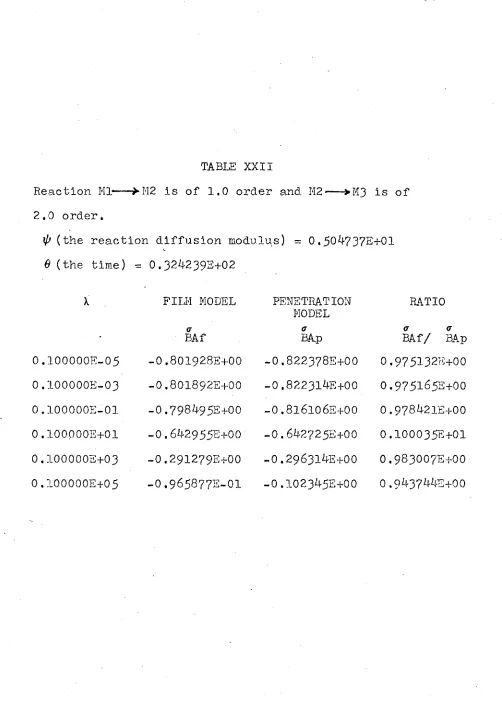
6 (the time) = 0 .324239E+02
0.100000E-05 0.100000E-03 0.100000E-01 0.100000E+01 0.100000E+03 0.100000E+05 FILM MODEL a BAf .O.78927OE+OO .0.789297E+00 -0 .783962E+00 •0.582A05E+00 ■0 .190835E+00 •0.375011E-01 PENETRATION MODEL a BAp -0.822378E+00 -0.822286E+00 -0.813^81E+00 -0.583095E+00 -o.195532E+00 -0.736272E-01 RATIO
a a
BAf/ BAp 0 . 9 5 9 7 ^ + 0 0 0.959881E+00 O.963712E+OO
0.998815E+00
0.975980E+00 0.509337E+00
Reaction Ml *-M2 is of 1.0 order and M2 *-M3 is of 1.5 order.
^ (the reaction diffusion modulus) = O.582766E+OI
0 (the time)
X 0.1OOOOOE-O5 0.100000E-03 0.100000E-01 0,100000E+01 0.100000E+03 0.100000E+05 = 0.432240E+02 FILM MODEL a BAf -0.813855E+00 -0.813891E+00 -0.806852E+00 -0.581930E+00 -O.I88967E+OO -0.359067E-01 PENETRATION MODEL a BAp -0.8^93^2E+00 -0.849223E+00 -0.838019E+00 -0.588464E+00 -0.196^29E+00 -0.739^79E-01 RATIO
a a
TABLE XVI
Reaction Ml ►M2 is of 1.0 order and M2--- ►M3 is of
1.5 order.
i/'Cthe reaction diffusion modulus) = 0.683302E+01
6 (the time) = 0 .59^2i|-0E+02
0.100000E-05 0.100000E-03 0.100000E-01 0.100000E+01 0.100000E+03 0.100000E+05 FILM MODEL a BAf .O.836619E+OO -O.836562E+OO .0.827362E+00 -0 .580129E+00 .O.I8656OE+OO
•0.339^7 5E-01
PENETRATION MODEL a BAp -O.875E56E+OO -0.875301E+00 - 0 ,86093^E+00
-0.592888E+00
-0.197169E+00
-0.7^2121E-01
RATIO
a a
BAf/ BAp O.955638E+OO 0.9557^2E+00 0.961005E+00 0 .978E79E+00 0.9^6l91E+00 0.^57^393+00
TABLE XVII
Reaction Ml— ►M2 is of 1.0 order and M2
2,0 order.
^(the reaction diffusion modulus)
M3 is of
0.118923E+00
RATIO
6 (the time) =
\ O.lOOOOOE-05 0.100000E-03 0.100000E-01 0.100000E+01 0 .100000E+03 0.100000E+05 0.180000E-01 FILM MODEL a BAf -0.468774E-02 -0.468774E-02 - 0 .468774E-02
-0.465200E-02 -0.465232E-02 -0.462080E-02 PENETRATION MODEL a BAp -0.502903E-02 -0.502903E-02 -0 .502903E-02 -0.502901E-02 -0.502724E-02 -0.486582E-02
BAf/ BAp
60
TABLE XVIII
Reaction Ml— ►M2 is of 1.0 order and M2 ^M3 is of
2.0 order.
^(the reaction diffusion modulus) = 0.931358E+00
0 (the time) '=
X 0 .100000E-05 0.100000E-03 0.100000E-01 0.1000003+01 O.100000E+03 0.100000E+05 0.110^00E+01 FILM MODEL O’ BAf -0.21^88lE+00 -0.214881E+00 -0.21^-8763+00 -0.212677E+00 -0.182366E+00 -0.758907E-01 PENETRATION MODEL a BAp -0.251173E+00’ -0.251173E+00 -0.251151E+00 -0.2^9020E+00 -0.181657E+00 -0 .701529S-01 RATIO
<r a
BAf/ BAp
0.855511E+00 0.8555HE+00 0 .855566E+00 0.854056S+00 0 .100390S+01 0.108178E+01
TABLE XIX
Reaction Ml ^M2 is of 1.0 order and M2 >M3 is of
2.0 order,
^(the reaction diffusion modulus) - 0 .206^39^4-01
0 (the time) = 0 . 5^2399E-K)1
0.100000E-05 0.100000E-03 0.100000E-01 0.100000E+01 0 .100000E+03 0 .100000E+05
FILM MODE I.
a BAf -0.5309.50E+00 ■0 .5309^82+00 ■0.530738S+00 .0.507111E+00 •0.285607E+00 •0,100282E+00 PENETRATION MODEL a BAp -0.565250E+00 -0.565243E+00 -0.564618E+00 -0 .519583E+00 -0.268579E+00 -0.9^5728E-01 RATIO
a a
62
TABLE XX
Reaction Ml ►•M2 is of 1.0 order and M2 >u)3 is of
2,0 order.
ip (the reaction diffusion modulus) = 0.291625E+01
6 (the time) = 0.108240E+02
0.100000E-05 0.100000E-03 0.100000E-01 0.100000E+01 0.100000E+03 0.100000E-i-05 FILM MODEL a BAf -0 .65910^+00 -0 .659096E+00 .0 .658356E+00 -0.596959E+00 ■0.29^l89E+00 •0 .IOIO89E+OO PENETRATION MODEL a BAp -O.68E553E+OO -0.684536E+00 - 0 .682766E+00 -0.590022E+00
-0.284705E+00
-0.990919E-01
RATIO
BAf/ BAp 0 .962822E+00 0.962837E+00 0 .96i|-2L7E+00 0.101175E+01 0.103331E+01 0.102016E+01
TABLE XXI
Reaction Ml > JA2 is of 1.0 order and M2 ►M3 is of
2.0 order.
^(the reaction diffusion modulus) = 0.^12192E+01
6 (the time) = 0.2l62^0E+02
0.100000E-05 0.100000E-03
0.100000E-01
0
.
1000002+010 .100000E+03 0 .100000E+05 FILM MODEL a BAf -0.757539E+00 •0.757519E+00 -o.755^57E+oo .0 .63596IE+00
.0 .293372E +00 ■0.9875^9E-0l PENETRATION MODEL <r BAp -0.778436E+00 -0.77839^E+00 -0.77it-309E+00 -0.629165E+00 -O.293343E+OO -0.101512E+00 RATIO
BAf/ BAp