STUDY ON THE MANAGEMENT OF ENGINEERING
PROCUREMENT AND CONSTRUCTION (EPC) PROJECTS
SENG HANSEN
FACULTY OF BUILT ENVIRONMENT UNIVERSITI TEKNOLOGI MALAYSIA
STUDY ON THE MANAGEMENT OF ENGINEERING PROCUREMENT AND CONSTRUCTION (EPC) PROJECTS
SENG HANSEN
A master’s project report submitted in partial fulfillment of the requirements for the award of the degree of
Master of Science in Construction Contract Management.
Faculty of Built Environment Universiti Teknologi Malaysia
To my beloved Father, Mother, Brother and Sisters
THANK YOU
Thousand of candles can be lit from a single candle,
and the life of the candle will not be shortened.
ACKNOWLEDGEMENTS
I would like to take this opportunity to express my sincere appreciation to many people who have supported me during this study. First, my utmost thanks to the Government of Indonesia through Public Works Department for CCM/QS Scholarship.
I wish to express my very sincere appreciation and acknowledgment to my supervisor, Assoc. Prof. Dr. Razali Adul Hamid, for his encouragement, guidance, critics and efforts throughout the process, and to Prof. Ahmad Rosdan bin Abdul Razak for his help and critics. I am also very grateful to all the lecturers of Construction Contract Management for their kind help and support, motivation and advices to me throughout this program. They have contributed a lot towards my understanding and thoughts.
ABSTRACT
TABLE OF CONTENTS
CHAPTER TITLE PAGE
DECLARATION ii
DEDICATION iv
ACKNOWLEDGEMENT v
ABSTRACT vi
TABLE OF CONTENTS vii
LIST OF TABLES xi
LIST OF FIGURES xiii
LIST OF ABBREVIATIONS xvi
LIST OF APPENDICES xviii
1 INTRODUCTION
1.1 Background of Research 1
1.2 Problem Statement 7
1.3 Research Questions 10
1.4 Research Objectives 11
1.5 Scope of the Research 11
1.6 Limitation of the Research 12
1.7 Research Significance 13
1.8 Research Methodology 13
2 LITERATURE REVIEW
2.1 Introduction 16
2.2 The History and Development of Project Delivery in
Indonesia 24
2.3 Engineering Procurement & Construction (EPC) Projects 30
2.4 EPC Standard Forms of Contract 38
2.4.1 The ENAA Model Form International Contract 39 2.4.2 The ICE Design and Construct Conditions of
Contract 39
2.4.3 The DBIA Agreement Between Employer and
Design-Builder – Lump Sum 40
2.4.4 The AIA Form A191 40
2.4.5 The AGC 415 (1994) 40
2.4.6 The EIC Contract (1994) 41
2.4.7 The FIDIC Orange Book (1995) 41
2.4.8 The FIDIC Yellow Book (1999) 42
2.4.9 The FIDIC Silver Book (1999) 43
2.4.10 The JCT Design and Build Standard Form of
Contract 43
2.4.11 The Orgalime Standard Form of Contract 43 2.4.12 EPC Contract as Practiced in Waskita 44
2.5 EPC Project Life Cycle 45
2.5.1 Project Life Cycle in EPC Project 46
2.5.2 Feasibility Study 50
2.5.3 Design/Engineering 52
2.5.4 Procurement 53
2.5.5 Construction 54
2.6 Previous Researches 55
3 RESEARCH METHODOLOGY
3.1 Introduction 58
3.2 Research Methodology 59
3.3 Preliminary Research 64
3.5 Data Collection 65
3.6 Data Analysis 66
3.7 Reporting 69 4 DATA ANALYSIS AND FINDINGS 4.1 Introduction 70
4.2 Case Study 71 4.2.1 Sample 1: Genyem 73 4.2.2 Sample 2: Malinau 78 4.2.3 Sample 3: Sampit 82 4.2.4 Sample 4: Rote 85 4.2.5 Sample 5: Batam 87 4.2.6 Sample 6: Sulsel 88 4.3 The Nature of EPC Projects 90
4.3.1 Category 1: General Aspects 93
4.3.2 Category 2: Legal & Contractual Aspects 98 4.3.3 Category 3: Technical Aspects 102
4.3.4 Other Characteristics Not Based on Case Study 103
4.3.5 EPC Specific Characteristics 106
4.3.6 Common Problems in EPC Projects 107
4.3.7 Claims in EPC Projects 120
4.4 EPC in Waskita 121
4.4.1 Waskita EPC Division 121
4.4.2 History of EPC in Waskita 124
4.4.3 EPC Implementation in Waskita 125
4.4.4 Problems in EPC Division 129
4.4.5 Prospects of EPC Projects 130
4.5 Improving the Effectiveness of Business Process for EPC Projects 132
4.5.1 Insights and Strategies for the Contractor 135
4.5.2 Insights and Strategies for the Employer 140
5 CONCLUSION & RECOMMENDATIONS
5.1 Introduction 146
5.2 Summary of Research Findings 146
5.3 Research Constraints 152
5.3.1 Duration of the Research 152
5.3.2 Lack of Literatures related to EPC Procurement 152
5.4 Future Research 153
REFERENCES 154
APPENDICES A. Interview 156
B. Interview Results from Respondent A 160
C. Interview Results from Respondent B 162
D. Interview Results from Respondent C 166
LIST OF TABLES
TABLE NO. TITLE PAGE
1.1 Indonesia Macro Economy and Construction Industry Data 8
2.1 Comparison of Procurement System 19
2.2 Advantages and Disadvantages of EPC Procurement 22
2.3 Indonesia GDP Growth from 2001 to 2011 26
2.4 Some EPC Projects in the World 32
2.5 Some EPC Projects in Indonesia 33
2.6 The Availability and Demand of Natural Resources in Indonesia 35 4.1 The availability of Project Data Type 73
4.2 Sample 1 Brief Information 73
4.3 Sample 2 Brief Information 78
4.4 Sample 3 Brief Information 82
4.5 Sample 4 Brief Information 85
4.6 Sample 5 Brief Information 87
4.7 Sample 6 Brief Information 88
4.8 EPC Projects’ Characteristics 91
4.9 Common Problems in EPC Projects 107
4.10 Problem Identification (Based on Project Data Analysis) 108
4.11 Project Problem Codification 109
4.12 Problem Occurrence Categorization 110
4.13 Project Problems Report 119
4.16 Reasons for Extension of Time as described in FIDIC
Silver Book 138
4.17 Reasons for Potential Price Increase as described in FIDIC
Silver Book 138
LIST OF FIGURES
FIGURE NO. TITLE PAGE
1.1 Typical EPC Project Organization 3
1.2 The TCP Project Triangle 3
1.3 Project Management Process Group 4
1.4 Typical Project Life Cycle 5 1.5 Critical Factors in Project Success 6 1.6 Research Methodology 14
2.1 Types of Procurement System 18
2.2 Comparison between Construction Industry and Economic Growth 26
2.3 Indonesia Population Forecast 28
2.4 Types of EPC Projects 31
2.5 Natural Resources Investment Development in Indonesia 36
2.6 General Project Criteria (Project Triangle) 45
2.7 EPC Project Criteria (Project Square ) 46
2.8 Typical Project Life Cycle 47
2.9 Process Groups Interact in a Phase or Project 48
2.10 Typical EPC Project Life Cycle 49
2.11 Project Development Management for EPC Projects 49
2.12 Break Even Point Analysis 52
2.13 Engineering Process 53
3.1 Research Tools and Techniques 59
3.2 Research Methodology 63
3.4 Project Data Available 67
3.5 Data Analysis Approaches 68
4.1 Matrix of Project Data Availability 71
4.2 Project Data Distribution 72
4.3 Genyem Project Location 74
4.4 Lay Out of Genyem Project 75
4.5 Genyem Project Design Phase 75
4.6 Genyem Project Procurement & Construction Phases 76
4.7 Genyem Project Organizational Chart 76
4.8 Photos of Genyem Project 77
4.9 Malinau Project Location 79
4.10 Model of Malinau Steam Power Plant Project 80
4.11 Malinau Project Flowchart 80
4.12 Malinau Project Organizational Chart 81
4.13 Photos of Malinau Project 81
4.14 Sampit Project Location 83
4.15 Photos of Sampit Project 84
4.16 Rote Project Location 86
4.17 Batam Project Location 87
4.18 Sulsel Project Location 89
4.19 Model of Sulsel Project 89
4.20 Photos of Sulsel Project 90
4.21 Relationship between Traditional and EPC Procurement 96
4.22 Risks and Claims Distribution between Traditional, DB and EPC 98
4.23 Triangle and Square Project Criteria 104
4.24 EPC Specific Characteristics 106
4.25 Problems Occurrence Chart 109
4.26 Problem Occurrence Diagram 109
4.27 Project Problems Management 118
4.28 Indonesia State-Owned Enterprises 122
4.29 Numbers of Local and Foreign EPC Contractors 123
4.31 An Example of Agreement between EPC Division and
Division VI 126
4.32 EPC Division Organisation Structure 127
4.33 EPC Project Organisation Structure 127
4.34 Waskita EPC Division Strategic Plan 128
4.35 Waskita EPC Division SWOT Analysis 131
4.36 Insights and Strategies for EPC Projects 133
4.37 Relationship between Problems and Strategies 134
4.38 Flow of Cost Overrun 141
4.39 EPC-LLIs Life Cycle 142
4.40 Other Contracting Strategies 144
5.1 EPC Project’s Characteristics (Based on Project Analysis) 147
5.2 EPC Project Specific Characteristics 148
5.3 Venn Diagram for EPC Implementation in Waskita 149
5.4 Waskita EPC Division Projection 149
LIST OF ABBRIEVATIONS
AGC Associated General Contractors of America AIA American Institute of Architects
BANI Badan Arbitrase Nasional Indonesia (en: Indonesian National Board of Arbitration)
DB Design and Build
DBIA Design-Build Institute of America
DLP Defect Liability Period
EIC European International Contractors
ENAA Engineering Advancement Association of Japan
E-P Engineering and Procurement
EPC Engineering, Procurement and Construction
EPCC Engineering, Procurement, Construction and Commissioning EPCI Engineering, Procurement, Construction and Installation EPC-LLIs EPC with Long Lead Items
EPCM Engineering, Procurement and Construction Management FIDIC Fédération Internationale des Ingénieurs-Conseils
GDP Gross Domestic Product
ICE Institute of Civil Engineers
IDR Indonesian Rupiah
IPP Independent Power Producers
IRR Internal Rate of Return
JCT Joint Contract Tribunal
LNG Liquid Natural Gas
LSTK Lump Sum Turn Key
NPV Net Present Value
PEST Political, Economic, Social and Technological
PLN Perusahaan Listrik Negara (en: State Electric Company) PLTA Pembangkit Listrik Tenaga Air (en: hydro power plant) PLTG Pembangkit Listrik Tenaga Gas (en: gas power plant)
PLTMH Pembangkit Listrik Tenaga Mini Hidro (en: mini hydro power plant)
PLTU Pembangkit Listrik Tenaga Uap (en: steam power plant)
PMI Project Management Institute
PT Perseroan Terbatas (en: limited company)
ROE Return on Equity
ROI Return on Investment
SMW Sistem Manajemen Waskita (en: Waskita Management System)
SWOT Strengths, Weaknesses, Opportunities and Threats
TCP Time, Cost, Performance
LIST OF APPENDICES
APPENDIX TITLE PAGE
A Interview 156
B Interview Results from Respondent A 160
C Interview Results from Respondent B 162
D Interview Results from Respondent C 166
CHAPTER 1
INTRODUCTION
1.1 Background of Research
Construction projects can be categorized in several ways. The most commonly used categorization as described by Hinze in Construction Contracts (2011, p.10) is housing construction, nonresidential building construction, engineering construction, and industrial construction. Each categories has their own determinants and demand factors.
Meanwhile, EPC is the abbreviation for Engineering, Procurement and Construction. EPC is a type of construction contract where the contractor holds the responsibility for engineering services, procurement of materials, and construction. Due to its characteristics, EPC project is also known as turnkey project service. The term ‘turnkey’ here is used to indicate that the project is delivered to the employer ready for operations.
Figure 1.1
There are three main aspects which should be considered in executing any project, i.e. the TCP Triangle which stands for time, cost, and performance aspects in a project. In order to get a project successfully completed, a good project management implementation is needed. PMI as in PMBOK Guide 2008 (p.6) has defined project management
knowledge, skills, tools, and techniques to project activities project requirements. Pro
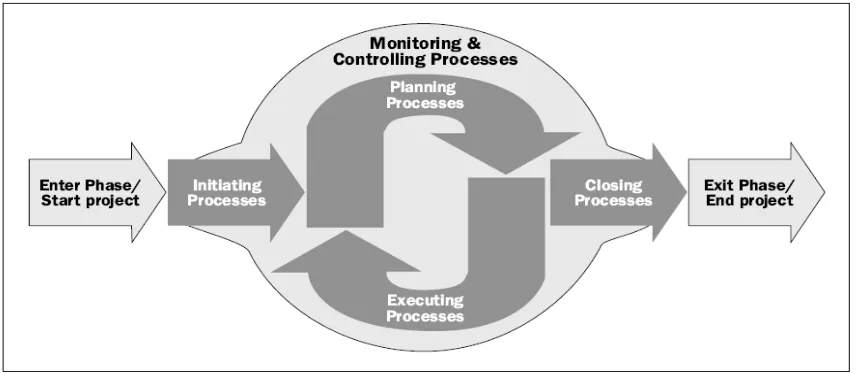
application and integration of the 5 (five) process groups; i.e. initiating, planning, executing, monitoring & controlling, and closing.
Figure 1.1 Typical EPC Project Organization
There are three main aspects which should be considered in executing any project, i.e. the TCP Triangle which stands for time, cost, and performance aspects in a project. In order to get a project successfully completed, a good project ement implementation is needed. PMI as in PMBOK Guide 2008 (p.6) has
project management as the implementation of construction
knowledge, skills, tools, and techniques to project activities with the aims
project requirements. Project management is accomplished through the appropriate application and integration of the 5 (five) process groups; i.e. initiating, planning, executing, monitoring & controlling, and closing.
Figure 1.2 The TCP Project Triangle Organization
Initiating process deals with the identification of project key players, feasibility and viability study of the project, and development of project charter. Planning process deals with project scheduling and cost estimating, development of WBS, project design and planning, and development of subsidiary plan (risk, human resource, quality, procurement, monitoring and reporting, etc). Executing process deals with execution of project design according to statutory provisions and technical specifications. Monitoring & controlling process deals with project monitoring and reporting status, management of project risk and future impacts, etc. While closing process deals with close-out contract, complete administrative close-out, and deliver project to the employer.
Figure 1.3 Project Management Process Group (PMI, “A Guide to PMBOK 4th Ed.”, 2008, p. 40)
The project implementation process is simultaneous attention to a wide variety of human
technical variables. As a result, the organizational project difficult job characterized by overload
superficiality. Often the typical project manager project outcomes without sufficient
elements crucial for
context of a turbulent, unpredictable, and dynamic environment. important that the project manager would be well served by m
project specific factors critical to project success. The project manager necessary tools to assist
and set differential priorities demonstrated that a set of factors
significant impact on project implementation success, the project manager will be better able to effectively deal with the many demands created by his job, channe
Figure 1.4 Typical Project Life Cycle
The project implementation process is very complex simultaneous attention to a wide variety of human interactions, budgetary
technical variables. As a result, the organizational project manager is faced with a difficult job characterized by overload tasks, frenetic activities, fragmentation, and superficiality. Often the typical project manager must take the responsibility
project outcomes without sufficient time, budget, or people to handle all of the for the success of the project. Projects are often initiated in the context of a turbulent, unpredictable, and dynamic environment.
the project manager would be well served by more information about specific factors critical to project success. The project manager
assist him or her to focus his or her attention on important areas differential priorities across different project element
demonstrated that a set of factors under the project manager's control
significant impact on project implementation success, the project manager will be better able to effectively deal with the many demands created by his job, channe
his energy more efficiently in attempting to successfully implement the project under development (Jeffrey and Dennis, 1987).
Figure 1.5 Critical Factors in Project Success (Edmond W.M. Lam, Albert P.C.
Project management implementation for EPC projects is quite different with project management implementation for building and civil engineering works. One thing that differentiates this is the project procurement system. In traditional procurement system, whether
be prepared by the employer and his architects. The contractor will only be responsible for managing the project during the construction period and this responsible will be completed by handing over an
In another aspect, contractor also is not been troublesome with financial problems because the project financing is in the concern of the employer and not the his energy more efficiently in attempting to successfully implement the project under development (Jeffrey and Dennis, 1987).
Critical Factors in Project Success (Edmond W.M. Lam, Albert P.C. Chan & Daniel W.M. Chan, 2004)
management implementation for EPC projects is quite different with project management implementation for building and civil engineering works. One thing that differentiates this is the project procurement system. In traditional procurement system, whether for building and civil engineering works, design will be prepared by the employer and his architects. The contractor will only be responsible for managing the project during the construction period and this responsible will be completed by handing over and closing ceremony of the project. In another aspect, contractor also is not been troublesome with financial problems because the project financing is in the concern of the employer and not the his energy more efficiently in attempting to successfully implement the project under
Critical Factors in Project Success (Edmond W.M. Lam, Albert P.C.
contractor. The contractor will only receive the payment for his work performance based on the payment procedure which is already been agreed under its contract.
However this is quite different in EPC projects. EPC projects are basically a
design and build type project. Therefore, design is prepared by both the architect and contractor with the main responsibility will be fall to contractor. Plus, in EPC projects usually applies the contractor will finance some or whole of the project cost and only will be paid after the completion of the project. This system is known as project pre-financing1. The amount and procedure of payment will depend on the agreed terms in the contract.
1.2 Problem Statement
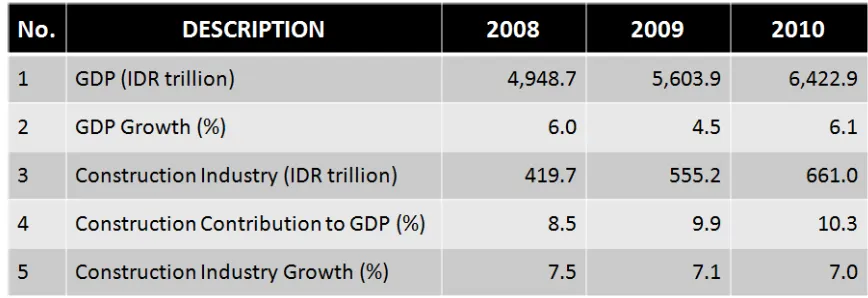
Since 2008, Indonesia’s GDP has been growing significantly. In 2010, its GDP has reached IDR 6,422.9 trillion compares to IDR 4,948.7 trillion in 2008. This means there is a growth as much as 6.0% in 2008, 4.5% in 2009, and 6.1% in 2010. Meanwhile, Indonesia construction industry has also recorded a significant improvement. The industry is experiencing average growth of 7% per year. Moreover, the industry also shows its contribution growth to Indonesia GDP. Table 1 below shows the Indonesia economy data and its relation to construction industry.
1
Table 1.1 Indonesia Macro Economy and Construction Industry Data
Source: Badan Pusat Statistik (Central Statistic Bureau), 2011
With its rapid development, Indonesia needs many industrial public sector projects. Especially with the population over 230 million people, its demand for power plant projects, gas development projects, and other type of industrial sector projects has risen significantly.
Project is the main business in construction industry. Traditional definition of
construction company only describes its activities as to construct, alter, repair and demolish man-made structures such as building, highways, dams, airports, power plants, etc. However, with the development of today’s market, some big construction companies do not only deal with construction services but also make a deal as investors. In relation to its financial aspect, Adler (1970) described a project as the minimum investment which is economically and technically feasible. It means that the construction companies should know and implement a good project management system in order to be financially healthy.
structures, and EPC projects. For the latest, Waskita has won some fascinating projects such as PLTU Sulawesi Selatan 2x50 MW (South Sulawesi Steam Power Plant Project), PLTA Genyem 2x10 MW (Genyem Hydro Power Project), PLTU Malinau 2x3 MW (Malinau Steam Power Plant Project), Leces Coal Boiler Construction Project, and PLTMH 8 MW Cirompang (Cirompang Microhydro Power Project).
The demand for EPC projects has been growing recently, especially for power plant projects. In 2011, Waskita has bid for some EPC projects such as Batam Independent Power Plant 2x60 MW, Senoro Gas Development Project, PLTU Dumai 2x(120-150) MW (Dumai Steam Power Plant Project), and PLTU Sicanang 2x35 MW & PLTG KIM 2x 80 MW – Belawan, North Sumatra (Sicanang Steam Power Plant Project & KIM Gas Power Plant Project – Belawan, North Sumatra).
With this rapid growth of EPC projects demand, Waskita has made strategic company policy to establish its own division for EPC projects. For this reason, Waskita needs a scholastic management and learning. Waskita has so many experiences over its 50 years operation in building and civil engineering works. However, it must admit that EPC projects have not been in its scope of operation before and therefore it does not fully understand the nature of EPC projects.
Second, today many of EPC projects are being held as partnering projects. By this way, employers are trying to engage the main contractors such as Waskita to become a partner and make a partnership. This means Waskita as the contractor has to give funding for the completion of the projects. This is in line with the need for Waskita to become an investor-contractor. Therefore, the project management knowledge for EPC projects is a must. And lastly, Waskita has established a separate division for EPC projects in its company structural organization. The need of project management knowledge for EPC projects is essential in order to ensure the profitability and sustainability of the division.
1.3 Research Questions
In doing this research, there are some questions that need to be answered in order to achieve this research’s objectives, namely:
1. What does Engineering, Procurement and Construction (EPC) mean? 2. What is the nature of EPC projects?
3. What are the problems usually occur in EPC projects? 4. How to mitigate and reduce the impacts of these problems? 5. How does EPC projects have been done in Waskita? 6. What is the scope and life cycle of EPC projects?
7. How does project management be implemented in EPC projects? 8. How does risk management be implemented in EPC projects? 9. How does quality management be implemented in EPC projects? 10.Why should someone invest in the EPC projects?
11.How to manage the disputes occur in EPC projects? 12.What are the success criteria in EPC projects?
1.4 Research Objectives
The aim of this research is to study the project management system for EPC projects. While the objectives of this research are:
a) To identify the nature of EPC projects
b) To identify the management system for EPC projects applied by PT Waskita Karya (Persero)
c) To improve the effectiveness of the business process for EPC projects
Therefore, with the implementation of good EPC project management system, it will ensure the achievement of the above objectives. In the end, the result of this research will serve as a guidance for PT Waskita Karya (Persero) to comprehend the project management for EPC projects.
1.5 Scope of the Research
The scope of this research consists of the following matters:
a) This research will discuss about the management of EPC projects in 3 (three) aspects, namely: the characteristics of EPC projects, the implementation of EPC project management, and the strategies to improve the effectiveness of the business for EPC projects
c) Review of available literature data is done to give an understanding of the importance of the management implementation at a very early stage of the project life cycle
1.6 Limitation of the Research
In order to direct the research focus, research limitation should be arranged as follows:
a) The research is limited for EPC project only which is very different with other types of construction categorization
b) The project data are taken from PT Waskita Karya (Persero) as one of the main leading construction company in Indonesia
c) The method used for collecting data consists mainly of two techniques, i.e. expert interview and legitimate data (company data)
d) The total duration for conducting this study is very limited, effective duration is less than 2 (two) months
1.7 Research Significance
The importance of the research is mainly to identify the nature and problems in EPC projects and by doing so it will eventually improve the project delivery system for EPC projects. This research will result in the implementation of project management for EPC projects which is still seldom be researched before. Lastly, this research also serves as a guidance for PT Waskita Karya (Persero) to comprehend the project management for EPC projects.
1.8 Research Methodology
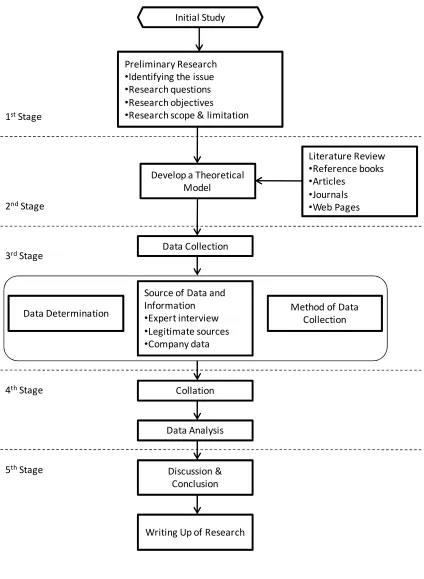
Figure 1.6 Research Methodology Preliminary Research
•Identifying the issue
•Research questions
•Research objectives
•Research scope & limitation Initial Study
Develop a Theoretical Model
Data Collection
Data Determination
Source of Data and Information
•Expert interview
•Legitimate sources
•Company data
Method of Data Collection
Collation
Data Analysis
Writing Up of Research
Literature Review
•Reference books
•Articles
•Journals
•Web Pages
Discussion & Conclusion 1stStage
2ndStage
3rdStage
4thStage
1.9 Report Organization
This study is composed of five chapters as follows:
Chapter 1 presents the introduction of this research which includes background of the study, problem statement, research questions, objectives of the study, scope of the research, limitation of the research, significance of the study, research methodology, and thesis organization.
Chapter 2 will review literatures related to project procurement systems, project management processes, brief introduction on EPC projects and its standard forms, EPC project life cycle, the significance of EPC projects, and some previous researches.
Chapter 3 describes the methodology that is adopted to conduct this research. It consists of the preliminary research, theoretical model, data collection, and data analysis.
Chapter 4 describes data analysis as results of the project management implementation for EPC projects, the nature of EPC projects, EPC as applied in Waskita, and some insights and strategies to improve the effectiveness of business process in EPC projects.
REFERENCES
Alsaqor, N.A. (2010). Engineering & Procurement and Construction (EPC) Projects “Examining Causes & Effects of Delays”. Open University Malaysia: Master of Business Administration.
Cartlidge, D. (2009). Quantity Surveyor’s Pocket Book 1st Edition. Burlington: Elsevier Ltd.
Deyi, T. (2011). Morgan Stanley Research. Indonesia Infrastructure: A US$250bn Opportunity.
Hardjomuljadi, S. (2011). FIDIC EPC/Turnkey Contract, Understanding and Its Implementation. Jakarta: FIDIC International Training Seminar “Management of Construction Claims”.
Hinze, J. (2011). Construction Contracts 3rd Edition. New York: The McGraw-Hill Companies, Inc.
Hosie, J. (2007). Turnkey contracting under the FIDIC Silver Book: What do owners want? What do they get?. Mayer-Brown International LLP.
Huse, J.A. (2002). Understanding and Negotiating Turnkey and EPC Contracts 2nd Edition. London: Sweet & Maxwell Ltd.
Hutchinson, K. (1993). Building Project Appraisal. Hampshire: The Macmillan Press Ltd.
Jeffrey, K.P. and Dennis, P.S. (1987). Critical Success Factors in Effective Project Implementation. Unknown.
Komarudin, I. (2007). Desain Electronic Procurement Untuk Perusahaan Kontraktor EPC. Studi Kasus: PT. Rekayasa Industri. Universitas Indonesia: Magister Manajemen.
Mohd Syafei Bin Ahmad. (2011). Responsibilities of Contractors in EPC Contract. UTM: Master of Science.
Mosavat, M. (2009). Change Order Causes and Control in the Oil and Gas Construction Projects. UTM: Master of Engineering.
Perry, J.G. (1985). The Development of Contract Strategies for Construction Projects. University of Manchester: Unpublished PhD Thesis.
PMI. (2008). A Guide to the Project Management Body of Knowledge 4th Edition. Pennsylvania: Project Management Institute, Inc.
Riyatno, I.H. (2008). Risk Factors Identification that Influence Cost Performance on Engineering Phase of EPC Project (A Review to Establish Engineering Procedure at PT. X). MT. Universitas Indonesia: Magister Teknik.
Rogers, M. (2001). Engineering Project Appraisal. London: Blackwell Science Ltd. Schramm, C., Meibner, A. and Weidinger, G. (2010). Contracting Strategies in the
Oil and Gas Industry. 3R International – Special Edition. 1/2010.Shtub, A., Bard, J.F. and Globerson, S. (2005). Project Management Processes, Methodologies, and Economics 2nd Edition. Upper Saddle River, NJ: Pearson Prentice Hall.
Silitonga, D.D. (2009). The Effect of Organizational Factors on the Engineering Procurement Construction (EPC) Projects Towards Company Performance and Efficiency (Case Study PT. XYZ). Universitas Indonesia: Magister Teknik.
Sudarto (2011). Meningkatkan Kinerja Perusahaan Jasa Konstruksi di Indonesia,
Aplikasi Knowledge Based Management System. Jakarta: Center for
Construction and Infrastructure Studies.
Suraji, A. and Krisnandar, D. (2008). National Construction Services Development Board. Indonesia Country Report. The 14th Asia Construct Conference. The Ministry of Energy and Mineral Resources. (2008). Key Indicator of Indonesia
Energy and Mineral Resources.
Vasilescu, AM., Dima, A.M., Vasilache, S. (2009). Credit Analysis Policies in Construction Project Finance. Academy of Economic Studies, Bucharest. Published in Management & Marketing (2009) Vol. 4, No. 2.