i
INTEGRATING CONSTRUACTABILITY INTO THE DESIGN PROCESS
WOON KAI SIONG
A project report submitted in partial fulfillment of the requirements for the award of the degree of Master of Science (Construction Management)
Faculty of Civil Engineering Universiti Teknologi Malaysia
iii
iv
ACKNOWLEDGEMENT
First of all, I would like to express my sincere appreciation to my project supervisor, Ir. Dr. Rosli Mohamad Zin of the Faculty of Civil Engineering, Universiti Teknologi Malaysia, for his generous advice, patience, guidance and encouragement during the years of my study.
I would like to express my sincere thanks to all the architect and civil engineers who generously spent their precious time to participate the interview of my project data collection and comment to my work. Their opinions and comments are useful indeed. My seniors and friends, who have provided assistance in arranging the interviews and at various occasions, also deserve my special thanks.
Finally, I am most thankful to my parents and family for their support and encouragement given to me unconditionally in taking this project report.
v
ABSTRACT
vi
ABSTRAK
vii
TABLE OF CONTENTS
CHAPTER TITLE PAGE
THESIS TITLE i
DECLARATION ii
DEDICATION iii
ACKNOWLEDGEMENT iv
ABSTRACT v
ABSTRAK vi
TABLE OF CONTENTS vii
LIST OF TABLES xii
LIST OF FIGURES xiii
LIST OF APPENDICES xv
1 INTRODUCTION
1.1 Introduction 1
1.2 Problem Statement 2
1.3 The Objectives 3
1.4 Scope of Study 3
1.5 Research Methodology 4
2 LITERATURE REVIEW
viii
2.2 Constructability Definitions 7
2.3 Development of the Principles of Constructability 8 2.4 An Overview of Project Life Cycle 17 2.5 Constructability Review in Design 23
2.5.1 The Guidelines 24
2.5.2 Computer Based System 24
2.5.3 Non-computer Based System 26 2.6 Responsibilities of Designers in Constructability 27 Enhancement
2.7 Constructability Principles for the Design Phase 29 2.7.1 Carry Out Thorough Investigation of the Site 30 2.7.2 Design for Minimum Time Below Ground 30 2.7.3 Design for Simple Assembly 32 2.7.4 Encourage Standardisation/Repetition 33 2.7.5 Design for Pre-fabrication, Pre-assembly or 34 Modularisation
2.7.6 Analyse Accessibility of the Jobsite 36 2.7.7 Employ Any Visualisation Tools Such As 3D 39
CAD to Avoid Physical Interference
2.7.8 Investigate Any Unsuspected Unrealistic or 40 Incompatible Tolerances
2.7.9 Investigate the Practical Sequence of 41 Construction
2.7.10 Plan to Avoid Damage to Work by 42 Subsequent Operations
2.7.11 Consider Storage Requirement at the Jobsite 44 2.7.12 Investigate the Impact of Design on Safety 44 During Construction
ix Materials or Construction Method
2.8 Summary 50
3 RESEARCH METHODOLOGY
3.1 Introduction 53
3.2 Phase 1 55
3.2.1 Determine the Objectives and Scope 55
3.2.2 Literature Review 55
3.2.3 Preliminary Interview 56
3.3 Phase 2 57
3.3.1 The Interview 57
3.3.2 Develop Current Design Process Model 59 3.3.2.1 Data Flow Diagram (DFD) 59 3.3.2.2 Drawing A Data Flow Diagram 62
3.4 Phase 3 63
3.4.1 Integrating Constructability into Design 63 Process
3.4.2 Constructability Design Review Checklist 64
3.4.3 Review by Experts 65
3.5 Summary 65
4 DATA COLLECTION AND ANALYSIS
4.1 Introduction 67
4.2 The Architect Firm #1 67
4.2.1 Model of Architect Firm #A1 69 4.2.2 Additional Information from Architect 72
Firm #A1
4.3 The Consultancy Firm 74
x 4.3.1.2 Additional Information from 78
Consultancy Firm #C1
4.3.2 The Consultancy Firm #C2 79 4.3.2.1 Model of Consultancy Firm #C2 82 4.3.2.2 Additional Information from 85
Consultancy Firm #C2
4.3.3 The Consultancy Firm #C3 87 4.3.3.1 Model of Consultancy Firm #C3 89 4.3.3.2 Additional Information from 92
Consultancy Firm #C3
4.4 Summary 94
5 MODEL DEVELOPMENT AND DISCUSSION
5.1 Introduction 96
5.2 The General Building Design Process Model 96 5.3 The Constructability Integrated Building 105
Design Process Model
5.4 Summary 110
6 CHECKLIST DEVELOPMENT AND DISCUSSION
6.1 Introduction 112
6.2 The Development of Design Constructability 112 Checklist
6.3 The Discussion 114
6.4 Summary 114
7 CONCLUSIONS AND RECOMMENDATIONS
xi
7.2 Conclusions 116
7.3 Recommendations for Future Research 118
REFERENCES 120
xii
LIST OF TABLES
TABLE NO. TITLE PAGE
3.1 Basic selection criteria in determining the interviewees 58 3.2 Components of a data flow diagram for design 60
4.1 The summary of the interviewee #A1 and #C1’s responses 94
4.2 The summary of the interviewee #C2 and #C3’s responses 95
5.1a Inputs and outputs of process 1: preliminary design 102
5.1b Inputs and outputs of process 1: preliminary design 103
(continue) 5.2a Inputs and outputs of process 3: detailed design 103
5.2b Inputs and outputs of process 3: detailed design (continue) 104
5.3 Inputs and outputs of process 2: estimating costs 104
5.4 Inputs and outputs of process 2: review design 110
xiii
LIST OF FIGURES
FIGURE NO. TITLE PAGE
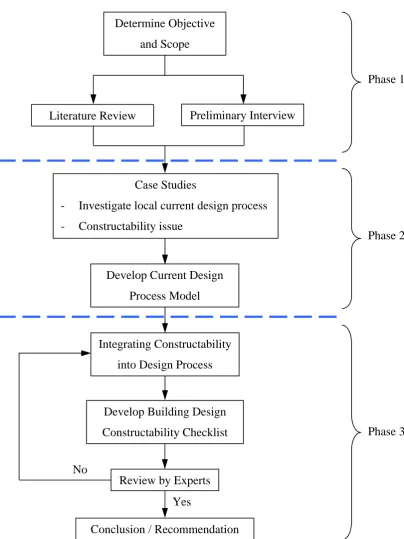
1.1 Schematic of research methodology 5, 54
2.1 The life cycle of a construction project 18
2.2 Constructability cost-influence curve 23
2.3 Building on land reclaimed from sea 31
2.4 Steel-framed system build project: ground-floor plan 38
2.5 Steel beam on block walls 40
2.6 Revised scheme for practical sequence of construction 42
2.7 Typical floor beam with service holes 43
2.8 Two alternative designs for capping of a coal mineshaft 45 2.9 Elevation showing proposed development within an historic 46 terrace
3.1 Schematic of constructability integration into design process 64 4.1a The current building design process model #A1: level 2, 70
preliminary design and detail design
4.1b The current building design process model #A1: level 1 71 4.1c The context diagram of current building design process 72
model #A1: level 0
4.2a The current building design process model #C1: level 2, 77 preliminary design and detail design
4.2b The current building design process model #C1: level 1 77 4.2c The context diagram of current building design process 78
model #C1: level 0
xiv 4.3b The current building design process model #C2: level 1 84 4.3c The context diagram of current building design process 84
model #C2: level 0
4.4a The current building design process model #C3: level 2, 90 preliminary design and detail design
4.4b The current building design process model #C3: level 1 91 4.4c The context diagram of current building design process 91
model #C3: level 0
5.1 The context diagram of general building design process 97 model: level 0
5.2 The general building design process model: level 1 98 5.3 The general building design process model: level 2, 99
preliminary design
5.4 The general building design process model: level 2, 101 detailed design
5.5 The context diagram of constructability integrated building 105 design process model: level 0
5.6 The constructability integrated building design process 106 model: level 2, preliminary design
5.7 The constructability integrated building design process 107 model: level 2, detailed design
xv
LIST OF APPENDICES
APPENDIX TITLE PAGE
A The Interview Questionnaire Form 125 B Building Design Constructability Checklist – 130
Assesment on Foundation
1
CHAPTER 1
INTRODUCTION
1.1 Introduction
In the late of 1970s, the constructability concept emerged and evolved from studies into how improvement can be achieved to increase cost efficiency and quality in the construction industry. Nowadays, constructability concept has been extensively being developed and applied in the USA, UK and later in Australia, where their studies have demonstrated that improved constructability has lead to significant savings in both cost and time required for completing construction projects (Russel et al., 1992a; Jergeas and Van der Put, 2001).
2 constructability in design stage, when compared with the engineers in more developed countries.
1.2 Problem Statement
In the construction process of a traditional contracting system, it is the A/E’s responsibility to develop a design that able to produce a project that, when it is implemented by the contractor, meets the client’s needs and expectation. However, by the A/E’s very nature, A/Es are not exactly expert in construction means and methods. According to Glavinich (1995), most design drawings and specifications that produced by the design engineers are tend to be performance oriented, specifying an end result and materials, while leaves the means and methods for constructing the work to the contractor. As a result, the reality of construction is that most of the problems encountered in the field are often compounded by inherent design flaws that generated in the design phase. Therefore, it is important to emphasis constructability during the early stage of a design. Besides, many studies (Paulson, 1976; Glavinich, 1995; Mendelsohn, 1997; Nima et al., 1999; Nima et al., 2004) found that integrating constructability knowledge into design processes is the best time to influence project costs, decrease the likelihood of delays, contract change orders due to unforeseen site conditions and legal entanglement and claims.
3 Constructability concept can be implemented in design on several ways. Several researchers have developed develop tools that can be use and to enhance the constructability of project designs (Anderson et al., 2000; Arditi et al., 2002; Navon et al., 2000; Soibelman et al., 2003; Pulaski and Horman, 2005). However, the level of formality of those methods is varied. It is because some of them are very formal as they incorporated the constructability concepts, such as specifying constructability objectives, forming a constructability team and identifying means to obtain constructability input. While, several methods incorporate constructability only through standard design procedures. Nonetheless, constructability improvement tool in the form of checklist is considered to be comprehensive in term of the concepts covered (Rosli, 2004). Suitable constructability checklist for the local construction industry is currently unavailable, therefore, as initially, it is essential to develop a constructability checklist that able to check a design work.
1.3 The Objectives
The following are the objectives of this study:
a) To determine the local construction industry’s current building design process.
b) To propose a model that integrates constructability to the general building design process.
c) To develop a building design constructability checklist.
1.4 Scope of Study
4 Although the constructability concepts can be implemented through the entire project life cycle: i.e. from conceptual planning until construction, however, the study will only focus on the constructability improvement at the design phase.
In order to develop the building design constructability checklist, the design phase’s constructability principles identified by Rosli (2004) will be used. Therefore, those principles will not be formulated by the writer in this study. Besides, due to limitation of time, only a sample of building design constructability checklist for foundation assessment I developed fore reviewing and checking the design work.
1.5 Research Methodology
5
Determine Objective and Scope
Preliminary Interview
Develop Current Design Process Model
Case Studies
- Investigate local current design process - Constructability issue
Integrating Constructability into Design Process
Develop Building Design Constructability Checklist
Review by Experts
Conclusion / Recommendation Yes
No
Literature Review
Phase 1
Phase 2
Phase 3
120
REFERENCES
Adams, S. (1989) Practical Buildability - CIRIA Building Design Report. London: Butterworths.
Anderson, S. D., Fisher, D. J., and Rahman, S. P. (2000). Integrating Constructability into Project Development: A Process Approach. Journal of Construction Engineering and Management. 126(2): 81-88.
Anderson, S. D., Fisher, D. J., and Gupta, V. K. (1995). Total constructability management: A process-oriented framework. Project Management Journal. 26(3): 3-11.
Arditi, D., Elhassan, A., and Toklu, Y. C. (2002). Constructability Analysis in the Design Firm. Journal of Construction Engineering and Management. 128(2): 117-126.
Baldwin, A. N., Austin, S. A., Hassan, T. M., Thorpe, A. (1999). Modelling Information Flow during the Conceptual and Schematic Stages of Building Design. Construction management and Economics. 17: 155-167.
Barrie, D. S., and Paulson, B., C. (1984). Professional Construction Management. Second Edition. New York: McGraw-Hill. 18-32.
121 Buidable Design and Appraisal System (BDAS) (2000). Fourth Edition. Singapore:
Building and Construction Industry of Singapore.
Building and Construction Authority. Code of practice on buildable design. Building and Construction Authority, Singapore, 2000. p. 1–44
CII (1986). Constructability – A Primer. Publication 3-1. Austin, Texas: Construction Industry Institute.
CIIA (1993). Constructability Principles File. University of South Australia. Adelaide: Construction Industry Institute Australia.
CIRIA (1983). Buildability: An Assessment. CIRIA Special Publication 26. CIRIA, London.
Fellows, R., and Liu, A. (1997). Research Methods for Construction. London: Blackwell Science.
Ferguson, I. (1989). Buildability in Practice. Mitchell’s Professional Library, London, England.
Fisher, M., and Tatum, C. B. (1997). Characteristics of Design-Relevant Constructability Knowledge. Journal of Construction Engineering and Management. 123(3): 253-260.
Ganah, A., Anumba, C., and Bouchlaghem, N. (2000). The Use of Visualisation to Communicate Information to Construction Sites. ARCOM 16th. Annual Conference. 6-8 September. Glasgow Caledonian University, UK: 833-842.
122 Gould, F. E., and Joyce, N., E. (2000) Construction Project Management. Upper
Saddle River, New Jersey: Prentice Hall.
Griffith, A. (1984). A critical investigation of factors influencing buildability and productivity. Department of Building, Heriot-Watt University.
Griffith, A., and Sidwell, A. C. (1995). Constructability in Building and Engineering Projects. London: MacMillan Press Ltd.
Gugel, J. G., & Russell, J. S. (1994). Model for constructability approach selection. Journal of Construction Engineering and Management. 120(3): 509-521.
Hugo, F., O’Connor, J. T., and Ward, W. V. (1990). Highway constructability guide. Research Project. 3-6-88-1149. Centre for Transportation Research, University of Texas, Austin, Texas.
Jergeas, G., and Van der Put, J. (2001). Benefits of Constructability on Construction Projects. Journal of Construction Engineering and Management. 127(4): 281– 290.
Kvale, S. (1996). InterViews: An Introduction to Qualitative Research Interviewing. Thousand Oaks, California: Sage Publications.
Mahoney, J., and Tatum, C. (1994). Construction site applications of CAD. Journal of Construction Engineering and Management. 120(3): 617–631.
123 Navon, R., Shapira, A., and Sheehori, Y. (2000). Automated Rebar Constructability
Diagnosis. Journal of Construction Engineering and Management. 126(5): 389-397.
Nima, M. A., Abdul-Kadir, M. R., and Jaafar, M. S. (1999). Evaluation of Engineer Personnel’s Role’s in Enhancing the Project Constructability. Facilities. 17(11): 423-430.
Nima, M. A., Abdul-Kadir, M. R., Jaafar, M. S., and Alghulami, R. G. (2001). Constructability Implementation: A Survey in the Malaysian Construction Industry. Construction Management and Economics. 19: 819-829.
Nima, M. A., Abdul-Kadir, M. R., Jaafar, M. S., and Alghulami, R. G. (2004) Constructability Concepts in Kuala Selangor Cable-Stayed Bridge in Malaysia. Journal of Construction Engineering and Management. 130(3): 315-321.
Oberlender, G. D. (2000). Project Management for Engineering and Construction. Second Edition. New York: McGraw-Hill Higher Education. 253-255.
O’Connor, J. T., Rusch, S. E., and Schulz, M. J. (1987). Constructability Concepts for Engineering and Procurement. Journal of Construction Engineering and Management. 113(2): 235-248.
O’Connor, J. T., and Miller, S. J. (1993). Constructability: Program Assessment and Barriers to Implementation. Austin, Texas: Construction Industry Institute.
124 Pulaski, M., and Horman, M. J. (2005). Organizing Constructability knowledge for
Design. Journal of Construction Engineering and Management. 131(8): 911-919.
Ramli, M. Z., and Mesir, B. (2004). Civil Engineering IT for Civil Engineers. Third Edition. UTM: ITUCE, Faculty of Civil Engineering.
Rosli Mohamad Zin. (2004). Constructability Assessment of Project at Design Phase. Faculty of Civil Engineering, Universiti Teknologi Malaysia: PhD. Thesis. Unpublished.
Russell, J., Gugel, J., and Radke, M. W. (1992a). Benefits of Constructability: Four Case Studies. The Construction Industry Institute, Austin, Texas.
Soibelman, L., Liu, L. Y., Kirby, J. G., East, E. W., Caldas, C. H., and Lin, K. Y. (2003). Design Review Checking System with Corporate Lessons Learned. Journal of Construction Engineering and Management. 129(5): 475-484.
Tatum, C. B. (1987). Improving Constructability during Conceptual Planning. Journal of Construction Engineering and Management. 113(2): 191-207.
Tatum, C. B., Vanegas, J. A., and William, J. M. (1985). Constructability Improvement Using Prefabrication, Preassembly and modularisation. Technical Report No. 297. Department of Civil Engineering, University of Standford, Standford, C. A.