Performance Comparison of Various DBA
Algorithms on an Emulated 10Gbps Next
Generation EPON Access Network
Satya Prakash RoutHead of Department, Dept. of ECE, Temple City Institute of Technology and Engineering, Bhubaneswar, Odisha, India
ABSTRACT: A 10Gbps next generation EPON network has been emulated by using simulated voice, video and data packets with the implementation of different dynamic bandwidth allocation algorithms. Three DBA algorithms i.e. DBA-MAX, DBA-LINEAR and DBA-GATED has been proposed and compared to measure the performance of the access network. The performance parameters are mainly the average delay and throughput and its respective variations with the increase of offer loads has been observed.
KEYWORDS: OLT, ONU, Socket, REGISTER_MSG_ACK, GATE_MSG, Offer Load, Average Delay, Throughput, REGISTER_ACK, REPORT_MSG
I. INTRODUCTION
Significant amount of research and development has been made in the field of core network and it operates in hundreds Gigabits per second (Gbps) speed currently. But on seeing the growth in bandwidth demand in the access network which is exploding day by day, the only promising solution is to upgrade the access network. So it is essential to have an efficient access network that can operate at high functional speeds to support differentiated services like Video on Demand (VOD), High Definition TV, Video Conferencing, Telemedicine, Uploading and Downloading Jumbo Files (9000-15000 Bytes). Apart from these access network always been sensitive to cost and geographical region of coverage it can handle. So internet service providers will have to make a trade-off between Capital Expenditure (CAPEX), Operational Expenditure (OPEX) and geographical region of coverage. There are mainly five types of access network APON, BPON, GPON, EPON and 10G-EPON [1]. APON provides 622 Mbps of downstream bandwidth and 155 Mbps of upstream. GPON was the advanced version of the BPON and support at a rate of 2.444 Mbps and 1.42 Mbps in downstream and upstream data rate. EPON has symmetry of 1Gbps of upstream and downstream rates. EPON is totally data-centric based on voice, video and data. 10G-EPON is capable of providing broadband access to large number of customers in metropolitan area. Due to the advancement in the optical technology, 10G-EPON (IEEE 803.2av) provides 1Gbps and 10Gbps upstream and downstream data rate with distance more than 20 km.
In conventional technologies, optical fiber was used as a feeder, to shorten the length of copper and access network. The Next Generation Access Network guarantees to fetch all the way to apartments and offices. This new optical network can provide gigabits per second speed at a minimal cost. Another advantage of this fiber deployment is the ability to penetrate up to the distance beyond 20 Km in the first mile while providing bandwidth intensive services such as Triple Play Service i.e. voice, video and data. The ways of realizing this goal is to use point-to-point networks, or installing a remote switch. The disadvantage of using point-to-point network is that for N subscribers we need 2N x L fiber length with 2N transceivers. The notion is non- realistic and is not effective for the retailers. Using a curb switch also has two major disadvantages. The switch requires electric power to deliver 27x7 accesses. Also 2N+2 transceivers are required for the curb- switch network. Thus it again represents an active passive optical network.
relaxed timing requirements and the capability to encapsulate variable-size frames. IEEE EFM formally ratified IEEE standard 802.3ah in June 2004 to support the physical and data link layers of the EPON network. Since the introduction of EPON, it has quickly captured the interestof industry because EPON significantly simplifies the interoperability with Ethernet MAN and WAN equipment compared to the use of BPON equipment. Unlike ITU-T B/GPON standards [3][4], IEEE 802.3ah specifies only a small portion of an EPON system and thus also creates significant interests from the research community to address interesting challenges that are omitted from the standard.IEEE 802.3ah specifies the EPON architecture in terms of its physical medium–dependent sublayer, P2MP protocol specification, and extensions for reconciliation, physical coding and physical medium attachment sublayers [7] [8].
II. RELATED WORK
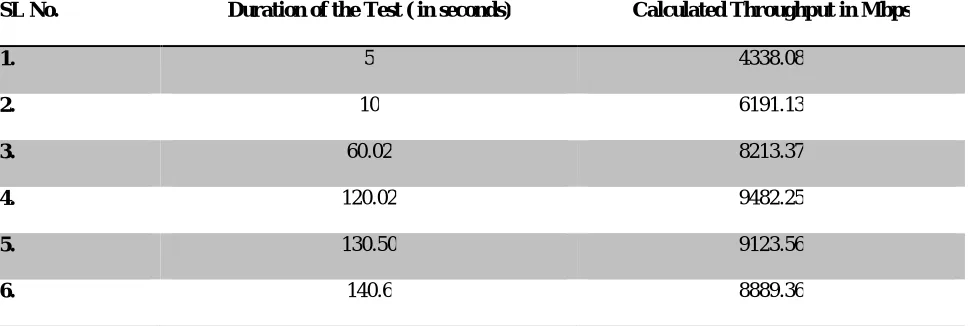
In this project two10G transceiver adapter cards (NIC Cards) from Femrice Technology, China manufactured operating at 1310 nm upstream direction and 1550nm downstream direction were used, to emulate the semi-real access network in the Optical Networking Lab. The two transceiver cards are installed in two Linux OS PCs with some hardware limitations. Due to this real generation of Jumbo Packets of 9000 bytes to 15000 bytes are getting dropped during packet transmission. So Ramdisk Software has been used (having upto 4 GB disk size).A video file of 1.5 GB was stored in it and was transferred to the file of the other system. This enhanced the data throughput from 200 Mbps to 750-800 Mbps, which is almost near to the capacity of the transceiver NIC cards. When another file of 1 GB was stored in the memory of the RAM using Ramdisk and was transferred to another RAM of the other system, the data throughput improved from 200 Mbps to 850-880 Mbps, which is almost close to the capacity of the NIC card. From this experimental study, this can be inferred that the read-write speed of the hard drive plays an important role in determining the rate at which the microprocessor can read and send the required data from the hard disk to the NIC card.The project needs to transfer 10Gbps of data over the NIC cards in per seconds. To achieve the better regulation of desired traffic, a number of random traffic generator modules are used that generates traffic with different speed. This modules stimulates packets of variable size with a given speed and empty payload. These processes are controlled by the processors speed. So using these traffic generator modules we can generate data upto more than 10 Gbps. These modules helped to generate random packets of different size which was the best option for the project.The emulation basically used two PCs running two traffic generator modules of different traffic distribution, to generate voice, video and data packets. Three DBA algorithms have also been proposed in this work, to improve the network performance. The basic network monitoring tool Netperf is used to measure the speed of the packets which move across the LC Fiber Connector connected two NIC cards.The initial throughput with offer loads and delay has been shown in Table.1.
SL No. Duration of the Test ( in seconds) Calculated Throughput in Mbps
1. 5 4338.08
2. 10 6191.13
3. 60.02 8213.37
4. 120.02 9482.25
5. 130.50 9123.56
6. 140.6 8889.36
Table 1: Initial calculation of throughput of 10Gbps Transceiver Cards
behaves differently during the testing condition. There are five types messages that will propagate across the channel. They are Register message, Gate message, Acknowledgement message, Report message and Data. The ONU initially sends its LLID with a register message to OLT. The OLT sends the REGISTER_MSG_ACK and the initial Gate message [5][6]. Upon receiving the Gate message, the ONU checks the queue in its buffer which is filled with data, pumped by the random traffic generator and sends the REPORT_MSG, contains the size of the buffer and its corresponding LLID. The OLT on receiving the Gate computes the channel idle time and chooses the DBA algorithms appropriate for the effective transmission. The OLT sends the Gate message back with the time after which ONU should transmit and the amount of data it can transmit. Once the data is transmitted by the ONU, it empties the queue partially or completely depending on the request and fills it up with new data generated by the traffic generators from the end users. Once the queue in the buffer is full, the data is dropped until transmission occurs. The OLT continues the process of accepting the data from different ONUs.
Fig.1. Network Simulation Design of 10Gbps Access Network
The 10G-EPON network emulated consist of threads and processes for distinguishing OLT and ONUs. The Processes considered as OLT and the threads associated with each process considered as ONUs. The Socket Programming is used to send Data Packet and Control Packet. The Control Packet used for timing synchronization between the packets. The basic objective of taking this scenario is to avoid traffic congestion and increase of network performance and efficiency.
III.DBA-GATEDALGORITHM
The first algorithm proposed for this project is DBA-GATED Algorithm.This algorithm trails on very simple procedure of granting the looked-for transmission window to the ONU without any complex calculations. So if an ONU asks for the duration of 50,000 bytes, a window transmit 50,000 bytes is to be provided. Further if the ONU has more number of packets to be sent to the queue, it has to send one more request to OLT for granting the window. The offer load has considered which is having the value equal to the value of rate of generation in the traffic generator module.
IV.DBA-LINEARALGORITHM
a little more number of data involved which is getting added to the already existing queue at the ONU. So once a window is granted ONU can finish its data transfer completely. This way DBA_LINEAR provides better quality of service to any of the user connected to the existing ONUs
V. DBA-MAXALGORITHM
In this algorithm the OLT is scheduled to a Gate threshold value which is fixed for every user. If the user asks for the duration greater than the Gate threshold value, then the threshold value will be allocated for the user. Let the duration of the timing windows be Ti where i is denoted as the number of users. The threshold timing window is denoted as Threshold. Let Tj be the minimum duration of the timing windows any users want. If the timing window for any user exceeds the threshold value the OLT automatically allocate the threshold value timing window for transmission of data. If the timing window for any user i where i=1, 2, 3, 4……n is smaller than the duration of the fixed Gate the appropriate value of the timing window what the user wants will be allocated. In a given case format it can be written as
If Ti > Tthreshold
Then Ti = Tthreshold, i= 1, 2, 3, 4, 5…n and j=1, 2, 3, 4, 5…n Else Ti <= Tthreshold
Then Ti = Tj, i= 1, 2, 3, 4, 5…………n
But while implementing the algorithm it has been found that it solves a large problem which occurred during the implementation of DBA-GATED Algorithm. In this the OLT was not being blocked by the other users. But one disadvantage was found that it creates a lot of overhead as the transfer rate is fixed and is independent of size of the transfer OLT wants to make.
VI.SIMULATION RESULTS
The semi real 10G EPON access network simulation starts with generation of packets from both PCs. First PC acts as OLT (Optical Line Terminal) and other PC acts as ONUs and end users. Fig.2 shows the variation of throughput with respect to time. With increase in delay between packets, the throughput decreases. The fig.3 shows that increase in the offer load results to increase in throughput in case of DBA-GATED and DBA-LINEAR. But in case it got decrease in DBA-MAX.
Fig.2.Throughput (Mbps) vs. Delay (ms) DBA-GATED, DBA-LINEAR and DBA-MAX Algorithm
0 500 1000 1500 2000 2500 3000
0 0.2 0 .4 0.6 0.8 1 1.2 1.4
Th
ro
ug
hp
ut
(M
bp
s)
Delay (ms)
Throughput vs. Delay
Fig.3.Throughput (Mbps) vs. Offer Load (Gbps) of DBA-GATED, DBA-LINEAR, DBA-MAX Algorithm
Fig.4. Delay (ms) vs. Offer Load (Gbps) of DBA-GATED, DBA-LINEAR and DBA-MAX Algorithm
VII. OBSERVATIONSANDDISCUSSIONS
VIII. CONCLUSION AND FUTURE WORK
The simulation results showed that the proposed algorithmsare similar with their performances when it’s compared with different simulation parameters. DBA-LINEAR Algorithm provides an average quality of service by maintaining a desired throughput. The DBA-GATED Algorithm is more efficient than DBA-LINEAR Algorithm. The set up modified to multiple 1G NIC cards to be act as ONUs and running processes on each system to make it end users. The 10G NIC cards can be used together to make it as server (OLT) for transmissions.Next is the achieving of nano second precision delay between the packets.
REFERENCES
[1] H. Miyoshi, T. Inoue, and K. Yamashita, “QoS-Aware dynamic bandwidth allocation scheme in Gigabit-Ethernet passive optical network,” in
Proc. IEEE ICC 2004, Paris, 2004, pp. 90–94223, 2012.
[2] Leonid G. Kazovsky, Ning Cheng, Wei-Tao Shaw, David Gutierrez, Shing-Wa Wong, “Broadband Optical Access Network”: pp. 143-145, 2011. [3] Usman Tariq, “A Review of Scenarios and Enabling Technology Directions for 5g Wireless Communications “, Indian Journal of Science and Technology, Vol.9, Issue.4, 2016, Doi no:10.17485/ijst/2016/v9i4/80420
[4] B. Nethravathi, V. N. Kamalesh, V. G. Manjunatha Guru,“Topological Design of Computer Communication Network Structures: A Comprehensive Review”, Indian Journal of Science and Technology,Vol.7, Issue.9,2016, Doi no: 10.17485/ijst/2016/v9i7/85211
[5] Sandeep Kumar Arora, Gurjot Singh Gaba, “Improvement in Data Packet Routing on the basis of Stability “, Indian Journal of Science and Technology, Vol.3, Isuue.9,2016 , Doi no:10.17485/ijst/2016/v9i3/81898
[6] J. Govindarajan, N. Vibhurani, G. Kousalya,“An Analysis on TCP Packet Reordering Problem in Mobile Ad-Hoc Network”,Indian Journal of Science and Technology,Vol.8, Issue.16,2015, Doi no:10.17485/ijst/2015/v8i16/62902
[7] S. Radhakrishnan, S. Neduncheliyan, K. K. Thyagharajan ,“A Review of Downlink Packet Scheduling Algorithms for Real Time Traffic in LTE-Advanced Networks “,Indian Journal of Science and Technology,Vol.9, Issue.4,2016, Doi no:10.17485/ijst/2016/v9i4/84061
[8] F. Effenberger and T.S. E1-Bawab, “Passive Optical Network (PONs): Past, Present and Future,” Optical Switching and Networking”, vol.6 , pp-143-150,2009
[9] G.Han, et.al., “Long-Reached Optical Access Network: A survey of research, challenges, demonstration and bandwidth assignment mechanisms,” Communication Surveys & Tutorials, IEEE, vol.12,pp.112-123,2010
[10] A.R Hedyati and M.N Fesharaki, et.al., “Parnian: A two stage nested auction for dynamic bandwidth allocation for Ethernet passive optical network” vol.35, No.E1, pp-45-61,2011
[11] S. Huan, et al., "Long-reach optical access networks: A survey of research challenges, demonstrations, and bandwidth assignment mechanisms," Communications Surveys & Tutorials, IEEE, vol. 12, pp. 112-123, 2010.
BIOGRAPHY
Mr. Satya Prakash Rout received the bachelor degree in Electronics & Communication engineering from Gandhi Engineering College,