University of Windsor University of Windsor
Scholarship at UWindsor
Scholarship at UWindsor
Electronic Theses and Dissertations Theses, Dissertations, and Major Papers
2011
A Distributed Task Management Solution for Peer-To-Peer and
A Distributed Task Management Solution for Peer-To-Peer and
Cloud Environments
Cloud Environments
Lichun Zhu
University of Windsor
Follow this and additional works at: https://scholar.uwindsor.ca/etd
Recommended Citation Recommended Citation
Zhu, Lichun, "A Distributed Task Management Solution for Peer-To-Peer and Cloud Environments" (2011). Electronic Theses and Dissertations. 106.
https://scholar.uwindsor.ca/etd/106
A Distributed Task Management Solution
for Peer-To-Peer and Cloud Environments
by
Lichun Zhu
A Thesis
Submitted to the Faculty of Graduate Studies through Computer Science
in Partial Fulfillment of the Requirements for the Degree of Master of Science at the
University of Windsor
Windsor, Ontario, Canada
2011
A Distributed Task Management Solution
for Peer-To-Peer and Cloud Environments
by
Lichun Zhu
APPROVED BY:
______________________________________________ Dr. Gokul Bhandari
Odette School of Business
______________________________________________ Dr. Jianguo Lu
School of Computer Science
______________________________________________ Dr. Christie Ezeife, Co-supervisor
School of Computer Science
______________________________________________ Dr. Robert Kent, Advisor
School of Computer Science
______________________________________________ Dr. Joan Morrissey, Chair of Defense
School of Computer Science
DECLARATION OF ORIGINALITY
I hereby certify that I am the sole author of this thesis and that no part of this thesis
has been published or submitted for publication.
I certify that, to the best of my knowledge, my thesis does not infringe upon anyone’s
copyright nor violate any proprietary rights and that any ideas, techniques, quotations, or
any other material from the work of other people included in my thesis, published or
otherwise, are fully acknowledged in accordance with the standard referencing practices.
Furthermore, to the extent that I have included copyrighted material that surpasses the
bounds of fair dealing within the meaning of the Canada Copyright Act, I certify that I
have obtained a written permission from the copyright owner(s) to include such
material(s) in my thesis and have included copies of such copyright clearances to my
appendix.
I declare that this is a true copy of my thesis, including any final revisions, as
approved by my thesis committee and the Graduate Studies office, and that this thesis has
ABSTRACT
In this thesis we introduced the Lightweight Coordination Calculus based logic
programming approach to the programming models of the Platform-as-a-Service cloud.
By using this approach, PaaS based cloud systems will enable cloud application
developers to have more options to implement various kinds of programming models for
their distributed tasks. We built a prototype framework based on OpenKnowledge
middleware because the OpenKnowledge currently is the only framework that fully
supports the LCC based programming model. By adding task control and administrative
features such as automated task initiation, task status querying, task termination and
input/output message channel, we extended the original usage of the OpenKnowledge
framework and made it capable of being used to construct PaaS cloud systems. The
automation level of the transformed OpenKnowledge framework is improved and its
original advantages are retained simultaneously. All of our work reveals the underlying
mechanism of the next generation Platform-as-a-Service cloud system which supports
DEDICATION
The thesis is dedicated to
those who enlightened me,
ACKNOWLEDGEMENTS
First, I owe my deepest gratitude to my supervisor, Dr. Robert Kent, who guided me
as I stepped into the fantastic domain of distributed computation, and provided great
patience, encouragement, guidance and support of my exploration. Without his help
during a time of handicap, it would have been impossible for me to find a proper thesis
topic and proceed in the correct direction.
Besides my supervisor, I would like to thank the rest of my thesis committee: my
co-supervisor, Dr. Christie Ezeife, Dr. Jianguo Lu, and Dr. Gokul Bhandari, for their
encouragement, insightful comments, and hard questions.
I thank my fellow classmates of the School of Computer Science department: Paul
Preney, Lihua Duan, and Xin Wu, for the broad and stimulating discussions of emerging
state of art technologies and theories. In particular, I am grateful to Xin Wu for
enlightening me with the first glance of a feasible path.
I would like to thank my family: my mother-in-law Yuguang Zhong, my wife
Lingru Li and other parents on both sides, for the encouragement and support both
spiritually and physically during these busy days and nights. Last, I would send my deep
regret to my daughter, Caroline, for my losing a lot of time to fulfill my responsibility as
TABLE OF CONTENTS
DECLARATION OF ORIGINALITY ... iii
ABSTRACT ... iv
DEDICATION...v
ACKNOWLEDGEMENTS ... vi
LIST OF TABLES ...x
LIST OF FIGURES ... xi
1. INTRODUCTION... 1
2. BACKGROUND STUDY ... 4
2.1 Contemporary PaaS Cloud ...4
2.1.1 INTRODUCTION OF PAAS CLOUD ... 4
2.1.2 LIMITATION STATEMENT ... 5
2.2 LCC and OpenKnowledge Framework ...5
2.2.1 INTRODUCTION OF LIGHT WEIGHT COORDINATION CALCULUS BASED MODELING TECHNOLOGY... 5
2.2.2 TASK MANAGEMENT AND COORDINATION SUPPORTED BY OK FRAMEWORK ... 7
2.2.3 LIMITATION STATEMENT OF EXISTING OK FRAMEWORK ... 8
2.3 Summary and Statement of Research Objectives ...9
2.4 Related Work ...10
2.4.1 IN THE DOMAIN OF CLOUD COMPUTATION ... 10
2.4.2 IN THE DOMAIN OF AGENT SYSTEMS ... 11
2.4.3 IN THE DOMAIN OF GRID AND P2P ... 12
2.4.4 SUMMARY ... 13
2.5 Contribution ...13
3. OPENKNOWLEDGE SYSTEM ARCHITECTURE AND COORDINATION PROTOCOL ANALYSIS ... 16
3.2 Issues for Enhancing and Extending ...25
4. FORMALIZATION ... 28
5. DESIGN AND IMPLEMENTAION ... 30
5.1 System Architecture ...30
5.2 Design of Task Description Data Structure ...31
5.3 Design of GP ...33
5.4 Extension made to the OKManager ...40
5.5 Enhancements to the Role Allocation Procedure ...41
5.6 Enhancements to the Interaction Complete Procedure ...41
6. EXPERIMENTAL APPROACH AND RESULTS ... 43
6.1 Experimental Environment Usage ...43
6.1.1 START THE ENVIRONMENT ... 43
6.1.2 SUBMIT A TASK ... 47
6.1.3 AUTOMATED TASK ENROLMENTS AND SHOW TASK STATUS ... 48
6.1.4 TERMINATE A TASK ... 51
6.1.5 USER I/O MESSAGE CHANNEL VIA THE MESSAGECLIENT API ... 51
6.1.6 INVOKE A CHILD TASK WITHIN A RUNNING TASK ... 52
6.2 Performance Analysis ...54
6.2.1 PERFORMANCE ANALYSIS VIA REAL TESTING ENVIRONMENT ... 55
6.2.2 PERFORMANCE ANALYSIS VIA SIMULATION... 57
6.2.3 SIMULATION OF SEQUENTIAL TASK PROCESSING ... 58
6.2.4 SIMULATION OF CONCURRENT TASK PROCESSING ... 60
6.3 Concerns about Dead Locks ...65
7. CONCLUSIONS AND FUTURE WORK ... 66
7.1 Conclusions ...66
7.2 Future Work ...68
REFERENCES ...70
A1. MAJOR ADMINISTRATIVE RELATED METHODS OF EXTENDED
OKMANAGER AND OKMANAGERIMPL ... 74
A2. NEWLY ADDED MESSAGE TYPES ... 78
A3. TEST DATA COLLECTED FROM REAL EXPERIMENTS ... 80
A4. SOURCE CODE AND EXPERIMENT DATA DOWNLOAD ... 81
A5. LCC SPECIFICATION AND EXAMPLE ... 82
A6. OPENKNOWLEDGE COMPONENT EXAMPLE... 85
LIST OF TABLES
TABLE 1.COMPARISON OF TASK MANAGEMENT MECHANISMS. ... 13
TABLE 2.TASKDESCRIPTION RELATED OPERATIONS ... 33
TABLE 3.MAJOR METHODS OF TASKMANAGERHELPER ... 35
TABLE 4.MAJOR METHODS OF MESSAGECLIENT AND MESSAGECLIENTIMPL ... 38
TABLE 5.TESTING ENVIRONMENT ... 43
TABLE 6.SOURCE CODE TREE OF THE EXTENDED OK FRAMEWORK ... 44
TABLE 7.MAJOR ADMINISTRATIVE RELATED METHODS OF OKMANAGER AND OKMANAGERIMPL ... 77
TABLE 8.NEWLY ADDED MESSAGE TYPES FOR TASK MANAGEMENT PURPOSE ... 79
TABLE 9.TEST DATA COLLECTED FROM REAL EX EXPERIMENTS ... 80
LIST OF FIGURES
FIGURE 1.OK SYSTEM COMPONENTS AND THEIR RELATIONSHIPS ... 16
FIGURE 2.LIFE CYCLE OF OK SYSTEM ... 19
FIGURE 3.[UML]SEQUENCE DIAGRAM FOR PUBLISHING AN INTERACTION MODEL ... 20
FIGURE 4.UMLSEQUENCE DIAGRAM FOR SEARCHING IM AND ROLE SUBSCRIPTION ... 21
FIGURE 5.UMLSEQUENCE DIAGRAM FOR INITIATING AN INTERACTION ... 22
FIGURE 6.UMLSEQUENCE DIAGRAM FOR CHOOSING PARTNERS AND ALLOCATING ROLES23 FIGURE 7.UMLSEQUENCE DIAGRAM FOR STARTING AND TERMINATION OF AN INTERACTION ... 25
FIGURE 8.LOGICAL ARCHITECTURE OF THE PROTOTYPE TASK MANAGER ... 31
FIGURE 9.UMLCLASS DIAGRAM OF TASKDESCRIPTION ... 32
FIGURE 10.UMLCLASS DIAGRAM OF GP ... 33
FIGURE 11.UMLSEQUENCE DIAGRAM FOR I/O REQUEST BETWEEN OKC INSTANCE AND TASK MANAGER ... 39
FIGURE 12.UMLSEQUENCE DIAGRAM FOR I/O REQUEST RELAY BETWEEN OKC INSTANCES OF PARENT TASK AND CHILD TASK ... 40
FIGURE 13.UPDATED UML SEQUENCE DIAGRAM FOR CHOOSING PARTNERS AND ALLOCATING ROLES ... 41
FIGURE 14.UPDATED UML SEQUENCE DIAGRAM FOR THE TASK COMPLETING PROCESS ... 42
FIGURE 15.INITIAL RUNNING ENVIRONMENT OF GP1 ... 45
FIGURE 16.IP AND PORT ALLOCATION OF INITIAL RUNNING ENVIRONMENT ... 46
FIGURE 17.INITIAL RUNNING ENVIRONMENT OF GP2 ... 46
FIGURE 19.SCREEN SHOT AFTER TASK “HELLO WORLD” IS SUBMITTED (GP1) ... 49
FIGURE 20.SCREEN SHOT OF HOW ORIGINAL OK WORKS WITH THE “DINING PHILOSOPHER”
EXAMPLE. ... 50
FIGURE 21.SCREEN SHOT AFTER TASK “HELLO WORLD” INVOKED CHILD TASK “DINING
PHILOSOPHERS”(GP1) ... 53
FIGURE 22.SCREEN SHOT AFTER TASK “HELLO WORLD” INVOKED CHILD TASK “DINING
PHILOSOPHERS”(GP2) ... 54
FIGURE 23.RESPONSE TIME WITH FIXED NUMBER OF PEERS AND CHANGING NUMBER OF
ROLES. . ... 58
FIGURE 24.RESPONSE TIME WITH FIXED NUMBER OF ROLES AND CHANGING NUMBER OF
PEERS. ... 59
FIGURE 25. p r M N
L N
⋅
⋅ RATIO VS. THE THROUGHPUT.. ... 61
FIGURE 26.EXPANDED VIEW OF FIGURE 25, WHICH SHOWS THAT THE THROUGHPUT HAS AN
UPPER LIMIT ... 62
FIGURE 27.TASK SUBMISSION SPEED/THROUGHPUT RATIO V/TP VS. AVERAGE RESPONSE
TIME T OF ALL DATA SERIES WITH UPPER BOUND AND LOWER BOUND ENVELOPE. ... 64
FIGURE 28.EXPONENTIAL REGRESSION FUNCTION OF AVERAGE RESPONSE TIME T BASED ON
1.
INTRODUCTION
In recent years, a new service model called Cloud computing [Buyya et al
2009][Zhang et al 2010] has gained considerable interest and undergone rapid
development. Within this service model, resources such as CPU and storage capacity are
provided as general utilities that can be leased and released by users through the internet
in an on-demand fashion. From the perspective of users, the cloud is a kind of virtual
sandbox that hides the complexity of management details of internal distributed resources
and provide services at different levels: from the infrastructure level, which offers virtual
machine service; to the platform level, which offers operating systems and application
framework service; and to the application level, which offers specific software utility to
end users. In this thesis, we focus on the platform layer service, also called
Platform-as-a-Service (PaaS), which offers the service of a computation platform that enables
application developers to submit and manage their own distributed tasks to the cloud.
There are many tools and frameworks at this level that have emerged to support
distributed data storage and access and software programming. Through a literature
review we found that, compared to the advances made in data storage and access
measures, progress towards more effective support for programming methodologies
offered by existing PaaS frameworks are relatively limited. Due to the distributed nature
that cloud computing has, we focus our attention to the concurrent system modeling
techniques.
In 2005, Robertson et al presented a new modeling technique that is called the Light
Weight Coordination Calculus (LCC) [Robertson 2005]. They also presented a
developers a flexible way to define complex programming models using LCC and also
provides basic support to deploy and execute such applications in a peer-to-peer based
overlay network.
We conducted research on exploring how to introduce LCC based concurrent system
modeling techniques to the domain of PaaS cloud computation by studying the
underlying working mechanism of OK, and found that one major obstacle is its lack of a
sophisticated management infrastructure that automates the task deployment, launch of
interactions as well as the monitor and task control functionality after the distributed task
is launched.
In this thesis, we constructed a task manager prototype framework by providing two
extensions to the OK framework to make it cloud ready. First, we extended the OK
framework’s computation model from the “submit-manual
select–subscribe–allocation-run” model to the “submit-proactive select–subscribe–allocation-select–subscribe–allocation-run” model by
introducing a new type of peer (GP) that has the intelligence of detecting and
participating newly submitted tasks proactively. Second, we enhanced the task
management functionality of the OK framework by adding a task control console to the
peer so that user can monitor the execution status of the distributed task and provide
intervention to the execution process.
The significance of our research lies on:
1. To the best of our knowledge, we believe that we are the first to introduce formal
concurrent system based modeling techniques (specifically LCC) to the domain
benefit from more selections enabled to design their applications and have more
controls on the distributed resources.
2. We provided partial solutions to management and coordination challenges
encountered during the construction of the prototype framework. The method
we used to solve the challenges can be contributed to the design of the future
generation cloud infrastructure that supports above computation models.
3. The open source OK framework coupled with the extensions and modifications
presented in our work can be used to support and conduct further research, and
we provided a benchmark for comparison against future improvements.
The impact of this work is expected to change how the applications are constructed
to utilize clouds. This will be achieved using the new features developed in this thesis
that support more complex coordination and negotiation protocols.
The rest of the thesis is organized in this way: Section 2 presents the background
study. Section 3 analyzes lifecycle of OK framework and proposes our enhancements and
extensions to the framework. Section 4 presents formalization of the task management
model we extended. Section 5 presents the detailed design and implementation of our
approach. Section 6 demonstrates our experimental approaches and result analysis.
2.
BACKGROUND STUDY
2.1Contemporary PaaS Cloud
2.1.1 Introduction of PaaS Cloud
According to [Zhang et al 2010], Cloud computing is a model for enabling
convenient, on-demand network access to a shared pool of configurable computing
resources (e.g., networks, servers, storage, applications, and services) that can be rapidly
provisioned and released with minimal management effort or service provider interaction.
From above definition and the study of how existing cloud system works, it demonstrates
that two important requirements that cloud management system should solve are the
dynamically provision of resources for tasks and how Service-Level-Agreement
established via negotiation [Buyya et al 2009]. Cloud computation works at three
different layers, infrastructure, platform and application. At the level of platform, the
computation model delivers a computing platform and/or solution stack as a service, i.e.
providing platform layer resources, including operating system support and software
development frameworks, which is called Platform-as-a-Service (PaaS). Typical PaaS
providers include Google App Engine [Google App Engine], Aneka system [Chu et al
2007], Apache HaDoop [HADOOP Project] and Microsoft Windows Azure [Windows
Azure].
From the aspect of software development, two factors of major concerns are how
data is stored and accessed, and how to design and express a distributed computation
within cloud. At the data storage layer, PaaS clouds provide technologies such as
distributed file system [Google GFS][HDFS] to provide persistent and durable storage for
the Aneka system [Chu et al 2007] SDK enlisted three programming models that are
adopted as standards in all other PaaS cloud SDKs:
Task Programming Model: In this model, a distributed application is a
collection of independent tasks. The system does not enforce any execution order or
sequencing but these operations have to be completely managed by the developer on the
client application if needed.
Thread Programming Model: This model provides fundamental component for
building distributed applications based on the concept of distributed thread. It allows
developers to have finer controls to a single thread.
MapReduce Programming Model: MapReduce [Dean and Ghemawat 2008] is a
widely used programming model in PaaS cloud. It provides a standard mechanism to split
task into partitions, map them to the worker nodes in the cloud, and then aggregate or
reduce the computation result and present it to the end user.
2.1.2 Limitation Statement
Compared to the data storage service methods, the programming models offered by
PaaS that developer can choose are still limited. For applications that have complex
interacting role relationships, currently there is little way of defining such interaction
model at abstract level. This situation gave us the motivation to introduce LCC based
interaction model into PaaS.
2.2LCC and OpenKnowledge Framework
2.2.1 Introduction of Light Weight Coordination Calculus based modeling technology
[Robertson 2005] defines the notion and syntax of the Light Weight Coordination
among different roles scattered over a p2p network. One can refer to Appendix A5 for
detailed specification and example. In the rest of the thesis, we use term “protocol” to
represent the interaction model defined using LCC, and use “OK” to represent the
OpenKnowledge framework.
The LCC based modeling originates from process calculi [Milner et al 1992], Actor
model [Agha 1986] and the study of role & social norm based multiple-agent systems
[Robertson 2005]. Although LCC is used to describe behaviour of agents in
multiple-agent systems, it has been proven through our work to also possess significant power to
deal with other domain of applications.
From the aspect of business process standards, there exist two methods of automated
arrangement, coordination, and management of complex computer systems, one is
orchestration, and the other one is choreography [Peltz 2003].
Characterized by workflow specifications like BPEL [OASIS-BPEL 2007],
orchestration is a kind of collaboration, which focuses on a common goal and has a
central coordinator that controls the involved participants and coordinates the execution
of their different operations. The involved participants do not need to have the knowledge
about their position in a higher business process. Only the central coordinator of the
orchestration knows this, so the orchestration is centralized with explicit definitions of
operations and the order of invocation of the participants.
On the other hand, choreography such as [W3C-WS-CDL 2004] is a collaborative
effort focused on a common goal, but there is no central coordinator (at least logically).
Each participant involved in the collaboration effort knows exactly when to execute its
The LCC automatically falls to the choreography category based on its specification.
Compared with orchestration based collaboration, choreography possesses the advantages
like:
Fully decentralized nature make it suitable for distributed environment with p2p
based fabric,
Easier to achieve load balance and avoid single point of failure.
However, the decentralized nature of choreography also adds the difficulty to implement
this collaboration pattern.
2.2.2 Task management and coordination supported by OK Framework
The OK framework is a middleware that is designed to support deploy, launching
and interpreting distributed tasks with interaction model defined in LCC. Taking the
advantage of a modeling language LCC that can be used to define the interaction model
at abstract level, OK hides the underlying message relay operation to the application
developer and provides a nice and neat way for developers to focus their effort on
defining: the role of peers, the business logic of each role (implemented as class library
called OKC or OpenKnowledge Components) and the way peer interact each other. The
standard routine of running a task is (For detailed task lifecycle explanation at API level
please refer section 3.1):
1. User publish the interaction model defined in LCC and necessary supportive code
defined as OKC package (see Appendix A6 for example),
2. Distributed participants subscribe to the roles of the published interaction model
and download the code needed,
environment, then handles the control of the task to a selected component called
Coordinator,
4. The Coordinator interprets the LCC and controls the message1 exchange with all
selected role participants.
2.2.3 Limitation Statement of existing OK framework
By comparing OK’s standard routine of running a task to the internal requirements of
PaaS as mentioned in Section 2.1.1, which are dynamically provision of resources for
tasks and Service-Level-Agreements established via negotiation. One can see that the OK
framework already provides the provision and negotiation mechanism to some extent,
which established a base for integrating OK middleware into the infrastructure of PaaS
cloud. However, existing OK framework still have limitations that hinders this
integration:
Limitation one: limited management supports.
Existing OK framework only offers a small management interface. However, it can
only satisfy the management requirements on a single peer. Other than this, existing OK
framework does not offer task management supports for users to control and monitor the
status of their submitted tasks as well the communication mechanisms between the task
manager and its running task, or between one task and another.
Limitation two: the role subscription (step 2 in section 3.1) of current
implementation of OK is not automated.
Limitation three: the coordination method (step 4 in section 3.1) of current
implementation of OK is based on centralized model. The distributed coordination
mechanisms depicted in [Robertson 2005] are not realized in existing implementation.
The centralized coordination model will increase the network traffic and make the
coordinator component itself a single point of failure.
2.3Summary and Statement of Research Objectives
In section 2.1, we analyzed the limitations of the programming models that current
PaaS cloud supports, which reveals the significance of enriching cloud programming
models using other programming methodologies such as logic programming in the
concurrent systems realm. Based on our further analysis in Section 2.2, we found that
LCC based logic programming approach is an ideal candidate for PaaS clouds because of
its choreography based nature. The underlying design of the OK framework that supports
the deployment and runtime management of LCC based tasks already provides some
extent of provision and negotiation mechanism that PaaS cloud system requires. This also
makes it worthwhile to integrate OK into the PaaS cloud infrastructure. However, major
obstacles exist to achieve this integration. We summarized three limitations in section
2.2.3 that reveals our objective in this integration.
Statement of Research Objectives:
The objective of our work is to demonstrate that the LCC based logic programming
approach, and its entire set of supportive mechanisms provided by OK framework, can be
integrated into the infrastructure of the cloud platform, through enhancing the provision
and negotiation mechanism of existing OK framework and extending its task
In this thesis research, our practical goal is to construct a prototype system that
provides for proving the concepts and establishing benchmarks of behaviour, while also
serving as a foundation platform for future research. We focused on solving the first two
limitations in section 2.2.3, namely enhancement of the management capabilities and
interface, and automation of role subscription. For limitation three, that deals with the
low efficiency problem of the centralized coordination mechanism, since it does not
affect the runnability of the system we leave it as one major problem to be solved in
future optimization research.
2.4Related Work
We surveyed task management solutions provided by distributed computation
systems from different domains. Our goal is to evaluate their pros and cons, and examine
if they have unique characteristics that can be referred to and provide comparison in the
future evolution of our solution.
2.4.1 In the domain of Cloud computation
Related work includes the Aneka system [Chu et al 2007]. As the producer
Manjrasoft Ltd. mentioned [Chu et al 2007], Aneka is a platform for deploying clouds
developing applications on top of it. It provides a runtime environment and a set of APIs
that allow developers to build .NET applications that leverage their computation on either
public or private clouds. Like OK, it is a middleware that provides a set of APIs that
support developers to build their own applications. We find that several of its components
have correspondences in OK system. The Aneka Scheduler is actually performing the
role that the OK Coordinator does, and the Aneka Executor is doing OKManager
Aneka is that it provides a complete mechanism for security, management functions like
task monitoring and accounting, while the major weak point of Aneka is its lack of
methods to describe complex coordination between work units running on different
Executors at abstract level like LCC to OK.
Another related work is the Apache HaDoop [HADOOP Project], which is an open
source software library that allows for the distributed processing of large data sets across
clusters of computation and data storage nodes using a simple programming model. This
project is widely used in PaaS based Google applications. The Cloudera Enterprise offers
a collection of administrative tools to enhance the HaDoop’s functionality from the
aspect of Authorization Management & Provisioning, Resource Management and
Integration Configuration & Monitoring. The major limitation of HaDoop is it only
supports the MapReduce [Dean and Ghemawat 2008] model for its distributed
computation.
2.4.2 In the domain of Agent systems
A related work in the domain of Agent systems is the JADE (Java Agent
DEvelopment Framework) [Bellifemine et al 2001]. The JADE framework is running on
top of one or many containers (including one main container, additional containers are
registered to the main container). In each container can register one or many agents and
each agent has a collection of behaviours that defines the agent’s task. The main
container has two special agents, one is Agent Management System that provides
administration and monitor service, another one is Directory Facilitator that provides
search and index service. Although JADE provides a management mechanism, like
the interaction model in an abstract manner. User will have to implement their interaction
model through implementing different behaviours and message relay protocols at low
level. A later work based on JADE is WADE (Workflows and Agents Development
Environment) [Caire et al 2008], which provides the support of defining, deploying,
executing and fault management of workflow tasks over a network composted of JADE
nodes. However, the workflow is expressed at Java class level and it is user’s
responsibility to deploy the activities to different agents.
2.4.3 In the domain of Grid and p2p
Related work on distributed task management on peer-to-peer network can be seen
on [Yan et al 2005] and [Yan et al 2006], which introduced the p2p-based decentralized
workflow management system, known as SwinDeW. This system combines grid (based
on GT4) and p2p (based on Sun JXTA) technologies and simulates the enactment of
business processes in a decentralized manner. Similar to the way that OK allocates roles
to subscribed peers, SwinDeW assigns activities called processes to suitable peers. As
workflow execution is coordinated by distributed peers, management and monitoring of
workflow execution becomes more difficult. To handle the management task, SwinDeW
implements a special, but centralized management peer that communicates with ordinary
peers directly to obtain the related information. Compared with other related works, the
stated workflow management mechanism provided by SwinDeW is comparatively more
complete. What we want to explore is to construct a management mechanism over a fully
decentralized p2p network, while it still retains all the management mechanism provided
2.4.4 Summary
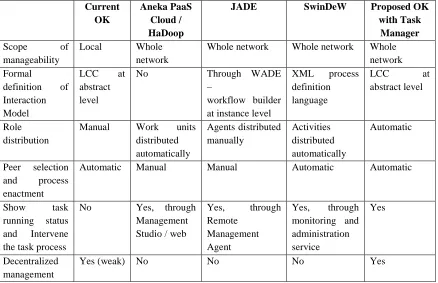
In Table 1, we compare the aforementioned three related works with the current
OK framework and our proposed OK framework with task management extension. From
the table, we state once again that our goal is to enable the OK based collaborate network
with enhanced process management, automated process deployment and process
enactment along with the full advantage of LCC based interaction model definition. The
features listed under the proposed OK with task manager column can be viewed as a wish
list that needs to be implemented in our work.
Current OK
Aneka PaaS Cloud / HaDoop
JADE SwinDeW Proposed OK with Task
Manager
Scope of manageability
Local Whole network
Whole network Whole network Whole network Formal
definition of Interaction Model
LCC at abstract level
No Through WADE –
workflow builder at instance level
XML process definition language
LCC at abstract level
Role distribution
Manual Work units distributed automatically Agents distributed manually Activities distributed automatically Automatic
Peer selection and process enactment
Automatic Manual Manual Automatic Automatic
Show task running status and Intervene the task process
No Yes, through Management Studio / web
Yes, through Remote
Management Agent
Yes, through monitoring and administration service
Yes
Decentralized management
Yes (weak) No No No Yes
Table 1. Comparison of task management mechanisms.
2.5Contribution
We list two contributions of our work:
1. Proposed a new concept of introducing LCC based logic programming approach
application developers to have more options to implement various kinds of
programming models for their distributed tasks,
2. Built a prototype framework that proves this concept is feasible and serve as a
platform to support future research.
Based on the objective stated in section 2.3, in the prototype of the extended OK
framework, the working scenario is a pool of peers with computation resources for
generic purposes (GP) cooperate each other. To ensure the prototype is runnable and
meets the PaaS cloud requirement of integration, we summarized a minimal set of
features need to be implemented listed as follows:
Dynamic join of peers: new GP can join the network dynamically.
Fully decentralized management pattern. Each GP can act as a management
console, which greatly lowers the management burden of the whole system.
User interface: each GP has a management console that can accept and execute
users’ input, including task submit, show task status, and terminate a task.
Task detection: each GP routinely checks from the Discovery Service for pending
tasks, decides if it has enough resources to participate the role of the task, and
subscribe to the selected role.
Input/output channel: redirect the input/output requests of roles on distributed
peers back to the management console or the parent task.
In [Robertson 2004], the author proposed a broker model as shown as below (5), (6)
that act as an extension of LCC. In this model, a client role can request the broker role to
send the whole protocol of a task and then initiate and continue as the received protocol.
complete a specific task. No further achievements have been found be done in this
direction. In our experimental work, we realize a scenario that can be seen as one step
toward this direction. Instead of transfer a whole protocol, a task managed by our
prototype task manager can invoke a child task that uses a newly published or existing
interaction model. The child task can communicate with is parent task and further interact
with the end user at the management console via the above mentioned input/output
channel.
(5)
(6)
In the following sections we will analyze how the OK framework works at
underlying level and we will demonstrate how to extend the framework to make it
3.
OPENKNOWLEDGE SYSTEM ARCHITECTURE AND
COORDINATION PROTOCOL ANALYSIS
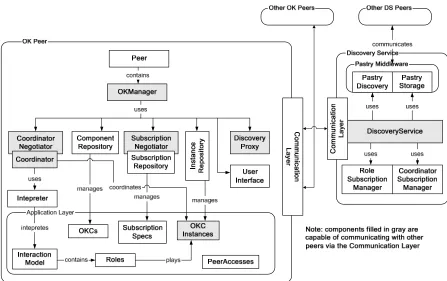
As shown in Figure 1, the architecture of the OK system includes many modules
which we discuss individually in the following [PA et al 2007]:
Figure 1. OK system components and their relationships
Interaction Model (IM)
The IM is a piece of script written in the LCC language which defines how
multiple roles collaborate between each other to complete a task. It can be published
to the p2p network and can be found by OK peers.
OpenKnowledge Component (OKC)
The OKC is a class library that implements the service provided by the roles.
constraints. It is mobile and can be published to the Discovery Service (DS). Peers
that want to act as specific roles can find and download proper OKC libraries the DS,
and use it to support its business functionality upon interaction initiated.
OK Manager - OKManager
The OKManager is the class module that controls all other OK peer modules.
Its functions include creating OKC instance from an OKC, delegating constraints
received from coordinators to appropriate OKC instance, delegating all the
publishing, subscription and search actions.
Coordinator
The Coordinator is the component dynamically allocated to a peer that interprets
the IMs and coordinates the communication with each OKC Instances.
OKC Instance – InteractionRunContext
The component generated after the peer is accepted to play as a specific role in
an IM, which contains the pointers to the OKCs needed for solving all the
constraints in a specific run of an interaction. It interacts with Coordinator to
complete the interaction.
Discovery & Storage Service (DS)
The DS provides persistent storage for published IMs and OKCs and dynamic
storage to their descriptive information. It also stores other information such as
available coordinators, roles for published IMs, subscribed candidates for roles etc.
Currently it is constructed based on Pastry [Rowstron and Druschel 2001] based p2p
framework.
The interpreter is a LCC parser that interprets the IM by transforming it into a
parse tree. It determines which role is acting, which message is to be sent by
expanding, traversing and closing branches of the tree. It also interacts with OKC
instances to collect results of constraints to determine how to traverse the tree.
Like other peer-to-peer or agent based systems, the OK interaction is completed
based on message exchange. The basic component of an OK network that can listen to
and handle the received message must implement the Endpoint interface. Each Endpoint
has a unique URI called EndpointID. Many above mentioned components including OK
Manager, Coordinator, OKC Instance and DS etc are derived from the Endpoint that are
designated to handle specifically kinds of messages based on their functionality. The
module at transport layer that support the message exchange is called Communication
Layer.
From Figure 1 one can also see that the manager (OKManager) is the class module
that controls all the other modular components in a peer.
3.1Lifecycle of an Interaction
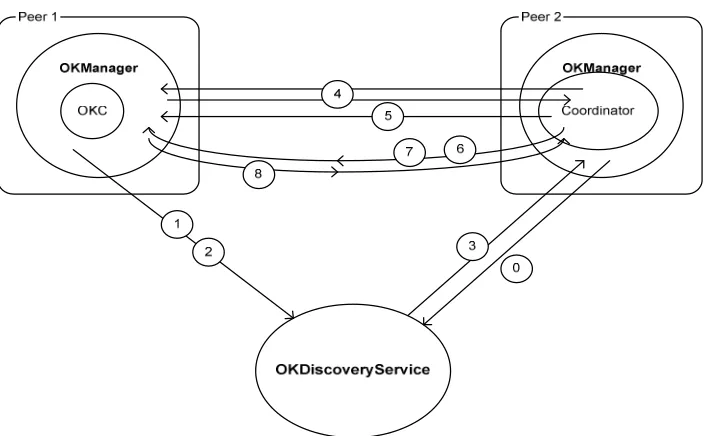
Figure 2 depicts our in-depth analysis about how the whole OK framework works
based on the life cycle of an interaction. The lifecycle of an interaction contains eight
Figure 2. Life cycle of OK system
Step 0: Peer Joins To The Network
This action is taken place between OKManager and DS. Whenever a peer joins the
OK network, it can choose whether it can be dynamically selected to act as the
Coordinator. If it chooses to behave like a Coordinator, it will send the
RequestSubscribAsCoordinator message to the DS to register itself as a candidate of the
Coordinator.
Step 1: Publish An Interaction Model
As shown in Figure 3, the IM publishing action takes place between OKManager and
DS when a peer in the network decides to publish a new Interaction Model to the network.
The OKManager of the peer that wants to publish the IM sends a
RequestPublishIMMessage to DS. The DS publishes this IM to the p2p network, and
provides persistent storage to the published IM. Each published IM will be assigned with
OKManager Communication Layer DS
PublishIM through
DiscoveryProxy.PublishIM RequestPublishIMMessage handlePublishIM create PublishIMHandler,
insert descriptor to FreePastry network, persistant storage of LCC
ResultPublishMessage handleResultPublishMessage()
invoke callback registered in a list called PublishCallbacks
Figure 3. [UML] Sequence diagram for publishing an interaction model
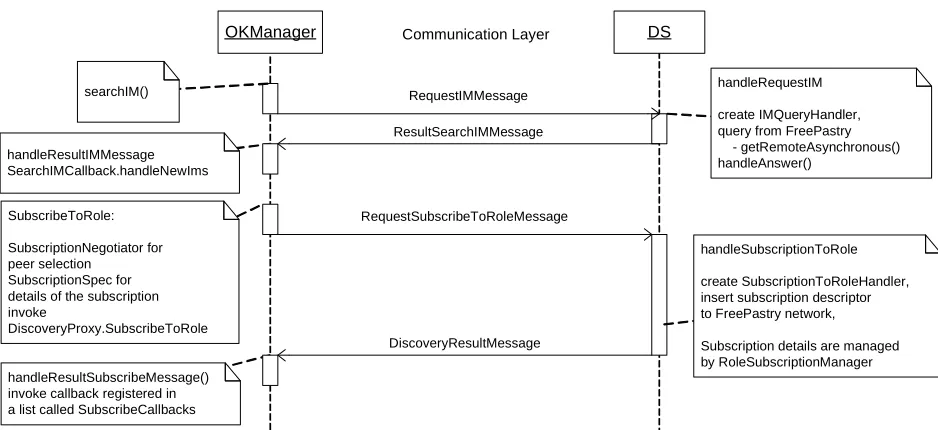
Step 2: Search IM and Subscribe To Interaction
After an IM is published, it is discoverable to all the peers in the network. The peer
can inquiry a published IM by search its name. The DS will return the Interaction Model
ID, descriptive information and all the roles it has. Then the peer can decide which role it
can participate. Upon it decides which role to participate; it uses the sequence described
in Figure 4 to subscribe to the role. This interaction is taken place between OKManager
OKManager Communication Layer DS
SubscribeToRole:
SubscriptionNegotiator for peer selection
SubscriptionSpec for details of the subscription invoke
DiscoveryProxy.SubscribeToRole
RequestSubscribeToRoleMessage
handleSubscriptionToRole
create SubscriptionToRoleHandler, insert subscription descriptor to FreePastry network,
Subscription details are managed by RoleSubscriptionManager DiscoveryResultMessage
handleResultSubscribeMessage() invoke callback registered in a list called SubscribeCallbacks
RequestIMMessage
ResultSearchIMMessage
searchIM() handleRequestIM
create IMQueryHandler, query from FreePastry - getRemoteAsynchronous() handleAnswer()
handleResultIMMessage SearchIMCallback.handleNewIms
Figure 4. UML Sequence diagram for searching IM and role subscription
When the OKManager of a peer decides to subscribe itself to a role of an IM, it
invokes its SubscribeToRole member function. Inside this function, an instance of
SubscriptionSpec class is created along with a SubscriptNegotiator instance, which is
later used for peer selection. The SubscriptionSpec instance contains all the subscription
information and is sent via the RequestSubscribeToRoleMessage to the DS. The
subscription information is then made discoverable and is managed by the
RoleSubscriptionManager.
Step 3: Initiate The Interaction – Choose the Coordinator
As mentioned above, the roles of an IM can be subscribed by different peers over the
network. All the subscription information is maintained by the RoleSubscriptionManager
in the DS. The RoleSubscriptionManager checks if all roles of an IM is subscribed and
StartInteractionMessage to a selected peer that is registered to be a candidate of the
Coordinator. After the peer that is selected as the Coordinator received this message, it
goes into the bootstrap process (OK uses BootStrapCoordinator to handle the
Coordinator’s bootstrap process).
Figure 5. UML Sequence diagram for initiating an interaction
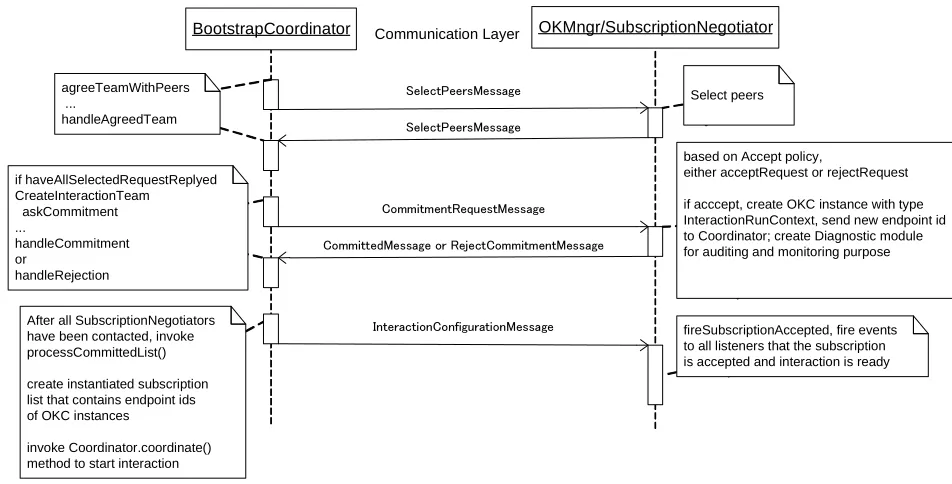
Step 4: Choose Partners
This interaction happens between the BootStrapCoordinator and the
SubscriptionNegotiator of subscribed peers via message SelectPeersMessage. It belongs
to the peer election process. The SelectPeersMessage contains the subscription
information of all proposed peers. It is first sent from BootStrapCoordinator to each
SubscriptionNegotiator. The SubscriptionNegotiator of each peer uses its own experience
to select peers it is comfort to interact with using OK provided trust model interface. The
subscription information of selected peers is also packed into a SelectPeersMessage and
is sent back to the BootStrapCoordinator. Each time upon received the
SelectPeersMessage, the BootStrapCoordinator uses haveAllSelectRequestsReplied
uses the list of agreed peers to find out a mutually compatible team of peers to run the
interaction. And then starts to allocate the roles to the team of peers.
Step 5: Allocating Roles
The BootStrapCoordinator sends CommittedRequestMessage to selected peers.
When the SubscriptionNegotiator of a selected peer receives the message, it can either
choose to accept the request, which means that it will join the interaction, or choose to
reject the request. If the negotiator selects to accept the request, it will create the runtime
context of the role on the peer as well as the diagnostic module that is used for
monitoring and auditing purpose. The runtime context is also called the OKC instance
that has a new endpoint id. It will be used to interact with the Coordinator during the
BootstrapCoordinator Communication Layer OKMngr/SubscriptionNegotiator
agreeTeamWithPeers ... handleAgreedTeam SelectPeersMessage Select peers SelectPeersMessage if haveAllSelectedRequestReplyed CreateInteractionTeam askCommitment ... handleCommitment or handleRejection CommitmentRequestMessage
based on Accept policy,
either acceptRequest or rejectRequest if acccept, create OKC instance with type InteractionRunContext, send new endpoint id to Coordinator; create Diagnostic module for auditing and monitoring purpose
CommittedMessage or RejectCommitmentMessage
After all SubscriptionNegotiators have been contacted, invoke processCommittedList() create instantiated subscription list that contains endpoint ids of OKC instances
invoke Coordinator.coordinate() method to start interaction
InteractionConfigurationMessage fireSubscriptionAccepted, fire events
to all listeners that the subscription is accepted and interaction is ready
Figure 6. UML Sequence diagram for choosing partners and allocating roles
interaction (solving constraints requested by Coordinator). A ComittedMessage or a
accepts or reject the commitment request. As to the BootStrapCoordinator, after it has
accepted committed message from all the selected roles, it will invoke the Coordinator’s
coordinate member function, which starts the interaction.
Step 6: Start Interaction
The Coordinator uses LCCIntegreter that is a LL parser generated by [JavaCC] to
interpret the LCC interaction model. By executing the IM, the Coordinator determines
which role is switched to the current role and which constraint is going to be solved.
When the Coordinator needs to resolve a constraint, it sends SolveConstraintMessage to
the InteractionRunContext instance of the peer that is allocated with the specific role. The
constraint is solved remotely and the result is sent back to Coordinator via the
SolveConstraintResponseMessage. From here we can see that the current OK kernel uses
orchestration to handle the interaction at fundamental level. The Coordinator is the one
that actually owns the conversation. Solving the constraint remotely is similar of
invoking web services from service providers. The choreography only happens at abstract
level. A difference of OK based orchestration versus BPEL based orchestration is that the
OK Coordinator is dynamically allocated, which provides room for future improvements
on fault tolerance and load balancing optimization etc.
Step 7: Interaction Terminate
The Interpreter on the Coordinator determines which role is completed. When all
roles are completed and there is no next role to execute, the interaction goes into the
terminate state and gets into the shutdown process.
The shutdown process fires interactionEnded event to all its listeners, which causes
sending InteractionCompletedMessage to InteractionRunContext instances of all
participated peers and fires up the cleanup process on each peer. The
InteractionCompletedMessage also contains the status information on the Coordinator,
hence peers can determine how things going on during the execution of the IM.
Coordinator Communication Layer OKM/InteractionRunContext
coordinate() ---for each role,
Intepreter.addInstance(OKC,role,args) Intepreter.StartInteraction
SolveConstraintResponseMessage
invoke subscribed OKC member functions to solve the constraint SolveConstraintMessage
InteractionCompletedMessage Interaction complete
shutdownInteraction
cleanup registrations handleMessage
Figure 7. UML Sequence diagram for starting and termination of an interaction
Step 9: Learning From Interactions
This is an optional step. As participated peers can receive abundant information from
Coordinator about the execution of the IM, they can use this information to adjust their
future behaviour autonomously.
3.2Issues for Enhancing and Extending
Based on the lifecycle analysis of the existing OK framework and the proposed
features mentioned in section 2.5, we proposed two extensions and three enhancements to
the OK framework:
TaskDescription to the extended OK framework
A task represents one execution of an interaction model. It uses a
TaskDescription instance to record all of the information of its internal state. Each
TaskDescription has a unique task id. It contains the reference to the interaction
model and the descriptive information of the required collection of OKCs. The
TaskDescription instance retains all the runtime status of the lifecycle of a task from
pending, running to termination. It is publishable and is discoverable by participant
peers.
Introduce a new component to the framework called Generic Peer (GP)
The GP component acts at the top most layer of a peer in the p2p environment.
At one hand, it provides a management console to handle the end user’s input/output
requirements, which includes a command parser to interpret task submit, task status
query and terminate task commands, and also provides interface for user to provide
input for a participant of running task and display output information of a remote
task participant to the management console. On the other hand, the GP routinely
inspects the DS and tries to find pending tasks in which it can participate potentially.
Upon finding a matching task, the GP selects a role based on its own resources and
subscribes the role to the DS, and let the OK framework to select and execute the
interaction.
Enhance the task management mechanism to the existing control manager
(OKManager)
The management functionalities of above mentioned GP is supported by an
types of messages for the administrative purpose are added. Detailed message types
are defined in the following categories: task publish, task status query, updating task
status, task termination and inter-task communication.
Enhancements added to the coordinator allocation procedure (Step 3)
Upon the coordinator of an interaction is selected, The TaskDescription need to
be updated to reflect the allocation of the Coordinator.
Enhancements added to the role allocation procedure (Step 5)
Upon a role is allocated to the subscriber of the interaction of a task and the
OKC instance is created, the TaskDescription need to be updated to reflect the
4.
FORMALIZATION
We define the distributed task as
T = {Tid, pm, Rs, Ps, RP} (7)
Where Tid is the unique identifier of the task, pm is the peer from which the task is
submitted; Rs is the set of roles that the task defined, Rs = {r1, r2, …, rn}; Ps is the set of
peer variables that represent the peer for the role to run, Ps = {P1, P2, …, Pn }; RP is a
subset of Rs × Ps, which contains a set of tuples like (r1, P1), (r2, P2), that we call agents.
We use T’ to represent the instantiated task, i.e. the task after deployed to the
network that is under running state.
T’ = {Tid, pm, C, Rs, Ps’, RP’} (8)
Where the Tid and pm are same as above, C is the id of the allocated coordinator for
the interaction, Rs is the same set of roles as defined above (We presume each role
contains all the information at implementation level, which is defined by OKC class
library. When a role is deployed to a peer, the OKC is deployed to the same peer
accordingly), Ps’ is the set of peer ids that are allocated to the task. Ps’ = {p1, p2, …, pn },
we use lower case characters to represent id of actual peers that are constants. RP’ is a
subset of Rs × Ps’, which contains a set of tuples like (r1, p1), (r2, p2), that we call
instantiated agents.
After a task is submitted from GP running at peer pm, its roles will be automatically
subscribed by a group of listening GPs. The task enrollment is the process of instantiating
Pi ∈ Ps to pi ∈ Ps’ and instantiating (ri, Pi) ∈ RP to (ri, pi) ∈ RP’. The difference
between the original OK framework and the extended OK framework is that to the latter,
A role ri of task T can decide whether to redirect user input/output request to the
task’s management console pm or handle the I/O request on local pi, depending on if it
uses provided API to handle the user I/O request. If the role decides to redirect user’s I/O
to the task’s management console, the user I/O request that generated at (ri, pi) ∈RP’ will
be relayed to pm via the extended message interface of OKManager and the management
console at pm will act as an I/O broker to collect input or display output to the end user. If
the task T’ = {Tid, pm, C, Rs, Ps’, RP’} is the child task of another task T’0 = {Tid0, pm0, C0,
Rs0, Ps0’, RP’0}, when the message of I/O request is relayed to the management console of
T’ at pm, it will be cached in a message queue instead of being processed. The running
instantiated agent (rk, pk) ∈RP’0 that belongs to the parent task can inspect the cached I/O
request and either process the request and send the input back to (ri, pi) ∈RP’, or it can
relay the I/O request to the parent task’s own management console at pm0 hence a chain of
message relay channel is formed and user at the management console of the parent task
5.
DESIGN AND IMPLEMENTAION
5.1System Architecture
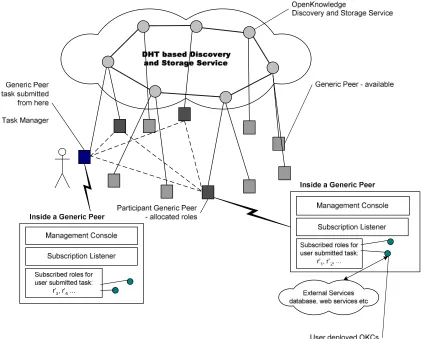
The proposed system architecture of the task management system is shown in Figure
8. The entire system contains a collection of Generic Peers. Each peer itself is a Java
application running on the same or different machines.
After a GP is launched, it automatically joins the network. All GPs are running based
on the same code base that enables them either to be a management console or a role
subscription listener. Therefore an end user can submit new tasks and query task runtime
information at the management console of any GP. A GP can subscribe to one or many
roles of one or more tasks, depending on its own capability such as computation power,
resources etc. After it subscribes to the roles, it participates in the interaction lifecycle
depicted in section 3.1. From here on, we call the GP from which task T is submitted as
the task manager of task T, and other GPs that participate with task T as participant GPs
of T.
The whole system is implemented using Java programming language (JDK 1.5 or
Figure 8. Logical architecture of the prototype task manager
Below is the detailed design of the task management system.
5.2Design of Task Description Data Structure
The TaskDescription data structure is used to record the status of a submitted task.
Each TaskDescription instance retains all runtime status of the lifecycle of the task from
Figure 9. UML Class diagram of TaskDescription
TaskDescription related operations are defined as follows:
Operation Description
Create task The TaskDescription instance is created upon a task is submitted. Upon creation,
the status is initiated as PENDING, and the set of TaskOKC reflects the minimal
set of required OKCs to support the running of the task. At this time, because the
interaction is not started, the Coordinator EndpointID is null, the OKC Instance
EndpointID of each TaskOKC is also null.
Publish task Upon task submission, its search criteria and the EndpointID of the OKManager
are published to DS and are discoverable. The effective TaskDescription instance
is stored at the OKManager from which the task is submitted.
Search task Query the DS by using criteria strings, obtain the OKManager Endpoint from
which the task is submitted, and then query from the OKManager
Update task status During the lifecycle of a task, the TaskDescription instance is always updated to
reflect the current task status:
The Coordinator EndpointID will be updated when the interaction is
ready to start, with the selected Coordinator’s EndpointID;
The corresponding TaskOKC’s OKC Instance EndpointID will be
updated when the OKC instance is created.
The status of the TaskDescription will be changed to COMPLETE when interaction is completed
After the TaskDescription instance is updated, it will be written back to the list of
running task of the OKManager from which the task is submitted. When the task
is completed, the instance will be taken away from the list of running tasks of the
OKManager.
Table 2. TaskDescription related operations
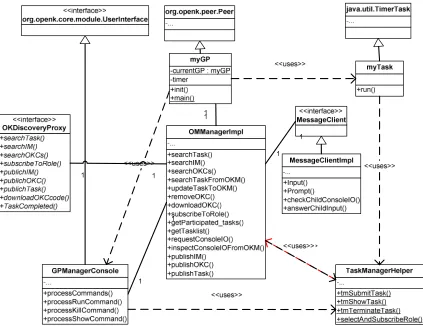
5.3Design of GP
The Generic Peer is the top level program of the peer application that runs as an
autonomous peer. It contains a group of classes either added to the OK kernel or extended
from the existing classes of the OK kernel. The class diagram of the Generic Peer can be
referred to as Figure 10.
The myGP class is a new class introduced as the main entrance of the peer
application.
It has two functionalities. The first function is to use a timer to schedule a timer task
that checks the DS regularly in order to find and attempt to participate newly submitted
tasks, by invoking method TaskManagerHelper.selectAndSubscribeRole. The second
function is to use class GPManagerConsole to construct a user interface, interpreting user
submitted administration commands.
In order to make the extended code more manageable, we introduced the
TaskManagerHelper class that provides a group of static functions that are used for task
managements. All these functions provide synchronized interface to their callers. Major
methods include:
Method Description
tmSubmitTask Submit a new task.
Parameters:
mgr – reference to OKManagerImpl instance
taskname – string of task name,
im – string of the interaction model defined in LCC,
okcs[] – array of OKCDescription,
ptid – task id of parent task if has one
Returns:
A TaskDescription instance
tmShowTask Query the task running status and print out.
Parameters:
mgr – reference to OKManagerImpl instance
taskname – string of task name
tmTerminateTask Terminate a task.
Parameters:
mgr – reference to OKManagerImpl instance
force – Boolean value to specify if the kill is a forced kill
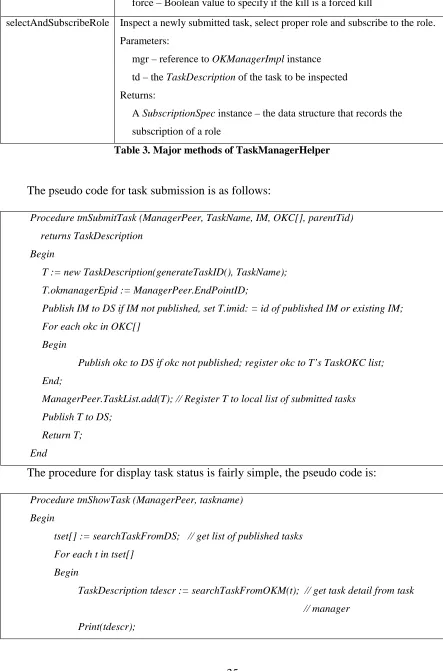
selectAndSubscribeRole Inspect a newly submitted task, select proper role and subscribe to the role.
Parameters:
mgr – reference to OKManagerImpl instance
td – the TaskDescription of the task to be inspected
Returns:
A SubscriptionSpec instance – the data structure that records the
subscription of a role
Table 3. Major methods of TaskManagerHelper
The pseudo code for task submission is as follows:
Procedure tmSubmitTask (ManagerPeer, TaskName, IM, OKC[], parentTid)
returns TaskDescription
Begin
T := new TaskDescription(generateTaskID(), TaskName);
T.okmanagerEpid := ManagerPeer.EndPointID;
Publish IM to DS if IM not published, set T.imid: = id of published IM or existing IM;
For each okc in OKC[]
Begin
Publish okc to DS if okc not published; register okc to T’s TaskOKC list;
End;
ManagerPeer.TaskList.add(T); // Register T to local list of submitted tasks
Publish T to DS;
Return T;
End
The procedure for display task status is fairly simple, the pseudo code is:
Procedure tmShowTask (ManagerPeer, taskname)
Begin
tset[] := searchTaskFromDS; // get list of published tasks
For each t in tset[]
Begin
TaskDescription tdescr := searchTaskFromOKM(t); // get task detail from task
// manager
End;
End
The pseudo code for task termination is as follows:
Procedure tmTerminateTask (ManagerPeer, taskid, isforce)
Begin
tset[] := searchTaskFromDS; // get list of published tasks
For each t in tset[]
Begin
If t.taskid = tasked Then
Begin
M := createTaskCompletedMessage(t, force);
Send M to t’s Coordinator;
/* Upon received M, the coordinator will perform all the resource release works
and send InteractionComplete messages to all the participants of the task */
End;
End;
End
The pseudo code for task enrollment is as follows:
Function selectAndSubscribeRole (ManagerPeer, T) returns SubscriptionSpec
Begin
IM := searchIMFromDS(T.taskname);
Select role to subscribe based on IM’s role semantics and subscription status of
T.TaskOKC[];
OKCDescription okcdes := searchOKCFromDS(selected T.taskOKC);
Download OKC code from DS and save it to local OKC storage;
// Subscribe to the selected role from DS
SubscriptionSpec s := subscribeToRole(selected role, okcdes);
// register endpoint id of the SubscriptionNegotiator of selected role
T.taskOKC.subscriberEPID := s.subscriberEPID;
Return s;
End;
tset[] := searchTaskFromDS; // get list of published tasks
Begin
TaskDescription tdescr := searchTaskFromOKM(t); // get task detail from task manager
SubscriptionSpec s := selectAndSubscribeRole(self.mamager, tdescr);
If sub <> null then
Begin
// update task subscription information back to task manager
updateTaskDescriptionToOKM(tdescr, s);
Register tdescr to local list of participated tasks;
End;
End;
It is possible to consider several algorithms to deal with the role select and
subscription problem. In this thesis we have selected simple algorithm to let participant
GP decide which task and role to subscribe. The GP only considers two factors to decide
the role subscription to ensure that a task can be initiated upon minimal running criteria
has been reached.
If the maximum number of subscription has reached;
If the minimal number of requested subscriptions of a role has reached.
More sophisticated selection algorithms that consider load balance and performance
optimization will be introduced in the future versions.
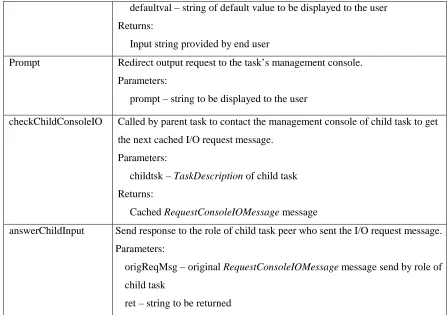
The MessageClient interface and its implementation MessageClientImpl is the client
API that provides synchronized interface for inter-task and task/manager communication.
It contains the following 4 methods:
Method Description
Input Redirect user input request to the task’s management console in order to get
user’s input.
Parameters:
defaultval – string of default value to be displayed to the user
Returns:
Input string provided by end user
Prompt Redirect output request to the task’s management console.
Parameters:
prompt – string to be displayed to the user
checkChildConsoleIO Called by parent task to contact the management console of child task to get
the next cached I/O request message.
Parameters:
childtsk – TaskDescription of child task
Returns:
Cached RequestConsoleIOMessage message
answerChildInput Send response to the role of child task peer who sent the I/O request message.
Parameters:
origReqMsg – original RequestConsoleIOMessage message send by role of
child task
ret – string to be returned
Table 4. Major methods of MessageClient and MessageClientImpl
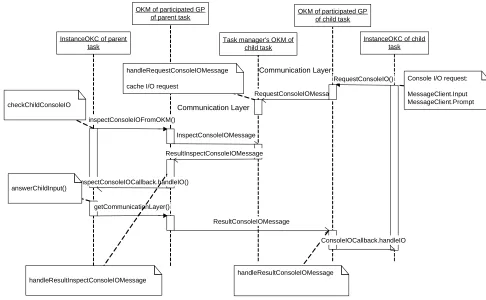
Figure 11 displays the time sequence of how the Input and Prompt methods work
between an OKC instance of a role and the task’s management console. The Task
manager’s OKManager acts as a server by responding I/O requests sent from OKC