Scholarship at UWindsor
Scholarship at UWindsor
Electronic Theses and Dissertations Theses, Dissertations, and Major Papers
1-1-1983
The effect of bi-modality on the functional adaptability of older
The effect of bi-modality on the functional adaptability of older
adults.
adults.
Simon Davis University of Windsor
Follow this and additional works at: https://scholar.uwindsor.ca/etd
Recommended Citation Recommended Citation
Davis, Simon, "The effect of bi-modality on the functional adaptability of older adults." (1983). Electronic Theses and Dissertations. 6777.
https://scholar.uwindsor.ca/etd/6777
This online database contains the full-text of PhD dissertations and Masters’ theses of University of Windsor students from 1954 forward. These documents are made available for personal study and research purposes only, in accordance with the Canadian Copyright Act and the Creative Commons license—CC BY-NC-ND (Attribution, Non-Commercial, No Derivative Works). Under this license, works must always be attributed to the copyright holder (original author), cannot be used for any commercial purposes, and may not be altered. Any other use would require the permission of the copyright holder. Students may inquire about withdrawing their dissertation and/or thesis from this database. For additional inquiries, please contact the repository administrator via email
A D A P T A B I L I T Y OF O L D E R AD U L T S
by
Simon D a vis
A Thesis
submitted to the F a c u l t y of G r a d u a t e Studies th r ough the F a c u l t y of
H u m a n K i n e t i c s in P a r tial F u l f i l l m e n t of the r e q u i rements for the D e g r e e of
M a s t e r of H u m a n K i n e t i c s at T h e U n i v e r s i t y of W i n d s o r
Windsor, Ontario, Ca n a d a
IN FO R M A TIO N T O U SER S
The quality of this reproduction is dependent upon the quality of the copy
submitted. Broken or indistinct print, colored or poor quality illustrations
and photographs, print bleed-through, substandard margins, and improper
alignment can adversely affect reproduction.
In the unlikely event that the author did not send a complete manuscript
and there are missing pages, these will be noted. Also, if unauthorized
copyright material had to be removed, a note will indicate the deletion.
UMI Microform E C 5 4 7 6 3 Copyright 2 01 0 by ProQuest LLC
All rights reserved. This microform edition is protected against unauthorized copying under Title 17, United States Code.
ProQuest LLC
789 East Eisenhower Parkway P.O. Box 1346
The results of this study Indicate that the concept of bi-modallty
facilitates greater functional adaptability, as measured by PADL, in
older adults, and should therefore be promoted in order to maintain
I would like, to de.dlca.te. thl& the&li to my pan.ent&
and family {on theln contlnucd love and 6uppont, to all
my {nlend&, and to
Mantha Jill
<[on. making me 6mlle.
I would like to express ray appreciation to the members of my
committee, whose careful reading of both the proposal and the final
draft assisted in changing the ellipticity.
To Dr. James Duthie, I proffer special thanks for his sagacity
and counsel, and the inspiration to obviate the barriers to
eclecticism.
» •
ABSTRACT. ... iv
D E D I C A T I O N ... vi
A C K NOWLEDGEMENTS ... vii
LIST OF T A B L E S ... x
LIST OF A P P E N D I C E S ... xi
CHAPTER I. PURPOSE OF THE S T U D Y ... 1
I. The Conceptual Background to the S t u d y ... 1
t II. J u s t i f i c a t i o n ... 2
U y {ill. The P r o b l e m ... 5
IV. Definition of T e r m s ... 7
r
^ V. H y p o t h e s e s ... 7'{£)] VI. D e l i m i t a t i o n s ... 7
Lvil. L i m i t a t i o n s ... 8
■'(✓All. REVIEW OF L I T E R A T U R E ... 9
J
III. INSTRUMENTS AND M E T H O D O L O G Y ... 24I. Selection and Construction ... 24
II. Locus of Control Ins t r u m e n t... 24
III. Adaptability Measures. . . . ... 26
I. Research D e s i g n ... 30
II. S u b j e c t s ... .. . 30
III. Collection of Data and Testing Procedure . 31 IV. Analysis of the D a t a ... 35
IV. R E S U L T S ... 38
f V. SUMMARY AND C O N C L U S I O N S ... 49
\ L
I. S u m m a r y ... 49\ II. C o n c l u s i o n s ... 49
III. R e c o m m e n d a t i o n s ... 56
R E F E R E N C E S ... 59
A P P E N D I X ... 65
Table Page
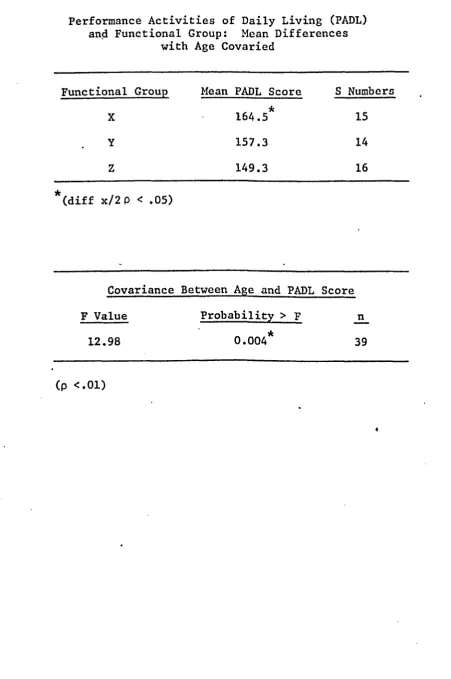
1. PADL and Functional Group: M e a n Differences
wi t h Age C o v a r i e d ... 39
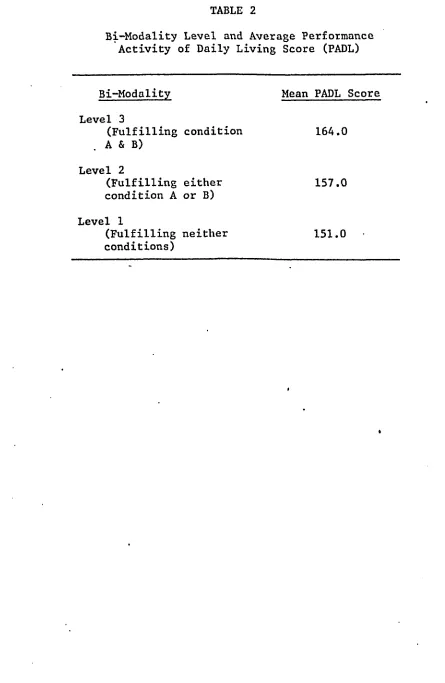
2. Bi-Modality Level and Average PADL S c o r e ... 41
3. Bi-Modality Levels 1 and 3: Differences on P A D L ... 42
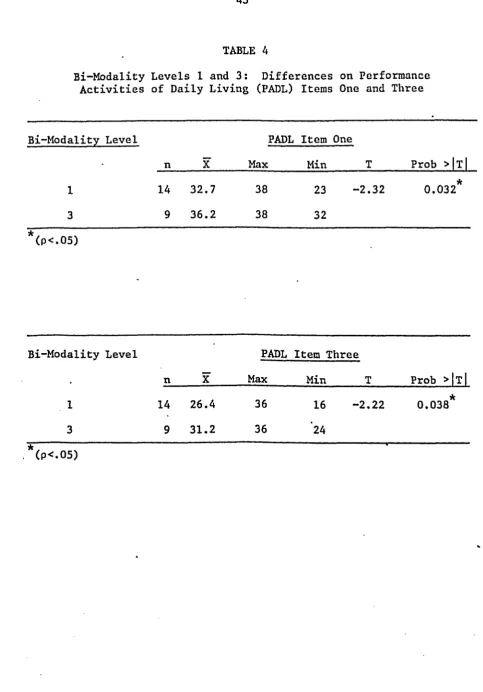
4. Bi-Modality Levels 1 and 3: Differences on PADL
Items 1 and 3 ... 43
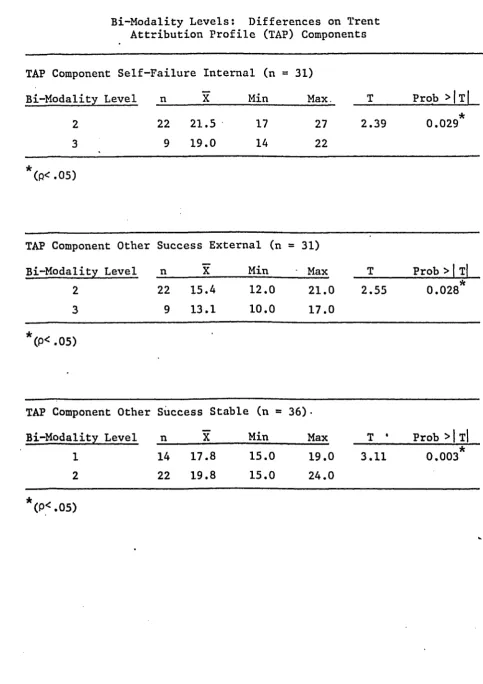
5. Bi-Modality Levels: Differences on TAP C o m p o n e n t s 45
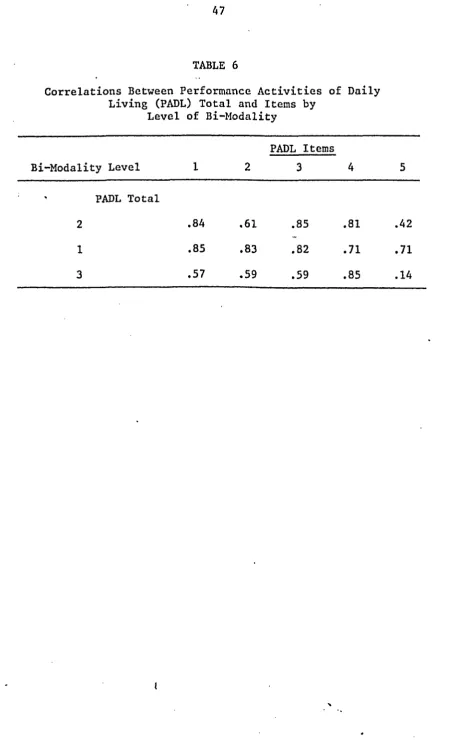
6. Correlations Between PADL Total and Items by
Level of B i - M o d a l i t y ... 47
Appendix Page
A Demographics and Projections ... 65
B Cost of Elderly Care ... 67
C Trent Attribution Profile Response Sheets ... 69
D Performance Activities of Daily Living 7 3 Instructions and Scoring ... 7 3 E Social Interest Scale (SIS) Data Sheet ... 89
F Trent Attribution Profile (TAP) Data Sheet ... 90
G Profile of Level 3 B i - M o d a l ... 92
H Profile of Level 2 Bi-Modal ... 94
I Profile of Level 1 Bi-Modal ... 96
J Trent Attribution Profile Components ... 98
PURPOSE OF THE STUDY
Increasing age demands conventionally that individuals make adjust
ments in physical and mental capabilities, in order to compensate for
predictable decline. The purpose of this study is to investigate how
older adults maintain independent living when confronted with such age
related decrements, by examining the relationship between the degree
of behavioural adaptability or flexibility and the level of independence
maintained by each subject.
Individuals display behavioural adaptability by demonstrating the
willingness to accept their own limitations, thereby facilitating the
engagement of various forms of external assistance (community services,
technological aids). The individual who avails him/herself of various
supportive measures and agencies, increases an ability to compensate for
various deficiencies and thus maintain independent, although modified,
living.
F r o m a theoretical perspective, a n attempt will be made to discover the
effect of 'bi-modality1 on an individual's adaptability/flexibility, and
thus independence. This research will demonstrate whether bi-modal
individuals display significantly higher levels of functional adaptability,
and are therefore better able to maintain a higher level of independent
living than low bi-modals (comprised of both high internals and high
I I . JUSTIFICATION OF THE STUDY
Fr o m a demographic perspective, Canadian society is experiencing
structural changes. The percentage of adults over the age of sixty-five
years is expected to increase in both absolute number and percentage of
the total population, for the period 1980 until the end of the century
(Statistics Canada, 1976), (see A p pendix A). Changes in the age structure
will inevitably produce repercussions on community services such as health.
Demand on such services will increase, posing severe financial problems,
(Science Council of Canada, 1976), (see Appendix B).
According to the Science Council of Canada (1976), Canada has chosen
to devote the majority of 'medical resources' to the treatment of acute
illnesses, neglecting as a result the feasibility of developing a well
structured, preventative care programme. The overwhelming emphasis has
been on institutional settings for the older adult, with health care
programmes designed to remove the individual from the community rather
than assist with supportive in-home services.
Rapidly escalating costs in the provision of health services for the
older adult has, as an expedience, necessitated a reappraisal of the
current policy and attitudes towards the increasing number of older adults.
Solutions are complicated by the existence of widespread 'ageism' (Palmore,
1982) which includes negative stereotypes and attitudes, both of paramount
Importance in the quality of life of older adults in our society.
In order to escape from the stigma and myths attached to aging, we
must attempt to understand the true meaning of aging and the practical
implications. Selye (1956) has emphasized that true aging is determined
a factor which lacks homogeneity. The alternative would be to encourage
a de-emphasis of chronological age and concentrate on more realistic
measures, based on a recognition of wide individual differences and
re q u i rements.
On a practical level, recent research has been conducted to assess the
impact and effect of institutionalization, and to develop alternatives.
A study by Kraus et al (1976) examined the process of institutionalization
in Kingston, Ontario, discovering that in 50 percent of the cases physicians
were the first to suggest entry into an institution, and were the major
decision maker in 25 percent of the cases reviewed (193). Over 20.percent
of the institutional applicants were independently assessed by the
researchers and found to be suitable for continued independent living,
provided they received a reasonable amount of community assistance.
Conflict also existed over the reasons given for seeking admission,
applicants and family members frequently citing 'excessive burden' as
a major cause, whilst the physicians attributed need for admittance to
increasing fraility and general old age.
A similar study carried out in Rhode Island (Scitovsky & Nelda, 1975)
revealed that despite a majority of patients displaying a relatively
low need for institutional care, very few were recommended for a return
to the community. Aside from the financial coBt of institutionalization,
prolonged exposure to such an environment can produce the behavioural
manifestation of learned helplessness (Seligman, 1975), where individuals
learn to accept that they lack control, and as a result display apathy,
depression and indifference.
In an attempt to examine alternatives to institutionalization, the
Connecticut area, designed to examine the feasibility, cost and effectiveness
of a client/consumer centered model for an alternative health care
delivery system. ' The service was based upon the specific needs of, and
the integration with, the individual's personal and community support
system. In assessing the impact of the programme (1976 to 1979), client
moral was found to be important in stabilizing the health status of the
older adult, and in maintaining maximum levels of independent functioning.
The study revealed significantly positive shifts in attitude, with the
Initial assessment figure of Triage clients perceiving their health
status as good increasing from 41 to 50 percent.
Accepting the inadequacies of institutions necessitates implementing
additional research in order to assess and examine whether the needs and
requirements of the elderly population are actually being met. Detailed
information is required to explain the differences between older adults
who remain functionally independent and those who are relocated in
institutions, or who are assessed as being 'at-risk' of institutionalization.
Acknowledging that chronological age alone cannot explain the wide
differences in older adult's ability to live independently, this thesis
will examine three groups of older adults in order to discover the
relationship between their level of bi-modality (individual believes
that control results from a combination of personal factors, such as
ability and effort, and environmental factors, such as fate or chance),
and functional adaptability (as measured by adaptability test battery).
If, as hypothesised, bi-modality produces the highest degree of functional
adaptability, the practical implications involve promoting bi-modality
in order to maintain functional independence and to reduce the level
social and psychological).
III. TEE PROBLEM
Statement of the Problem: To discover whether bi-modal older adults display
significantly more functional adaptability than low bi-modals (high
internals and high externals). Sub-problems involved examining whether
high lnternality and high externality decreased functional adaptability,
and whether functional adaptability and bi-modality increase functional
independence in the older adult.
Internal Locus of Control (lnternality): A locus of control*which
attributes the relationship between behaviour and reinforcement to be
c U - V ‘. M x - 1
contingent upon the individual's own a b i l i t y .
External Locus of Control (Externality): A locus of control which
attributes the relationship between behaviour to be contingent upon
environmental factors.
Bi-Modal Locus of Control (Bi-modalJXy.): A dual-dimensional locus of
IV. DEFINITION OF TERMS
Locus of Control: A concept used to explain whether an individual
' / ( : y . V t '
7
contingent upon his/her" own ability or to external factors such as fateor chance
control whereby individuals attribute the relationship between behaviour
(lnternality) and environment (externallfcy.), as measured by the Trent
Attribution Profile (TAP).
Functional Capacity: A n i n d ividual’s ability to perform basic activities
essential to daily living, such as preparing food and telephoning.
Functional Independence: Exists when an individual's functional capacity
is sufficient to facilitate living at home, maintaining a standard which
is acceptable to physicians and referral agencies.
his/her own behavio u r f as a response to age related decrements In ability,
in order to maintain functional capacity and functional independence.
Older Adult: Any Individual over the chronological age of ^ i x t y - f i v e years.
Independent Older Adult: Older adult who Is living alone and coping
with the demands.
High-Risk Older Adult: Older adult in danger of becoming institutionalized,
because they can no longer cope with their deficiencies, in the estimation
of others.
Institutionalized Older Adult: Older adults l i v i n g -in~a-home organized
■
---by the community or the private sector.
and reinforcement to be contingent upon an interaction between ability
•S t
to measure the ability of subjects to perform daily tasks, being used
in this study to assess adaptability.
V. HYPOTHESES
HI = Older adults with a bi-modal locus of control will display significantly
more functional adaptability than low bi-modals.
H2 “ Bi-modals will obtain significantly higher scores on PADL than
no n -bi-modals.
H3 “ Bi-modals will have the highest representation in the independent
group of older adults.
H4 » Independent subjects will achieve significantly higher scores on
PADL than the institutionalized group of subjects.
H5 ■ Internals and externals will have the highest representation in
the high-risk group of older adults.
H6 - Chronological age does not determine performance on PADL.
VI. D E L I M I T A T I O N S ^
j
1. The test group for this study was comprised of forty-five older
the three groups: independent, high-risk and institutionalized, which
were roughly matched according to age.
1. Response Reliability of Subjects
As all the subjects in this study were over sixty-five years of age,
response reliability was taken into account through:
a) Instructional clarity: clear, precise instructions were given
to the subjects in order to prevent confusion and misinterpretation.
b) Visual clarity: instructions presented visually were always
clear and bold.
c) Length of tests: as motivation was an important factor, all
the tests employed were short in duration.
2. Test Scoring
a) As some of the tests involved self-report, considerable care
was taken to relax the subjects and to convince them that there were
no right or wrong answers/replies.
b) tests requiring subjective assessment on the part of the
experimenter (e.g. PADL), were independently assessed in order to
increase reliability. Standardized instructions also facilitated
R E V I E W OF LIT E R A T U R E
The c o n cept of in t e r n a l - e x t e r n a l locus of c o n trol (I-E), has been
d eveloped from social l e a r n i n g_t h e p t y (Rotter 1954), as part of our
a t t e m p t to e x p lain h u m a n behaviour.,in...relatively..complex .sociaL.,.sltuations.
S ocial l e a r ning theory is based up o n the -in t e r a c t i o n between_the
in d i v i d u a l and a m e a n i n g ful environment, w i t h the emphasis b e ing upon
i m p ortance of g o als o r reinforcement, and m o r e i m p o r t a n t l y the e x p e c t a n cy
that— these, goals— wi l l o c c u r .
S o c i a l l e arning theory suggests that a n i n a b i l i ty to c o n t r o l or
predict in situations prevents i n dividuals f r o m gen e r a l i z i n g
expe c t a n c i e s or e x p e r i e n c e s fr o m the past. A n e x p e c t a n c y is the
pr o b a b i l i t y that a p a r t i c u l a r reinfo r c e m e n t w i l l o c c u r as a fu n c t i o n
\ . x
of a spe c i f i c ^ b e h a v i o u r in a specific situ a t i o n (Rotter 1954). Thus
i n c r e a s i n g exp e r i e n c e does not n e c e s s a r i l y result in individuals
expecting a n in c r e a s e In their a b i l i t y to cope wi t h the situation
or the e n v i r o n m e n t . I n a n a v e r s i v e situa t i o n the ind i v i d u a l m a y
«/
have a l o w expectancy, w h i c h m a y produce i n c r e a s e d a n x i e t y and
therefore a lower l e vel of performance.
- ^ L e a r n i n g the o r y d e s c r i b e s h o w choices are ma d e by individuals
l e a rned b e h a v i o u r. H o w e v e r this behaviour, as e m p hasized by Fhares
(1966), has both g e n e r a l and specific determinants, is p u r p o s e f u l and
go a l directed, and involves a s t r i v i n g _jtp__attain or a void c e r t a i n
aspects of the environment. :tual b e h a v i o u r is det e r m i n e d b y the
suggests that in u n f a m i l i a r situations g e n e r a l i z e d e x p e c tancies w i l l
be m o r e important in d e t e r m i n g their e x p e c t a n c y than w i l l specific
e x p e c tancies based on p r i o r e x p erience in that situation.
Conversely, in familiar situations s p e c i f i c expe c t a n c i e s w i l l be the
p r i mary d e t e r m i n a n t s .
W i t h i n social l e a r n i n g theory, locus of c o n t r o l is concerned w i t h
the ind i v i d u a l ' s g e n e r a l i z e d beliefs about w h e t h e r they exert
influence or control ov e r the occur e n c e of rewards, or w h e t h e r various
outside forces exert that control. Thus l e arning and p e r f o r m a n c e in
' }
specific situations is d i f f e r e n t w h e n the subjects b e l ieve that they y
control the c o n t i n g e n c y b e t w e e n b e h a v i o u r and reinforcement, and
w h e n they p e r c e i v e that they la c k control. As Ro t t e r (1966) states:
"When a r e i n f o r c e m e n t is p e r c e i v e d by the subject
as f o l l o w i n g some a c t i o n of his own, but not being
e n t i r e l y con t i n g e n t up o n his action, then in our
culture it is typic a l l y p e r c e i v e d as the result of
luck, chance, fate, as u n d e r the c o n t r o l of
pow e r f u l others, or as u n p r e d i c t a b l e b e c ause of
the great c o m p l e x i t y of the forces s u r r o u n d i n g him
... w e ha v e labeled this belief as external
control. If the p e r s o n perce i v e s that the event is
c o n tingent u p o n his own behaviour, or his own
r e l a t i v e l y p e r m a n e n t characteristics, w e ha v e termed
this a be l i e f in in t e r n a l c o n t r o l . "
ex p e c t a n c y of Internal versus ex t e r n a l c o n t r o l is not the result of
simply a c k n o w l e d g i n g success and failure, but more i m p o r t a n t l y the
causal Interpretation. W e i n e r (1979) stresses that two separate
causal dim e n s i o n s exist; locus of cont r o l and locus of causality. /
The ^causa l i t y dimensJLon is c o n c erned w i t h the source of c a u sality,
(whether in you or the e n v i r o n m e n t ) , w h e reas the control d i m e n s i o n
is conce r n e d w i t h the extent of the i n d i v idual's m a s t e r y over the
causal factors. W e i n e r (1981) suggests that these two d i m ensions ■
are f r e q u e n t l y orthogonal, such as in the case of p hysical h a n d i c a p '
/
w h e r e there exists the p e r c e p t i o n of internal c a u s a l i t y and external
control.
W h e r e a s R o t t e r (1966) believes that the per c e p t i o n of internal
c ontrol is based upon a perfect c o n t i n g e n c y b e t w e e n b e h a v i o u r and
outcome, W o n g (1982) and W e i n e r (1981) e m p h asize that such p e r c eption
depends on mo r e than a simple behaviour-outcorae contingency-. W o n g
cites the e x a mple of the a u t h o r i t a r i a n s o c iety w h e r e the q u e s t i o n of
j L n t e m a l — con'troT is con f o u n d e d b y the idea of survival, w h i c h is
en t i r e l y d e p e n d e n t upon complying w i t h e x t e r n a l l y 'imposed rules.
W o n g also m a i n t a i n s that external c a u s a l i t y does not imply absence
of internal control. L o cus of c a u s a l i t y w o u l d appear to involve
the ass i g n m e n t of causa l i t y to various loci, and locus of c o n trol
w o u l d involve the a s s ignment of responsibility.
L ocus of control is con c e p t u a l l y different to locus of causality,
regardless of the b e h a v i o u r a l instrumentality. Wo n g (1982) believes
•' C—
that the p ercep t i o n of internal— oontrrol— occurs w h e n one assumes full
re s p o n s i b i l i t y for outcome, even though e x t e r n a l l y caused. C o n v e r s e l y
rests elsewhere, regardless of whether It Is the direct consequence
K - '
of one’s own behaviour. Bi-modality, the central tenet of this thesis.
occurs with the perception of dual-control, responsibility for an outorae
being shared by individuals and external_sources. V
Older adults, faced with age-related decrements in ability (real
and irreversible), may attribute the cause to uncontrollable internal
factors, although control of outcome (continued independent living),
can be maintained providing the individual is willing to seek assistance.
From a conceptual perspective, any purposeful examination of the locus
y
of control construct requires the distinction to be made between the '
, <
controllability of cause and controllability of outcome. Weiner (1979)
perceives control as a causal dimension along with other dimensions
such as causality. _Once_an individual has attributed an outcome to
a certain cause, the dimensional properties of the cause must be
identified (controllable or uncontrollable). The control dimension
is concerned with the perceived controllability/uncontrollability of
the cause, rather than the outcome. Perceived controllability of
cause according to Wong (1982), is not necessarily positively related
to perceived controllability of outcome. For example ability, considered
ered an uncontrollable, dispositional causal factor, enhances control
over outcomes, whereas carelessness, considered controllable, decreases
the likelihood of gaining control. Thus causal ascriptions, whether
perceived as controllable or not, would appear to have no direct
bearing on perceived controllability of outcome, the individual
possessing the potential to be instrumental.
Previous research, already-referenced, suggests...that the concept
jadults we must distinguish,between the. concept of control and coping.
Rothbaum, Weisz and Snyder (1982) distinguish between the idea of primary
control (direct behavioural control to change world to fit needs)
and secondary control (change oneself to fit world). Wong (1982) is
unhappy with the use of the word control, and equates secondary control
with the concept of 'coping1. Control implies efficacy (imagined or
real), the individual having the perception and actuality of having 7
the capability to effect changes in one's environment. Coping suggests
,*s‘
the attempt to achieve efficacy (successful or not).
From the older adult perspective, coping strategies may provide
a wide range of responses which assist the individual to adapt to
demanding situations. The older adult, faced with age related decrements
in ability, may facilitate continued control of a dual nature, through
.behavioural flexibility and coping mechanisms. Lazurus, Averlll, and
Opton (1974) emphasize that only certain types of coping are conducive1,
to the perception and actuality of control. Instrumental coping,
according to Miller (1979), is the most conducive to control as it
produces changes in the situation to produce desirable outcomes,
constituting a form of behavioural control.
, / > . . / ' •• i?; •, 11
Thus perception of control involves more than causal attribution and
cpping strategies. Perceived control is primarily concerned with
, J < ' *"
the assessment of efficacy or competence over a situation,^and locus
of control is concerned with the source of attribution-and~heace_th£
attribution of responsibility. ^Older adults, high in lnternality,
would not only perceive but desire more personal control than externals,
this perceived and desired efficacy Involve the individual ignoring
offers of assistance, (community help, health facilities, social help),
which they believe are unnecessary and constitute a threat to their
control and independence. Bi-modal individuals, perceiving responsibility
for outcomes to be shared, will display coping strategies and dual
control, recognising their limitation. In practical terms these
individuals will avail themselves of technological devices, such as
hearing aids, and financial assistance, in order to maintain a high
level of perceived and actual control. This is adaptive behaviour in
these circumstances.
Only in recent years has the study of locus of control been applied to
elderly populations (Reid, Haas and Hawkins, 1977). Results are similar
to those reported for other age groups, with internal locus of control
beliefs (perceived) being associated with a higher level of psychological
adjustment. Zeigler and Reid (1979), researching with elderly subjects,
found that both community residents and hospitalized patients revealed
desired control Jbeing negatively correlated with depression, and
positively correlated with health, knowledge of services and-use
of services. Desired control was also significantly correlated with
four or five indices of psychological adjustment.
Both Nehrke (1977) and Palmore (1977) conducted research with older
adults and the locus of control construct, their results revealing
internalcpntrol being associated with higher life satisfaction_and
*
positive self-concept. Positive self-concept was found to be positively
related to life satisfaction. Nehrke (1980) related self-concept, life
satisfaction and locus of control with Erikson's (1963) concept of ego
crisis results in the individual accepting and valuing themselves, their
lives and their situation, being less afraid of death, less defensive
and/or anxious, and more able to cope with change. Erikson found such
individuals to be characterized by a positive self-concept, high life
satisfaction and an internal locus of control. A failure to resolve
this crisis produces low self-concept, a low level of life satisfaction,
manifested under an external locus of control.
Nehrke (1980) produced research data which revealed significant age
differences on measures of life satisfaction, self-concept and locus of
control, producing a marked effect on the resolution of ego integrity
versus despair. Older institutionalized individuals demonstrated higher
levels of positive self-concept, life satisfaction, internality, and
were more advanced in the resolution of the crisis. Nehrke wcnild argue
against the stereotypic idea of institutions being dull, blunting
Institutions which facilitate withdrawal and depression, instead he
Suggests that they may well have a positive impact on the resolution
of the ego integrity versus-despair crisis.
^ E r i k s o n (1973) and Nehrke (1980) both stress the positive role that
Institutions can play with regards to self-concept, life satisfaction
and locus of control
Y
An underlying assumption of their work is thatlnternality should be encouraged la order to facilitate ajndjpromote
*-r
psychological well-being and adjustment with old age. Internals are
-considered superior over externals in their efforts at coping with and v
* /
gaining a measure of control over the environment, their own behaviour
(
and their lives (Rotter 1966). The result of being more attentive to \
the environment (cues) enables the internal individual to acquire more /
such information (Phares 1976). Internals have been found more likely
to resist outside influence (Odell 1959, Lefcourt 1969, Crown & Liverant
1963), being able to withstand pressure and persuasion, and display
greater cognitive activity (Lefcourt 1971). If these behavioural
’advantages’ are applied in a social context, internals would display
significantly more independence and more reliance on their own ability
and judgements (less easily influenced).
Promoting lnternality often assumes the bi-polarity of the locus
construct (Rotter 1966, O'Brien 1981), whereas recent researchers
advocate viewing this concept as multi-dimensional (Wong 1982). Despite
the apparent advantages of internality, ignoring the external component
fflay have serious negative consequences (Gilbert and Mangelsdorff 1979).
These two researchers examined the effect of the perception of personal
control on reactions to stressful events. Their results revealed high
internals reporting higher stress than low internals or moderate
internals (as measured by Levenson's I.P.C. Scale, 1972), when they
were confronted with similarly difficult life events. High internals,
in comparison with non-client controls, reported lower self-esteem,
higher stress and less control over recent events.
Wong (1982) suggests-that__the„extremes of the locus of control
construct reflect the illusion of control in high internals, and
pessimistic controllees In the* case of externals. The introduction
)
of realism, as opposed to idealism, facilitates a degree of
f
compatibility between realistic externals and a belief in personal
J
efficacy. In order to avoid the extremes of the locus of control, and
to incorporate the dual dimensionality of this concept, Wong advocates
category displays greater adaptive potential and greater realism than
either high internality or high externality#
jControllers (high internals) are by definition frequently seen as
aggressive and domineering, experiencing great stress and anxiety in
subservient roles (Glass 1977), which advocates of internality suggest
will frustrate their need/desire for control. Older adults, high inv
internality, may view the offer of external assistance, vital in
order to maintain their independence as social, physiological and
^
psychological attributes begin to degenerate, as a threat to their
j
autonomy. Failure to avail themselves of external assistance may <\
\
accelerate the degenerative process, reducing functional independence
j"
to a level which requires institutionalization.
J
Research carried out by Glass (1977) has revealed a relationship
between a high controlling disposition and coronary heart disease.
Glass found that ’controllers’ exhibited Type A behaviour, defined by
Friedman and Rosenam (1974) as:
"an action-emotlon complex that can be
observed in any person who is aggressively
involved in a chronic, incessant struggle
to achieve more and more in less time."
Such a behaviour pattern, according to Glass, represents a strong
tendency to cope with stress by means of behavioural control. The
result of extended exposure to uncontrollability will produce a
perception of non-contingency between responses and outcomes, resulting
in cessation of efforts to control. Glass and Singer (1972) suggest
the reason for this behavioural change is that 'A's' are assumed to
individuals with 'B' type characteristics, who in general are less
ambitious and achievement orientated, displaying a more relaxed
disposition This perception of uncontrollability may transfer to
subsequent task situations where it appears as learned helplessness
(Seligman 1975), or the 'give up' syndrome (Engel 1967).
Learned helplessness is produced when response outcome has become
independent of subject response. Seligman's learned helplessness
model (1975) is based upon the assumption that individuals are usually
aware of the contingency between their responses and the outcomes of
those actions. Exposure to experiences of sustained non-contingency
between action and outcome will eventually produce apathetic or highly
depressed behaviour. Frequently the individual perceives response
outcome as not under personal control, regardless of the reality of
that perception (Solomon 1982). The constellation of response deficits
following a learned helplessness experience has been proposed as similar
to clinical depression. Rehm (1977), utilizing his self-concept model,
suggests that with learned helplessness there is a "lessening of cues for
self-reinforcement, manifested as passivity". Research conducted by
Roth et al (1980) and Roszensky et al (1977), suggests that with increasing
levels of depression there are marked decreases in self-reward and
Increases in self-punishment. Learned helplessness— is-therefore an
form of behaviour, representing a low level of self-concept
and motivation, which in older adults virtually guarantees the need
^ or institutionalization.
Conceptually learned helplessness can be seen as the behavioural
outcome of. either extreme externality or internality. Whereas an
factors (Rotter 1966), learned helplessness is the result of continuously
experiencing the non-contingency “between action and outcome (Seligman
1975). In the case of internals, learned helplessness may indicate the
breakdown suggested by Glass (1977). Traumatic and highly stressful
life events, which for this thesis constitute the aging process, may
find the internal individual unable and unwilling to adapt. Exposure
to events beyond the internal's control, constitutes a new experience,
the behavioural response representing renewed attempts to assert
autonomy and independent control, however impractical. Faced with an
array of problems, which have no frame of reference and cannot be
remedied on an individual basis, the highly internal person will likely
reveal many of the behavioural characteristics suggested by Glass.
We can conclude that internals frequently display type 'A' behaviour,
which results in an elevated threshold of responsivity for cues with
a high degree of uncontrollability (Glass 1977). This elevated
threshold, which results in enhanced efforts at control, produces a
greater vulnerability to helplessness after extended experience with
uncontrollable stressors. Conversely, bi-raodals appear to display
greater flexibility and problem solving potential in a stressful
situation (Wong 1982). Such flexibility/adaptability would engage
external assistance in order to overcome obstacles/problems, or the
inevitable losses and deficiencies of increasing age, without feeling
their autonomy or independence was being threatened.
Workman and Brehm (1975) incorporated the limitations of high
internality into their theory of psychological reactance. The theory
claims that the degree of reactance (motivational arousal used to
dependent upon the expectations of freedom (higher with internals),
and implications for other freedoms (more relevant to internals).
Brehm and Workman conclude that "emphasis on personal causation may be
dangerous when individuals are faced with truly uncontrollable situations".
Working on the research of Miller and Ross (1975), who stated that
individuals are motivated to view themselves positively and avoid
self-attributions which reflect negatively on their self-esteem, we
can assume that individuals who attribute failure to exert effective control
to their own shortcomings, will react more intensely than those making
external attributions (Workman and Brehm 1975). Wong (1982) claims
that internals will display greater inflexibility, reduced behavioural
adaptation potential, and greater behavioural rigidity when faced
with uncontrollable situations. Such entrenchment, when faced with
difficult problems, is the result of their belief and expectancy that
they should be able to control the situation.
Uncontrollable situations, and stress in general, are to some
extent inevitable throughout all life stages. Selye (1976) suggests
that no one can live without experiencing some degree of stress all
the time, stress in Selye's opinion constituting a basic component of
life itself, believing that "an organism without stress is lifeless".
However, stress will have a varying effect on different individuals
V !
,>
(Selye 1976, tazarus 1976), depending on personal-characteristics.
Lazarus suggests that an individual's perception of a threat, in a
L - - • ' —--- #
potentially anxiety-arousing situation, is mediated..by-the. belief in
their own ability to exert control over potential threats, feelings
of stress being proportional to the expectancy of control. Researchers
expectancy of control, will be less vulnerable to stress providing
they maintain a high level of expectancy and actual control. Internal
individuals, when exposed to uncontrollable events, will find this
situation highly stressful as they have less relevant experience to
relate to, and will resort to inflexible behaviour in an attempt to regain
or maintain control (Glass 1977).
Coleman (1973), in studying the effects of life stress on individuals,
illustrates the resultant maladaptive and inflexible behaviour. The
main manifestations recorded by Coleman include; hyper-irritability,
disturbed interpersonal relationships, and ego-defence orientated
reactions which included emotional insulation and detachment. These
components of maladaptive behaviour, produced in all of us as a result
of stress, may have a significant effect on an older adult's ability to
compensate for age induced decrements in performance, by drastically
reducing any tendency to seek or accept assistance of all types.
The behavioural limitations of high internality are accentuated with
older adults, who should be displaying greater behavioural flexibility
in order to compensate for age related deficiencies. Along these lines,
Statts (1972) is in agreement with earlier research by Strickland and
Shaffer (1971), which revealed a highly significant correlation between
age and internal choices. Statts, working with three age groups (5-15,
16-25, 46-60), reported that the increase in internality up to the
age of sixty was significant. Interpretation of these results may
suggest that people become more effective in securing reinforcement
and have cognizance of this effectiveness, or that this reflects an
increase in behavioural inflexibility, external ascription being perceived
and freedom*
Internals manifesting behavioural inflexibility, were examined in a
study by Lipp et'al (1968). The responses of disabled (internal and
external) subjects and normal subjects (internal and external) to
tachistoscopically presented studies of disabled and non-disabled
people, indicated that the externally disabled subjects were less
denying of disability than an internally controlled subject. Internal
subjects can be assumed to perceive disability as a greater threat
than externals.
The limitations and inherent weaknesses of a unidimensional locus
of control, with emphasis on internality, predicates a dual-dimensional
approach. Wong (1982) stresses that high internals frequently have an
illusion of control, are susceptible to stress if exposed to prolonged
uncontrollability, and are behayiourally inflexible. Bi-modals are
adaptive, agreeable to collective decision making and shared control/
responsibility. A bi-modal individual will perceive partial dependence
as a supplement (necessity) rather than a substitute for personal control.
The concept of bi-modality will therefore have a direct application to
older adults who require some degree of external assistance in order
to maintain their independence. A high degree of autonomy is thus
preserved while motivation, expectation and positive self-concept are
maintained intact. Such components of personality are essential if
individuals are to avoid learned helplessness, apathy and depression.
Therapy and assistance for the older adult will be greatly facilitated
by the introduction and application of the bi-modal perspective. The
concept of internality has been fostered in theraputic circles, for
may prove erroneous. Researchers, such as Mitchell et al (1975), have
demonstrated that the environment must be altered depending on the
individual's locus of control. External retirees were found to be
more satisfied with a structured, directive environment (institutions),
internals being more satisfied with environments which were participative
and provided opportunities for self-directed activities. However, an
environment facilitating a bi-modal form of behaviour may prove to be
the most beneficial and relevant to older adults. As a dual dimensional
concept, bi-modality, if encouraged within the environment of older
adults, can assist internal individuals by making them more, flexible
and willing to share responsibility, and externals by encouraging them
to make decisions and accept responsibility^ when their own efforts are
Accepting the importance attached to the locus of control concept
this control concept in others. As Phares (1976) and others have
indicated, an individual's behaviour is far from static and in fact
changes as a person encounters new experiences which lead to changes
in the individual's expectancies, or in the value attached to particular
reinforcements. This research intends to demonstrate that bi-modality
is a more desirable disposition/or attribute in older adults than
internality, and should be recognized and encouraged in order to
INSTRUMENTS AND METHODOLOGY
A. INSTRUMENTS
I. SELECTION AND CONSTRUCTION
Test instruments have been selected in order to obtain information
from a randomly selected group of older adults. Test data will consist
of: (1) locus of control information and (2) adaptability information.
II. LOCUS OF CONTROL INSTRUMENT
Bi-Modality - Trent Attribution Profile (TAP)
The TAP (Wong 1982), is a measure of locus of control based on
Weiner's (1971) m o d e l of causal attribution. Weiner's model identifies
two prominent causal dimensions of attribution: locus of control (internal
versus external) and stability (stable versus unstable). Major causal
factors in the achievement domain are considered to be; ability, effort,
task difficulty and luck, classified according to the two dimensional
scheme (ability is internal and stable, effort is internal and unstable).
Stable and unstable- refer to the degree of consistency inherent in the
causal factors, ability being innate and constant, whereas effort fluctuates
considerably, depending upon individual characteristics such as motivation
and ambition.
and failure in order to allow for hedonic bias (Ross, 1977), the
phenomenon that success is attributed to internal causes and failure to
external causes*’ Attribution bias of self versus other perspectives
on the attribution of causality is also included in the model. This
facility recognizes that attributions for one's own behaviour tend to .
be more situational (external), whilst attributions for other people
tend to be more dispositional (internal), (Jones & Nisbett, 1972).
Thus TAP is based on two dimensions (locus of control/stability),
with separate measures for success and failure. A profile is developed
about an individual's causal beliefs under four conditions: self-success;
self-failure; other-success; and other-fallure. Each of these four
conditions is related to three different life domains: academic; social;
vand financial. Wong (1978) generated the profile items by using the
following criteria: (1) both success and failure should be related to
common life situation; (2) these situations should be
achievement-related but not limited to academic situations; (3) other-orientation
should be presented in general terms, e.g., 'others', 'a person', or
'an individual'. The profile consists of twelve items representing
twelve different conditions (three common life situations, two different
outcomes in success and failure and two different orientations in self
and others), (see Appendix C)
(
The TAP was selected for this study for the following reasons:
i) Provides a measure of bi-modality, internality and externality for
.each older adult. Unlike Rotter's locus of control scale (1954) which
yields only a global score of internality, the TAP provides scores
on internality, externality and facilitates the calculation of a bl
I-E scale (1954). Extensive information is provided on attributional
elements, attribution dimensions, plus the magnitude of hedonic and
self-other biases.
ii) The test-xetest reliability and the validity of the TAP have
been found_J:cu.be_liigh (Wong et al, 1978). In all four attribution
elements the reliability coefficients of total rating scores in TAP
were of the same magnitude as those associated with the I-E scale (Rotter,
1966). Dependent t-tests failed to reveal any significant statistical
differences between test and retest in all attribution ratings in the
TAP. Significant correlations were found between the I-E scale and
the Internal attribution elements of the profile, offering strong evi
dence for the validity of this test instrument.
ill) Logistically the TAP avoids the forced choice format, and is therefore
easier for older adults to interpret. The subject only has to respond to
twelve items, and the scale is therefore suitable for use by older adults
with reduced attention spans*
«
III. ADAPTABILITY MEASURES
In order to obtain a measure of a d a p t a b i l i t y t w o instruments were
used: 1) Performance Activities of Daily.Living (PADL) and Social
Jlnterest Scale (SIS).
Performance Activities of Daily Living
The PADL test used in this study is a modified version of the
test devised by Kuriansky et al (1976). This test is an objective and
has the advantage of minimizing the interference, on the measurement
of functional capacity, of subjective aspects of an individual's condition.
Subjects are required to demonstrate their ability to perform basic
tasks which are considered essential for functional independence, (e.g.
telephoning and preparing food), (see Appendix D)
The PADL was selected for the following reasons:
i) Provides an objective measure of functional ability, avoiding the
inherent weaknesses of self-report. Kuriansky et al (1976) found a
low level of accordance between self-report and actual level of perform
ance, 59% of subjects evaluating their physical performance as either
higher (28%) or lower (31%) than the test recorded.
ii) Displays high concurrent validity between test results and informant
reports, psychiatric diagnosis and physical condition. Predictive
validity has been higher than patient or informant reports (as tested
against disposition or mortality after three months of hospitalization),
(Kuriansky et al, 1976).
iii) High level,.of .'ecological validity' (Rabbitt, 1982), which in the
case of older adults is particularly important. Rabbitt claims that
older adults must be familiar with the requirements of the test in
order to ensure reliable results. Rabbitt concludes that ecological
validity is frequently more important than primary cognitive deficits
in the explanation of performance differences between age groups.
Social Interest Scale (SIS)
The Social Interest Scale (SIS) is a self-report measure designed
_to a s s e s s an individual's interest in the welfare of others, (Crandall,
1975). The instrument requires the subject to make a number of choices
Each pair of values includes one closely related to social qualities
and one less relevant, (see Appendix E)
Social interest was the key construct in the psychology of Alfred
Adler. As Adler (1956) noted, social interest is a social feeling, and
more than a feeling: 'an evaluative attitude towards li f e 1, which is
expressed through empathic understanding. Adler's concept has been
given various interpretations (Bickard & Ford, 1976), although in the
broadest sense the index involves an affirmative attitude towards all
humanity, (Adler, 1959, p.46). In Adler's most concise definition,
social interest means: 'feeling with the w h o l e , ....under the aspect of
eternity, striving for a form of community which must be thought of as
everlasting, as it could be thought of if mankind had reached the goal
of perfection', (Ansbacher, 1973, pp. 34— 35).
Ansbacher's (1968) preference for defining social interest as: 'an
interest in the interests of mankind', (1968, p.148), provides the
basis for Crandall's approach. Whilst considerable debate exists over
the interpretation of Adler's concept, (Bickard & Ford, 1976), a basic
tenet of Individual psychology is that social Interest is a prerequisite
for psychological adjustment and well-being, (Crandall & Putnam, 1975).
Measures of social interest have shown positive correlations with various
indicators of well-being, and two studies, (Crandall, 1975 & Crandall
& Putnam, 1975), have indicated that the relations are genuine and not
to be accounted for*merely in terms of social desirablity response sets.
Crandall and Kytonen (1978) found that a significant relationship
between social Interest and psychological well-being does not occur
until after adolescence, with significant correlations occuring earlier
evidence of the importance of social interest for well-being in older
men. F r o m the perspective of older adults, social interest would appear
to be an important factor in their adaptability potential. Accepting
Bickard and Ford's (1976) conclusion that 'man as s o c i u s 1, (refers to
man's capability of relating to and interacting with others), is the most
appropriate explication of Adler's concept, w e can justify the inclusion
of the social, interest scale in the measure of adaptability. From a
theoretical perspective, w e could hypothesize that bi-modal individuals
wi l l reveal higher correlations with the SIS than high internals
or high externals, (low bi-modals). Social interaction, indicative of
bi-modals and high social interest, would intuitively be low in high
internals, who are preoccupied wi t h the self, and high externals, who
believe social involvement is futile due to 'powerful others'.
The SIS was selected for the following reason:
The scale provides a measure of^he individual's interest in other people,
indicative therefore of their desire/potential for social interaction,
and thus an important component of their adaptability level. Dolen and
Bearison (1982), in extensive research with older adults and the concept
of social interaction and cognition, concluded that the positive and
significant relationships found between levels of social interaction
and social cognition suggest that levels _of social interaction w ere a
more reliable predictor of cognitive decline than age.^JThey reported
that age by itself did not predict levels of cognitive functioning in
the e l d e r l y .
Adler (1956) consistently associates social interest with courage
and independence, believing that desirable education should promote
independence from the opinion of'other people. In Adler's model the
mentally healthy person cooperates for a better future for all and thus
gains the independence and courage to fight present evils. The element
of cooperation, whilst benefiting society as a whole, also increases
the independence of the individual. Intuitively, one can expect Wong's
(1982) bi-modals to register high social interest scores, reflecting
their adaptability and willingness to cooperate, whilst maintaining
a high level of independence.
B. METHODOLOGY
I. RESEARCH DESIGN
The research design for this study involved an examination of the
correlational relationship between the independent and dependent variables.
In this design, older adults from three functional groups (independent,
high-risk and institutionalized), were randomly assigned to the test
procedures.
II. SUBJECTS
Forty-eight older adults were selected for this study, sixteen in
each group (independent, high-risk and institutionalized). Subjects
had to fullfil certain criteria before being eligible for random Delineation of the Variables:
Independent variable: Level of bi-modality (level 3, 2, or 1).
t
selection: (1) sixty-five years of age and higher; (2) ambulatory; (3)
basic senses intact; (4) free from psychotropic (personality changing)
drugs, and (5) volunteered to participate.
All subjects were from the Windsor, Ontario region:
* Community-Independent - from the list of volunteers, fifteen subjects
were randomly selected for participation.
0 High-Risk - various referral agencies in the Windsor area were
contacted with a view to obtaining subjects for the study. Referral
agencies deal with individuals who are on waiting lists for institutions,
and/or who satisfy the criteria for institutionalization, having been
assessed by a physician and referral agency. Fr o m the names supplied,
fourteen were randomly selected for the study.
o
Institutionalized - individuals were selected from lodges and resthomes in the Windsor area. Supervisors, within the various institutions,
Indicated the subjects who satisfied the selection criteria, sixteen
being randomly selected.
All subjects were provided with a written and verbal outline of the
study, and all completed an informed consent sheet.
4
III. COLLECTION OF THE DATA AND TESTING PROCEDURE
Subjects selected for this study were randomly assigned numbers and
test days. The testing was carried out over a twelve day period, during
which time the subjects were assessed on the following measures, among
njeasures:
i) Bi-Modality - Trent Attribution Profile (TAP)