Exploring IT Professionals’ IntentiontoUseSoftwareDevelopmentRisk
AssessmentFramework
ELNAZ FARHANG DAREHSHORI, NORSHIDAH MOHAMED International Business School
Universiti Teknologi Malaysia
Level 11, HEAMC Building, JlnSemarak, 54100 KL MALAYSIA.
[email protected],[email protected], http://www.ibs.utm.my
Abstract: - The paper builds on the Theory of Reason Action (TRA) and Technology Acceptance Model (TAM) to develop a research model in exploring information technology (IT) professionals’ intention to usea risk assessment framework in the context of software development. A total of 150 survey questionnaires were distributed on a convenient basis to Malaysian IT professionalsin a software company; 106 were received. Out of this number, only 100 were used for analysis. There is evidence to suggestthe application of TRA and TAM in explaining the intention to use a risk assessment framework in Malaysian software development environment. Other implications and future areas for research are discussed herein.
Key-Words: -risk assessment, software development, technology acceptance model, theory of reasoned action
1 Introduction
The rapid development of information technology (IT) sees new business models such as electronic commerce and mobile commerce. To stay ahead of competitors, typical business organizations invest in information and communication technologies (ICT) for operational efficiency.Companies whose primary focus is on software business invest in tools to enhance their internal software development effectiveness.
While many technological tools have emerged since the explosive growth of the Internet, it is evident that software projects have shown an increase in size, complexity and number[1]. Whilethe success of software projects is becoming more critical for these companies[2],a high percentage of software projects still fail to meet their objectives [3]. Hence, a major area of concern for software development companies revolves around the successful completion of their projects[4; 5].
To help software companies better manage the software project, researchers have devoted considerable attention to exploring risk factors.Prasanta et al. [6] defined risks as possible problems.
The notion of managing risks is to minimise the threat output of an organisation [7; 8]. In software project management, risk management is used to avert the impact of risk or decrease the impact of threats by resolving potential problems before
occurring[9]. Ezamly and Hussin [10] proposed that risk method could be used in practice and could prevent software project failure.Since understanding related risks is important to ensure software project success, numerous studies were conducted to identify these risks and their categories [11; 12; 13].
There are notable risk assessment models in
software projectliterature[14]:Risk Drivers
Method,Software Engineering Risk Model(SERIM) and Software Risk Assessment Model (SRAM). In Malaysia, the Malaysian Administrative Modernisation and Management Planning Unit developed and commissioned the Risk Assessment Guideline (MyRAM) [15].MyRAM provides guidelines for both private and public organizations to conduct security risk assessment in information security management systems. It is based on ISO27001: 2005 and 27002:2005.
The paper considers the integrated MyRAM and CAPA as an innovation in software projects that deals with risk assessment of such. The research aims to explorethe acceptance of MyRAM and CAPA.Thus, the research questions areset out: (1) What is the acceptance of MyRAM and CAPA among IT professionals? (2) Do subjective normperceived awareness and perceived importancecorrelate to risk assessment framework acceptance?
2 Problem Formulation
This section examines the theoretical base for the research. The research builds on the Theory of Reasoned Action or TRA (Fig. 1) andTechnology Acceptance Model or TAM (Fig. 2).Based on TAM, we construct external variables as perceived awareness, perceived importance and subjective norm. Acceptance of the risk assessment framework in the present research refers to the perceived ease of compliance to it, perceived usefulness by users and intention to use it.
Fig. 1 Theory of Reasoned Action[14]
Fig. 2Technology Acceptance Model [10]
Accordingly, we hypothesize the following:-
H1: Perceived usefulness is positively correlated to intention to use MyRAM and CAPA.
H2: Perceived ease of compliance is positively correlated to intention to use MyRAM and CAPA.
H3: Perceived ease of use is positively correlated to perceived usefulness of MyRAM and CAPA.
H4a:Subjective norm is positively correlated to perceived ease of compliancetoMyRAM and CAPA.
H4b:Subjective norm is positively correlated to perceived usefulness of MyRAM and CAPA.
H4c:Subjective norm is positively correlated to intention to use MyRAM and CAPA.
H5a:Perceived importance is positively correlated to perceived ease of compliancetoMyRAM and CAPA.
H5b:Perceived importance is positively correlated to perceived usefulness of MyRAM and CAPA.
H5c:Perceived importance is positively correlated to intention to use MyRAM and CAPA.
H6a:Perceived awareness is positively correlated to perceived ease of compliancetoMyRAM and CAPA.
H6b:Perceived awareness is positively correlated to perceived usefulness of MyRAM and CAPA.
H6c: Perceived awareness is positively correlated to intention to use of MyRAM and CAPA.
Fig. 3 shows the present research model.
Fig. 3Research Model
3 Problem Solution
This section discusses the research design and findings.
3.1 Research Context, Population and Sampling
A software company in Malaysia was selected as a case study for the research. ItsITprofessionalswere the research participants. A survey questionnaire was used as the instrument. MyRAM and CAPA as a new software risk assessment framework waschosen as an innovative tool in managing risks for software implementation.
manager, software engineers and IT officer. Permission was granted by the company for the researchers to collect the data and responsesto the survey are on voluntary basis. Thus, the research used a convenient sampling approach. For confidentiality reason, the company remains anonymous.
3.3 Constructs and Measures
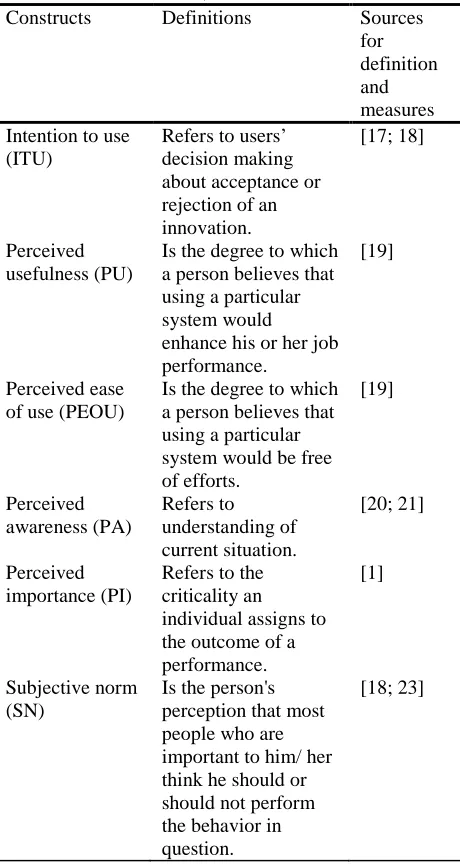
Table 1shows the sources and definitions for the measures used in the research.
Table 1. Constructs, Sources and Definitions
Constructs Definitions Sources for definition and measures Intention to use
(ITU)
Refers to users’ decision making about acceptance or rejection of an innovation.
[17; 18]
Perceived usefulness (PU)
Is the degree to which a person believes that using a particular system would enhance his or her job performance.
[19]
Perceived ease of use (PEOU)
Is the degree to which a person believes that using a particular system would be free of efforts.
[19]
Perceived awareness (PA)
Refers to understanding of current situation.
[20; 21]
Perceived importance (PI)
Refers to the criticality an individual assigns to the outcome of a performance.
[1]
Subjective norm (SN)
Is the person's perception that most people who are important to him/ her think he should or should not perform the behavior in question.
[18; 23]
3.3 Data Analysis and Findings
Prior to collecting the data, a pilot test was conducted. A total of 30 IT employees of the company participated in the pilot test. SPSS version 16 was used to run the analysis. The pilot test results
show that the Cronbach’s alpha (α) for all measures is greater than 0.70 [24]; suggesting reliable measures for all constructs. Therefore, no measure was omitted for the final data collection purpose. A remaining total of 120 survey questionnaires were distributed. A total of 76 were received but only 100 were used in the final analysis. The data for the pilot study were combined with the subsequent final phase of data collection. Table 2 shows the profile of respondents.
Table 2. Profile of respondents
Profile of respondents Percentage
Gender Male 54
Female 46
Total 100
Age 20-29 36
30-39 43
40-49 20
Missing 1
Total 100
Education Bachelor 46
Master 52
Doctorate 2
Total 100
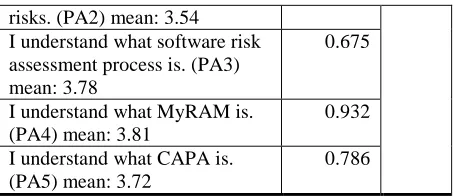
Factor analysis was run separately for independent and dependent variables. Table 3 show the results of factor analysis using principal component with Varimax rotationand results of reliability analysis.
Table 3. Factor analysis and reliability analysis
Measures / code / mean Factor loading
α
Intention to use (overall mean score: 3.49)
It is worth to use MyRAM and CAPA in software development. (ITU1) mean: 3.91
0.865 0.861
In developing software, I will frequently use MyRAM and CAPA. (ITU2) mean: 3.67
0.841
I will strongly recommend others to use MyRAM and CAPA when developing software. (ITU3) mean: 3.08
0.840
When developing software, I plan to use MyRAM and CAPA. (ITU4) mean: 3.30
0.838
Perceived usefulness(overall mean score: 3.43)
Using MyRAM and CAPA improves my performance in assessing software development risks. (PU1) mean: 3.46
0.764 0.880
In software development, using MyRAM and CAPA enhances my effectiveness in assessing software development risks.
(PU2) mean: 3.38
Using MyRAM and CAPA improves the quality of software development risk assessment. (PU3) mean: 3.33
0.885
Overall, I find using MyRAM and CAPA useful in assessing software development risks. (PU4) mean: 3.55
0.823
Perceived ease of compliance (overall mean score: 3.68)
MyRAM and CAPA are easy for me to comply to. (PEOU1) mean:3.51
0.890 0.879
I find it is easy to comply toMyRAM and CAPA. (PEOU2) mean: 3.43
0.894
It would be easy for me to become skilful at complying to both MyRAM and CAPA. (PEOU3) mean: 3.85
0.747
Overall, I find MyRAM and CAPA as software development risk assessment tool easy to comply to. (PEOU4) mean: 3.92
0.654
Subjective norm(overall mean score: 3.48)
Most people (e.g. my team members, colleagues) who are important to me would think that I should use MyRAM and CAPA. (SN1) mean: 3.48
0.850 0.895
The organisation that I work for would think that I should use MyRAM and CAPA. (SN2) mean: 3.53
0.817
My superior and/or sponsor who influence(s) my behaviour would think that I should use MyRAM and CAPA. (SN3) mean: 3.44
0.826
Perceived importance(overall mean score: 3.40)
For me personally, in my job, MyRAM and CAPA are important. (PI1) mean: 3.42
0.835 0.899
For me personally, in my job, MyRAM and CAPA are relevant. (PI2) mean: 3.41
0.837
For me personally, in my job,MyRAM and CAPA are needed. (PI4) mean: 3.28
0.816
For me personally, in my job, MyRAM and CAPA are essential. (PI3) mean: 3.48
0.780
Perceived awareness(overall mean score: 3.70)
I understand what software development risks are. (PA1) mean: 3.64
0.894 0.824
I understand the procedure to deal with software development
0.889
risks. (PA2) mean: 3.54 I understand what software risk assessment process is. (PA3) mean: 3.78
0.675
I understand what MyRAM is. (PA4) mean: 3.81
0.932
I understand what CAPA is. (PA5) mean: 3.72
0.786
The cut-off point for factor loading is 0.55 based on a sample size of 100 [24]. All measures loaded onto the hypothesized constructs although for perceived awareness, measures loaded onto two factors. Because the two factors were correlated, they were regarded as a similar construct.All measures Cronbach’s alpha (α) were greater than 0.70 indicating reliable measures A correlation analysis was consequently run using summated scale (Table 4).
Table 4. Correlation analysis results
ITU PU PEOU SN PI PA
ITU 1
PU 0.808** 1
PEOU 0.708** 0.491** 1
SN 0.591** 0.565** 0.483** 1
PI 0.699** 0.711** 0.390** 0.626** 1 PA 0.845** 0.774** 0.546** 0.596** 0.641** 1
Correlation is significant at the 0.01 level (2-tailed)
Based on Table 4, all factors under investigation are positively correlated to each other.
4 Conclusion
The exploratory research sets out to answer two research questions: (1) What is the acceptance of MyRAM and CAPA among IT professionals? (2) Do subjective norm, perceived awareness and perceived importance correlate to risk assessment framework acceptance? Consequently, 12 hypotheses were proposed and the results show that all hypotheses were supported.
In answering the second research question, the results of factor analysis and reliability analysis similarly suggest that all measures for subjective norm, perceived importance, perceived awareness perceived usefulness, perceived ease of compliance and intention to use were valid and reliable. There is evidence to support that people who matter to IT professionals at the workplace will promote the professionals’ acceptance of the risk assessment framework. With awareness and perception of importance of the assessment framework, it may be inferred that they are likely to use it.
The TAM and TRA have been around for more than two decades. Yet they have shown the ability to explain the context of IT professionals’ acceptance of risk assessment framework that have been implementedsince the last two years. This sheds new light in its application amidst new business models, explosive growth of the Internet, new business focus of software companies and complexities that have surfaced out of innovations.
The findings lend practical support to software companies desirous of implementing innovations at the workplace. To begin with, companies may consider specific awareness programs for employees that emphasize on the importance of such risk assessment methodology as a discipline. Only when employees are aware and perceive its importance, are they likely to accept it. As employees look up to others for personal gratification, companies may consider developing a culture where employees use others as a reference point in adopting innovations.
Limitations exist for the research.The data was collected on a convenient basis at a particular software company and in Malaysia. Future research may explore other companies and in countries other than Malaysia.
Acknowledgement
The researchers express utmost appreciation to all research participants of the company.
References:
[1] C. López and J. L. Salmeron, Risks response strategies for supporting practitioners decision-making in software projects, Procedia Technology, Vol. 5, 2012, pp. 437-444.
[2] J. Evans and R. Mahanti, Critical success factors for implementing statistical process control in the software industry,
Benchmarking: An International Journal, Vol. 19, No. 3, 2012, pp. 374-94.
[3] R. N. Charette, Software Engineering Risk Analysis and Management, McGraw-Hill Software Engineering Series, 1996.
[4] D. Rubinstein, Standish Group Report: There is Less Development Chaos Today, 2007,
(available at http://pdd.citsolutions.edu.au/Clients/DOGPM/
documentation/Standish_Group_Chaos_Article _2006.pdf.pdf)
[5] S. Thomas and M. Bhasi, Software
development project risk: a second order factor model validated in the Indian context, International Journal of Information Technology Project Management, Vol. 3, No. 4, 2012, pp. 41-55.
[6] K. D. Prasanta, K. Jason and O. Stephen, Managing risk in software development projects: a case study, Industrial Management & Data Systems, Vol. 107, No. 2, 2007, pp. 284-303.
[7] B. W. Boehm, (1991). Software risk
management: principles and practices, IEEE Software, Vol. 8, No. 1, pp. 32-41.
[8] S. Zardari, Software risk management, Proceedings of the International Conference on Information Management and Engineering, 2009, pp. 375-379.
[9] H. Barki, S. Rivard, and J. Talbot, Toward an assessment of software development risk, Journal of Management Information Systems, Vol. 10, No. 2, 1993, pp. 203-225.
[10][10] F. D. Davis, R. P. Bagozzi, and P. R. Warshaw, User acceptance of computer technology: a comparison of two theoretical models, Management Science, Vol. 13, No. 8, 1989, pp. 982-1003.
[11]C. Chittister and Y. Y.Haimes, Assessment and management of software technical risk, IEEE Transactions on Systems, Man and Cybernetics, Vol. 24, No. 2, 1994, pp. 187-202.
[12]D. Gupta and M. Sadiq, Software risk assessment and estimation model, Proceedings of the International Conference on Computer Science and Information Technology (ICCSIT), 2008, pp. 963-967.
[13]R. P. Kendall, D. E. Post, J. C. Carver, D. B. Henderson and D. A. Fisher, (2007). A Proposed Taxonomy for Software Development Risks for High-performance Computing, 2007, (available at
[14]M. Sadiq, M. K. I. Rahmani, M. W. Ahmad and S. Jung, Software risk assessment and evaluation process (SRAEP) using model based approach. Proceedings of the International Conference on Networking and Information Technology (ICNIT), 2010, pp. 171-177.
[15]The Malaysian Administrative Modernisation and Management Planning Unit (MAMPU), Risk Assessment Guideline, 2010, (available at http://www.mampu.gov.my/pdf/surat_arahankp 24nov10/SAMPEL%20DOKUMEN%20ISMS/ Sampel%20dokumen%20P1/RA%20Guideline %20(MAMPU-BPICT-ISMS-P1-008).pdf). [16]A. F. Dareshuri, E. F. Darehshori, A. H.
Hardoroudi and H. M. Sarkan (2011). Implementing corrective and preventive actions in risk assessment software, Proceedings of the IEEE Conference on Open Systems (ICOS), 2011, pp. 327-331.
[17]A. Ezamly and B. Hussin, Estimating quality-affecting risks in software projects, International Management Review, Vol. 7, No. 2, 2011, pp. 66-83.
[18]M. Fishbein and I. Ajzen, Belief, Attitude, Intention, and Behavior: An Introduction to Theory and Research, Addison-Wesley, 1975. [19]F. D. Davis, Perceived usefulness, perceived
ease of use, and user acceptance of information technology, MIS Quarterly, Vol. 13, No. 3, 1989, pp. 319–339.
[20]M. Endsley, Toward a theory of situation awareness in dynamic systems, Human Factors, Vol. 3, No. 1, 1995, pp. 32–64.
[21]R. Mejias, An integrative model of information security awareness for assessing information systems security risk, Proceedings of the 45th Hawaii International Conference on System Sciences, 2012, pp. 3258-3267.
[22]R. Agarwal and J. Prasad, The role of innovation characteristics and perceived voluntariness in the acceptance of information technologies, Decision Sciences, Vol. 28, No. 3, 1997, pp. 557-82.
[23]I. Ajzen, From intentions to actions: A theory of planned behavior, in J. Kuhl and J. Beckman (Eds.), Action-control: From Cognition to Behavior, Springer, 1985, pp. 11-39.
![Fig. 1 Theory of Reasoned Action[14]](https://thumb-us.123doks.com/thumbv2/123dok_us/1369747.1169712/2.595.66.270.374.586/fig-theory-of-reasoned-action.webp)