GE-International Journal of Management Research
Vol. 4, Issue 11, November 2016 Impact Factor- 5.779 ISSN(O): 2321-1709, ISSN(P): 2394-4226
© Associated Asia Research Foundation (AARF)
Website: www.aarf.asia Email : [email protected] , [email protected]
A THEORETICAL FRAMEWORK FOR UNDERSTANDING CONSUMER
BEHAVIOR TOWARDS SMARTWATCHES
Dr. P. Kishore Kumar
Associate professor, Department of Management SVS Group of Institutions Warangal Urban Telangana, India
ABSTRACT
The paper is about proposal of specific consumer behavior model towards smartwatches.
The theoretical framework was developed in the paper and propositions are explained based on
the model. The measurement scale is developed based on the proposed model and future
researchers can use it for testing the model empirically. The popular research models were
reviewed and finally a model was proposed in this paper. The dependent variables are attitude
and purchase intention. The independent variables are subjective norms, usefulness, ease of use,
price and internet usage. The proposed model helps the academicians and researchers in
marketing field.
Keywords: smartwatch, smartphone, attitude, consumer behavior, purchase intention.
INTRODUCTION
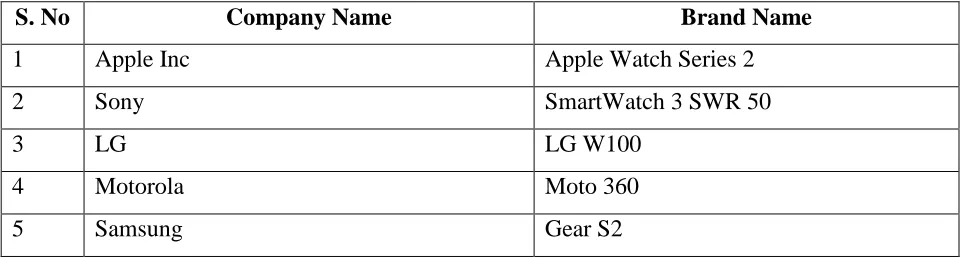
Table 1: List of selected brands of smartwatches
S. No Company Name Brand Name
1 Apple Inc Apple Watch Series 2
2 Sony SmartWatch 3 SWR 50
3 LG LG W100
4 Motorola Moto 360
5 Samsung Gear S2
(Source: Compiled by the researcher)
RESEARCH OBJECTIVES
1. To propose a consumer behavior model for studying consumer behavior towards Smartwatches.
2. To develop a measurement scale with regard to consumer behavior model in this study
REVIEW OF LITERATURE
Chuah et al (2016) had explained that perceived usefulness and visibility as important factors that drive adoption intention of smart watches. Further smartwatches represent a type of ‘fashnology’ a new term which is combination of fashion and technology (Chuah, Rauschnabel, Krey, Nguyen, Ramayah, & Lade, 2016). The technology acceptance model (TAM) had been adopted and modified while understanding consumer behavior towards smart watches.
RESEARCH METHODOLOGY
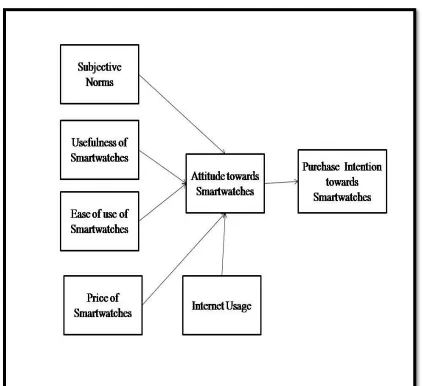
[image:3.612.93.515.257.643.2]The present study is based on secondary data. The dependent variables and independent variables which are considered by earlier researchers are reviewed. The consumer behavior models with regard to innovative, electronic and technological products are reviewed from journals and books etc. The items for each variable are adopted and modified from previous research works. The independent variables in this study are subjective norms, usefulness, ease of use, price and internet usage. The dependent variables in the proposed model are attitude and purchase intention. The propositions based on the theoretical model are also explained in this paper.
SCOPE OF THE STUDY
The proposed model in the study considers five independent factors and two dependent factors. The impact of demographic variables on the dependent variable is not considered in the model. The proposed only is only suitable for smartwatches from the perspective of consumer behavior. The purchase behavior is not considered in the present study because it new and innovative product in the present era. However the purchase intention can be considered as positive purchase behavior.
Proposition 1: The subjective norms positively influence the attitude of consumers towards
Smartwatch.
Proposition 2: The usefulness of smart watches creates positive impact on attitude of consumers
towards Smartwatch.
Proposition 3: If Smartwatches are easy to use (user-friendly) then consumers create positively
attitude towards it.
Proposition 4: If Smartwatches are available at reasonable price then consumers like it.
Proposition 5: If consumers’ usage of internet is more then they develop positive attitude
towards Smartwatch
Proposition 6: The consumers who have positive attitude towards Smartwatch develop positive
Table 2: Proposed Measurement Scale for Collecting Primary Data towards Smartwatch
Construct Items Source of Items
Subjective Norms
1. In order to complete my personal and professional works I need to use Smartwatch
2. Most people who are important to me think that I should use Smartwatch 3. My family expects me to use Smartwatch
(Schielke & Altobelli, 2012)
Usefulness 1. Smartwatch is more useful electronic gadget. 2. Smartwatch would help me in many ways. 3. I can complete many tasks using smartwatch
Suggested by experts
Ease of Use 1. I believe smartwatch is easy to use.
2. Using smartwatch for checking notifications and messages etc is easy. 3. It is easy to become skillful in using Smartwatch
(Park, 2009)
Price 1. Overall, I think the Smartwatch will be a good value for the money. 2. If I buy the Smartwatch when it becomes available, I will be getting my money’s worth.
3. If I buy the Smartwatch when it becomes available, I will be getting a smartwatch for a reasonable price.
(Taylor & Bearden, 2002)
Internet Usage
1. I use the Internet quite often for personal use
2. I spend a lot of time on the Internet for personal use.
3. I have been using the Internet for personal use for a very long time now
(Porter & Donthu, 2006)
Attitude 1. I believe that Smartwatches are more useful compared to traditional watches
2. Smartwatches features appeal more than traditional wrist watches 2. I like Smartwatch
(Soyez, 2012)
Purchase Intention
1. If I have to buy watch, I will purchase Smartwatch
2. In future I will give priority for Smartwatch while purchasing an electronic product.
3. I am interested to purchase Smartwatch
DISCUSSION
In this paper a customized consumer behavior model was developed to study about behavior of consumers towards smartwatch. The popular models like Technology Acceptance Model (TAM), Theory of Reasoned Action (TRA) and Theory of Planned Behavior (TPB) were reviewed and the model in the Figure 1 was developed. There are seven constructs in the proposed model and items for each construct were mentioned in the Table 2. All the items under each construct were adopted and modified from published research papers. All the items need to be measured on 5 point Likert-type scale anchored from ‘5’ for Strongly Agree to ‘1’ for Strongly Disagree. The association between dependent variables can be rested by using different statistical tools like correlation, regression and descriptive statistics.
LIMITATIONS
Due to lack of time the proposed model was not empirically tested. There can be many other independent factors like perception and knowledge etc which may influence the attitude and purchase intention towards smartwatches. But all those factors are not considered in the present study.
FUTURE RESEARCH
The present study is about proposal of consumer behavior model towards smartwatches. The model can be used by researchers and test it empirically. Some more relevant variables can be added to the proposed model and research can be conducted in future. Longitudinal studies can be conducted in future to know the trends in consumer behavior towards smart watches.
REFERENCES
Chuah, S. H.-W., Rauschnabel, P. A., Krey, N., Nguyen, B., Ramayah, T., & Lade, S. (2016). Wearable technologies: The role of usefulness and visibility in smartwatch adoption. Computers in Human Behavior, 65, 276-284.
Jeong, S. C., Kim, S.-H., Park, J. Y., & Choi, B. (2016). Domain-specific innovativeness and new product adoption: A case of wearable devices. Telematics and Informatics , http://dx.doi.org/10.1016/j.tele.2016.09.001.
Osman, M. A., Talib, A. Z., Sanusi, Z. A., Shiang-Yen, T., & Alwi, A. S. (2012). A Study of the Trend of Smartphone and its Usage Behavior in Malaysia. International Journal on New Computer Architectures and Their Applications (IJNCAA). 2(1), pp. 275-286. Malaysia: The Society of Digital Information and Wireless Communications.
Park, S. Y. (2009). An Analysis of the Technology Acceptance Model in Understanding University Students' Behavioral Intention to Use e-Learning. Educational Technology & Society, 12 (3), 150-162.
Porter, C. E., & Donthu, N. (2006). Using the technology acceptance model to explain how attitudes determine Internet usage: The role of perceived access barriers and demographics. Journal of Business Research, 59, 999-1007.
Schielke, S., & Altobelli, C. F. (2012). Consumer Greenwashing : Using the Theory of Planned Behaviour to Explain Unethical Consumer Behaviour.
Soyez, K. (2012). How national cultural values affect pro-environmental consumer behavior. International Marketing Review , 623-646.
Taylor, V. A., & Bearden, W. O. (2002). The Effects of Price on Brand Extension Evaluations: The Moderating Role of Extension Similarity. Journal of the Academy of Marketing Science, 30 (2), 131-140.
Wolf, M. (2013, September 26). Smartwatch Market Forecast to Grow From 15 Million in 2014 to 373 Million by 2020. Retrieved November 2, 2016, from Next Market Insights: http://nextmarket.co/blogs/news-1/9278081-smartwatch-market-forecast-to-grow-from-15-million-in-2014-to-373-million-by-2020