Improved Efficient Data Classification Model
for Ensuring Data Security in Cloud
Environment
Meenal Jain, Ashok Verma
Research Scholar, Software System, Dept. of Computer Science and Engg, Gyan Ganga Intt. of Tech. and Science
Jabalpur (M.P.), India
Professor, Computer Science & Engg, Dept. of Computer Science and Engg, Gyan Ganga Intt. of Tech. and Science
Jabalpur (M.P.), India
ABSTRACT: Cloud computing assumes a stimulating job by golf stroke away the knowledge ANd it o.k. could also be masterminded by an outsider. the $64000 disadvantage within the cloud field is protection and security problems. one amongst the first problems is that the data security and protection of knowledge place away and ready at the cloud specialist co-op's frameworks. In spite of each one amongst these administrations given by cloud, it slacks within the real aspect of security. Distributed computing primarily assumes employment within the a part of powerful quality usage and administration utilization. freelance of the type of mists every specialist organizations focuses on the knowledge abode in cloud servers. Be that because it might, shoppers still have vital security and protection worries regarding their re-appropriated data as a results of conceivable unapproved access within the specialist organizations. this arrangements inscribe all information utilizing the distinctive key size while not mulling over the privacy dimension of data. during this analysis, we tend to propose a protected distributed computing model addicted to data order. The projected cloud model limits the overhead and getting ready time expected to safeguard information through utilizing numerous cryptography elements with variable key sizes to grant the correct secrecy level needed for the knowledge. during this exploration, a secure distributed computing model addicted to data grouping is projected. The increasing volume of individual and crucial information raises a lot of spotlights on golf stroke away the knowledge safely. data will incorporate basic shopper knowledge, vital reports, and alternative client's connected substance for arrangement of client's data. characterised data are disorganized by utilizing numerous AES cryptography calculations like AES 128, AES 192 and AES 256. finally disorganized data are place away distinctive style of cloud model as indicated by their information classification. The projected model is tried with numerous metric, informational collections and cryptography calculations. Re-enactment results incontestible the responsibility and proficiency of the projected structure.
KEYWORDS: Cloud Computing; Data Security, Secure Cloud Storage, Encryption, Cryptography, Multilevel Data Classification, AES
I. INTRODUCTION
encourage information sharing among clients and synchronization of different gadgets. Be that as it may, there is indispensable information that is prepared and put away in the cloud frameworks. Losing or uncovering this important information will have colossal terrible effect on the information proprietors being people or associations. Thus, there is an expanding request to secure information over the cloud frameworks. Clients dread from transferring private and secret documents to the online reinforcement because of worries that the specialist organization may utilize them improperly. Adding to that, there are worries about their information being hacked and bargained because of the spread of distributed storage fruitful assaults. Treating the low and high secret information by a similar route and at a similar security level will include pointless overhead and increment the handling time.
1.1 Characteristics of Cloud Computing
NIST further specifies that cloud computing exhibits the following five characteristics in its operation
On-Demand Self Service
Broad Network Access
Measured Service
Rapid Elasticity
Resource Pooling
Figre 1.1 Characteristics of Cloud Computing
i. On demand Self Service
On interest self-administration implies that clients can get to the functionalities and administrations without reliance. Customer can give abilities of processing, for example, server time; arrange capacity, programmed Information Technology (IT) assets that require no human collaborations. The client can likewise change or trim the functionalities and arrangement its offices dependent on the client's needs.
ii. Broad Network Access
This implies assets can be gotten to in stages like cell phones, workstation, and work area from any far (remote) area over the system. Organizations incline toward private cloud administration since they will be applicable about their data spills in external territory.
iii. Measured Service
iv. Rapid Elasticity
Quick flexibility is one of the fundamental key qualities of distributed computing, where the capacities can be flexibly orchestrated and discharged naturally dependent on the internal and outward on relating request. At the end of the day, the client can increment or decline the product necessities as per his need which will be cost effective.
v. Resource Pooling
The assets of cloud are pooled and exhibited to more than one client suing the Multi-Tenant Model. This Multi-Tenant model caused the client to have a similar corporal equipment to more people so the client to can utilize the product with less budgetary expenses. Numerous mirror duplicates are put away and reflecting procedure is done to diminish the loss of information [2].
II. DATA SECURITY ISSUES OR CHALLENGES
In big business figuring, information is put away inside their association and it is completely under the control of the venture [5]. In distributed computing, the information is put away outside the client's place (in the CSP's side). Thus, distributed computing must utilize extra safety efforts separated from the customary security checks to guarantee that information is sheltered and no information breaks because of security vulnerabilities.
2.1. Data Security Basics
There are six phases in the existence cycle of information: Create Store, Use, Share, Archive and Destroy. When the information is made, it can move openly between any stages. Information ought to be verified in every one of an amazing phase’s cycle from its creation to its annihilation. One of the disregarded issues is information after-erase [1] and this is additionally called as information remanence.
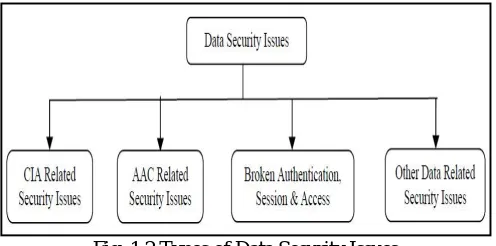
Fig. 1.2 Types of Data Security Issues
2.2. Security Challenges in the CIA Triad
Privacy, Integrity and Availability (CIA) misfortunes can have a major effect in the matter of the distributed computing in light of the fact that the information is the canter part for any business. Information honesty is the confirmation given to the computerized data is uncorrupted and just be gotten to by those approved clients. In this way, uprightness includes keeping up the precision, consistency and dependability of information over its whole life cycle [6].
2.3 Security Challenges in the Authentication and Access Control (AAC)
Validation and Access Control (AAC) is the procedure of check and affirmation on client's personality to interface, to access and utilize the cloud assets. In big business processing, the accreditations are put away in the server as Active Directory (AD) or Lightweight Directory Access Protocol (LDAP). AAC security challenges:
• Multi-factor verification can be utilized which empowers both character and access the board and it is utilized Amazon Web Services (AWS).
• Biometric verification can possibly be the most secure type of single-sign-on validation.
• RSA cryptosystem can be embraced which can acknowledge diverse validation models like two-factor verification, information based confirmation and versatile validation. The above strategies are extremely successful for information insurance in distributed computing.
• Intrusion Detection System (IDS), firewalls just as isolation of commitments can be executed on the distinctive system and cloud layers to empower legitimate access control in distributed computing for better information assurance.
• There are some outsider personalities the executive’s arrangements in the market. Utilize some outsider arrangements like Microsoft Azure Active Directory, Okta character the board, McAfee cloud personality chief, and so forth. As of late, Identity-Management-as-a-Service (IDaaS) arrangements are getting increasingly mainstream in the corporate framework.
• Cloud applications should utilize open principles where relevant, for example, Security Assertion Markup Language (SAML), a XML-based OASIS (Organization for the Advancement of Structured Information Standards) open standard for trading validation and approval information between security spaces and Open Authorization (OAuth), an open standard for approval, enabling clients to share their private assets utilizing tokens as opposed to qualifications.
2.4. Other Data Related Security Issues
Other minor information related security issues can happen through Data area, Multi-occupancy and Backup in distributed computing. Coming up next are a portion of the strategies to defeat other information related security issues: • CSC should know the sensible and the physical area of the information if not in any event which state, nation and server farm because of all the potential administrative, authoritative and other jurisdictional issues.
• Establish area and jurisdictional strategies to administer the information area.
• Adopt clever information isolation strategies to isolate the information from various clients. • Use solid encryption procedures for the reinforcement information to dodge information spillage.
III. DATA CLASSIFICATION
Information grouping is a productive strategy to ensure the information as indicated by its significance and affectability. In this area, we present four order levels (high, medium, low, ordinary) as per the diverse degree of the potential side impact on authoritative activities, institutional resources, or people.
Confidentiality: A shortage of privacy is the unauthorized leak of data.
Integrity: A scarcity of integrity is the unauthorized alteration or damage of data
Availability: A scarcity of availability is the commotion of access to or use of data.
3.1 High sensitivity
On the off chance that the missing of CIA of information is foreseen to have a serious or damaging symptom, the grouping of information is high affectability. Genuine or dangerous outcomes show, for example: (I) The serious reduction or loss of mission capacities results in the association losing its capacity to satisfy its essential capacity. (ii) Serious harm to design resources. (iii) Significant budgetary misfortune. or on the other hand (iv) r Serious or disastrous harm to people. Instances of high affectability information incorporates yet not constrained:
1) Core business data: Core business data is the unmistakably significant data for association, the loss of which is significant on the mission, money related, notoriety, etc. For instance:
a) The mid-long haul improvement projects and exceptional plans b) Safety insurance conspire
2) Personal delicate data: Personal touchy data is firmly identified with individual rights or interests, the exposure or maltreatment of which may imperil property security and life, unfriendly effect on close to home notoriety, prompting prejudicial treatment and other delicate data. For instance:
a) Identification card number, international ID number, and so on. b) Credit/check card data and financial balance data
c) Protected Health Information
d) Electronic marks, biometric data, secret word data, and private encryption keys e) Criminal foundation.
3) Industry-explicit touchy data: From viewpoint of national security, some Industry-explicit delicate data, for example, oil, gas, coal and power plant related data ought to be ensured carefully. For instance:
a) Oil and gas creation data
b) Petrochemical industry significant creation materials import plan and outside trade sum c) Distribution of Urban Power Network Pipeline
d) Power transmission and change gear unwavering quality parameter.
3.2 Medium sensitivity
At the point when the loss of information of CIA is foreseen to have a genuine symptom, the characterization of information is medium affectability. An extreme symptom demonstrates that, for example:
(i) The noteworthy reduction of mission capacities to satisfy its essential capacity and the adequacy of the capacities is decreased
(ii) Substantial harm to institutional resources; (iii) Substantial budgetary misfortune; or
(iv) Huge harm to people that includes neither under mortality nor lethal wounds. Instances of medium affectability information incorporate however not constrained:
1) Important business data:
Significant business data is the data the loss of which will result in genuine antagonistic effect on the mission, monetary, notoriety, etc. For instance:
a) Important pointer of advertising activities
b) Operation observing centre markers and operational information c) Computer programming source code
d) Important business understandings or contracts and the applicable data
2) Personal typical data:
Individual data b(Personal data is data that is recorded electronically or something else, which can be utilized alone or in mix with other data to recognize natives, including however not constrained to residents' names, birth dates, character report numbers, individual biometric data, phone number, etc.) is partitioned into individual touchy data and individual typical data. Therefore, if individual data isn't touchy, it might be typical data. For the most part, individual typical data can't distinguish an individual alone, yet in blend with other data together.
a) Email address or substance b) Phone number, place of residence
c) Information used to approve personality, for example, name, date of birth, mother's name, and so on. d) Other data not named as delicate data (organize client account, race, ethnicity, conjugal status).
3.3 Low sensitivity
At the point when the loss of information of CIA is foreseen to have a constrained reaction, the characterization of information is low affectability. A constrained reaction demonstrates that, for example:
(ii) Negligible harm to institutional resources; (iii) Trivial money related misfortune; or (iv) Minor harm to people.
1) Normal business data:
Typical business data is the data the loss of which will result in restricted unfavorable effect on the mission, monetary, notoriety, etc. For instance:
a) Company address book
b) Final records and review report PC of ventures
c) Important business understandings or contracts and the significant data d) Employee execution survey data
2) Personal administration data:
Individual administration data is the information and substance data that the association gathers in the administration procedure with individual security qualities. For instance:
a) Payment recodes, for example, gas, power, cell phone bill, and so on. b) Device data, for example, Meter, power gathering terminal
c) Service content data, for example, business charges, client value program, client value methodology, and so forth.
3.4 Normal sensitivity
In the event that information is relied upon to be open, the arrangement of information is ordinary affectability. The greater part of the data from the web is typical delicate data.
IV. PROPOSED METHODOLOGY
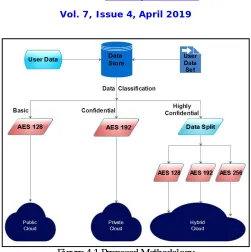
Figure 4.1 Proposed Methodology
Figure demonstrates the three sorts of attributes on which information must be characterized and in like manner security contemplations can be connected. Information grouping approach can be considered and its adequacy can be dictated by re-enacting on an example informational collection. Re-enacting the order of information dependent on close to home informational collection is broke down. Individual information components like name, addresses and so forth are taken as the example. We have utilized the emotional criteria to order them and in like manner security arrangements for the capacity and interchanges can be joined.
4.1 Execution Steps of Proposed Methodology
Step 1 – User data is stored in local data storage.
Step 2 – A user data set which is a set of user’s information (like user’s name, date of birth, address, Aadhar number, Driving License Number, Area PIN number, Favorite sports, Favorite Color, School name, University Name etc.. ) is stored in local level for data classification scheme.
Step 3 – Data Classification will take place for separation of user data according to data set which was provided by user at the time of registration.
Step 4 – Data will be classified as Basic Data, Confidential Data and Highly Confidential Data by using Data Set.
Step 5 – Now data will be encrypted by using Advanced Encryption Standard (AES) Encryption
technique:-
I. Basic type of data will be encrypted by AES-128. II. Confidential type of data will be encrypted by AES-192.
III. Highly Confidential type of data splits in 3 parts, First part will be encrypted by AES-128, Second part will
be encrypted by AES-192, and Third part will be encrypted by AES-256.
Step 6 – After encryption, Basic type of data will be stored in Public Cloud, Confidential type of data will
V. IMPLEMENTATION AND RESULTS
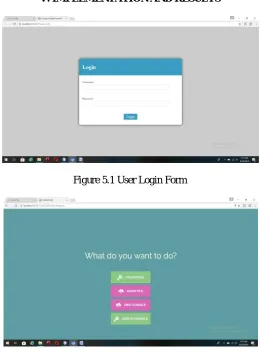
Figure 5.1 User Login Form
Figure 5.2 Options for File Operations
Figure 5.4 Show uploaded file in public cloud environment
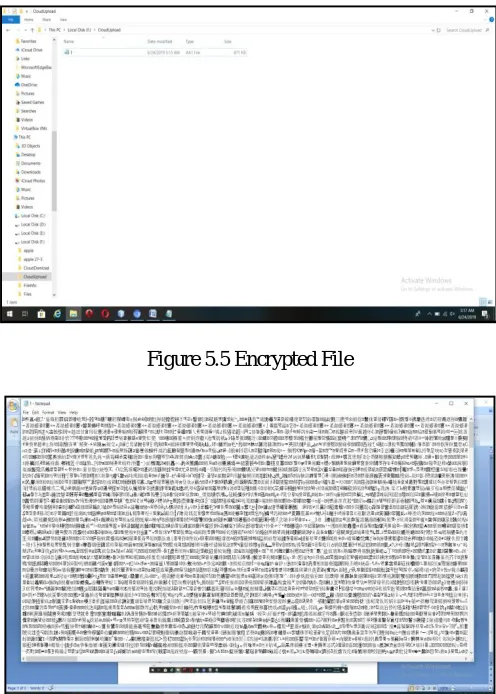
Figure 5.5 Encrypted File
Figure 5.7 AES 128bit Encrypted file’s information file
Figure 5.8 Showing total executions overhead in public cloud
Figure 5.21 Google Drive cloud environment for Public cloud and Hybrid Cloud
5.1 COMPARISON
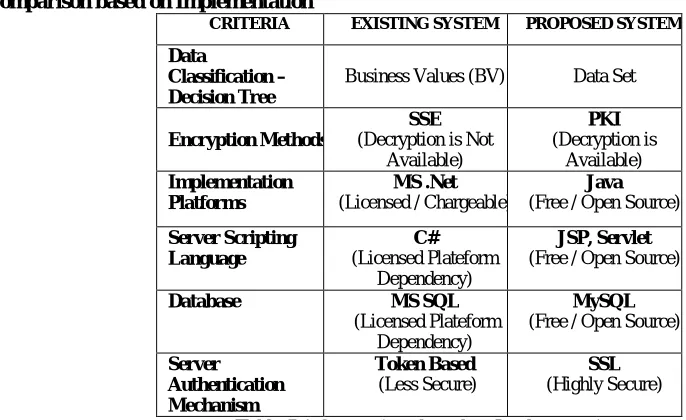
Comparison between Existing system and proposed system.
5.1.1 Comparison based on Implementation
CRITERIA EXISTING SYSTEM PROPOSED SYSTEM
Data
Classification – Decision Tree
Business Values (BV) Data Set
Encryption Methods
SSE (Decryption is Not
Available) PKI (Decryption is Available) Implementation Platforms MS .Net (Licensed / Chargeable)
Java (Free / Open Source)
Server Scripting Language C# (Licensed Plateform Dependency) JSP, Servlet (Free / Open Source)
Database MS SQL
(Licensed Plateform Dependency)
MySQL (Free / Open Source)
Server Authentication Mechanism Token Based (Less Secure) SSL (Highly Secure)
Table 5.1 Comparison based on Implementation
5.2.2 Comparison based on Results and Output
Cloud Type Existing System (Overhead)
Proposed System (Overhead)
Private Cloud 1 0.9
Public Cloud 0.7 0.6
Hybrid Cloud 0.4 0.38
VI. CONCLUSION
The fundamental point of research is to group the information proficiently and secure that information relying on the security components of the information. This will isolate information into Basic, touchy and exceedingly delicate by improved arrangement system dependent on informational index grouping with information security. In this exploration, AES encryption strategies is utilized with AES-128, AES-192 and AES-256 security standard which gives better information security on arranged information contrasted and existing usage. Open source systems are utilized for usage which is savvy moreover. Distinctive cloud condition like Private Public and Hybrid cloud are executed and utilized for information stockpiling in this exploration. Complete framework is tried with various running conditions and informational indexe. All outcomes and testing demonstrates that the proposed framework is increasingly proficient and secure.
In our future work, focus on the experimental evaluation of the proposed architecture and the test assessment of the proposed engineering and the appraisal of the forecast precision at scale. Additionally investigate the utilization of dispersed AI calculations for this application and evaluate them grouping exactness with progressively secure encryption calculations for better information security.
REFERENCES
[1]. Uma Somani, Kanika Lakhani, Manish Mundra, “Implementing Digital Signature with RSA Encryption Algorithm to Enhance the Data Security of Cloud in Cloud Computing”, 2010 1st International Conference on Parallel, Distributed and Grid Computing (PDGC - 2010), ©2010 IEEE.
[2]. Mr. Prashant Rewagad, Ms.Yogita Pawar, “Use of Digital Signature with Diffie Hellman Key Exchange and AES Encryption Algorithm to Enhance Data Security in Cloud Computing”, 2013 International Conference on Communication Systems and Network Technologies, © 2013 IEEE. [3]. Kumar Pal Singh, Dr. Vinay Rishiwal, “Classification of Data to Enhance Data Security in Cloud Computing”, © 2018 by IEEE.
[4]. Vanya Diwan, Shubhra Malhotra,Rachna Jain, “ Cloud Security Solutions: Comparison among Various Cryptographic Algorithms”, © 2014, IJARCSS.
[5]. Gitanjali, Dr. Kamlesh, “Securing Big Data Over Cloud Using Classification and Encryption Techniques”, IJRECE VOL. 6 ISSUE 2 APR-JUNE 2018.
[6]. Rizwana Shaikh, Dr. M. Sasikumar, “Data Classification for achieving Security in cloud computing”, Procedia Computer Science 45 ( 2015 ) 493 – 498, ScienceDirect.
[7]. Lo’ai Tawalbeh , Nour S. Darwazeh, Raad S. Al-Qassas2 and Fahd AlDosari, “A Secure Cloud Computing Model based on Data Classification”, Procedia Computer Science 52 ( 2015 ) 1153 – 1158, ScienceDirect.
[8]. Amiza Amir, Bala Srinivasan and Asad I Khan,” A Communication-Efficient Distributed Algorithm for Large-scale Classification within P2P Networks”, SoICT 2015, December 03-04, 2015, Hue City, Viet Nam c 2015 ACM. ISBN 978-1-4503-3843-1/15/12.
[9]. Tina Francis, Dr. Muthiya Madiajagan and Dr. Vijay Kumar, “Privacy Issues and Techniques in E-Health Systems”, SIGMIS CPR ’15, June 4–6, 2015, Newport Beach, California, USA.
[10]. Spyridoula Lakka, Christos Michalakelis, Teta Stamati and Dimosthenis Anagnostopoulos, “A framework for the classification of Could Computing Business Models”, PCI 2015, October 01-03, 2015, Athens, Greece © 2015 ACM. ISBN 978-1-4503-3551-5/15/10.
[11]. Fara Yahya, Robert J Walters, Gary B Wills, “Protecting Data in Personal Cloud Storage with Security Classifications”, Science and Information Conference 2015.
[12] Lei Ding, Malek Ben Salem, “A Novel Architecture for Automatic Document Classification for
Effective Security in Edge Computing Environments”, 2018 Third ACM/IEEE Symposium on Edge Computing.
[13] Miraj Hossain, Md. Rafiqul Islam, “A Model for Ensuring Data Security to Distributed Financial System in Cloud Storage”, A Model for Ensuring Data Security to Distributed Financial System in Cloud Storage.
[14] Rasmeet Kour, Suparti Koul, Manpreet kour, “A Classification Based Approach For Data Confidentiality in Cloud Environment”, 2017 International Conference on Next Generation Computing and Information Systems (ICNGCIS).