Ahmed et al. World Journal of Engineering Research and Technology
PERFORMANCE ANALYSIS OF MULTI-LEVEL ALGORITHM FOR
DATA STORAGE SECURITY IN CLOUD COMPUTING
Ismail Ahmed*1 and Rashid Husain2
1
Research Scholar, Department of Mathematics and Computer Science, UMYU, Katsina.
2
Lecturer, Department of Mathematics and Computer Science, UMYU, Katsina.
Article Received on 29/07/2017 Article Revised on 19/08/2017 Article Accepted on 09/09/2017
ABSTRACT
Internet is a public-interacted system in which the amount of
information exchanged over the Internet is completely not safe.
Protecting the information transmitted over the network is a difficult
task and the data security issues become increasingly important. At
present, various types of cryptographic algorithms provide high
security of data on the Internet, but still there are also some drawbacks. To enhance the
strength of these algorithms, designed a Multi-level Algorithm. The algorithm designed using
combination of two asymmetric cryptographic algorithms these two algorithms are
Multi-prime RSA and MD5 algorithm. The performance of Multi-level algorithm analyzed by
comparing it with multi-prime RSA and MD5 cryptographic algorithms in terms of execution
time and memory space.
KEYWORDS: Cryptography, Symmetric, Asymmetric, Multi-Prime RSA, and MD5.
INTRODUCTION
Cloud computing can be considered a new computing paradigm that allows users to
temporary utilize computing infrastructure over the network, supplied as a service by the
cloud-provider at possibly one or more levels of abstraction (Rao, et. al., 2009). The word
cryptography comes from the two Greek words – Crypto meaning secret or hidden and graph
meaning writing. It is the practice and study of hiding information. The term refers to the
science and art of transforming messages to make them secure and immune to attacks. The
wjert, 2017, Vol. 3, Issue 5, 480-487.
World Journal of Engineering Research and Technology
WJERT
www.wjert.org
ISSN 2454-695X Original Article
SJIF Impact Factor: 4.326
*Corresponding Author
Ismail Ahmed
Research Scholar,
Ahmed et al. World Journal of Engineering Research and Technology
schemes used for encryption constitute this area (Forouzan, 2017). There are a number of
cryptographic primitives— basic building blocks, such as block ciphers, stream ciphers, and
hash functions. Block ciphers may either have one key for both encryption and decryption, in
which case they’re called shared key (also secret key or symmetric), or have separate keys for encryption and decryption, in which case they’re called public key or asymmetric (Caesar and
Kennedy, 2017).
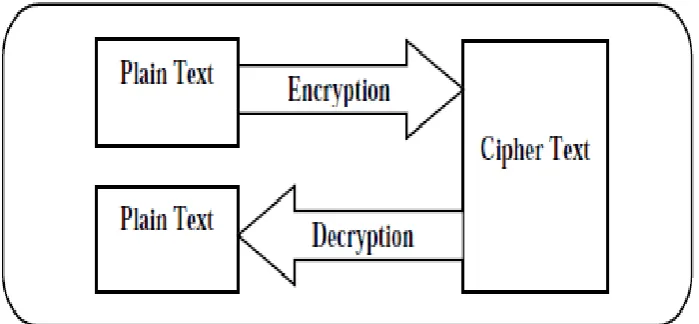
Fig. 1: Simple Cryptosystem.
Categories of Cryptography
The cryptographic algorithms are divided into two groups: symmetric key cryptography
algorithms and asymmetric key cryptography algorithms.
Symmetric Key Cryptography
In a symmetric key cryptography, the same key is used by both the parties. The sender uses
this key and encryption algorithm to encrypt the data; the receiver uses the same key and the
corresponding decryption algorithm to decrypt the data. The key is shared. It is also known as
secret-key cryptography asymmetric (Caesar and Kennedy, 2017). Symmetric algorithms
have the advantage of not consuming too much of computing power and it works with high
speed in encrypting them (Triphathi and Agrawal, 2014). Some of the currently used
cryptographic technologies in symmetric key cryptography are DES (Data Encryption
Standard), IDEA (International Data Encryption Algorithm), Blowfish, RC5 (Rivest Cipher
5), AES (Advanced Encryption Standard), ECC (Elliptic Curve Cryptography) etc (Forouzan,
Ahmed et al. World Journal of Engineering Research and Technology
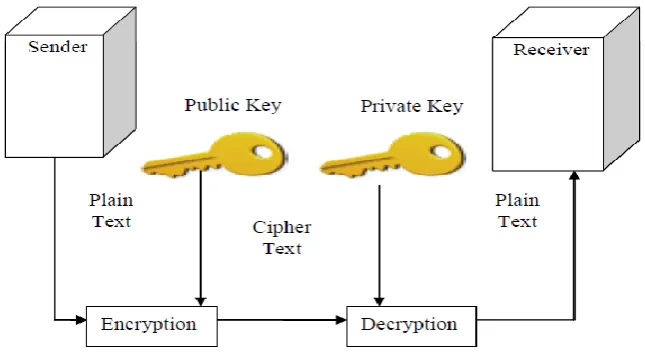
Fig. 2: Symmetric Key Cryptography (Zaren 2011).
Asymmetric Key Cryptography
In asymmetric or public key cryptography, there are two keys: a private key and a public key.
The private key is kept by the receiver. The public key is announced to the public. It is also
known as public-key cryptography (Forouzan, 2017). Asymmetric key encryption is the
technique, in which the different keys are for the encryption and the decryption process. One
key is public (published) and second is kept private. The keys used in public-key encryption
algorithms are usually much longer that improves the security of the data being transmitted
(Triphathi and Agrawal, 2014). Some of the cryptographic algorithms used in asymmetric
key cryptography are RSA (Rivest, Shamir, adleman), DH (Diffie-Hellman Key
Arrangement Algorithm), ECDH (Elliptic Curve Diffie-Hellman Key Arrangement
Algorithm), RPK (Raike Public Key), ElGamal, IES (Integrated Encryption Scheme),
CEILIDIH, MD (Message Disgest Algorithms) etc (Triphathi and Agrawal, 2014).
Ahmed et al. World Journal of Engineering Research and Technology
Multi-Level Cryptographic Algorithm (Ahmed and Husain, 2017)
The Hybrid Cryptographic Algorithm was designed using the combination of two asymmetric
key cryptography algorithms namely; Multi-prime RSA which is among the variants of RSA
algorithm and MD5 which is also among the variants of Message Digest Algorithms. The
designed algorithm consisted of five steps. However, the algorithm is as follows:
Step 1: Key Generation
i.e.
Step 2: Digital Signature
Ahmed et al. World Journal of Engineering Research and Technology
Step 4: Decryption
Step 5: Signature Verification
Performance Analysis of Multi- Level Cryptographic Algorithm
The algorithm was implemented in Java programming language and it was evaluated using
two parameters; Execution time and Memory space.
Execution Time
The execution time considered as the time that the algorithm takes to produces a cipher text
from a plain text. It is commonly calculated by counting the total operations performed by
the system where each operation takes a fixed amount of time. An algorithm performance
time may vary with different input size (Khatoon and Ikram, 2014). Execution time normally
increases as the input size increase. A good algorithm is expected to execute in a very small
period of time
Memory Space
Apart from Execution time, Memory space is also an important measure to judge the
performance of an algorithm. It is the amount of memory which the algorithm needs for
performing its computations. A good algorithm keeps the amount of memory as small as
possible. The way in which the amount of storage space required by an algorithm varies with
Ahmed et al. World Journal of Engineering Research and Technology
Table 1: Execution Time and Memory Space of the Hybrid Algorithm.
Input Size Time
(millisecond)
Memory Space (Kilobyte)
7 0.7 0.39
31 0.9 1.36
169 1.6 5.70
869 2.1 23.90
1238 2.4 40.10
Comparison of Performance between the Multi-Level Cryptographic Algorithm and Existing Algorithms
To find out the efficiency of this algorithm, the algorithm was evaluated using two
parameters; execution time and memory space, the algorithm was then compared with some
existing algorithms based on this parameters and obtained the following:
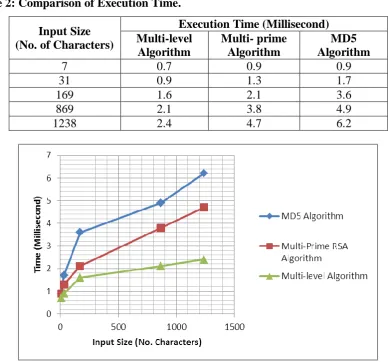
Execution Time (millisecond)
Table 2: Comparison of Execution Time.
Input Size (No. of Characters)
Execution Time (Millisecond) Multi-level
Algorithm
Multi- prime Algorithm
MD5 Algorithm
7 0.7 0.9 0.9
31 0.9 1.3 1.7
169 1.6 2.1 3.6
869 2.1 3.8 4.9
1238 2.4 4.7 6.2
Fig. 4: Graph of Comparison Based on Execution Time.
Ahmed et al. World Journal of Engineering Research and Technology
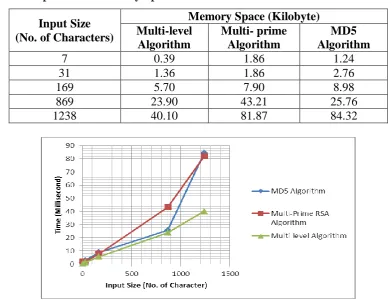
Table 3: Comparison of Memory Space.
Input Size (No. of Characters)
Memory Space (Kilobyte) Multi-level
Algorithm
Multi- prime Algorithm
MD5 Algorithm
7 0.39 1.86 1.24
31 1.36 1.86 2.76
169 5.70 7.90 8.98
869 23.90 43.21 25.76
1238 40.10 81.87 84.32
Fig. 5: Graph of Comparison Based on Memory Space.
CONCLUSION
Multi-level cryptographic algorithm was developed in order to overcome the shortcomings of
the previously used cryptographic algorithms (such as MD5 and Multi-prime RSA), the
algorithm was designed, evaluated and compared its performance with the existing
algorithms. It was found out that, the algorithm is very fast in execution time and required
less memory space compared to other algorithms. Therefore the algorithm is very efficient
and can resist some kinds of attacks like brute force and mathematical attacks.
REFERENCES
1. Ahmed, I. and Husain, R Design of Muli-level Algorithm for Data Storage Security in
Cloud Computing, WJERT, 2017; 3(4): 112-119.
2. Caesar G. J and Kennedy, J. F Cryptography. Security Engineering: A Guide to Building
Dependable Distributed Systems, 2017.
3. Khatoon, A. and Ikram, A.A Performance Evaluation of RSA Algorithm in Cloud
Computing Security. International Journal of Innovation and Scientific Research, 2014;
Ahmed et al. World Journal of Engineering Research and Technology
4. Padmavathi, B. and Kumari, S. R A Survey on Performance Analysis of DES, AES and
RSA Algorithm along with LSB Substitution Technique. International Journal of Science
and Research. India [Online] ISSN, 2013; 2319-7064.
5. Roy, R. C Security in Cloud Computing. International Journal of Computer Applications,
2014; 96(15).
6. Sudhansu, R. J. and Nayak, B. Enhancing data security in cloud computing using RSA
encryption and MD5 algorithm. International Journal of Computer Science Trends and
Technology, 2014; 2(3).
7. Sugunya, M., Boopal, M. E and Naveena, M. Implementing multiprime RSA algorithm to
enhance the data security in cloud computing. International Journal of Innovative
Research in Scienec, Engineering and Technology, 2015; 4(3).
8. Tripathi, R and Agrawwal, S Comparative Study of Symmetric and Asymmetric
Cryptography Techniques. International Journal of Advance Foundation and Research in
Computer, 2014; 1(6).
9. Zareen Enhancement on implementation of multi-prime and multi-power RSA algorithm.