Effects of Limonene on the PAHs mutagenicity risk in Roasted Fish Skin
1
Yu-Wei Chen1, Ping-Hsiu Huang2, Yung-Hsiang Tsai1, Chii-Ming Jiang3, Chih-Yao 2
Hou1* 3
4
Yu-Wei Chen M.D. 5
1Department of Seafood Science, National Kaohsiung University of Science and 6
Technology, Kaohsiung, Taiwan, ROC 7
9
Ping-Hsiu, Huang Ph. D. 10
2College of Food Science and Technology, Hainan University, Haikou, China 11
13
Yung-Hsiang Tsai Ph. D. 14
3Department of Seafood Science, National Kaohsiung University of Science and 15
Technology, Kaohsiung, Taiwan, ROC 16
Chii-Ming Jiang Ph. D. 19
3Department of food science and technology National Taitung Jr. College, Taitung, 20
Taiwan, ROC 21
23
Chih-Yao, Hou Ph. D. 24
1Department of Seafood Science, National Kaohsiung University of Science and 25
Technology, Kaohsiung, Taiwan, ROC 26
+88673617141*23607 28
29
30
31
ABSTRACT
32
Traditional edible barbecue products use with lemon juice not only make the 33
barbecue more delicious but also reduce the risk of PAHs in the barbecue products. One 34
of the major economics crops in Taiwan, the waste from citrus fruits was very tremendous 35
limonene is the major. Whether the anti-carcinogenesis activities of terpene, such as 37
limonene, in citrus fruits essential oil extraction. This study to demonstrate the PAHs 38
content in fish skin increased markedly after being roasted at 210℃ for 20 minutes and 39
greater mutagenicity risk of roasted fish skin was observed by Ame's test. The reduction 40
of mutagenicity risk of roasted fish skin, which the antimutagenic abilities of substances 41
in descending order were limonene > cold pressure oil > lemon >grapefruit. The 42
antimutagenicity rate and ability of the three extracts were limonene: 18–23%; cold-43
pressed lemon oil: 18–22%; and steam distilled lemon essential oil: 8–16%. The obvious 44
anti- mutagenicity effects against the PAHs mutagenicity of roasted fish skins can be 45
found in citrus fruits essential oil extraction. 46
Keywords:Roasted Fish Skin, PAHs mutagenicity risk, Limonene 47
48
1. Introduction
49
Citrus is one of the most abundant agriculture crops worldwide. With a global 50
production of 4,200,000 metric tonnes, lemon (Citrus limon (L.)) is the third most 51
important cultivated citrus species after orange and mandarin. Countries with the most 52
important lemon productions for processing are Argentina (1,000,000 tonnes), Italy 53
tonnes). Of the 2,130,000 tonnes of lemons processed globally in 2007, peel waste made 55
up 57% (~1,200,000 tonnes) [1]. Citrus peels are rich in essential oils, which in various 56
plants exhibit antioxidant properties that can extend the shelf life in foods by lowering 57
lipid oxidation [2]. High-purity limonene, a major component of lemon essential oil found 58
in the peels, can be used as fragrance, flavour, insecticide, or renewable solvent for 59
coating or replacing aromatic and mineral oils [3]. Researchers worldwide are 60
investigating this substance as a method to protect food from bacterial growth without the 61
need for harmful chemicals [4]. 62
63
Polycyclic aromatic hydrocarbons (PAHs) are organic toxins consisting of two or 64
more aromatic rings fused in linear, angular, or clustered arrangements. These compounds 65
do not undergo self-degradation easily in nature owing to their stable chemical structures 66
[5]. Some PAHs such as acenaphthene anthracene, phenanthrene, fluorene, fluoranthene, 67
pyrene, benzo[a]pyrene are included in the list of priority pollutants by the United States 68
Environmental Protection Agency [5]. In 1976, there are at least 30 PAHs that are 69
recognised internationally to be carcinogens, which is the largest group of known 70
carcinogens in the world currently. 71
and bioaccumulation characteristics. PAHs are mainly produced from incomplete 73
combustion of carbon-containing compounds or use of fossil fuels. Examples include the 74
combustion of plants that releases and spreads PAHs into nature; spillage of crude oil in 75
the petrochemical industry [5]; roasted meats, smoked fishes, and cured meats. The use 76
of baking, roasting, and other cooking techniques will generate more PAHs and increase 77
PAH content in foods [6-9]. Consumption of fish and roasted and smoked meats by 78
humans allow PAHs to enter the human body. In this study, tilapia skins were soaked in 79
limonene and lemon essential oil to examine their ability to prevent PAH-induced 80
mutagenicity induced by roasting. 81
82
2. Materials and methods 83
2.1 Materials 84
Lemons (C. limon) purchased from a supermarket in Kaohsiung city were washed 85
and wiped dry. Lemon skins were collected without disrupting the oil sacs and were 86
directly used for subsequent experiments. 87
Limonene, glucose-6-phosphate, ß-Nicotine adenine dinucleotide phosphate, and 88
sodium ammonium hydrogen phosphate tetrahydrate were purchased from Fluka 89
company. Benzo [a]pyrenene was purchased from Supelco Inc., US. 4-Nitroquinoline-N-91
oxide L-histidine, Sodium chloride and D-biotin were purchased from Sigma Inc., US. 92
Nutrient agar, nutrient broth, tryptic soy agar, tryptic soy broth, and Bacto agar were 93
purchased from Difco Inc., US. Magnesium sulfate heptahydrate, citric acid, H2O, 94
dipotassium hydrogen phosphate, magnesium chloride anhydrous, potassium chloride, 95
sodium dihydrogenphosphate anhydrous, disodium hydrogenphosphate, and glucose 96
were purchased from Showa Inc., JP. 97
98
99
2.4. Methods 100
2.4 Extraction and analysis of essential oil from citrus peels 101
2.4.1.1 Steam distillation 102
700 g of distilled water was added to 150 g of citrus peels for blending before being 103
placed in a three-neck round-bottom flask for steam distillation. After the distillate 104
separated into layers, the upper layer containing distilled essential oil was collected. This 105
oil was stored in the dark at -20℃ before gas chromatography-mass spectrometry 106
(GC/MS) was used to analyse the types and levels of compounds [10], [11] 107
108
The method of Ou [12] was used in which lemons were cut in half, the flesh was 110
removed, and the peels were pressed. Afterward, distilled water was used to flush the 111
pressed juice. The mixture was then centrifuged at 3000 rpm for 10 min. Cold pressed oil 112
was then collected from the upper layer. 113
114
2.4.2 Analysis of citrus peel essential oil 115
The Agilent 6890 (Agilent technologies Inc., US) GC system used in this was 116
connected in tandem to an Agilent 5973N quadrupole mass selective detector (MSD). The 117
temperature of the ion source was 230℃, and the quadrupole temperature was 150℃. A 118
DB-1 separating column with a length of 60 m and inner diameter of 0.25 mm was used; 119
the injection port temperature was 150℃. The initial temperature of the column was 40℃ 120
for 0 min, which increased to 75℃ at 35℃/min before holding for 2 min. This was 121
followed by an increase of 5℃/min to 120℃ and holding for 0 min. Finally, the 122
temperature was increased at 15℃/min to 210℃ and was held at 2 min. The carrier gas 123
used was helium, and the flow rate was 1 mL/min. The obtained MS data were aligned 124
with the Wiley7n Mass Spectral Library. 125
126
on Salmonella typhimurium TA100 128
129
2.5.1 S. typhimurium TA100experiment strains 130
Biotechnology was used to modify this genetically defective strain from that 131
growing in a histidine-deficient environment to a strain that requires histidine for growth. 132
Samples containing mutagenic substances will revert back to a histidine-independent 133
form. This experiment strain was obtained from Chung Shan Medical University. 134
135
2.5.2 Toxicity testing 136
This test examines whether the experimental samples exhibit toxicity towards 137
bacteria in the presence or absence of metabolism by liver enzymes. Toxicity is present if 138
the colony count of the experimental group is 80% of that in the control group. The 139
experimental samples of limonene and citrus essential oil were diluted by 1% Tween into 140
different concentrations. The control group consisted of 1% Tween. Hereafter, these 141
samples are referred to as “experimental Tween samples” and “Tween control group,” 142
respectively. 143
First, 0.1 mL of the Tween sample was added into 0.1 mL of phosphate buffer (pH 144
mixture, 0.5 mL of the phosphate buffer was added. For that with S9, this mixture was 146
added in place of the phosphate buffer. After mixing, the mixtures were precultured for 147
20 min at 37℃. They were then diluted to 102–103 CFU/mL, and 1 mL of diluate was 148
mixed with a suitable volume of melted nutrient agar. The plates were grown in an 149
inverted position at 37℃ for 48 h before the colony counts were enumerated. 150
151
2.5.3 Mutagenicity experiments 152
The method used to perform the mutagenicity test (Ames test) involved the pre-153
incubation method as described by Maron and Ames [13]. This test examined whether 154
the experimental samples exhibited mutagenic effects towards bacteria in the presence or 155
absence of metabolism by liver enzymes. If the data of the experimental group were more 156
than twice that of the control group, the sample was mutagenic. 157
First, 0.1 mL of the experimental Tween sample was added to 0.1 mL of the 158
phosphate buffer before 0.1 mL of overnight bacterial culture was added. For the group 159
without S9 mixture, 0.5 mL of the phosphate buffer was added. For that with S9, this 160
mixture was added place of the phosphate buffer. After mixing, the mixtures were 161
precultured for 20 min at 37℃. Then, 2 mL melted top agar containing 40% glucose and 162
at 37℃ for 48 h before the colony counts were enumerated [14]. 164
165
2.5.4 Antimutagenicity experiments 166
This experiment examines whether the experimental samples have antimutagenic 167
ability following the addition of standard mutagens that do or do not require liver enzyme 168
metabolism. The mutagen selected for the group without S9 mixture added was 4-169
Nitroquinoline-N-oxide, which does not require metabolism by liver enzymes. 170
Benzo[a]pyrene, which requires liver enzyme metabolism, was used for the group with 171
S9 mixture added. In both cases, 0.1 mL of overnight bacterial culture was added. 172
First, 0.1 mL of the experimental Tween sample was added into 0.1 mL of 173
commercial mutagens. For the group without S9 mixture, 0.5 mL the phosphate buffer 174
was added. For that with S9, this mixture was added in place of the phosphate buffer. 175
After mixing, the mixtures were precultured for 20 minutes at 37℃before 2 mL of melted 176
top agar containing 40% glucose and 0.5 mM histidine/biotin solution was added. The 177
plates were grown in an inverted position at 37℃ for 48 hours before the colony counts 178
were enumerated [15]. 179
Antimutagenicity was calculated according to the following formula: 180
100 182
183
2.6 Antimutagenicity of limonene and citrus essential oil on roasted fish skins 184
2.6.1 Extraction of roasted fish skins 185
70 g of descaled tilapia skins 20 cm long × 8 cm wide was weighed and washed 186
before being wiping dry (treated samples). Afterwards, the skins were placed in an oven 187
for 20 min of roasting at 210℃. After the skins were crushed, three volumes of 188
dichloromethane were added for 1 h of extraction. The dichloromethane layer was 189
collected and concentrated under reduced pressure. The concentrate obtained was stored 190
in the dark at -20℃. 191
192
2.6.2 Toxicity of extracts from roasted fish skins 193
This test examines whether the extracts from roasted fish skins exhibit toxicity 194
towards bacteria in the presence or absence of metabolism by liver enzymes. Toxicity is 195
present if the colony count of the experimental group is 80% of that in the control group. 196
Extracts from roasted fish skins were dissolved in dimethyl sulfoxide (DMSO). The 197
control group contained DMSO alone; these are referred to as “experimental DMSO 198
samples was added to 0.1 mL of phosphate buffer (pH 7.4) and 0.1 mL of overnight 200
culture. The group without S9 mixture had 0.5 mL of the phosphate buffer added, whereas 201
the group with S9 had the S9 mixture added in place of the aforementioned 0.5 mL 202
phosphate buffer. After mixing, the mixtures were precultured for 20 min at 37℃. The 203
mixture was diluted to 102–103 CFU/mL, and 1 mL of diluate was mixed with a suitable 204
volume of melted nutrient agar. The plates were grown in an inverted position at 37℃ for 205
48 h before the colony counts were enumerated [13-15]. 206
207
2.6.3 Mutagenicity of extracts from roasted fish skins 208
This test examines whether the experimental samples exhibit mutagenic effects 209
towards bacteria in the presence or absence of metabolism by liver enzymes. If the data 210
of the experimental group is more than twice that of the control group, the sample is 211
mutagenic. First, 0.1 mL of DMSO experimental samples was added to 0.1 mL of 212
phosphate buffer (pH 7.4) before 0.1 mL of overnight bacterial culture was added. The 213
group without S9 mixture had 0.5 mL of the phosphate buffer added, whereas the group 214
with S9 had the S9 mixture added in place of the aforementioned phosphate buffer. After 215
mixing, the mixtures were precultured for 20 min at 37℃ before adding 2 mL of melted 216
grown in an inverted position at 37℃ for 48 h before the colony counts were enumerated 218
[14].. 219
220
2.6.4 Antimutagenicity of limonene and citrus essential oil on extracts from roasted fish 221
skins 222
This experiment examines whether limonene and lemon essential oil, including cold 223
pressed oil and that from steam distillation, have antimutagenic ability when extracts are 224
added from roasted fish skin in the presence or absence of liver enzyme metabolism. First, 225
0.1 mL of experimental Tween samples was added to 0.1 mL of extracts from roasted fish 226
skins; the extracts were dissolved in DMSO as 50 μg/plate and 200 μg/plate. The group 227
without S9 mixture had 0.1 mL of overnight bacterial culture added before the addition 228
of 0.5 mL of phosphate buffer (pH 7.4). For the group with S9, S9 mixture was added in 229
place of the aforementioned phosphate buffer. After mixing, the mixtures were 230
precultured for 20 min at 37 ℃before adding 2 mL of melted TOP agar containing 40% 231
glucose and 0.5 mM histidine/biotin solution. The plates were grown in an inverted 232
position at 37℃ for 48 h before the colony counts were enumerated [13-15].. 233
234
2.6.5 Evaluation of toxicity and mutagenicity of fish skin extracts regarding S.
typhimurium TA 100 236
70 g of descaled tilapia skins 20 cm long × 8 cm wide was weighed and washed 237
before being wiped dry. Afterwards, the skins were soaked in 15 mL of 10% limonene 238
and lemon essential oil, including cold pressed oil and that extracted from steam 239
distillation, until the oils were completely absorbed, about 10–15 min. The skins were 240
then placed in an oven for 20 min of roasting at 210℃. Afterwards, the skins were crushed, 241
and three volumes of dichloromethane were added for 1 h of extraction. The 242
dichloromethane layer was collected and concentrated under reduced pressure. The 243
concentrate obtained was used for toxicity and mutagenicity evaluation following the 244
procedures in described in sections 2.6.2 and 2.6.3. 245
246
2.6.6 Evaluation of toxicity and mutagenicity of fish skin extracts regarding S.
247
typhimurium TA 100 248
70 g of descaled Tilapia skins 20 cm long × 8 cm wide was weighed and washed 249
before being wiped dry. Afterwards, the skins were soaked in 15 mL of 10% limonene 250
and lemon essential oil, including cold pressed oil and that extracted from steam 251
distillation, until the oils were completely absorbed, about 10–15 min. The skins were 252
and, three volumes of dichloromethane were added for 1 h of extraction. The 254
dichloromethane layer was collected and concentrated under reduced pressure. The 255
concentrate obtained was used for toxicity and mutagenicity evaluation, following the 256
procedures described in sections 2.6.2 and 2.6.3. 257
2.7 Statistical analysis 258
Statistical analysis was conducted with one-way analysis of variance (ANOVA) with 259
an LSD post hoc test for multiple comparisons. Data are reported as the mean ± standard 260
error of mean (SEM) with a p value less than 0.05 being considered statistically 261
significant. Analyses were performed using the Statistical Package for the Social Sciences 262
(SPSS) software (Chicago, IL, USA). 263
3. Results and discussion 264
3.1 Identification of components in citrus essential oils 265
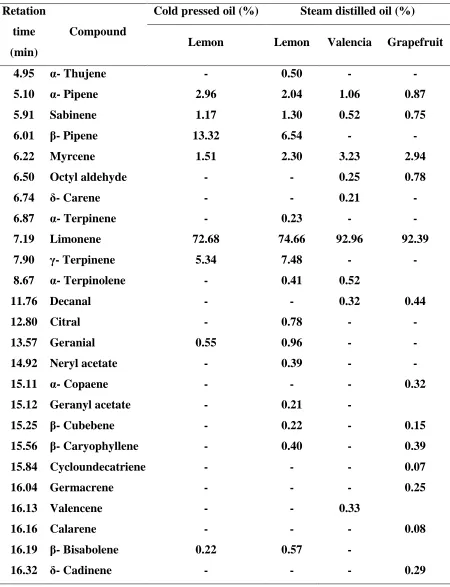
In total, 26 aromatic compounds were identified from the citrus essential oil obtained 266
by different extraction methods (Table 1). Terpenes had the highest levels, accounting for 267
20 of the 26 aromatic compounds; the remaining compounds consisted of 4 types of 268
aldehydes and 2 types of esters. The limonene content in the four types of citrus essential 269
oils was 70–90%, showing that limonene content in citrus essential oils is extremely high. 270
of whether cold pressing or steam distillation was used. Studies have shown that these 272
two compounds have antimicrobial and anti-cancer properties [16-20]. 273
274
3.2. Toxicity, mutagenicity, and antimutagenicity tests 275
The method used to perform the mutagenicity test (Ames test) involved the pre-276
incubation method as described by Maron and Ames [13]. In the Ames test, toxicity 277
testing is an extremely important step. The test sample must first undergo toxicity testing 278
so that the sample concentration used in subsequent experiments will not have toxic 279
effects on the experimental bacterial strains. This is because if toxicity occurs when the 280
sample concentration is not high, error in colony counts can occur in subsequent 281
experiments [14]. Therefore, it is necessary to determine the concentration with no 282
toxicity effects when conducting the Ames test [15]. While determining whether the 283
sample concentrations have toxicity effects, we can monitor whether the colony counts 284
of the test sample group are lower than 80% of the control group. If so, concentration is 285
toxic to the experimental bacterial strain and is not suitable for subsequent experiments. 286
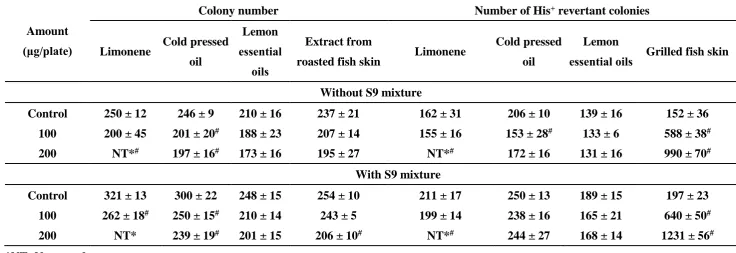
Table 2, shows that as the sample concentration increased, the bacterial counts 287
exhibited a gradual decreasing trend regardless of whether liver enzymes were added. 288
Toxicity occurs when the concentration of limonene is greater than 100 μg/plate and when 289
the concentration of limonene, cold pressed oil, lemon essential oil, and the extract from 290
roasted fish skins are greater than 200 μg/plate. Therefore, this value was used as the 291
maximum concentration for the four samples in subsequent experiments. However, 292
within this concentration range, the colony counts exhibited a significant increasing trend 293
undergoing high-temperature roasting contain large amounts of toxic substances that 295
could cause DNA mutations, which is similar to the document released by the World 296
Health Organization [5]. 297
After identifying the concentration not causing toxicity, mutagenicity experiments 298
were conducted to confirm that the test samples are safe and not mutagenic in order to 299
avoid errors in colony counts and doubts about safety. Therefore, this test must be 300
conducted if the sample is determined to be antimutagenic or edible so that 301
antimutagenicity and safety can be accurately calculated in subsequent antimutagenicity 302
experiments [21]. 303
When determining whether the test sample is mutagenic, the colony counts of the 304
test sample and control groups are compared. If the colony counts of the sample group 305
are more than twice that of the control group, safety issues and mutagenicity are present 306
for that concentration, which makes it unsuitable for subsequent experiments [22-23]. 307
Table 2 shows that the colony count trends of the four test samples at various 308
concentrations were comparable with the control group, regardless of whether liver 309
enzymes were added. This shows that the concentrations of these samples are not 310
mutagenic towards the bacterial strain used. The results showed that when 100 and 200 311
μg/plate concentrations of limonene and various citrus essential oils were used, 312
respectively, no mutagenicity was present, and the safety of the samples was confirmed. 313
Antimutagenicity analysis was conducted according to the confirmed sample 314
concentrations in the two aforementioned experiments. The aims of this experiment were 315
to examine whether these four samples can decrease mutagenicity caused by interaction 316
with mutagens and to calculate the antimutagenicity rate. Table 3 shows that as the 317
standard mutagens, 4-Nitroquinoline-N-oxide and benzo[a]pyrene, both increased 319
regardless of whether liver enzymes were added. The antimutagenicity rate and ability of 320
these samples at their highest concentrations were limonene: 49–52%; cold pressed lemon 321
oil: 45%; steam distilled lemon essential oil: 342%; and extract from roasted fish skins: 322
286–551% Overall, the three citrus essential oils all have antimutagenic effects, which 323
were strongest in limonene and lemon essential oil. Therefore, subsequent studies were 324
conducted using limonene and lemon essential oil for toxicity, mutagenicity, and 325
antimutagenicity evaluation on extracts from roasted fish skins. 326
327
3.4 Antimutagenicity of limonene and citrus essential oils on extracts from roasted fish 328
skins 329
Antimutagenicity tests using the three citrus essential oils were conducted using a 330
high mutagenicity concentration. In this experiment, limonene, cold pressed lemon oil, 331
and steam distilled extracted lemon essential oil were used as experimental samples. Table 332
3 shows the results. Under the maximum concentrations of these three samples, the 333
antimutagenicity rate and ability of these samples towards extracts from roasted fish skin 334
(200 μg/plate) were limonene: 18–23%; cold pressed lemon oil: 18–22%; and steam 335
distilled extracted lemon essential oil: 8–16%. The antimutagenicity rate exhibited 336
significant increases only under high doses of samples, which is likely attributed to the 337
mutagenic fish skin extract (50 μg/plate) was used for subsequent identical experiments. 339
The antimutagenicity rate and ability of these samples towards extracts from roasted fish 340
skins (50 μg/plate) were limonene: 24–35%; cold pressed lemon oil: 14–24%; and steam 341
distilled extracted lemon essential oil: 15–20%. When compared with high concentrations 342
of fish skin extracts (200 μg/plate), the antimutagenicity rates of the three samples 343
increased by 12%, 2%, and 4% for limonene, cold pressed lemon oil, and steam distilled 344
extracted lemon essential oil, respectively (data not shown). 345
346
3.5 Toxicity and mutagenicity tests before roasting 347
Table 2 shows the toxicity of extracts from fish skins after pre-treatment with citrus 348
essential oils and roasting. As the concentration the extract increased, the colony counts 349
showed a decreasing trend. No toxicity occurred when a dose of 150 μg/plate was used 350
regardless of whether liver enzymes were added. 351
The most suitable concentration for toxicity testing, 150 μg/plate, was used for 352
antimutagenic ability comparison for various groups. The results are shown in Table 4. 353
Limonene pre-treatment before roasting showed only a slight reduction in mutagenicity 354
when liver enzymes were added. However, similar results were not obtained after liver 355
not have effectively inhibited mutagenic substances activated by liver metabolism. In 357
addition, neither cold pressed lemon oil nor steam distilled essential oil was able to reduce 358
the mutagenicity in the roasted fish skins. 359
360
3.6 Toxicity and mutagenicity tests after roasting 361
Table 4 shows the toxicity of extracts from fish skins that were treated with citrus 362
essential oils after roasting. As the concentration of the extract increased, the colony 363
counts showed a decreasing trend. Regardless of whether liver enzymes were added, no 364
toxicity occurred when a dose of 150 μg/plate was used. 365
The most suitable concentration for toxicity testing, 150 μg/plate, was used for 366
antimutagenic ability comparison for various groups. The results are shown in Table 4. 367
Limonene pre-treatment before roasting showed only a slight reduction in mutagenicity 368
regardless of whether liver enzymes were added. Because limonene and other citrus 369
essential oils are volatile substances, high-temperature roasting may dramatically reduce 370
their effective levels, thereby decreasing their antimutagenic abilities. However, treatment 371
with limonene and other volatile substances after roasting does not require high-372
temperature roasting and thus limonene may be present in the roasted material. This 373
inhibition of mutagenicity by roasting before limonene treatment, with or without 375
addition of liver enzymes, may be attributed the loss of volatile substances during high-376
temperature roasting, although it doesn’t reduce mutagenicity after various treatments, at 377
the same results demonstrate addition of limonene and cold pressure oil will not cause 378
mutagenic risk (Table 4), but lemon essential oils groups (with or without S9 mixture) 379
versus untreated had significantly difference, maybe caused by the evaporation of 380
effective substances during the roasted. 381
382
4. Conclusions 383
This study demonstrated that among the four types of citrus essential oils extracted 384
from lemons using different methods, limonene had the highest content of 70% to more 385
than 90% [24-28]. This shows that the limonene content in citrus essential oils is 386
extremely high. When standard mutagens were used in antimutagenicity experiments, the 387
antimutagenic abilities of substances in descending order were limonene > cold pressure 388
oil > lemon >grapefruit [29-33]. When extracts from roasted fish skins were used as a 389
mutagen at a concentration of 200 μg/plate, the antimutagenicity rate and ability of the 390
three extracts were limonene: 18–23%; cold pressed lemon oil: 18–22%; and steam 391
distilled lemon essential oil: 8–16%. When a concentration of 50 μg/plate of extracts from 392
roasted fish skins was used, the antimutagenicity rate and ability of the three extracts were 393
limonene: 24–35%; cold pressed lemon oil: 14–24%; and steam distilled lemon essential 394
for pre-soaking before and after roasting. 397
398
Acknowledgments 399
The research was supported by the Ministry of Science and Technology, R.O.C (MOST) 400
(106-2218-E-022-001) and MOST (107-2221-E-992 -033). 401
402
References 403
[1] Gonzalez-Molina, E, Dominguez-Perles, R, Moreno, DA and Garcia-Viguera, C. 404
Natural bioactive compounds of Citrus limon for food and health. Journal of 405
Pharmaceutical and Biomedical Analysis 2010: 51 (2) 327–345. 406
[2] Oussalah, M, Caillet, S, Salmieri, S, Saucier, L and Lacroix, M. Antimicrobial and 407
antioxidant effects of milk protein-based film containing essential oils for the 408
preservation of whole beef muscle. Journal of Agricultural and Food Chemistry 409
2004: 52(18) 5598–5605. 410
[3] Wróblewska, A, Makuch, E and Piotr M. The studies on the limonene oxidation over 411
the microporous TS-1 catalyst. Catalysis Today 2016: 268 121–129. 412
slightly acidic electrolyzed waster. Journal of Bioscience and Bioengineering 2010: 415
110 308–313. 416
[5] WHO, (1998). Polynuclear aromatic hydrocarbons. In: Guidelines for drinking-water 417
quality, 2nd ed. Vol. 2. Health criteria and other supporting information. Geneva, 418
World Health Organization. pp. 123- 152. 419
[6] Onwukeme, VI, Obijiofor, OC, Asomugha, RN, and Okafor, FA. Impact of Cooking 420
Methods on the Levels of Polycyclic Aromatic Hydrocarbons (PAHs) in Chicken 421
Meat. IOSR Journal of Environmental Science Toxicology and Food Technology 422
2015: 9(4) 21-27 423
[7] Zelinkova, Z, and Wenzl T. The Occurrence of 16 EPA PAHs in Food – A Review. 424
Polycyclic Aromatic Compounds 2015: 35(2-4) 248–284. 425
[8] Sobral, MMC, Cunha, SC, Faria, MA, and Ferreira, IM. Domestic Cooking of 426
Muscle Foods: Impact on Composition of Nutrients and Contaminants. 427
Comprehensive Reviews in Food Science and Food Safety, 2018: 17(2) 309-333. 428
[9] Pouzou, JG, Costard, S, and Zagmutt, FJ. Probabilistic estimates of heterocyclic 429
amines and polycyclic aromatic hydrocarbons concentrations in meats and breads 430
applicable to exposure assessments. Food and Chemical Toxicology, 2018: 114 346-431
[10] Jiang, MH, Yang, L, Zhu L, Piao, JH, and Jiang JG. Comparative GC/MS analysis 433
of essential oils extracted by 3 methods from the bud of Citrus aurantium L. var. 434
amara Engl. Journal of Food Science, 2011: 76(9) C1219-25. 435
[11] Liu, YY, Liu, ZI, Wang, C, Zha, QG, Lu, C, Song, ZQ, Ning, ZG Zhao, S, Lu, XM, 436
and Lu AP. Study on essential oils from four species of Zhishi with gas 437
chromatography–mass spectrometry. Chemistry Central Journal, 2014: 8 22. 438
[12] Ou, MC, Liu, YH, Sun YW, and Chan, CF. The Composition, Antioxidant and 439
Antibacterial Activities of Cold-Pressed and Distilled Essential Oils of Citrus
440
paradisi and Citrus grandis (L.) Osbeck. Evidence-Based Complementary and 441
Alternative Medicine, 2015: Article ID 804091, 9 pages. 442
[13] Maron, DM., Ames, BN. 1983. Revised methods for the Salmonella mutagenicity 443
test. Mutation Research/Environmental Mutagenesis and Related Subjects, 113(3-444
4), 173-215. https://doi.org/10.1016/ 0165-1161 (83)90010-9. 445
[14] Mortelmans K, Zeiger E. The Ames Salmonella/microsome mutagenicity assay. 446
2010. Mutation Research - Fundamental and Molecular Mechanisms of 447
Mutagenesis, 2000, 455(1):29-60. 448
[15] Ghazali, AR, Khairuddin, FM, Nagapan, TS, Basri, DF. 2017. The Mutagenicity and 449
Journal of Agricultural Science. 9(13):62-72. 451
[16] Hsouna, AB,Halima, NB, Smaoui, S, and Hamdi, N. Citrus lemon essential oil: 452
chemical composition, antioxidant and antimicrobial activities with its preservative 453
effect against Listeria monocytogenes inoculated in minced beef meat. Lipids in 454
Health and Disease, 2017: 16 146. 455
[17] Bourgou, S, Rahali, FZ, Ourghemmi, I, and Tounsi, MS. Changes of Peel Essential 456
Oil Composition of Four Tunisian Citrus during Fruit Maturation. The Scientific 457
World Journal, 2012: Article ID 528593, 10 pages 458
[18] Navarra, M, Mannucci,C,Delbò, M and Calapai, G. Citrus bergamia essential oil: 459
from basic research to clinical application. Frontiers in Pharmacology, 2015: 6 (36) 460
1-7. 461
[19] Vaio, CD, Graziani, G, Gaspari, A, Scaglione, G, Nocerino, S, Ritieni, A. 2010. 462
Essential oils content and antioxidant properties of peel ethanol extract in 18 lemon 463
cultivars. Scientia Horticulturae, 126:50–55. 464
[20] Bacanlı, M, Başaran, AA, Başaran, N. 2015. The antioxidant and antigenotoxic. 465
properties of citrus phenolics limonene and naringin. Food and Chemical Toxicology, 466
81: 160–170. 467
Essential Oils from the Malaysian Citrus (Rutaceae) Medicinal Plants. Medicines. 469
3(13) doi:10.3390/medicines3020013. 470
[22] Stogiannidis, E, Laane, R. 2015. Reviews of Environmental Contamination and 471
Toxicology. 234, doi:10.1007/978-3-319-10638-0_2. 472
[23] Dugo,P, Mondello,L, Dugo, Laura, Stancanelli, R, Dugo, G.2000. LC-MS for the 473
identification of oxygen heterocyclic compounds in citrus essential oils. Journal of. 474
Pharmaceutical and Biomedical Analysis, 24:147-154. 475
[24] Högnadóttir A, Rouseff RL. 2003. Identification of aroma active compounds in. 476
orange essence oil using gas chromatography-olfactometry and gas 477
chromatography-mass spectrometry. J Chromatogr A.998:201-211. 478
[25] Wang, Y, Yi, L, Liang, Y, Li, H, Yuan, D, Gao, H, Zeng, M. 2008. Comparative 479
analysis of essential oil components in Pericarpium Citri Reticulatae Viride and 480
Pericarpium Citri Reticulatae by GC-MS combined with chemometric resolution 481
method. J Pharm Biomed Anal, 46: 66-74. 482
[26] Park, IK, Kim, JN, Lee, YS, Lee, SG, Ahn, YJ, Shin, SC. 2008. Toxicity of plant 483
essential oils and their components against Lycoriella ingenua (Diptera: Sciaridae). 484
J Econ Entomol. 101:139-44. 485
characterization of volatile components of the Japanese sour citrus fruit Citrus 487
nagato-yuzukichi Tanaka. Biosci Biotechnol Biochem. 72:1965-1968. 488
[28] Yu, L, Li, X, Liu, S, Xu, G, Liang, Y. 2009. Comparative analysis of volatile 489
constituents in Citrus reticulata Blanco using GC-MS and alternative moving 490
window factor analysis. J Sep Sci. 32: 3457-65. doi: 10.1002/jssc.200900267. 491
[29] Venturini, N, Curk, F, Desjobert, JM, Karp, D, Costa, J, Paolini, J. 2010. 492
Chemotaxonomic investigations of peel and petitgrain essential oils from 17 citron 493
cultivars. Chem Biodivers. 2010. 7:736-51. doi: 10.1002/cbdv.200900028. 494
[30] Araújo, CP Jr, da Camara, CA, Neves, IA, Ribeiro, Nde C, Gomes, CA, de Moraes, 495
MM, Botelho, Pde S. 2010. Acaricidal activity against Tetranychus urticae and 496
chemical composition of peel essential oils of three Citrus species cultivated in NE 497
Brazil. Nat Prod Commun. 5: 471-6. 498
[31] Phillips, CA, Gkatzionis, K, Laird, K, Score, J, Kant, A, Fielder, MD. 2012. 499
Identification and quantification of the antimicrobial components of a citrus 500
essential oil vapor. Nat Prod Commun. 7:103-107. 501
[32] Ellouze, I, Abderrabba, M, Sabaou, N, Mathieu, F, Lebrihi, A, Bouajila, J. 2012. 502
Season's variation impact on Citrus aurantium leaves essential oil: chemical 503
3841.2012.02846.x. 505
[33] Wang, J, Chen, HP, Liu, YP, Wei, Z, Liu, R, Fan, DQ. 2013. Deconvolution of 506
overlapped peaks in total ion chromatogram of essential oil from citri reticulatae 507
pericarpium viride by automated mass spectral deconvolution & identification 508
methods
Retation
time
(min)
Compound
Cold pressed oil (%) Steam distilled oil (%)
Lemon Lemon Valencia Grapefruit
4.95 α- Thujene - 0.50 - -
5.10 α- Pipene 2.96 2.04 1.06 0.87
5.91 Sabinene 1.17 1.30 0.52 0.75
6.01 β- Pipene 13.32 6.54 - -
6.22 Myrcene 1.51 2.30 3.23 2.94
6.50 Octyl aldehyde - - 0.25 0.78
6.74 δ- Carene - - 0.21 -
6.87 α- Terpinene - 0.23 - -
7.19 Limonene 72.68 74.66 92.96 92.39
7.90 γ- Terpinene 5.34 7.48 - -
8.67 α- Terpinolene - 0.41 0.52
11.76 Decanal - - 0.32 0.44
12.80 Citral - 0.78 - -
13.57 Geranial 0.55 0.96 - -
14.92 Neryl acetate - 0.39 - -
15.11 α- Copaene - - - 0.32
15.12 Geranyl acetate - 0.21 -
15.25 β- Cubebene - 0.22 - 0.15
15.56 β- Caryophyllene - 0.40 - 0.39
15.84 Cycloundecatriene - - - 0.07
16.04 Germacrene - - - 0.25
16.13 Valencene - - 0.33
16.16 Calarene - - - 0.08
16.19 β- Bisabolene 0.22 0.57 -
Table 2. Toxicity and mutagenicity of essential oil from citrus and the extract from grilled fish skin regarding S. typhimurium TA100 with and without S9 mixture (N=3/Group)
Amount (μg/plate)
Colony number Number of His+ revertant colonies
Limonene Cold pressed
oil
Lemon essential
oils
Extract from
roasted fish skin Limonene
Cold pressed oil
Lemon
essential oils Grilled fish skin
Without S9 mixture
Control 250 ± 12 246 ± 9 210 ± 16 237 ± 21 162 ± 31 206 ± 10 139 ± 16 152 ± 36
100 200 ± 45 201 ± 20# 188 ± 23 207 ± 14 155 ± 16 153 ± 28# 133 ± 6 588 ± 38#
200 NT*# 197 ± 16# 173 ± 16 195 ± 27 NT*# 172 ± 16 131 ± 16 990 ± 70#
With S9 mixture
Control 321 ± 13 300 ± 22 248 ± 15 254 ± 10 211 ± 17 250 ± 13 189 ± 15 197 ± 23
100 262 ± 18# 250 ± 15# 210 ± 14 243 ± 5 199 ± 14 238 ± 16 165 ± 21 640 ± 50#
200 NT* 239 ± 19# 201 ± 15 206 ± 10# NT*# 244 ± 27 168 ± 14 1231 ± 56#
*NT: Not tested
Table 3. Antimutagenic effects and toxicity of limonene and lemon essential oil mixed with the extract from grilled fish skin (200 μg/plate) regarding S. typhimurium TA100 (N=3/Group)
Amount (μg/plate)
Number of His+ revertant colonies
Amount (μg/plate)
Colony number
Without S9 mixture Without S9 mixture
Limonene Cold pressed oil
Lemon essential
oils
Tween 20 Limonene
Cold pressed
oil
Lemon essential
oils
Control 776 ± 30 899 ± 41 997 ± 83 Control 174 ± 33* 128 ± 14 154 ± 34 120 ± 23
100 672 ± 34# 784 ± 30# 949 ± 97 100 146 ± 24 106 ± 13 130 ± 15 101 ± 15
200 NT*# 760 ± 14# 907 ± 36 150 142 ± 16 101 ± 11# 122 ± 22 97 ± 16
With S9 mixture With S9 mixture
Control 944 ± 49 1013 ± 44 1296 ± 32 Control 150 ± 13 166 ± 20 222 ± 16 165 ± 27
100 831 ± 77# 931 ± 49 1317 ± 24 100 205 ± 19# 140 ± 16 184 ± 22 134 ± 19
200 NT# 888 ± 66# 1224 ± 24 150 193 ± 17# 135 ± 15 175 ± 19# 132 ± 13
*NT: Not tested
limonene and lemon essential oil regarding S. typhimurium TA100
(N=3/Group)
Concentration (150 μg/plate)
Number of His+ revertant colonies
Different samples
Without S9 mixture With S9 mixture
Control 185 ± 34† 231 ± 41†
Untreated 997 ± 30# 985 ± 58#
Tween 20 909 ± 56# 961 ± 40#
Limonene 949 ± 57# 1040 ± 41#
Cold pressed oil 1015 ± 77# 1119 ± 68#†
Lemon essential oils 1083 ± 121#† 1157 ± 48#†
*NT: Not tested