Exotics at BESIII
Zhiyong Wang
for the BESIII Collaboration
1Institute of High Energy of Physics, Chinese Academy of Sciences
Abstract. Using the 1.31 × 10¹⁰ J/ψ events and the data above open charm
collected at BESIII detector, we studied and observed a lot of exotics, including
X(3872),X(3823),Y(2175),Y(4140),Zc(3900),Zc(4020), and so on. Some of them are confirmed, some of them are observed for the first time, and some of them are searched, but with no obvious signal.
1 Introduction
The exotics are quite different from the common hadrons though they are not forbidden by QCD theory. The study on these exotics is very helpful to understand the nature of hadrons. A lots of exotics, some of them are calledX,Y, andZstates, are observed in different experiments. However, our understanding to these exotics is quite limited. For example, the Y(4260) is discovered in ISR processe+e−→γπ+π+J/ψ, and despite its subsequent observation, its nature has remained a mystery. Considering that its mass above open charm and its strong coupling toπ+π+J/ψ, it is regarded as a non-conventional state of charmonium.
In this paper, we report the study onX,Y, andZstates at BESIII detector.
2 X states
2.1 X(3872)
2.2 X(3823)
The lightest charmonium state aboveDD¯ isψ(3770), which is currently defined as 13D
1 state [5].
Until now, there have been no definitive observations its two D-wave spin-triplet partner states. i.e., 13D
2 and 13D3 states. Phenomenological models predict that the 13D2 charmnium state has large
decay widths toγχc1 andγχc2. Recently, the Belle Collaboration reported evidence for a narrow
resonanceX(3823)→ γχc1 inBmeson decays with 3.8σsignificance and mass 3823.1±1.8±0.7
MeV/c2, and suggested that this is a good candidate for the 13D2charmonium state [6]. We performed
search for the production of the 13D2 state via the processe+e− → π+π−X, using 4.67 fb−1 data at
√
s=4.19-4.60 GeV. The 13D2candidates are reconstructed in theirγχc1,2decay modes. Figure 1
(top-left) shows the fit toMrecoil(π+π−) ofγχc1,2, respectively. The statistical significance of theX(3823)
signal inγχc1mode is estimated to be 6.2σ. For theγχc2mode, we don’t observe anX(3823) signal.
The X(3823) is a candidate for the 13D
2 charmonium state with JPC = 2−−. The product of the
Born-order cross section and the branching ratio ofX(3823)→γχc1,2is calculated. We fit the
energy-dependent cross sections ofe+e−→π+π−X(3823) with theY(4360) shape or theψ(4415) shape with their resonance parameters fixed to the PDG values. Figure 1 (bottom-right) shows the fit results. Due to the low statistics, we accept both theY(4360) andψ(4415) hypotheses at 90% C.L.
Figure 1. (top-left)X(3872) signal. (top-right)X(3823) signal. (bottom-left) Born cross-section ofe+e− →
γX(3872). (bottom-right) Born cross-section ofe+e−→γX(3823)
3 Y state
3.1 Y(2175)
TheY(2175) was first observed by theBABARexperment [7] in thee+e−→γIS Rφf0(980) process. It
was later confirmed by the BESII experiment inJ/ψ→ηφf0(980) decays [8] and other experiments.
Y(4260). A number of different interpretations have been proposed for theY(2175). The confirmation and study of theY(2175) in J/ψ→ ηφπ+π−with a large data sample is necessary for clarifying its nature. Figure 2 (left) shows the fit results toφf0(980) invariant mass spectrum. The solid curve is the
overall fit projection and a clearY(2175) signal is seen [9]. Its mass and width are determined to be M=2200±6 MeV/c2andΓ =104±15 MeV, respectively.
3.2 Y(4140)
The CDF experiment observed theY(4140) in the decay of B+ → φJ/ψK+with a statistical signif-icance greater than 5σ [10]. However, this new state was not confirmed by the Belle and LHCb collaborations, but confirmed by CMS and D0 Collaborations. The Y(4140) is the first charmo-niumlike state decaying into two vector mesons consisting ofc¯candΣ0Σ¯0 pairs. Since the φJ/ψ system has positiveC-parity, and can be searched for through radiative transitions of Y(4260) or other 1−−charmonium or charmoniumlike states. Here, we report a search for the radiative transition Y(4260)→γY(4140)→γφJ/ψwith the data collected at √s=4.23, 4.26, and 4.36 GeV. As a result, no obvious signal is found inφJ/ψmass spectrum (see Fig. 2 (right)) and the upper limit is given [11].
)
2
) (GeV/c
ψ
J/
φ
M(
4.1 4.15 4.2 4.25 4.3 4.35 4.4
2
Events / 0.003 GeV/c
0 0.5 1 1.5 2 2.5 3 3.5
Figure 2. (left) The invariant mass ofφf0(980) in J/ψ → π+π−φη. (right) The invariant mass ofφJ/ψ in
e+e−→γK+K−J/ψ.
3.3 e+e−→ωχcJ
The authors of Ref. [12] predict a sizeable coupling between theY(4260) and theωχc0channel by the
considering the threshold effect that plays a role in reducing the decay rates into open-charm channels. By adopting the spin rearrangement scheme in the heary quark limit and the experimental information, Ref. [13] predicts the ratio of the decaysY(4260)→ωχcJ(J=0,1,2) to be 4:3:5.
Enhancements can be seen in the line shapes ofωχc0mode. It is fitted with a phase-space modified
BW function, and the fit results for the structure parameters areΓeeB(ωχc0) =(2.8±0.5±0.4) eV,
M = (4226±8±6) MeV/c2, andΓt = (39±12±2) MeV, where M,Γee,Γt are mass, total width, e+e− partial for the potential Y state. In thee+e− → ωχ
c2 cross section, an enhancement is seen
around 4.146 GeV, so we use a coherent sum of theψ(4415) BW function and a phase-space term to fit the cross section. There are two solutions, constructive and destructive [14]. The cross section of e+e− → ωχc
1 seems to be raising near 4.6 GeV. The different line shapes observed forωχcJmight
4 Z states
4.1 Zc(3900)andZc(3885)
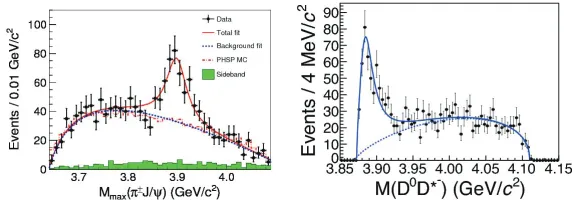
The nature ofY(4260) has remained a mystery since its discovery. Unlike other charmonium states with the same quantum numbers and in the same mass region, theY(4260) state does not have a natural place within the quark model of charmonium. Furthermore, it shows strong coupling to theπ+π+J/ψ final state, but relatively small coupling to open charm decay modes. A similar situation has recently become apparent in the bottomonium system above thebb¯threshold. The observed substructure in these two decay modes indicates the possible existence of charged bottomniumlike state [15], which must have a t least four constituent quarks. By analogy, this suggests there may exist interesting substructure in theY(4260)→π+π+J/ψprocess in the charmonium region. Figure 3 (left) shows the distribution ofMmax(π±J/ψ), the larger one of the two mass combinationsM(π+J/ψ) andM(π−J/ψ) in each event. A clear structure near 3.9 GeV is seen An unbinned maximum likelihood fit yields a mass of (3899.0±3.6) MeV/c2, and a width of (46±10) MeV [16]. Later a search of its neutral
isospin partner, Zc(3900)0, was also performed ine+e− → π0π0J/ψ process in BESIII [17]. The Zc(3900)0mass and width values with statistical and systematic errors are consistent with the charged Zc(3900)±. Meanwhile, we also calculated the Born cross section of e+e− → π+π+J/ψat different energies. Compared with the measured Born cross sections ofe+e−→π+π+J/ψby Belle, we found that the ratio between charged and neutral is consistent with the isospin symmetry expectation for resonances
A peculiar feature ofY(4260) is the absence of any apparent corresponding structure in the cross sections fore+e−→D(∗)D¯(∗)(π) in the same energy region. This implies a partial-width lower-limit of Γ(Y(4260)→π+π+J/ψ)>1 MeV that is 1 order of magnitude larger than is typical for conventional charmonium meson transitions, and indicates that theY(4260) is probably not a conventional quarko-nium state. The mass of observedZc(3900) ine+e− → π+π+J/ψis 24 MeV/c2above theDD¯∗mass threshold, which is suggestive of a virtualDD¯∗moleculelike structure, i.e., a charmed-sector analogy of theZb(10650). We observed a peak in the (DD¯∗)−invariant mass distribution ine+e−→π+(DD¯∗)− annihilation events at √s=4.26 GeV [18]. Figure 3 (right) shows the distribution ofD0D∗−invariant
masses. There is a distinct peak near themD+mD¯∗ mass threshold. The solid curves show the fit
results and the dashed curves show the non-resonant background. TheZc(3885) signal significance for each fit is greater than 18σ. Later, its neutral isospin partner is also observed in the processes e+e− → D+D∗−π0+c.c. ande+e− → D0D¯∗0π0+c.c. at √s=4.226 and 4.257 GeV [19]. The fitted
mass and width to the enhancement in neutral mode are very consistent with those of the charged Zc(3885). Meanwhile, we also determined the ratio,R =BD+D∗−/BD0D¯∗0 to be 0.96±0.18, which is
very close to the expectation value from isospin conservation.
Assuming theZc(3885) structure is due to theZc(3900), the ratio of partial decay widths is deter-mined to be (Γ(Zc(3885)→DD¯∗)/Γ(Zc(3900)→πJ/ψ))=6.2±1.1±2.7. This ratio is much smaller than typical values for decays of conventional charmonium states above the open charm threshold. This suggests the influence of very different dynamics in theY(4260)−Zc(3900) system.
4.2 Zc(4025)andZc(4020)
Figure 3. (left) The invariant mass ofπ±J/ψin e+e− → π+π+J/ψ. (right) The invariant mass ofD0D¯∗− in
e+e−→π+D0D¯∗−.
into D∗D¯∗ pairs is strongly motivated. We study the process e+e− → (D∗D¯∗)±πmpat a center-of-mass energy √s=4.26 GeV, where (D∗D¯∗) refers to the sum of theD∗+D¯∗0and its charge conjugate
¯
D∗+D∗0 states. Here, we use a partial reconstruction technique to identify theD∗+D¯∗0π−final states
This technique requires that only thepi−from the primary decay (denoted as the bachelorπ−), the D+decaying fromD∗+ → D+π0, and at least one softπ0 fromD∗+or ¯D∗0 decay are reconstructed.
By reconstructing theD+particle the charges of its other particle D∗+ and the bachelorπ−can be unambiguously identified. Therefore, possible combinatoric backgrounds are suppressed with respect to the signals. Figure 4 (left) shows the recoil mass of bachelorπ−with the events inD∗+D¯∗0mass
region. An enhancement nearD∗+D¯∗0threshold is seen [20]. We assume that this enhancement is due
to a particle, Labeled asZc(4025)+, and parameterized its line shape by the product of an S-wave BW shape and a phase space factor. An unbinned maximum likelihood fit to theπ−recoil mass spectrum yields the massm=(4026.3±2.6) MeV/c2andΓ =(24.8±5.6) MeV. Later its neutral isospin partner,
Zc(4025)0is also observed ine+e−→ (D∗D¯∗)π0. A clear enhancement nearD∗D¯∗mass threshold is seen. A simultaneous unbinned maximum likelihood fit yields the pole positionmpole =(4025.5+−24..07) MeV/c2 and width at pole Γpole = (23.0±6.0) MeV [21], which are consistent with those of the chargedZc(4025).
After the report of the observation of chargedZc(4025), someone points that it may couple toπ±hc. Thus it can be searched for ine+e−→π+π−hc. We present such a search at 13 energies from 3.900 to 4.420 GeV. Here, thehcis reconstructed via its electric-dipole transitionhc→γηcwithηcdecays to 16 exclusive hadronic final states. Figure 4 (right) shows the fit to the invariant mass ofMπ±hc(two entries
per event) distribution. The fit yields a mass of (4020±0.8) MeV/c2and a width of (7.9±2.7) MeV.
We also tried to add aZc(3900) with the mass and width fixed to the measured value. It is found that the statistical significance ofZc(3900) is 2.9σ. Later, with similar technique, we observed the neutral charmoniumlike stateZc(4020)0ine+e− →π0π0h
cprocess [23]. An unbinned maximum likelihood fit with the fixed width to its charged partner yields aZc(40200mass of 4023.9±2.2 MeV/c2, which
agrees with that of its charged partner. We also measured the Born cross section ofe+e− → ππhc ande+e− → πZcfor charged and neutral modes. No obvious isospin violation are found for both processes.
References
)
2
) (GeV/c
-π
RM(
4.02 4.04 4.06 4.08
)
2
Events / ( 2.5 MeV/c 10 20 30 40 50 60 70
80 data
total fit
(4025)
c
Z comb. BKG PHSP signal WS
Figure 4.(left) The recoil mass ofπ−ine+e−→(D∗D¯∗)+π−. (right) The recoil mass ofπ±ine+e−→π+π−hc.
[4] B. Aubertet al.(BARBARCollaboration) Phys. Rev. D71, 071103 (2005).
[5] E. Eichen, K. Gottfried, T. Kinoshita, K. D. Lane, and T. M. Yan, Phys. Rev. D17, 3092 (1978); 21, 203 (1980).