Article
Comparative study of the effects of different wood
chip extract species (oak, acacia and cherry) on color
properties and anthocyanin content by the use of
model wine solutions
António M. Jordão 1,2*, Virginia Lozano 3, María L. González-SanJosé 3
1 Polytechnic Institute of Viseu, Agrarian Higher School, Department of Food Industries, 3500-606 Viseu, Portugal; [email protected]
2 Chemistry Research Centre (CQ-VR), 5001-801 Vila Real, Portugal.
3 University of Burgos, Department of Food Science and Biotechnology, 09001 Burgos, Spain; [email protected] (V.L.); [email protected] (M.L.G.-S.)
* Correspondence: [email protected]; Tel.: +351938455249
Abstract: There is a restricted knowledge about the potential impact of the use of different wood
species on color and anthocyanin changes during the red wine aging process. This lack of
knowledge is even greater when no oak wood species are used. Thus, the aim of this study was to carry out a comparative analysis of the impact of wood chip extracts from oak, acacia and cherry species on the chromatic characteristics and anthocyanins changes by the use of model wine solutions. In this context, several methodologies were used to quantified, color and anthocyanins changes during the aging time studied. The results indicated that the contact between wood chip extracts and grape skin isolated anthocyanin extracts induced a decrease of color intensity, particularly red color, and also the anthocyanin content in the different experimental model wine
solutions studied. All chromatic modifications are potentially detected by human eyes because ΔE
values were much higher than 3 CIELab units. These tendencies seems to be independent of the wood species used, but more pronounced for higher contact time between wood chip extracts and anthocyanins. The obtained results may contribute to a better understanding of the chromatic changes of red wines when aged in contact with different wood chips species.
Keywords: acacia; anthocyanins; cherry; color; model wine; oak; wood extracts.
1. Introduction
The use of wood during the process of red wine aging is a common practice in most of the
world’s wine producing regions. The main purposes of this practice are to enrich the wine with
substances released by the wood, promote reactions due to contact with air diffused through the wood pores and develop certain interactive chemical reactions and consequently improve wine’s quality.
One of the altered parameters during red wine aging in contact with oak wood is the color, which is a very important sensory characteristic of red wines. Several authors describe a decrease of anthocyanin content in red wines aged in contact with different oak woods [1-3]. According to Barrera-García et al. [4] the potential anthocyanin decrease in red wine aged in contact with oak wood is a consequence of reactions with ellagitannins extracted from the wood. However, other authors reported a positive impact of oak wood aging in the preservation of individual anthocyanins, namely against oxidation and consequently in red wine color [5-8]. Wine aging in
contact with oak wood play also a key role in the formation of “new” pigments which could improve
and maintain red wine color intensity for longer periods [9-12]. For example the formation of several oligomeric and polymeric pigments resulting from reactions between malvidin-3-monoglucoside
and (+)-catechin mediated by oak derived compounds, such as furfural, methyl-furfural, vannilin, ellagic acid and ellagitannins [12-15]. In addition, some other new compounds formed during red wine aging in contact with oak wood, namely oaklins [15] and condensation reaction products obtained between c-glycosidic ellagitannins and malvidin-3-monoglucoside [16] contribute also to changes in the color of wines during aging.
The majority of publications concerning the impact of wood on red wine color changes only mentioned the use of oak wood species, but less attention has been directed to other non oak wood species, such as, cherry and acacia. These last two wood species, in recent years have been considered as a possible sources of wood for the wine aging process. In fact some works reported the use of acacia and cherry barrels in wine aging [17-23]. However, despite the above-mentioned works demonstrating the value of cherry and acacia woods in cooperage, little information is available about the potential impact of the use of these wood species in the form of chips during the wine aging process specifically on color parameters and individual anthocyanin content changes.
Thus, the main goal of this study was to carry out a comparative study of the impact of oak (French, American and Iberian species) and no oak wood (acacia and cherry) chips species on the chromatic characteristics of red wine and on the main compounds responsible of the color of these wines, the anthocyanins. To well understand the factor associated to the cited aim, this research was focused on model wine solutions containing grape isolated anthocyanins and several wood chips extracts from different wood species obtained by two extractions times.
2. Materials and Methods
2.1. Wood chips samples
The wood chip samples used were: acacia (Acacia pseudorobinia) purchased by SAI company
(Paredes, Portugal), cherry (Prunus avium), French and American oak (Quercus petraea and Quercus
alba, respectively) purchased by AEB Bioquímica company (Viseu, Portugal), and Iberian oak from
Portugal (Quercus pyrenaica) purchased by J.M. Gonçalves company (Palaçoulo, Portugal). All wood
chips used exhibited a medium toasting (20 min at 160-170 °C), a particle size of 8 mm and were previously submitted to a natural drying process.
2.2. Wood chips extracts preparation
To reproduce extractions conditions similar to those in wine, the different wood chips samples used in this study were macerated in model wine solution (12% alcohol content and pH 3.5 with tartaric-tartrate buffer, 1:250, p/v) during 15 and 30 days at 14 ± 2ºC, under darkness conditions and stirred daily. At the end of this maceration, the extracts obtained after 15 and 30 extraction days were filtered through wool prior to being used in the study. All extracts were made in duplicate.
2.3. Anthocyanin grape skin extracts preparation
Fresh red grape skins, manual separated from the pulp and seeds, were macerated during one week in a model wine solution (12% alcohol content and pH 3.5 with tartaric-tartrate buffer). The solid:liquid proportion used was 1:2 (p/v). At the end of the maceration, liquid fraction was separated by filtration through paper filter (Whatman, Merck, Germany), then concentrated under vacuum conditions until around the 30% of initial volume. After, two consecutive liquid/liquid extraction with ethyl-acetate (1:2, v/v) were achieved to eliminate other phenolic compounds extracted from grapes skins. Finally, a vacuum treatment removed residual ethyl-acetate, and the anthocyanin extract resulted were used as source of anthocyanins [24].
2.4. Red model wine solutions
model wine solutions containing anthocyanin and each of the chip extracts (1:3, v/v) were arranged. All experimental red model wine solutions were kept in darkness at 14 ± 2ºC during 30 days. At each sampling point (after 15 and 30 days), aliquots of each model mixture was taken and analyzed by duplicate.
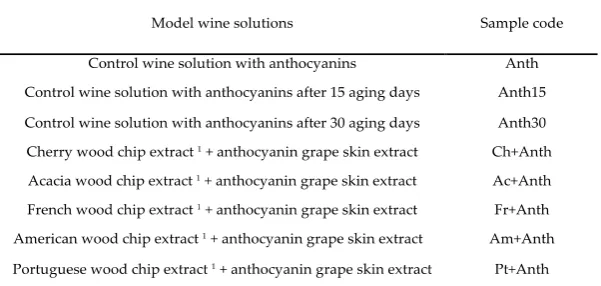
Table 1. Experimental red model wine solutions with different combinations prepared in this study.
1 Model wine solutions containing wood chips extracts obtained after 15 or 30 extraction days (codes = ext15 and ext30,
respectively).
2.5. Total phenol and anthocyanin content
Total phenol content was quantified by the use of Folin-Ciocalteau reagent, using gallic acid as standard [25]. The results were expressed as gallic acid equivalents. Total anthocyanin content was quantified by measuring the changes of color according to the pH of the medium [26]. The results were expressed as malvidin-3-monoglucoside equivalents.
2.6. Individual anthocyanins analysis
Individual anthocyanins were analyzed by HPLC-DAD (Agilent LC-DAD series 1100,
Waldbronn, Germany) in gradient mode using a C18 column, (Nova-Pack®, 300 mm x 3.9 mm, particle
size 5 μm) following the method described by Pérez-Magariño and González-Sanjosé [27].
Simultaneous detection was performed between 313 and 530 nm and the UV-Vis spectra were recorded for all peaks. Both information, together with retention time, were useful to name the anthocyanins quantified. The quantification of the individual anthocyanins was made by mean of calibration curve obtained with standard solutions of malvidin-3-monoglucoside chloride (>95 % purity, Extra-synthese, Genay, France).
2.7. Chromatic parameters evaluation
Color intensity (A420+A520+A620) and tonality (A420/A520) was determined using the analytical
methodology described by Glories [28], while CIELaB* coordinates L* (%) (lightness), a* (redness) and
b* (yellowness), were evaluated according to OIV method [29]. To distinguish the color more
accurately, the color difference was also calculated using the following formula: (ΔE=[(ΔL*)2+(Δa*)2+(Δb*)2]1/2). Color differences can be distinguished by the human eye when the
differences between ΔE values are higher or equal to 3 CIELab units [30].
2.8. Statistical analysis
3. Results and Discussion
According to the main aim of this study, discussion of the obtained results will be focused on the effect of wood extractable components on the chromatic characteristics of red model wine and on the anthocyanins, which are the compounds with more influence on red wine color.
3.1. Effect on chromatic characteristics of red model wine solutions
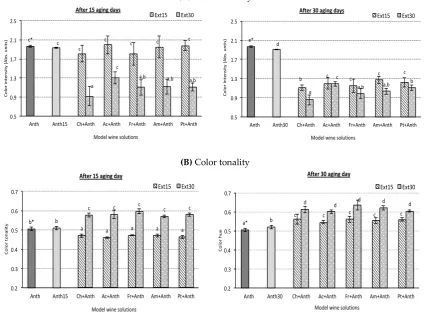
It is well known that during storages and aging period, red wine color commonly change. Thus, a decrease of color intensity occurs together with a color tonality increase. Obtained results of chromatic characteristics agree with these usual changes of wine color (Figure 1 and Table 2). The decrease of color intensity detected in the different experimental model wine solutions was intense in all cases (an average value reduction ranged from 21.7 to 38.3%, respectively after 15 and 30 aging days) although it was quicker when wood extracts of 30 extraction days were used. In these cases, significant decreases were observed after the first 15 aging days, whiles extracts of 15 extraction days produced significant changes only after one month of aging (Figure 1 A).
(A) Color intensity
e* d
b c c c
c
a c
a,b a,b b
0.5 0.9 1.3 1.7 2.1 2.5
Anth Anth30 Ch+Anth Ac+Anth Fr+Anth Am+Anth Pt+Anth
C o lo r In te n si ty (A b s. u n ti s)
Model wine solutions
After 30 aging days
Ext15 Ext30
c* c
c c
c c c
a c
a,b a,b a,b
0.5 0.9 1.3 1.7 2.1 2.5
Anth Anth15 Ch+Anth Ac+Anth Fr+Anth Am+Anth Pt+Anth
C o lo r in te n si ty (A b s. u n it s)
Model wine solutions
After 15 aging days
Ext15 Ext30
(B) Color tonality
b* b
a a a a a
c c c c c
0.2 0.3 0.4 0.5 0.6 0.7
Anth Anth15 Ch+Anth Ac+Anth Fr+Anth Am+Anth Pt+Anth
C o lo r to n a li ty
Model wine solutions After 15 aging day
Ext15 Ext30
a* b
c c c c c
d d d d d
0.2 0.3 0.4 0.5 0.6 0.7
Anth Anth30 Ch+Anth Ac+Anth Fr+Anth Am+Anth Pt+Anth
C o lo r h u e
Model wine solutions After 30 aging day
Ext15 Ext30
Figure 1. Color intensity (A) and tonality (B) quantified in red model wine solutions containing different wood chips species and anthocyanin grape skin extracts after 15 and 30 aging days (sample codes see Table 1).
All data express the average of four replicates ± standard deviation; data points showing the same letter are not significantly different (p < 0.05).
Respect to color tonality (Figure 1 B), significant and similar increases were detected for all model wine solutions containing the wood extracts with similar extraction time and the anthocyanin extracts. In agreement with the changes in color intensity, tonality increased quicker and more intensively when wood extracts obtained after 30 extraction days were used. In this case, no significantly effect of wood species were observed. Tonality results agree previous data obtained in red wines aging with oak chips [5, 23, 32].
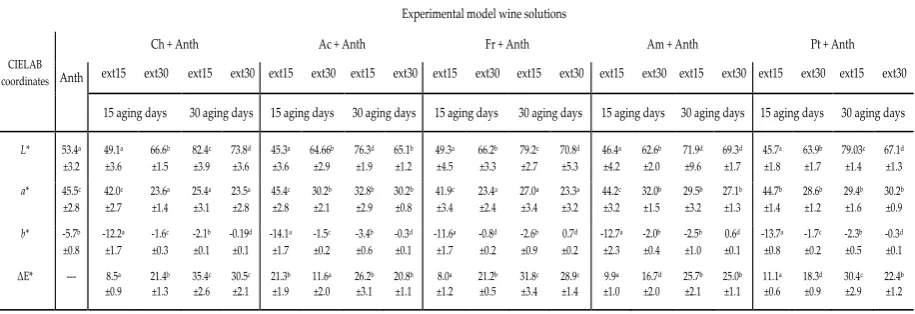
Regarding to CIELab* parameters (Table 2), lightness (L*) values showed the usual increase
tendency which correspond to color losses, mainly with the reduction of absorbance at 525 nm [33].
Thus, L* values showed the same tendency that color intensity, being the model wine solutions
containing wood extracts of 30 extraction days, those that induced quicker L* value changes. In
addition, the general decrease tendency observed for a* (redness) agree with the observed results for
color intensity showed in Figure 1A. The a* values decreases were particularly intense when wood
chips extracts obtained after 30 extraction days were used. In addition, the lower a* values were detected when wood chips extracts from French oak and cherry wood were used. Previously, Jordão et al. [11, 12] also reported for model wine solutions containing malvidin-3-glucoside, a decrease of
this anthocyanin and a* values more pronounced when in presence of oak wood extracts.
Furthermore, for b* values (yellowness), in general, an increase of the values was detected.
Corresponding with the increase of color tonality, b* values in general increased after mixed
anthocyanin and wood extracts (Table 2). This fact pointed out a clear increase of the yellow color that was more intense when extracts of oak wood species (French, American and Iberian species) were used. Beside of this, results of 15 days of maceration extracts wrote down significant increase of
b* values after the first 15 aging days. This point together with the stability of a* values could point
out a possible protective color of these extracts but only during this period. It is important to note
that the extraction of several wood phenolic compounds could explain an increase in b* values
(yellowness) that was already detected in red and white wines aged in contact with different wood chips [22, 23].
Table 2.CIELab chromatic coordinates (L*, a* and b*) and color difference (ΔE) quantified in red model wine solutions containing different wood chips species and anthocyanin grape skin extracts after 15 and 30 aging days (sample codes see table 1).
L* (%) (lightness); L* (%) (lightness); a* (from green (-) to red (+) ); b* (from blue (-) to yellow (+) ); ΔE* total color difference; the values corresponding to ΔE* were obtained taking as a reference the anthocyanin extract solution alone. Data points derived for each CIELab coordinate in same line showing the same letter are not significantly different (p < 0.05). ± Standard deviation. Average values of four replicates.
Finally, the values obtained for color difference (ΔE) between control and the other model wine
solutions showed that in all cases ΔE values were much higher than 3 CIELab units (values ranging
from 8.0 to 35.4 CIELab units, Table 2) and then all chromatic modifications were potentially
detected by human eyes [30]. According to previously commented results, ΔE values showed
Considering all chromatic results obtained it is possible to assert that as higher levels of extractable wood components (Table 3), higher modification of color was observed, and this fact could have negative consequences on quality, especially due to a the drastic reduction of the color intensity. In fact, it was clear that model wine solutions containing extracts obtained with higher extraction time (30 days), showed in general a significant increase of total phenolic content.
Table 3.Total phenolic content (mg/L expressed in gallic acid equivalents) quantified in experimental model wine solutions containing different wood chips species after 15 and 30 extraction days.
All data express the average of three replicates ± standard deviation. Values with same letter are not significantly different (p < 0.05); wherein for same
1
column capital letters are used for wood chips species factor, while for the same line small letters are used for extraction time factor
2
3.2. Effect on total anthocyanin and phenolic levels
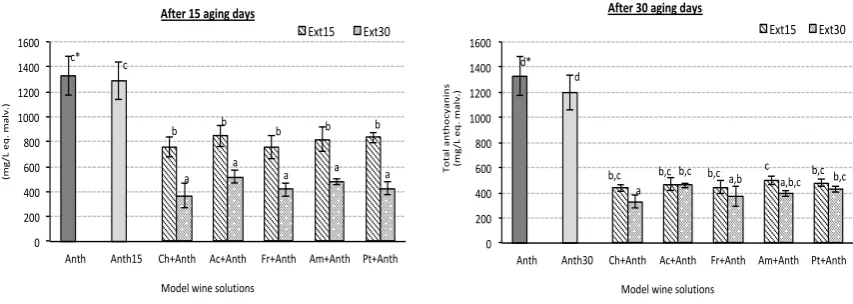
Results showed an intense and quick reduction of the global level of total anthocyanins in model wines solutions with wood extracts of 30 days of maceration, and similar results were observed until one month of aging of model wines containing wood extracts of 15 days of maceration (Figure 2). These results explain the evident decrease of color intensity and a* values
commented previously. Furthermore, it is well correlated with the increase of L* values, since losses
of red pigments produce lighter solutions.
c* c
b b b b b
a a
a a a
0 200 400 600 800 1000 1200 1400 1600
Anth Anth15 Ch+Anth Ac+Anth Fr+Anth Am+Anth Pt+Anth
T
o
ta
l
a
n
th
o
c
y
a
n
in
s
(m
g
/L
e
q
.
m
a
lv
.)
Model wine solutions After 15 aging days
Ext15 Ext30
d* d
b,c b,c b,c c b,c
a b,c
a,b a,b,c b,c
0 200 400 600 800 1000 1200 1400 1600
Anth Anth30 Ch+Anth Ac+Anth Fr+Anth Am+Anth Pt+Anth
T
o
ta
l
a
n
th
o
c
y
a
n
in
s
(m
g
/L
e
q
.
m
a
lv
.)
Model wine solutions After 30 aging days
Ext15 Ext30
Figure 2. Total anthocyanins quantified in experimental red model wine solutions containing different wood chips extract species and anthocyanin grape skin extracts after 15 and 30 aging days (sample codes see table 1).
All data express the average of four replicates ± standard deviation; * data points showing the same letter are not significantly different (p < 0.05).
higher absorbance in the visible region around 400-460 nm, that correspond with yellow-brown
tones, justifying the previously commented increase of tonality and b* values. These results are
contrary to previous works in which wood contact was described as a stabilizing wine color process [32, 34]. However, it is interesting have in mind that the cited studies were carried out in wines, where other many compounds can interfere the reactions occurring between anthocyanins and wood compounds, and where anthocyanins can be in more stable structures (co-pigmented and condensed forms) than the “free anthocyanins” extracted from red grapes skins.
From other point of view, results also showed that the effect of extractable wood components seems to be independent of the quantity and type of extractable wood compounds since all the extracts, independent of their global phenolic content (Table 3), produced similar final effect.
Levels of total phenolic of the wood extracts were significant different respect both factors, wood species and maceration time. In general, as longer the extraction time higher the quantity of total phenols extracted. However, the increase ratio was very different among wood species. Thus, whiles American oak extracts showed very low increment with the time of extraction, that in fact was not statistically significant, French oak extracts showed the highest increase around 42%, followed by Acacia extracts (around 28%) and cherry and Portuguese oak extracts with increment between 15 and 18%, respectively. These results agree those of previous works which pointed out that each type of wood showed particular extraction kinetics [35]. For example, the anatomical structure of the American oak wood itself, including its porosity, makes ease the extraction of wood components. This fact may explain that most extractable compounds of American oak were extracted during the first 15 days of maceration. Furthermore, results agree with previous studies that reported a variability of total and individual extractable phenolic compounds between oak and other no oak wood species, and indicated higher total phenolic composition of oak woods in comparison with cherry wood [21-23, 31, 36, 37]. In addition, the slight influence of wood species factor on the final levels of total anthocyanins of the model solutions agree with previous work [34] carried out with chips of different types of oak and with diverse toasting degree.
3.3. Effect on individual anthocyanin levels
The analysis of the levels of some individual anthocyanins gave more information about the anthocyanin transformation globally tested by the decrease of total anthocyanins levels.
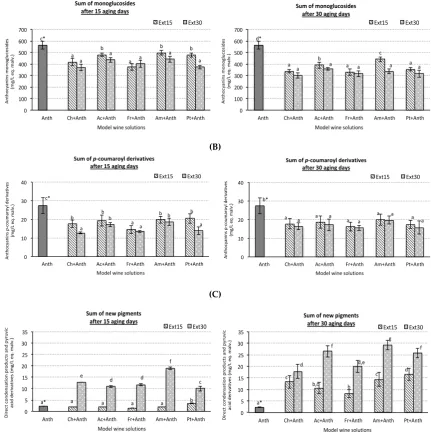
Levels of free monoglucoside anthocyanins, which includes -3-0-glucosil derivatives of cyanidin, delphinidin, malvidin, peonidin and petunidin, were significant lower in all model solutions containing wood extracts than in control solution, containing only grape skin anthocyanin extract (Figure 3A). In general, the lowest levels were measured under 30 days of storage. Mean loss of monoglucoside anthocyanins level was around 45%, indicating a drastic reduction of free anthocyanin pigments. Barrera-García et al. [4] also reported 30% lower levels of malvidin-3-monoglucoside after 20 days of contact with wood extracts in model wine solution. Nor remarkable differences were detected for the extracts with 15 and 30 days of extraction, neither respect the wood species factor. These results are contrary to other published works. Thus, Del Álamo Sanza et al. [5, 32] reported a greater decrease of monomeric anthocyanins in red wines aged with French than those aged with American oak. In addition, other authors [34] reported a significant effect of oak wood origin on the individual anthocyanin level of a wine macerated with chips, however the effect was variety wood dependent. Once more, the cited differences could be attributed to the effect of other compounds present in wines and no in the model solutions, which can interfere in the reactions that occurring between anthocyanins and wood compounds. In addition, it is important to note that some anthocyanins (co-pigmented and condensed forms), formed during fermentation and others during the winemaking process, are in more stable structures in wines.
c* a b a b b a a
a a a
0 100 200 300 400 500 600 700
Anth Ch+Anth Ac+Anth Fr+Anth Am+Anth Pt+Anth
A n th o cy a n in s m o n o g lu co si d e s (m g /L e q . m a lv .)
Model wine solutions
Sum of monoglucosides after 15 aging days
Ext15 Ext30
d*
a b a
c a
a a a a a
0 100 200 300 400 500 600 700
Anth Ch+Anth Ac+Anth Fr+Anth Am+Anth Pt+Anth
A n th o cy a n in s m o n o g lu co si d e s (m g /L e q . m a lv .)
Model wine solutions
Sum of monoglucosides after 30 aging days
Ext15 Ext30 (B) c* b b a b b a b a b a 0 10 20 30 40
Anth Ch+Anth Ac+Anth Fr+Anth Am+Anth Pt+Anth
A n th o cy an in s p -c o u m ar o yl d e ri va ti ve s (m g/ L e q .m al v. )
Model wine solutions
Sum ofp-coumaroyl derivatives after 15 aging days
Ext15 Ext30
b*
a a a a a
a a a
a a 0 10 20 30 40
Anth Ch+Anth Ac+Anth Fr+Anth Am+Anth Pt+Anth
A n th o cy an in s p -c o u m ar o yl d e ri va ti ve s (m g/ L e q .m al v. )
Model wine solutions
Sum ofp-coumaroyl derivatives after 30 aging days
Ext15 Ext30
(C)
a* a a a a b
e d d f c 0 5 10 15 20 25 30 35
Anth Ch+Anth Ac+Anth Fr+Anth Am+Anth Pt+Anth
D ir e ct co n d e n sa ti o n p ro d u ct s a n d p y ru vi c a ci d d e ri va ti ve s (m g /L e q . m a lv .)
Model wine solutions
Sum of new pigments after 15 aging days
Ext15 Ext30 a* c b,c b c d d f d,e g f 0 5 10 15 20 25 30 35
Anth Ch+Anth Ac+Anth Fr+Anth Am+Anth Pt+Anth
D ir e ct co n d e n sa ti o n p ro d u ct s a n d p y ru vi c a ci d d e ri va ti ve s (m g /L e q . m a lv .)
Model wine solutions
Sum of new pigments after 30 aging days
Ext15 Ext30
Figure 3. Sum of anthocyanins monoglucoside derivates (A), sum of anthocyanins p-coumaroyl derivates (B) and sum of new pigments formed (C), quantified in experimental red model wine solutions containing different wood chips extract species and anthocyanin grape skin extracts after 15 and 30 aging days (sample codes see table 1).
All data express the average of four replicates ± standard deviation; * data points showing the same letter are not significantly different (p < 0.05).
Similarly to monoglucoside anthocyanins, levels of the main p-coumaroyl derivatives (Figure
3B) were also significant lower in all model wines containing wood extracts than in the control model wines and no remarkable differences among species were detected. In addition, the decrease
ratio of p-coumaroyl derivatives was lower than that of monoglucoside derivatives (30%). These
results agree with the higher stability of acyl-anthocyanins respect to no-acylated derivatives already reported by other authors [38-40]. According to Smart [41], wines made from red grapevine cultivars with high proportions of acylated anthocyanins can have greater color stability compared with those from red varieties with no acylated anthocyanins, such as cv Pinot Noir.
different, fact that allow to difference ones to the others. In general, all the new pigments showed UV-Vis spectrum with the maximum of absorbance in visible zone lower than 520 nm. No all the new pigments detected (chromatographic peaks) could be identified and named. Beside of this, those “new” chromatographic peaks well defined were considered together, being named new pigments group (Figure 3C).
The levels of new pigments were higher when wood extracts of 30 days of extraction were used, and new pigment levels increased along the time of storages. Previously, Jordão et al. [12] reported the formation of new compounds detected in model wine solutions containing malvidin-3-monoglucoside and oak wood extracts after a short storage period. According to these new compounds showed a slightly increase during 64 storage days.
Significant effects of wood species and maceration time factors on new pigment formation were detected. Wood extracts of 30 days of maceration produced higher and quicker increases than those of 15 days. After 15 days of aging, levels of these pigments were between 4 and 8 times higher than in control wine, and after 30 days of aging raised increase ranged between 7 and 13 times. The extracts of American oak and 30 extraction days, induced the quickest and maximum formation of this type of new pigments, and only model wines with wood extracts of acacia and Portuguese oak, obtained after 30 extraction days, showed levels of new pigments similar to them.
Observed results could be explained by the ability of anthocyanins to interact with wood components. Among extractable wood components, ellagitannins are easily extracted from wood by water-alcohol and water-acetone mixtures [11, 42], and ellagitannins can indeed react with flavanols and anthocyanins to provide condensation products [43-45]. Then, a dynamic evolution from several interaction reactions and subsequent transformation of the original pigments results. The loss of free
anthocyanins and the new compounds formed contribute to the color differences (ΔE), that were
commented previously. Several authors [18, 31] reported that the use of cherry barrels in wine aging induce a faster evolution of wine pigments with a quick augmentation formation of derived and polymeric compounds with a consequently decrease of anthocyanin content. However, for the different model wine solutions studied it was not evident a more marked increased in new pigments formed in solutions containing cherry wood extracts compared to the others. Probably other compounds, than the anthocyanins themselves may play an important role in new pigments formation. For example, condensed tannins present in wines may help to explain a greater evolution in the formation of new compounds during the wine aging process in contact with the cherry wood, in comparison to the verified in the model solutions studied.
4. Conclusions
The present work points out the impact of the different wood chip species (oak, acacia and cherry) on anthocyanin content and chromatic characteristics of model wine solutions during the contact time considered. Thus, the obtained results indicated that the interaction of anthocyanins with wood extracted components and the changes of chromatic characteristics derived of these interactions seems to be independent of the wood species.
To the best of our knowledge, this is the first or one of the first research that has investigated the impact of the use of no oak wood chip species (cherry and acacia) on individual anthocyanin composition and chromatic characteristics of model wine solutions. In this sense, the obtained results may contribute to a better understanding of the chromatic changes of red wines when aged in contact with acacia and cherry wood chips. However, further research, will be necessary to improve the knowledge about the potential impact of the use of oak and no oak wood chip species on wine quality.
Author Contributions: Conceptualization, A.M.J. and M.L.G.-S.; methodology, M.L.G.-S.; validation, A.M.J. and M.L.G.-S.; Lab analysis, V.L.; data analysis, A.M.J., V.L. and M.L.G.-S; writing-original draft preparation, A.M.J.; writing-review and editing, A.M.J. and M.L.G.-S; project administration, M.L.G.-S.
Conflicts of Interest: The authors declare no conflict of interest.
References
1. Pomar, M.; Gonzalez-Mendoza, L.A. Changes in composition and sensory quality of red wine aged in American and French oak barrels. J. Int. Sci. Vigne Vin2001, 35, 41-48.
2. De Coninck, G.; Jordão, A.M.; Ricardo-da-Silva, J.M.; Laureano, O. Evolution of phenolic composition and sensory properties in red wine aged in contact with Portuguese and French oak wood chips. J. Int. Sci.
Vigne Vin2006, 40, 25-34.
3. Gonçalves, F.J.; Jordão, A.M. Changes in antioxidant activity and proanthocyanidin fraction of red wine aged in contact with Portuguese (Quercus pyrenaica Willd.) and American (Quercus alba L.) oak wood chips.
Ital. J. Food Sci.2009, 21, 51-64.
4. Barrera-García, V.D.; Gougeon, R.D.; Majo, D.D.; Aguirre, C.; Voilley, A.; Chassagne, D. Different sorption behaviors for wine polyphenols in contact with oak wood. J. Agric. Food Chem.2007, 55, 7021-7027. 5. Del Álamo Sanza, M.; Domínguez, I.N. Wine aging in bottle from artificial systems (staves and chips) and
oak woods: anthocyanin composition. Anal. Chim. Acta2006, 563, 255-263.
6. Gambuti, A.; Capuano, R.; Lisanti, M.T.; Strollo, D.; Moio, L. Effect of aging in new oak, one-year-used oak, chestnut barrels and bottle on color, phenolics and gustative profile of three monovarietal red wines.
Eur. Food Res. Technol.2010, 231, 455-465.
7. Cejudo-Bastante, M.J.; Hermosín-Gutiérrez, I.; Pérez-Coello, M.S. Micro-oxygenation and oak chip treatments of red wines: Effects on colour-related phenolics, volatile composition and sensory characteristics. Part II: Merlot wines. Food Chem.2011, 124, 738-748.
8. Gortzi, O.; Metaxa, X.; Mantanis, G.; Lalas, S. Effect of artificial ageing using different wood chips on the antioxidant activity, resveratrol and catechin concentration, sensory properties and colour of two Greek red wines. Food Chem.2013, 141, 2887-2895.
9. Revilla, I.; González -Sanjosé, M.L.; Gómez-Cordovés, M.C. Chromatic modifications of aged red wines depending on aging barrel type. Food Sci. Technol. Int.1999, 5, 177-181.
10. Es-Safi, N.E.; Le Guernevé, C.; Fulcrand, H.; Cheynier, V.; Moutounet, M. Xanthylium salts formation involved in wine colour changes. Int. J. Food Sci. Technol.2000, 35, 63-74.
11. Jordão, A.M.; Ricardo-da-Silva, J.M.; Laureano, O. Effect of oak wood constituents and oxygen on the evolution of malvidin-3-glucoside and (+)-catechin in model wine. Am. J. Enol. Vitic.2006, 57, 377-381. 12. Jordão, A.M.; Ricardo-da-Silva, J.M.; Laureano, O.; Mullen, W.; Crozier, A. Effect of ellagitannins, ellagic
acid and some volatile compounds from oak wood on the (+)-catechin, procyanidin B1 and malvidin-3-glucoside content of model wine solutions. Aust. J. Grape Wine R.2008,14, 260-270.
13. De Freitas, V.; Sousa, C.; González-Paramás, A.M.; Santos-Buelga, C.; Mateus, N. Synthesis of new catechin-pyrylium derived pigment. Tetrahedron Lett.2004, 45, 9349-9352.
14. Pissarra, J.; Lourenço, S.; González-Paramás, A.M.; Mateus, N.; Santos-Buelga, C.; Silva, A.M.S.; De Freitas, V. Isolation and structural characterization of new anthocyanin-alkyl-catechin pigments. Food Chem. 2005, 90, 81-87.
15. Sousa, C.; Mateus, N.; Perez-Alonso, J.; Santos-Buelga, C.; De Freitas, V. Preliminary study of oaklins, a new class of brick-red catechinpyrylium pigments from the reaction between catechin and wood aldehydes. J. Agric. Food Chem.2005, 53, 9249-9256.
16. Lefeuvre, D.; Jourdes, M.; Quideau, S.; Saucier, C.; Glories, Y. Hemissyntheses of anthocyano-ellagitannins. Proceedings of XXII International Conference on Polyphenols, Helsinki, Finland, Antti Hoikkala and Otto Soidinsalo edition (University of Helsinki: Helsinki) 2004, 657–658.
17. Kozlovic, G.; Jeromel, A.; Maslov, L.; Pollnitz, A.; Orlic, S. Use of acacia barrique barrels- Influence on the quality of Malvazika from Istria wines. Food Chem.2010, 120, 698-702.
18. Chinnici, F.; Natali, N.; Sonni, F.; Bellachioma, A.; Riponi, C. Comparative changes in color features and pigment composition of red wines aged in oak and cherry wood casks. J. Agric. Food Chem. 2011, 59, 6575-6682.
20. Fernández de Simon, B.; Sanz, M.; Cadahía, E.; Martínez, J.; Esteruelas, E.; Muñoz, A.M. Polyphenolic compounds as chemical markers of wine ageing in contact with cherry, chestnut, false acacia, ash and oak wood. Food Chem.2014, 143,66-76.
21. Chinnici, F.; Natali, N.; Bellachioma, A.; Versari, A.; Riponi, C. Changes in phenolic composition of red wines aged in cherry wood. LWT - Food Sci. Technol.2015, 60, 977-984.
22. Délia, L.; Jordão, A.M.; Ricardo-da-Silva, J.M. Influence of different wood chips species (oak, acacia and cherry) used in a short period of aging on the quality of 'Encruzado' white wines. Mitt. Klosterneuburg 2017, 67, 84-96.
23. Tavares, M.; Jordão, A.M.; Ricardo-da-Silva, J.M. Impact of cherry, acacia and oak chips on red wine phenolic parameters and sensory profile. OENO One2017, 51, 329-342.
24. Gonzaléz-Sanjosé, M.L.; DiStefano, R. Fattori che condizionano la stabilità degli antociani in soluzione.
Riv. Viticoltura e Enologia1990, 43, 63-68.
25. Singleton, V.L.; Rossi, J.A. Colorimetry of total phenolics with phosphomolybdic-phosphotungstic acid reagents. Am. J. Enol. Vitic. 1965, 16, 144-158.
26. Paronetto, L. Polifenoli e tecnica enologica. Ed. Edagricole, Milano, 1977.
27. Pérez-Magariño, S.; González-SanJosé, M.L. Evolution of flavanols, anthocyanins, and their derivatives during the aging of red wines elaborated from grapes harvested at different stages of ripening. J. Agric.
Food Chem. 2004, 52, 1181-1189.
28. Glories, Y. La couleur des vins rouges II. Connaiss. Vigne Vin1984, 18, 253-271.
29. OIV. Organisation International de la Vigne et du Vin. International Oenological Codex. 2012, Edition Officielle, Paris.
30. Martínez, J.A.; Melgosa, M.; Pérez, M.M.; Hita, E.; Negueruela, A.I. Visual and instrumental color evaluation in red wines. Food Sci. Technol. Int. 2001, 7, 439-444.
31. De Rosso, M.; Panighel, A.; Dalla Vedova, A.; Stella, L.; Flamini, R. Changes in chemical composition of a red wine aged in acacia, cherry, chestnut, mulberry, and oak wood barrels. J. Agric. Food Chem. 2009, 57, 1915-1920.
32. Del Álamo Sanza, M.; Domínguez, I.N.; Merino, S.G. Influence of different aging systems and oak woods on aged wine color and anthocyanin composition. Eur. Food Res. Technol. 2004, 219, 124-132.
33. Pérez-Magariño, S.; González-Sanjosé, M.L. Application of absorbance values used in wineries for estimating CIELAB parameters in red wines. Food Chem.2003, 81, 301-306.
34. Perez-Magariño, S.; Ortega-Heras, M.; Cano-Mozo, E.; Gonzaléz-SanJosé, M.L. The influence of oak wood chips, micro-oxygenation treatment, and grape variety on colour, and anthocyanin and phenolic composition of red wines. J. Food Compos. Anal.2009, 22, 204-211.
35. Fernández de Simón, B.; Cadahía, E.; Muiño, I.; Del Álamo-Sanza, M.; Nevares, I. Volatile composition of toasted oak chips and staves and of red wine aged with them. Am. J. Enol. Vitic.2010, 61, 157-165.
36. De Rosso, M.; Cancian, D.; Panighel, A.; Dalla Vedova, A.; Flamini, R. Chemical compounds released from five different woods used to make barrels for aging wines and spirits: volatile compounds and polyphenols. Wood Sci. Technol.2009, 43, 375-385.
37. Soares, B.; Garcia, R.; Costa, A.M.; Cabrita, M.J. Phenolic compounds realesed from oak, cherry, chestnut and robinia chips into a synthetic wine: influence of toasting level. Ciênc. Tec. Vitivinic.2012, 27, 17-26. 38. Liazid, A.; Barbero, G.F.; Azaroual, L.; Palma, M.; Barroso, C.G. Stability of anthocyanins from red grape
skins under pressurized liquid extraction and ultrasound-assisted extraction conditions. Molecules2014, 19, 21034-21043.
39. Rinaldo, A.M.; Cavallini, E.; Jia, Y.; Moss, S.M.A.; McDavid, D.A.J.; Hooper, L.C.; Robinson, S.P.; Tornielli, G.B.; Zenoni, S.; Ford, C.M.; Boss, P.K.; Walker, A.R. A grapevine anthocyanin acyltransferase, transcriptionally regulated by VvMYBA, can produce most acylated anthocyanins present in grape skins.
Plant Physiol. 2015, 169, 1897-1916.
40. Zhao, C.L.; Yu, Y.Q.; Chen, Z.J.; Wen, G.S.; Wei, F.G.; Zhen, Q.; Wang, C.D.; Xiao, X.L. Stability-increasing effects of anthocyanin glycosyl acylation. Food Chem.2017, 214, 119-128.
41. Smart, R. Pinot Noir: the ultimate viticultural challenge ? Aust. Grapegrower Winemaker 1992, 340, 77-85. 42. Jordão, A.M.; Ricardo-da-Silva, J.M.; Laureano, O. Ellagitannins from Portuguese oak wood (Quercus
pyrenaica Willd.) used in cooperage: Influence of geographical origin, coarseness of the grain and toasting
43. Fukui, Y.; Nomoto, K.; Iwashita, T.; Masuda, K.; Tanaka, Y.; Kusumi, K. Two novel blue pigments with ellagitannin moiety, rosacyanins A1 and A2, isolated from the petals of Rosa hybrida. Tetrahedron 2006, 62, 9661-9670.
44. Saucier, C.; Jourdes, M.; Glories, Y.; Quideau, S. Extraction, detection, and quantification of flavano-ellagitannins and ethylvescalagin in a Bordeaux red wine aged in oak barrels. J. Agric. Food Chem. 2006, 54, 7349-7354.
45. Quideau, S.; Jourdes, M.; Lefeuvre, D.; Montaudon, D.; Saucier, C.; Glories, Y.; Pardon, P.; Pourquier, P. The chemistry of wine polyphenolic C-glycosidic ellagitannins targeting human topoisomerase II. Chem.
Eur. J.2005, 11, 6503-6513.