ISSN (Print) : 2320 – 3765 ISSN (Online): 2278 – 8875
I
nternational
J
ournal of
A
dvanced
R
esearch in
E
lectrical,
E
lectronics and
I
nstrumentation
E
ngineering
(An ISO 3297: 2007 Certified Organization)
Vol. 4, Issue 3, March 2015
Simulation of an Interline Dynamic Voltage
Restoring and Displacement Factor
Controlling Device (IVDFC)
V. Jayalakshmi, Jafar Ali, S.P.Vijayaragavan
Assistant Professor, Dept. of EEE, Bharath University, Chennai, Chennai, Tamil Nadu, India
Dept. of EEE, Bharath University, Chennai, Tamil Nadu, India
Assistant Professor, Dept. of EEE, Bharath University, Chennai, Tamil Nadu, India
ABSTRACT: An interline dynamic voltage restorer (IDVR) is invariably employed in distribution systems to mitigate voltage sag/swell problems. An IDVR merely consists of several dynamic voltage restorers (DVRs) sharing a common dc link connecting independent feeders to secure electric power to critical loads. While one of the DVRs compensates for the local voltage sag in its feeder, the other DVRs replenish the common dc-link voltage. For normal voltage levels, the DVRs should be bypassed. Instead of bypassing the DVRs in normal conditions, this paper proposes operating the DVRs, if needed, to improve the displacement factor (DF) of one of the involved feeders. DF improvement can be achieved via active and reactive power exchange (PQ sharing) between different feeders. To successfully apply this concept, several constraints are addressed throughout the paper. Simulation results elucidate and substantiate the proposed concept
I. INTRODUCTION
ISSN (Print) : 2320 – 3765 ISSN (Online): 2278 – 8875
I
nternational
J
ournal of
A
dvanced
R
esearch in
E
lectrical,
E
lectronics and
I
nstrumentation
E
ngineering
(An ISO 3297: 2007 Certified Organization)
Vol. 4, Issue 3, March 2015
the voltage requirements of the semiconductor devices). The DVR is one of the most common and effective solutions for protecting critical loads against voltage sags. The DVR is a power electronic device used to inject three-phase voltages in series and in synchronism with the distribution feeder voltages in order to compensate for voltage sags. Moreover, it can be effectively used to enhance the fault ride through capability in wind applications.[5-7] Detection time is an important factor in the voltage restoration process. Fast detection algorithms and effective control schemes for a DVR are proposed in [8] and [9], respectively. Space vector modulation (SVM) is the recommended modulation scheme in a DVR due to its simple digital realization and improved dc-link utilization [10]. In distribution systems, load voltage restoration can be achieved by injecting active and/or reactive power into the distribution feeder. Active power capability of the DVR is governed by the capacity of the energy storage element and the employed compensation technique [11]. Several control techniques have been proposed for voltage sag compensation, such as presag, in-phase, and minimal energy control approaches [12]. If the required power for voltage restoration is obtained from the neighboring feeder(s), the compensating device is technically called an interline dynamic voltage restorer (IDVR) [13]. The basic concept behind the IDVR is derived from the interline power flow controller (IPFC) proposed by Gyugyi in 1999 [14] to exchange power between parallel transmission lines.
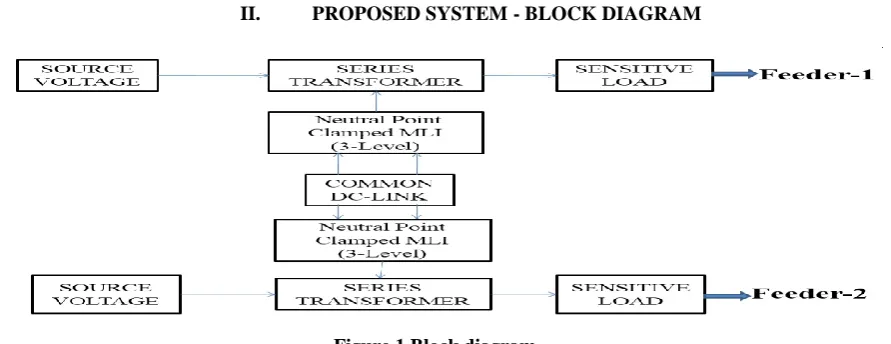
II. PROPOSED SYSTEM - BLOCK DIAGRAM
Figure 1 Block diagram Description:
• The Neutral Point Clamped MLI is also Known as Diode Clamped MLI.
• The NPC Inverter (or) the Diode Clamped MLI topology based IDVR is proposed to compensate voltage sag/swell and also to suppress the odd order harmonics .
• It can be employed in normal as well as in abnormal conditions in distribution system.
Dc link
A DC link exists between a rectifier and an inverter, for example, in a VFD or phase converter. On one end, the utility connection is rectified into a high voltage DC. On the other end, that DC is switched to generate a new AC power waveform. It's a link because it connects the input and output stages.
The term "DC link" is also used to describe the decoupling capacitor in the DC link. I assume that this is what you're asking about. The switching network on the output side generates very large transients at the switching frequency. The DC link capacitor helps to keep these transients from radiating back to the input. This can also help prevent the switching network from oscillating or triggering inadvertently at an inappropriate moment and causing a short. Additionally, if the input is not multiple-phase, the capacitor helps provide a source of energy when the input waveform is near zero.[15]
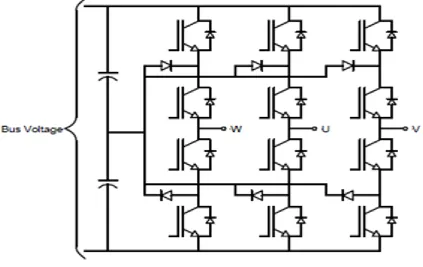
Neutral Point Clamped (NPC) inverter
ISSN (Print) : 2320 – 3765 ISSN (Online): 2278 – 8875
I
nternational
J
ournal of
A
dvanced
R
esearch in
E
lectrical,
E
lectronics and
I
nstrumentation
E
ngineering
(An ISO 3297: 2007 Certified Organization)
Vol. 4, Issue 3, March 2015
twice that of the actual switching frequency. Should an output filter be required, the components will be smaller and less costly than for an equivalent rated two level inverter. Most often the NPC inverter is used for higher voltage inverters. Because the IGBTs are only subjected to half of the bus voltage, lower voltage IGBT modules can be used. Powerex’s TLI series of IGBT modules provides a cost effective way to bring the advantages of this topology to 460V applications. For more detailed information please refer to the datasheets located on the Powerex web site. Basic Circuit Configuration and Its Behavior Figure 1 shows the circuit configuration of the NPC inverter. Each leg has four IGBTs connected in series. The applied voltage on the IGBT is one-half that of the conventional two level inverter. The bus voltage is split in two by the connection of equal series connected bus capacitors. Each leg is completed by the addition of two clamp diodes.
Figure 2 NPC inverter
ISSN (Print) : 2320 – 3765 ISSN (Online): 2278 – 8875
I
nternational
J
ournal of
A
dvanced
R
esearch in
E
lectrical,
E
lectronics and
I
nstrumentation
E
ngineering
(An ISO 3297: 2007 Certified Organization)
Vol. 4, Issue 3, March 2015
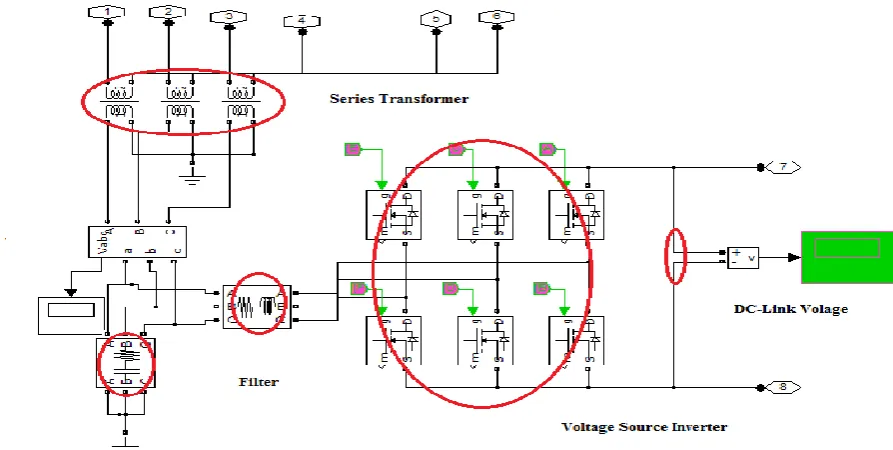
III. SIMULATION ANALYSIS
Figure 3 Simulation Circuit of an -IDVR DVR(Subsystem)-Voltage Source Converter
ISSN (Print) : 2320 – 3765 ISSN (Online): 2278 – 8875
I
nternational
J
ournal of
A
dvanced
R
esearch in
E
lectrical,
E
lectronics and
I
nstrumentation
E
ngineering
(An ISO 3297: 2007 Certified Organization)
Vol. 4, Issue 3, March 2015
Feeder-1 Output Voltage & Current Waveform
ISSN (Print) : 2320 – 3765 ISSN (Online): 2278 – 8875
I
nternational
J
ournal of
A
dvanced
R
esearch in
E
lectrical,
E
lectronics and
I
nstrumentation
E
ngineering
(An ISO 3297: 2007 Certified Organization)
Vol. 4, Issue 3, March 2015
Injected DVR Voltage Waveform
ISSN (Print) : 2320 – 3765 ISSN (Online): 2278 – 8875
I
nternational
J
ournal of
A
dvanced
R
esearch in
E
lectrical,
E
lectronics and
I
nstrumentation
E
ngineering
(An ISO 3297: 2007 Certified Organization)
Vol. 4, Issue 3, March 2015
Figure 5 simulation Results
ISSN (Print) : 2320 – 3765 ISSN (Online): 2278 – 8875
I
nternational
J
ournal of
A
dvanced
R
esearch in
E
lectrical,
E
lectronics and
I
nstrumentation
E
ngineering
(An ISO 3297: 2007 Certified Organization)
Vol. 4, Issue 3, March 2015
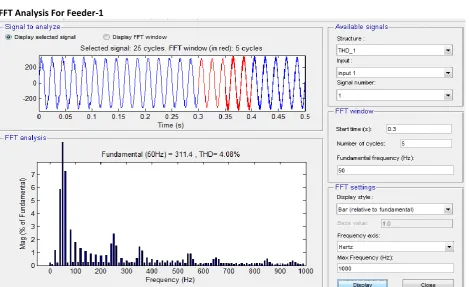
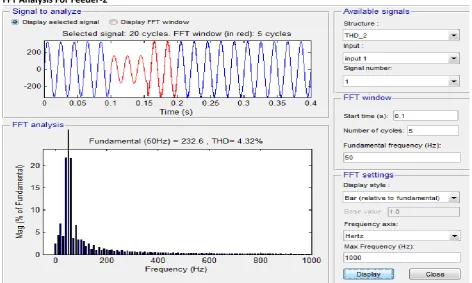
FFT Analysis For Feeder-2
Figure 6 FFT waveform
IV. CONCLUSION
This paper proposes a new operational mode for the IDVR to improve the DF of different feeders under normal operation. In this mode, the DF of one of the feeders is improved via active and reactive power exchange (PQ sharing) between feeders through the common dc link. The same system can also be used under abnormal conditions for voltage sag/swell mitigation. The main conclusions of this work can be summarized as follows: 1) Under PQ sharing mode, the injected voltage in any feeder does not affect its load voltage/current magnitude, however, it affects the DFs of both sourcing and receiving feeders. The DF of the sourcing feeder increases while the DF of the receiving feeder decreases. 2) When applying the proposed concept, some constraints should be satisfied to maintain the DF of both sourcing and receiving feeders within acceptable limits imposed by the utility companies. These operational constraints have been identified and considered. 3) The proposed mode is highly beneficial if the active power rating of the receiving feeder is higher than the sourcing feeder. In this case, the DF of the sourcing feeder will have a notable improvement with only a slight variation in DF of the receiving feeder. The proposed concept has been supported with simulation and experimental results.
REFERENCES
[1] S. A. Qureshi and N. Aslam, “Efficient power factor improvement technique and energy conservation of power system,” Int. Conf. Energy Manage. Power Del., vol. 2, pp. 749–752, Nov. 21–23, 1995.
[2]Sukumaran V.G., Bharadwaj N., "Ceramics in dental applications", Trends in Biomaterials and Artificial Organs, ISSN : 0971-1198, 20(1) (2006) pp.7-11.
ISSN (Print) : 2320 – 3765 ISSN (Online): 2278 – 8875
I
nternational
J
ournal of
A
dvanced
R
esearch in
E
lectrical,
E
lectronics and
I
nstrumentation
E
ngineering
(An ISO 3297: 2007 Certified Organization)
Vol. 4, Issue 3, March 2015
[5] S. M. Kannan, P. Renuga, and A. R. Grace, “Application of fuzzy logic and particle swarm optimization for reactive power compensation of radial distribution systems,” J. Electr. Syst., 6-3, vol. 6, no. 3, pp. 407–425, 2010.
[6]Menon R., Kiran C.M., "Concomitant presentation of alopecia areata in siblings: A rare occurrence", International Journal of Trichology, ISSN : 0974-7753, 4(2) (2012) pp.86-88.
[7] L. Ramesh, S. P. Chowdhury, S. Chowdhury, A. A. Natarajan, and C. T. Gaunt, “Minimization of power loss in distribution networks by different techniques,” Int. J. Electr. Power Energy Syst. Eng., vol. 3, no. 9, pp. 521–527, 2009.
[8]Rayen R., Hariharan V.S., Elavazhagan N., Kamalendran N., Varadarajan R., "Dental management of hemophiliac child under general anesthesia", Journal of Indian Society of Pedodontics and Preventive Dentistry, ISSN : 0970-4388, 29(1) (2011) pp.74-79.
[9] T. P. Wagner, A. Y. Chikhani, and R. Hackam, “Feeder reconfiguration for loss reduction: An application of distribution automation,” IEEE Trans. Power Del., vol. 6, no. 4, pp. 1922–1933, Oct. 1991. [6] A. Luo, Z. Shuai, W. Zhu, and Z. J. Shen, “Combined system for harmonic suppression and reactive power compensation,” IEEE Trans. Ind. Electr., vol. 56, no. 2, pp. 418–428, Feb. 2009.
[10]Shanthi B., Revathy C., Devi A.J.M., Subhashree, "Effect of iron deficiency on glycation of haemoglobin in nondiabetics", Journal of Clinical and Diagnostic Research, ISSN : 0973 - 709X, 7(1) (2013) pp.15-17.
[11] S. B. Karanki, N. Geddada, M. K. Mishra, and B. K. Kumar, “A DSTATCOM topology with reduced DC link voltage rating for load compensation with nonstiff source,” IEEE Trans. Power Electr., vol. 27, no. 3, pp. 1201– 1211, Mar. 2012.
[12] K. Sano and M. Takasaki, “A transformerless D-STATCOM based on a multivoltage cascade converter requiring no DC sources,” IEEE Trans.
Power Electr., vol. 27, no. 6, pp. 2783–2795, Jun. 2012. [9] B. Singh and S. R. Arya, “Adaptive theory-based improved linear sinusoidal
tracer control algorithm for DSTATCOM,” IEEE Trans. Power Electron., vol. 28, no. 8, pp. 3768–3778, Aug. 2013.
[13] L. Gyugyi, K. K. Sen, and C. D. Schauder, “The interline power flow controller concept: A new approach to power flow management in transmission systems,”,” IEEE Trans. Power Del., vol. 14, no. 3, pp. 1115–1123, Jul. 1999.
[14] H. M. Wijekoon, D. M. Vilathgamuwa, and S. S. Choi, “Interline dynamic voltage restorer: An economical way to improve interline power quality,” IEE Proc. Gener. Transmiss. Distrib., vol. 150, no. 5, pp. 513–520, 2003.
[15] B.Vamsi Krishna, A New Technique for Elimination of Harmonics Using Three Phase Shunt Active Filter, International Journal of Advanced
Research in Electrical, Electronics and Instrumentation Engineering, ISSN (Online): 2278 – 8875,pp 5596-5602, Vol. 2, Issue 11, November 2013
[16] P.Thamarai, B.Karthik, ARM Based Automatic Meteorological Data Acquisition System, International Journal of Advanced Research in
Electrical, Electronics and Instrumentation Engineering, ISSN (Online): 2278 – 8875,pp 6461-6465, Vol. 2, Issue 12, December 2013
[17] M.Bharathi,Effective Transfer Function Approach for Decentralized Controller,International Journal of Advanced Research in Electrical,
Electronics and Instrumentation Engineering, ISSN 2278 - 8875 , pp 21-27, Vol. 1, Issue 1, July 2012.
[18] Vijayan T ,Energy-efficient MAC for Wireless Sensor Networks,International Journal of Advanced Research in Electrical, Electronics and
Instrumentation Engineering,ISSN 2278 - 8875, pp 51-57,Vol. 1, Issue 1, July 2012.