Article
1
Effects of Continuous Deep Fat Frying on the Physical
2
and Chemical Properties of Assorted Brands of Edible
3
Cooking Oils Sold in Metropolitan Kampala
4
Timothy Omara1,2,3*, Erisa Kigenyi3,4 (version xx)
5
1 Department of Quality Control, Quality Assurance and Product Development, AgroWays Uganda Limited,
6
34-60, Kyabazinga Way, Jinja Uganda; [email protected]/[email protected]
7
2 Department of Health Sciences, Unicaf University, Longacres, Lusaka, Zambia
8
3 Department of Chemistry, Faculty of Science, Kyambogo University, Kampala, Uganda
9
4 Department of Quality Control and Quality Assurance, Leading Distillers Uganda Limited, Kampala
10
Uganda, [email protected]
11
12
* Correspondence: [email protected]/[email protected]; Tel.: +25-675-212-9606 (T.O.)
13
14
Abstract: Deep fat frying is not novel, but a classical antiquity culinary technique preferred chiefly
15
for its swiftness, amenity, conferment of a crisp texture, attractive sensorial and organoleptic
16
qualities and thus delectableness of the fries. Regrettably, repeated use of oils for deep frying
17
impacts the storage life and nutritional suitability of fries. This concerted study investigated the
18
effects of continuous deep fat frying on the physicochemical properties of ten brands of edible
19
cooking oils: Fortune Butto, Roki, Tamu, Best Fry, Golden Fry, Mukwano, Sunny, Sunvita, Sunlite
20
and Sunseed used in deep frying of potato chips in Kampala, Uganda. Three oil samples from local
21
Irish chip fryers were also collected. The color value (CV) and the acidification of the oils as free fatty
22
acid (FFA), peroxide value (POV), paraanisidine value (AnV) and iodine adsorption value (IV)
23
before and between ten successive deep-fryings using potato chips were determined.The possible
24
reuse of the oils was estimated from the frying round when a quality criterion surpassed national or
25
CODEX specifications for the respective edible cooking oils. For fresh oils, the statistical parameter
26
ranges were: CV (0.4R 3.4Y-7.7R 70Y), % FFA (0.0430-0.1508), POV (0.5951-6.6134 meqO2/Kg), AnV
27
(0.90-4.30) and IV (57.62-128.35gI2/100g). By the tenth fry, the values were respectively 3.0R
28
23Y-20.4R 70Y, 0.2286-0.4817, 11.1138-15.7525 meqO2/Kg, 10.31-22.16 and 53.66-126.03 gI2/100g.
29
Reuse of the oils for continuous frying of potatoes on the same day can be done only up to 7 times on
30
average for hard oils and 6 times for soft oils.
31
Keywords: Color; free fatty acids; iodine absorption value; paraanisidine value; peroxide value.
32
1. Introduction
33
Kampala, the central business district and capital city of Uganda is an area of population with
34
an approximated 1.53 million people in mid-2009 growing by 3.9% annually [1]. People in the city
35
are surviving on a vast array of ready-to-eat Ugandan unique deep-fried delicacies namely: fried
36
dough (mandazi), sweet plantain (gonja), edible grasshoppers (nsenene), banana pancakes
37
(kabalagala), Nile perch fish (emputa), chapatti, sausages, chicken, Irish potatoes and cassava chips
38
prepared using repeatedly used edible cooking oils. Sometimes, fresh oil is added to the used oils
39
and in either case, recycling of oil enhances the innocuous contamination and interaction of moisture
40
and air (oxygen) with the oil [2-5].
41
42
1.1 Deep frying
43
Deep frying (or less commonly deep-fat frying), is a yearthousand food-in-oil culinary
44
procedure performed at elevated temperatures, typically above the boiling point of water between
45
160oC to 190oC [6]. Material and heat transfers occur concomitantly with the wholly or partly
46
submersed food in the hot fat typically at or in excess of 180oC [7-9]. The heat, augmented by
47
moisture, oxygen and air culminates in food dehydration, further potentiating a complex cascade of
48
physical and chemical changes including breakdown of sugars and proteins via starch
49
gelatinization, protein denaturation, induced flavor and color [9], hydrolysis [10], free radical
50
production, formation of heterocyclic flavouring substances from amino acids, oxidation,
51
somerizations, dietary fibre softening, Millard reaction and caramelization. Hydrolytic degradation
52
ensues the attack of the ester linkage of triacylglycerols by water (a weak nucleophile) almost always
53
entrained in the food to be fried and yields diglycerols, monoglycerols and free fatty acids (FFAs).
54
This is further energized by the yielded fatty acids and other low molecular weight acids [11].
55
Copious amounts of water has been reported to hydrolyze deep frying oils more rapidly [12]than
56
steam [13]. On average, these reaction cascades increase oil darkening, flow viscosity, density,
57
specific heat, foaming and reduce considerably the smoke point [14].
58
1.1.Stability of deep fat frying oils
59
The heat stability of frying oil is governed primarily by two inherent factors: the fatty acid
60
composition and the presence of antioxidants and precursors such as butylatedhydroxyanisole
61
(BHA), tert-butylhydroquinone (TBHQ), butylated hydroxytoluene (BHT), propyl gallate (PG) and
62
tocopherols [15]. Antioxidants have been proven to retard room temperature auto-oxidation of oils
63
but are rendered inefficient at typical frying temperatures due to volatilization losses and thermal
64
fissions [16, 17]. An ideal frying oil should thus possess little amount of polyunsaturated fatty acids
65
(notably linolenic acids) and prominent levels of oleic acid with moderate amounts of saturated fatty
66
acids as the former are highly susceptible to oxidative degradation during frying [18], potentiating
67
breakdown reactions that often yield harmful polymers [19-21]. Thus, the accompanying changes in
68
the physical and chemical parameters of oils used repeatedly for deep frying has raised global health
69
concerns [22].
70
Subtly, the frying stability of oils are assessed by physicochemical investigation of changes
71
occurring during heating of the oils at elevated temperatures. The color value of oils, usually
72
expressed as 1 × Red + 1 × Yellow Lovibond units, registers a drastic increase in both the red and
73
yellow units during the incipient phases of heating. According to the results of Baby Latha and
74
Nasirullah [23] using rice bran oil, a threefold increase in red units and nearly fourfold increase in
75
yellow units was found after 2 hours of frying while darkening occurred beyond 2 hours.
76
Physicochemical properties and oxidative degradation of the frying oil during the initial 2 hours of
77
heating registered a steep increment in POV from 0.2 to 6.3 meqO2/kg, AnV from 5.04 to 19.4 and
78
total polar components from 1 to 4.1% [23]. FFA content of frying oils has been reported to rise with
79
number of fryings [24] and frying time [25]. The formed FFA, glycerol, di- and mono-acylglycerols
80
have been implicated by several authors to energize further thermohydrolysis [26-28]. Fatty acids
81
[29, 30] with some polar compounds such as triacylglycerol dimers and oxidation triacylglycerols
83
[31, 32], dimers [33] and polymers [34] reported to accumulate during the frying process. Warner et
84
al [35] reported that polar compounds accumulation during potato chips frying in cottonseed oil
85
increased proportionately with increase in the oil linoleic acid content. Mono- and di-acylglycerols in
86
cotton seed oil during frying of potato chips at 155 to 195oC increased initially and then reached a
87
plateau according to the results of Houhoula et al [5].
88
Frequent replenishing of frying oil retards its hydrolysis [36] and increases its frying life; alkalis
89
deployed in cleaning a fryer potentiates oil hydrolytic degradation while the frying time has no
90
appreciable effect on hydrolysis rate [37]. Diop et al [38] investigated the effects of deep fat frying on
91
chemical properties of three selected brands of oils ( two peanut oils A and B and sunflower oil, C)
92
common in Senegalese preparation of fried meat, fish and potatoes. Their findings revealed that
93
frying affects the chemical stability of cooking oils. The acid value as reported increased after 40
94
minutes from 0.62 to 1.08 mg/kg after frying fish, from 0.39 to 0.73mg/kg for meat and 0.37 to 0.51
95
mg/kg for potatoes. Peroxide value increased slightly for A and sharply for B and C oils.
96
Juárez et al [39] assessed some physicochemical changes occurring during discontinuous potato
97
frying using milanesas and churros in partly hydrogenated, soybean and sunflower oils. For 80.5
98
hours of churros deep fat frying, the oils measured total polar compounds surpassing 25% and the
99
corresponding percentage dimeric and polymeric triacylglycerols surpassed 10% with tocopherol
100
losses of 70%. Xu et al [40] compared the oxidative stability of camellia oil composed of saturated
101
fatty acid (SFA), monounsaturated fatty acid (MSFA) and polyunsaturated fatty acid (PUFA) in a
102
ratio of 1:7:1 during potato deep frying with palm and peanut oils composed of SFA, MSFA and
103
PUFA in ratios of 4:4:1 and 2:4:4 respectively. Their evaluations of acid value, IV, POV, AnV, total
104
oxidation (TOTOX) value, tocopherols content and fatty acids composition of the oils registered little
105
alteration of the fatty acid contents of camellia oil with alpha-tocopherol reported to be more
106
thermally labile compared to gamma and delta tocopherols. They concluded that the stabilities of
107
the oils as determined by oxidizability value followed the sequence camellia oil > palm oil >peanut
108
oil. The initially highest recorded AnV was in palm oil, which rose from 0.11 to 0.40. The recorded
109
AnV change was initially high in peanut oil prior to frying but increased more gradually from 0.74 to
110
1.04 while that of camellia oil rose from 0.17 to 0.55. The IV recorded in peanut oil was the largest
111
though it reduced from 104.74 to 80.52 gI2/100g. Insignificant changes of 53.83 to 45.36 gI2/100 g and
112
65.40 to 55.29 gI2/100g was registered in palm oil and camellia oils respectively. POV in palm oil
113
registered an increment from 4.98 to 18.86 meqO2/kg while that of peanut and camellia oils changed
114
from 4.75 to 13.24 meqO2/kg and 4.68 to 11.58 meqO2/kg. The least AnV was in camellia oil that
115
increased from 1.70 to 51.78 while peanut and palm oils registered 2.25 to 84.71 and 1.36 to 60.00
116
respectively.Abdulkarim [41] assessed the frying suitability of high-oleic Moringa oleifera seed oil
117
saturated fatty acid (SFA) consisting of SFA: MUFA: PUFA in a ratio of 2:7:0 vis-a-vis soybean, palm
118
olein and canola oils with SFA: MUFA:PUFA ratios of 1.5:2.5:6, 4:4:1 an 1:6:3 respectively.
119
Experimental results showed that the %FFA of the four conventional oils used comparatively in the
120
assessment respectively increased by 66.6, 71.4, 60.0 and 65.0%. TOTOX and AnV values of the oils
121
This research, in addition to assessing the effects of continuous deep-fat frying on the
123
physicochemical parameters of edible cooking oils sold in Metropolitan Kampala reveals the
124
maximum number of times the edible oils can be reused for continuous deep frying of Irish potato
125
chips without posing potential health risk to the final consumers.
126
127
2. Materials and Methods
128
2.1. Apparatus and reagents
129
The chemicals used in this investigation were of high analytical purity. The assortment of
130
volumetric glassware employed were presterilized in an autoclave and oven dried prior to analysis.
131
Mettler PM200 balance (Marshall scientific, USA) was used for all weighings. Amprobe IR608A
132
non-contact infrared thermometer with laser pointer, -18°C to 400°C (Amprobe, Everett, USA) was
133
used for monitoring temperatures during frying.
134
2.2. Sampling procedure and sample size
135
Six one litre samples of hard oil brands (Fortune butto, Roki, Tamu, Best fry, Golden fry and
136
Mukwano) and soft oil brands (Sunny, Sunvita, Sunlite and Sunseed) of approximate manufacturing
137
dates were procured from Mega Standard supermarket, Yusuf Lule road, Kampala-Uganda on 4th
138
May 2017. The brands were chosen based on their common use in deep frying according to a
139
prestudy tour taken and were majorly brands from two giant oil processing companies: Bidco
140
Uganda Limited (BUL)-Jinja Uganda and Mukwano Industries Limited-Kampala Uganda. Hence
141
exactly thirty (30) samples of cooking oils were procured and maintained in their original packaging
142
materials under ambient conditions to avoid any possible degradation. Three oil samples used up to
143
ten times continuous fry from Makindye division of Metropolitan Kampala were collected at
144
intervals from three randomly selected local traders carrying out deep frying of Irish potato chips
145
during their successive fries. Ten (10) kilograms of fresh white (Irish) potatoes (Solanum tuberosum),
146
were purchased from Nakasero market, Nakasero Hill, Market square road, Kampala, washed and
147
peeled manually using a clean stainless-steel knife. They were then sliced into cylindrical sizeable
148
pieces (1cm×1cm×3cm) corresponding to that used in the Kampala Irish potato culinary. The
149
analyses were done at the Quality control laboratory of Mukwano Industries Limited, Plot 30,
150
Mukwano Road, Kampala Industrial area.
151
2.3. Analysis of fresh oil samples
152
Both physical and chemical parameters of the oil samples were analyzed before being used for
153
deep fat frying.
154
2.4. Frying method
155
Exactly 400g of the Irish potato slices were submersed in oil in Skyline VT5424 4L Electric Deep
156
Fryer (Skyline, New Dehli, India) with detachable oil tank and slotted spoon with 1500mL of the
157
heated oil maintained at 140°C for 6 minutes. A frying time of 10 minutes was used with 800g of the
158
Irish fried in 20 minutes.
159
161
2.5. Determination of colour
162
Colour value (colour index) of the oil samples free from moisture and insoluble impurities were
163
measured in triplicates in a Lovibond Tintometer (The Tintometer Ltd, UK) using a 2.54cm cell
164
operating in the transmittance mode and recorded in Lovibond units.
165
2.6. Determination of free fatty acids
166
Exactly 10g of the oil sample was weighed in a 250ml beaker. 60mls of neutralized ethanol was
167
added and then boiled. The solution was then titrated with standardized 0.025M sodium hydroxide
168
using phenolphthalein indicator until the solution just turned pink. The FFA value was expressed as
169
the percentage of oleic acid in the sample [42].
170
2.7. Determination of Iodine adsorption value
171
Iodine value was determined according to ISO 3961: 2009 iodometric procedure [43]. 0.2g of oil
172
sample was weighed into a quick fit flask and dissolved in 20ml of chloroform. 25mL of Hanus
173
iodine solution was added to the resultant solution. Few drops of potassium iodide were put on
174
mouth of the flask and then kept in the dark for 30minutes. The sample was then removed and 10mls
175
of 15% Potassium Iodide solution was added followed by 100mls of freshly distilled water. The
176
solution was subsequently titrated with a standard 0.1N Sodium thiosulphate solution while stirring
177
until the golden yellow color appeared. Exactly 5mls of starch indicator was added to the resultant
178
solution and titration was continued until the blue-black solution turned colorless. A blank was
179
conducted where the total halogen content of 25mL of Hanus iodine was determined by a sodium
180
thiosulphate solution without the addition of an oil sample. Iodine value was expressed in grams of
181
Iodine absorbed by 100g of the oil.
182
2.8. Determination of peroxide value
183
Peroxide value was estimated according to ISO 3960: 2007 [44] and recorded as milliequivalents of
184
active oxygen/kg of oil.
185
2.9. Determination of paraanisidine value
186
Paraanisidine value was determined using the AOCS Official Method Cd 18-90 [45] and expressed
187
in anisidine numbers.
188
3. Results and statistical analyses
189
Analyses were performed in triplicate and the statistical average values were calculated using
190
Microsoft Excel 2016.
191
3.1. Hard oils
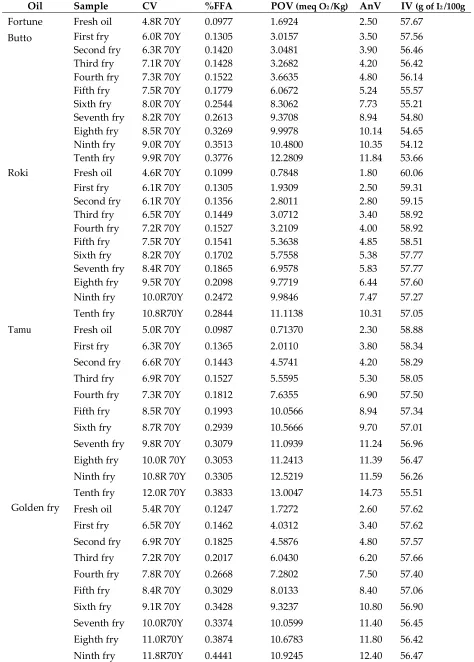
192
The investigated physicochemical properties of the hard oils are given in Table 1.
193
Table 1. Changes in the physicochemical properties of the hard oils.
195
Oil Sample CV %FFA POV (meq O2 /Kg) AnV IV (g of I2 /100g Fortune
Butto
Fresh oil 4.8R 70Y 0.0977 1.6924 2.50 57.67
First fry 6.0R 70Y 0.1305 3.0157 3.50 57.56
Second fry 6.3R 70Y 0.1420 3.0481 3.90 56.46
Third fry 7.1R 70Y 0.1428 3.2682 4.20 56.42
Fourth fry 7.3R 70Y 0.1522 3.6635 4.80 56.14
Fifth fry 7.5R 70Y 0.1779 6.0672 5.24 55.57
Sixth fry 8.0R 70Y 0.2544 8.3062 7.73 55.21
Seventh fry 8.2R 70Y 0.2613 9.3708 8.94 54.80 Eighth fry 8.5R 70Y 0.3269 9.9978 10.14 54.65 Ninth fry 9.0R 70Y 0.3513 10.4800 10.35 54.12 Tenth fry 9.9R 70Y 0.3776 12.2809 11.84 53.66
Roki Fresh oil 4.6R 70Y 0.1099 0.7848 1.80 60.06
First fry 6.1R 70Y 0.1305 1.9309 2.50 59.31
Second fry 6.1R 70Y 0.1356 2.8011 2.80 59.15
Third fry 6.5R 70Y 0.1449 3.0712 3.40 58.92
Fourth fry 7.2R 70Y 0.1527 3.2109 4.00 58.92
Fifth fry 7.5R 70Y 0.1541 5.3638 4.85 58.51
Sixth fry 8.2R 70Y 0.1702 5.7558 5.38 57.77
Seventh fry 8.4R 70Y 0.1865 6.9578 5.83 57.77
Eighth fry 9.5R 70Y 0.2098 9.7719 6.44 57.60
Ninth fry 10.0R70Y 0.2472 9.9846 7.47 57.27
Tenth fry 10.8R70Y 0.2844 11.1138 10.31 57.05
Tamu Fresh oil 5.0R 70Y 0.0987 0.71370 2.30 58.88
First fry 6.3R 70Y 0.1365 2.0110 3.80 58.34
Second fry 6.6R 70Y 0.1443 4.5741 4.20 58.29
Third fry 6.9R 70Y 0.1527 5.5595 5.30 58.05
Fourth fry 7.3R 70Y 0.1812 7.6355 6.90 57.50
Fifth fry 8.5R 70Y 0.1993 10.0566 8.94 57.34
Sixth fry 8.7R 70Y 0.2939 10.5666 9.70 57.01
Seventh fry 9.8R 70Y 0.3079 11.0939 11.24 56.96 Eighth fry 10.0R 70Y 0.3053 11.2413 11.39 56.47
Ninth fry 10.8R 70Y 0.3305 12.5219 11.59 56.26 Tenth fry 12.0R 70Y 0.3833 13.0047 14.73 55.51 Golden fry Fresh oil 5.4R 70Y 0.1247 1.7272 2.60 57.62
First fry 6.5R 70Y 0.1462 4.0312 3.40 57.62
Second fry 6.9R 70Y 0.1825 4.5876 4.80 57.57
Third fry 7.2R 70Y 0.2017 6.0430 6.20 57.66
Fourth fry 7.8R 70Y 0.2668 7.2802 7.50 57.40
Fifth fry 8.4R 70Y 0.3029 8.0133 8.40 57.06
Sixth fry 9.1R 70Y 0.3428 9.3237 10.80 56.90
Seventh fry 10.0R70Y 0.3374 10.0599 11.40 56.45 Eighth fry 11.0R70Y 0.3874 10.6783 11.80 56.42
Tenth fry 12.4R70Y 0.4817 11.7157 12.80 56.15 Mukwano Fresh oil 4.5R 70Y 0.0576 0.7119 0.90 61.59
First fry 5.8R 70Y 0.1429 3.9388 2.90 61.18
Second fry 6.2R 70Y 0.1581 4.1649 3.40 60.57
Third fry 6.5R 70Y 0.1665 4.6978 4.50 60.20
Fourth fry 6.4R 70Y 0.1755 6.1839 6.20 60.31
Fifth fry 7.0R 70Y 0.2275 7.4132 6.80 59.92
Sixth fry 7.4R 70Y 0.2372 7.4361 7.90 59.22
Seventh fry 8.3R 70Y 0.2534 9.7599 8.70 59.06
Eighth fry 8.9R 70Y 0.2785 9.9139 10.20 58.71
Ninth fry 9.5R 70Y 0.3216 11.009 12.69 58.34
Tenth fry 10.9R70Y 0.3310 11.820 14.73 58.13
Best fry Fresh oil 5.2R 70Y 0.1376 2.3542 3.40 58.34
First fry 7.4R 70Y 0.1927 3.1264 4.90 58.16
Second fry 7.9R 70Y 0.2528 4.2248 5.80 57.94
Third fry 8.3R 70Y 0.2655 4.5703 7.70 57.25
Fourth fry 8.8R 70Y 0.2829 5.8642 8.40 57.29
Fifth fry 9.7R 70Y 0.2854 6.1624 9.11 57.13
Sixth fry 10.5R 70Y 0.2978 6.9323 12.63 57.03 Seventh fry 12.0R 70Y 0.2989 8.8926 14.21 57.04
Eighth fry 15.0R 70Y 0.3595 10.422 16.12 56.87 Ninth fry 16.0R 70Y 0.3591 11.017 17.03 56.71 Tenth fry 17.5R 70Y 0.3591 11.952 17.77 56.66
196
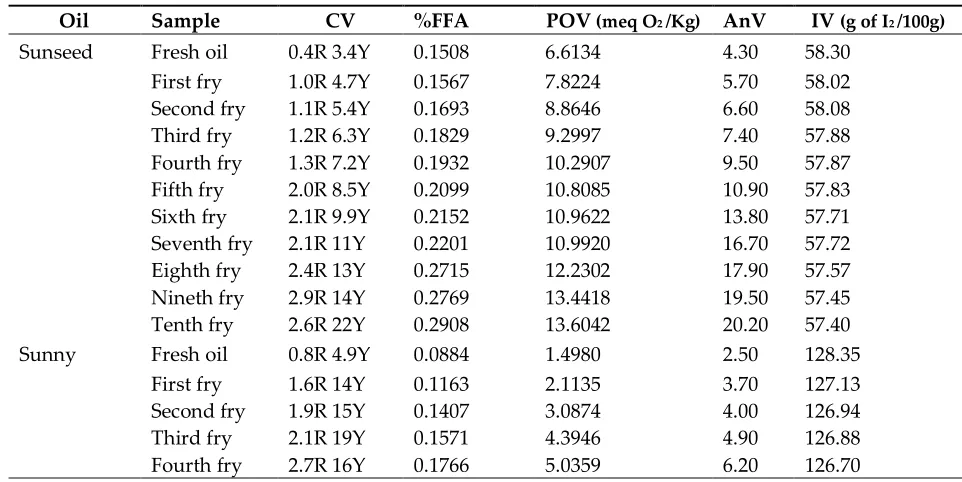
3.2. Soft Oils
197
The physicochemical properties of the soft oils are given in Table 2.
198
Table 2. Changes in the physicochemical properties of the soft oils.
199
Oil Sample CV %FFA POV (meq O2 /Kg) AnV IV (g of I2 /100g)
Sunseed Fresh oil 0.4R 3.4Y 0.1508 6.6134 4.30 58.30
First fry 1.0R 4.7Y 0.1567 7.8224 5.70 58.02
Second fry 1.1R 5.4Y 0.1693 8.8646 6.60 58.08
Third fry 1.2R 6.3Y 0.1829 9.2997 7.40 57.88
Fourth fry 1.3R 7.2Y 0.1932 10.2907 9.50 57.87 Fifth fry 2.0R 8.5Y 0.2099 10.8085 10.90 57.83 Sixth fry 2.1R 9.9Y 0.2152 10.9622 13.80 57.71 Seventh fry 2.1R 11Y 0.2201 10.9920 16.70 57.72 Eighth fry 2.4R 13Y 0.2715 12.2302 17.90 57.57 Nineth fry 2.9R 14Y 0.2769 13.4418 19.50 57.45 Tenth fry 2.6R 22Y 0.2908 13.6042 20.20 57.40
Sunny Fresh oil 0.8R 4.9Y 0.0884 1.4980 2.50 128.35
First fry 1.6R 14Y 0.1163 2.1135 3.70 127.13
Second fry 1.9R 15Y 0.1407 3.0874 4.00 126.94
Third fry 2.1R 19Y 0.1571 4.3946 4.90 126.88
Fifth fry 2.9R 19Y 0.1875 6.7514 7.60 126.69 Sixth fry 3.0R 23Y 0.1917 7.9430 9.40 126.33 Seventh fry 3.0R 24Y 0.2173 9.0678 10.40 126.27 Eighth fry 3.3R 24Y 0.2435 10.3814 12.80 126.24 Nineth fry 3.5R 27Y 0.2477 10.8668 15.50 126.08
Tenth fry 3.6R 27Y 0.2540 11.7032 17.50 126.03
Sunvita Fresh oil 0.9R 5.1Y 0.0430 1.4714 2.80 126.96
First fry 0.9R 6.7Y 0.0892 3.3087 3.50 126.10 Second fry 0.9R 7.5Y 0.1503 3.8037 4.70 123.03
Third fry 1R 9.1Y 0.1666 4.9809 5.70 124.88
Fourth fry 1.1R 11Y 0.1937 5.2830 6.80 123.96
Fifth fry 1.3R 11Y 0.1991 5.9740 7.75 123.27 Sixth fry 1.7R 14Y 0.2136 8.2301 10.46 122.59
Seventh fry 2.1R 15Y 0.2576 10.11 14.89 121.81 Eighth fry 2.4R 20Y 0.3081 11.53 15.78 121.48 Nineth fry 2.8R 22Y 0.3078 14.68 16.49 121.48
Tenth fry 3.0R 23Y 0.3396 15.37 18.66 120.28
Sunlite Fresh oil 0.7R 5Y 0.0963 1.2723 2.60 126.80
First fry 0.7R 5.5Y 0.1098 2.0882 2.92 126.46 Second fry 0.8R 5.8Y 0.1319 3.9624 3.50 125.98
Third fry 1.0R 6.0Y 0.1458 4.4835 4.30 125.79 Fourth fry 1.3R 6.8Y 0.1603 5.9978 5.80 125.73
Fifth fry 1.5R 6.8Y 0.1720 7.5574 6.90 125.47 Sixth fry 1.8R 7.2Y 0.2001 9.0822 8.30 125.29
Seventh fry 2.0R 7.5Y 0.2159 10.5798 10.0 124.89 Eighth fry 2.4R13.0Y 0.2599 11.2972 12.72 124.57 Nineth fry 2.56R 13Y 0.2828 11.9001 14.68 124.55
Tenth fry 2.9R14.5Y 0.3202 12.7721 16.02 124.21
200
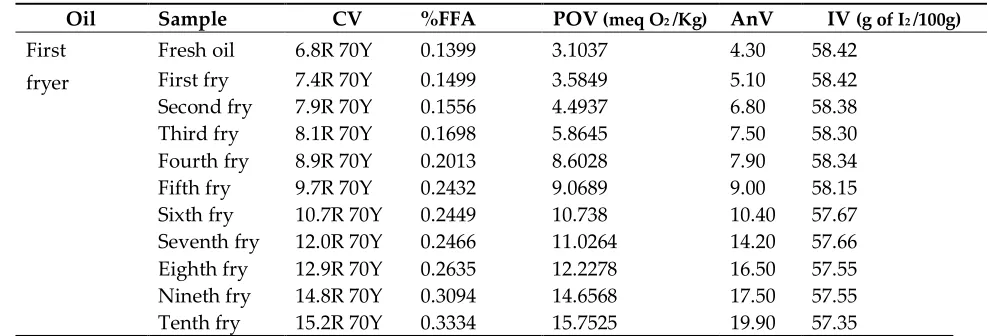
3.3. Oils From Outside Chips Fryers
201
The physicochemical properties of oils from outside chips fryers are presented in Table 3.
202
Table 3. Changes in the physicochemical properties of oils from outside chips fryers.
203
Oil Sample CV %FFA POV (meq O2 /Kg) AnV IV (g of I2 /100g) First
fryer
Fresh oil 6.8R 70Y 0.1399 3.1037 4.30 58.42
First fry 7.4R 70Y 0.1499 3.5849 5.10 58.42
Second fry 7.9R 70Y 0.1556 4.4937 6.80 58.38
Third fry 8.1R 70Y 0.1698 5.8645 7.50 58.30
Fourth fry 8.9R 70Y 0.2013 8.6028 7.90 58.34
Second fryer
Fresh oil 4.5R 70Y 0.1007 0.5951 2.80 59.43 First fry 6.0R 70Y 0.1282 0.9021 3.40 59.23 Second fry 6.0R 70Y 0.1300 1.5840 3.80 58.90 Third fry 6.2R 70Y 0.1354 2.2182 4.50 58.97 Fourth fry 7.1R 70Y 0.1398 2.9961 5.10 58.55 Fifth fry 7.3R 70Y 0.1403 3.3954 6.30 58.37 Sixth fry 7.8R 70Y 0.1625 4.4962 6.50 58.27 Seventh fry 8.2R 70Y 0.1687 5.1984 7.40 58.15 Eighth fry 8.7R 70Y 0.1812 6.5811 8.50 58.10
Nineth fry 9.0R 70Y 0.2014 6.9981 9.10 58.10
Tenth fry 9.5R 70Y 0.2286 7.995 10.70 58.12
Third Fryer
Fresh oil 7.7R 70Y 0.0496 1.1957 2.70 128.16
First fry 9.0R 70Y 0.1362 1.6099 3.60 127.18
Second fry 10.1R 70Y 0.1535 1.7636 3.90 126.33 Third fry 10.9R 70Y 0.1634 2.0909 4.80 124.79
Fourth fry 12.5R 70Y 0.1697 2.5227 5.90 124.22 Fifth fry 14.3R 70Y 0.2030 2.4450 7.46 123.30
Sixth fry 16.0R 70Y 0.2980 2.9739 8.65 121.40
Seventh fry 17.0R 70Y 0.3235 6.0875 14.20 120.13 Eighth fry 18.8R 70Y 0.3874 6.3546 17.98 118.77
Nineth fry 19.2R 70Y 0.4165 7.1760 20.70 119.00 Tenth fry 20.4R 70Y 0.4748 8.5800 22.16 119.14
204
4. Discussion
205
4.1. Color
206
There is no standard specification for colour as per Uganda National Bureau of Standards (UNBS)
207
for edible oils. However, most edible oil refining companies (including Mukwano group of
208
companies) have internal colour specifications of 7.5R 70Y maximum. Sunseed, Sunvita, Sunlite and
209
Sunny cooking oils passed colour parameter specifications even after the tenth fry. Mukwano after
210
the 6th fry, Fortune Butto, Roki and Best fry after the 5th fry, while Tamu after the 4th fry and Golden
211
fry after the 3rd fry fell out of specifications (Tables 1 and 2). Oil from the first and second outside
212
chips fryers fell out of colour specifications after a fry while oil from the third outside chips fryer did
213
not meet the specifications (Table 3). The physical change in the color value of oils is a rather
214
intuitive and swift visual index implicatory of a trend of oil deterioration. Of the fresh oil samples,
215
oil from the third outside chips fryer had the highest color reading of 7.7R 70Y (Table 3) while the
216
lowest color reading was obtained from the oil from the Sunseed with a color reading of 0.4R 3.4Y
217
(Table 2). The color readings increased steadily. By the ninth fry, the color recitation for oil from the
218
third outside chips fryer could hardly be determined experimentally (Table 3) and by the tenth fry,
219
the oil from the second outside chips fryer had become reasonably dark. Generally, by the tenth fry,
220
all the oils had changed the color of the fried food product. Available empirical data shows that
221
unsaturated carbonyl compounds (including ketones, conjugated dienoic acids) and degraded
222
Another close cause of the observed colour regression could be attributable to the dispersion of
224
Millard pigments from the fries [49]. Choe and Min [8] also hinted that polymerized fats
225
accumulated in a fryer during frying causes foam and gum formation as well as oil darkening. Oil
226
darkening, albeit, an experimentally valuable index while monitoring deterioration of oils heated at
227
elevated temperatures has been underscored to not be solely attributable to oxidative degradation
228
by Che Man and Tan [50]. Non-enzymatic browning of potato chips has been reported to be
229
proportionate to the amount of reducing sugars in the potato, as both browning and Maillard
230
reactions are stimulated by the level of oxidation of the food and the entrained characteristic heme
231
pigments [51]. More so, the Maillard reaction enhances nutrient losses and the ensuing browning
232
intensity it impacts on the fries is proportionate to the proteinaceous loss of the amino acids: lysine,
233
histidine and methionine. This result is in agreement with the diagnostic statements of Orthoefer
234
and Cooper [52] that assorted frying oils and the food fried darken oils to varying degrees during
235
deep frying.
236
4.2. Free fatty acids
237
The chief composition of oils is fatty acids and degree of unsaturation is the very first factor
238
influencing the oxidative stability of frying oils despite other oil intrinsic and external factors [30].
239
For fresh oils, the lowest FFA of 0.0430 was observed in Sunvita while the highest recorded FFA of
240
0.1508 was in Sunseed (Table 2). Roki, Best fry, third chips fryer oil and Sunvita were still within the
241
maximum % FFA specification of 0.30 after the tenth fry. Sunlite after the 9th fry, Mukwano and oil
242
from second outside chips fryer after the 8th fry while Fortune Butto, Sunny and oil from first outside
243
chips fryer after the 7th fry had % FFA greater than the maximum FFA specification of UNBS. Tamu
244
and Sunseed after the 6th fry and Golden fry after the 4th fry had the % FFA greater than the
245
maximum FFA specification of 0.30. The differences observed in the fresh oil FFA values could be
246
attributed to blending of several edible oils by the manufacturing companies. Blending of assorted
247
edible oils is known to alter the fatty acid profile of oils [53, 54] and can steeply retard oxidation of
248
oils during deep-fat frying. The increase in free fatty acid values of oils can be attributed to the
249
breakdown of long carbon chains into shorter carbon chains due to thermal and oxidative
250
decomposition of oils at elevated temperatures. During elevated temperature heating of oils, FFA
251
formation is attributed to the cleavage and oxidation of double bonds to form carbonyl compounds,
252
which are subsequently oxidized to fatty acids of low molecular masses [55-57]. It is preferred
253
frequently by food processors for indication of oil acidity and oil authenticity verification [14, 58].
254
Filtration of frying oils have been reported to reduce FFA content of oils and improve their frying
255
stability. The results of this study is concordant with that of Stevenson et al [59] who reported that
256
edible oils with %FFA less than 0.05% and POV of 1.0 meqO2/kg or less are best suited for deep
257
frying.
258
4.3. Peroxide value
259
For peroxide values of fresh oil samples, oil from the second outside chips fryer had the lowest
260
peroxide value (0.5951meqO2/Kg) while the highest peroxide value of 6.6134 meqO2/Kg was
261
observed in Sunseed. Aside from the nature of the oil, fresh oils to be utilized in deep fat frying
262
should have a Codex regulatory maximum POV of 15meqO2/Kg [60]. The peroxide values increased
263
is because of oxidation of carbon atoms adjacent to the double bonds in the triacylglyceride structure
265
leading to the formation of hydroperoxides. These hydroperoxides, are the direct cause of anisidine
266
value shoot up as they decompose further to secondary oxidative components which constitute the
267
paraanisidine components. Peroxide value is implicative of incipient oxidation which directly
268
translates to the buildup and breakdown of oxidation products. Peroxides are reasonably unstable,
269
and fissions at typical frying temperatures. In addition, it is a useful biomarker of the preliminary
270
stages of rancidity occurring under mild conditions and the freshness of the lipid matrix. Thus, the
271
greater the POV, the faster will the oxidation of the oil occur [61]. After the fifth fry, the peroxide
272
value of all oils was still concordant with the maximum Codex standard POV for vegetable oils.
273
However, only Best fry and Sunseed after the tenth fry were still in the maximum Codex standard
274
POV of 10meq O2/Kg. Roki after the 9th fry, while Fortune Butto and Mukwano after the 8th fry fell
275
out of specifications (Table 1). Sunvita and oil from first outside chips fryer were out of specifications
276
after the 7th fry; Golden fry, Sunny and Sunlite were all out of specifications of POV after the 6th fry.
277
Oil from second outside chips fryer after the fifth fry was out of specification while Tamu and oil
278
from third outside chips fryer fell out of the maximum Codex standard POV after the 4th and 3rd fry
279
respectively. The observed increase in peroxide value during heating of oils have been reported by
280
other authors [14, 62, 63]. Furthermore, polyunsaturated oils exhibit readily depressed stability at
281
elevated temperatures because the unsaturated fatty acids are readily oxidized to peroxides [63, 64].
282
Empirical data shows that the peroxide values of fresh oils may be higher than the Codex standard
283
primarily owing to improper storage and packaging that triggers degradation via photo-oxidation.
284
Self-oxidation may supposedly occur in storage due to chemical interaction with air, peculiarly
285
oxygen [65].
286
4.4. Paraanisidine value
287
Oxidative degradation of oils is innocuously deleterious as it impacts sensorial and organoleptic
288
attributes of fries [66]. Primary oxidation quantifies the amount of hydroperoxides as peroxide value
289
(POV). Further degradation of hydroperoxides yields aldehydes, ketones, carboxylic acids, short
290
chain alkanes and alkenes better quantitatively described by paraanisidine value (AnV). For fresh
291
oils, the lowest value of 0.90 was observed in Mukwano vegetable cooking oil (Table 1) while the
292
highest recorded AnV was 4.30 in Sunseed and oil from first outside chips fryer (Tables 2 and 3
293
respectively). Golden fry, Tamu, Best fry, Sunny, Sunlite, Fortune Butto, Mukwano, Sunvita, Roki
294
and oil from first and second outside chips fryer after the tenth fry were still within the range (0.00 to
295
20.00) after the tenth fry. Only the oil from third outside chips fryer and Sunseed exceeded the
296
maximum value after the 9th and 8th fry respectively. Secondary oxidation products are principally
297
non-volatile aldehydes, principally 2,4-dienals and 2-alkenals [67, 68] which anisidine value is a
298
quantitative measure. The AnV was observed to increase gradually between the successive fries.
299
Initial stages of heating resulted in faster increase of AnV followed by a gradual increment. This
300
could be due to further decomposition of the carbonyls and polymerization reactions. Similar results
301
have been reported by Xu et al [40] in their comparison of oxidative stability of edible oils under
302
4.5. Iodine adsorption value
304
At fresh conditions, the maximum IV observed was in sunny cooking oil (128.35gI2/100g) (Table
305
2) and the least was observed in Golden fry vegetable oil (57.62gI2/100g) (Table 1). The iodine
306
adsorption value, iodine number or sometimes iodine index, is chemically the mass of iodine in
307
grams that is consumed by 100 grams of a chemical substance by mass as oleic acid. Iodine numbers
308
are often used to determine the amount of unsaturation in fatty acids. The higher the Iodine index
309
(the greater the unsaturation), the faster is the tendency of oil oxidation during heating at elevated
310
temperatures as in deep frying [69]. Iodine index, is a frequently measured vital analytical measure
311
of the unsaturation of an edible cooking oil [70]. It was observed that IV decreased slightly during
312
deep frying. Golden fry, Tamu, Best fry, Sunny, Sunlite, Fortune button, Mukwano, Sunvita, Roki,
313
Sunseed and oil from first, second and third outside chips fryer even after the tenth fry were still
314
within specifications. The observed decrement in the Iodine index is concordant with the decrement
315
in double bonds attributed to oxidation and thermal decomposition.
316
4.6. Frying stability of the edible cooking oils
317
The average number of times the hard oils and soft oils could be re-used for continuous deep-fat
318
frying were statistically calculated using Microsoft Excel 2016. The analysis gave an average of 7.0
319
times for hard oils and 6.25 times (approximately 6 times) for soft oils.
320
5. Conclusions
321
Prior to deep-fat frying, all the selected brands of edible cooking oils met the National and thus
322
Codex specifications in terms of the assessed physicochemical properties. Oil from the third outside
323
chips fryer however, failed to meet the color specification. After successive deep fat fryings, the
324
physicochemical properties of the edible oils increased significantly between fryings and some oils
325
went out of specifications of the Codex standards before the tenth fry. Iodine adsorption values
326
decreased only slightly for the ten fryings. The results of the study showed that changes in the
327
physical and chemical parameters increases with increase in the number of fries of the potato chips.
328
Repeated re-use of oils for consecutive deep frying of potato chips on the same day can be done only
329
up to a maximum of 7 times on average for hard oils and 6 times for soft oils with the oils still
330
regarded as safe for frying potato chips for human consumption. Thus, hard oils should be preferred
331
to soft oils for deep frying of Irish potato chips.
332
There is a continuous need to subtly carry out research on every new edible cooking oil brand on
333
the Ugandan market as most companies tend to package a blend of oils. Further comprehensive
334
research should be done to elucidate the variation of physicochemical properties of other edible
335
cooking oil brands on the Ugandan market such as Nile, Fortune, Kimbo, Cow boy and Ufuta.
336
Further research should be done with other food samples such as fish, cassava, chicken, plantain,
337
dough, meat and edible grasshoppers as the nature of the food sample influences the quality of the
338
oil after deep frying. The organoleptic test of smell should not be used physiognomically in making
339
conclusions about the suitability of cooking oils after deep fat frying as it is hard to clearly deduce
340
since individual sensoriums vary widely and thus judgement is made so indifferently. Other
341
physicochemical properties of the investigated edible cooking oils such as smoke point, viscosity,
342
moisture content, volatile matter content, total polar components and saponification value should be
343
Author Contributions: Conceptualization, Timothy Omara and Erisa Kigenyi; Data Curation, Timothy Omara
345
and Erisa Kigenyi; Methodology, Timothy Omara and Erisa Kigenyi; Project Administration, Erisa Kigenyi.
346
Funding: This research received no external funding.
347
Acknowledgments: We acknowledge the support of Mukwano Group of Companies which enabled us to
348
realize and finalize this research.
349
Conflicts of Interest: The authors declare no conflict of interest
350
References
351
1. Uganda National Bureau of Statistsics (UBOS). Preliminary Results for Uganda Population and Housing
352
Census, pp. xii, 2009.
353
2. Peers, K.E.and Swoboda, P.A.T. Deterioration of sunflower Seed Oil Under Simulated Frying Conditions and
354
During Small-Scale Frying of Potato Chips. J Sci Food Agric 1982, 33, 389–395.
355
3. Cuesta, C., Sanchez-Muniz, F.J., Garrido-Polonio, C., Lopez-Varela, S. and Arroyo, R. Thermooxidative and
356
Hydrolytic Changes in Sunflower Oil Used in Frying With a Fast Turnover of Fresh Oil. J Am Oil Chem Soc, 1993,
357
70, 1069–1073.
358
4. Sanchez-Muniz, F.J., Cuesta, C., Lopez-Varela, M.C., Garrido-Polonio, M.C. and Arroyo, R. Evaluation of the
359
Thermal Oxidation Rate of Sunflower Oil Using Various Frying Methods. In: Applewhite TH, editor. Proceedings of
360
World Conference on Oilseed and Technology and Utilization. Champaign, Ill: American Oil Chemists Society, 1993.
361
5. Houhoula, D.P., Oreopoulou, V., Tzia, C. The Effect Of Process Time and Temperature on the Accumulation
362
of Polar Compounds in Cottonseed Oil During Deep-Fat Frying. J Sci Food Agric, 2003, 83 (4), 314–319.
363
6. Aladedunye, F.A. Curbing Thermo-Oxidative Degradation of Frying Oils: Current Knowledge and
364
challenges. European J Lipid Sci Tech, 2015, 117 (11), 1867-1881.
365
7. Kita, A. The Influence of Potato Chemical Composition on Crisp Texture. Food Chem, 2002, 76 (2), 173–179.
366
8. Choe, E. and Min, D. B. Chemistry of Deep-Fat Frying Oils and Fats. J Food Sci, 2007, 72 (5), 77–86.
367
9. Weisshaar, R. Quality Control of Used Deep-Frying Oils. European J Lipid Sci Tech, 2014, 116 (6), 716–722.
368
10. Yoon, S.H., Kim, S.K., Kim, K.H., Kwon, T.W. and Teah, Y.K. Evaluation of Physicochemical Changes in
369
Cooking Oil During Heating. J Am Oil Chem Soc, 1987, 64 (6), 870–873.
370
11. Mariod, A., Omer, N., Al, E. and Mokhtar, M. Chemical Reactions Taken Place During Deep-Fat Frying and
371
Their Products: A review. SUST J Natur Medic Sci. Supplementary issue, 2014, 09, 1-17.
372
12. Dana, D. and Saguy, I.S. The Protective Role of Water Injection on Oil Quality in Deep Fat Frying
373
Conditions. Eur Food Res Tech, 2003, 217, 104-109.
374
13. Pokorny, J. Flavor Chemistry of Deep Fat Frying in Oil. In: Min DB, Smouse TH, editors. Flavor chemistry of lipid
375
foods. Champaign, Ill., USA: American Oil Chemists Society, 1989.
376
14. Park, J. and Kim, J. Monitoring of Used Frying Oils and Frying Times for Frying Chicken Nuggets Using
377
Peroxide Value and Acid Value. Korean J Food Sci An, 2016, 5(36), 612–616.
378
15. Rohman, A. and Che Man, Y.B. Authentication of Extra Virgin Olive Oil from Sesame Oil Using FTIR
379
Spectroscopy and Gas Chromatography. Int J Food Prop, 2015, 15, 1309–18.
380
16. Boskou, D. Stability of Frying Oils In Frying of Food: Principles, Changes, New Approaches, VCH
381
Publishers: New York. 1998, 174-182.
382
17. Choe, E. and Lee, J. Thermooxidative Stability of Soybean Oil, Beef Tallow and Palm Oil During Frying of
383
Steamed Noodles. Korean J Food Sci Tech, 1998, 30, 288–292.
384
18. Chen, J.F., Tai, C.Y., Chen, Y.C., and Chen, B.H. Effects of Conjugated Linoleic Acid on the Oxidation
385
19. Gertz, C. and Klostermann, S. H. Analysis of Acylamide And Mechanisms of its Formation in Deep-Fried
387
Products. Eur J Lipid Sci Tech, 2002, 104, 762–771.
388
20. Debnath, N.K., Rastogi, N.K., Gopal Krishna, A.G. and Lokesh, B.R. Oil Partitioning Between Surface and
389
Structure of Potato Slices-A Kinetic Study. Food Sci Tech, 2009, 42,1054–1058.
390
21. Ghidurus, M., Turtoi, M., Boskou, G., Niculita, P. and Stan, S. Nutritional and Health Aspects Related to
391
Frying (I). Roman Biotech Letts, 2010, 15, 5675–5682.
392
22. Dhaka,V., Gulia, N., Ahlawat, K. and Khatkar, B. Trans Fats –Sources, Health Risks and Alternative
393
Approach – A Review. J Food Sci Tech, 2011, 48, 534-541.
394
23. Baby Latha, R. and Nasirullah. Physico-chemical Changes in Rice Bran Oil During Heating at Frying
395
Temperature. J Food Sci Tech, 2014, 51, 335-340.
396
24. Chung, J., Lee, J. and Choe, E. Oxidative Stability of Soybean and Sesame Oil Mixture During Frying of Flour
397
Dough. J Food Sci, 2004, 69, 574-578.
398
25. Mazza, G. and Qi, H. Effect of After-Cooking Darkening Inhibitors on Stability of frying Oil and Quality of
399
French Fries". J Am Oil Chem Soc, 1992, 69, 847–853.
400
26. Frega,N., Mozzon, M. and Lecker, G. Effects of Free Fatty Acids on Oxidative Stability of Vegetable Oil. J Am
401
Oil Chem Soc,1999, 76, 325–329.
402
27. Miyashita, K., and Takagi, T. Study on the Oxidative Rate and Prooxidant Activity of Free Fatty Acids. J Am
403
Oil Chem Soc, 1986, 63, 1380–1384.
404
28. Mistry, B.S. and Min, D.B. Effects of Fatty Acids on the Oxidative Stability of Soybean Oil. J Food Sci, 1987, 52
405
(3), 831–832.
406
29. Karakaya, S. and Simsek, S. Changes in Total Polar Compounds, Peroxide Value, Total Phenols, and
407
Antioxidant Activity of Various Oils Used in Deep Fat Frying. J Am Oil Chem Soc, 2011, 88, 1361–1366.
408
30. Casal, S., Malheiro, R., Sendas, A., Oliveira, B.P.P and Pereira, J.A. Olive Oil Stability Under Deep-Frying
409
Conditions. Food Chem Toxicol, 2010, 48, 2972–2979.
410
31. Romero, A., Cuesta, C. and Sanchez-Muniz, F.J. Effect of Oil Replenishment During Deepfat Frying Of
411
Frozen Foods In Sunflower Oil And High-Oleic Acid Sunflower Oil. J Am Oil Chem Soc, 1998, 75, 161–167.
412
32. Xu, X., Tran, V.H., Palmer, M., White, K. and Salisbury, P. Chemical and Physical Analyses and Sensory
413
Evaluation Of Six Deep-Frying Oils. J Am Oil Chem Soc, 1999, 76, 1091–1099.
414
33. Gordon, M.H. and Kourimska, L. The Effects of Antioxidants On Changes In Oils During Heating And Deep
415
Frying. J Sci Food Agric, 1998, 68, 347–353.
416
34. Tompkins, C. and Perkins, E.G. Frying Performance of Low-Linolenic Acid Soybean Oil. J Am Oil Chem Soc,
417
2000, 77, 223–229.
418
35. Warner, K., Orr, P. and Glynn, M. Effect of Fatty Acid Composition of Oils on Flavor and Stability of Fried
419
Foods. J Am Oil Chem Soc, 1997, 74, 347–356.
420
36. Romero, A., Cuesta, C. and Sa´nchez-Muniz, F. J. Trans Fatty Acid Production In Deep Fat Frying Of Frozen
421
Foods With Different Oils and Frying Modalities. Nutr Res, 2000, 20(4), 599–608.
422
37. Naz,S., Siddiqi, R. and Sayeed, S.A. Effect of Flavonoids on the oxidative Stability of Corn Oil During Deep
423
Frying. Int J Food Sci Tech, 2005, 43(10), 1850-1854.
424
38. Diop, A., Ndao, S., Cissé, M., Baldé, M., Ndiaye, B. and Diop, Y.M. Effect of Deep-Fat Frying on Chemical
425
Properties of Edible Vegetable Oils Used by Senegalese Households. Afr J Food Agric Nutr Dev, 2014, 14(6),
426
39. Juárez, M.D., Osawa, C.C., Acuña, M.E., Sammán, N. and Gonçalves, L.A.G. Degradation in Soybean Oil,
428
Sunflower Oil and Partially Hydrogenated Fats After Food Frying, Monitored By Conventional and
429
Unconventional Methods. Food Control, 2010, 22, 1920–1927.
430
40. Xu, T., Li, J., Fan, Y., Zheng, T. and Deng, Z. Comparison of Oxidative Stability Among Edible Oils Under
431
Continuous Frying Conditions. Int J Food Prop, 2015, 18, 1478–1490.
432
41. Abdulkarim, S.M., Long, K., Lai, O.M., Muhammad, S.K.S. and Ghazali, H.M. Frying Quality and Stability of
433
High-Oleic Moringa Oleifera Seed Oil in Comparison With Other Vegetable Oils. Food Chem, 2007, 105,
434
1382–1389.
435
42. AOCS. AOCS-Official Methods And Recommended Practices of the American Oil Chemists’ Society. 2004,
436
Champaign: American Oil Chemists’ Society.
437
43. ISO. Animal and Vegetable Fats and Oils- Determination of Iodine Value. ISO 3961: 2009. Vol. 4th edn. 2009,
438
Geneva, Switzerland.
439
44. ISO. Animal and vegetable Fats and Oils-Determination of Peroxide Value. ISO 3960: 2007. 2007, Geneva,
440
Switzerland.
441
45. AOCS. AOCS. p-Anisidine value. In AOCS Official Method Cd 18-90: Official Methods and Recommended
442
Practices of the American Oil Chemists’ Society. 1998, Champaign, IL, USA.
443
46. Gutierrez, R., Gonzalez-Quijano, J. and Dobermans, M.C. Analytical Procedures for the Evaluation of Used
444
Frying Fats. In: Varela G, Bender A E and Morton I D (Eds.), Frying of Food: Principles, Changes, New
445
Approaches. England: VCH-Ellis Horwood Ltd, 141-154
446
47. Augustin, M.A. and Berry, S.K. Efficacy of the Antioxidants BHA and BHT in Palm Olein During Heating
447
and Frying. J Am Oil Chem Soc, 1983, 60, 1520-1523.
448
48. Farhoosh, R., Kenari, R.E. and Pooazrang, R. Frying stability Of Canola Oil Blended With Palm Olein, Olive
449
And Corn Oils. J Am Oil Chem Soc, 2009, 86(1), 71-76.
450
49. Lalas, S., Gortzi, O. and Tsankanis, J. Frying stability of Moringa stenopetala Seed Oil. Plant Foods Hum Nutr,
451
2006, 61(2), 99-108.
452
50. Che Man, Y.B. and Tan, C.P. Effects of Natural Antioxidants on Changes in Refined, Bleached and
453
Deodorized Palm Olein During Deep-Fat Frying of Potato Chips. J Am Oil Chem Soc, 1999, 76,331-339.
454
51. Reda, S.Y. Comparative Study of Vegetable Oils Subjected to Thermal Stress. Masters Dissertation,
455
Universidade Estadual de Ponta Grossa, 2000.
456
52. Orthoefer, E.T. and Cooper, D.S. Evaluation of Used Frying Oil. In: Perkins, E.G. Erickson, M.D. Deep frying:
457
Chemistry, Nutrition and Practical Applications. 1996, AOAC Press: Champaign. 285-296.
458
53. Shiota, M., Konishi, H. and Tatsumi, K. Oxidative Stability of Fish Oil Blended with Butter. J Dairy Sci, 1999,
459
82, 1877–1881.
460
54. Mamat, H., Aini, I.N., Said, M. and Jamaludin, R.. "Physicochemical characteristics of palm oil and
461
sunflower oil blends fractionated at different temperatures". Food Chemistry, Vol. 91, pp. 731–6, 2005.
462
55. Baby Latha, R. and Nasirullah. Effect of Heat on Physico-Chemical and Thermo-Oxidative Stability of
463
Repeatedly Heated Rice Bran Oil (RBO). Int J Food Nutr Sci, 2016, 5, 2.
464
56. Faridah, D. N., Lioe, H.N., Palupi, N.S. and Kahfi, J. Detection of FFA and PV Values using FTIR for Quality
465
Measurement In Palm Oil Frying Activities. J Oil Palm Res, 2015, 27(2),156-167.
466
57. S. Lalas. Quality of frying oil. Advances in Deep-fat Frying of Foods. New York, USA: CRC Press, 2009.
467
58. Ahmad-Tarmizi, A.H. and Siew, W.L. Quality Assessment of Palm Products Upon Prolonged Heat
468
59. Stevenson, S.G., Vaisey-Genser, M. and Eskin, N.A.M. Quality Control in the Use of Deep Frying Oils. J Am
470
Oil Chem Soc. 1984, 61, 1102–1108.
471
60. Codex Alimentarius. Codex Standard for Named Vegetable Oils, CODEX STAN 210-1999. Amended in 2005
472
and 2011. Rome, Italy, 1999.
473
61. Atinafu, D.G. and Bedemo, B. Estimation of Total Free Fatty Acid and Cholesterol Content in Some
474
Commercial Edible Oils in Ethiopia, Bahir DAR. J Cereals Oilseeds, 2001, 2, 71-76.
475
62. Sulthana, S.N. and Sen, D.P. Studies on Deep Fat Frying: Changes During Heating of Oil. J Food Sci Tech,
476
1979, 16, 208.
477
63. Serjouie, A., Tan, C.P., Mirhosseini, H. and CheMan, Y.B. Effect of Vegetable-Based Oil Blends on
478
Physicochemical Properties of Oils During Deep-Fat Frying. Am J Food Tech, 2010, 5(5), 310-323.
479
64. Che-Man, Y.B. and Wan-Hussin, W.R. Comparison of the Frying Performance of Refined, Bleached and
480
Deodorized Palm Olein and Coconut Oil. J Food Lipids, 1998, 5, 197–210.
481
65. Susheelamma, N.S., Asha, M.R., Ravi, R. and Kumar, A.K.V. Comparative Studies on Physical Properties of
482
Vegetable Oils and Their Blends After Frying. J Food Lipids, 2002, 9, 259–276.
483
66. Dana, D. and Saguy, I.S. Frying of Nutritious Food: Obstacles and Feasibility. Food Sci Tech Res, 2001, 7(4),
484
265-279.
485
67. Sulieman, M.R., Makhzangy, A.E. and Ramadan, M.F. Antiradical Performance and Physicochemical
486
Characteristics of Vegetable Oils Upon Frying of French Fries: A Preliminary Comparative Study. J Food Lipids,
487
2006, 13(3), 259-276.
488
68. Bou, R., Navas J.A., Tres, A., Codony, R., Guardiola, F. Quality Assessment of Frying Fats and Fried Snacks
489
During Continuous Deep-Fat Frying at Different Large-Scale Producers. Food Control, 2012, 27(1), 254–267.
490
69. Tomkins, P.C. and Perkins, E.G. The Evaluation of Frying Oils with the P-Anisidine Value. J Am Oil Chem
491
Soc, 1999, 76 (8), 945-947.
492
70. Otunola, A.G., Adebayo, G.B. and Olufemi, O.G. Evaluation of Some Physicochemical Parameters of