International Journal of COPD 2018:13 3529–3538
International Journal of COPD
Dove
press
submit your manuscript | www.dovepress.com 3529
O r I g I n a l r e s e a r C h
open access to scientific and medical research
Open access Full Text article
exercise performance and symptoms in
lowlanders with COPD ascending to moderate
altitude: randomized trial
Michael Furian1,*
Deborah Flueck1,*
Tsogyal D latshang1
Philipp M scheiwiller1
sebastian Daniel segitz1
séverine Mueller-Mottet1
Christian Murer1
adrian steiner1
silvia Ulrich1
Thomas rothe2
Malcolm Kohler1
Konrad e Bloch1
1Department of respiratory Medicine,
University hospital of Zurich, Zurich, switzerland; 2Zuercher rehaZentrum
Davos, Davos Clavadel, switzerland *These authors contributed equally to this work
Objective: To evaluate the effects of altitude travel on exercise performance and symptoms
in lowlanders with COPD.
Design: Randomized crossover trial.
Setting: University Hospital Zurich (490 m), research facility in mountain villages, Davos
Clavadel (1,650 m) and Davos Jakobshorn (2,590 m).
Participants: Forty COPD patients, Global Initiative for Obstructive Lung Disease (GOLD)
grade 2–3, living below 800 m, median (quartiles) age 67 y (60; 69), forced expiratory volume in 1 second 57% predicted (49; 70).
Intervention: Two-day sojourns at 490 m, 1,650 m, and 2,590 m in randomized order.
Outcome measures: Six-minute walk distance (6MWD), cardiopulmonary exercise tests,
symptoms, and other health effects.
Results: At 490 m, days 1 and 2, median (quartiles) 6MWD were 558 m (477; 587) and 577 m
(531; 629). At 2,590 m, days 1 and 2, mean changes in 6MWD from corresponding day at 490 m were -41 m (95% CI -51 to -31) and -40 m (-53 to -27), n=40, P,0.05, both changes. At 1,650 m, day 1, 6MWD had changed by -22 m (-32 to -13), maximal oxygen uptake during bicycle exer-cise by -7% (-13 to 0) vs 490 m, P,0.05, both changes. At 490 m, 1,650 m, and 2,590 m, day 1, resting PaO2 were 9.0 (8.4; 9.4), 8.1 (7.5; 8.6), and 6.8 (6.3; 7.4) kPa, respectively, P,0.05 higher altitudes vs 490 m. While staying at higher altitudes, nine patients (24%) experienced symptoms or adverse health effects requiring oxygen therapy or relocation to lower altitude.
Conclusion: During sojourns at 1,650 m and 2,590 m, lowlanders with moderate to severe
COPD experienced a mild reduction in exercise performance and nearly one quarter required oxygen therapy or descent to lower altitude because of adverse health effects. The findings may help to counsel COPD patients planning altitude travel.
Registration:ClinicalTrials.gov: NCT01875133
Keywords: CPET, cardiopulmonary exercise testing, acute mountain sickness, hypoxia, adverse
health effects, dyspnea, altitude illness, arterial blood gas analysis, pulmonary function
Introduction
COPD is characterized by chronic airflow obstruction related to airway inflammation, remodeling, and parenchymal destruction of the lung.1 This causes dyspnea, exercise
limitation, and an impaired quality of life. Worldwide, more than 200 million tourists are estimated to visit altitudes over 1,500 m each year.2 Among them, many patients
with COPD are expected to experience adverse health effects including acute mountain sickness,3 excessive dyspnea, and impairment of exercise performance during
every-day activities when exposed to hypobaric hypoxia during altitude sojourns. However, Correspondence: Konrad e Bloch
Department of respiratory Medicine, University hospital of Zurich, raemistrasse 100, 8091 Zurich, switzerland
Tel +41 44 255 3828 Fax +41 44 255 4451 email [email protected]
Journal name: International Journal of COPD Article Designation: Original Research Year: 2018
Volume: 13
Running head verso: Furian et al
Running head recto: Exercise performance in lowlanders with COPD DOI: 173039
International Journal of Chronic Obstructive Pulmonary Disease downloaded from https://www.dovepress.com/ by 118.70.13.36 on 22-Aug-2020
For personal use only.
Dovepress
Furian et al
whether and to which extent impaired pulmonary gas exchange, reduced muscle strength, and cardiovascular and other limitations affect well-being and physical performance in COPD patients traveling to high altitude has not been extensively studied. In a recent physiological investigation, we observed a reduction of submaximal constant load bicycle exercise by about one half due to systemic and cerebral hypox-emia in a group of COPD patients at 2,590 m compared with the performance at their low altitude residence.4 To provide
a scientific basis to counsel COPD patients planning altitude sojourns, the current study evaluated the effect of travel to altitudes of 1,650 and 2,590 m for a total of 4 days on exercise performance, general well-being, and several other outcomes in lowlanders with moderate to severe COPD.
Methods
study design and setting
This randomized crossover trial evaluated the effect of a 4-day sojourn at moderate altitude on exercise performance, symptoms, and several physiological outcomes in patients with stable COPD, Global Initiative for Obstructive Lung Disease (GOLD) grades 2–3, living below 800 m. The studies were performed from June to August 2013 in Zurich (490 m, 1,608 ft, barometric pressure [PB] 719 Torr) and in Swiss alpine villages, Davos Clavadel (1,650 m, 5,413 ft, PB 628 Torr) and Davos Jakobshorn (2,590 m, 8,497 ft, PB 562 Torr). Participants spent 2 days at each study location, in random order, to undergo outcome assessments. Some physiological outcomes evaluating gas exchange, cerebral blood flow, and cerebral and muscle tissue oxygenation as a part of the cur-rent trial have been reported recently.4 Apart from baseline
characteristics of study participants, the data presented here have not been published except previously in abstract form. The study was approved by the Cantonal Ethics Committee of Zurich (EK-2013-0088), subjects gave written informed consent, and the trial is registered at www.ClinicalTrials. gov: NCT01875133.
Participants
Subjects with stable COPD, GOLD grade 2–3, diagnosed according to the GOLD guidelines (forced expiratory volume in 1 second [FEV1]/forced vital capacity [FVC] ratio ,0.7, FEV1 between 30% and 80% predicted), aged 18 to 75 years, both sexes, living below 800 m, were invited to participate. Subjects with very severe COPD (FEV1,30% predicted), respiratory failure at lowland (PaO2,7.3 kPa or PaCO2.6.0 kPa), or those with known previous intolerance
of altitude 2,600 m or lower, a history of sleep apnea syn-drome, or more than mild or inadequately controlled cardio-vascular disease were excluded. Patients having traveled to altitudes .1,500 m for .2 days within 4 weeks prior to the study were also excluded.
randomization and intervention
Using a balanced block design, participants were randomized to one of the following four sequences of altitude expo-sure with sojourns of 2 days at each location: Group A 490/1,650/2,590 m; Group B 490/2,590/1,650 m; Group C 1,650/2,590/490 m; Group D 2,590/1,650/490 m. Partici-pants traveled by train and car between Zurich and Davos Clavadel and by cable car between Davos Clavadel and Davos Jakobshorn.
As a safety precaution, the protocol required that any patient with intolerable discomfort (according to the patient’s own subjective assessment), symptoms or signs of relevant intercurrent illness, such as a COPD exacerbation, new onset or unstable cardiovascular disease including uncontrolled hyper-tension (systolic and/or diastolic blood pressure .220 and/ or .110 mmHg), neurological impairment, gastrointestinal symptoms requiring treatment, or severe hypoxemia (arterial oxygen saturation ,80% for .30 minutes) were withdrawn from the study, treated with oxygen and other measures as appropriate, and transported to low altitude. Maximal bicycle exercise tests to exhaustion were performed at 490 m and 1,650 m, but for safety reasons, not at 2,590 m. Patients were asked to continue their regular medication during the study.
assessments
exercise tests, pulmonary function, and arterial blood gas analysis
Six-minute walk tests with monitoring of pulse oximetry (SpO2) were performed.5
Lung function studies including spirometry, body plethysmography (only at 490 and 2,590 m due to logistical constraints), diffusing capacity (Bodystik™ and Diffustik™, Geratherm Respiratory GmbH, Bad Kissingen, Germany), and nasal sniff inspiratory pressure (Morgan P max, Morgan Medical Ltd., Gillingham, UK) were performed 15 minutes after inhalation of a short-acting bronchodilator.6,7 Pulmonary
volumes and flows were expressed in body temperature, pressure, and saturated conditions. Diffusing capacity was measured by the single-breath technique. To allow for con-venient comparisons between values measured at 490 m, 2,590 m, and predicted values for sea level, values measured
International Journal of Chronic Obstructive Pulmonary Disease downloaded from https://www.dovepress.com/ by 118.70.13.36 on 22-Aug-2020
Dovepress exercise performance in lowlanders with COPD
at 2,590 m were corrected for the lower PB at altitude by transforming the equation recommended to predict values at high altitude:8
[DLCOaltitude=DLCOsea level/(1 +0.00031*[PI, O2-150])], and solving for DLCOsea level,
[DLCOsea level=DLCO2,590 m*(1 +0.00031*[PI, O2- 150])], whereas PI, O2 at 2,590 m corresponds to 108 mmHg.
Cardiopulmonary cycle exercise tests were performed with a progressive ramp protocol to exhaustion9 at 490 m
and 1,650 m. The target duration of the exercise test at 490 m was 8–12 minutes, and the slope (ie, increase in watts per minute) was selected accordingly, based on the individually predicted maximal work rate (Wmax). For each individual, an identical ramp protocol was applied at 490 m and 1,650 m. Ventilation, gas exchange, oxygen saturation, and electro-cardiogram were recorded breath by breath (Ergostik™, Geratherm Respiratory GmbH). Radial artery blood was drawn at rest and during maximal exercise and analyzed immediately (RAPIDPOINT 405, Siemens Healthcare Diag-nostics GmbH, Zurich, Switzerland). Maximal physiologic variables of exercise tests were defined as mean values during the final 30 seconds of maximal exercise. Patients indicated the perceived exertion on the Borg CR10 scale.10
Clinical examination, evaluation of acute mountain sickness (aMs), and dyspnea
A complete medical history was obtained. Physical exami-nation included weight, height, blood pressure, pulse rate, and SpO2. Dyspnea was assessed by the modified Medical Research Council dyspnea score.11 AMS was assessed in
the morning and evening by the Environmental Symptoms Questionnaire cerebral score (AMSc) comprising 11 questions on AMS symptoms rated from 0 (not at all) to 5 (extreme). The weighted sum of responses ranges from 0 to 5. Scores $0.7 are considered to reflect clinically relevant AMS.12
Outcomes
The primary outcome was the change in the 6-minute walk dis-tance (6MWD). Secondary outcomes were the oxygen satura-tion by SpO2, heart rate, lung function, arterial blood gases, and measures derived from cardiopulmonary exercise testing.
sample size
Sample size estimation indicated that at least 36 participants were required to detect a minimally important difference
in the 6MWD of 30 m (SD 55 m) with a power of 80%, alpha 0.05.13 To account for dropouts, 40 participants were
included.
Blinding
Investigators analyzing the data were blinded to altitude and altitude exposure sequence.
statistical analysis
Due to non-normal distribution of the majority of the data, all variables were summarized by medians and quartiles. Overall effects were evaluated by Friedman ANOVA, and significant findings were further analyzed by post hoc analyses using Wilcoxon matched pairs tests. Effects of altitude exposure were evaluated by computing mean differences in outcomes with 95% CIs. The primary outcome was analyzed according to the intention-to-treat principle with missing data replaced by multiple imputations applying a multivariable regression model with baseline variables as independent predictors. Secondary outcomes were analyzed according to the per-protocol principle on all available data. Regression analyses were used to separately assess the effect of altitude (1,650 m and 2,590 m vs 490 m) on the 6MWD while controlling for baseline characteristics and potential confounders. Age, sex, and all predictor variables for which univariate analy-sis revealed an association with P,0.2 were entered into a subsequent multivariable model. A probability of P,0.05 was considered as statistically significant.
Results
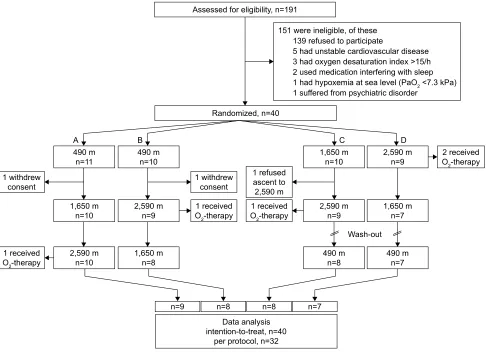
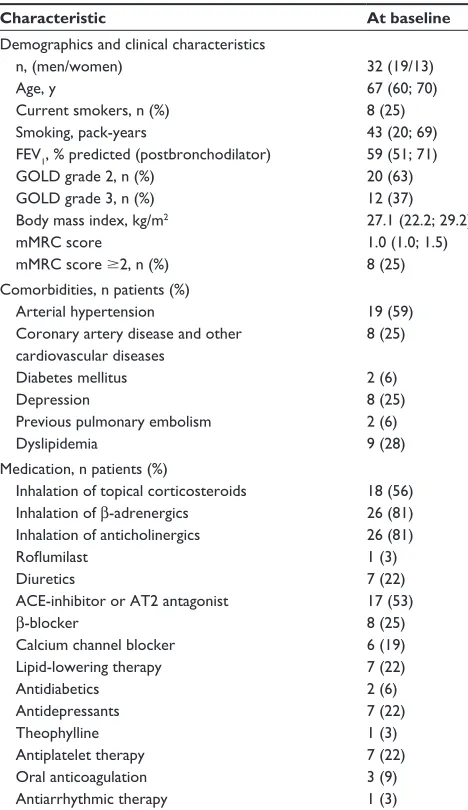
The study participant flow is shown in Figure 1. Of 191 screened subjects, 139 refused to participate and 12 met exclusion criteria. Thus, 40 subjects were included and randomized and their primary outcome (6MWD) was analyzed according to the intention-to-treat principle. One patient each in groups A to C and two in group D required nocturnal supplemental oxygen because of severe hypox-emia (as defined per protocol by a value of SpO2 ,80% for $30 minutes) or dyspnea. These subjects felt well there-after and remained at altitude but were excluded from exer-cise tests on the next day. Two subjects withdrew informed consent after baseline examination in Zurich and one refused to ascend to 2,590 m because of insomnia at 1,650 m. Thus, the per-protocol group consisted of 32 participants (Table 1). The age of patients ranged from 51 to 74 y, 25% were cur-rent smokers, and the median FEV1 was 59% predicted. The most prevalent comorbidities were cardiovascular diseases.
International Journal of Chronic Obstructive Pulmonary Disease downloaded from https://www.dovepress.com/ by 118.70.13.36 on 22-Aug-2020
Dovepress
Furian et al
The majority of participants (81%) used regular inhaled
β-adrenergics or anticholinergics and 56% used inhaled glucocorticoids (Table 1).
Several participants experienced altitude-related adverse health effects. In addition to those mentioned above who were withdrawn because of severe hypoxemia, dyspnea, or other discomfort, patients had (on average) mild symptoms of AMS that were most pronounced on the first day at 2,590 m (Table 2). The incidence of clinically relevant AMS (AMSc score $0.7) on the first and second day at 1,650 m was 3% (1 out of 38) and 0%, and on the first and second day at 2,590 m was 5% (2 out of 38) and 0% in patients ascending to higher altitudes. The combined incidence of any altitude-related adverse health effect during the 4 days at altitude was 24% (9 out of 38).
six-minute walk tests, pulmonary
function, and arterial blood gases
The 6MWD and SpO2 at the beginning and end of the 6-minute walk test were significantly reduced at 1,650 m
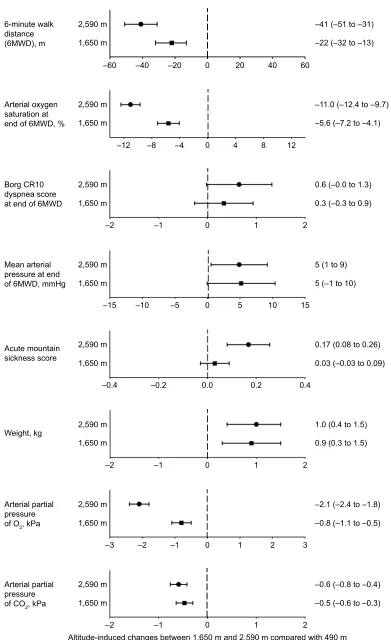
and 2,590 m compared with those at 490 m, and the per-ceived dyspnea at the end of the 6MWD was greater at higher altitudes compared with values at 490 m (Table 2 and Figure 2).
Univariable regression analysis with the change in the 6MWD from 490 m baseline as the dependent vari-able revealed that altitude, second vs first day at altitude, the 6MWD, FEV1, and DLCO at 490 m were significant predictors. In a multivariable analysis, maintaining age, sex, and variables with P,0.2 in univariable analysis in the model, significant independent predictors for the 6MWD were altitude 1,650 m (predicted mean change -17 m [95% CI -27 to -6 m], P=0.001) and 2,590 m (predicted mean change -37 m [95% CI -47 to -27 m], P,0.001). Additional independent predictors were the baseline value of the 6MWD (+0.8 m [+0.7 to +0.9], P,0.001) and FEV1 % predicted at 490 m (+0.9 m [+0.1 to +1.7], P=0.029), while age (P=0.866), sex (P=0.333), and DLCO at 490 m (P=0.188) were not.
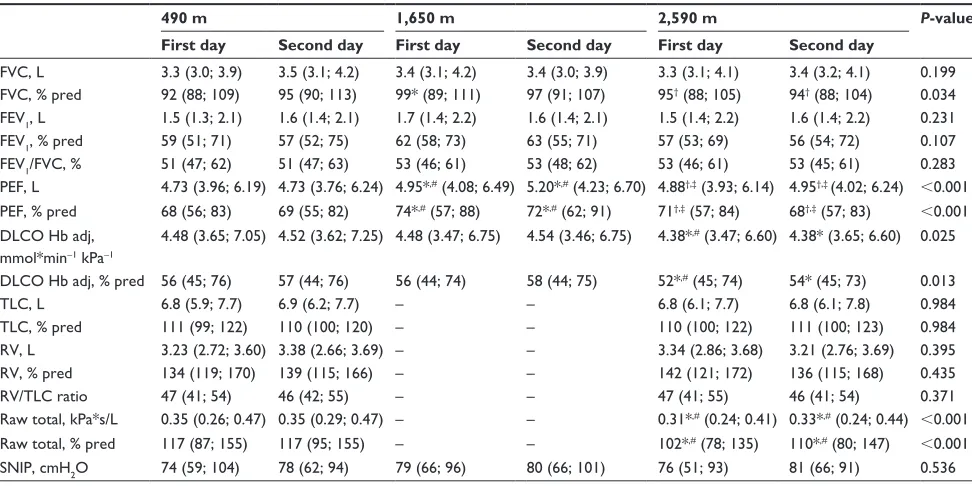
Spirometry revealed no significant changes in FVC and FEV1 (in liters) nor in their ratio over the course of the study $VVHVVHGIRUHOLJLELOLW\Q
ZHUHLQHOLJLEOHRIWKHVH UHIXVHGWRSDUWLFLSDWH
KDGXQVWDEOHFDUGLRYDVFXODUGLVHDVH KDGR[\JHQGHVDWXUDWLRQLQGH[!K XVHGPHGLFDWLRQLQWHUIHULQJZLWKVOHHS KDGK\SR[HPLDDWVHDOHYHO3D2N3D VXIIHUHGIURPSV\FKLDWULFGLVRUGHU
5DQGRPL]HGQ
P Q
P Q
P Q
P Q
P Q
P Q P
Q
P Q
P Q P
Q PQ
UHIXVHG DVFHQWWR P
$ % & '
P Q ZLWKGUHZ
FRQVHQW ZLWKGUHZFRQVHQW
UHFHLYHG 2WKHUDS\
UHFHLYHG 2WKHUDS\
UHFHLYHG 2WKHUDS\
UHFHLYHG 2WKHUDS\
'DWDDQDO\VLV LQWHQWLRQWRWUHDWQ
SHUSURWRFROQ
Q Q Q Q
:DVKRXW
Figure 1 Patient flow.
Notes: Of 191 eligible subjects, 40 were randomized into one of the four altitude exposure sequences (a–D) and included in the intention-to-treat analysis. Data from 32 subjects were included in the per-protocol analysis.
International Journal of Chronic Obstructive Pulmonary Disease downloaded from https://www.dovepress.com/ by 118.70.13.36 on 22-Aug-2020
Dovepress exercise performance in lowlanders with COPD
at the different altitudes (Table 3). FVC (in % predicted) tended to be minimally greater at 1,650 m compared with other altitudes. Static lung volumes (total lung capacity, residual volume) were not different at 2,590 m vs 490 m. Peak expiratory flow improved significantly with increasing altitude, and correspondingly, airway resistance was reduced at 2,590 m vs 490 m. There was a slight but statistically significant reduction in the DLCO corrected for hemoglobin and for the reduced PB at 2,590 m.
The arterial blood gas analysis revealed a mild to moderate hypoxemia that increased with altitude (Figure 2, Table 4). The alveolar–arterial PO2 gradient was elevated at 490 m and decreased slightly at higher altitudes but remained elevated. According to inclusion criteria, patients were normocapnic at 490 m and their PaCO2 was slightly reduced at higher altitudes with an associated increase in pH.
Cardiopulmonary exercise tests
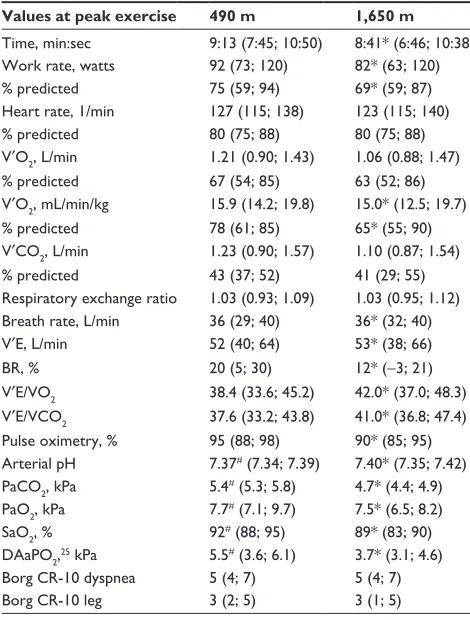
Compared with 490 m, endurance time, Wmax, and maximal oxygen uptake (V′O2 normalized for weight) were all sig-nificantly reduced at 1,650 m. The reduction in endurance time and thus Wmax was -7% (95% CI -13 to 0, P,0.01). The impairment in exercise performance at 1,650 m was associated with a reduced PaO2, SaO2, and alveolar–arterial PO2 gradient during maximal exercise; in addition, there was a lower PaCO2 and increased ventilatory equivalents for O2 uptake and CO2 output (V′E/O2 and V′E/CO2) compared with 490 m. Subjective perception of dyspnea and leg fatigue were similar at low and high altitude (Table 5).
Discussion
The results of the current randomized trial show that patients with moderate to severe COPD living below 800 m
Table 2 six-minute walk test and clinical evaluation
490 m 1,650 m 2,590 m P-value
First day Second day First day Second day First day Second day 6-minute walk
distance, m
534±93 547±93* 512±93*,# 525±93#,† 491±93*,#,†,‡ 504±93#,‡,¶ ,0.001
spO2, rest, % 94 (94; 96) 94 (93; 95) 92*,# (91; 94) 93*,# (91; 95) 89*,#,†,‡ (88; 91) 90*,#,†,‡ (87; 92) ,0.001
spO2, end of 6MWT, % 90 (84; 92) 89 (83; 92) 84*,# (78; 87) 85*,# (77; 87) 78*,#,†,‡ (73; 82) 77*,#,†,‡ (73; 82) ,0.001
Borg dyspnea 3.0 (2.0; 5.0) 3.0 (3.0; 4.5) 4.0 (2.0; 4.5) 4.0*,#,† (3.0; 5.5) 3.5 (3.0; 5.0) 4.0*,#,† (3.0; 6.0) 0.003
Borg leg fatigue 2.5 (2.0; 4.0) 3.0 (1.0; 5.0) 2.5 (1.5; 4.0) 3.0 (1.0; 4.0) 2.0 (0.8; 3.0) 3.0 (1.5; 3.0) 0.567
mMrC dyspnea score 1 (0; 1) 1 (1; 1) 1 (1; 1) 1 (1; 1) 1 (1; 1) 1# (1; 1) 0.045
acute mountain sickness score
0.00 (0.00; 0.09) 0.00 (0.00; 0.00) 0.00 (0.00; 0.18) 0.00 (0.00; 0.09) 0.18*,#,†,‡ (0.00; 0.35) 0.00¶ (0.00; 0.09) ,0.001
Weight, kg 77.3 (67.9; 87.4) 77.3 (68.2; 87.4) 78.2*,# (66.6; 88.6) 78.3*,# (67.4; 87.9) 78.3*,# (67.9; 88.0) 78.6*,# (67.5; 87.9) ,0.001
Notes: six-minute walk distance analyzed by the intention-to-treat analysis including all 40 randomized patients, values presented as mean ±sD. Other outcomes analyzed by the per-protocol approach including 32 patients, values presented as median (quartiles). P-values from Friedman anOVa. *P,0.05 vs 490 m day 1, #P,0.05 vs 490 m day 2, †P,0.05 vs 1,650 m day 1, ‡P,0.05 vs 1,650 m day 2, ¶P,0.05 vs 2,590 m day 1.
Abbreviations: 6MWT, 6-minute walk test; mMRC, modified Medical Research Council dyspnea score; SpO2, pulse oximetry.
Table 1 Characteristics of patients
Characteristic At baseline Demographics and clinical characteristics
n, (men/women) age, y
Current smokers, n (%) smoking, pack-years
FeV1, % predicted (postbronchodilator)
gOlD grade 2, n (%) gOlD grade 3, n (%) Body mass index, kg/m2
mMrC score mMrC score $2, n (%)
32 (19/13) 67 (60; 70) 8 (25) 43 (20; 69) 59 (51; 71) 20 (63) 12 (37) 27.1 (22.2; 29.2) 1.0 (1.0; 1.5) 8 (25) Comorbidities, n patients (%)
arterial hypertension
Coronary artery disease and other cardiovascular diseases
Diabetes mellitus Depression
Previous pulmonary embolism Dyslipidemia
19 (59) 8 (25) 2 (6) 8 (25) 2 (6) 9 (28) Medication, n patients (%)
Inhalation of topical corticosteroids Inhalation of β-adrenergics Inhalation of anticholinergics Roflumilast
Diuretics
aCe-inhibitor or aT2 antagonist
β-blocker
Calcium channel blocker lipid-lowering therapy antidiabetics antidepressants Theophylline antiplatelet therapy Oral anticoagulation antiarrhythmic therapy
18 (56) 26 (81) 26 (81) 1 (3) 7 (22) 17 (53) 8 (25) 6 (19) 7 (22) 2 (6) 7 (22) 1 (3) 7 (22) 3 (9) 1 (3) Note: Values presented as median (quartiles) unless indicated otherwise.
Abbreviations: aCe, angiotensin-converting enzyme; aT2, angiotensin II receptor; FeV1, forced expiratory volume in 1 second; gOlD, global initiative for chronic
obstructive lung disease; mMRC, modified Medical Research Council dyspnea score; Pack-years, sum of years smoked a packet of cigarettes per day.
International Journal of Chronic Obstructive Pulmonary Disease downloaded from https://www.dovepress.com/ by 118.70.13.36 on 22-Aug-2020
Dovepress
Furian et al
Figure 2 altitude-induced changes.
Notes: Dots represent mean differences and horizontal bars the 95% CIs, values are numerically indicated on the right. Altitude effect is significant when the zero value is not part of the 95% CI.
2,590 m 6-minute walk
distance
(6MWD), m 1,650 m
–41 (–51 to –31)
–22 (–32 to –13)
–60 –40 –20 0 20 40 60
2,590 m Arterial oxygen
saturation at
end of 6MWD, % 1,650 m
–11.0 (–12.4 to –9.7)
–5.6 (–7.2 to –4.1)
–12 –8 –4 0 4 8 12
2,590 m Borg CR10
dyspnea score
at end of 6MWD 1,650 m
0.6 (–0.0 to 1.3)
0.3 (–0.3 to 0.9)
–2 –1 0 1 2
2,590 m Mean arterial
pressure at end
of 6MWD, mmHg 1,650 m
5 (1 to 9)
5 (–1 to 10)
–15 –10 –5 0 5 10 15
2,590 m Acute mountain
sickness score 1,650 m
0.17 (0.08 to 0.26)
0.03 (–0.03 to 0.09)
–0.4 –0.2 0.0 0.2 0.4
2,590 m Weight, kg
1,650 m
1.0 (0.4 to 1.5)
0.9 (0.3 to 1.5)
2,590 m Arterial partial
pressure
of O2, kPa 1,650 m
–2.1 (–2.4 to –1.8)
–0.8 (–1.1 to –0.5)
–3 –2 –1 0 1 2 3
2,590 m Arterial partial
pressure
of CO2, kPa 1,650 m
–0.6 (–0.8 to –0.4)
–0.5 (–0.6 to –0.3)
–2
Altitude-induced changes between 1,650 m and 2,590 m compared with 490 m
–1 0 1 2
–2 –1 0 1 2
International Journal of Chronic Obstructive Pulmonary Disease downloaded from https://www.dovepress.com/ by 118.70.13.36 on 22-Aug-2020
Dovepress exercise performance in lowlanders with COPD
experienced a mild reduction in the 6MWD by a mean of 41 m at 2,590 m and by 22 m at 1,650 m. At 1,650 m, bicycle exer-cise tests revealed a mild reduction of maximal performance by 7% related to hypoxemia and ventilatory limitation. Over the course of the 4-day sojourn at higher altitude, 9 of the 38 patients (24%) experienced symptoms of AMS, dyspnea, or severe hypoxemia that required oxygen therapy for safety reasons. The current results represent a valuable reference that might help to counsel COPD patients planning altitude travel and prevent adverse effects on their health.
Data on exercise performance of COPD patients traveling to altitude are scant. In a study by Kelly et al,14 18 COPD
patients (mean FEV1 42% predicted) were transported by car from sea level to Mt Hutt (2,086 m) for a sojourn of few hours. Not all patients were able to complete the 6-minute walk, and their mean walk distance was reduced to less than half of that at sea level (from 467 to 245 m). In eight COPD patients (FEV1 25%–78% predicted) traveling from sea level to Mount Washington (1,920 m), Vermont, PaO2 initially dropped from 8.8 to 6.8 kPa, but values increased to 7.3 kPa with acclimatization over 4 days; patients per-formed mild treadmill exercise without notable problems.15
In the Dutch Asthma Center Davos (1,560 m), 37 lowlanders with COPD (FEV1 63% predicted) underwent a 5-week
Table 3 Pulmonary function
490 m 1,650 m 2,590 m P-value
First day Second day First day Second day First day Second day
FVC, l 3.3 (3.0; 3.9) 3.5 (3.1; 4.2) 3.4 (3.1; 4.2) 3.4 (3.0; 3.9) 3.3 (3.1; 4.1) 3.4 (3.2; 4.1) 0.199 FVC, % pred 92 (88; 109) 95 (90; 113) 99* (89; 111) 97 (91; 107) 95† (88; 105) 94† (88; 104) 0.034
FeV1, l 1.5 (1.3; 2.1) 1.6 (1.4; 2.1) 1.7 (1.4; 2.2) 1.6 (1.4; 2.1) 1.5 (1.4; 2.2) 1.6 (1.4; 2.2) 0.231
FeV1, % pred 59 (51; 71) 57 (52; 75) 62 (58; 73) 63 (55; 71) 57 (53; 69) 56 (54; 72) 0.107
FeV1/FVC, % 51 (47; 62) 51 (47; 63) 53 (46; 61) 53 (48; 62) 53 (46; 61) 53 (45; 61) 0.283
PeF, l 4.73 (3.96; 6.19) 4.73 (3.76; 6.24) 4.95*,# (4.08; 6.49) 5.20*,# (4.23; 6.70) 4.88†,‡ (3.93; 6.14) 4.95†,‡ (4.02; 6.24) ,0.001
PeF, % pred 68 (56; 83) 69 (55; 82) 74*,# (57; 88) 72*,# (62; 91) 71†,‡ (57; 84) 68†,‡ (57; 83) ,0.001
DlCO hb adj, mmol*min-1 kPa-1
4.48 (3.65; 7.05) 4.52 (3.62; 7.25) 4.48 (3.47; 6.75) 4.54 (3.46; 6.75) 4.38*,# (3.47; 6.60) 4.38* (3.65; 6.60) 0.025
DlCO hb adj, % pred 56 (45; 76) 57 (44; 76) 56 (44; 74) 58 (44; 75) 52*,# (45; 74) 54* (45; 73) 0.013
TlC, l 6.8 (5.9; 7.7) 6.9 (6.2; 7.7) – – 6.8 (6.1; 7.7) 6.8 (6.1; 7.8) 0.984
TlC, % pred 111 (99; 122) 110 (100; 120) – – 110 (100; 122) 111 (100; 123) 0.984
rV, l 3.23 (2.72; 3.60) 3.38 (2.66; 3.69) – – 3.34 (2.86; 3.68) 3.21 (2.76; 3.69) 0.395
rV, % pred 134 (119; 170) 139 (115; 166) – – 142 (121; 172) 136 (115; 168) 0.435
rV/TlC ratio 47 (41; 54) 46 (42; 55) – – 47 (41; 55) 46 (41; 54) 0.371
raw total, kPa*s/l 0.35 (0.26; 0.47) 0.35 (0.29; 0.47) – – 0.31*,# (0.24; 0.41) 0.33*,# (0.24; 0.44) ,0.001
raw total, % pred 117 (87; 155) 117 (95; 155) – – 102*,# (78; 135) 110*,# (80; 147) ,0.001
snIP, cmh2O 74 (59; 104) 78 (62; 94) 79 (66; 96) 80 (66; 101) 76 (51; 93) 81 (66; 91) 0.536
Notes: Median (quartiles), n=32. P-values computed by Friedman anOVa for overall effects. *P,0.05 vs 490 m day 1, #P,0.05 vs 490 m day 2, †P,0.05 vs 1,650 m day 1, ‡P,0.05 vs 1,650 m day 2. DlCO hb adj is the diffusing capacity adjusted for reduced inspiratory PO
2 at altitude and corrected for measured hemoglobin (see Methods).
Abbreviations: DlCO, diffusing capacity test; FeV1, forced expiratory volume in 1 second; FVC, forced vital capacity; PEF, peak expiratory flow; RV, residual volume; SNIP,
sniff nasal inspiratory pressure; TlC, total lung capacity.
Table 4 arterial blood gases
490 m 1,650 m 2,590 m P-value
ph 7.41 (7.39; 7.42) 7.44* (7.42; 7.45) 7.45*,† (7.43; 7.46) ,0.001
PaCO2, kPa 5.5 (4.9; 5.9) 5.0* (4.7; 5.3) 4.9* (4.6; 5.2) ,0.001
PaO2, kPa 9.0 (8.4; 9.4) 8.1* (7.5; 8.6) 6.8*,† (6.3; 7.4) ,0.001
saO2, % 93 (93; 95) 91* (89; 92) 85*,† (84; 89) ,0.001
hCO3-, mmol/l 25.9 (24.5; 27.4) 25.0 (24.4; 25.5) 25.6† (25.2; 26.8) 0.006
Base excess, mmol/l 1.2 (0.9; 2.1) 0.7* (0.1; 1.4) 0.9 (0.3; 1.8) 0.037
DaaPO2,25 kPa 4.5 (3.9; 5.4) 3.4* (2.5; 3.9) 3.1*,† (2.5; 3.4) ,0.001
hemoglobin, g/dl 15.0 (14.5; 15.2) 14.6 (14.1; 15.2) 14.8 (14.2; 15.5) 0.066
hematocrit, % 44.5 (43.0; 44.8) 43.0* (41.0; 44.5) 43.8† (42.0; 46.0) 0.015
Notes: Median (quartiles), n=32. Arterial blood gases were drawn in the morning after the first night at the corresponding altitude. P-values computed by Friedman anOVa for overall effects. *P,0.05 vs 490 m day 1, †P,0.05 vs 1,650 m day 1.
Abbreviation: DaaPO2, alveolar–arterial PO2 difference.
International Journal of Chronic Obstructive Pulmonary Disease downloaded from https://www.dovepress.com/ by 118.70.13.36 on 22-Aug-2020
Dovepress
Furian et al
rehabilitation training. Compared with baseline evaluation at sea level, their exercise capacity at arrival at 1,560 m was not significantly reduced and it increased over the course of rehabilitation.16 No other studies on exercise performance
during intermediate or long-term altitude sojourns of COPD patients were identified.
Compared with the patients reported by Kelly et al,14 the
participants in the current trial had a less pronounced reduc-tion in the 6MWD, which might be due to less severe COPD in the current trial (FEV1 59% vs 42% predicted). Another explanation is the difference in the study design because half of the patients in the current trial already stayed for 2 days at 1,650 m before ascending further to 2,590 m (Figure 1), which might have led to improved physical performance at 2,590 m by acclimatization.
We have previously reported a reduction of endurance time during submaximal cycle exercise by 54% in COPD patients at 2,590 m.4 Underlying mechanisms were combined
effects of hypobaric hypoxia on dyspnea and pulmonary gas
exchange with arterial and cerebral hypoxemia (measured by near-infrared spectroscopy), while ventilatory limitation seemed not to have played a predominant role. Because exercise intensity during a 6MWD is submaximal, we assume that similar mechanisms may have contributed to the impaired performance at higher altitudes compared with 490 m in COPD patients participating in the current study. In turn, during progressive maximal ramp exercise at 1,650 m, our results suggest that mechanical ventilatory limitation has contributed to the reduction in maximal work performance. Thus, the breathing reserve was reduced, and there was a greater ventilatory inefficiency evidenced by the increased ventilatory equivalents for both O2 uptake and CO2 output (Table 3).
In the current patients, there were no relevant changes in static and dynamic lung volumes at 2,590 vs 490 m (Table 3). For comparison, previous studies in healthy individuals17
and in patients with obstructive sleep apnea syndrome18
ascending to 2,590 m have shown a slight reduction in FVC that was not associated with a change in inspiratory muscle strength and was therefore possibly related to subclinical interstitial fluid accumulation. In the current study, a larger interindividual variability of baseline lung function in the COPD patients may have reduced the power to detect minor, altitude-induced changes. However, the current patients having an already reduced diffusing capacity to nearly half of the predicted value at 490 m revealed a further decrease at 2,590 m (Table 3). This was associated with an increase in body weight, suggesting a possible interstitial pulmonary fluid accumulation as suspected in healthy individuals in previous studies.19,20
In addition to the impairment of pulmonary gas exchange and consecutive hypoxemia related to the airflow limitation and parenchymal destruction of the lung, a potential further cause of exercise limitation in COPD patients at altitude relates to an excessive rise in pulmonary artery pressure due to hypoxic vasoconstriction in the presence of some degree of preexisting pulmonary hypertension. In support of this hypothesis, echocardiographic studies performed at rest revealed an elevated pulmonary artery pressure at 2,590 m compared with that at 490 m.21
In this trial, 9 of the 38 randomized patients (24%) ascending to higher altitude suffered from adverse altitude-related health effects including headaches and clinically relevant symptoms of AMS (5% at 1,650 m, 18% at 2,590 m), and 13% had severe hypoxemia at 2,590 m that prompted us to administer supplemental oxygen. While symptoms of AMS might have been controlled by pain
Table 5 Maximal exercise performance
Values at peak exercise 490 m 1,650 m Time, min:sec 9:13 (7:45; 10:50) 8:41* (6:46; 10:38) Work rate, watts 92 (73; 120) 82* (63; 120)
% predicted 75 (59; 94) 69* (59; 87)
heart rate, 1/min 127 (115; 138) 123 (115; 140)
% predicted 80 (75; 88) 80 (75; 88)
V′O2, l/min 1.21 (0.90; 1.43) 1.06 (0.88; 1.47)
% predicted 67 (54; 85) 63 (52; 86)
V′O2, ml/min/kg 15.9 (14.2; 19.8) 15.0* (12.5; 19.7)
% predicted 78 (61; 85) 65* (55; 90)
V′CO2, l/min 1.23 (0.90; 1.57) 1.10 (0.87; 1.54)
% predicted 43 (37; 52) 41 (29; 55)
respiratory exchange ratio 1.03 (0.93; 1.09) 1.03 (0.95; 1.12) Breath rate, l/min 36 (29; 40) 36* (32; 40)
V′e, l/min 52 (40; 64) 53* (38; 66)
Br, % 20 (5; 30) 12* (-3; 21)
V′e/VO2 38.4 (33.6; 45.2) 42.0* (37.0; 48.3) V′e/VCO2 37.6 (33.2; 43.8) 41.0* (36.8; 47.4)
Pulse oximetry, % 95 (88; 98) 90* (85; 95) arterial ph 7.37# (7.34; 7.39) 7.40* (7.35; 7.42)
PaCO2, kPa 5.4# (5.3; 5.8) 4.7* (4.4; 4.9)
PaO2, kPa 7.7# (7.1; 9.7) 7.5* (6.5; 8.2)
saO2, % 92# (88; 95) 89* (83; 90)
DaaPO2,25 kPa 5.5# (3.6; 6.1) 3.7* (3.1; 4.6)
Borg Cr-10 dyspnea 5 (4; 7) 5 (4; 7)
Borg Cr-10 leg 3 (2; 5) 3 (1; 5)
Notes: Median (quartiles), n=31. Breathing reserve calculated by (MVV-V′e)/ MVV*100; *P,0.05 vs 490 m; #arterial blood gas analysis during maximal exercise
was available in 31 patients at 1,650 m and in 12 patients at 490 m; changes in arterial blood gas between 490 and 1,650 m are presented for the 12 patients.
Abbreviations: Br, breathing reserve; DaaPO2, alveolar–arterial PO2 difference;
MVV, maximal voluntary ventilation; V′O2, oxygen uptake; V′CO2, carbon dioxide
output; V′e, minute ventilation.
International Journal of Chronic Obstructive Pulmonary Disease downloaded from https://www.dovepress.com/ by 118.70.13.36 on 22-Aug-2020
Dovepress exercise performance in lowlanders with COPD
suppressants and other drugs including acetazolamide or dexamethasone that are successfully used in healthy moun-taineers suffering from AMS,22 we considered it unethical
to expose the COPD patients to prolonged hypoxemia with SpO2,80%. The rules for administration of oxygen were arbitrary because there is no conclusive evidence to suggest that level and duration of hypoxemia represent an increased risk for COPD patients, some of them with cardiovascular comorbidities. It is conceivable, however, that the risk for relevant cardiac arrhythmias and possibly adverse cardiovascular events might have been elevated at 2,590 m because we have previously observed a prolonga-tion of the QT interval in patients with COPD during a stay at 2,048 m23 or with obstructive sleep apnea syndrome at
2,590 m.24 Moreover, we suspect that those COPD patients
who had severe hypoxemia would have developed more severe symptoms of AMS if they had stayed untreated at altitude for a longer time.
According to our study design, the order of exposure to the different altitudes was performed in random order to reduce the bias that might have been induced by a fixed sequence of stay at the three elevations. The fact that half of the patients had already spent 2 days at a higher altitude than that of their residence before assessments at 1,650 or 2,590 m, respectively (Figure 1), is a limitation that might have influ-enced the incidence of AMS and other altitude-related adverse health effects by acclimatization. In particular, we cannot exclude that a direct ascent from 490 m to 2,590 m by all participants might have resulted in a higher incidence of AMS and other adverse outcomes. However, in multivariable regression analysis, the altitude exposure sequence was not an independent predictor of the 6MWD. Although a relatively large number of well-characterized COPD patients partici-pated in the current study, it included patients with moderate to severe COPD only; therefore, our results might not apply to patients with very severe (FEV1,30% predicted) or only mild (FEV1.80% predicted) COPD.
Conclusion
The results of the current study demonstrate that lowlanders with moderate to severe COPD experience a modest decrease in the 6MWD when ascending for 2 days to 1,650 m and 2,590 m and their maximal performance during bicycle exercise is decreased at 1,650 m due to hypoxemia and ventilatory limitation. Severe hypoxemia for prolonged time was prevented by oxygen administration. Therefore, more severe impairments and adverse health effects might have been avoided. Our data may serve as a valuable basis
for counseling patients with COPD planning altitude travel taking the individual condition, the physical fitness, and comorbidities into account.
Acknowledgments
This study has been supported by grants of the Swiss National Science Foundation and Zurich Lung League. Siemens Healthcare Diagnostics GmbH, Zurich, Switzerland, pro-vided the blood gas analyzer and some equipment.
Author contributions
MF, DF, TDL, and KEB contributed to study design, data collection, analysis and drafting, or critically revising the manuscript. PMS, SDS, SM-M, CM, and AS contributed to data collection, analysis, and took part in revising the manuscript. SU, TR, and MK contributed to study design, data analysis, and took part in revising the manuscript. All authors gave final approval of the version to be published; and agree to be accountable for all aspects of the work.
Disclosure
SU reports grants from Swiss National Science Foundation, Zurich Lung League, grants and personal fees from Actelion SA, OrPha Swiss, personal fees from MSD, outside the submitted work. MK reports personal fees from Boehringer Ingelheim, Novartis, CSL Behring, Mundipharma grants, and personal fees from Roche, AstraZeneca, and Bayer outside the submitted work. The other authors report no conflicts of interest in this work.
References
1. Global Initiative for Chronic Obstructive Lung Disease. Global
strat-egy for diagnosis, management, and prevention of chronic obstructive pulmonary disease. GOLD; 2017. Available from: https://goldcopd.org/
download/326/. Accessed August 28, 2018.
2. Tourism statistics – intra-EU tourism flows 2017. Available from: http://ec.europa.eu/eurostat/statistics-explained/index.php/ Tourism_statistics_-_intra-EU_tourism_flows. Accessed May 2, 2018. 3. Meier D, Collet TH, Locatelli I, et al. Does this patient have acute
mountain sickness? The rational clinical examination systematic review.
JAMA. 2017;318(18):1810–1819.
4. Furian M, Hartmann SE, Latshang TD, et al. Exercise performance of lowlanders with COPD at 2,590 m: data from a randomized trial.
Respiration. 2018;95(6):422–432.
5. ATS statement, ATS Committee on Proficiency Standards for Clinical Pulmonary Function Laboratories, Statement ATS. ATS statement: guidelines for the six-minute walk test. Am J Respir Crit Care Med. 2002; 166(1):111–117.
6. American Thoracic Society/European Respiratory Society. ATS/ERS Statement on respiratory muscle testing. Am J Respir Crit Care Med. 2002;166(4):518–624.
7. Miller MR, Hankinson J, Brusasco V, et al. Standardisation of spirometry.
Eur Respir J. 2005;26(2):319–338.
International Journal of Chronic Obstructive Pulmonary Disease downloaded from https://www.dovepress.com/ by 118.70.13.36 on 22-Aug-2020
International Journal of COPD
Publish your work in this journal
Submit your manuscript here: http://www.dovepress.com/international-journal-of-chronic-obstructive-pulmonary-disease-journal
The International Journal of COPD is an international, peer-reviewed journal of therapeutics and pharmacology focusing on concise rapid reporting of clinical studies and reviews in COPD. Special focus is given to the pathophysiological processes underlying the disease, intervention programs, patient focused education, and self management protocols.
This journal is indexed on PubMed Central, MedLine and CAS. The manuscript management system is completely online and includes a very quick and fair peer-review system, which is all easy to use. Visit http://www.dovepress.com/testimonials.php to read real quotes from published authors.
Dovepress
Dove
press
Furian et al
8. Macintyre N, Crapo RO, Viegi G, et al. Standardisation of the single-breath determination of carbon monoxide uptake in the lung.
Eur Respir J. 2005;26(4):720–735.
9. American Thoracic Society, American College of Chest Physicians. ATS/ACCP Statement on cardiopulmonary exercise testing. Am J
Respir Crit Care Med. 2003;167(2):211–277.
10. Borg E, Kaijser L. A comparison between three rating scales for per-ceived exertion and two different work tests. Scand J Med Sci Sports. 2006;16(1):57–69.
11. Mahler DA, Wells CK. Evaluation of clinical methods for rating dys-pnea. Chest. 1988;93(3):580–586.
12. Sampson JB, Cymerman A, Burse RL, Maher JT, Rock PB. Procedures for the measurement of acute mountain sickness. Aviat Space Environ
Med. 1983;54(12 Pt 1):1063–1073.
13. Puhan MA, Mador MJ, Held U, Goldstein R, Guyatt GH, Schünemann HJ. Interpretation of treatment changes in 6-minute walk distance in patients with COPD. Eur Respir J. 2008;32(3):637–643.
14. Kelly PT, Swanney MP, Stanton JD, Frampton C, Peters MJ, Beckert LE. Resting and exercise response to altitude in patients with chronic obstructive pulmonary disease. Aviat Space Environ Med. 2009;80(2): 102–107.
15. Graham WG, Houston CS. Short-term adaptation to moderate altitude. Patients with chronic obstructive pulmonary disease. JAMA. 1978; 240(14):1491–1494.
16. Bijl D, Speelberg B, Folgering HT. Pulmonary rehabilitation at moderate altitude: a 1-year follow-up. Neth J Med. 1994;45(4):154–161. 17. Latshang TD, Lo Cascio CM, Stöwhas A-C, et al. Are nocturnal
breath-ing, sleep, and cognitive performance impaired at moderate altitude (1,630–2,590 m)? Sleep. 2013;36(12):1969–1976.
18. Latshang TD, Nussbaumer-Ochsner Y, Henn RM, et al. Effect of acetazolamide and autoCPAP therapy on breathing disturbances among patients with obstructive sleep apnea syndrome who travel to altitude: a randomized controlled trial. JAMA. 2012;308(22):2390–2398. 19. Clarenbach CF, Senn O, Christ AL, Fischler M, Maggiorini M, Bloch KE.
Lung function and breathing pattern in subjects developing high altitude pulmonary edema. PLoS One. 2012;7(7):e41188.
20. Senn O, Clarenbach CF, Fischler M, et al. Do changes in lung function predict high-altitude pulmonary edema at an early stage? Med Sci Sports
Exerc. 2006;38(9):1565–1570.
21. Lichtblau M, Latshang T, Furian M, et al. Right and left ventricular function in lowlanders with COPD travelling to moderate altitude.
Eur Respir J. 2015;46(Suppl 59):PA3756.
22. Luks AM, Mcintosh SE, Grissom CK, et al. Wilderness Medical Society practice guidelines for the prevention and treatment of acute altitude illness: 2014 update. Wilderness Environ Med. 2014;25(4 Suppl): S4–S14.
23. Bisang M, Latshang TD, Furian M, et al. P156 Risk of cardiac arrhyth-mias in lowlanders with COPD travelling to high altitude. Randomized trial of nocturnal oxygen therapy. Chest. 2017;151(5):A54.
24. Latshang TD, Kaufmann B, Nussbaumer-Ochsner Y, et al. Patients with obstructive sleep apnea have cardiac repolarization disturbances when travelling to altitude: randomized, placebo-controlled trial of acetazolamide. Sleep. 2016;39(9):1631–1637.
25. Crapo RO, Jensen RL, Hegewald M, Tashkin DP. Arterial blood gas reference values for sea level and an altitude of 1,400 meters. Am J
Respir Crit Care Med. 1999;160(5 Pt 1):1525–1531.
International Journal of Chronic Obstructive Pulmonary Disease downloaded from https://www.dovepress.com/ by 118.70.13.36 on 22-Aug-2020