1
Article
1
2
Two Classes of Pigments, Carotenoids and C-Phycocyanin, in
3
Spirulina Powder and Their Antioxidant Activities
4
5
Woo Sung Park 1, Hye-Jin Kim 1, Min Li 2, Dong-Hoon Lim 3, Jungmin Kim 4, Sang-Soo
6
Kwak 5, Chang-Min Kang 4, Mario G. Ferruzzi 2,*, Mi-Jeong Ahn 1,* 7
8
1
College of Pharmacy and Research Institute of Pharmaceutical Sciences, Gyeongsang 9
National University, Jinju 52828, Korea; [email protected] (W.S.P.); 10
[email protected] (H.-J.K.) 11
2 Plants for Human Health Institute, North Carolina State University, Kannapolis, NC 28081,
12
USA; [email protected] (M.L.) 13
3 College of Natural Sciences, Gyeongsang National University, Jinju 52828, Korea;
14
[email protected] (D.H.L.) 15
4 Korea Institute of Toxicology (KIT), Jinju 52834, Korea; [email protected] (J.K.);
16
[email protected] (C.M.K.) 17
5 Plant Systems Engineering Research Center, Korea Research Institute of Bioscience and
18
Biotechnology (KRIBB), Daejeon 34141, Korea; [email protected] (S.-S.K.) 19
Both first authors contributed equally to this work. 20
* Correspondence:[email protected] (M.G.F.); [email protected], Tel.: +82-55-772-21
2425 (M.-J.A.) 22
23
Running title: Two classes of pigments in spirulina
Abstract: Arthrospira platensis is the widely available source of spirulina and contains
25
distinctive natural pigments including carotenoids and C-phycocyanin (C-PC). In this
26
study, the major carotenoid and C-PC contents were determined in seven commercially
27
available spirulina powder products and laboratory-prepared A. platensis trichomes
28
(AP-1) by an LC-DAD method and a UV-Visible spectrometry, respectively. The
29
correlation of these two pigment content levels with Hunter color coordinates and
30
antioxidant activity was also evaluated. The L* value failed to show a significant
31
correlation with pigment content, but a positive correlation was observed between a*
32
values and the contents of total carotenoid and C-PC. As b* values decreased, the total
33
carotenoid and C-PC contents increased. AP-1 exhibited the highest content of total
34
carotenoids, chlorophyll a and C-PC, and antioxidant activities among the samples.
35
This observation could be related to degradation of these pigments during the mass
36
production process. The carotenoid profiles suggested that the commercial spirulina
37
powders originated from two different sources, A. platensis and A. maxima. Total
38
carotenoid and C-PC content exhibited positive significant correlations with
39
antioxidant activities measured by DPPH and ABTS assays. These results provide a
40
strong scientific foundation for the establishment of standards for the commercial
41
distribution of quality spirulina products.
43
Keywords: Arthrospira platensis; carotenoids; natural pigments; spirulina powder; C-44
phycocyanin; antioxidant activity 45
46
1. Introduction
48
49
Most commercial spirulina powder is composed of dried bodies of Arthrospira
50
(Spirulina) platensisis or A. maxima [1]. These species, also known as spirulina, are
51
gram-negative, nontoxic species of cyanobacteria that are widely used as food
52
supplements or natural additives. Spirulina is regarded as an ideal food and drug
53
quality resource due to its high content of protein, lipid, vitamins, minerals, chlorophyll,
54
-carotene, and polysaccharides. With two distinctive natural colors, carotenoids and
55
C-phycocyanin [2,3], spirulina use has aligned with consumer awareness regarding the
56
importance of natural colors agents from their nutritional, pharmacological and
health-57
related benefits. As a result, the number of applications of natural pigments and
58
spirulina as a source of these pigments is increasing, especially in the food and
59
cosmetic industries [4].
60
Carotenoids are a class of natural lipid-soluble pigments that are responsible for the
61
red, yellow, and orange colors found in various plants and microorganisms. They
62
function primarily as photosynthesis aids and are used in the photoprotection process.
63
Humans and other animals are unable to synthesize carotenoids and acquire them
64
through alimentation. Carotenoids are used in food and feed as colorants and flavorings
and in nutritional supplements as a source of provitamin A [1]. The health benefits of
66
carotenoids to humans and animals are becoming increasingly apparent. For example,
67
there is evidence that these pigments may protect humans from serious disorders
68
associated with oxidative and inflammatory stress including skin degeneration and
69
aging, cardiovascular disease, certain types of cancer, and age-related diseases of the
70
eye, such as macular degeneration or cataracts [5–7].
71
C-phycocyanin (C-PC) is a hydrophilic and intense blue-colored biliprotein found in
72
blue green algae. C-PC comprises a protein and the chromophore phycocyanobilin. The
73
protein moiety consists of alpha and beta subunits with molecular weights near 18,000
74
and 20,000 Da, respectively. This colorant is highly stable in the pH range of 5-8 and
75
exhibits a strong red fluorescence when present in its native form [4]. The biological
76
activities of C-PC are wide-ranging and include antioxidant, antimutative, antiviral and
77
antitumor properties. C-PC has also been shown to stimulate the immune system and
78
exhibit hepatoprotective, antiplatelet, and neuroprotective activities [8–10]. It is
79
believed that the various health benefits of spirulina are derived from oxidative stress
80
reduction [11,12], and β-carotene and C-PC are important contributors to this effect
81
[13].
82
Meanwhile, these pigments can be easily degraded during the mass production
process using sunlight or hot-air dry. In order to provide improved characterization of
84
available spirulina ingredients to manufacturers and scientist, the carotenoid and C-PC
85
content levels were determined for seven commercially available spirulina powder
86
products and for freeze-dried A. platensis trichomes cultured in our laboratory which
87
could give best condition for retaining these pigments. Additionally, the correlation of
88
pigment levels with the Hunter Lab color parameters was assessed as was the
89
relationship of the pigments to antioxidant activity as a method to better understand
90
predictive quality factors for these ingredients.
91
92
2. Results
93
94
2.1. Colorimetric evaluation of spirulina powder 95
96
Because carotenoids and C-PC are pigments, a colorimetric evaluation was
97
performed on the spirulina powders obtained from Athrospira platensis cultivated in
98
our laboratory (AP-1) or purchased from on-line and local stores (C1–C7). All of the
99
powders were dark green and differed slightly from each other in the Hunter color
100
coordinates of brightness (L*), redness (a*) and yellowness (b*). The highest L* and
b* values were obtained in C6, with C7 displaying the second highest L* value (Table
102
1). All samples showed negative a* values due to the green color, and the mean b*
103
values were between 6.3 and 13.3.
104
105
2.2. Carotenoid and C-PC content in spirulina powder 106
107
Calibration curves were constructed by analyzing a mixture containing five
108
carotenoids at various concentration levels and plotting peak area against the
109
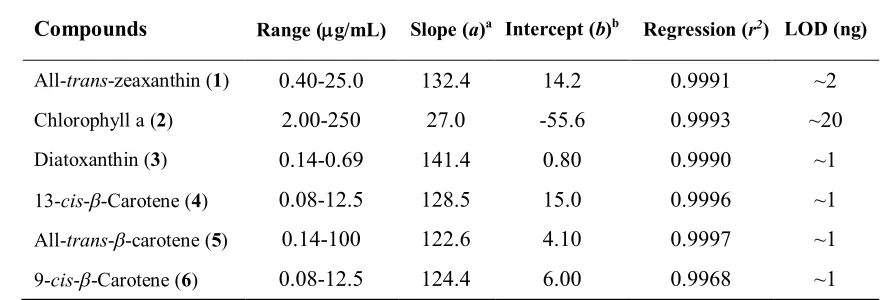
concentration of each reference standard (Table 2). The curves showed good linearity,
110
and the correlation coefficients were between 0.997 and 0.999 for all of the compounds
111
over the concentration ranges of quantification. The recovery of four carotenoids
112
excepting diatoxanthin was assessed by spiking samples with high and low
113
concentrations of each reference compound, 1,000 and 30 ng, respectively. Spiking
114
with 19.2 and 2.8 ng was done for diatoxanthin. The average recoveries were between
115
85.6% and 107.4% (n = 3). The limits of detection (LOD) were determined by serial
116
dilution based on a signal-to-noise (S/N) ratio of 3:1 (Table 2). The peak purity was
117
determined by the photodiode array detector and the corresponding computer software
118
that confirmed the singularity of each peak. In addition, the absorption spectrum of
Table 1. Hunter values and pigment contents in spirulina samples, and their antioxidant activities.
121
Items Samples
AP-1 C1 C2 C3 C4 C5 C6 C7
Hunter Values
L* 19.2 ± 0.7c 18.8 ± 0.5c 16.9 ± 0.9d 17.4 ± 0.9d 16.3 ± 0.1d 14.1 ± 0.6e 28.0 ± 1.2a 24.4 ± 0.1b
a* -7.4 ± 0.1b -7.2 ± 0.1b -6.8 ± 0.2a -9.0 ± 0.1d -8.1 ± 0.3c -7.5 ± 0.2b -9.5 ± 0.0e -10.0 ± 0.0f
b* 6.9 ± 0.1d 8.4 ± 0.1b 7.0 ± 0.2d 8.7 ± 0.4b 8.7 ± 0.4b 6.3 ± 0.1e 13.3 ± 0.3a 8.0 ± 0.1c
Carotenoids (µg/g)
All-trans-zeaxanthin 1266.7 ± 118.1a 535.3 ± 84.8b 694.0 ± 113.9b 132.7 ± 16.8e 216.4 ± 34.4d 89.5 ± 15.4f 307.5 ± 13.8c 115.1 ± 12.5e
Diatoxanthin 263.2 ± 40.8a 136.3 ± 24.5b 166.5 ± 30.9b 50.7 ± 9.8d 59.5 ± 3.0d 49.4 ± 5.9d 79.8 ± 5.4c 87.5 ± 10.1c
cis--Carotene 55.7 ± 9.6a 21.7 ± 0.3c 36.5 ± 3.9b 8.3 ±1.2d 5.7 ± 0.3e 9.7 ± 1.4d 18.4 ± 3.4c 6.7 ± 0.7e
All-trans--carotene 2296.5 ± 51.3a 716.2 ± 25.3b 923.1 ± 174.4b 83.1 ± 14.0d 162.2 ± 16.7c 155.4 ± 23.7c 189.6 ± 16.2c 23.6 ± 3.2e
cis--Carotene 381.6 ± 49.0a 165.5 ± 20.3c 249.6 ± 31.2b 50.7 ± 5.2e 69.2 ± 13.4e 64.7 ± 10.8e 89.4 ± 4.9d 3.7 ± 0.3f
Others 165.2 ± 13.2a 124.2 ± 9.8b 161.2 ± 4.1a 56.2 ± 1.8d 69.0 ± 9.2c 46.3 ± 3.7e 78.3 ± 2.5c 46.7 ± 6.5e
Total carotenoids (mg/g) 4.43 ± 0.03a 1.70 ± 0.15c 2.23 ± 0.35b 0.38 ± 0.03f 0.58 ± 0.05e 0.41 ± 0.05f 0.76 ± 0.03d 0.28 ± 0.02g
Chlorophyll a (mg/g) 10.8 ± 1.1a 3.4 ± 0.3c 4.7 ± 0.6b 3.5 ± 0.6c 2.7 ± 0.2d 3.3 ± 0.4c 2.6 ± 0.0d 3.6 ± 0.5c
C-Phycocyanin (mg/g) 251.2 ± 11.2a 100.2 ± 1.1d 153.3 ± 2.3b 106.5 ± 1.5c 113.4 ± 9.1c 144.8 ± 4.1b 94.9 ± 6.3d 108.6 ± 0.7c
Anti-oxidant activity of carotenoid extracts
Total phenolics (μmol GAE/g) 1.3 ± 0.1d 2.3 ± 0.4c 1.5 ± 0.2d 4.6 ± 0.6b 2.9 ± 0.5c 6.4 ± 0.6a 2.9 ± 0.4c 2.5 ± 0.0c
Total flavonoids (μmol QE/g) 26.6 ± 2.4a 22.8 ± 3.4a 24.0 ± 1.0a 15.6 ± 0.9b 15.0 ± 2.4b 12.9 ± 0.4c 18.5 ± 1.9b 24.0 ± 2.9a
DPPH (μmol TE/g) 18.5 ± 0.5a 8.4 ± 1.3c 10.3 ± 1.1b 6.1 ± 0.8d 5.8 ± 1.2d 5.2 ± 0.8d 7.3 ± 0.4c 6.4 ± 0.8d
ABTS (μmol TE/g) 33.7 ± 5.0a 18.7 ± 3.9b 23.6 ± 1.6b 24.8 ± 4.2b 21.4 ± 3.6b 18.1 ± 2.0b 19.3 ± 3.1b 19.3 ± 3.2b
Total phenolics (μmol GAE/g) 82.1 ± 4.8a 66.2 ± 4.5bc 70.6 ± 2.6b 47.0 ± 5.4c 53.9 ± 8.8c 62.4 ± 4.8bc 64.3 ± 6.2bc 47.6 ± 0.8c
Total flavonoids (μmol QE/g) ND ND ND ND ND ND ND ND
DPPH (μmol TE/g) 18.7 ± 0.2a 14.8 ± 1.4b 19.1 ± 1.5a 18.1 ± 1.6a 15.5 ± 2.3b 16.2 ± 1.2b 16.5 ± 1.1b 14.4 ± 0.9b
ABTS (μmol TE/g) 108.3 ± 10.2a 66.6 ± 3.3c 83.4 ± 5.1b 42.7 ± 4.4e 49.4 ± 1.5d 51.7 ± 2.7d 47.3 ± 6.1de 42.5 ± 6.2e L*, lightness; a*, + red – green; b*, + yellow – blue (CR-400, Minolta); GAE, gallic acid equivalent; QE, quercetin equivalent; TE, trolox equivalent.
122
Data are expressed as the mean (the average value of content for dry weight) and SD (the standard deviation value) of three independent experiments. Different letters in the same 123
row mean significantly different (p<0.05). ND, not detected. 124
125
Table 2.Linear ranges and correlation coefficients of calibration curves.
127
a,b Slope and intercept represent a and b in Y= ax + b linear model.Y means peak area and x,
128
concentration. 129
Compounds Range (g/mL) Slope (a)a Intercept (b)b
Regression (r2) LOD (ng)
All-trans-zeaxanthin (1) 0.40-25.0 132.4 14.2 0.9991 ~2
Chlorophyll a (2) 2.00-250 27.0 -55.6 0.9993 ~20
Diatoxanthin (3) 0.14-0.69 141.4 0.80 0.9990 ~1
13-cis--Carotene (4) 0.08-12.5 128.5 15.0 0.9996 ~1
All-trans--carotene (5) 0.14-100 122.6 4.10 0.9997 ~1
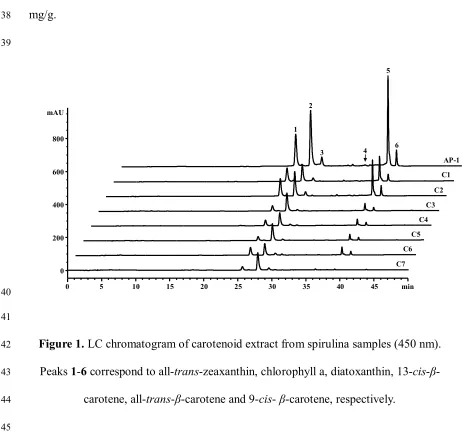
All-trans-β-carotene, all-trans-zeaxanthin, 9-cis-β-carotene and diatoxanthin were
131
found to be the major carotenoids present in spirulina (Figure 1). 13-cis-β-Carotene
132
was also detected. The content of all-trans-β-carotene was highest among the four
133
major carotenoids in AP-1, C1, C2 and C5 while that of all-trans-zeaxanthin was
134
highest in the remaining samples. AP-1, C1 and C2 contained more than 1.6 mg/g dry
135
weight of total carotenoids while the other samples contained less than 0.8 mg/g total
136
carotenoid content. AP-1 showed the highest total carotenoid content of 4.43±0.03
137
mg/g.
138
139
140
141
Figure 1. LC chromatogram of carotenoid extract from spirulina samples (450 nm).
142
Peaks 1-6 correspond to all-trans-zeaxanthin, chlorophyll a, diatoxanthin, 13-cis-β
-143
carotene, all-trans-β-carotene and 9-cis- β-carotene, respectively.
144
145
146
min
0 5 10 15 20 25 30 35 40 45
mAU
0 200 400 600 800
C7 C6
AP-1
C1
C2
C3
C4
C5 1
2
3
5
The green photosynthetic pigment chlorophyll a which is essential for
148
photosynthesis in cyanobacteria as primary electron donor was also determined at the
149
same LC conditions used for carotenoid analysis with a different wavelength. AP-1
150
showed the highest level of chlorophyll a, 10.8±1.1 mg/g, while the mean values in
151
the other samples were between 2.6-4.7 mg/g.
152
C-PC, a major biliprotein of spirulina, was extracted by grinding the sample powder
153
with sea sand and sonication at 4C. The extraction efficiency observed at pH 7 was
154
higher than at pH 4 and 10 (data not shown). AP-1 showed the greatest amount of
C-155
PC, 251.2±11.2 mg/g, and the mean values in the commercial spirulina samples were
156
between 94.9-153.3 mg/g.
157
Among the three major pigments in spirulina, the content of C-PC was highest with
158
a value of 10-25% (w/w). The average percentages of chlorophyll a and carotenoids
159
were 0.26-1.1% and 0.03-0.38%, respectively. The total carotenoid content varied by
160
up to eight-fold among the commercial samples, while the content variations of
161
chlorophyll a and C-PC were 1.8 and 1.6-fold, respectively.
162
163
2.3. Antioxidant activity of carotenoid and C-PC extracts 164
165
Carotenoids, phycocyanins and spirulina are known to have potent antioxidant
166
activity. DPPH and ABTS methods were applied to determine antioxidant activity of
167
carotenoid and C-PC extracts obtained from spirulina samples. The C-PC extract
168
showed higher antioxidant activities than the carotenoid extract in the DPPH and
169
ABTS assays. The carotenoid extract of AP-1 with the highest content of total
170
carotenoids and chlorophyll a exhibited the highest DPPH and ABTS radical
171
scavenging activities among the tested carotenoid extracts. AP-1 with the highest
pattern in carotenoid and C-PC extracts, respectively.
175
The total phenol and flavonoid contents were evaluated to investigate the effect of
176
phenolic and flavonoid compounds on the antioxidant activities of these extracts. The
177
results showed that the mean value of total phenol content in the carotenoid extract was
178
in the range of 1.3-6.4 μmol gallic acid equivalents (GAE)/g dry weight, which was
179
much lower than that of 47.0-82.1 μmol GAE/g observed in the C-PC extract (Table 1).
180
Additionally, significant negative correlation were observed between total phenolic
181
content in the carotenoid extract with the content of carotenoids, chlorophyll a and
182
flavonoids, and DPPH radical scavenging activity of the extract (Table 3). Meanwhile,
183
the mean flavonoid content in the carotenoid extract was in the range of 12.9-26.6
184
quercetin equivalents (QE)/g and displayed significant positive correlations with
185
carotenoid and chlorophyll a contents and DPPH radical scavenging activity of the
186
extract. Flavonoids were not detected in the C-PC extract. Total phenol content of the
187
C-PC extract exhibited significant positive correlations with the content level of three
188
pigments and antioxidant activities of the extract.
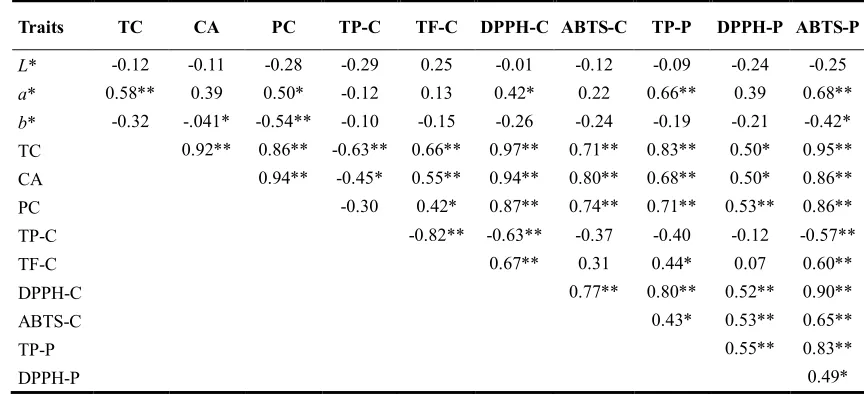
Table 3. Pearson’s correlation coefficients of Hunter values, pigment contents and
190
antioxidant activities.
191
Traits TC CA PC TP-C TF-C DPPH-C ABTS-C TP-P DPPH-P ABTS-P
L* -0.12 -0.11 -0.28 -0.29 0.25 -0.01 -0.12 -0.09 -0.24 -0.25
a* 0.58** 0.39 0.50* -0.12 0.13 0.42* 0.22 0.66** 0.39 0.68**
b* -0.32 -.041* -0.54** -0.10 -0.15 -0.26 -0.24 -0.19 -0.21 -0.42*
TC 0.92** 0.86** -0.63** 0.66** 0.97** 0.71** 0.83** 0.50* 0.95**
CA 0.94** -0.45* 0.55** 0.94** 0.80** 0.68** 0.50* 0.86**
PC -0.30 0.42* 0.87** 0.74** 0.71** 0.53** 0.86**
TP-C -0.82** -0.63** -0.37 -0.40 -0.12 -0.57**
TF-C 0.67** 0.31 0.44* 0.07 0.60**
DPPH-C 0.77** 0.80** 0.52** 0.90**
ABTS-C 0.43* 0.53** 0.65**
TP-P 0.55** 0.83**
DPPH-P 0.49*
TC, total carotenoid content; CA, chlorophyll a content; PC, phycocyanin content; TP-C, total phenolic 192
content in carotenoid extract; TF-C, total flavonoid content in carotenoid extract; DPPH-C, antioxidant 193
activity of carotenoid extract on DPPH assay; ABTS-C, antioxidant activity of carotenoid extract on 194
ABTS assay;; TP-P, total phenolic content in C-PC extract; TF-P, total flavonoid content in C-PC extract; 195
DPPH-P, antioxidant activity of C-PC extract on DPPH assay; ABTS-P, antioxidant activity of C-PC 196
extract on ABTS assay. 197
*Significant at P<0.05. **Significant at P<0.01.
198 199 200 3. Discussion 201 202
Spirulina has been used as an additive in a variety of health foods and animal feeds,
203
and has been produced commercially for the last 30 years for these purposes.
204
Commercially grown spirulina is normally produced in large outdoor ponds under
205
controlled conditions or harvested directly from lakes [1]. It contains substantial
206
amount of two distinctive antioxidant pigmented antioxidants: the yellow-to-red
207
carotenoids and blue phycocyanin (PC). In this study, the major carotenoid and
C-208
PC content levels were determined using an LC-DAD method and a UV spectrometer,
209
respectively, for seven commercially available spirulina powder products (C1-C7) with
210
freeze-dried A. platensis trichomes cultured in our laboratory (AP-1). The correlation
211
of the content level of these two pigments with a visible parameter and antioxidant
antioxidant activities (Table 3). As the a* values (redness) increased, the total
215
carotenoid and C-PC content increased. The redness value displayed a non-significant
216
correlation with chlorophyll a content. As the b* values (+ yellow – blue) decreased,
217
the total carotenoid and C-PC content of the extracts increased.
218
There were substantial differences in carotenoid, chlorophyll a and C-PC content
219
between the lyophilized sample AP-1 and commercially available spirulina powders
220
(C1-C7). AP-1 was cultivated and freshly prepared in our laboratory. The total
221
carotenoid, chlorophyll a and C-PC contents observed in AP-1 were the highest seen
222
among the eight samples. AP-1 also exhibited the highest antioxidant activities among
223
the samples. The overall lower amounts of carotenoid, chlorophyll a and C-PC contents
224
found in commercial spirulina powder compared to AP-1 could stem from pigment
225
degradation during the mass production process, as the natural pigments are sensitive to
226
light, heat and oxygen. It has been reported that the carotenoid composition differences
227
of dried commercial spirulina preparations are most likely due to their thermolability
228
[14]. While reportedly stable over a pH range of 5-7.5 at 9 ± 1°C, thermal instability of
229
C-PC obtained from A. platensis above 40°C has been observed [15]. Chlorophyll
230
degradation is known to occur during the roasting process [16]. A solar or hot-air based
231
drying process is utilized in the mass production of most commercial spirulina powders,
232
which could decrease the pigment content of the powder. Additional food processing
233
techniques and storage conditions can have a similar effect. The antioxidant potential
234
of A. platensis powder was easily degraded after exposure of the biomass to heat and
235
light [17].
236
The content of all-trans-β-carotene was highest among the four major carotenoid
237
ingredients of the spirulina powder samples in AP-1, C1, C2 and C5 while that of
filamentous blue-green microalgae belonging to the two separate genera Spirulina and
240
Arthrospira, which consist of approximately 15 species. Of these, Arthrospira platensis 241
is the most common and widely available source of spirulina and most of the published
242
research and public health decisions refer to this specific species [18]. Therefore, A.
243
plantensis was chosen and cultivated in this study as a control. However, two
244
Arthrospira species, A. platensis and A. maxima, have been used as a food source,
245
dietary supplement, and feed supplement [1]. It has been reported that the content of
246
zeaxanthin was higher than that of β-carotene in a dried A. maxima sample [14].
247
Therefore, the difference in carotenoid profiles between the two groups might result
248
from the fact that the group including AP-1 belonged to A. platensis and the other
249
group belonged to A. maxima. Contrary to previous findings, -cryptoxanthin was not
250
detected in the spirulina powder used in this study [2,14]. Instead of -cryptoxanthin,
251
diatoxanthin was detected along with 9-cis-β-carotene and 13-cis-β-carotene (Fig. 1)
252
[1,18].
253
Total carotenoid content showed high correlation coefficients of 0.92 and 0.86 to
254
chlorophyll a and C-PC content, respectively. The total carotenoid content also
255
exhibited greater positive correlations with antioxidant activities than the total
256
flavonoid contents of the carotenoid extract. These strong correlations suggest that the
257
major antioxidant compounds in the carotenoid extract are carotenoids, not phenols or
258
flavonoids, although phenols and flavonoids are also known antioxidants, and the
259
flavonoid content level contributed in portion to the antioxidant activity of the samples
260
with low content of total carotenoids. Chlorophyll a and C-PC contents also showed
261
significant positive correlations, respectively, with the other two pigment contents and
262
antioxidant activities. Compared to the C-PC content in C-PC extract, the total phenol
263
content showed similar positive correlations with antioxidant activities of this extract.
antioxidant ingredient of this extract.
267
The antioxidant activities against DPPH and ABTS radicals displayed overall
268
significant positive correlations to each other in both carotenoid and C-PC extracts.
269
While in the carotenoid extract DPPH assay exhibited greater correlations with the
270
lipophilic total carotenoid, chlorophyll a and flavonoid contents than ABTS assay, in
271
the C-PC extract ABTS assay showed higher positive correlations with the hydrophilic
272
C-PC and total phenolic contents than DPPH assay. These results provide a scientific
273
foundation for proper identification and establishment of standards for distribution of
274
quality commercial spirulina products. Future studies will evaluate the stability of these
275
natural pigments in spirulina powder during storage under various conditions.
276
277
4. Materials and Methods
278
279
4.1. Sample preparation 280
281
Athrospira platensis (Nordstedt) Gomont (P_PS_00001194) was provided by the
282
Korea Institute of Ocean Science and Technology (Geoje, Korea). Cultivation was
283
conducted for a period of 10 days in 500 ml baffled flasks containing 300 ml of
284
Zarrouk’s medium (Sigma, St. Louis, MO, USA) with stirring at 120 rpm at 25C
285
under 130 μmol/m2 s illumination. Cells were harvested by centrifugation (Vision
286
Scientific Co., Ltd., VS-24SMTi, Daejeon, Korea) at 3,000 g for 5 min at 4C and
287
freeze-dried (ilShin BioBase Co., Ltd., TFD 5503, Korea, -40C). The lyophilized
288
sample (AP) was stored at -80C until analysis was completed. The seven
289
commercially available spirulina powder samples (C1-C7) were purchased from
Australia, China, India, New Zealand and USA.
292
293
4.2. Colorimetric evaluation 294
295
Color attributes of samples were measured with a colorimeter (Konica Minolta
CR-296
400, Osaka, Japan). Prior to testing, the colorimeter was calibrated using a Minolta
297
standard white reflector plate. Color measurements were taken between three and five
298
times per sample, depending on the portion of each powder. The data were presented as
299
L* (lightness), a* (redness), and b* (yellowness) values according to the Hunter color
300
system.
301
302
4.3. Carotenoid analysis 303
304
All extraction procedures were performed under subdued light to avoid pigment
305
degradation. Two hundred and fifty milligrams of the lyophilized samples were
306
homogenized using a pestle in a prechilled mortar with 1 mL of acetone (stabilized
307
with 0.01% butylated hydroxytoluene, BHT), sea sand, Na2SO4 and NaHCO3. The
308
solution was transferred to a 10 mL conical tube and sonicated three times for 10 min.
309
The extract was centrifuged at 5,700 g at 4C for 10 min (Eppendorf, 5430R, Hamburg,
310
Germany), and 5 mL of the supernatant was dried under a stream of N2 gas and
311
dissolved in 500 μL of a CH2Cl2 and acetone mixture (1:1, v/v). This sample solution
312
was filtered through a 0.45 m membrane filter (Whatman, PTFE, 13 mm) prior to LC
313
analysis.
314
Carotenoid analysis was conducted according to our previously reported method [19]
315
using an Agilent 1260 HPLC system (Hewlett-Packard, Waldbronn, Germany).
(min): 25.0 for all-trans-zeaxanthin, 27.2 for chlorophyll a, 28.9 for diatoxanthin, 36.3
319
for 13-cis--carotene, 39.0 for all-trans--carotene and 40.3 for 9-cis--carotene.
320
Methanol, water and methyl-tert-butyl ether used in the HPLC system were all of
321
HPLC grade, and all other chemicals were extra grade. A stock solution of diatoxanthin
322
(0.691 mg/L) was purchased from DHI (Hoersholm, Denmark), and the other
323
carotenoids and chlorophyll a were purchased from CaroteNature GmBH (Switzerland)
324
and Sigma (St. Louis, MO, USA), respectively.
325
326
4.4. C-PC analysis 327
328
C-PC was quantified by UV-Visible electronic absorption using an external
329
calibration method [4]. Briefly, one hundred milligrams of the lyophilized samples
330
were ground with seasand and extracted by four times sonication for 30 min each with
331
30 mL of PBS (pH 7.0) buffer solution. The extract was centrifuged at 20,000 g at 4C
332
for 6 hours and the supernatant was filtered through a 0.45 μm membrane filter
333
(Whatman, PTFE, 13 mm). Two hundred microliters of each extract was transferred to
334
a 96 well plate, where a microplate reader (BioTek, Synergy H1, Winooski, VT, USA)
335
was used to detect the absorbance at 620 nm. Working calibration solutions in the range
336
of 0.5-5 mg/mL were prepared by diluting the stock solution of C-phycocyanin (Sigma,
337
St. Louis, MO, USA) with PBS buffer. All of the procedures were performed under
338
subdued light to avoid pigment degradation as described above.
339
340
4.5. Total phenol and total flavonoid contents 341
according to our previously described method [20], which is a slightly modified form
344
of the Folin-Ciocalteu colorimetric method [21]. One hundred microliters of the extract
345
was mixed with 500 μL of Folin-Ciocalteu solution (Merck, Darmstadt, Germany) and
346
400 μL of a 200 mM sodium carbonate solution. After mixing, the solution was
347
centrifuged at 3,000 g for 5 min. Two hundred microliters of the upper layer were
348
transferred to a 96-well plate and the absorbance was measured at 765 nm with a
349
microplate reader (BioTek, Synergy H1, Winooski, VT, USA). Using a gallic acid
350
(Sigma, Hong Kong, China) calibration standard, the results were expressed as μmol
351
gallic acid equivalents per g (μmol GAE/g).
352
The total flavonoid content was determined using a diethylene glycol colorimetric
353
method [21] using quercetin as the standard. Sample extracts (20 μL) were added to
354
170 μL of 90% diethylene glycol and 10 μl of a 4 M NaOH solution. The absorbance
355
was measured at 420 nm after 10 min. The results were expressed as μmol quercetin
356
(Sigma-Aldrich, Munich, Germany) equivalents per gram (μmol QE/g).
357
358
4.6. Antioxidant activity test with DPPH radical 359
360
The scavenging activities of the samples on 1,1-diphenyl-2-picrylhydrazyl (DPPH)
361
were measured using a slightly modified form of our previously reported method [20].
362
The radical scavenging activity was expressed as Trolox (Sigma, St. Louis, MO, USA)
363
equivalents per gram (μmol TE/g).
364
365
4.7. Antioxidant activity test with ABTS radical 366
367
The ABTS radical was generated using a previously reported method [22]. Each
each sample was expressed as Trolox (Sigma, USA) equivalents per gram (μmol TE/g).
371
372
4.8. Statistical analysis 373
374
All of the contents and the antioxidant activities are expressed as the means ±
375
standard deviations (SD) of triplicate determinations. The differences among samples
376
were statistically evaluated via one-way analysis of variance (ANOVA). The values
377
were evaluated at the 5% significance level using two-sided tests. Pearson's correlation
378
coefficients were obtained using IBM SPSS Statistics 24.0 software (Armonk, NY,
379
USA).
380
381
Author Contributions: Conceptualization, S.-S.K., M.G.F. and M.-J.A.; Data curation,
382
D.H.L.; Funding acquisition, J.K., S.-S.K., C.M.K. and M.-J.A.; Investigation, W.S.P.
383
and M.L.; Methodology, W.S.P., H.-J.K., and M.G.F..; Resources, J.K. and C.M.K.;
384
Validation, H.-J.K. and D.H.L.; Writing‒original draft, W.S.P. and H.-J.K.; Writing‒
385
review and editing, M.L., M.G.F. and M.-J.A.
386
387
Funding:
This study was supported by the Korea Institute of Toxicology (Grant
KK-388
1709) and the Next-Generation BioGreen 21 Program, Rural Development
389
Administration, Republic of Korea (SSAC, Grant# no. PJ01318402).
390
391
Conflicts of Interest:
The authors declare no conflicts of interest.
392
393
References
1. Kim, S.K. Handbook of Marine Microalgae: Biotechnology Advances, Academic
396
Press, New York, 2015; p. 300; ISBN 978-0-12-800776-1.
397
2. Careri, M.; Furlattini, L.; Mangia, A.; Musc, M.; Anklam, E.; Theobald, A.; von
398
Holst, C. Supercritical fluid extraction for liquid chromatographic determination
399
of carotenoids in Spirulina Pacifica algae: a chemometric approach. J.
400
Chromatogr. A2001, 912, 61‒71. doi:10.1016/S0021-9673(01)00545-3.
401
3. Bingula, R.; Dupuis, C.; Pichon, C.; Berthon, J.-Y.; Filaire, M.; Pigeon, L.; Filaire,
402
E. Study of the effects of betaine and/or C-phycocyanin on the growth of lung
403
cancer A549 cells in vitro and in vivo. J. Oncol. 2016, Article ID 8162952.
404
doi:10.1155/2016/8162952.
405
4. Chethana, S.; Nayak, C.A.; Madhusudhan, M.C.; Raghavarao, K.S.M.C. Single
406
step aqueous two-phase extraction for downstream processing of C-phycocyanin
407
from Spirulina platensis. J. Food Sci. Technol. 2015, 52, 2415‒2421.
408
doi:10.1007/s13197-014-1287-9.
409
5. Tapiero, H.; Townsend, D.M.; Tew, K.D. The role of carotenoids in the
410
prevention of human pathologies. Biomed. Pharmacother. 2004, 58, 100‒110.
411
doi:10.1016/j.biopha.2003.12.006.
412
6. Stahl, W.; Sies, H. Bioactivity and protective effects of natural carotenoids.
413
Biochim. Biophys. Acta2005, 1740, 101‒107. doi:10.1016/j.bbadis.2004.12.006.
414
7. Rao, A.V.; Rao, L.G. Carotenoids and human health. Pharmacol. Res. 2007, 55,
415
207‒216. doi:10.1016/j.phrs.2007.01.012.
416
8. Romay, C.; Gonzalez, R.; Ledon, N.; Remirez, D.; Rimbaw, V. C-phycocyanin: a
417
biliprotein with antioxidant, anti-inflamatory and neuro-protective effects. Curr.
418
Protein Pept. Sci. 2003, 4, 207‒216. doi:10.2174/1389203033487216.
419
9. Ramos, A.; Acién, F.G.; Fernández-Sevilla, J.M.; González, C.V.; Bermejo, R.
Chromatogr. B: Analytical technologies in the biomedical and life sciences2011,
423
879, 511‒519. doi:10.1016/j.jchromb.2011.01.013.
424
10. Fernández-Rojas, B.; Medina-Campos, O.N.; Hernández-Pando, R.;
Negrette-425
Guzmán, M.; Huerta-Yepez, S.; Pedraza-Chaverri, J. C-phycocyanin prevents
426
cisplatin-induced nephrotoxicity through inhibition of oxidative stress. Food Funct.
427
2014, 5, 480‒490. doi:10.1039/c3fo60501a.
428
11. Abdel-Daim, M.M.; Abuzead, S.M.; Halawa, S.M. Protective role of Spirulina
429
platensis against acute deltamethrin-induced toxicity in rats. PLoS ONE 2013,
430
8:e72991. doi:doi.org/10.1371/journal.pone.0072991.
431
12. Abdel-Daim, M.M.; Farouk, S.M.; Madkour, F.F.; Azab, S.S. Anti-inflammatory
432
and immunomodulatory effects of Spirulina platensis in comparison to Dunaliella
433
salina in acetic acid-induced rat experimental colitis. Immunopharmacol. 434
Immunotoxicol.2015, 37, 126‒139. doi:10.3109/08923973.2014.998368.
435
13. Wu, Q.; Liu, L.; Miron, A.; Klímová, B.; Wan, D.; Kuča, K. The antioxidant,
436
immunomodulatory, and anti-inflammatory activities of Spirulina: an overview.
437
Arch. Toxicol. 2016, 90, 1817‒1840. doi:10.1007/s00204-016-1744-5.
438
14. Miki, W.; Yamaguchi, K.; Konosu, S. Carotenoid composition of Spirulina
439
maxima. Bull. Japan. Soc. Sci. Fish. 1986, 52, 1225‒1227.
440
doi:10.2331/suisan.52.1225.
441
15. Sarada, R.; Phillai, M.G.; Ravishankar, G.A. Phycocyanin from Spirulina sp:
442
influence of processing of biomass on phycocyanin yield, analysis of efficacy of
443
extraction methods and stability studies on phycocyanin. Process Biochem. 1999,
444
34, 795‒801. doi:10.1016/S0032-9592(98)00153-8.
445
16. Pumilia, G.; Cichon, M.J.; Cooperstone, J.L.; Giuffrida, D.; Dugo, G.; Schwartz,
pistachio kernels (Pistacia vera L.) during roasting. Food Res. Int. 2014, 65, 193‒
448
198. doi:10.1016/j.foodres.2014.05.047.
449
17. Colla, L.M.; Bertol, C.D.; Ferreira, D.J.; Bavaresco, J.; Costa, J.A.; Bertolin, T.E.
450
Thermal and photo-stability of the antioxidant potential of Spirulina platensis
451
powder. Bra. J. Biol.2017, 77, 332‒339. doi:10.1590/1519-6984.14315.
452
18. Habib, M.A.B.; Parvin, M,; Huntington, T.C.; Hasan, M.R. A Review on Culture,
453
Production and Use of Spirulina as Food for Humans and Feeds for Domestic
454
Animals and Fish. FAO Fisheries and Aquaculture Circular. No. 1034. FAO,
455
Rome, 2008; p. 33.
456
19. Kim, H.J.; Park, W.S.; Bae, J.-Y.; Kang, S.Y.; Yang, M.H.; Lee, S,; Lee, H.-S.,
457
Kwak, S.-S., Ahn, M.-J. Variations in the carotenoid and anthocyanin contents in
458
sweet potato according to Korean cultural varieties and home-processing methods.
459
J. Food Compost. Anal. 2015, 41, 188‒193. doi:10.1016/j.jfca.2015.01.012.
460
20. Yoon, K.D,; Kang, S.-N.; Bae, J.-Y,; Lee, H.-S.; Kwak, S.-S.; Jang, I.; Kim, I.-S.;
461
Lee, C.H.; Bae, J.M.; Lee, S.W.; Ahn, M.-J. Enhanced antioxidant and protective
462
activities on retinal ganglion cells of carotenoids-overexpressing transgenic carrot.
463
Curr. Drug Targets2013, 14, 999‒1005. doi:10.2174/1389450111314090008.
464
21. Abeysinghe, D.C.; Li, X.; Sun, C.; Zhang, W.; Zhou, C.; Chen, K. Bioactive
465
compounds and antioxidant capacities in different edible tissues of citrus fruit of
466
four species. Food Chem. 2007, 104, 1338‒1344.
467
doi:10.1016/j.foodchem.2007.01.047.
468
22. Re, R.; Pellegrini, N.; Proteggente, A.; Pannala, A.; Yang, M.; Rice-Evans, C.
469
Antioxidant activity applying an improved ABTS radical cation decolorization
470
assay. Free Radic. Biol. Med. 1999, 26, 1231‒1237.
doi:10.1016/S0891-471
5849(98)00315-3.