Porting the LHCb Stack from x86 (Intel) to aarch64 (ARM)
and ppc64le (PowerPC)
Laura Promberger1,∗, Marco Clemencic2, Ben Couturier2, Aritz Brosa Iartza3, and Niko Neufeld2on behalf of the LHCb collaboration
1Fakultät für Informatik und Wirtschaftsinformatik Fachgebiet Informatik, Hochschule Karlsruhe
-Technik und Wirtschaft, Karlsruhe, Germany
2EP, CERN, Meyrin, Switzerland
3Escuela de Ingeniería Informática, Universidad de Oviedo, Oviedo, Asturias, Spain
Abstract.LHCb is undergoing major changes in its data selection and process-ing chain for the upcomprocess-ing LHC Run 3 startprocess-ing in 2021. With this in sight several initiatives have been launched to optimise the software stack. This con-tribution discusses porting the LHCb Stack from x86_64 architecture to both ar-chitectures aarch64 and ppc64le with the goal to evaluate the performance and the cost of the computing infrastructure for the High Level Trigger (HLT). This requires porting a stack with more than five million lines of code and finding working versions of external libraries provided by LCG. Across all software packages the biggest challenge is the growing use of vectorisation - as many vectorisation libraries are specialised on x86 architecture and do not have any support for other architectures. In spite of these challenges we have success-fully ported the LHCb High Level Trigger code to aarch64 and ppc64le. This contribution discusses the status and plans for the porting of the software as well as the LHCb approach for tackling code vectorisation in a platform independent way.
1 Introduction
In 2021 the LHCb experiment will undergo a major upgrade for Run 3. With the increased luminosity provided by the LHC and the introduction of new sub-detectors, the LHCb exper-iment will be able to research new phenomena and known ones more in detail. At the same time this results in an increase of the raw data detector output by a factor of 100 from 50 GB/s to approximately 4 TB/s. And the output data rate of the final selection of the events being written to disk will increase from 0.7 GB/s to 2 - 10 GB/s.
To cope with the large increase of data volume a combination of upgrading the hardware resources of the HLT computing farm and increasing the performance of the software stack is necessary. The increase of performance can be achieved by optimizing the logic of algorithms and exploiting techniques which maximize hardware efficiency. Mainly to be named are multi-threading and vectorisation.
The upgrade of the computing farm will include a new data center and new compute nodes. For the most competitive cost-performance solution it is important to have several
options. For this LHCb decided to extend the architecture support from Intel x86_64 to ARM aarch64 and PowerPc ppc64le.
1.1 The LHCb software stack
The LHCb software stack is made up of multiple, large projects. These projects can be divided into three groups. The LCG project provides external dependencies (e.g. Oracle, ROOT, Python). On top of these is the experiment-independent project Gaudi which is being used by different experiments at CERN. Last there are the experiment-specific projects LHCb, Lbcom, Rec and Brunel which alone sum up to about five million lines of code.
For this study we used the LHCb stack with Brunel v53r1 [1]. First, with the predefined LCG version 91 [2], but later LCG was upgraded to version 92 [3]. This version of the stack was selected because vectorisation is considered to be the largest challenge for porting the code. The selected version contains less vectorised code than the software stack being currently developed for Run 3. At the same time this version has the disadvantage that it is not multi-threaded, yet.
2 Vectorisation
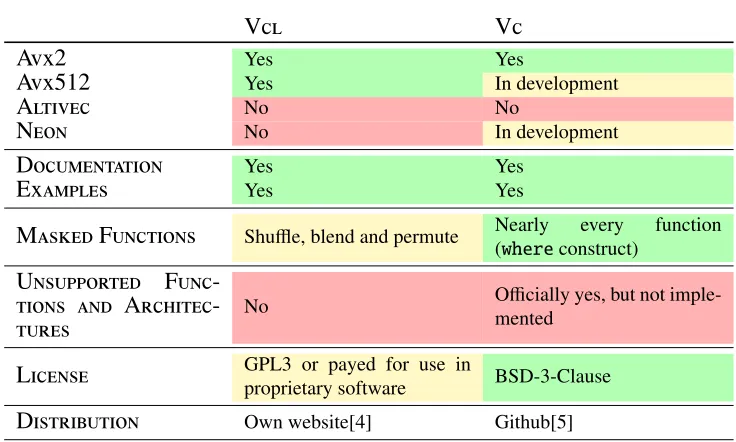
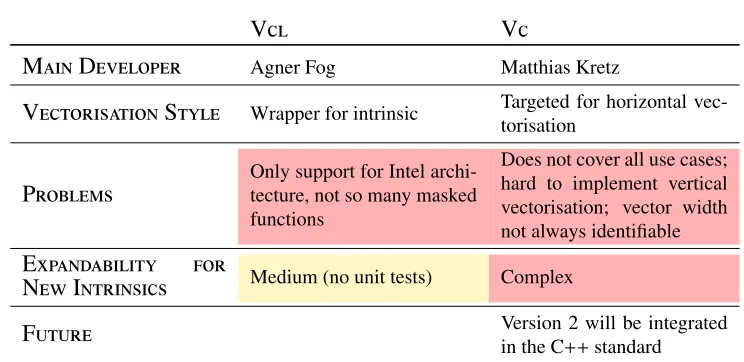
Before being able to port the software stack, several vectorisation libraries being used by LHCb are evaluated for their cross-platform support. The two libraries used are Vc and Vcl. An overview of their features is shown in Table 1. Both libraries do not have any support for either aarch64 (ARM) or ppc64le (PowerPc). However, Vcl being a light low-level wrapper on top of the intrinsic functions allows an implementation of the missing architectures in a limited time. Whereas Vc is a more high-level approach making its usage easier but with a more complex internal structure. Therefore it was decided for the port to add the cross-platform support to Vcl for all needed functions and replace the usage of Vc by either Vcl or a generic scalar implementation.
Table 1:Vectorisation libraries
V
cl
V
c
A
vx
2
Yes YesA
vx
512
Yes In developmentA
ltivec
No NoN
eon
No In developmentD
ocumentation
Yes YesE
xamples
Yes YesM
asked
F
unctions
Shuffle, blend and permute Nearly every function(whereconstruct)
U
nsupported
F
unc
-tions and
A
rchitec
-tures
No Omentedfficially yes, but not
imple-L
icense
GPL3 or payed for use inproprietary software BSD-3-Clause
options. For this LHCb decided to extend the architecture support from Intel x86_64 to ARM aarch64 and PowerPc ppc64le.
1.1 The LHCb software stack
The LHCb software stack is made up of multiple, large projects. These projects can be divided into three groups. The LCG project provides external dependencies (e.g. Oracle, ROOT, Python). On top of these is the experiment-independent project Gaudi which is being used by different experiments at CERN. Last there are the experiment-specific projects LHCb, Lbcom, Rec and Brunel which alone sum up to about five million lines of code.
For this study we used the LHCb stack with Brunel v53r1 [1]. First, with the predefined LCG version 91 [2], but later LCG was upgraded to version 92 [3]. This version of the stack was selected because vectorisation is considered to be the largest challenge for porting the code. The selected version contains less vectorised code than the software stack being currently developed for Run 3. At the same time this version has the disadvantage that it is not multi-threaded, yet.
2 Vectorisation
Before being able to port the software stack, several vectorisation libraries being used by LHCb are evaluated for their cross-platform support. The two libraries used are Vc and Vcl. An overview of their features is shown in Table 1. Both libraries do not have any support for either aarch64 (ARM) or ppc64le (PowerPc). However, Vcl being a light low-level wrapper on top of the intrinsic functions allows an implementation of the missing architectures in a limited time. Whereas Vc is a more high-level approach making its usage easier but with a more complex internal structure. Therefore it was decided for the port to add the cross-platform support to Vcl for all needed functions and replace the usage of Vc by either Vcl or a generic scalar implementation.
Table 1:Vectorisation libraries
V
cl
V
c
A
vx
2
Yes YesA
vx
512
Yes In developmentA
ltivec
No NoN
eon
No In developmentD
ocumentation
Yes YesE
xamples
Yes YesM
asked
F
unctions
Shuffle, blend and permute Nearly every function(whereconstruct)
U
nsupported
F
unc
-tions and
A
rchitec
-tures
No Omentedfficially yes, but not
imple-L
icense
GPL3 or payed for use inproprietary software BSD-3-Clause
D
istribution
Own website[4] Github[5]Table 1:Vectorisation libraries
V
cl
V
c
M
ain
D
eveloper
Agner Fog Matthias KretzV
ectorisation
S
tyle
Wrapper for intrinsic Targeted for horizontal vec-torisationP
roblems
Only support for Intel archi-tecture, not so many masked functions
Does not cover all use cases; hard to implement vertical vectorisation; vector width not always identifiable
E
xpandability
for
N
ew
I
ntrinsics
Medium (no unit tests) ComplexF
uture
Version 2 will be integratedin the C++standard
3 Porting to aarch64 (ARM)
The LHCb stack is first ported to aarch64. For LCG it requires changing compile flags and versions of the external dependencies. Some optional dependencies, like Oracle, are not supported on the architecture, so they can be deactivated without creating any problems. For the other projects (Gaudi, LHCb, ...) compile flags also have to be changed. Additionally, all usage of Vc is replaced either by Vcl or a generic scalar implementation.
During the port two major problems occurred. First, there are platform-specific diff er-ences when castingdoubletounsigned int. Intel does not have a specific instruction to cast fromdoubletounsigned int. Instead Intel cast fromdoubletosigned intand then reinterprets it to unsigned int. ARM on the other hand has an instruction to cast fromdoubletounsigned int. As a result casting the number -2.3 tounsigned intis not valid on ARM. It will result in a floating-point exception stating that the operation is invalid as the value is out of range forunsigned int. To solve this problem the behavior of Intel is mimicked explicitly: castdoubletosigned int and then to unsigned int. The mimicking was selected as enforcing the proper data range would have resulted in an unreasonable amount of code breaking changes for this study. The second problem is also a platform-specific problem. It is about the default expansion of char. On Intelchar is expanded tosigned charand on ARM it is expanded to unsigned char. This resulted within the LHCb stack in a wrongly calculated hash function. To solve the problem the Gcc compile flag-fsigned-charhas to be used, forcing ARM to behave like Intel: expanding chartosigned char.
After successfully building the LHCb stack on aarch64, the results of the full reconstruc-tion test (Brunel) were validated for their numerical accuracy as the values fluctuate depend-ing on the compiler version and the platform bedepend-ing used. The validation returned that the results are inside the accepted range.
4 Porting to ppc64le (PowerPc)
Here, the main work was related to optimizing compile flags for ppc64le and changing guards from checking whether it is an aarch64 platform to checking that it is not a x86_64 platform. Further changes included replacing__linuxby__linux__as the macro__linux is not defined on the PowerPc platform. This change mainly affected the external dependen-cies provided by LCG, for which the changes had to be recorded in form of patches to apply to the original code.
5 Performance
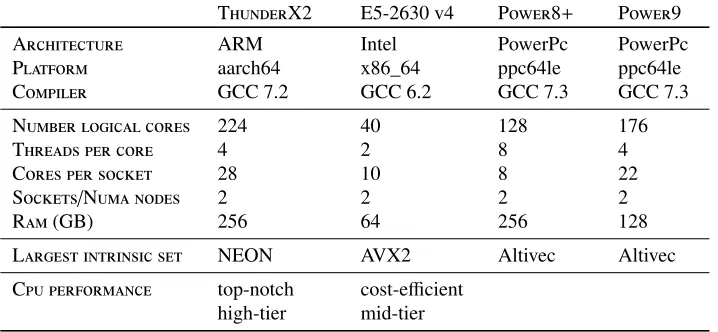
The performance benchmark is the full reconstruction which runs for about 1 to 1.5 hours. This run time length allows to neglect the different performance behavior which can occur when the machine is warming up. Table 2 contains details of the machines used for the benchmark. Depending on their performance the benchmark was either run over 6,000 or 12,000 events to reach the required run-duration. As the LHCb stack in this study is not multi-threaded, multiple processes are started in parallel. NUMA-binding is used to balance the load on all available NUMA-nodes and prevent performance-deteriorating effects due to cross NUMA-node communication.
Table 2:Machines used for the benchmark
ThunderX2 E5-2630v4 Power8+ Power9
Architecture ARM Intel PowerPc PowerPc
Platform aarch64 x86_64 ppc64le ppc64le
Compiler GCC 7.2 GCC 6.2 GCC 7.3 GCC 7.3
Number logical cores 224 40 128 176
Threads per core 4 2 8 4
Cores per socket 28 10 8 22
Sockets/Numa nodes 2 2 2 2
Ram(GB) 256 64 256 128
Largest intrinsic set NEON AVX2 Altivec Altivec Cpu performance top-notch
high-tier cost-e
fficient mid-tier
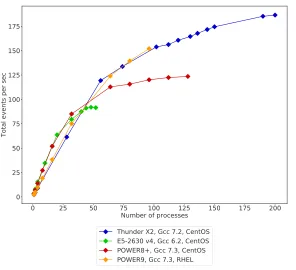
The scalability of the stack is shown in Figure 1. Here, the Intel E5-2630 v4 and the POWER8+have the same speed-up even though the Intel E5-2630 v4 has four more real cores. Whereas the ThunderX2 and the POWER9 have a slower speed-up in the beginning but on the long run better performance due to the higher number of cores. The measurement of the POWER9 does only cover around half of the all the logical cores due to limitations of the amount of RAM currently available in the machine.
Here, the main work was related to optimizing compile flags for ppc64le and changing guards from checking whether it is an aarch64 platform to checking that it is not a x86_64 platform. Further changes included replacing__linuxby__linux__as the macro__linux is not defined on the PowerPc platform. This change mainly affected the external dependen-cies provided by LCG, for which the changes had to be recorded in form of patches to apply to the original code.
5 Performance
The performance benchmark is the full reconstruction which runs for about 1 to 1.5 hours. This run time length allows to neglect the different performance behavior which can occur when the machine is warming up. Table 2 contains details of the machines used for the benchmark. Depending on their performance the benchmark was either run over 6,000 or 12,000 events to reach the required run-duration. As the LHCb stack in this study is not multi-threaded, multiple processes are started in parallel. NUMA-binding is used to balance the load on all available NUMA-nodes and prevent performance-deteriorating effects due to cross NUMA-node communication.
Table 2:Machines used for the benchmark
ThunderX2 E5-2630v4 Power8+ Power9
Architecture ARM Intel PowerPc PowerPc
Platform aarch64 x86_64 ppc64le ppc64le
Compiler GCC 7.2 GCC 6.2 GCC 7.3 GCC 7.3
Number logical cores 224 40 128 176
Threads per core 4 2 8 4
Cores per socket 28 10 8 22
Sockets/Numa nodes 2 2 2 2
Ram(GB) 256 64 256 128
Largest intrinsic set NEON AVX2 Altivec Altivec
Cpu performance top-notch
high-tier cost-e
fficient mid-tier
The scalability of the stack is shown in Figure 1. Here, the Intel E5-2630 v4 and the POWER8+have the same speed-up even though the Intel E5-2630 v4 has four more real cores. Whereas the ThunderX2 and the POWER9 have a slower speed-up in the beginning but on the long run better performance due to the higher number of cores. The measurement of the POWER9 does only cover around half of the all the logical cores due to limitations of the amount of RAM currently available in the machine.
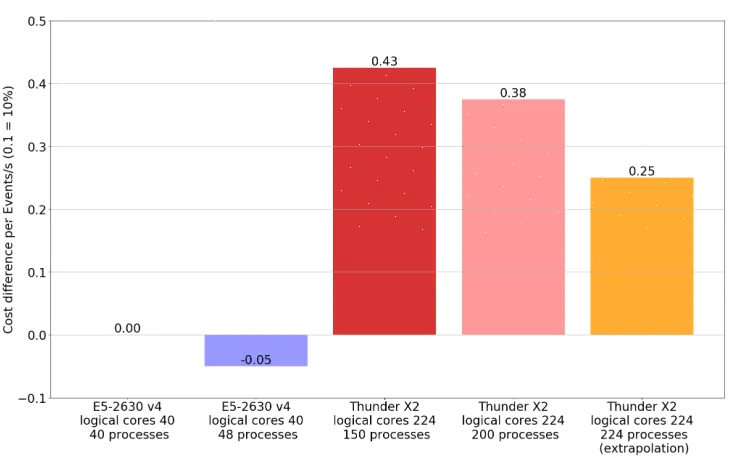
Furthermore, for the Intel E5-2630 v4 and the Cavium ThunderX2 a cost-performance estimation is done. The Power8+is not part of it as it is a machine being part of IBM’s "scale-up" offering, and not the cloud-oriented "scale-out" offering. It is designed for ma-chine learning on GPUs and therefore as such the results cannot be representative for systems which might realistically enter the data-centre. While to have a and therefore of no design which would be considered for the computing farm. And for the Power9 the price was not known. The results are shown in Figure 2. The numbers are in favor for Intel. But there are three things to be considered: One, the ported version of the stack uses less vectorisation
Figure 1:Performance based on average time of one event per process
as some parts were not replaced by Vcl but by a generic scalar code. Two, the stack is not multi-threaded which prevents positive effects of cache-locality. It therefore penalizes a high number of hyper-threads and makes machines with many cores expensive as each process requires about 1.5 GB RAM. This disadvantages the ThunderX2 as it has 224 logical cores and four hyper-threads compared to 40 logical cores and two hyper-threads of the E5-2630 v4. Three, the pricing for buying the machines is not fair. The E5-2630 v4 is a middle tier machine especially selected for its cost-performance ratio and was bought in a bulk of several hundreds of servers. Whereas the ThunderX2 is the top-notch high tier solution from Cavium and the price of it is the price for buying a single machine. Nonetheless, the numbers are not offby factors. They suggest that in a competitive tender both, ARM and Intel, could be viable options.
6 Future work
The main goal is to have a cross-platform support in LHCb software stack for Run 3. How-ever, to be able to do this the major problem of cross-platform vectorisation has to be solved. For this aside from Vc and Vcl additional vectorisation libraries like UMESIMD and boost.simd where explored for their long-term maintainability, functionality and cross-platform support. None of those libraries was able to fulfill all requirements.
Figure 2:Cost-performance estimation based on the price for buying a server
VecCore. And LHCb has done a first pilot study on the original LHCb stack which was also used to do this cross-platform support study. Next steps will be to introduce VecCore to the development teams of the sub-detectors. So that missing functions are detected early enough to be able to be integrated in VecCore in time for the tender of the new HLT computing farm. Further future work is a detailed analysis of the power-consumption for the different archi-tectures. Such an analysis would improve the quality of the measurement of competitiveness.
7 Conclusion
This study is the first step to enable the LHCb collaboration to run their Run 3 HLT computing farm not only on Intel x86_64 machines but also on ARM aarch64 and PowerPc ppc64le. Throughout the work the first analysis that cross-platform support for vectorisation will be a major problem was proven to be true. However, as this study could prove that a port is feasible and that the cost-performance difference between the Intel E5-2630 v4 and the ARM Cavium ThunderX2 does not differ by factors we are confident that continuing this work will benefit the diversity and competitiveness of the tender for the HLT computing farm.
References
[1] L. Brunel,Files · v53r1 · LHCb/Brunel · GitLab, [Online; accessed October 11, 2018], https://gitlab.cern.ch/lhcb/Brunel/tree/v53r1
[2] LHCb, Files · LCG_91_aarch64 · LHCb Core Software/lcgcmake · GitLab, [Online; accessed October 11, 2018; LCG 91 with aarch64 modifications],https://gitlab. cern.ch/lhcb-core/lcgcmake/tree/LCG_91_aarch64
[3] LHCb, Files · LCG_92_ppc64le_based_on_aarch64 · LHCb Core Software /
Figure 2:Cost-performance estimation based on the price for buying a server
VecCore. And LHCb has done a first pilot study on the original LHCb stack which was also used to do this cross-platform support study. Next steps will be to introduce VecCore to the development teams of the sub-detectors. So that missing functions are detected early enough to be able to be integrated in VecCore in time for the tender of the new HLT computing farm. Further future work is a detailed analysis of the power-consumption for the different archi-tectures. Such an analysis would improve the quality of the measurement of competitiveness.
7 Conclusion
This study is the first step to enable the LHCb collaboration to run their Run 3 HLT computing farm not only on Intel x86_64 machines but also on ARM aarch64 and PowerPc ppc64le. Throughout the work the first analysis that cross-platform support for vectorisation will be a major problem was proven to be true. However, as this study could prove that a port is feasible and that the cost-performance difference between the Intel E5-2630 v4 and the ARM Cavium ThunderX2 does not differ by factors we are confident that continuing this work will benefit the diversity and competitiveness of the tender for the HLT computing farm.
References
[1] L. Brunel,Files · v53r1 · LHCb/Brunel · GitLab, [Online; accessed October 11, 2018], https://gitlab.cern.ch/lhcb/Brunel/tree/v53r1
[2] LHCb, Files · LCG_91_aarch64 · LHCb Core Software /lcgcmake · GitLab, [Online; accessed October 11, 2018; LCG 91 with aarch64 modifications],https://gitlab. cern.ch/lhcb-core/lcgcmake/tree/LCG_91_aarch64
[3] LHCb, Files · LCG_92_ppc64le_based_on_aarch64 · LHCb Core Software /
lcgc-make · GitLab, [Online; accessed October 11, 2018; LCG 92 with aarch64 and
ppc64le modifications], https://gitlab.cern.ch/lhcb-core/lcgcmake/tree/ LCG_92_ppc64le_based_on_aarch64
[4] A. Fog,Software optimization resources. C++and assembly. Windows, Linux, BSD, Mac
OS X, [Online; accessed January 19, 2018],http://www.agner.org/optimize/ [5] M. Kretz,GitHub - VcDevel/Vc: SIMD Vector Classes for C++, [Online; accessed
Jan-uary 19, 2018],https://github.com/VcDevel/Vc