Recent results from the COMPASS hadron program
Sebastian Uhl1,a,b, on behalf of the COMPASS Collaboration
1Technische Universität München, James-Franck-Straße, 85748 Garching
Abstract.COMPASS is a fixed-target experiment aimed to study the structure and
dy-namics of hadrons. Using a 190 GeV/cpion beam, the spectrum of light mesons is
stud-ied at four-momentum transfers squared to the target between 0.1 and 1.0 GeV2/c2. The
flagship channel is the diffractive production ofπ−π−π+final states for which COMPASS
has recorded the world’s largest data sample. The determination of properties of known
resonances, and the search for new states is also pursued in theπ−π0π0final state, and in
centrally produced systems. The structure of light mesons is studied in Primakoff
reac-tions at lowest four-momentum transfers. Using these processes, the polarizability of the
pion, the radiative width of thea2(1320) and, for the first time, that of theπ2(1670) have
been measured.
1 Introduction
TheCommonMuon andProtonApparatus forStructure andSpectroscopy (COMPASS) is a
fixed-target experiment located at CERN’s Super Proton Synchrotron (SPS). It is aimed to study the struc-ture and dynamics of hadrons. Spectrum and strucstruc-ture of light mesons are investigated using reactions
of hadron beams with different targets. The spectrum of light mesons is studied in two different
pro-cesses. Isovector states are diffractively produced using a pion beam impinging on a liquid-hydrogen
target (figure 1(a)), isoscalar states are produced in central production reactions of a proton beam also
with a liquid-hydrogen target (figure 1(b)). The structure of light mesons is investigated in Primakoff
reactions of a beam pion and a heavy (highZ) target (figure 1(c)). The decay products of the
inter-mediate states are detected in a two-stage magnetic spectrometer equipped with an electromagnetic and hadronic calorimeter in each spectrometer stage [1]. This provides full coverage for charged and neutral particles, resulting in a homogenous acceptance over a rather wide kinematic range.
2 Diffractive Dissociation into three Pions
Concerning diffractive production of intermediate states, the diffractive dissociation of a beam pion
into the three-pion final state is the dominant process. In COMPASS it can be studied in two different
channels simultaneously, namely inπ−π−π+andπ−π0π0, providing an immediate handle on systematic
ae-mail: [email protected]
bThe author acknowledges financial support by the German Bundesministerium für Bildung und Forschung (BMBF), by the
Maier-Leibnitz- Laboratorium der Universität und der Technischen Universität München, and by the DFG Cluster of Excellence “Origin and Structure of the Universe” (Exc153).
DOI: 10.1051/
C
Owned by the authors, published by EDP Sciences, 2014
/2 014800005
π− X−
P
p p
(a) diffractive dissociation
p p
X P
P
p p
(b) central production
π− X−
γ
Z Z
(c) Primakoffreaction
Figure 1.The different production mechanisms used for the present studies.
effects, as the reconstruction of relies on different parts of the detector. About 50 million exclusive
π−p → π−π−π+pevents in a range of the four-momentum transfer squaredtfrom the beam to the
target between 0.1 and 1.0 GeV2/c2 have been recorded with a pion beam impinging on a
liquid-hydrogen target. The same data set contains roughly 3.5 million events withπ−π0π0in the final state.
Finally, the data are decomposed into spin-parity components using a partial-wave analysis
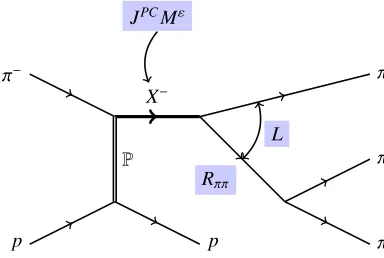
em-ploying the isobar model. Figure 2 shows the process under study. The incoming beam pion diff
rac-tively scatters offa proton in the liquid-hydrogen target producing an intermediate state X−, which
subsequently decays into a two-pion isobarRππ and a bachelor pion with a relative orbital angular
momentumLin between. The isobar decays further into two pions. For the present analysisρ(770),
f0(980), f2(1270), f0(1500),ρ3(1690), and a broad (ππ)S component have been used. The applied
fit model contains partial waves with the spin J of X−and the angular momentum L between the
isobarRππ and the bachelor pion going up to 6. Out of the possible combinations, 87 waves with
non-negligible intensity are kept for the final analysis: 80 with a positive reflectivityε = +1 and 7
withε=−1. In addition one incoherent wave with an isotropic angular distribution is included.
The process is factorized into one part describing the production of the stateX−, and a second one
describing its decay. The latter part can be calculated from the five phase-space variables given the
quantum numbers of the stateX−and the decay channel. The production amplitude are extracted by
a fit, which maximizes the likelihood of observing the data given the model taking into account the detector acceptance.
The three-pion mass range between 500 and 2500 MeV/c2 is studied in bins of 20 MeV/c2 for
theπ−π−π+channel and 40 MeV/c2for theπ−π0π0channel. The data are divided into eleven bins of
π−
X− π
π
π P
p p
JPCMε
L
Rππ
)
2
(GeV/c
− ) π (3
m 0.6 0.8 1 1.2 1.4 1.6 1.8 2 2.2 2.4
)
2
intensity (per 40 MeV/c
0 0.5 1 1.5 2
6
10
× COMPASS 2008 (π−p→(3π)−p) D
π
(770)
ρ
+
1
+ +
2
(scaled)
+ π − π − π
,
0
π
0
π
−
π
2
/c
2
0.100 < t' < 1.000 GeV (incoherent sum)
Preliminary
(a) 2++1+ρ(770)πD
)
2
(GeV/c
− ) π (3
m 0.6 0.8 1 1.2 1.4 1.6 1.8 2 2.2 2.4
)
2
intensity (per 40 MeV/c
0 0.05 0.1 0.15 0.2 0.25 0.3
6
10
× COMPASS 2008 (π−p→(3π)−p) S
π
(1270)
2
f
+
0
+ −
2
(scaled)
+ π − π − π
,
0
π
0
π
−
π
2
/c
2
0.100 < t' < 1.000 GeV (incoherent sum)
Preliminary
(b) 2−+0+f2(1270)πS
Figure 3.Sum of partial-wave intensities over alltbins for two of the waves with a high intensity.
tfor theπ−π−π+channel (eight bins forπ−π0π0), such that the number of events over the analyzed
mass range is approximately equal for all the bins. A rank-1 fit in each of those bins is performed.
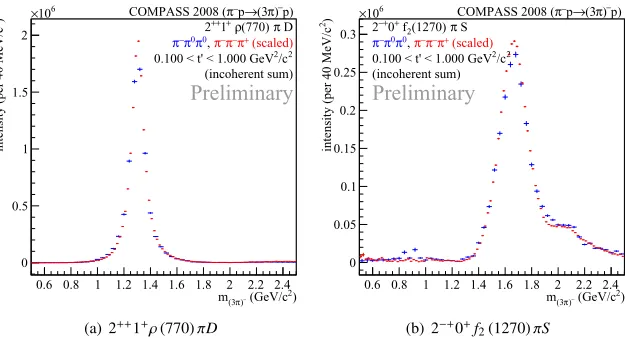
Figure 3 shows the intensity sum over allt bins for two high-intensity waves. The wave names
JPCMεisobarπLcontain the quantum numbersJPCMεof the intermediate stateX−and information
on the decay channel. The 2++1+ρ(770)πDwave with the dominanta2(1320) is shown in figure 3(a),
the 2−+0+f2(1270)πS wave with theπ2(1670) and a tail towards higher masses in figure 3(b). In both
cases the results for theπ−π−π+(red markers) and theπ−π0π0(blue markers) channel are overlaid and
in good agreement. Here and in the following plots the two channels are normalized on the integral for each plot individually. For those two waves, the shape of the intensity spectra does not change
witht. This is in contrast to the 1++0+ρ(770)πS wave shown in figure 4. For this wave, in which a
stronga1(1260) is expected, the peak of the intensity shifts by about 100 MeV/c2over the studiedt
range indicating a rather large non-resonant contribution.
Apart from these three largest waves, also for smaller waves good agreement for the two channels
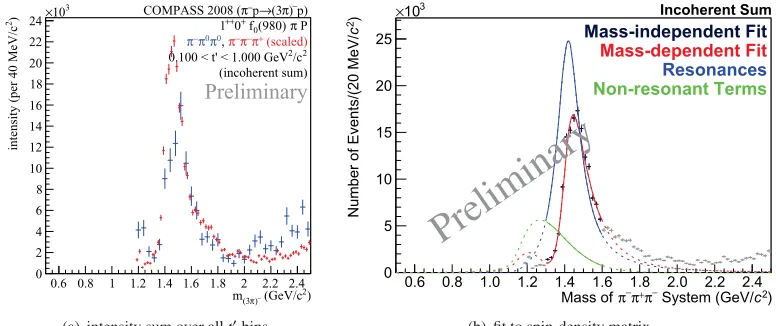
is found. One particularly interesting signal is found in the 1++0+f0(980)πPwave (see figure 5(a)). A
narrow structure around 1400 MeV/c2is observed in both channels. In addition to the intensity peak,
also a rapid phase motion with respect to other waves is found. This previously unobserved signal
could correspond to a new statea1(1420). Different parameterizations for the isobars, in particular
for the f0(980) and the broad (ππ)S component, have been tested to exclude a possible artifact from
the used model.
Finally, resonance parameters are extracted from a fit of Breit-Wigner amplitudes to a subset of the
spin-density matrix for theπ−π−π+channel. Apart from the intensities, this fit also takes into account
the interferences between the waves. In addition to the four waves shown above, the 0−+0+f0(980)πS
and 4++1+ρ(770)πGwaves are used. The model includes Breit-Wigner functions for thea1(1260),
ana1, thea2(1320), ana2, theπ2(1670),π2(1880),π(1800),a4(2040), and for the newa1(1420).
Also a non-resonant term is included for each wave. The Breit-Wigner parameters are obtained from
a simultaneousχ2fit to the spin-density submatrix of the six waves in all eleventbins.
The extracted parameters of the major resonances are in agreement with previous measurements by COMPASS and other experiments [2]. Figure 5(b) shows the result from this fit for the new
) 2 (GeV/c − ) π (3 m 0.6 0.8 1 1.2 1.4 1.6 1.8 2 2.2 2.4
)
2
intensity (per 40 MeV/c
0 0.1 0.2 0.3 0.4 0.5 6 10
× COMPASS 2008 (π−p→(3π)−p) S π (770) ρ + 0 + + 1 (scaled) + π − π − π , 0 π 0 π − π 2 /c 2
0.100 < t' < 0.116 GeV
2
/c
2
0.100 < t' < 0.113 GeV
Preliminary
(a) lowt
) 2 (GeV/c − ) π (3 m 0.6 0.8 1 1.2 1.4 1.6 1.8 2 2.2 2.4
)
2
intensity (per 40 MeV/c
0 0.05 0.1 0.15 0.2 0.25 0.3 6 10
× COMPASS 2008 (π−p→(3π)−p) S π (770) ρ + 0 + + 1 (scaled) + π − π − π , 0 π 0 π − π 2 /c 2
0.285 < t' < 0.395 GeV
2
/c
2
0.262 < t' < 0.326 GeV
Preliminary
(b) hight
Figure 4.Partial-wave intensity of the 1++0+ρ(770)πSwave in twotregions.
) 2 (GeV/c − ) π (3 m 0.6 0.8 1 1.2 1.4 1.6 1.8 2 2.2 2.4
)
2
intensity (per 40 MeV/c
0 2 4 6 8 10 12 14 16 18 20 22 24 3 10
× COMPASS 2008 (π−p→(3π)−p) P π (980) 0 f + 0 + + 1 (scaled) + π − π − π , 0 π 0 π − π 2 /c 2
0.100 < t' < 1.000 GeV (incoherent sum)
Preliminary
(a) intensity sum over alltbins
) 2 c System (GeV/ − π + π − π Mass of
0.6 0.8 1.0 1.2 1.4 1.6 1.8 2.0 2.2 2.4
)
2c
Number of Events/(20 MeV/
0 5 10 15 20 25 3 10
× Incoherent Sum
Mass-independent Fit
Mass-dependent Fit
Resonances
Non-resonant Terms
Preliminary
(b) fit to spin-density matrix
Figure 5.Partial-wave intensities of the 1++0+f0(980)πPwave.
the total result (red line) which is the coherent sum of a resonant (blue line) and a non-resonant (green
line) contribution. A well determined mass of M = 1412−1422 MeV/c2 and a narrow width of
Γ =130−150 MeV/c2is obtained. This is in contrast to other signals of similar magnitude like the
a
1, thea2or theπ2(1880) for which a larger uncertainty in mass and width is retrieved from the same
fit.
3 Central Production
The spin-parity decomposition cannot only be applied in diffractively produced systems, but also in
liquid-) 2 (GeV/c − K + Invariant Mass of K
1.2 1.4 1.6 1.8 2 2.2 2.4
)
2
Intensity / (10MeV/c
0 20 40 60 80 100 3 10
×
COMPASS 2009
s p − K + K f p
→
p p
preliminary
Intensity of S0 wave) 2 (GeV/c − K + Invariant Mass of K
1.2 1.4 1.6 1.8 2 2.2 2.4
Phase
0 20 40 60 80 100 120 140 160 180
COMPASS 2009
s p − K + K f p
→
p p
preliminary
Phase(S0 − D0)) 2 (GeV/c − K + Invariant Mass of K
1.2 1.4 1.6 1.8 2 2.2 2.4
)
2
Intensity / (10MeV/c
0 1 2 3 4 5 6 7 8
3 10
×
COMPASS 2009
s p − K + K f p
→
p p
preliminary
Intensity of D0 waveFigure 6.Spin-density matrix for the centrally producedK−K+system.
hydrogen target [3]. Kaons are identified in a ring-imaging Cherenkov detector. Centrally produced
systems are selected by requiring a rapidity gap between the fast proton and theK−K+system.
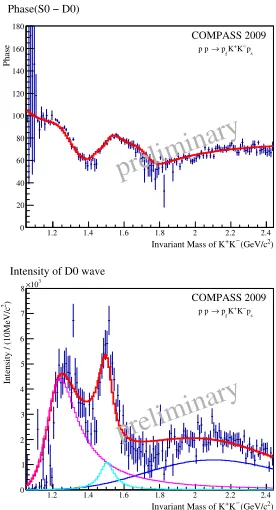
The spin-parity decomposition is performed with four partial-waves, of which two collect
negligi-ble intensity, so that only theS0andD0waves are used to extract Breit-Wigner resonance parameters.
Figure 6 shows the intensities of the two waves, and the phase between them (blue markers). Again, the mass dependence is described by Breit-Wigner amplitudes and a coherent background for each wave. The total result is shown by the red, the coherent non-resonant terms by the blue lines.
Reso-nant contributions are shown in magenta, turquoise, and green. TheD0 wave is described using the
f2(1270) and f2(1525). For theS0 wave in addition to the f0(1500) and f0(1710), a f0(1370) is
required in particular to get a good description of the phase around 1350 MeV/c2.
4 Radiative Widths
Radiative decaysX−→π−γof resonances allow to measure electromagnetic transitions.
Experimen-tally a direct measurement is challenging. The inverse process, that is the scattering of a pion offa
Coulomb field producing an intermediate stateX−(see figure 1(c)) is called a Primakoffreaction. The
Coulomb potential of a heavy nucleus acts as a source of quasi-real photons. The cross section for
Primakoffproduction of a resonance is proportional to the width of its radiative decay. Since the
ex-change particle is a quasi-real photon, Primakoffproduced states predominantly have spin projection
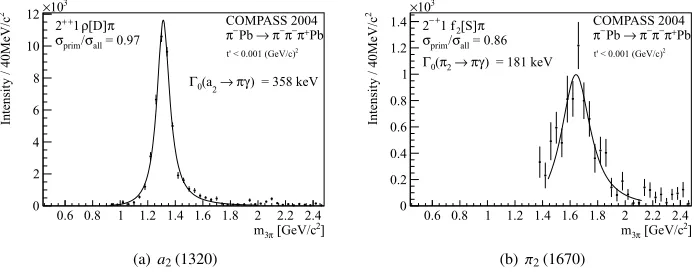
] 2 [GeV/c π 3 m 0.6 0.8 1 1.2 1.4 1.6 1.8 2 2.2 2.4
2
Intensity / 40MeV/c
0 2 4 6 8 10 12 3 10 × π [D] ρ 1 + + 2 = 0.97 all σ / prim σ
) = 358 keV γ π → 2 (a 0 Γ COMPASS 2004 Pb + π − π − π → Pb − π 2
t' < 0.001 (GeV/c)
(a)a2(1320)
] 2 [GeV/c π 3 m 0.6 0.8 1 1.2 1.4 1.6 1.8 2 2.2 2.4
2
Intensity / 40MeV/c
0 0.2 0.4 0.6 0.8 1 1.2 1.4 3 10 × π [S] 2 1 f + − 2 = 0.86 all σ / prim σ
) = 181 keV γ π → 2 π ( 0 Γ COMPASS 2004 Pb + π − π − π → Pb − π 2
t' < 0.001 (GeV/c)
(b)π2(1670)
Figure 7.Partial-wave intensities for the two waves used to extract the radiative widths.
states is proportional tot|M|e−bt, so that at smallt M =1 states should predominantly be produced
by the Primakoffreaction.
COMPASS has studied this reaction by scattering a pion beam offa thin disk of lead [4]. A
partial-wave analysis is employed in order to decompose the collected data into spin-parity states,
thereby also identifying theM =1 final states. Two waves have been considered to extract radiative
widths, the 2++1ρ(770)πDwave for that of the a2(1320), and the 2−+1f2(1270)πS wave for that
of theπ2(1670). At four-momentum transfers squaredt <0.001 GeV2/c2the Primakoffproduction
contributes 97 % (86 %) of the intensity found in the 2++1ρ(770)πDwave (in the 2−+1f2(1270)πS
wave, respectively). Note that in this case the intensities of the two different reflectivitiesε = ±1
have to be summed up incoherently, as the production plane at such small t is poorly measured
due to limited experimental resolution. For both resonances the observed decay channels, ρπ for
thea2(1320) and f2πfor theπ2(1670), are not the only possible decay channels. This is taken into
account by considering the relevant branching fractions.
A radiative width of the a2(1320) of Γ0(a2(1320)→πγ) = (358±6±42) keV is measured,
consistent with calculations from the VMD model [5]. For the first time a radiative width of the
π2(1670) ofΓ0(π2(1670)→πγ)=(181±11±27) keV is measured.
5 Pion Polarizability
Polarizabilities describe the rigidity of a particle against deformations in an external electric (α) or
magnetic (β) field. Typically polarizabilities are measured in Compton scattering processes. Pions
cannot be used as a fixed target, but they can be scattered off the Coulomb potential of a heavy
nucleus. In the reactionπ−γ→π−γthe polarizabilities appear as a correction factor to the Born cross
section of a point-like particle. A measurement of the cross section for this process provides access to this factor, and therefore to the polarizabilities.
COMPASS has taken data where this reaction is embedded into the scattering of a pion beam off
a Nickel target. A large energy deposit in the electromagnetic calorimeter is required to select the photon in the final state, the photon in the initial state is ensured by removing hadronic interactions
with a cut on low photon virtualityQ2. Photons in the final state are required to have a ratioxγ of
the photon and the initial beam energy between 0.4 and 0.9, in the kinematic region of stable trigger
efficiency and muon identification. Due to limited statistics in the region of phase space sensitive to
γ x 0.5 0.6 0.7 0.8 0.9 1
counts / 0.005
0 500 1000 1500
2000 π data− Ni →π−γ Ni
simulation (normalised)
COMPASS 2009
(a) comparison of measurement and simulation
γ
x
0.4 0.5 0.6 0.7 0.8 0.9
R
0.9 1 1.1
with RC, pion loops, Ni FF
Ni
γ
−
π →
Ni
−
π
COMPASS 2009
(b) ratioR
Figure 8.Number of measured and simulated events, and their ratioRused to extract the polarizabilities.
should manifest itself in a decreasing ratioRof the measured cross section over the simulated cross
section for a point-like particle towards higher xγ (see figure 8(b), see [6] for more details on the
data selection and the way the polarizability is obtained). A value for the polarizability ofαπ =
(2.0±0.6±0.7)·10−4fm3is extracted using this approach. A control measurement with a muon beam
is performed, yielding a false polarizability of the muon that is compatible with zero. The observed pion polarizability is at variance from previous experiments, but in agreement with the prediction from chiral perturbation theory [7].
6 Outlook
COMPASS has collected a large data set that is used to perform spectroscopy in the light-meson sector. Apart from the results presented here, also new insights concerning the spin-exotic candidate
π1(1600) are gained, not only in the two (3π)−channels discussed above, but also in theπ−ηandπ−η
channels. Finally, the analysis of (5π)− andπ−ηηfinal states should provide access towards higher
masses.
In 2012 a considerably larger data set has been taken in order to improve on the measurement of
the pion polarizabilities. The range inxγwas extended, providing a handle also onαπ+βπ. For the
first time, a measurement of the kaon polarisabilites is foreseen.
References
[1] COMPASS collaboration, P. Abbonet al., Nucl. Instrum. Methods Phys. Res., Sect. A577, 455
(2007).
[2] COMPASS collaboration, M.G. Alekseevet al., Phys. Rev. Lett.104, 241803 (2010).
[3] A. Austregesilo on behalf of the COMPASS Collaboratian, PoS(Hadron 2013)102.
[4] COMPASS collaboration, C. Adolphet al., European Physical Journal A50, 79 (2014).
[5] J.L. Rosner, Phys. Rev. D23, 1127 (1981).
[6] S. Huber on behalf of the COMPASS Collaboration, PoS(Hadron 2013)125.