94 |
P a g e
Automatic Text Summarization Methods
Vikas Nirgude
1,Vaishali Nirgude
2 1Sanjivani College of Engineering, Kopargaon Ahmednagar, India
2Thakur college of Engineering and Technology,Mumbai-400001,India
Abstract
:
Test summarization is a process of extracting large and useful information from original documents and represent it in the summary/ abstract form. Nowadays huge amount of information is available on internet. There are many application where we need summary of the large documents such as news headlines, market review, email summary, short messages on mobile, research work, medical need such as patients’ history for further treatment, business analysis, educational field, movie summary, minutes of meeting etc. Human being can give very accurate summary of the original document but it is very tedious job for human being to manually summarize large documents. Therefore to save time and efforts, software approach is used for text summarization. Automatic text summarization broadly classified into extractive and abstractive summarization. This paper mainly focus on comparative study of different extractive and abstractive text summarization techniques with algorithms, advantages and limitations of each technique. Study shows that most of the work has done in Extractive text summarization but still abstractive text summarization is a challenging area due to complexity of Natural Language Processing.
Keywor
ds:LSA, ML, NLP, Ontology ,TF-IDF
I. INTRODUCTION
Nowadays large volume of data is available on the internet. Retrieving large volume of data is not a big
problem today but due to time constraints, extracting required information from vast information is really
a difficult task. Therefore, text summarization is very important and timely tool for human being to
understand the large volume of data in summarize form within a specific time. Human summarization can
be person-dependent, context-dependent, varies with human thought so for uniformity automatic text
summarization is needed. In automatic text summarization process, extract or collect required information
from original documents and represent the most important content to the user in condensed form. When
text summarization is done through software it is called Automatic text summarization. In today‟s data
growing age, need of abstract / summary has also increased such as business analysis, market survey,
short messages on mobile, medical field, government offices, news headlines, research review,
95 |
P a g e
techniques are available to get successful summary, each technique has its own advantages anddrawbacks. Initially researchers mainly focused on Single Document Summarization but as the need of
automatic text summarization increases due to vast amount of information, researchers are focusing on
multi-document summarization. Single document summarization produces summary of single input
document. On the other hand, multiple document summarization produces summary of multiple input
documents. Automatic text summarization approach include both machine learning and data mining.
Automatic text summarization techniques are broadly classified into two categories, extractive
summarization and abstractive summarization. Extractive summarization methods extract keywords,
phrases, useful sentences etc from the input documents and generate the summary/ abstract. Whereas
abstractive summarization methods include deep understanding of input text document and show
semantic relation between sentences and then use natural language processing techniques to write new
sentences and create a meaningful summary / abstract which is closer to human being.
II. LITERATURE REVIEW
AUTOMATIC TEXT SUMMARIZATION TECHNIQUES :
Automatic Text summarization techniques are discussed in following section:
1. EXTRACTIVE TEXTS UMMARIZATION TECHNIQUES
An extractive summarization method consists of ext racting important sentences, paragraphs,
keywords, phrases etc. from
the original document(s) and concate them to produce summary.
1.1 ATTRIBUT ES / FEATUR ES FOR EXTRACTIVE TEXT SUMMARIZATION
One of the usual way to decide the importance of a sentence is to identify features or attributes.
Following are few features
/ attributes which can be considered while including the important sentences into the final summary.
Position of Sentence: Usually first and last sentence of a text document are more important and
are having greater
chances to be included in summary Score (S) = 1 / Position in the section.
Sentence length: Sentences which are short contain less information and long sentences are not
appropriate to represent
96 |
P a g e
Proper Noun: Proper noun is name of a person, place and thing etc. Sentences containing proper
nouns are carrying
important information, so can be included in summary.
Title words : The words in the Title and section or subsection heading words are generally included
in summary.
Keyword: Sentences having keywords are of greater chances to be included in summary.
Font style: Sentences containing words appearing in upper case, bold, italics or Underlined fonts are
usually more
important.
Pronouns: Pronouns cannot be included in summary.
Cue Phrases: Some words or phrases positively or negatively correlated to summary such as
„important‟, ‟to conclude‟,
‟exception‟ etc. Sentence containing any cue phrases are mostly added into the summary.
Term Frequency: Find most frequently used words in the original documents . The word frequency is
calculated using TF-
IDF measure.
Presence of Irrelevant words: Some sentences contains non essential words such as „because‟, „due
to‟, ‟however‟ etc
EXTRACTIVE TEXT SUMMARIZATION STEPS :
Following are the steps to extract text from original documents and generate meaningful summary .
Fig. 1 Text Summarization Steps
Informative Sentence Selection
97 |
P a g e
a. Input Document: Source Text (Input):
• Source: single-document vs. multi-document • Language: monolingual vs. multilingual • Category: news vs. technical paper • Specificity: domain-specific vs. general • Length: short vs. long
• Media: text, graphics, audio, video, multi-media
b. Preprocessing:
Preprocessing is structured representation of the original document which includes:
Sentence boundary identification: Sentence boundary is identified with presence of dot at the end of
sentence.
Stop word elimination: Common words with no semantic relation.
Stemming : A word is reduced to common form.
Tokenization: Source text divided into different tokens.
c. Feature Extraction: Identify features/ attributes such as keywords, location of sentences, title,
phrases etc to find informative sentences.
d. Informative Sentence Selection: Select information rich senetences for summary using automatic
te xt summarization techniques.
e. Summary Generation: Generated summary should be precise, information rich, semantically
related , less redundant etc.
EXTRAC TIVE TEXT SUMMARIZARION TEC HNIQUES :
Most of the work has been done on extractive summarization. Extractive text summarization create the
summary from phrases or sentences in the source documents. Information rich sentences are selected from
original documents to form abstract / summary by using different ext ractive text summarization techniques.
1. Term Frequency-Inverse Document Frequency (TF- IDF)
2. Cluster Based Method
3. Graph Theoretic Approach
4. Machine Learning Approach
5. LSA Method
98 |
P a g e
7. Automatic Text Summarization based on fuzzy logic
8. Query Based Extractive Text Summarization
LIMITATION OF EXTRACTIVE TEXT SUMMARIZATION:
1. Extractive text summarization sometimes takes more time to form summary than average time.
2. Sometimes generate redundant summary.
3. Sometimes in final summary, sentences are not logically related to each other i.e . sematic relation is
missing.
4. Multi-lingual text summarization is difficult.
5. Selected sentences for summary generally longer, so irrelevant part of sentences also get added in the
summary.
6. In multi document summarization, there is possibility of contradiction between sources.
EVALUATION OF AUTOMATIC TEXT SUMMARIZATION:
There is no straightforward approach to evaluate summaries or automatic text summarization methods.
There are two summary
evaluation methods: Intrinsic and Extrinsic. While evaluating summaries, following are two properties of
the summary that
must be measured.
The Compression Ratio ( how much shorter the summary is than the original):
CR= Length of summary / Length of input document
Retention Ratio (how much information is retained): RR= Information in summary/ information in
input document
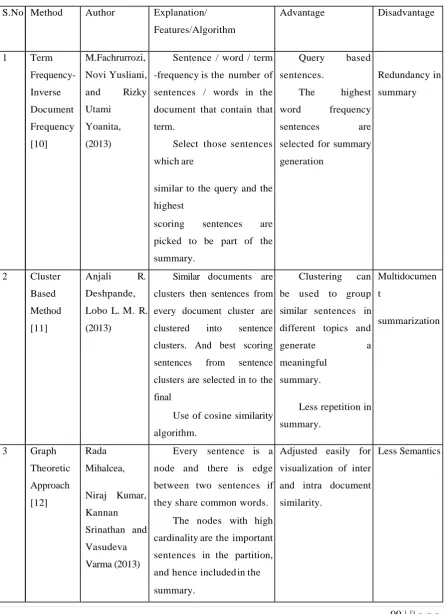
Table 1 Shows comparison of above Extractive Text summarization methods based on the different parameters
99 |
P a g e
Table 1. Comparison between Extractive Text Summarization Techniques
S.No Method Author Explanation/
Features/Algorithm
Advantage Disadvantage
1 Term
Frequency- Inverse Document Frequency [10] M.Fachrurrozi, Novi Yusliani,
and Rizky
Utami
Yoanita,
(2013)
1. Sentence / word / term
-frequency is the number of
sentences / words in the
document that contain that
term.
2. Select those sentences
which are
similar to the query and the
highest
scoring sentences are
picked to be part of the
summary.
1. Query based
sentences.
2. The highest
word frequency
sentences are
selected for summary
generation
Redundancy in
summary
2 Cluster
Based
Method
[11]
Anjali R.
Deshpande,
Lobo L. M. R.
(2013)
1. Similar documents are
clusters then sentences from
every document cluster are
clustered into sentence
clusters. And best scoring
sentences from sentence
clusters are selected in to the
final
2. Use of cosine similarity
algorithm.
1. Clustering can
be used to group
similar sentences in
different topics and
generate a
meaningful
summary.
2. Less repetition in
summary.
Multidocumen
t
summarization
3 Graph
Theoretic
Approach
[12]
Rada
Mihalcea,
Niraj Kumar,
Kannan
Srinathan and
Vasudeva
Varma (2013)
1. Every sentence is a
node and there is edge
between two sentences if
they share common words.
2. The nodes with high
cardinality are the important
sentences in the partition,
and hence included in the
summary.
Adjusted easily for
visualization of inter
and intra document
similarity.
100 |
P a g e
4 Machine
Learning
Approach
[13]
Kamal Sarkar,
Mita
Nasipuri,,
Suranjan
Ghose(2011)
1. The training dataset is
used for reference.
2. Sentences are classified
as summary
and non-summary sentences
based on the features that
they possess.
It provides a
universal summary.
Machine
learning
techniques are
computationall
y complex.
5 LSA
Method [14]
Hanane
Froud,
Abdelmonaim
e Lachkar and
Said Alaoui
Ouatik
(2013)
1. Latent Semantic
Analysis (LSA) in text
processing.
2. It gets this name LSA
because SVD (Singular
Value Decomposition
(SVD) is a very powerful
mathematical tool applied
to document word matrices,
groups documents that are
semantically
related to each other.
Automatically extract
Semantically related
sentences even
though common
words are not present
, just like
human brain
Complex
calculations
needed.
2.
ABSTRACTIVE TEXT SUMMARIZATION TECHNIQUES:The abstractive summarization objectives to produce a generalized summary which is crisp, intelligent,
information rich and semantically related. The abstractive summarization usually requires advanced language
generation and compression techniques. Initial work only on single document summarization. Due to large
amount of information on web , multi document summarization arose. Multi document summarization
produces summaries from many source documents on the same topic.
Abstractive text summarization techniques are broadly classified into two categories [18] :
A. Structured based approach
101 |
P a g e
A. Structured Based Approach:
Structured based approach improves the quality of summaries. All most all approaches produces abstract,
relevant, information rich and less redundant summary. Only lead and body phrase me thod produces
summary with redundant sentences. These methods most important in formation from the original
documents through cognitive schemes such as templates, e xt raction etc. Five techniques under
structured Based Approach are as follows:
1. Tree Based Method
2. Template Based Method
3. Ontology Based Method
4. Lead and Body Phrase method
5. Rule Based Method
B. Semantic Based Approach
Semantic based approach based on semantic representation of original documents. These methods produce
concise, information rich, coherent, and less redundant summary. Three techniques under Semantic Based
Approach are as follows:
1. Multimodal semantic model
2. Information Item Based Method
3. Semantic Graph Based method
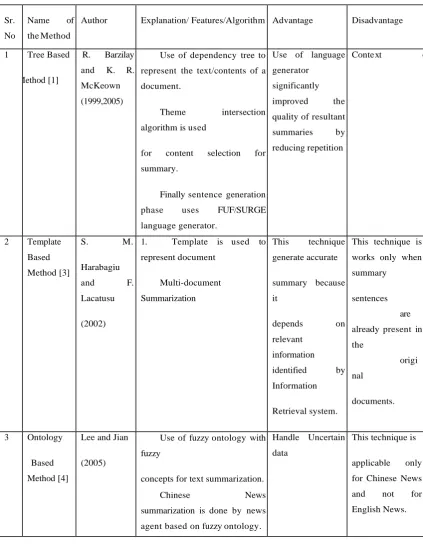
Table 2 Compares all the Abstractive Text summarization methods based on the different parameters such as
algorithm / features , advantages and drawbacks etc.
C. LIMITATION OF ABSTRACTIVE TEXT SUMMARIZATION:
1. Abstractive text summarization is difficult to implement compare to Extractive text summarization.
2. The quality of summaries are varying from system to systemor person to person.
3.
There is no generalized structure / template that humans can use for abstractive summarization.
4. Evaluating an abstractive summary is not a straightforward because there does not e xist an ideal
summary for a given document.
102 |
P a g e
III. DISCUSSION
Automatic Text summarization broadly classified into Extractive and abstractive. Extract ive summaries are
created by reusing portions such as words, sentences etc of the input text. Search engines (Information
Retrieval System) typically generate extractive summaries from WebPages. Most of the summarization work
has been done today on extractive summarization. In abstractive summarization, information from the source
text is re-phrased and deep analysis of input text is done to generate semantically meaningful summary. Human
beings generally write abstractive summaries. Still Abstractive summarization is a challenging area because of
the semantic representation, inference and complexity of natural language processing. In future, more focus
should be done in the following direction in the field of automatic te xt summarization:
1. Text summarization for Indian languages such as Bengali, Telugu, Hindi, Marathi, Tamil etc
2. Multi-lingual text summarization.
103 |
P a g e
Table 2. Comparison between Abstractive Text Summarization Techniques
Sr.
No
Name of
the Method
Author Explanation/ Features/Algorithm Advantage Disadvantage
1 Tree Based
Method [1]
R. Barzilay
and K. R.
McKeown
(1999,2005)
1. Use of dependency tree to
represent the text/contents of a
document.
2. Theme intersection
algorithm is used
for content selection for
summary.
3. Finally sentence generation
phase uses FUF/SURGE
language generator.
Use of language
generator
significantly
improved the
quality of resultant
summaries by
reducing repetition
Conte xt of sentence was not included while capturing the intersected phrase
2 Template
Based
Method [3]
S. M.
Harabagiu
and F.
Lacatusu
(2002)
1. Template is used to
represent document
2. Multi-document
Summarization
This technique
generate accurate
summary because
it
depends on
relevant
information
identified by
Information
Retrieval system.
This technique is
works only when
summary
sentences
are
already present in
the
origi
nal
documents.
3 Ontology
Based
Method [4]
Lee and Jian
(2005)
1. Use of fuzzy ontology with
fuzzy
concepts for text summarization.
2. Chinese News
summarization is done by news
agent based on fuzzy ontology.
Handle Uncertain
data
This technique is
applicable only
for Chinese News
and not for
104 |
P a g e
4 Lead and
Body Phrase method [5] Tanaka and Kinoshita (2009)
Insertion and substitution
operations on
phrases that have same syntactic
head chunk in the lead and body
sentences in order to rewrite the
lead sentence.
It found
semantically
appropriate
revisions for
revising a lead
sentence.
Due to
parsing
errors,
reduc
es completeness of
sentences
e
.g. grammatically
incorrect
5 Rule Based
Method [6]
Genest and
Lapalme
(2012)
1. The documents to be
summarized
are represented in terms of
categories and a list of aspects.
2. Generation patterns
designed for each
abstraction scheme to generate summary
Generate a
meaningful
summary
All the generation
patterns
are manually
written which is
time consuming
and tedious.
6 Multimodal
sematic
model [7]
C. F.
Greenbacker
(2011)
1. This technique focus on
concepts and relationship among
concepts.
2. Multimodal document
contains both
images and text.
It generates
abstract summary
which contains all
possible important
information
because it includes
both textual and
graphical content
from the entire
document.
It is
manually
evaluated
by
Human being.
IV. CONCLUSION
Text Summarization is one of the inspiring field of research because it has many applications where we need
summary of the large documents such as news headlines, market review, short messages on mobile, medical,
business analysis etc. This review paper focused on both the comparative study of extractive and abstractive
text summarization techniques along with their advantages and limitations. An extractive summary is selection
of important sentences from the original documents based on different attributes or features of sentences.
Abstractive summary methods produces highly relevant, crisp, information rich and less redundant summary. A
lot of work has been done in Ext ractive te xt summarization but Abstractive text summarization is a still
105 |
P a g e
V. REFERENC ES
[1] R. Barzilay, et al., "Information fusion in the context of multi-document summarization," in
Proceedings of the 37th annual meeting of the Association for Computational inguistics on Computational Linguistics, 1999, pp. 550-557.
[2] R. Barzilay and K. R. McKeown,"Sentence fusion for multidocument news summarization,"
Computational Linguistics, vol. 31, pp. 297-328, 2005.
[3] S. M. Harabagiu and F. Lacatusu, "Generating single and multi-document summaries with gistexter," in
Document
[4] C.-S. Lee, et al., "A fuzzy ontology and its application to news summarization," Systems, Man, and Cybernetics, Part B: Cybernetics, IEEE Transactions on, vol. 35, pp. 859-880, 005.
Understanding Conferences, 2002
[5] H. Tanaka , et al., "Synta x-driven sentence revision for broadcast news summarization," in
Proceedings of the
2009 Workshop on Language Generation and Summarisation, 2009, pp. 39-47.
[6] P.-E. Genest and G. Lapalme, "Fully abstractive approach to guided summarization," in Proceedings of the 50th Annual Meeting of the Association for Computational Linguistics: Short Papers-Volume 2, 2012, pp. 354-358.
[7] C. F. Greenbacker, "Towards a framework for abstractive summarization of multimodal documents,"
ACL HLT 2011,p. 75, 2011.
[8] P.E. Genest and G. Lapalme, "Framework for abstractive summarization using te xt -to-te xt generation,"
in Proceedings of the Workshop on Monolingual Te xt-To-Te xt Generation, 2011, pp. 64-73.
[9] I. F. Moawad and M. Are f, "Semantic graph reduction approach for abstractive Text Summarization,"
in Computer Engineering & Systems (ICCES), 2012 Seventh International Conference on, 2012, pp.
132-138.
[10] Fachrurrozi M., Yusliani Novi, and Yoan ita Rizky Utami, “Frequent Term based Te xt Summarization
for Bahasa Indonesia”, International Conference on Innovations in Engineering and Technology
Bangkok (Thailand), 2013.
[11] Deshpande Anjali R., Lobo L. M. R. J., “Te xt Summarization using Clustering Technique”,
International Journal of Engineering Trends and Technology (IJETT) , 2013, Vol. 4 Issue8.
[12] Kumar Niraj, Srinathan Kannan and Varma Vasudeva, “A Knowledge Induced Graph-Theoretica l
Model for Extract and Abstract Single Document Summarization”, Computational Linguistics and
106 |
P a g e
[13] Sarkar Kamal, Nasipuri Mita, Ghose Suranjan, “Using Machine Learning for Medical Document Summarization”, International Journal of
Database Theory and Application, 2011.
[14] Froud Hanane, Lachkar Abdelmonaime and Ouatik Said Alaoui, “Arabic Te xt Summarization
Based On Latent Semantic Analysis To Enhance Arabic Documents
Clustering”, International Journal of Data Mining & Knowledge Management
Process (IJDKP), 2013, Vol.3, No.1. [15] Khosrow Kaikhan, “Te xt Summarization Using Neural
Networks”, Proceedings. 2004 Second IEEE International Conference on Intelligent Systems, 2004,
Vol. 1.
[16] Ladda Suanmali, Salim Naomie, and Mohammed Salem Binwahlan, “ Fuzzy Logic Based Method for
Improving Te xt summarization” IJCSIS, 2009.
[17] Ibrahim Imam, Nihal Nounou, Alaa Hamouda, Hebat Allah Abdul Khalek, “Query Based Arabic Te xt
Summarization”, IJCST, 2013, Vol. 4, Issue Spl - 2.
[18] Atif Khan, Naomie Salim,” A Review On Abstractive Summarization Methods”, Journal of Theoretical
and Applied Information Technology,2014, Vol. 59 No.1.
[19] Deepali K. Gaikwad1 and C. Namrata Mahender2,”