Plant classification based on leaf Shape features using
Neural Network
Manisha M. Amlekar
1, Ashok T. Gaikwad
21,2
Institute of Management Studies and Information Technology, Samarthnagar,
Affiliated to Dr. Babasaheb Ambedkar Marathwada University,
Aurangabad,431001, Maharashtra, (India)
ABSTRACT
Plant classification becomes very much demanding research area for the use of taxonomist and botanist as well
as in agricultural requirement. Using computerized techniques for performing these task is more effective. This
research paper presents the classification of plants by using Feed forward Back Propagation Neural Network
designed.This method performed in three steps first is leaf image processing to find the leaf shape patterns, leaf
shape features extraction that follows classification. Leaf images of 220 different plant species are processed to
find the leaf shape patterns. Leaf shape features are computed automatically from the leaf shape patterns of the
leaf image samples. Neural network designed based on the leaf shape features for plant classification. This
paper is organized in the sections, Introduction,Methods, Methodology and Conclusion
Keywords—Leaf Image Processing,Leaf Shape,Plant Classification, Feed Forward Neural
Network.
I . INTRODUCTION
IIMETHODS
2.1
Leaf image processing
The leaf image processing is required to eliminate the unwanted part from the leaf image that reduces the leaf features for studying the leaf shape which may make the classification complex and affect the efficiency of the classification model. In leaf image processing techniques the image segmentation task performs major role for finding the leaf shape. This image segmentation method find the leaf shape starts with examining the local discontinuity at each pixel level element in an image. This process examines the location of part of the feature that is of interest, it also examine the boundary pixel to define it as a part of leaf shape. Boundary pixels has the property of having gradual change in intensity operators required supposed to determine such gradual change for determining the boundary pixel.Canny method by double thresholding perform the task of leaf image segmentation to extract leaf shape[4].
2.2
Classification
In classification method the Feed Forward Back propagation Neural network model is designed with the function Levenberg-Marquardt backpropagation. Thismodel performs sigmoidal function in the hidden layer. The Jacobian matrix is computed by using first derivative of error with respect to weight and bias of the input. This is used for finding the gradient for approximation.For overall performance of the network, mu is adjustedto minimize error and used with the approximation. Performance of the classification model is evaluated based on mean squared error.
Training stops when either the maximum number of epochsis reached or performance is minimized to the goal or the performance gradient falls below minimum gradient or mu exceeds the maximum value.
III METHODOLOGY
This set of experiment is performed on the leaf images from the ICL database [5] This database contain the leaf shape images of 220 different species. For finding the leaf shape patterns the steps are followed as given in Fig.1.
Fig.1: Leaf image processing
3.1. Leaf image pre-processing
format for processing further. Original true colored leaf image is processed pixel by pixel to map in gray level format by combining weighted red, green and blue color code of every pixel as given in equation (1).
0.2989 * R + 0.5870 * G + 0.1140 * B (1)
3.2.Leaf image segmentation
This step preprocesses all the leaf images to uniform gray level code. Preprocessed images then segmented to extract the leaf shape patterns.Canny method is applied for segmenting leaf image for shape extraction.In this experiment the grey level code component of threshold of leaf image is used as the high threshold and 0.4 multiple of this high threshold value is used as low threshold. Thus we found the leaf shape of the all the leaf image samples for various species in the dataset. Fig.1 shows the result of the leaf image segmentation i.e. leaf shape for the sample image.
3.3.Extracting the shape Features
After finding the leaf shape from the leaf images, the leaf features are extracted. These eighteen features includes geometrical features of the leaf shape these shape features are variant to the leaf images.
Table1: Shape Features
Sr.No Features Description
Area It is the total number of pixels in the leaf image that is area of leaf Eccentry This the ratio between DistBetFoci and MajorLength
Perimeter Distance around the boundary of the region of leaf shape MajorLength Length of minor axis of the elliptical shape of leaf MinorLength Length of major axis of the elliptical shape of leaf ConvexArea Number of pixels in the convex image of leaf
Solidity This is the proportion of the pixels in the convex hull i.e the ratio of Area of leaf and its ConvexArea
DistBetFoci The ratio between Eccentricity and MajorLength Orientation Angle between MajorLength and X-axis for leaf image
Circularity It is the ratio between the Area and square of Perimeter that determines the circular shape of leaf
Eqdiam Regional Diameter of leaf calculated as Sqrt(4*Area/ π) Elongation Ratio of Length of the leaf to the width
AspectRatio It is the ratio from width to length of leaf
Rectangularity This is computed by finding multiplication of MajorLength and MinorLength/Area
Cx Centroid x-axis
Cy Centroid y-axis
3.4. Performing Classification
With eighteen features classification of the 220 plants are performed. This uses artificial neural network classification method. Feed forward neural network classification model is designed to perform the plant classification based on leaf shape 18 features with classical architecture of 70-30% of the data set input. About 70 % of the dataset is used for training the neural network and 30 % of dataset is used for testing the classification model.
Table 2: Classification Result
Dataset
Correct
Classification
Incorrect
Classification
ICL 93.82% 6.18%
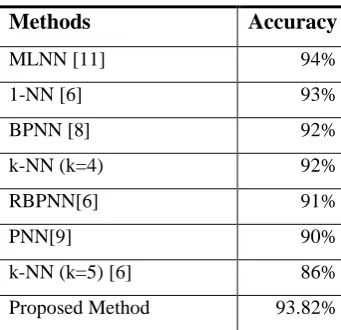
To study the performance of the model first it is designed with the one hidden layer and five species row vector. This model takes input, as leaf shape features of samples of five species of the plants at iteration. This way total 220 species of the plants are classified by the model. This neural network model has given the average of 93.82% accuracy for classification all 220 plant species. 6.18% species are incorrectly classified.
Table 3: Classification Accuracy
Methods
Accuracy
MLNN [11] 94%
1-NN [6] 93%
BPNN [8] 92%
k-NN (k=4) 92%
RBPNN[6] 91%
PNN[9] 90%
k-NN (k=5) [6] 86%
Proposed Method 93.82%
IV. CONCLUSION
VII. ACKNOWLEDGEMENT
We acknowledge Intelligent computing laboratory , Chinese Academy of Sciences as they provided the database for this research work. We also acknowledge Dr. R. R. Manza and Dr. P.L. Yannawar.
REFERENCES
[1] Stephen Gang Wu, F. S.-X.-F.-L., A Leaf Recognition Algorithm for Plant Classification Using Probabilistic Neural Network,. IEEE International Symposium on Signal Processing and Inform, 2007 [2] Jiazhi Pan, Yong He, Recognition of plant by leaves digital image and neural network, International
conference on Computer Science and Software Engineering, Vol. 4, pp. 906-910, December 2008.
[3] J. Hossain, M.A. Amin, Leaf shape identification based plant biometrics , 13th International Conference on Computer and Information Technology (ICCIT), pp. 458-463, 23-25 December, 2010.
[4] Amlekar M. M., Gaikwad A.T., Yannawar P. L., Manza R. R., 2015. Leaf Shape Extraction for Plant Classification. Pervasive Computing (ICPC) IEEE International Conference on
[5] ICL, Chinese Academy of Sciences Plant leaf image dataset 2010-2012. Homepage: http://www.intelengine.cn/index.html
[6] X. Gu, J.-X. Du, and X.-F. Wang, “Leaf recognition based on the combination of wavelet transform and gaussian interpolation, in Proceedings of International Conference on Intelligent Computing 2005, ser. LNCS3644. Springer, 2005.
[7] N.Valliammal and Dr.S.N.Geethalakshmi, Plant Leaf Segmentation Using Non Linear K means Clustering, IJCSI International Journal of Computer Science Issues, Vol. 9, Issue 3, No 1, May 2012
[8] X.-F. Wang, J.-X. Du, and G.-J. Zhang, Recognition of leaf imagesbased on shape features using a hypersphere classifier, in Proceedingsof International Conference on Intelligent Computing 2005, ser. LNCS3644. Springer, 2005.
[9] Stephan Gang Wu,Forrest Sheng Bao, Erc You Xu,Yu-Xuan Wang, Yi-fan Chang, Qiao-Liang Xiang, ALeaf Recognition Algorithm for Plant Classification using Probabilistic Neural Network, arXiv-0707.4289V1[CS.AI], 2007
[10] ZalikhaZulkifli, Plant leaf identification using moment invariants & General Regression Neural Network, 11th International Conference on Hybrid Intelligent Systems (HIS), 12/2011