1005 | P a g e
CUED CLICK POINT (CCP) ALGORITHM FOR
GRAPHICAL PASSWORD TO AUTHENTICATE
SHOULDER SURFING RESISTANCE
Soni Sharma
1, Prof. G.S Mate
2, Monali Pawar
3, Snehal Patil
4, Sonam Gole
5Department of Information Technology, JSPM’s Rajarshi Shahu College of Engineering,
Savitribai Phule Pune University Tathawade, Pune, Maharashtra ( India)
ABSTRACT
In this paper,we present an approach using cued click point (CCP) under graphical password that permits to enrich authentication technique of graphical password in(CCP). Our literature studies shows various limitations for textual passwords, they are exposed to shoulder surfing attack however strong textual passwords are tough to memorize. Graphical Passwords are introduced to resist the Shoulder surfing attack. .Looking at the success of this system , using graphical password as input and grid lines for image point verificationand enrich it to provide security using normal login and graphical password. This system can be used in the field such as banking application, military application, civilians, forensic labs, etc.
Keywords:
Authentication, Cued click point ,Graphical password,Hotspot ,Shoulder surfing.
INTRODUCTION
Authentication plays an important role in security of the user system , without which the performance of user
system will not be yield very significant improvement. The need of authentication is required for high security
.There are various methods to provide authentication like password authentication but this type of authentication
cannot provide in the fields like banking application, military, forensic labs, etc. [1].Textual passwords are
attacked by Masquerading, Eaves dropping, Dictionary attack, Shoulder surfing attack, Spyware and Guessing
attack [7]. To overcome this drawbacks, graphical passwords were introduced. Using graphical password user
is able to set up a complex authentication password and is able to recollect it, even if the memory is not
activated periodically [3]. This paper focuses on the issues and eliminates them resulting more secure, reliable
and useable for users.
1005 | P a g e
II. LITRETURE SURVE
In paper[1] author T, R.Nagendran, implemented system in which password is selected block of the image
called the view port. But this system failed to secure from hotspot attack. In paper[2] author N. López, M.
Rodríguez, C. Fellegi, D. Long. proposed a graphical authentication systems in even odd form.Still unable to
resist from shoulder surfing.In paper [3]author S. Man, D. Hong, and M. Mathews, proposed that user should
rate colors from 1 to 4 for password and he can remember it as “RGBY”. But the interface is quite difficult to
understand to the normal user.In paper [4]author M.Shreelatha, M.Sashi proposed a methodology on Session
password which can be used only once,but this technique is proposed to generate session passwords using text
which fails to resist shoulder surfing. In paper [5] author, Ushir Kishori Narhar, Ram.B.Joshi proposed a
methodology using user name with graphical password using persuasive cued click points along with biometric
authentication using finger nail plate.. But biometrics such as face and fingerprints can easily be recorded and
potentially misused by biometrics experts without user’s consent. Inpaper [6] Author, Neha Singh, Nikhil
Bomanwar proposed a methodology of a persuasive cued click point which reduces the hotspot problem, but
provides no security mechanism for shoulder surfing attack .Inpaper[7] Author, Hung- Min Sun, Shiuan-Tung
Chen, Jyh-Haw Yeh proposed a system based on authentication system Pass Matrix, based on graphical
passwords with a one-time valid login indicator. But this System does not resist the shoulder surfing attack and
also vulnerable to smudge attack.
III.PROPOSED SYSTEMS
3.1 Problem Statement
From the above literature surveys, we have came to conclusion that there are many attacks taking place
regarding the authentication process of the existing system.So we come up with the new authentication system
which includes cued click point algorithm to resist shoulder surfing attack based on image password selected by
user from image grid and image point is stored in the form of rows and coloumns as password ..
1006 | P a g e
3.2
Methods Used
3.2.1. Cued Click Pointalgorithm
By selecting all click point on single image introduces hotspots creation. In CCP user have to select different
five images instead of selecting click point on same image. For every image user have to select only one click
point[4]. When user click on a correct position on image, then next image will displayed. In CCP address of
next image is stored in previous click point. If click point is wrong then wrong image will be displayed. Users
have to select sequence of click-point on correct images.
3.2.3. Recall Based Technique
A user is asked to reproduce something that he created or selected earlier during the registration stage.
3.2.4. Recognition Based Technique
A user is presented with a set of images and the user passes the authentication by recognizing and identifying
the images he selected during the registration stage.
3.3 Splits
In CCP, user choose one square per image for a sequence of n images. The module of CCP square images
divides each image into respective squares. The matrix method is used for dividing the image into squares in the
form of rows and columns.The address of each square of the image is recorded in the database when user selects
it. This address is stored in the form of rows and columns. For eg.,(1,1),(2,1)etc.
IV. IMPLEMENTATION
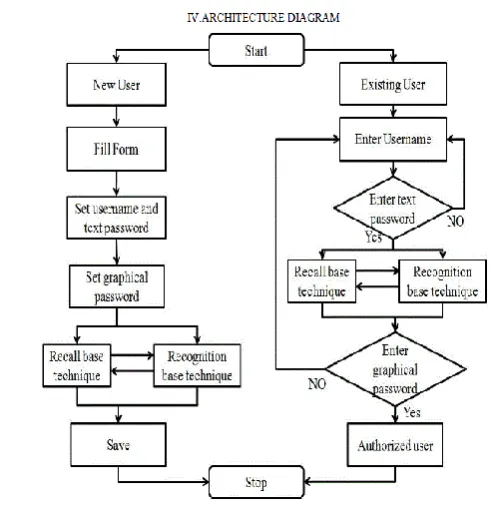
4.1. Registration
4.1.1.Text Based Registration
At this stage user creates an account using required credential. However this acts as the first stage of registration
of the system.
Fig 3: Text Based Registration.
4.1.2. CCP REGISTRATION
After the first phase, user needs to login using user name and password. CCP registration needs to be done
where user is asked to select number of images and splits. User needs to select images from the set of images as
1007 | P a g e
Fig 4: CCP Registration.The user needs to select one point from each image for CCP registration.This point will be recorded in the
database of the system.After that the user will have to wait for the approval/rejection from admin.
4.2.Login
4.2.1 Normal Login
After registration process, user needs to provide simple login details such as user id followed by password. User
is directed to graphical login window.
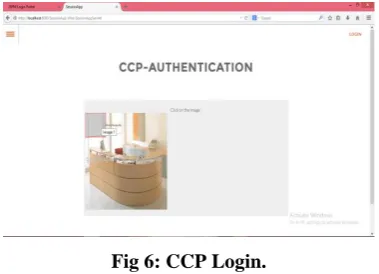
4.2.2. GRAPHICAL LOGIN
Authorized user will select one click point per image. Each point selection will display another image associated
with the address of click point.
Fig 6: CCP Login.
The user is directed to internet banking application as shown in the fig below.
V. MATHEMATICAL MODEL
5.1 Representation in the set format
Let S be set represents various parameters such as input(I), output(O),function(F) and failure case(FC).
S= {(I), (O), (F), (FC)}
Input (I)-
I is the subset of set S which represent input given by the user. Input contains set of images within that images
click-points are passed as input.
I = {Username, image 1, image 2,…….image n}
Output (O) -
O is the subset of set S which represent authentication is successfully. If set of click-points of images are correct
then it display login successfully.
O = {authentication successful, login successful}
1008 | P a g e
Set the click point of images. F= {Function}Failure Case (FC)-
If sequence of click points of images is not correct.
5.2 Calculation for username
Let L be the set of all capital letters A to Z.
L = {A, B ,C………..Z}
P is set of position on letter in L as,
P = {1, 2, 3 …………. 26}
<L =def {< l, p >: l є L ,p є P }>
u is username such that {u : u is a word which can be described as English words build up of combination of
letters in set L} Let u has length „len‟ Then sum of position values is done with function f(x) as ( ) Σ( ) .Such that „n‟ is the index representing the letter in L and Pn is associative position in P.
Sum=f(x) will do the calculation from username.
D1 represent the first digit of sum and always will be from 1 to 9.
5.3 Assigning set of image-
I = {I1, I2 …….I9} set of images such that each Ii is fixed set of rows of images as given J={J1,J2……J9}is
fixed set of Columns of images. IJ = {ij}where i1 is one image from set Ii.
5.4 Selection of password-
i1 and i2 will be two images selected from given set Ii
i3 and i4 are two images from server side image set Is
Above 4 images from a password Pw for user Ui Pair (Pw, Ui) will be stored for each user.
VI. RESULTS
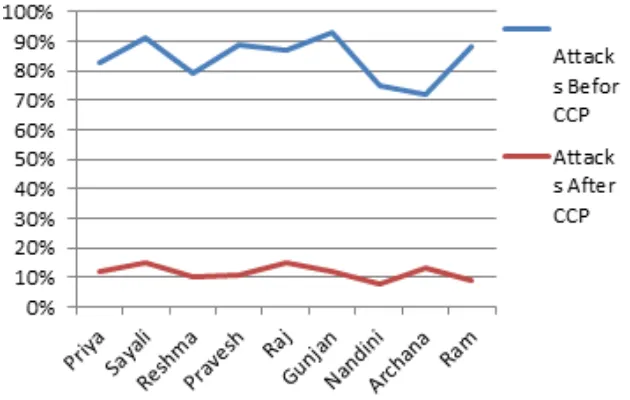
6.1 Graph
1009 | P a g e
6.2 TABLE
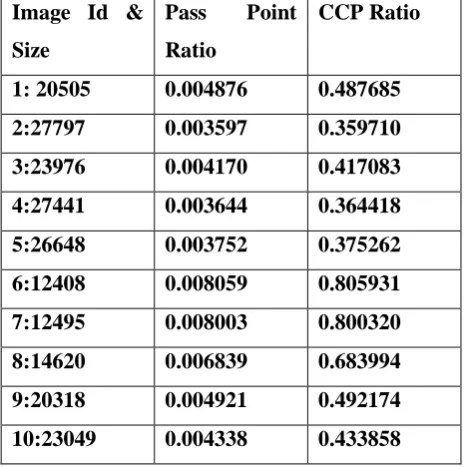
Table 1. Input parameters Image Id,Image Size, Passpoint Ratio, CCP Ratio.
6.2.1 Equations used in coverage ratio calculation
Image click ratio= (10 *10) /(Image Size)
View Port ratio =(100 *100) /(Image Size)
VII. FUTURE SCOPE
This system can be used for various security systems like system login and logout process in banking, web
locking system, folder locking system, etc.
Like most of the other graphical password authentication system shoulder surfing is vulnerable to the guessing
attacks. To overcome this problem the user can upload their own images to make it more difficult for attacker to
guess it.
VIII. CONCLUSION
Security is most important factor for any system authentication. Firstly pass point method is proposed but due to
all click point on the same image minimize the security of system To overcome this problem, we proposed a
shoulder surfing
resistant authentication system based on graphical
passwords. In CCP technique more images with separate click point on it is used. The problem of shoulder
surfing is solved.
IX.REFERENCES
[1.] Chippy.T, R.Nagendran “Defense against large scale online password guessing attack by using persuasive
cued click point” International Journal ofCommunications and Engineering Volume 03– No.3, Issue: 01
March2012.
[2.] N. López, M. Rodríguez, C. Fellegi, D. Long. “Even or Odd: A Simple Graphical Authentication System”
IEEE LATIN AMERICA TRANSACTIONS, VOL. 13, NO. 3, MARCH 2015.
Image Id &
Size
Pass
Point
Ratio
CCP Ratio
1: 20505
0.004876
0.487685
2:27797
0.003597
0.359710
3:23976
0.004170
0.417083
4:27441
0.003644
0.364418
5:26648
0.003752
0.375262
6:12408
0.008059
0.805931
7:12495
0.008003
0.800320
8:14620
0.006839
0.683994
9:20318
0.004921
0.492174
1010 | P a g e
[3.] S. Man, D. Hong, and M. Mathews, "A shoulder surfing resistant graphical password scheme," inProceedings of International conference on security and management. Las Vegas, NV, 2003.
[4.] M.Shreelatha, M.Shashi. M Anirudh, Md.Sultan Ahamer, V Manoj Kumar “Authentication scheme for
session password using color and images ” International Journal of Network Security & Its Applications
(IJNSA), Vol.3, No.3, May 2011.
[5.] Hung- Min Sun, Shiuan-Tung Chen, Jyh-Haw Yeh 2015 International Conference on Computing
Communication Control and Automation.” Highly Secure Authentication Scheme”.
[6.] Improved Authentication Scheme Using Password Enabled Persuasive Cued Click
Points”.978-1-4673-7910-6/15/$31.00_c 2015 IEEE.
[7.] DOI 10.1109/TDSC.2016.2539942, IEEE Transactions on Dependable and Secure
Computing.”A Shoulder Surfing Resistance Graphical Authentication System. .Hung-Min Sun,
Shiuan-Tung Chen, Jyh-Haw Yeh and Chia-Yun Chen.
[8.] S. Gurav, L. Gawade, P. Rane, and N. Khochare, “Graphical password authentication: Cloud securing
scheme,” in Electronic Systems, Signal Processing and Computing Technologies (ICESC), 2014
International Conference on, Jan 2014, pp. 479–483.
[9.] H. Zhao and X. Li, “S3pas: A scalable shoulder-surfing resistant textual-graphical password authentication
scheme,” in Advanced Information Networking and Applications Workshops, 2007, AINAW’07. 21st
International Conference on, vol. 2. IEEE, 2007, pp. 467–472.
[10.]M. Martinez-Diaz, J. Fierrez, and J. Galbally, “Graphical password based user authentication with