© 2018, IRJET | Impact Factor value: 6.171 | ISO 9001:2008 Certified Journal | Page 349
Location Identification for FACTs Device
Neha S. patel
1, Priyank R.Bhavsar
21
PG student, Department of Electrical Engineering, Sankalchand Patel College of Engineering, Gujarat, India
2Associate professor, Department of Electrical Engineering, Sankalchand Patel College of Engineering,
Gujarat, India
---***---Abstract—
As result of deregulation of the power system the power transmission line have to transfer power at their maximum transmission limits because of the competitive scenario of the electric market hence secured operation of power system has become one of the most issue of modern generation. It is essential for power system to study the impact of contingencies on system security by proper use of FACTs devices in electric network. This paper present three different selection factors to decide the best location to place FACTs device to improve the system security under contingencies . Three selection factors Contingency Severity Index (CSI), Excess Power Flow (EPF), Number of Times Overloaded Line (NOTOL) are considered. This approach is tested on IEEE 6- Bus and IEEE 30- Bus system and give ranking of most preferable lines for placement of FACTs devices.Keywords – Contingency Severity Index (CSI), Excess Power flow (EPF), Number of Times Overloads Line (NOTOL) Flexible ac Transmission system(FACTs)
1. INTRODUCTION
Day by day, increasing load on the power system, also increasing severe contingency so the transmission network parameter is working near to its thermal limits and voltage limits that leading threat to power system security. The whole system can lead to blackout because of severe condition of overloading. This is very important for power system security that the system would work within safe limits. The overloading of the system can be recovered which improve system security by two alternative, firstly restructuring of power system and secondly by controlling the line parameter of a system. But environmental, cost problems are major problems for power transmission network expansion due to power system restructuring requires expanding potentials of the system network. To Control the power flow of line in power system without generation rescheduling can improve the performance. [2]
Hence, for best utilization of available capacities of system and power flow control, installing FACTs devices. FACTs devices such as (TCPAR) Thyristor Controlled Phase Angle Regulator, (TCSC) Thyristor Controlled Series Capacitor, Unified Power Flow Controlled (UPFC). These devices can play an important role to reduce the flow of over-loaded lines, increasing load -ability, low system loss improve stability, reduce cost of production, stability margin increased These devices used to control the power flows in the line so power system security enhanced.[3]
2. POWER SYSTEM SECURITY
The security of power system can be defined as its ability to withstand a set of severe but credible contingencies and to survive the transition to acceptable new steady state condition.
Contingency Creation
It is the initial step of contingency analysis. It is made up of all set of viable contingencies that may happen in a power system. This process consists of making contingency lists.
Contingency Selection
It is the second step in contingency analysis it is the process which includes finding of severe contingencies from all that may cause to violate bus voltages and power through lines. Here in this procedure contingency list is reduced by rejection of least severe contingency and taking into consideration of most severe outages. In this process the performance index has been used to find the most severe ones.
Contingency Evaluation
It is the third step and the most significant step as it includes necessary control and security actions which are required in order to reduce the effects of most severe contingencies in a power system.[2]
3. METHOD FOR OPTIMAL LOCATION FOR FACTs
DEVICE
There are several methods for finding the optimal location of facts devices like: [4]
• Sensitivity Approach • Contingency severity Index
3.1 Sensitivity Approach
© 2018, IRJET | Impact Factor value: 6.171 | ISO 9001:2008 Certified Journal | Page 350 3.1.1 Real power performance index
The severity of the system loading under contingency and normal events can be drawn by an actual power line flow performance index given below[3]
n
p lm plm N
m n
W m PI
2
max
1 2
……….(1)
plm
= real power flowp
lm
max
= rated capacity of line m N= exponent
W m
= real non negative weighting coefficient which may be used to reflect the importance of lines.3.2 Contingency severity Index [1]
The fundamental principle used in FACTs placement for enhancing static security of the power system is to decide a branch, which is most severity to the biggest number of contingencies. Contingency severity Index (CSI) is a second method to determine the location of FACTs devices which is find from underneath equations. This chapter portrays the definition and calculation of the contingency severity index (CSI) and optimal placement procedure for the FACTs.
3.3 Problem Formulation
Selection three Factors to be considered for Optimal location of FACTS Controllers are:[1]
Selection Factor-1
:
Concept of Contingency Severity Index (CSI)The CSI of a branch “j” is defined as of the sensitivities of branch “j” to all the considered contingencies and is experessed as
wij uij m
i i
p j
CSI
1 ………(2)
Where,
pi
is the probability of occurrence for contingency “i” .uij
andwij
are elements of matrices U and W respectively. M=The Total number of single contingencypi uij wij
= The element of matrix P,U,WThis equation is defined as sum of considered contingency ‘i’ for all branches are calculated A branch which has highest CSI value will be more sensitive for security margin.
The participation matrix u:
This is an (m x n) binary matrix, where m is the aggregate of single contingency and n is the aggregate of branches of
interest. uij is an element of matrix U, whose values are “1” or “0” depending on comparing branch is overloaded. If uij=0, the branch ‘j’ is not overloaded for contingency ‘i’. If uij =1, the branch ‘j’ is overloaded for contingency ‘i’.
The Ratio Matrix W:
This is a matrix of normalized excess overload branch flow as for to the base case flow through branch “j” during contingency “I” in dimensions of (m x n) and it is given by bellowing equation:
1
sec
P
ojba
ase
P
ijcontinge
ncy
W ij
………..(3)
Where
Pij,cont = Power flow through branch” j” during specified contingency i
P oj,norm = base case Power flow through branch j
Selection Factor-2: Concept of Excess Power Flow (EPF) When there is a contingency, certain transmission lines may be overloaded with reference to thermal limit. The excess power flow in the various overloaded lines with reference to thermal limit of the corresponding lines for different contingency conditions have to be calculated. The sum of excess power flow in a particular branch for the different contingencies is the best factor to be considered for ranking of branches under different contingencies.
Selection Factor-3: Concept of Number of Times Overloaded (NOTOL) When there is different contingency condition, whether the line under study is getting overloaded or not and that particular line how many times getting overloaded for different contingencies have to be observed. Utilizing this aspect, all the lines under study have to be ranked.
Selection of branches for placement of FACTS Controllers
The branches are listed out based on the CSI value in descending order. While choosing selection factor-1, the branch with largest value of CSI is considered as the best location for FACTS Controller and to proceed further with next highest CSI value for the next FACTS Controller.
© 2018, IRJET | Impact Factor value: 6.171 | ISO 9001:2008 Certified Journal | Page 351
4. RESULTS AND SIMULATION
Simulation and analysis is done for the ranking of transmission lines for placement of FACTs devices for different contingency cases of IEEE 6 bus and IEEE 30 bus system by all selection factors individually as well as by combination of all selection factors.
A.IEEE 6 BUS RESULTS
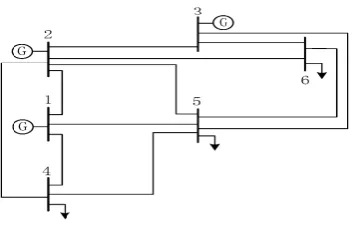
Figure-1 : IEEE 6 Bus System
The ranking method has been tested on IEEE 6-bus system which consist of three generator buses and three load buses are shown in figure 1.
Case 1 : Ranking of branches for IEEE 6 bus system 1. Ranking based on selection factor CSI
It can be seen that by considering selection factor-1 (CSI) line 1 is most suitable location for placement of FACTs device with highest value of CSI.
Table 1: Ranking of Branches for IEEE6 Bus system based on the proposed selection factors CSI of the Branch
2. Ranking based on selection factor EPF
[image:3.595.307.561.178.253.2]It can be seen that by considering selection factor-2 (EPF) line-1 is most suitable location for placement of FACTs devices with highest value of EPF.
Table 2: Ranking of Branches for IEEE6 Bus system based on the proposed selection factors EPF of the Branch
Line No. from bus to bus selection factor-2 (EPF)
1 1 2 30.00321
3 1 5 21.56756
5 2 4 8.384185
2 1 4 6.491353
3. Ranking of branches for IEEE 6 bus NOTOL
It can be seen that by considering selection factor-3(NOTOL) line-1 is most suitable location for placement of FACTs devices with highest value of NOTOL.
Table 3: Ranking of Branches for IEEE6 Bus system based on the proposed selection factors NOTOL of the Branch
Line No. from bus to bus selection factor-2 (EPF)
1 1 2 30.00321
3 1 5 21.56756
5 2 4 8.384185
2 1 4 6.491353
[image:3.595.75.253.191.308.2]4.Ranking of branches for IEEE6 bus system based on the combination of all selection factors
Table 4: Ranking of branches for IEEE6 bus system based on the combination of all selection factors
The ranking of branches for optimal location were studied based on the proposed selection factors viz., CSI, EPF and
NOTOL. It can be seen that considering combination of all selection factors line-1 is most suitable location for placement of FACTs device.
B. IEEE 30 BUS RESULTS
Figure1: IEEE 30 Bus System
Line No. from bus to bus selection factor-1 (CSI)
1 1 2 0.16674939
2 1 4 0.1162547
5 2 4 0.09695934
3 1 5 0.07754107
Line
No. from bus bus to
selection factor-1 (CSI)
selection factor-2
(EPF)
selection factor-3
(NOTOL) Rank
1 1 2 0.1667494 30.003209 3 1
2 1 4 0.1162547 21.567559 2 3
5 2 4 0.0969593 8.3841845 2 2
[image:3.595.303.574.337.432.2] [image:3.595.73.551.533.787.2]© 2018, IRJET | Impact Factor value: 6.171 | ISO 9001:2008 Certified Journal | Page 352 Case 2 : Ranking of branches for IEEE 30 bus system
based on the proposed selection factor viz CSI, EPF, NOTOL
1.Ranking based on selection factor CSI
[image:4.595.308.566.380.475.2]It can be seen that by considering selection factor-1 (CSI) line-27 is most suitable location for placement of FACTs device with highest value of CSI.
Table 1: Ranking of Branches for IEEE30 Bus system based on the proposed selection factors CSI of the Branch
2. Ranking based on selection factor EPF
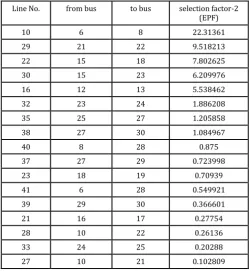
It can be seen that by considering selection factor-2(EPF) line-10 is most suitable location for placement of FACTs devices with highest value of EPF.
Table 2: Ranking of Branches for IEEE30 Bus system based on the proposed selection factors EPF of the Branch
Line No. from bus to bus selection factor-2
(EPF)
10 6 8 22.31361
29 21 22 9.518213
22 15 18 7.802625
30 15 23 6.209976
16 12 13 5.538462
32 23 24 1.886208
35 25 27 1.205858
38 27 30 1.084967
40 8 28 0.875
37 27 29 0.723998
23 18 19 0.70939
41 6 28 0.549921
39 29 30 0.366601
21 16 17 0.27754
28 10 22 0.26136
33 24 25 0.20288
27 10 21 0.102809
3. Ranking based on selection factor NOTOL
[image:4.595.34.284.434.706.2]It can be seen that by considering selection factor-3(NOTOL) line-32 is most suitable location for placement of FACTs devices with highest value of NOTOL.
Table 3: Ranking of Branches for IEEE30 Bus system based on the proposed selection factors NOTOL of the
Branch
4.Ranking of branches for IEEE30 bus system based on the proposed selection factors
Table 4: Ranking of branches for IEEE30 bus system based on the proposed selection factors
Line
No. from bus bus to
selection factor-1 (CSI)
selection factor-2 (EPF)
selection factor-3
(NOTOL) Rank
23 18 19 0.0484 7.8026 4 1
27 10 21 0.1379 0.1082 1 2
21 16 17 0.0322 6.2099 3 3
1 1 2 0 1.2058 0 0
The ranking of branches for optimal location were studied based on the proposed selection factors viz., CSI, EPF and
NOTOL. It can be seen that considering combination of all selection factors line-23 is most suitable location for placement of FACTs device.
5. CONCLUSION
From above analysis it can been that for IEEE 6 and IEEE 30 bus system by using different selection factors like CSI, EPF, NOTOL individually the best location for placement of FACTs device can be found and by combining all factors at a time more reliable results can be obtained.
REFERENCES
[1] Balamurali, G.,& Thanushkodi, K. (2011). Novel selection factors based optimal placement of TCSC controller in power transmission system for contingencies using PSO.
[2] Burada, S., Joshi, D., & Mistry , K. D. (2016, July). Contingency analysis of power system by using
Line No. from bus to bus selection factor-1 (CSI)
27 10 21 0.13798
23 18 19 0.048414
22 15 18 0.047269
21 16 17 0.032259
10 6 8 0.003324
Line
No. from bus to bus contingency producing
overloads
selection factor-3 (NOTOL)
32 23 24
6-7,16-17,18-19,19- 20,10-20,23-24,25-27,27-29
8
23 18 19
16-17,10-17,10-21,25-26 4
21 16 17 19-20,10-22,6-7 3
38 27 30 29-30,6-28 2
27 10 21 22-24 1
37 27 29 8-28 1
39 29 30 8-28 1
© 2018, IRJET | Impact Factor value: 6.171 | ISO 9001:2008 Certified Journal | Page 353 voltage and active power performance index. In
Power Electronics, Intelligent Control and Energy Systems (ICPEICES), IEEE International Conference on. IEEE.
[3] Mishra, A., &Gundavarapu, V. N. K. (2016). Contingency management of power system with Interline Power Flow Controller using Real Power Performance Index and Line Stability Index. Ain Shams Engineering Journal, 7(1), 209-222
[4] Singh, S. N. (2001). Location of FACTS devices for enhancing power systems' security. In Power Engineering, 2001. LESCOPE'01. 2001 Large Engineering Systems Conference on (pp. 162-166). IEEE
[5] Wood, A. J., &Wollenberg, B. F. (2012). Power generation, operation, and control. John Wiley & Sons.
[6] Stott, B., Alsac, O., &Monticelli, A. J. (1987). Security analysis and optimization. Proceedings of the IEEE, 75(12), 1623-1644
[7] Shivashankar, S. (2013, February). Optimal location of TCSC in transmission lines using contingency severity index and performance index methods for single contingency using PSO. In Power, Energy and Control (ICPEC), 2013 International Conference on (pp. 135-138). IEEE.
[8] Hingorani, N. G. (1993). Flexible AC transmission. IEEE spectrum, 30(4), 40-45.
[9] Singh, S. N., & David, A. K. (2001). Optimal location of FACTS devices for congestion management. Electric Power Systems Research, 58(2), 71-79management. Electric Power Systems Research, 58.
BIOGRAPHIES
Neha S. Patel
M.Tech. research scholar Department of EE, SPCE, Visnagar, Gujarat, India
Priyank R. Bhavsar Associate professor Department of EE, SPCE, Visnagar, Gujarat, India
.