Sujit Kumar Dehury*, Malabika Talukdar, Upendra Nath Dash
Department of Chemistry, Institute of Technical Education and Research (ITER), Siksha ‘O’ Anusandhan University, Khandagiri, Bhubaneswar, OR, India.
*Corresponding author’s E-mail: [email protected]
Accepted on: 19-03-2014; Finalized on: 31-05-2014. ABSTRACT
The conductance of potassium dichromate and pyrophosphate has been measured in the concentration range of 1×10⁻³ to 6×10⁻² mol dm-3 in aqueous and aqueous binary mixtures containing d-mannitol (5, 10, 15% (w/w)) at different temperatures (298.15-313.15K). The conductance data in all cases have been computed by Shedlovsky equation to obtain Λom and KA. Based upon the
composition dependence of Walden product, the influence of the d-mannitol mixtures on the solvation of ions has been discussed. The values of the association constants, KA, are used to obtain various thermodynamic parameters for the association process in the
solution. It has been observed that the electronic contribution is totally negligible towards the standard transfer thermodynamic quantities.
Keywords: Aqueous d-mannitol, Association constant, Potassium dichromate and pyrophosphate.
INTRODUCTION
annitol, the sugar alcohol, is a white, crystalline solid with the chemical formula C6H8(OH)6. It is usually isolated from the secretions of the flowering ash and called manna after its resemblance to the Biblical food. In plants, it is used to induce osmotic stress. It has several industrial uses, but is mainly used to produce tablets of medicine. Mannitol is also used as a facilitating agent for the transportation of pharmaceuticals directly into the brain. Mannitol is commonly used in the circuit prime of a heart lung machine during cardiopulmonary bypass.1-2 The presence of mannitol preserves renal function during the times of low blood flow and pressure, while the patient is on bypass. Mannitol is also the first drug of choice for the treatment of acute glaucoma in veterinary medicine. Mannitol increases blood glucose to a lesser extent than sucrose (thus having a relatively low glycemic index and is therefore used as a sweetener for people with diabetes, and in chewing gums.3-4 Because of its important applications in food, pharmaceutical industry and solubility in water, it is of great interest for many researchers to study the ion-solvent interaction for multi-charged electrolytes like potassium dichromate and pyrophosphate ions. The conductance studies of dichromate and pyrophosphate ion in different compositions of water with d-mannitol mixtures can be useful for obtaining information on the behavior of ions in solutions and the interactions of water and d-mannitol with each other and with the solute. The calculated values of association constant are well known to be composite quantity depending upon specific and non-specific solute-solvent interaction, and the separation of various interaction contributions are usually difficult. Since the composition of aquo-organo solvent is varied, in
variation of solvent-solvent interaction in aquo-organo solvent. The specific and non-specific solvation effects on the ion-association phenomena may be obtained from the studies on aquo-organo solvents. However, there is a possibility of preferential solvation in d-mannitol solution. The aim of present investigation is to study the role of ion-aqueous d-mannitol interactions characterizing the preferential solvation of the solute. In this paper, we report the molar conductance of potassium dichromate and pyrophosphate in water and water with d-mannitol mixtures which is measured at temperatures at 5K intervals ranging from 298.15K to 313.15K.
MATERIALS AND METHODS
All chemicals used were of GR or BDH., AnalaR grades. Conductivity water (Specific conductance ~ 10-6 S cm-1) was used for preparing water with d-mannitol (0, 5, 10 and 15 %,(w/w)) mixtures. The d-mannitol content in the mixed solvents was accurate to within ±0.01%. The salt solutions were prepared on the molal basis and conversion of molal to molar was done by using the standard expression5 considering the density differences at the respective temperatures. The conductance measurements were made on a digital reading conductivity meter with a sensitivity of 0.1% and giving the conductance value of three digits. A conductivity cell with a platinized electrode (cell constant 1S cm-1) was used. The measurements were made over the temperature range of 298.15 - 313.15 K (±0.05K). The specific and molar conductance values are expressed in terms of S cm-1 and S cm2 mol-1, respectively. The ionic strengths of the solutions were kept as low as possible (~10-4 to 10-2 M). The experiment was carried out with different concentrations of solutions (ranging from 1×10⁻³
-2
Role of Cation and Anions (K
+, Cr
2
O
72-and P
2O
74-) Towards ion Association and Solvation
in Aqueous and Aqueous d-Mannitol Mixtures at Different Temperatures
M
concentrations of potassium dichromate and pyrophosphate were measured making appropriate corrections for the conductance of the solvents concerned.
RESULTS AND DISCUSSION
The experimental values of the conductance measurements for potassium dichromate and pyrophosphate in water and in three wt% compositions of water with d-mannitol mixtures, after solvent correction,
were analyzed using Shedlovsky6-7 equation. The limiting
molar conductivity values Λom are obtained by using the
value of ion-size parameter ao = q as ao = 0, q and 2q are very close to each other.8 The calculated values of KA, the
ion association constant and Λom values in aqueous and in
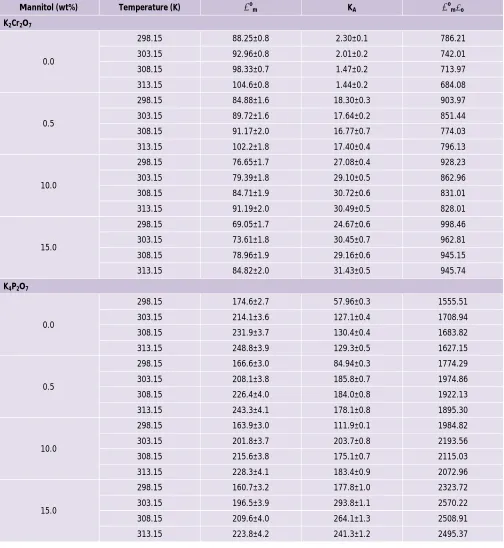
water- d-mannitol-mixed solvents are given in Table 1 at experimental temperatures. Table 1 also contains the
values of Walden product Λomηo for the multi-charged
electrolytes at 298.15 K only.
Table 1: Values of Λom (Sm2mol-1), KA(m3 mol-1) and Λomηo of Potassium Dichromate and Pyrophosphate in water and water and Mannitol mixtures at different temperatures.
Mannitol (wt%) Temperature (K) Λom KA Λomηo
K2Cr2O7
0.0
298.15 88.25±0.8 2.30±0.1 786.21
303.15 92.96±0.8 2.01±0.2 742.01
308.15 98.33±0.7 1.47±0.2 713.97
313.15 104.6±0.8 1.44±0.2 684.08
0.5
298.15 84.88±1.6 18.30±0.3 903.97
303.15 89.72±1.6 17.64±0.2 851.44
308.15 91.17±2.0 16.77±0.7 774.03
313.15 102.2±1.8 17.40±0.4 796.13
10.0
298.15 76.65±1.7 27.08±0.4 928.23
303.15 79.39±1.8 29.10±0.5 862.96
308.15 84.71±1.9 30.72±0.6 831.01
313.15 91.19±2.0 30.49±0.5 828.01
15.0
298.15 69.05±1.7 24.67±0.6 998.46
303.15 73.61±1.8 30.45±0.7 962.81
308.15 78.96±1.9 29.16±0.6 945.15
313.15 84.82±2.0 31.43±0.5 945.74
K4P2O7
0.0
298.15 174.6±2.7 57.96±0.3 1555.51
303.15 214.1±3.6 127.1±0.4 1708.94
308.15 231.9±3.7 130.4±0.4 1683.82
313.15 248.8±3.9 129.3±0.5 1627.15
0.5
298.15 166.6±3.0 84.94±0.3 1774.29
303.15 208.1±3.8 185.8±0.7 1974.86
308.15 226.4±4.0 184.0±0.8 1922.13
313.15 243.3±4.1 178.1±0.8 1895.30
10.0
298.15 163.9±3.0 111.9±0.1 1984.82
303.15 201.8±3.7 203.7±0.8 2193.56
308.15 215.6±3.8 175.1±0.7 2115.03
313.15 228.3±4.1 183.4±0.9 2072.96
15.0
298.15 160.7±3.2 177.8±1.0 2323.72
303.15 196.5±3.9 293.8±1.1 2570.22
308.15 209.6±4.0 264.1±1.3 2508.91
It is clear from Table 1 that the values of Λom increase regularly with an increase in temperature for both the electrolytes indicating less solvation or higher mobility of the ions in all the solvent systems studied. This is due to the fact that the increased thermal energy results in greater bond breaking and variation in vibrational, rotational and translational energy of the molecules that lead to higher frequency and hence, higher mobility of
ions. It is observed that the Λom values for pyrophosphate
are higher than those of dichromate. Hence we can conclude that the value of conductance increases with the charge and total number of ions. The solvation of potassium ion in water+ d-mannitol mixture is shown in figure 1. For simplicity, only one potassium ion, six H2O and two mannitol molecules are shown in the figure.
Figure 1: Schematic representation of salvation of potassium ion in water+ d-mannitol solvent
In both the cases, we observed that at all temperatures;
the Λom values in water are greater than those in all
compositions of water+ d-mannitol mixtures, which indicate that d-mannitol molecules hinder the mobility of ions in mixed solvents. As the weight percentage of d-mannitol increases, more is the number of d-d-mannitol molecules in solvent cage, hence less is the mobility of the ions.
The all time high value of Λom in water for both the salts
may be attributed to the fact that in spite of high dielectric constant of water, the potassium, dichromate and pyrophosphate ions have become highly hydrated. It reflects on the factors affecting their effective size and strength of the columbic field in the range of the hydration shell. The factors that affect the size of the ions can be the radii of the strongly hydrated potassium and pyrophosphate ions and the interionic distance between them. Both the factors influence the hydrodynamic radii
of the ions and thus influence the Λom values. The
schematic solvation process of pyrophosphate anion in water+d-mannitol mixture is shown in figure 2. For simplicity, only one pyrophosphate ion, six H2O and two mannitol molecules are shown.
The association constant, KA, values of both potassium dichromate and pyrophosphate obtained show an
increase in d-mannitol percentage. This may be attributed to the varying degree of exothermic ion-pair association caused due to difference in ionic stability, specific ion-solvent and ion-solvent-ion-solvent interactions.
It is found that the Walden product is higher in case of pyrophosphate ion than that of dichromate ion. The higher value of Walden product indicates weak solvation of the ions. It is known that the variation of Walden product reflects the change of solvation. As the weight percentage of d-mannitol increases, there is a variation trend observed in Walden product values.
Figure 2: Schematic representation of solvation of P2O7 4-ion in water+d-mannitol solvent
Since the conductance measurements of an ion depend upon mobility, it is quite reasonable to treat the conductance data similar to the one employed for the rate process9 that takes place with the change in temperature, i.e.
Λom = Ae-Es/RT ………..(1)
Where A is the frequency factor, R the gas constant and Es the Arrhenius activation energy of the transport process.
From the plot of log Λom versus 1/T, the Es values have
been computed from the slope (-Es/2.303R) and are given in Table 2.
Table 2: Thermodynamic Parameters ∆Go (kJ mol-1), ∆Ho (kJmol-1), ∆So (Jmol-1K-1) and Es (KJmol-1) at 25oC
D-Mannitol (wt%) ∆Go ∆Ho ∆So Es K2Cr2O7
0.0 -2.07 -26.56 -82.16 8.81
5.0 -7.21 -3.19 13.47 8.88
10.0 -8.17 6.39 48.89 9.07
15.0 -7.94 10.68 62.50 10.66
K4P2O7
The standard free energy change for the association process10-11 is calculated from equation (2)
∆Go = - RT lnKA ………. (2)
The heat of association, ∆Ho, is calculated from the slope of the plot of lnKA versus 1/T and the entropy change, ∆So, from Gibbs-Helmholtz equation,
∆Go = ∆Ho-T∆So……… (3)
The values of the standard thermodynamic parameters are given in Table 2 at 25oC only.
From Table 2, it is evident that the activation energy, Es, is positive for both the salts in all solvents. The free energy change, ∆Go, values are negative for both the salts in the solvent systems studied. This shows that the association process is favored over the dissociation process in all the mixed solvents. The positive values of ∆Ho and ∆So (except three cases) show that the association process is endothermic in nature and the randomness of ions in all the solvent systems.
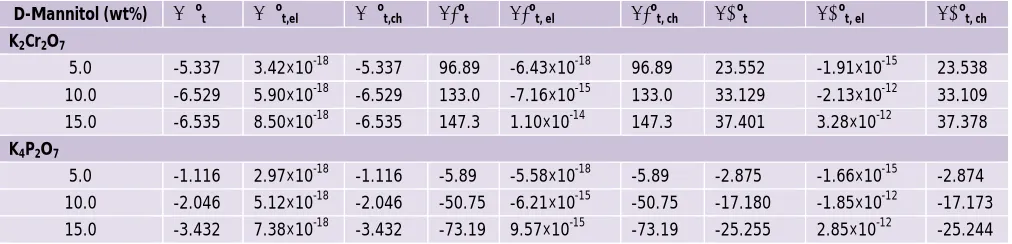
The transfer thermodynamic quantities, e.g., ∆Got, ∆Hot and ∆Sot for potassium dichromate and pyrophosphate in 5, 10, 15 wt% of d-mannitol solutions at 25oC are given in Table 3. The effect of solvent on these quantities may be explained on the basis of the magnitude and sign of these quantities.
The free energy change for the transfer process, MX(w) → MX(s), has been calculated in mole fraction scale because it will eliminate free energy changes and is given by
∆Got = (s∆GoN - w∆GoN) ……… (4)
where the superscripts w and s refer to water and mixed solvents, respectively, and ∆Go values are given in mole fraction scale, as
∆GoN = ∆Gom – (ν-1) × 2.303 RT log (0.001 Mav) …. (5)
where ν is the number of moles of ion produced from one mole of salt and Mav is the average molar mass of the concerned solvent.
The entropy change (∆Sot) and enthalpy change (∆Hot) of transfer process have been derived by means of the following equations
∆Sot = - d(∆Got)/dT
and ∆Hot = ∆Got + T ∆Sot ……….. (6)
The negative values of ∆Got in all cases indicate that the overall effect of permittivity as well as of chemical nature
(Which mainly reflects the relative basicity and solvating capacity) of the solvent makes the transfer of the solute (both cations and anions) from water to the mixed solvent favorable. In this case, the ions (of the solute) appear to be in a lower free energy state in the mixed solvent than in water, and hence the transfer is spontaneous.
The values of ∆Hot and ∆Sot are found to be negative in case of pyrophosphate salt. The negative values of ∆Hot and ∆Sot suggest that when a bulky organic molecule like d-mannitol, is added to a highly polar water molecule, the mixed solvent becomes less associated than pure water.
Thus, the transferred ion breaks more structure in pure water than in the mixed solvent. This is further supported by the fact that the transfer process is the structure forming process including the solvation of ions which is exothermic accompanied by entropy decrease. The negative entropy of the transfer of solutes (i.e. ions of the solutes) can probably be attributed to a greater structure formation in the mixed solvent than in water. Consequently, the degree of solvent orientation is more in the mixed solvent than in aqueous medium.
Considering the transfer thermodynamic quantities comprising of two parts, namely, electrostatic (el) arising from the difference in the dielectric constants of the solvents, and chemical (ch) which reflects the chemical nature of the solvent including basicity as well as the solvating capacity of the solvent as12
∆Xot = ∆Xot,el + ∆Xot,ch ……….. (7)
Where X stands for G, H or S.
Assuming that the radii of the ions do not change with the change of the solvent, the values of ∆Got,el and ∆Sot,el are calculated by means of Born equation:
∆Got,el = (Ne2/2) (εs-1 – εw-1)(r+-1 + r- -1) and
∆Sot,el = - (Ne2/2) (r+-1 + r- -1) (εs-1 θs-1 – εw-1 θw-1) ….. (8)
Where r+ and r- are the radii of cation and anion,
respectively, εs and εw are the dielectric constants of the
mixed solvent and water, respectively. θs= dln εs/dT and
θw = dln εw/dT, the temperature coefficients of the
corresponding solvents. N is the Avogadro number and e is the electronic charge. The values of the dielectric constants of water and that of the water and d-mannitol mixtures are taken from the literature.13
From equation (7), the value of ∆Got,ch is determined from the values of ∆Got and ∆Got,el and so is the value of ∆Sot,ch. Thus, from the values of ∆Got,ch and ∆Sot,ch, the value of ∆Hot,ch has been computed. All these computed values are given in Table 3.
Table 3: Standard transfer thermodynamic quantities ∆Got(kJ mol-1), ∆Hot (kJmol-1), ∆Sot in (Jmol-1K-1) at 298.15K
D-Mannitol (wt%) ∆Got ∆Got,el ∆Got,ch ∆Sot ∆Sot, el ∆Sot, ch ∆Hot ∆Hot, el ∆Hot, ch
K2Cr2O7
5.0 -5.337 3.42×10⁻¹⁸ -5.337 96.89 -6.43×10⁻¹⁸ 96.89 23.552 -1.91×10⁻¹⁵ 23.538 10.0 -6.529 5.90×10⁻¹⁸ -6.529 133.0 -7.16×10⁻¹⁵ 133.0 33.129 -2.13×10⁻¹² 33.109 15.0 -6.535 8.50×10⁻¹⁸ -6.535 147.3 1.10×10⁻¹⁴ 147.3 37.401 3.28×10⁻¹² 37.378 K4P2O7
5.0 -1.116 2.97×10⁻¹⁸ -1.116 -5.89 -5.58×10⁻¹⁸ -5.89 -2.875 -1.66×10⁻¹⁵ -2.874 10.0 -2.046 5.12×10⁻¹⁸ -2.046 -50.75 -6.21×10⁻¹⁵ -50.75 -17.180 -1.85×10⁻¹² -17.173 15.0 -3.432 7.38×10⁻¹⁸ -3.432 -73.19 9.57×10⁻¹⁵ -73.19 -25.255 2.85×10⁻¹² -25.244
CONCLUSION
The molar conductance of potassium dichromate and pyrophosphate in water and water with d-mannitol mixtures has been measured at temperatures ranging from 298.15K to 313.15K. As the temperature increases, the conductance value goes on increasing. Higher is the charge and total no of ions (in case of pyrophosphate), more is value of conductance. As the weight percentage of mannitol increases, more is the number of d-mannitol molecules in solvent cage, hence less is the mobility of the ions. This leads to low value of conductance at higher weight percentage of d-mannitol in comparison to water. The ion-association constant and thermodynamic parameters as well as transfer thermodynamic quantities have been calculated and their roles towards solvation have been discussed.
Acknowledgement: The authors would like to thank Department of Chemistry, ITER, Siksha ‘O’ Anusandhan University, Bhubaneswar, for providing financial, infrastructural support and experimental facilities.
REFERENCES
1. Song SH, Vieille C, Recent advances in the biological production of mannitol. Appl. Microbiol. Biotechnol., 84, 2009, 55.
2. Ghoreishi SM, Shahrestani RG, Innovative strategies for engineering mannitol production. Trends Food Sci. Technol., 20, 2009, 263.
3. Ikeda M, Bhattacharjee AK, Kondoh T, Nagashima T, Tamaki N, Synergistic Effect of Cold Mannitol and Na+/Ca2+ Exchange Blocker on Blood-Brain Barrier Opening., Biochem. Biophys. Res. Commun., 291, 2002, 669.
4. Wang M, Etu J, Joshi S, Enhanced disruption of the blood brain barrier by intracarotid mannitol injection during
transient cerebral hypoperfusion in rabbits., J. Neurosurg. Anesthesiol., 19, 2007, 249.
5. Robinson RA, Stokes RH, Electrolyte Solutions. Butterworths: London; 1955, 35.
6. Shedlovsky T, Kay RL, The Ionization Constant of Acetic Acid in Water–Methanol Mixtures at 25° from Conductance Measurements, J. Phys. Chem., 60, 1956, 151.
7. Fuoss RM, Conductance-concentration function for associated symmetrical electrolytes, J. Phys. Chem., 79, 1975, 525.
8. Bald A, Kinart Z, Wypych-Stasiewicz A, Tomaš R, “Conductance studies of NaCl, KCl, NaBr, KBr, Bu4NBr, and NaBPh4 in water + 2-methoxyethanol mixtures at 298.15 K”, Journal of Molecular Liquids, 182, 2013, 14.
9. Glasstone S., An Introduction to Electrochemistry (Van Nostrand, New York), 1965.
10. Dewan R, Roy MN, “Physico-chemical studies of sodium tetraphenylborate and tetrabutylammonium tetraphenylborate in pure nitrobenzene and nitromethane and their binaries probed by conductometry, refractometry and FT-IR spectroscopy”, J. Chem. Thermodynamics, 54, 2012, 28.
11. Dehury SK, Talukdar M, Dash UN, Studies on ion association and solvation of multi-charged electrolytes(potassium ferricyanide and ferrocyanide) in aqueous and aqueous D-fructose mixtures at different temperatures, Journal of Chemical and Pharmaceutical Research, 4(3), 2012, 1619. 12. Dash UN, Roy GS, Moharatha D, Talukdar M, Ion
association and solvent interaction-conductance of alkali metals and ammonium halides in aqueous binary mixtures containing dextran at different temperatures Phy. Chem. Liq., 49 (4), 2011, 421.
13. Akerlof G, Dielectric constants of some organic solvent-water mixtures at various temperatures, J. Am. Chem. Soc., 54, 1932, 4125.