864 | P a g e
An Overview of Breach Modeling of Earthen
Embankment Dams
Deepak Kumar
1, Monika Panwar
21
Assistant Professor, Civil Engineering Department, University Institute of Engineering and Technology Maharshi Daynand University, Rohtak (India)
2Ph.D., M.M. University, Mullana, Ambala (India)
ABSTRACT
Embankment dams are some of most significant and beneficial structures. These are constructed for
retention of water for irrigation and supply of water for domestic and industrial purposes. Failure of
any embankment results in loss of lives as well as loss of structures. To develop evacuation plans
(early warning system) for embankment failure, prediction of breach outflow hydrograph becomes
important. The existing models can simulate the failure of different embankments, by overtopping or
piping by considering embankment condition and soil parameters. This paper compares these models
on the basis of components involved like use standard principles of hydraulics, sediment transport
and soil mechanics etc. It also describes the necessity of development of a new model the failure of an
embankment that can simulate breach formation, and hence consequent risks, more reliably than
existing models.
Keywords: Embankment Dam, Overtopping, Breaching, Peak outflow, Fuse Plug, Physical Model,
Empirical model.
1. INTRODUCTION
Dams are the important hydraulic structures built across the rivers for various purposes. Embankment
dams are constructed for retention of water for irrigation and supply of water for domestic and
industrial purposes. Middlebrooks (1953) presented a brief history of earthen and rockfill dams and
summarized the causes of inadequacies of earth dams since 1914. The duration of earth dam breaches
can vary from 15 minutes to more than 5 hours (Singh and Snorrason. 1982).
2. DETAILS OF EXISTING MODELS
There are numerous methods for predicting the breach outflow and these may be based on case
studies, physically based methods, comparative analysis or process based methods. Pioneer Cristofano
865 | P a g e
with rate of water flow through breach by assuming a trapezoidal breach of constant bottom width.
Major contributions during the early times are described in Table 1.
From 1965 to 1990, various regression and mathematical models were developed, but none of these
routing models have specifically attempted to integrate a detailed simulation of the erosion processes
that lead to dam breach. Detailed simulation of the breach process has required the use of separate
models specifically focused on erosion processes that provide output of breach geometry development
over time. NWS BREACH model (Fread, 1988) was one of the well known models.
In the next decade, the researchers developed the models by considering the erosion processes as
described in Table 2.
Table 1: Models Developed in the duration 1965 – 1990
Authors Model description
Harris Wanger (1967) mathematical model
Johnson and Illes (1976) published a classification of breach shapes
Kirpatrick (1977) presented best fit relation for peak discharge as a function of depth of water behind dam at the time of
failure
Fread (1977) DAMBRK model
Brown and Rogers (1977) BRDAM model
Knauss (1979) considered various factors which affect the
instability of dams, degree of compaction and grain size diameter
SCS (1981) related peak outflow as a function of depth of water
behind dam at the time of failure Lou (1981) and
Ponce and Tsivoglou(1981)
developed a mathematical model
Simmmler and Samet (1982) studied the process of overtopping perimentally and concluded that as the erosion progresses,
triangular shape change into trapezoidal Singh and Snorrason (1982, 1984) provided the first quantitative guidance on breach
width by plotting breach width vs dam height graph for 20 dam failures.
MacDonald and Langride-MonoPiolis (1984)
relationship, using 42 data failures, for the Breach Formation Factor defined as product of volume of breach outflow and depth of water above
breach.
Costa (1985) presented a comprehensive summary of flood
discharges resulting from all types of dams
Pugh (1985) fuse plug embankments for lateral erosion
Froehlich (1987) developed non-dimensional equations for estimating
breach parameters.
Fread (1984) developed BREACH model
Singh and Scarlatos (1988) developed BEED model
USBR (1988) provided the guidance for selecting breach width
866 | P a g e
The regression equations and mathematical models were developed in 1970’s and 1980’s and refined
in 1990’s , to relate breach parameters to dam and reservoir characteristics. During 1990’s several
researchers compiled database and developed numerical models for predictive equations for breach
parameters and breach peak outflow.
Table 2: Models Developed in the decade 1990 - 2000
Researcher Model description
Von Thun and Gillette (1990) Proposed 2 methods for estimating breach formation time
Fread (1993) NWS-FLDWAV
Robinson and Hanson (1993,1994, 1996 )
Tested on different soils for Head cut Erosion and then developed a computer model
Froehlich (1995a,b) Developed new predictive equation for average width and time of failure.
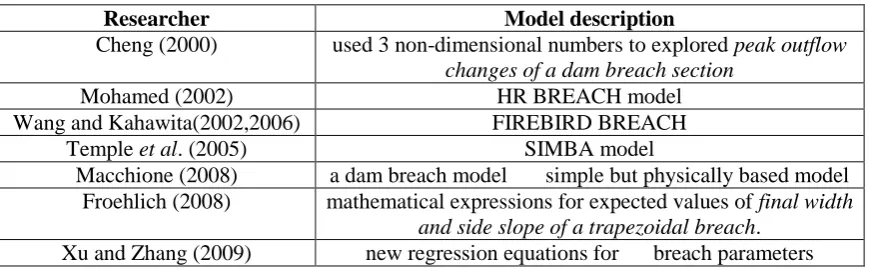
So in this decade a number of initiatives around the world had helped to understand breaching
processes, and feeding into improved numerical models for the prediction of breach growth. After 20th
centuary, the detailed physical models as described in Table 3.
Table 3: Models Developed in Present Century
Researcher Model description
Cheng (2000) used 3 non-dimensional numbers to explored peak outflow
changes of a dam breach section
Mohamed (2002) HR BREACH model
Wang and Kahawita(2002,2006) FIREBIRD BREACH
Temple et al. (2005) SIMBA model
Macchione (2008) a dam breach model simple but physically based model
Froehlich (2008) mathematical expressions for expected values of final width and side slope of a trapezoidal breach.
Xu and Zhang (2009) new regression equations for breach parameters
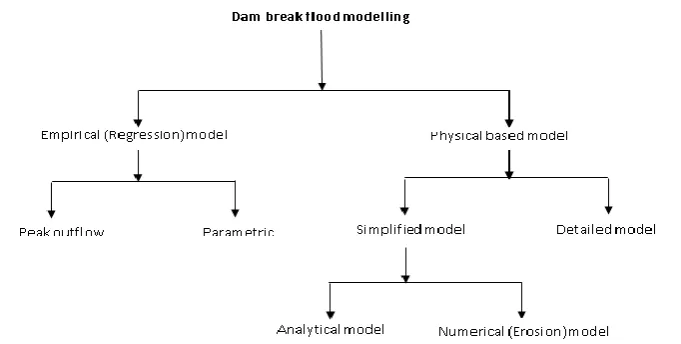
All the above methods and models are classified under different categories as described in the
literature (Reclamation, 1988), the different models are classified as shown in the Figure 1.
3. CLASSIFICATION OF EXISTING MODELS
The existing models may be classified on the basis of techniques or methods used for establishing
867 | P a g e
3.1 Empirical ModelsPredicting Peak Outflows from Case Study Data: Historical failures provide useful data for dam
breach modeling. The peak outflows and the time to reach the peak are the crucial parameters of
breach outflow hydrograph. From the various case study data, many researchers developed different
empirical formulae, based on dam characteristics to determine the peak outflows directly.
Figure 1: Classification of Existing Models
3.1.1 Regression models or Equations from breach parameter
There are different parameters which describe a breach. These may by dependent (breach depth,
breach width, time to failure, side slope etc.) and independent parameters (dam dimensions, type of
dam, initial water level, volume of reservoir etc.). In this approach, breach formation process was
determined by using statistically regression equations and the flow through the breach is analyzed
separately. As in previous method, the regression equations, used to determine breach parameters,
were based on dam failure case studies. Wu (2011) reviewed and stated that only few researchers
considered the effect of embankment erodibility in the breach modeling.
There are significant uncertainties in estimating the breach parameters and peak outflows Wahl (2004)
which is the disadvantage of this approach. Also the predicting breach characteristics and processes
were considered to contain the greatest uncertainty (Singh 1996; Morris 2000 Froehlich 2008). The
accuracy of regression models depends on the number of case studies and the accuracy of these
databases. In general, there are a number of factors on which peak outflow depends like ersion
process, hydraulic conditions, geotechnical factors etc. It may be concluded that up to last decades,
regression equations were widely used for estimating breach parameter as well as peak outflow, but
these did not correlate the erosion processes as the material erodibility was not considered in these
868 | P a g e
3.2 Physical ModelsDuring 1980’s, many physical models, analytical and numerical, were developed. These models were
base on principles of hydraulics, physics of breach erosion, sediment transport and geomechanics.
Also different flow equations, derived from regression analysis, were used to estimate breach outflow
hydrograph with some assumption. In the literature, the physically-based models were divided in
different groups based upon the degree of use of empirical relationships within the model versus
theoretical processes (Kahawita, 2007). These models are classified as simplified and detailed
physical models.
3.2.1 Simplified physically based breach models
Simplified models with significant simplifications were developed in last few decades on the basis of
analytical and numerical solutions. In these models the breach cross section was assumed as
rectangular, triangular of trapezoidal. The weir formula was also used to determine breach flow.
Analytical models: For analytical models, significant simplifications were made and different
equations like reservoir water-mass depletion equation, broad crested weir hydraulics, and breach
erosion relation were used to develop more reliable breach models. Fread (1981, 1984) developed an
analytical equation to predict peak outflow from a breached dam. The equation described the
simultaneous lowering of reservoir elevation as the breach forms. Singh & Scarltos (1988) developed
analytical models for the simulation of earth dam breach erosion by assuming trapezoidal breach
shape and assuming simplified reservoir storage curve. To estimate the flow over the breach they used
broad-crested weir hydraulics and a breach-erosion relation. Singh and Quiroga (1988) and
Macchione (1989) also derived the analytical solutions for breach outflow hydrograph. Walder and
O’Connor (1997) presented a mathematical model of dam breach formation and used it to relate
dimensionless peak outflow. Macchione (2008) assumed a critical flow through the breach and
proposed a dam breach model with cross section simplifications. He considered the geometry of the
embankment, the shape of the reservoir, and the hydraulic characteristics of the flow through the
breach and its erosive capacity, and the shape of the breach. After that this model was compared by
Macchione and Rino (2008) and found that this model was easy to use equations to predict peak
discharge as well as whole outflow hydrograph. The simplified physical models have the limited
applicability as many simplifications were made.
Numerical (Erosion) models: The numerical models were still simplified models but have accurate
approximations as compared to analytical models. These models used the geomechanics, flow
regimes, hydrodynamics and instability processes. According to many researchers (Wan and Fell
(2004), Jang et al. (2011), Hanson et al. (2011)), embankment erodibility plays an important role in
embankment breaching. Cristofano (1965) was the first to have simulated gradual dam breach erosion.
869 | P a g e
the effect of shear strength of soil particles and the force of the flowing water. The overflow section
was assumed trapezoidal in shape and the bottom width remained constant for all
timeOne-dimensional mathematical model was presented by Nogueira (1984) for progressive earth dam failure
by considering the equations of unsteady flow and derived geometric relationships for breach channel.
In the late 1990s, some research groups developed more comprehensive simplified physical models.
Till 1990’s there was no any model which can integrate a detailed simulation of erosion process for
dam breach modeling (Wahl, 2010). From 1998 to 2001, a research project was undertaken and HR
BREACH model was developed at HR Wallingford (Mohamed, 2002).
Recently Hanson et al. (2011) developed the soil parameters for dam breach. Wu (2013)
presented a comprehensive simplified physically based breach model, which was able to simulate the
breaching processes of non-cohesive and cohesive, homogeneous and composite embankments owing
to overtopping and piping. The model considered a flat broad-crested weir with a trapezoidal cross
section for estimating the breach due to overtopping. He simulated the cohesive embankment breach
erosion processes in the form of headcut migration and the breaching of composite embankment with
clay core and cover. The model covers the dam breaching by applying different algorithms to
determine the headwater and tail water levels and allowing embankment base erosion. A simple one
dimensional mathematical model was developed by Alhasan et. al. (2015) and a computer code was
compiled. The model was calibrated using the field data compiled from 4 failures of small
embankment dams breached during 2002 in the Czech Republic. He proposed a numerical procedure,
including conceptual, mathematical and numerical models and a comparison of calculated dam break
parameters with site data. NWS-BREACH model was probably the most famous physical model.
3.2.2 Detailed Physical Based Breach Models
Uncertainties in predicted breach parameters and the flood hydrograph exist because of significant
model simplifications (Mohamed et al. 2002). One, two and three dimensional numerical dam break
models are currently being developed by many authors worldwide. Recently many researches
(Mohamed et al. 2002; Wang et al. 2006; Wahl et al. 2008; Morris et al. 2009a; Wu et al. 2009) had
developed more comprehensive physically based embankment breach models which are able to
simulate the breaching processes of cohesive and noncohesive, homogeneous, and composite
embankments. The breach descriptions were used as input to these models, which calculate the breach
outflow analytically by assuming the occurrence of erosion. Tingsanchali and Chinnarasri (2001)
developed a one-dimensional numerical model to simulate the dam surface erosion and slope sliding
failure with time for dam failure due to flow overtopping. They used explicit finite difference scheme
to solve one-dimensional equations of continuity and momentum for unsteady varied flow over steep
bed slopes. Only a few recent models have considered the breach formation by headcut erosion
870 | P a g e
difficulties owing to a lack of understanding of sediment transport under embankment breach flow
conditions. The application of the models has been hindered by an inability to quantify the erodibility
of cohesive embankment materials (Wahl et al. 2008). The key objectives of these tests have been to
observe embankment failure processes, understanding of the erosion processes. Another objective of
these tests was to provide realistic information to improve and verify dam failure computer models.
Wu (2011) described the multi-dimensional physical based dam breach models developed
recently. He concluded that breaching of embankments due to overtopping involve mixed flow
regimes with overfalls, lateral erosion with huge mass failure. The embankment erodibility plays an
important role in breach analysis of embankments (Wan and Fen, 2004, Hanson et. al. 2011).
4. EXPERIMENTAL MODELS
Most of the approaches, as described in previous sections, were based on regression equations
physically based numerical or analytical models and the mechanism of breach erosion. For realistic
study of dam breach, experimental study is necessary which help to overcome the shortcomings
identified in other methods. In the last 30-40 years, relevant experimental studies have been made to
understand embankment breaching processes and collect reliable data to develop embankment breach
models, with significant contributions such as laboratory tests and field experiments (Coleman et al.
2002; Rozov 2003). Zhu et al, (2004) stated that various experiments were conducted on the
breaching of embankments during last several decades and they classified these experiments as
large-scale test (field test) and small-large-scale tests (laboratory tests).
4.1.1 Laboratory Experimental Model
In the past, the researchers’ had conducted numerous lab experiments with and without fuse plug.
Fuse plug is, a temporary earthfill structure, which is designed by considering the water surface of the
reservoir behind it and wash out in a predictable and controlled manner (Verma etal., 2014). It acts as
a safety valve for embankments and during floods and provides a safe passage without damaging the
body of dam (CWC, 1989). In laboratory, different experiments were conducted using fuse plug and
without fuse plug.
Initially the lab experiments using fuse plug were carried out by Tinney and Hsu (1961), Chee (1984),
Pugh (1985), Pan et al. (1993), Sahu et. al. (2013), Verma etal., (2014). Sahu et. al. (2013) stated that
the experimental study in the laboratory environment using fuse plug is necessary to establish the
relationships among breach hydraulic, breach geometry and transport of erodible soil.
The small-scale tests without fuse plug conducted by many researchers in laboratory to understand for
breaching processes of embankments Powledge and Dodge (1985), Visser (1998), Tingsanchali and
871 | P a g e
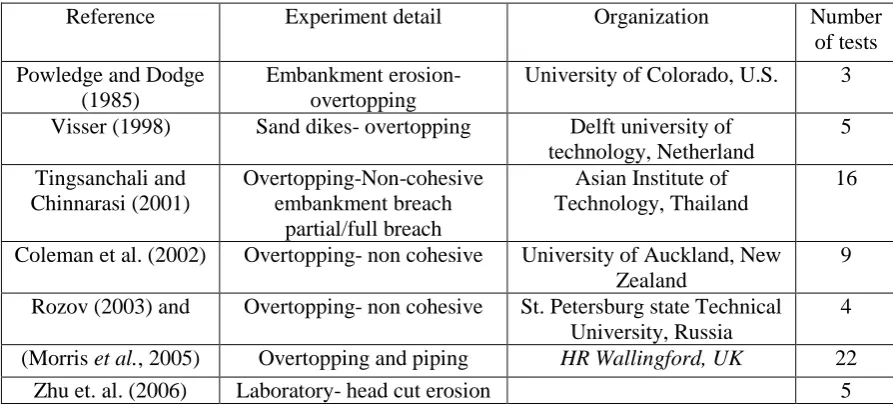
summarized the laboratory experiments conducted by many invetigators and Wu (2011) updated the
list given by Wahl. The selected laboratory test with and without fuse plug is summarized in Table4a
and 4b.
4.2.2 Field Experimental models
The researchers includes, Pan and Loukola (1993), Visser et al. (1991 and 1996), Meadowcroft et al.
(1996), Hahn et al. (2000) and Höeg et al. (2004) conducted the tests in field. The first significant
field experiments were done by Simmmler and Samet (1982) and studied the process of overtopping
experimentally. Recently various researchers conducted large scale experiments in the field like
European IMPACT project (Morris and Hassan 2005), USDAARS research project (Hanson and
Hunt, 2005), and Zhang et al. (2009).
Table 4a: Laboratory Experimentation Using Fuse Plug (Updated from Wahl, 2007 and
Wu, 2011)
Reference Experiment detail Organization Number
of tests
Tinney and Hsu
(1961),
Lab and field scale- overtopping
Washington State University, U.S. 13
Chee (1984), Lab scale- overtopping University of Windsor, Canada -
Pugh (1985), Laboratory scale Bureau of Reclamation, U.S. 8
Pan et al. (1993). Field scale- overtopping China >50
Schmocker et al. (2013),
Lab scale- two fuse plugs
Laboratory of Hydraulics,
Hydrology, and Glaciology, Zurich 10
Sahu et. al. (2013) Lab scale- overtopping India 4
(Verma etal., 2014) Lab scale- overtopping M.M. University, India 5
Table 4b: Laboratory Experimentation (Updated from Wahl, 2007 and Wu, 2011)
Reference Experiment detail Organization Number
of tests
Powledge and Dodge (1985)
Embankment erosion- overtopping
University of Colorado, U.S. 3
Visser (1998) Sand dikes- overtopping Delft university of
technology, Netherland 5 Tingsanchali and Chinnarasi (2001) Overtopping-Non-cohesive embankment breach partial/full breach
Asian Institute of Technology, Thailand
16
Coleman et al. (2002) Overtopping- non cohesive University of Auckland, New Zealand
9
Rozov (2003) and Overtopping- non cohesive St. Petersburg state Technical University, Russia
4
(Morris et al., 2005) Overtopping and piping HR Wallingford, UK 22
872 | P a g e
(Morris et al., 2007) IMPACT project HR Wallingford Ltd,
Howbery Park, Wallingford,
22
Al-Riffai et al. (2009) Homogeneous- side slope instability
University of Ottawa, Ottawa 8
Orendorff et al. (2010)
Small and large flume- variation in compaction
University of Ottawa, Canada
Zhu et. al. (2011) Laboratory scale- head cut erosion
Delft university of technology, Netherlands
5
The field tests of large scale tests was one of the important steps required to understand the complex
natural phenomena and validate embankment breach models. From laboratory experiments and field
tests, it may be concluded that in case of overtopping failure the erosion process was different for
different type of soil. According to Pugh 1985; Ralston 1987; Powledge et al. 1989; Singh 1996;
Visser 1998; Hanson et al. 2005) for non-cohesive, earth embankments, surface erosion occurs where
for cohesive embankments head cut erosion occurs.
5. CONCLUSION
Embankment breaching processes are very complex and involve strong vertical and lateral erosion,
discrete mass failure, and headcut migration. The failure mode and mechanism are affected by
upstream and downstream water conditions, embankment configurations and soil properties. A
number of parametric, empirical, erosion and physically-based embankment breach models have been
established in the past decades, but prediction with these models involves significant uncertainties.
The biggest limitation of the existing breach models is quantifying erosion rates or erodibility of
cohesive soils under embankment breaching flows. Great progress has been made to investigate
embankment breaching processes through laboratory and field experiments and real-world case
studies. However, most laboratory experiments were for small scale homogeneous embankments,
only a few outdoor experiments were conducted at large scales. It is important to conduct more
large-scale laboratory experiments and field case studies to improve existing embankment breach models or
develop new ones. Also for future calibration of earthen dam breaching more reliable data is required
which may be obtained from past experiments or sets of historical events.
6. BIBLIOGRAPHY
1. Babb, A.O. and T.W. Mermel, 1968, Catalog of Dam Disasters, Failures and Accidents,
873 | P a g e
2. Brown, Richard J., and David C. Rogers, 1977, “A Simulation of the Hydraulic Events
During and Following the Teton Dam Failure,” Proceedings of the Dam-Break Flood
Routing Workshop, Water Resources Council, p. 131-163.
3. Brown, Richard J., and David C. Rogers, 1981, Users Manual for Program BRDAM, U.S.
Bureau of Reclamation, Denver, Colorado, April 1981, 73 p.
4. Costa, John E., 1985, Floods from Dam Failures, U.S. Geological Survey Open-File Report
85-560, Denver, Colorado, 54 p.
5. Cristofano, E.A., 1965, Method of Computing Erosion Rate for Failure of Earthfill Dams,
U.S. Bureau of Reclamation, Denver, Colorado.
6. Fread, D.L., 1984, DAMBRK: The NWS Dam-Break Flood Forecasting Model, National
Weather Service, Office of Hydrology, Silver Spring, Maryland.
7. Froehlich, David C., 1987, “Embankment-Dam Breach Parameters,” Hydraulic
Engineering, Proceedings of the 1987 ASCE National Conference on Hydraulic
Engineering, Williamsburg, Virginia, August 3-7, 1987, p. 570-575.
8. Froehlich, David C., 1995a, “Peak Outflow from Breached Embankment Dam,” Journal of
Water Resources Planning and Management, vol. 121, no. 1, p. 90-97.
9. Harris, G.W., and D.A. Wagner, 1967, Outflow from Breached Earth Dams, University of
Utah, Salt Lake City, Utah.
10. Jansen, R.B., 1983, Dams and Public Safety, U.S. Dept. of the Interior, Bureau of
Reclamation, Denver, Colorado.
11. Johnson, F.A., and P. Illes, 1976, “A Classification of Dam Failures,” International Water
Power and Dam Construction, December 1976, p. 43-45.
12. Knauss, J., 1979, “Computation of Maximum Discharge at Overflow Rockfill Dams,”
Proceedings, International Commission on Large Dams, Thirteenth International Congress
on Large Dams, Q.50, R.9, New Delhi, India, 1979, p. 143-160.
13. Lou, W.C., 1981, Mathematical Modeling of Earth Dam Breaches, Thesis, presented to
Colorado State University, at Fort Collins, Colorado, in partial fulfillment of the
requirements for the degree of Doctor of Philosophy.
14. MacDonald, Thomas C., and Jennifer Langridge-Monopolis, 1984, “Breaching
Characteristics of Dam Failures,” Journal of Hydraulic Engineering, vol. 110, no. 5, p.
567-586.
15. Ponce, Victor M., 1982, Documented Cases of Earth Dam Breaches, San Diego State
University Series No. 82149, San Diego, California.
16. Rico, M.; Benito, G.; Salgueiro, A. R.; Diez-Herrero, A., (2008b). Reported tailing dam
874 | P a g e
17. Singh, Krishan P., and Arni Snorrason, 1982, Sensitivity of Outflow Peaks and Flood Stages
to the Selection of Dam Breach Parameters and Simulation Models, SWS Contract Report
288, Illinois Department of Energy and Natural Resources, State Water Survey Division,
Surface Water Section at the University of Illinois, 179 p.
18. Singh, V.P., and P.D. Scarlatos, 1988, “Analysis of Gradual Earth-Dam Failure,” Journal of
Hydraulic Engineering, vol. 114, no. 1, p. 21-42.
19. Turahim, A. H.; Mohd, N. A., (2002). Analysis of dam break for disaster preparedness. 2nd.
20. Von Thun, J. Lawrence, and David R. Gillette, 1990, Guidance on Breach Parameters,
unpublished internal document, U.S. Bureau of Reclamation, Denver, Colorado, March 13,
1990, 17 p.
21. Wang, Z. 2005. “A numerical three dimensional noncohesive earthen dam breach model”.
Ph.D. dissertation, 222pp., Utah State Univ., Logan, UT.
22. Wang, Z. and D. S. Bowles. 2006a. “Three dimensional noncohesive earthen dam breach
model”. Part 1, Theory and methodology, Advances in Water Resources; in press,
doi:10.1016/j.advwatres.2005.11.009.
23. Hanson, G. J., Temple, D. M., Hunt, S. L., and Tejral, R. D. (2011), ““Development and
characterization of soil material parameters for embankment breach.” Appl. Eng. Agric.,