78 | P a g e
EISO Technique for Wireless Mesh Networks
M.A.Archana
1, Dr.C. Parthasarathy
2Research scholar
1, Assistant Professor
2,
Sri Chandrasekharendra Saraswathi Viswa MahaVidyalaya, [SCSVMV]
1,2Kanchipuram, Tamilnadu, (India)
ABSTRACT
In this paper, we have proposed Energy Consumption Based On Improved Swarm Optimization (EISO)
Clustering with SOCCOR protocol for improving the overall network energy. Simulation results shows ample
minimum energy utilization is being achieved by EISO in SOCCOR compared to LEACH protocol. The
proposed system was tested and the results were demonstrated with proposal effectiveness in improving the
overall power efficiency over a wireless mesh network.
Keywords:
Energy, Cluster Head, PSO, EISO, LEACH, Wireless Mesh Networks
I. INTRODUCTION
A wireless mesh network (WMN) is an accumulation of radio terminals in which every hub transfers
information utilizing mesh topology. It is additionally characterized as a sort of wireless ad hoc networks. The
engineering of wireless mesh topology contains gateways, switches and mesh clients. The switches are in charge
of sending network traffic from or to the gateways which is not important to interface it to the internet. Mobile
phones, laptops and different gadgets are considered as mesh clients [1]. For the radio nodes, the scope region is
assessed in view of the working region of nodes called mesh cloud. To frame a radio network, the mesh cloud is
gotten to just in view of the working between each radio nodes. In mesh network, in the event that one hub is
not worked for quite a while then alternate nodes are speaking with each other to give repetition and unwavering
quality. It might act naturally mend or self-shape on the grounds that the nodes can impart utilizing different
nodes or middle of the road nodes. It is conceivable to execute it in all cellular and wireless innovations like
802.15, 802.11, and 802.16 without protocol confinements [2].
II. RELATED WORK
In a wireless mesh network, soaring is a well-known idea utilized with steering protocols. The explanation
behind utilizing is the need of interfacing internet with broad band get to. It is influenced in the area where
legitimate physical association is not given this network. Consequently the costly of developing the network
surpasses the real advantages of this mesh network. The ad hoc network gives the imperative idea of protocol
steering in WMNs. Contingent upon the aggregate number of nodes and conceivable ways the metrics based
protocols are just utilized as a part of this network. This system does not consider the request of different
innovations and execution of connections because of its adequacy. To make inventive steering and for the
advancement of existing protocols, the disadvantages and distinctive procedures of metrics are required. The
79 | P a g e
utilization of vitality, limit of switches without troubles and diminished reaction time if any progressions happenin topology needs to fulfil for the determination of protocol [3].Energy management in WMN is defined as the
set of rules to manage various energy supply mechanisms and then efficient consumption of the provided energy
in a sensor node [4]. The overall aim should be to manage energy in such a way that no node becomes energy
deficient and the network is operational perpetually [5].
III. ENERGY CONSUMPTION BASED ON IMPROVED SWARM OPTIMIZATION (EISO)
CLUSTERING
EISO is an optimization technique during which normal species communal activities concentrating for the aim
of reckoning. Swarm intelligence perceives that which attains the progression with the impartiality of adjusting
a fitness function. So the energy will be consumed by the result of EISO in which the transmission is carried out
from cluster head to cluster head. The foremost goal of this clustering process is to elevate average distance and
average energy. During this EISO technique, fitness value is calculated for every reiteration. The proposed
algorithm can be summarized as follows:
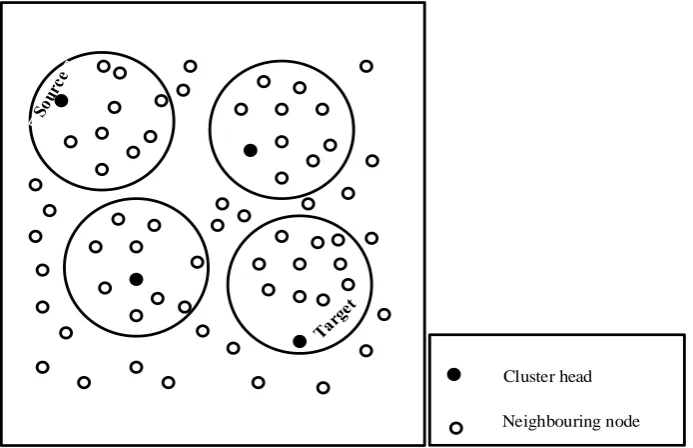
Neighbouring node Cluster head
Figure 1 Clustering architecture in wireless mesh networks
To adjust consistent changes, the system requires a multi-hop network. Through the grouping hubs are isolated
in gatherings called groups. The hubs in a specific bunch can be an entryway, straightforward hubs or the
foundation of the group. CH is in charge of coordination of operations in the bunch, framing of new bunches
and procedure conservation. Additionally, it has accountability to partition possessions among associates of a
group. Here, a sort of systems disarrangement of the CH is an obligation task. The procedure would not alter the
80 | P a g e
of requests, the likelihood of overwhelming escalation, well-organized behavior of movement, a recoveringconvention of bandwidth, aggregation procedures constructed evidence and denigration of essential storage
capacity for evidence. Upgraded inertia weight efficiency depletion established on Improved particle swarm
optimization (IPSO) consumes additional efficiency the optimize when associated towards different experiential
and measured route of occurrence.. Clustering (figure 1) is the progression of dipping vitality in the WMN. So
the data broadcast is conceded since the CH to the CH and thus power will be relatedly condensed.
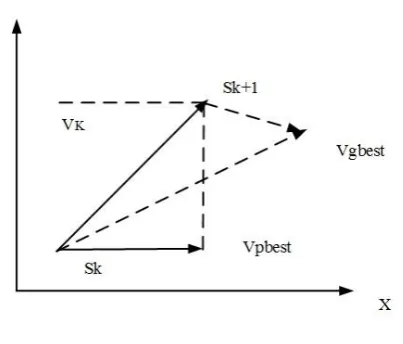
Figure 2 EISO searching point
Figure 2 represents the EISO searching point in which initial velocities and the positions of a set of elements
remains adjusted arbitrarily, then the ideal result can be observed through modernizing groups in this phase. By
way of, PSO pretends the performances of the flocking of bird. Supposing the subsequent state, a collection of
birds is arbitrarily penetrating fare in an area. Here is a solitary portion of the fare in the partial existence
examined. Altogether the fowl do not distinguish wherever the fare is located. Nonetheless, it recognizes just
how far the fare is in each repetition. It is cast off towards resolve the expansion difficulties. In PSO, every
solitary explanation is a "bird" in the examine gap and it is called as "particle". Every element has fitness
standards, it is calculated through the appropriate role toward augmented, and then has accelerated which
undeviating the winged of the atoms. The atoms fly over the problematic gap through subsequent the present
optimal subdivisions.
PSO is regulated through a collection of accidental solutions and formerly explorations aimed at goals through
appraising peers. In each replication, every single element remains modernized through subsequent binary
"best" standards. The principal one is the finest answer and it has accomplished so far. This worth is named
pbest. Additional "best" worth that is pursued through PSO is the best assessment, acquired so far by some
subdivision in the populace. This preeminent assessment is called gbest. In this EISO fitness value is
deliberated for every repetition. Here the newest best element is “pbest”, the position of the element is “lbest” and
81 | P a g e
changed over in order to get different pbest and lbest. In this EISO algorithm three global tenets are commonlydeposited and chronicle. Then base station originates the clustering enactment phases as follows,
C
by
ered
members
of
number
f
FV
x
f
cov
1
).
1
(
.
1 1 21
1
(1)In this major stage is to split the particles into position and velocity. Subsequently fitness value is estimated for
each and every element by the equation (2)
Where, Fitness value is
N
M
C
d
f
i N i)
,
(
0 1
(2)Where
C
= current node,Mi
= member node,N
is the number of members covered with in the clusterand
1,
2 are the weighing parameters (values are 0.2 and 0.2 respectively).Then the new velocity is calculated from the old velocity and lbest and gbest values. The time fluctuating weighting
function
z
using eqn. (3) is given by
x
f
z
z
*
1 (3)2 1
z
z
z
(4))
(
)
(
2 1 * best best bestbest
p
z
g
p
l
z
velocity
old
z
velocity
new
(5)Where
z
is the inertia weight (value is 1.5),z
1andz
2are the basic EISO tuning considerations (values are 0.9 and 0.4 respectively).Assessment of novel position by using new-fangled velocity is given below:velocity
new
position
old
position
new
(6)Subsequently the fitness value is calculated for the new particle with the help of the new position and velocity.
Among the fitness values highest value is chosen as the local best values. The fitness updating process is
repeated until getting optimum value. Hence for each iteration maximum fitness value selected as the local best
(lbest) and the final point from the local best (lbest) value is selected as the global best (gbest) value. Cluster Head is
liable for best path choice, coordinating nodes and makes the stability of the load equivalently among all the
nodes. In order to choose the cluster head, the following cluster head is connected with all. At that time the
fitness function for the cluster head assortment is given by the following equation (8)
C
by
ered
members
of
number
f
FV
cov
1
).
1
(
.
1 1 21
82 | P a g e
Where,
N i iN
M
C
d
f
0 1,
(8) Where,
else
C
by
ered
is
Mi
if
,
0
cov
,
1
In above calculation
is the capacity of attachments in the existent cluster node,
1 and
2 are weighingfeatures (standardized values), and N indicates the capacity of memberships surrounded inside the opposition
expanse of the cluster head in the EISO.
The novel velocity of the different elements is premeditated from the original result. From the equation (3)
new-fangled velocity will be calculated.
)
(
)
(
21
l
bestp
bestz
g
bestp
bestz
velocity
old
z
velocity
new
(9)Where
z
is the inertia weight,z
1andz
2are the basic PSO tuning parameters (values are 0.9 and 0.4 respectively). Assessment of novelty using novel velocity is as follows:velocity
new
position
old
position
new
(10)The fitness value for the novel particle is estimated from the equation (7). Then the fitness value of the old and
new particle is matched, from this best one is selected for the following iteration. Therefore, for every iteration
maximum fitness is selected as the local best solution (lbest). Among this lbest best one is selected as the global
best solution (gbest). Next to the cluster head selection the information security will be improved with the new
technique known as sparse matrix encryption algorithm. Thus message security will be improved before it sends
to the receiver side.
IV. RESULTS
The projected technique is enforced using NS-2 and valid by associated with the LEACH and SOCCOR
protocol. The projected system can give energy economical .At that point, the computation and communication
of the projected theme is related with different schemes. Simulation results are evaluated with the enactment
metrics like variety of packets received by sink node, delay, and packet loss, normalized overhead. The
projected work is implemented within the functional platform of network machine NS-2 and henceforth the
concert are analysed by assessment with any of the recent prevailing method. The total number of iteration is
83 | P a g e
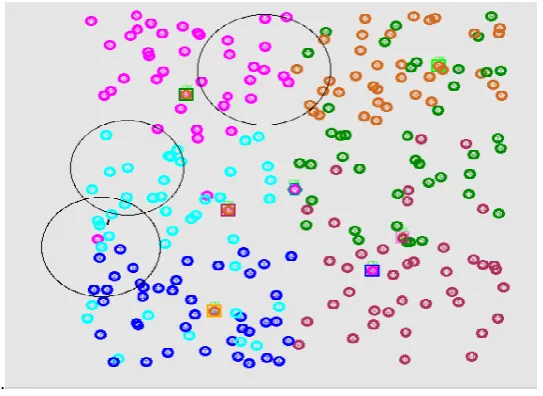
.Figure 3 Node placement in mesh networks
In our work totally 250 nodes are placed around a mesh network (figure 3). Then the deployment area is covered
by three clusters. Initially cluster heads are selected to form a cluster within the transmission area. In this figure
marked area represents the cluster head and totally three clusters are formed.
Table 1: Simulation parameters
Parameter Values
Number of nodes 250
Area(deployment) 300*300 m2
Initial energy 1 Joules
MAC Type IEEE 802.11
Data packet size 1024 bits/ sec
Transmitted power 0.02 watts
Received power 0.01 watts
Frequency range 5 GHZ
Transmission range 120m
Table 1 mentions the parameter which is required for the implementation and here the MAC type is IEEE
802.11 and the initial energy level is 1 joule. After that this energy will vary for each packet transmission.
Different performances are evaluated with the proposed EISO in SOCCOR protocol and its performance is
compared with the previous LEACH protocol. This protocol is done through the MAC type protocol with
minimum power consumption. The overhead analysis is outlined because the computed quantitative relation
84 | P a g e
energy
receiving
and
ng
transmitti
the
of
Sum
node
ing
correspond
the
of
Energy
Overhead
(11)
Figure 4 Overhead analysis
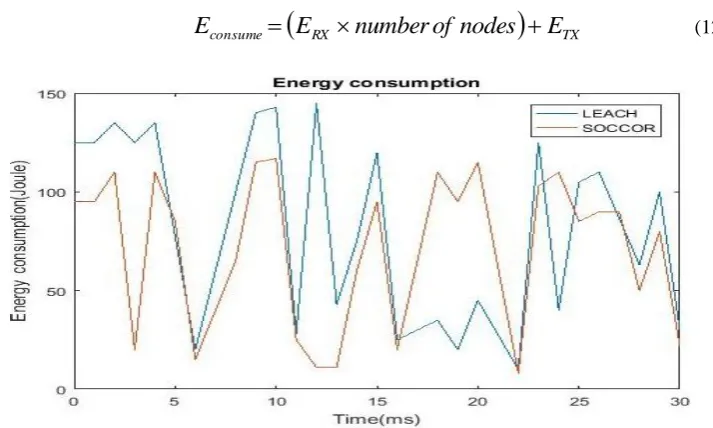
Energy consumption is defined as the sum of receiving energy with the number of nodes and the transmitted
energy.
RX
TX consumeE
number
of
nodes
E
E
(12)Figure 5 Energy consumption analysis
Subsequent to the numerical assesSubsequent to the numerical assessment achieved by means of optimization
procedures, the succeeding statement is made with the results of differentiating overhead and energy
consumption. Figures 4&5 displays the presentation, exploration of overhead and energy consumption for
85 | P a g e
the node‟s flexibility or fanciful route methods during the transmission. The results display that the values of theEISO in SOCCOR are much better than LEACH protocol.
V. CONCLUSION
The overall work of the paper concentrated on minimum energy utilization. Thus, proposed EISO clustering in
SOCCOR protocol provides energy efficient, secure routing over the entire network. Secure packet is
transmitted from the mesh nodes to another node. The delay will reduce while transferring the packet, and
optimized routing is achieved with the ant colony optimization. Therefore, this motivates wireless carriers to
pursue the most economical method for enhanced system having limited power consumption over wireless mesh
networks.
REFERENCES
[1] Daniel Aguayo, John Bicket, SanjitBiswas, Glenn Judd, and Robert Morris ,„Link-level measurements from
an 802.11 b mesh network‟, ACM, In ACM SIGCOMM Computer Communication Review, Vol 34, no 4,
2004,pp 121-132.
[2] Wei Zhang, Zhe Wang, Sajal K. Das, and Mahbub Hassan, „Security issues in wireless mesh networks‟,
Springer US, In Wireless Mesh Networks, 2008, pp 309-330.
[3] Sheikh Ferdoush, and Xinrong Li, „Wireless sensor network system design using Raspberry Pi and Arduino
for environmental monitoring applications‟, Procedia Computer Science, Vol 34,2014, pp 103-110.
[4] Goussevskaia O, Wattenhofer R, Halldórsson MM, Welzl E, „Capacity of arbitrary wireless networks‟ In
INFOCOM, 2009, pp. 1872-1880.
[5] Zhu N., Vasilakos A.V., EMrise: An Energy Management Platform for WSNs/WBANs, In Energy
Management in Wireless Cellular and Ad-hoc Networks, Springer International Publishing. 50,2016,
367-395.
[6] Cui, Goldsmith, A.J., Bahai, A., Energy-constrained modulation optimization. IEEE WirelesCommun.,
4(5),2005, 2349–2360
[7] Younis, O., Fahmy, S., HEED: a hybrid, energy-efficient, distributed clustering approach for adhoc sensor
networks. IEEE transaction on mobile computing, 3(4), 2004,366– 379.
[8] Hu, Y.F., Ding, Y.S., Ren, L.H., Hao, K.R., Han, H., An endocrine cooperative Energy consumption based
on Improved Swarm Optimization algorithm for routing recovery problem of wireless sensor networks with
multiple mobile sinks, Elsevier, Information Sciences, 300,2015, 100-113.
[9] Sakamoto, S., Oda, T., Ikeda, M., Barolli, L., Design and implementation of a simulation system based on
Energy consumption based on Improved Swarm Optimization for node placement problem in wireless mesh
networks,IEEE Intelligent Networking and Collaborative Systems (INCOS), 2016, pp.164-168.
[10] Avallone, Stefano, Albert Banchs, A Channel Assignment and Routing Algorithm for Energy Harvesting
Multi-Radio Wireless Mesh Networks, IEEE Journal on selected areas in communication, 34(5), 2016,
86 | P a g e
[11] Annappa, P. H., Udaya Kumar K. Shenoy, Shiva Prakash, S.P., An Approach to Detect Intruder inEnergy-Aware Routing for Wireless Mesh Networks, Springer, Proceedings of the Second International Conference
on Computer and Communication Technologies, 2016,pp.821-830.
[12] Chen .W, Guan, Q., Jiang, S., Guan. Q., Huang, T., Joint QoS provisioning and congestion control for
multi-hop wireless networks, Springer, Journal on Wireless Communications and Networking, 2016, 1-11.
[13] M. Bani Yassein, A. AL-zou‟bi, Y. Khamayseh, W. Mardini, “Improvement on LEACH Protocol of
Wireless Sensor Networks”, International Journal of Digital Content Technology and its Applications
Volume 3,No. 2,2009.
[14] Rajesh Patel, Sunil Pariyani, Vijay Ukani, “Energy and Throughput Analysis of Hierarchical Routing
Protocol (LEACH) for Wireless Sensor Networks”, International Journal of Computer Applications
Volume 20,No. 4,2011.
[15] R. K. Gill, P. Chawla, and M. Sachdeva,“Study of LEACH Routing Protocol for Wireless Sensor
Networks,” International Conference on Communication, Computing & Systems,2014 pp. 3–5.
[16] Alka Singh, Shubhangi rathkanthiwar, sandeep kakde, “LEACH based-energy efficient routing protocol
for wireless sensor networks” International Conference on Electrical, Electronics, and Optimization