Energy Efficient Routing Protocols for
Wireless sensor network
Suhaib sheikh
1, Bhawna Sharma
21
Mtech scholar in electronics and communication engineering,
YIET, Haryana, (India)
2
Assistant professor, Dept. of electronics and communication engineering,
YIET, Haryana, (India)
ABSTRACT
one of the challenging jobs in wireless sensor network is to route data efficiently from source to destination. And
also the increasing demand for real-time applications in Wireless Sensor Networks (WSNs) has made the Quality
of Service (QoS) based communication protocols an interesting and hot research topic. Satisfying Quality of
Service (QoS) requirements (e.g. bandwidth and delay constraints) for the different QoS based applications of
WSNs raises significant challenges. Energy consumption is also a prominent and critical issue faced by wireless
sensor networks. The maximum amount of energy is consumed when the sensors communicate with each other. In
order to develop the lifetime of the network, energy should be used in an efficient manner. Therefore energy
efficient routing mechanisms are required. Cluster-based routing techniques, such as the well-known low-energy
adaptive clustering hierarchy (LEACH), are used to achieve scalable solutions and extend the network lifetime
until the last node dies (LND).
Index Terms
—
WSN, Localization of WSN Nodes, Design challenges of WSN, Schemes of Node
Deployment
I.INTRODUCTION
Wireless Sensor Networks (WSNs) have gained worldwide attention in recent years, particularly with the
proliferation of Micro-Electro-Mechanical Systems (MEMS) technology, which has facilitated the development of
smart sensors [1]. In recent years, the rapid development of wireless communications technology, and the
miniaturization and low cost of sensing devices, have accelerated the development of wireless sensor networks
(WSNs)[2]. One of the major constraints of WSNs is the limited and generally irreplaceable power sources of the
sensor nodes. Still, in many applications, it is impractical to replace the sensor nodes as they work under harsh
environment. Therefore, reducing energy consumption of the sensor nodes is considered as the most critical
challenge for long run operation of WSNs. Extensive researches have been carried out in designing energy saving
protocols which include low-power radio communication hardware, energy-aware MAC protocols, etc[3].
Wireless Sensor Networks (WSN) refers to a group of spatially dispersed and dedicated sensors for monitoring and
recording the physical conditions of the environment and organizing the collected data at a central location. Like
WSNs determine. In general WSN may produce quite a substantial amount of data, If data fused could be used, the
throughput could be used [4].
1.1 Multi-hop routing algorithms for wireless sensor networks
The basic function of a routing algorithm is to select the path from a set of available paths that is most efficient
based on a specific criterion. Intuitively, to maximize the WSN’s network lifetime, the path that achieves minimum
power consumption while ensuring fair power consumption among individual nodes should be used. Much effort
has focused on
WSN multi-hop routing algorithms, and many algorithms have been proposed. These may be widely categorized as
flat multi-hop routing algorithms and hierarchical multi-hop routing algorithms.
1.1.1 Flat multi-hop routing algorithms
In Fig. 1, an illustration of how flat multi-hop routing algorithms are used to send data is shown. In the illustration,
each sensor node has the ability to communicate over a bounded area within its maximum transmission range to
other sensor nodes, and an arrow’s thickness is proportional to the quantity of facts being transmitted over that
corresponding link. In practice, link utilization differs greatly between different routing algorithms.
Fig. 1: Flat multi-hop routing.
1.1.2 Hierarchical multi-hop routing
Flat multi-hop routing algorithms are excellent in terms of their capability of using power-aware metrics to choose
minimum power consuming paths. However to take advantage of the highly correlated nature of the data collected
from the WSN they fail. The relatively high node density of the WSN and the application scope of the WSN (e.g.,
temperature readings collected from geographically close locations have a high probability of becoming similar),
make data aggregation a very gorgeous procedure in WSN. Hierarchal multi-hop routing algorithms successfully
utilize the data aggregation to decrease the volume of data flowing in the network. In hierarchical multi-hop routing
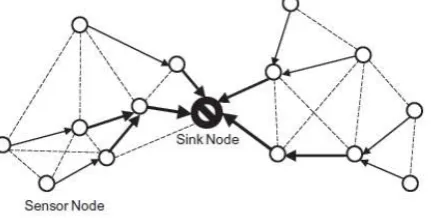
algorithms, sensor nodes assume different roles, which can be changed with time. LEACH is a two-layered
hierarchical multi-hop routing algorithm, as shown in Fig. 2. Each node can play the role of a Cluster Head (CH) or
Fig. 2: Hierarchical multi-hop routing [5].
1.2 Multipath routing
Single path routing protocols in sensor network are designed to discover a single path between a source/destination
pair. From the other hand, multipath routing consists of finding multiple paths between the source and destination
nodes. These multiple paths can be used to solve some trade-offs in such networks and accommodate with the
dynamic nature of WSNs.
1.2.1 Benefits of multipath routing
As mentioned in the introduction, multipath routing protocols can provide load balancing, fault tolerance,
bandwidth aggregation, and reduced delay. Below, we discuss how to provide each of these benefits in multipath
routing.
1.2.1.1 Load balancing
As stated in , one of the reasons for which classical multipath routing has been explored is to provide load
balancing. Load balancing can be achieved by splitting the traffic across multiple route. This use of multipath
routing is applicable to WSNs. in the sensor network Load balancing can spread energy utilization across nodes,
potentially resulting in longer lifetimes. Furthermore, load balancing helps in avoiding congestion and bottleneck
problems.
1.2.1.2 Reliability and fault tolerance
Reliability is a big matter in WSNs, because data transmission is subject to lost due to several reasons: various
kinds of interference, media access conflicts, network topology changes, etc. These reasons affect the wireless
radios to correctly decode the wireless signals. Behind developing multipath routing One of the reasons is to
provide route failure protection, and increase resiliency to route failures. Discovering and maintaining multiple
not used simultaneously. Multiple paths can be used simultaneously for data routing. Simultaneous multipath
routing could be used to improve reliability.
1.2.1.3 Highly aggregated bandwidth
Routing over a single path may not provide enough bandwidth for a connection; Bandwidth may be limited in a
WSN. However, the overall bandwidth of the paths may satisfy the bandwidth requirement of an application if data
are routed over multiple paths simultaneously.
1.2.1.4 Minimizing end to end delay
By assuming that the paths between the source and destination pair are node disjoint paths where correlation
between the paths is very low, and there is no route coupling between different routes (for example, through the
using of directional antennas this could be achieved), the end to end delay can be minimized by dividing the data (to
be sent) into a number of segments and using multiple paths to route segments simultaneously to the destination.
1.3 Problems with multipath routing
Nodes in the wireless sensor network use a shared wireless channel to communicate. This means neighboring nodes
must content for the channel. When the channel is busy by a transmitting node, neighboring nodes hear the
transmission and are blocked from receiving data from other nodes. Additionally, depending on the under laying
MAC protocol, neighboring nodes may have to defer their transmission till the channel is free. Even when multiple
channels are used, the quality of neighboring transmission may be degraded because of the interference. Now,
consider the use of a multipath routing, where the multiple paths are used simultaneously. Even, the multiple routes
are node-disjoint paths, transmissions over the routes may interfere if some nodes are in the transmission range of
each other. This problem is called route coupling. when two routes are located physically close enough to interfere
with each other during data communication Route coupling occurs. Nodes in those two routes are constantly
contending for access to the wireless channel they share and can end up performing worse than a single path
protocol As a result. Thus, node-disjoint routes are not a sufficient condition for improved performance [6].
II.LITERATURE REVIEW
Enan A. Khalil et al. in 2011[1]the main challenges in designing and planning the operations of Wireless Sensor Networks (WSNs) are to optimize energy consumption and prolong network lifetime. Such as the well-known
low-energy adaptive clustering hierarchy (LEACH) Cluster-based routing techniques, are used to achieve scalable
solutions and extend the network lifetime until the last node dies (LND). Also to address energy-aware routing
challenges as meta-heuristics by designing intelligent models that collaborate together to optimize an appropriate
energy aware objective function in recent years evolutionary algorithms (EAs) have been successfully used. On the
other hand, some protocols, are concerned with another objective: extending the stability time until the first node
and the time until LND. To our knowledge, no attempt has been made to obtain a better compromise between the
stability time and network lifetime. the design of the most important characteristic of the EA (i.e., the objective
function) This paper reformulates, so as to obtain a routing protocol that can provide more robust in terms of
network stability period results than the existing heuristic and meta-heuristic protocols, lifetime, and energy
consumption. better tradeoff between the lifespan and the stability period of the network with efficient energy
utilization routing protocol, which can guarantee An evolutionary-based is projected. WSN models are evaluated
and compared against the LEACH, SEP, and one of the existing evolutionary-based routing protocols, hierarchical
clustering-algorithm-based genetic algorithm (HCR) To support this claim, extensive simulations on 90
homogeneous and heterogeneous.
Ahmed E.A.A. Abdulla et al. in 2012[2] Power-aware routing in wireless sensor networks (WSNs) focuses on the crucial problem of extending the network lifetime of WSNs, which are limited by low-capacity batteries. However,
most of the contemporary works fail to resolve the hotspot problem, which is the isolation of the sink node due to
the power exhaustion of sink close-by nodes. To address this issue through a hybrid approach that combines two
routing strategies Author propose a solution, flat multi-hop routing and hierarchical multihop routing In this paper.
The former aims to minimize the total power consumption in the network, and the latter attempts to decrease the
amount of traffic by utilizing data compression. Author mathematically evaluate the power consumption of our
proposed algorithm, then author demonstrate through extensive simulations that the proposed scheme is able to
extend the network lifetime by alleviating the hotspot problem.
Md Azharuddin et al. in 2014[3] Conservation of energy and fault tolerance are two major issues in the deployment of a wireless sensor network (WSN). For a large scale WSN Design of clustering and routing algorithms should
incorporate both these issues for the long run operation of the network. Author proposes distributed clustering and
routing algorithms jointly referred as DFCR In this paper. to be energy efficient and fault tolerant The algorithm is
shown. Due to hasty failure of the cluster heads (CHs) The DFCR uses a distributed run time recovery of the sensor
nodes. It takes care of the sensor nodes which have no CH within their communication range. Author performs
extensive experiments on the proposed algorithm using various network scenarios. With the existing algorithms the
experimental outcome are compared to demonstrate the strength of the algorithm in terms of various performance
metrics.
A.SARANYA et al. in 2015[4] In Wireless Sensor Networks, Sensors are generally battery powered devices. This network is used to gather various kinds of information to Base station (BS). They contain of computational control,
storage capacity, energy supply are the important issues in their energy constraint. To maximize the network
lifetime, author need not only to minimize total energy consumption and also balance WSN load. A new Fuzzy
based General Self organized Tree based Energy Balance routing protocol proposed in this paper, which builds a
routing tree using a process where, for each round BS assigns a root node and broadcast to all sensor nodes. Equally
protocol. Simulation outcome show that projected protocol performance is better than other protocols.
Jalel Ben-Othman et al. in 2010[5] The increasing demand for real-time applications in Wireless Sensor Networks (WSNs) has made the Quality of Service (QoS) based communication protocols an interesting and hot research topic.
Satisfying Quality of Service (QoS) requirements (e.g. bandwidth and delay constraints) for the dissimilar QoS based
applications of WSNs raises significant challenges. More precisely, the networking protocols need to cope up with energy
constraints, while providing precise QoS guarantee. Hence, enabling QoS applications in sensor networks requires
power and QoS awareness in different layers of the protocol stack. In many of these applications (such as
multimedia applications, or real-time and mission critical applications), the network traffic is mixed of delay
sensitive and delay tolerant traffic. Hence, QoS routing becomes an important issue. In this paper, author propose
an Energy Efficient and QoS aware multipath routing protocol (abbreviated shortly as EQSR) that maximizes the
network lifetime through balancing energy consumption across multiple nodes, to allow delay sensitive traffic to
reach the sink node within an acceptable delay uses the concept of service differentiation, reduces the end to end
delay through spreading out the traffic across numerous paths, and increases the throughput through introducing
data redundancy. to predict the best next hop through the paths construction phase EQSR uses the residual energy,
node available buffer size, and Signal-to-Noise Ratio (SNR). EQSR protocol employs a queuing model to handle
both real-time and non-real-time traffic Relayed on the notion of service differentiation. By means of simulations,
we evaluate and compare the performance of our routing protocol with the MCMP (Multi-Constraint Multi-Path)
routing protocol. Achieves our protocol lower average delay Simulation outcome have shown that, more energy
savings, and higher packet delivery ratio than the MCMP protocol.
Basma M. Mohammad El-Basioni et al. in 2011[6] Because sensor nodes typically are battery-powered and in most cases it may not be possible to change or recharge batteries, the key challenge in Wireless Sensor Networks
(WSNs) design is the energy-efficiency and how to deal with the trade-off between it and the QoS parameters
required by some applications. This paper studies the QoS of an energy-efficient cluster-based routing protocol
called Energy-Aware routing Protocol (EAP) in terms of lifetime, delay, loss percentage, and throughput, and
proposes some modifications on it to enhance its performance. better characteristics in terms of packets loss, delay,
and throughput, but slightly affects lifetime negatively The modified protocol offers. in terms of packet loss
percentage by on average 93.4% Simulation results showed that The modified protocol significantly outperforms
EAP.
Harish Kumar et al. in 2013[7]Energy consumption is prominent and critical issue faced by wireless sensor networks. The maximum amount of energy is consumed when the sensors communicate with each other. Therefore
energy efficient routing mechanisms are required. In this paper, a routing scheme based on the fisheye state routing
with a difference in route selection mechanism has been proposed to ensure the reduction in the overall energy
consumption of the network. This format is termed as Energy-Aware Fisheye State Routing (EA-FSR). It is
original fisheye state routing algorithm which is also simulated in the same environment. various parameters For
comparison like end-to-end delay average, energy consumption and throughput have been considered.
J. Gnanambigai et al. in 2014[8] the fastest growing technology that would dominate the future world of wireless communication is Wireless Sensor Networks (WSNs).The critical issue in WSNs is energy. Energy should be used
in an efficient manner, In order to improve the lifetime of the network. Many routing protocols has been developed
to improve energy efficiency of wireless sensor networks. The routing protocol may be conventional type or hybrid
type. The advantages of two different protocols the hybrid type integrates. In this paper, a new hybrid routing
protocol called Quadrant Based Low Energy Adaptive clustering Hierarchy (QB-LEACH ) is developed where
lifetime improvement is vital. This protocol integrates the Quadrant based Directional Routing(Q-DIR), an Ad-hoc
routing algorithm and Low Energy Adaptive clustering Hierarchy (LEACH), a routing algorithm for WSNs. The
performance nature of the protocol is evaluated and observed that this protocol vanquish the other in terms of
energy conservation and network period.
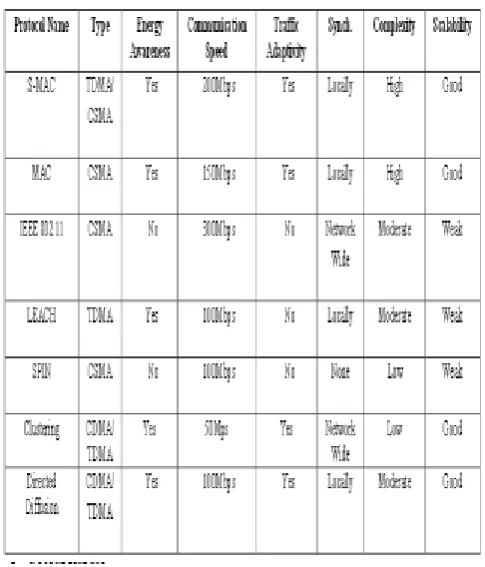
Table 1 Routing Protocols in WSN’s
III.CONCLUSION
A hybrid multi-hop routing algorithm by combining flat and hierarchical multi-hop routing algorithms can resolve
the problem of the isolation of the sink caused by the battery exhaustion of nodes around it. The hybrid multihop
tolerant. A novel Fuzzy based General Self organized Tree based Energy Balance routing protocol proposed,
which builds a routing tree using a process where, for each round BS assigns a root node and broadcast to all sensor
nodes. Equally each node selects itsparent by considering only itself and its neighbor’s information, thus making a
dynamic protocol. And the results show that proposed protocol performance is better than other protocols. an
Energy Efficient and QoS aware multipath routing protocol (abbreviated shortly as EQSR) that maximizes the
network lifetime through balancing energy consumption across multiple nodes. within an acceptable delay to reach
the sink node Uses the theory of service differentiation, reduces the end to end delay through spreading out the
traffic across multiple paths, and increases the throughput through introducing data redundancy. EQSR uses the
residual energy, node available buffer size, and Signal-to-Noise Ratio (SNR) to predict the best next hop through
the paths construction phase. EQSR protocol employs a queuing model to handle both real-time and non-real-time
traffic, Based on the concept of service differentiation.
REFERENCES
[1.] Enan A. Khalil, Bara’a A. Attea,”Energy-aware evolutionary routing protocol for dynamic clustering of
wireless sensor networks”,Swarm and Evolutionary Computation, 2011 ,pp. 195–203
[2.] Ahmed E.A.A. Abdulla , Hiroki Nishiyama, Nei Kato,” Extending the lifetime of wireless sensor networks: A
hybrid routing algorithm”, Computer Communications 35,2012, pp. 1056–1063
[3.] Md Azharuddin, Pratyay Kuila, Prasanta K. Jana, ”Energy efficient fault tolerant clustering and routing
algorithms for wireless sensor networks”, Computers and Electrical Engineering, 2014, pp.1-7
[4.] A.SARANYA, R.SENTHIL KUMARAN, Dr. G.NAGARAJAN, ”Enhancing Network Lifetime using Tree
Based Routing Protocol in Wireless Sensor Networks”, INTERNATIONAL CONFERENCE ON
ELECTRONICS AND COMMUNICATION SYSTEM , 2015, pp.1-10
[5.] Jalel Ben-Othman, Bashir Yahya, ”Energy efficient and QoS based routing protocol for wireless sensor
networks”, J. Parallel Distrib. Comput. 70,2010, pp. 849_857.
[6.] Basma M. Mohammad El-Basioni , Sherine M. Abd El-kader , Hussein S. Eissa , Mohammed M. Zahra, ”An
Optimized Energy-aware Routing Protocol for Wireless Sensor Network”, Egyptian Informatics Journal
,2011- 12, pp.61–72.
[7.] Harish Kumar , Harneet Arora , R.K. Singla, ”Energy-Aware Fisheye Routing (EA-FSR) algorithm for
wireless mobile sensor networks”,Egyptian Informatics Journal , 2013- 14, pp.235–238.
[8.] J. Gnanambigai, N. Rengarajan, N.Navaladi, ”A CLUSTERING BASED HYBRID ROUTING PROTOCOL
FOR ENHANCING NETWORK LIFETIME OF WIRELESS SENSOR NETWORK”, 2nd International
![Fig. 2: Hierarchical multi-hop routing [5].](https://thumb-us.123doks.com/thumbv2/123dok_us/7784643.1287346/3.595.188.391.126.283/fig-hierarchical-multi-hop-routing.webp)