ISSN(Online): 2320-9801
ISSN (Print): 2320-9798
International Journal of Innovative Research in Computer
and Communication Engineering
(An ISO 3297: 2007 Certified Organization)
Vol. 3, Issue 2, February 2015
Reliable Proactive Routing Protocol for
Wireless Sensor Networks
K. Nithya
1, K. Sundareswari
2III M.E., Dept of CSE, Karpagam University, Coimbatore, India1
Assistant Professor, Dept of CSE, Karpagam University, Coimbatore , India2
ABSTRACT: Providing reliable and efficient communication under fading channels is one of the major technical challenges in wireless sensor networks (WSNs), especially in industrial WSNs (IWSNs) with dynamic and harsh environments. Reliable Reactive Routing Enhancement (R3E) to increase the resilience to link dynamics for WSNs/IWSNs. R3E is designed to enhance existing reactive routing protocols to provide reliable and energy-efficient packet delivery against the unreliable wireless links by utilizing the local path diversity. A biased back off scheme has been introduced, during the route-discovery phase to find a robust guide path, which can provide more cooperative forwarding opportunities. Along this guide path, data packets are greedily progressed toward the destination through nodes’ cooperation without utilizing the location information.
R3E remarkably improves the packet delivery ratio, while maintaining high energy efficiency and low delivery latency.
KEYWORDS: ERMECR , WANET , MDR , MAC
I. INTRODUCTION
A wireless sensor network (WSN) consists of spatially distributed autonomous sensors to monitor physical or environmental conditions, such as temperature, sound, pressure, etc. and to cooperatively pass their data through the network to a main location. The more modern networks are bi-directional, also enabling control of sensor activity. The development of wireless sensor networks was motivated by military applications such as battlefield surveillance; today such networks are used in many industrial and consumer applications, such as industrial process monitoring and control, machine health monitoring. Wireless Sensor Network (WSN) is a collection of spatially deployed wireless sensors by which to monitor various changes of environmental conditions (e.g., forest fire, air pollutant concentration, and object moving) in a collaborative manner without relying on any underlying infrastructure support. Recently, a number of research efforts have been made to develop sensor hardware and network architectures in order to effectively deploy WSNs for a variety of applications. Themain characteristics of a WSN include:
Power consumption constrains for nodes using batteries or energy harvesting Ability to cope with node failures
Mobility of nodes Communication failures Heterogeneity of nodes
Scalability to large scale of deployment
Ability to withstand harsh environmental conditions Ease of use
ISSN(Online): 2320-9801
ISSN (Print): 2320-9798
International Journal of Innovative Research in Computer
and Communication Engineering
(An ISO 3297: 2007 Certified Organization)
Vol. 3, Issue 2, February 2015
II. RELATED WORK
In [1] several routing schemes proposed for ad hoc mobile networks. Authors provide a classification of these schemes according to the routing strategy (i.e., table-driven and on-demand) and presented a comparison of these two categories of routing protocols, highlighting their features, differences, and characteristics. Finally, they have identified possible applications and challenges facing ad hoc mobile wireless networks. While it is not clear that any particular algorithm or class of algorithm is the best for all scenarios, each protocol has definite advantages and disadvantages, and is well suited for certain situations. [2] Wireless multi-hop networks often experience severe performance degradations when legacy routing algorithms are employed, because they are not optimized to take advantage of the peculiarities of wireless links. Indeed, the wireless channel is intrinsically a broadcast medium, making a point-to-point link abstraction not suitable. Furthermore, channel conditions may significantly differ both in time and space, making routing over predetermined paths inadequate to adapt the forwarding process to the channel variability. Motivated by these limitations, the research community has started to explore novel routing paradigms and design principles dealing with the wireless diversity as an opportunity rather than a shortcoming. Within this large body of research, opportunistic routing and network coding are emerging as two of the most promising approaches to exploit the intrinsic characteristics of multi-hop wireless net- works, such as multi-user diversity. The aim of this survey is to examine how opportunistic forwarding and network coding can achieve performance gains by performing hop-by-hop route construction and by encoding data packets at intermediate nodes. Authors present a taxonomy of existing solutions, and describe their most representative features, benefits and design challenges. [3] In this paper authors proposes COPE, a new architecture for wireless mesh networks. In addition to forwarding packets, routers mix (i.e., code) packets from different sources to increase the information content of each transmission. We show that intelligently mixing packets increases network throughput. Our design is rooted in the theory of network coding. Prior work on network coding is mainly theo- retical and focuses on multicast traffic. Authors aims to bridge theory with practice; it addresses the common case of unicast traffic, dynamic and potentially bursty flows, and practical issues facing the integration of network coding in the current network stack. Authors evaluated the design on a 20-node wireless network, and discussed the results of the first test bed deployment of wireless network coding. In this paper [4] authors presents a protocol for routing in ad hoc networks that uses dynamic source routing. The protocol adapts quickly to routing changes when host movement is frequent, yet requires little or no overhead during periods in which hosts move less frequently. Based on results from a packet-level simulation of mobile hosts operating in an ad hoc network, the protocol performs well over a variety of environmental conditions such as host density and movement rates. For all but the highest rates of host movement simulated, the overhead of the protocol is quite low, falling to just 1% of total data packets transmitted for moderate movement rates in a network of 24 mobile hosts. In all cases, the difference in length between the routes used and the optimal route lengths is negligible, and in most cases, route lengths are on average within a factor of 1.01 of optimal. [5] Wireless Sensor and Actor Networks (WSANs) are characterized by the collective effort of heterogenous nodes called sensors and actors. Sensor nodes collect information about the physical world, while actor nodes take action decisions and perform appropriate actions upon the environment. The collaborative operation of sensors and actors brings significant advantages over traditional sensing, including improved accuracy, larger coverage area and timely actions upon the sensed phenomena. However, to realize these potential gains, there is a need for an efficient trans- port layer protocol that can address the unique communication challenges introduced by the coexistence of sensors and actors.
III. PROPOSED ALGORITHM
A. Description of the Proposed Algorithm:
ISSN(Online): 2320-9801
ISSN (Print): 2320-9798
International Journal of Innovative Research in Computer
and Communication Engineering
(An ISO 3297: 2007 Certified Organization)
Vol. 3, Issue 2, February 2015
higher prioritytransmitting an ACK before its backoff timer expires, it will broadcast an ACK and deliver the packet to the upper layer, i.e., trigger a receiving event in the network layer. The potential forwarder selection and prioritization module attaches the ordered forwarder list in the data packet header for the next hop. The outgoing packet will be submitted to the MAC layer and forwarded towards the destination.
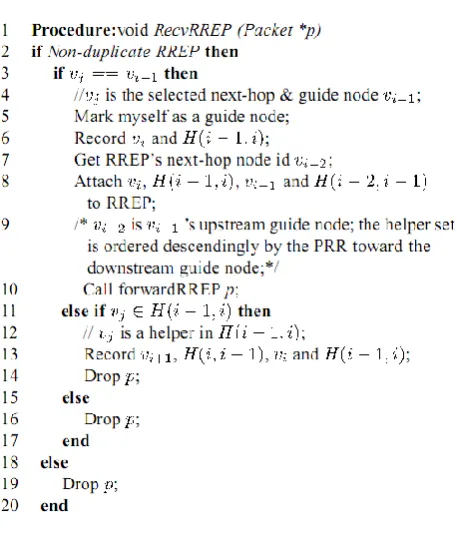
IV. PSEUDO CODE
V. SIMULATION RESULTS
The simulation analysis for R3E while the data transmission and certificate revocation based security is implemented using Network Simulator NS2
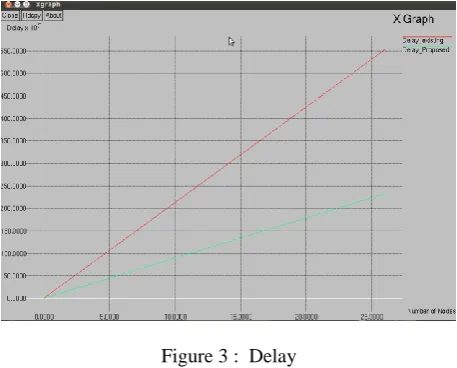
The simulation is done for Throughput , Packet delivery ratio and Delay using R3E whose results are shown in Figure 1 , 2 & 3 respectively.
ISSN(Online): 2320-9801
ISSN (Print): 2320-9798
International Journal of Innovative Research in Computer
and Communication Engineering
(An ISO 3297: 2007 Certified Organization)
Vol. 3, Issue 2, February 2015
From Figure 1 we have seen that the throughput of the proposed system is higher than the existing system.
Figure 2 : Packet delivery ratio
From Figure 2 we have seen that the packet delivery ratio of the proposed system is higher than the existing system.
Figure 3 : Delay
From Figure 1 we have seen that the delay of the proposed system is lower than the existing system.
VI. CONCLUSION AND FUTURE WORK
ISSN(Online): 2320-9801
ISSN (Print): 2320-9798
International Journal of Innovative Research in Computer
and Communication Engineering
(An ISO 3297: 2007 Certified Organization)
Vol. 3, Issue 2, February 2015
REFERENCES
1. E. Royer and C.-K. Toh, “A review of current routing protocols for ad hoc mobile wireless networks,” IEEE Pers. Communication., vol. 6, issue no. 2, pp. 46–55, 1999.
2. R. Bruno and M. Nurchis, “Survey on diversity-based routing in wireless mesh networks: Challenges and solutions,” Computer Communications., vol. 33, issue no. 3, pp. 269–282, Feb. 2010.
3. S. Katti, H. Rahul, W. Hu, D. Katabi, M. Medard, and J. Crowcroft, “XORs in the air: Practical wireless network coding,” IEEE/ACM Trans. Networks, vol. 16, issue no. 3, pp. 497–510, Jun. 2008.
4. D. B. Johnson and D. A. Maltz, “Dynamic source routing in ad hoc wireless networks,” International Journal on Mobile Computing,vol 8 issue 4, pp. 153–181, 1996.
5. V. Gungor, O. Akan, and I. Akyildiz, “A real-time and reliable transport protocol for wireless sensor and actor networks,” IEEE/ACM Transactions on Networks , vol. 16, issue no. 2, pp. 359–370, Apr. 2008.
6. K. Zeng, W. Lou, J. Yang, and D. Brown, “On geographic collaborative forwarding in wireless ad hoc and sensor networks,” ,
international Journal of Computer Networks and Wireless Communications, Vol.2, Issue 4, pp. 450-455, 2012.
7. X. Mao, S. Tang, X. Xu, Li X.-Y, and H. Ma, “Energy-efficient opportunistic routing in wireless sensor networks,” IEEE Trans. Parallel Distributed .Systems, vol. 22, issue no. 11, pp. 1934–1942, Nov. 2011.
8. AlGabri Malek, Chunlin LI, Z. Yang, Naji Hasan.A.H and X.Zhang ,“RSS-based routing protocol for industrial wireless sensor networks,” International Journal of Computer Networks , Vol.3, Issue 3, pp. 159-166, 2011.