ISSN(Online): 2320-9801
ISSN (Print): 2320-9798
I
nternational
J
ournal of
I
nnovative
R
esearch in
C
omputer
and
C
ommunication
E
ngineering
(An ISO 3297: 2007 Certified Organization) Vol. 3, Issue 6, June 2015
Clustered Information Retrieval Using
Image Query
Bandaru Venkata Hemanth Kumar
1, Ramya.G
2M.Tech(Software Technology), VIT University, Tamilnadu, Vellore, India 1
Senior Assistant Professor, VIT University, Tamilnadu, Vellore, India2
ABSTRACT: In today’s digital world the technology is updating every minute and rapidly it is giving a new way of search the things on various search engines. Because Human always wants different techniques to search this will give more accurate and efficient result. In this paper we will search the various things rather than using query, we use here an image search technique to get our desire result. In this paper we are uploading an image, which will go under various search techniques to give an acceptance result. Here the search technique will detect the edge of the image and also the color of the image, N-process and finally it will calculate the similarity of two images (one which will uploaded and another image which already in server where it will check for similarity).So the above process will be done using color coherence vector matrix
.
KEYWORDS: ccv matrix, images, color of the image, N-process
.
I. INTRODUCTION
As come to a human mentality we can remember thousand faces in life time, so in this case the searching by images has been taken over searching by query in the search engine. Whenever we searching by using keyword it will give the result based on page ranking algorithm. So this algorithm will work based on how many user has been visited the website, according to that it will produce what really the user want. So when come to image search, when we uploading the image for searching then first it will check in the server where all images are already store in the server. It will use all searching techniques and it will also check the number of visits of particular website or searching for a person has been already taken place. So if the pixel matches D<5000 then it will give the search result.
II. RELATED WORK
Histograms are usually used to comparing images in many applications. Color Coherence Vector can be computed at 5 images per second on standard work station. It is efficient to get similar images from database [6].
Image having texture, shape, color properties these are mainly used for getting correct images. These properties are sufficient to find similarity between images [1].
The pixels are used to find similarity between two images after user upload a query [7].
In today’s world search engine plays a major role. It is satisfying every client who want information from internet [5].
Web Search Engines - Scaling Up: 1994 – 2013
In 1998 – 400 billions, 2000- 600 billions, 2007 – 800 billions,
2009- 1000 billions, 2010- 1200 billions, 2011- 1400 billions, 2012- 1600 billions, 2013- 2000 billions. Not only per year the web search engines scales up day by day.
ISSN(Online): 2320-9801
ISSN (Print): 2320-9798
I
nternational
J
ournal of
I
nnovative
R
esearch in
C
omputer
and
C
ommunication
E
ngineering
(An ISO 3297: 2007 Certified Organization) Vol. 3, Issue 6, June 2015
III. APPLIED TECHNIQUES
Color Coherent Vector Matrix (CCV)
Figure 1
In this the color histograms are similar [6]The problem with this technique is sometimes it will give irrelevant data. The red appears in two images is approximately the same quantities. The left image has scattered pixels and the right image has clustered pixels Figure 1.For this x’th discretized color
ax
and the number of incoherent pixels bx. The total number of pixels with that color is (ax+bx so a color histogram would summarize an image as:
a
1
b
1
,
a
2
b
2
,
,
ax
bx
.The total color histogram in the picture is represented using (ax, bx). The ccv for the image consists of
a
1
,
b
1
,
a
2
,
b
2
,
,
ax
,
bx
.Edge Change Detection
In this process the edges of images played very effective role to get wishing content. Observe Figure 2. It will clearly explain how detection of edges works. [8]
Figure 2
N process
N-Negative, This is something new technique after the sequence of process this color detection will be useful to detect the color in the image. Based on this it will compare to the other images those are already in repository. Negative process is same like making (developing) a photo from negative.
ISSN(Online): 2320-9801
ISSN (Print): 2320-9798
I
nternational
J
ournal of
I
nnovative
R
esearch in
C
omputer
and
C
ommunication
E
ngineering
(An ISO 3297: 2007 Certified Organization) Vol. 3, Issue 6, June 2015
After developing negative
Figure 3
IV. PROPOSED ARCHITECTURE
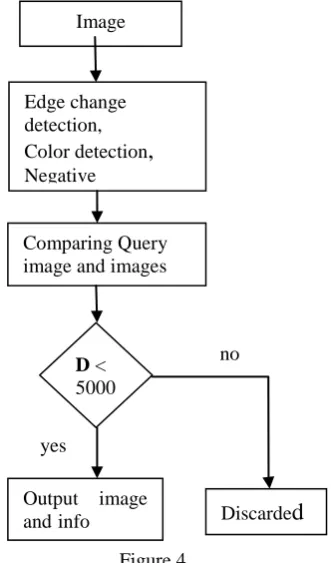
This is the process of getting clustered information. In this we have several techniques detecting edges, N-process, detecting color. In this the N-process will make less memory space in the repository for storing images.
If the similarity index between images is less than 5000 then only we will get correct information about what we uploaded.
no
yes
Figure 4
In this the D is the difference between two images in terms of similarity Negative of
the image
Compari-sion
Produce result
Repository Negative of images
Output image andinfo
Image
Edge change detection, Color detection
,
Negative
Comparing Query image and images
in repository
D < 5000
ISSN(Online): 2320-9801
ISSN (Print): 2320-9798
I
nternational
J
ournal of
I
nnovative
R
esearch in
C
omputer
and
C
ommunication
E
ngineering
(An ISO 3297: 2007 Certified Organization) Vol. 3, Issue 6, June 2015
V. CONCLUSION &EXPECTED RESULTS
In this proposed technique we have several additional techniques to get clustered information like detection, change. After this the analyzed results will be like Figure 5,6,7,8. These are the results which are unknown to the user because it will be done in background after the client query an image. Finally He/she will get coherent information about Query. In the expected results first one is uploading image with less quality, next one detecting edges, after this detection of color works an image finally the search engine reply with good quality image.
Figure 5: Query Image
Figure 6: Detecting edges
Figure 7: Detecting color
Figure 8: Result image
REFERENCES
1. W.Ran Li, Weiguang , Jianjiang Lu, Yafei Zhang, Zining Lu Technique of Large scale Image Set Construction Based on Web Image Searching Engine 2009 Eigth IEEE/ACIS International Conference on Computer and Information Science.
2. AmsaLakshmi,P.Solainayagi,J.Sivamurugan Retrieval of exact images from a bundle of images in the web for an object class” IEEE-International Conference On Advances In Engineering, Science And Management March.
3. Google http://www.google.com/
4. Rishi Mukhpadhya, Aiyesha, and Ishwer K.Sethi,"Pathfinder Networks for Content Based Image Retrieval Based on Automated Shape Feature
5. Enhancing Search Engine Performance Using Expert Systems Stan Lovic1, Meiliu Lu2, and Du Zhang2 1Intel Corp., 1900 Prairie City Road, Folsom, [email protected] 2Computer Science Department, California State University, Sacramento, CA 95819{mei, zhangd}@ecs.csus.edu
6. Comparing Images Using Color Coherence Vectors Greg Pass Ramin Zabih_ Justin Miller Computer Science Department Cornell University Ithaca,gregpass http://www.c.cornell.edu/home/rdz/ccv/html
7. Rishi Mukhopadhya, Aiyesha , and Ishwer K.Sethi,"Pathfinder Networks for Content Based Image Retrieval Based on Automated Shape Feature discovery."
ISSN(Online): 2320-9801
ISSN (Print): 2320-9798
I
nternational
J
ournal of
I
nnovative
R
esearch in
C
omputer
and
C
ommunication
E
ngineering
(An ISO 3297: 2007 Certified Organization) Vol. 3, Issue 6, June 2015
BIOGRAPHY
B.V.HEMANTH KUMAR received the B.Tech degree in Computer Science Engineering from the Sree Vidyanikethan Engineering College, Tirupati, Andhra Pradesh, in 2014. Currently doing the M.Tech in Software Technology from the Vellore Institute of Technology University, Vellore, and Tamilnadu. Operating Systems, Database Management System are areas of interest.
G.RAMYA, working as a senior assistant professor in VIT University. She has more than 6 years of teaching experience. She received B.Tech(IT) degree in anna university and M.Tech(IT) in VIT university. Also she has published her articles in 13+ international journals and published papers in national and international conferences. She is a life time member CSI. Formal languages and automata, open source programming, network security are area of interest.
![Figure 1 In this the color histograms are similar [6]The problem with this technique is sometimes it will give irrelevant data](https://thumb-us.123doks.com/thumbv2/123dok_us/1484496.1181615/2.595.171.392.512.624/figure-color-histograms-similar-problem-technique-irrelevant-data.webp)