Aadhar Enabled Electronic Voting Machine
P.V.V.N.D.P.Sunil1, K.Naga Jyothi2, K.Charitha3, K.Supriya4, Md. Rafeekh Basha5
Assistant Professor, Department of ECE, D.M.S.S.V.H College of Engineering, Machilipatnam, India 1 IV B.Tech, Department of ECE, D.M.S.S.V.H College of Engineering, Machilipatnam, India2345
ABSTRACT:This project is designed for integrating Electronic Voting Machine (EVM) with the data of the voter as in
the Aadhar. Using the Aadhar Number and its unique bio-metric identification system to prevent and alert the authorities against fake voting and voting on behalf of absent voters during election and prevent rigging during election. Electronic voting mean for (e-voting) and it casting votes and counting votes electronically. Electronic voting systems have much more advantages compared to other voting techniques. An electronic voting technology can speed the counting of ballots and can provide improved accessibility for voters.
KEYWORDS: Aadhar, Bio-metric Identification System, e-voting, EVM.
I. INTRODUCTION
In every country Election is a basic process of democracy which allows people to show their opinions by selecting their candidate. India is spending huge money to improve our whole voting system to provide a better government to citizens. In India, voting system should be honest, translucent and fully secure for the better democracy. The current system is used to less transparency because there could be chances of cheating at the voting time. Authentication of Voters, Security of the voting process, protecting voted data these are the main challenges of current Election voting. That’s why it is necessary to generate a secure election voting system.
In this paper, we have proposed an election voting system which is based on the fingerprint of voter which is saved as Aadhar card number in a central government database. In the Aadhar’s centralized database, the government collects biometric and demographic data of citizens and provides a 12-digit unique identity number to individual. Fingerprint biometric provide secure authentication because fingerprint is unique to each individual.
In the old system of voting, votes are cast by ballot paper. After entering the polling station, the officer checks identity proof (election ID card) of voters and allocated a ballot paper to a voter. The voter votes by marking the ballot paper with candidates name and symbol by rubber stamp, inside a voting compartment in the polling station. Then voter folds the ballot paper and inserts it in a ballot box. This is a long, time-consuming process and very much prone to errors. This situation continued till election scene was completely changed by EVM. No more ballot paper, ballot boxes, stamping, etc. all this condensed into a simple box called ballot unit of the EVM.
II. LITERATURESURVEY
1. Ashok Kumar D., Ummal Sariba Begum T., [2] Electronic Voting System that will automatically perform authentication validation and counting with the help of UIDAI. The proposed electronic voting system can be implemented along with the traditional election system. The proposed an approach that will use the information provided by UIDAI in electronic voting system. A Project Director at Contain Southampton, United Kingdom. His generation on Biometric technology such as finger print. The fingerprints are more secured technology. Those are use in smart e-voting to secure e voting process. Fingerprint are use to match the voter data otherwise voter cannot vote. The finger print technologies are using Chris Roberts in voting system.
2. Benjamin B., Bederson, Bongshin Lee., Robert M. Sherman., Paul S., Herrnson, Richard G. Niemi.,[3] The information provided by UIDAI in smart voting system. The proposed system procedure is carried out in mainly few stages: registration, verification and validation. These stages of proposed system are illustrated. the smart e voting system has been done on fingerprints in humans .There are two fundamentally main goal that have risen from voting process (1) A persons fingerprint will not change the structure naturally after about one year after birth and (2) Fingerprints of individuals are different. Even the twins in fingerprints are not the same. In practice two humans with the same fingerprint have never been found. Electronic Voting Machine was introduced to replace Ballet boxes from 1998 in India.
The voting machines used in India are a combination of two components namely the Balloting unit and Control unit. Balloting unit on which the voters press the button. Control unit gives the polling officer stationed at the poll booth to supervise the process. An EVM runs on 6v batteries and removes the requirement of an external power source. It is designed to record 64 candidate names and 3,840 votes at the max. The 64 candidate names can besplit across 4 units connected in parallel, with 16 names on each of the unit. The first ever vote in record took place in Rome in 139BC and used simple hand written paper ballots. This system was further modernized and the existing system was first used in Australia in1858. The system incorporated the use of a set of ballots that were provided by the government. The ballots contained the list of candidates and voters showed their preference by placing a mark on the provided area using pens, stamps and other specified markers. The voter received privacy to place their votes after which the paper ballot was returned andkept in safeguard until the time of tally. The tally is obtained from an accurate count, or soit is supposed to be. This system is still widely used today around the world; however the threats posed by the paper ballot system have been quite evident in many accounts. The most evident of the issue was the controlling of the count of votes. On many occasions ballot papers are found to have unclear markings that make it hard to distinguish the choice of the voter. These give a wide range chance of the rigging of votes. The party in power may deliberately chose counting teams so as to modify the outcome through the use of such circumstances. The 1910 Encyclopedia Britannica states in its information of voting machines that; up to forty percent of votes were commonly nullified in the process of tallying. Perhaps with the statistics in hand most electronic voting machines suggested have completely eradicated the use of paper ballots. However, as an age old method, it is one that voters can physically see and feel assured 13 that they have actually indeed cast their vote.
ballots we plan on using digital buttons systems. The advantage being that pressing on the button means a vote has been casted and no chance is left to human error. As suggested by research, an election system should be able to withstand fraudulent behaviours . This includes the familiar issue of multiple votes cast by a single voter. When a voter is admitted into the system to cast their vote, it is essential that they are properly identified and allowed to vote only once.
Keeping this in mind, the paper suggests the use of Near Field 14 Communication (NFC) cards as each voter’s identification tag. NFC technology allows for communication between the users ID card and the device in a very fast and uncomplicated manner and increases the usability . However, only NFC cards as the main entry system of a voting machine can make it susceptible to attacks . Furthermore, using only an ID card opens the opportunity for a voter to use different voter ID cards to cast multiple votes. To overcome these complications and to reinforce the checking procedure, the paper suggests the use of fingerprint identification using reliable biometric technologies. Use of biometrics in voting systems has been an acclaimed one as fingerprints are unique to individuals. The system suggested uses the fingerprint of the voter to compare to a predetermined data base where the information on the voters NFC ID card must match to their corresponding fingerprint. After the verification and matching of the two data, the voter is allowed to proceed to voting. With the automation and use of two layers of identification systems, the procedure removes the chance of any fraudulent entrants. Many electronic voting systems that have been proposed before contain the use of online networking, and the risk of tampering of information through hacking posed a great threat . The machine presented eliminates the use of a live network altogether, thus causing the vote casted to be safe from any tampering. Through the integration of these features and the multiple checking mechanism of using NFC cards and biometric fingerprint identifier, a more secure and prompt method of the traditional voting system can be developed which complies with the expectations mentioned in.
III.PROPOSEDMETHOD
In our paper we are adding a new feature to the existing voting method called Aadhar Authentication.In order to overcome the drawbacks of the present voting method like mal votes, time consumption, more economical, huge man power we proposed this system and this is fully automated contrast to the present voting system where the ballot unit is controlled by the polling officer. Another important feature in this proposed method is that it keeps the voter information more secured.
Figure(1) shows the architecture of the proposed method
(1)
ALGORITHM OF PROPOSED METHOD
StepA : Every citizen should update his/her AADHAR three months before the elections.
Step B : On the day of polling ,every voter should attend at his/her corresponding polling booth with the Aadhar card.
StepC : Without meeting third party the voter directly meets the polling officer.
Step D : After the entry of number ,if it is valid the system displays the photo and details of corresponding voter asks for the fingerprint.
StepE : If the authentication is done successfully, then the ballot unit will be turned on automatically. StepF : The voter cast his/her vote by pressing the buttons on the ballot unit.
StepG : LED and buzzer will be turned on and on the LCD of the ballot unit, the party to which the voter casted his/her vote.
StepH : On the day of counting, results will be displayed by pressing the result button.
CASES IN PROPOSED METHOD
Figure(2) shows the cases in the proposed method.
(2)
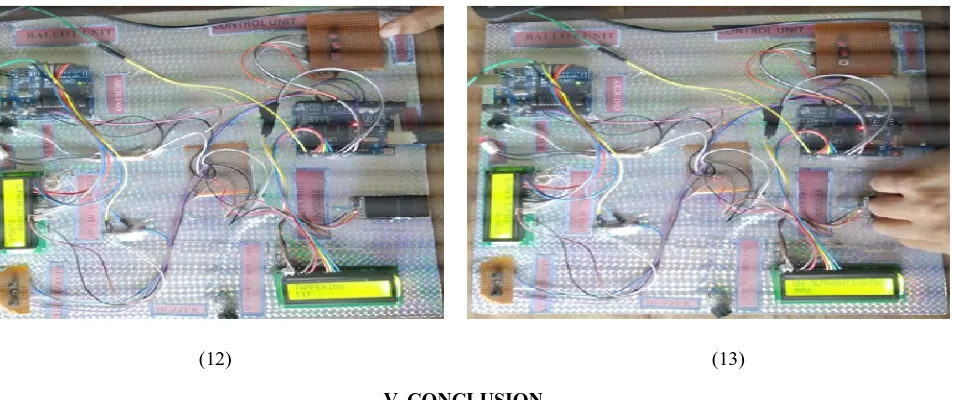
CASE 1 : If the person who had already casted his/her vote, tries to vote for the second time, as soon as the entry of the corresponding person Aadhar number, the system display the word tampering and a buzzer will be turned on automatic-ally.
IV. EXPERIMENTALRESULTS
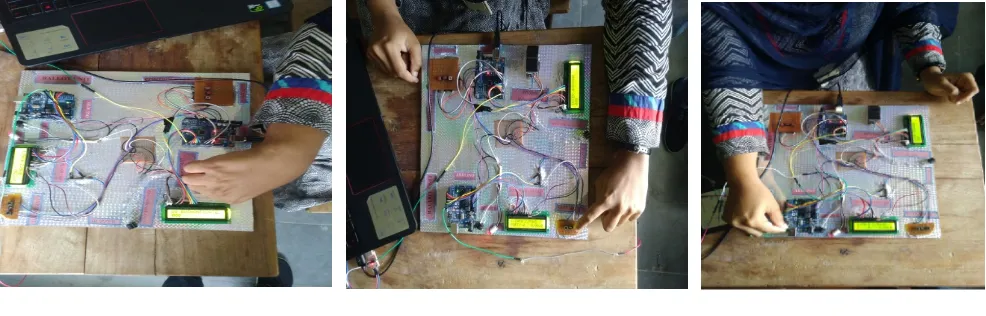
Figure (3) shows the overview of the project (4) shows the control unit (5) shows the ballot unit.
V.
(3) (4) (5)
Figure(6) shows the entry of the Aadhar number (7) shows the photo and details of the voter (8) shows activation of the fingerprint module.
(6) (7) (8)
Figure (9) shows the authentication of the fingerprint (10) shows the casting of vote (11) shows the pressing the result button in order to display the results.
Figure (12) shows the tampering case (13) shows the unauthenticated case.
(12) (13)
V.CONCLUSION
This paper suggest that the EVM system has to be further studied and innovated to reach all the levels of community, so that the voter’s trust o the election process will increase and election officials will make more involvement in purchasing the innovated EVM’s for conduct efficient, secure, corruption free Elections . Further innovations can be made so that the voter can vote wherever they are during the election, getting to choose the candidate competing in their home constituency without the necessity of travel. The described model consisting of fingerprint sensor can also be modified to be used with Retina scanner which provides even more secure and technologically advanced solution to fake voting and impersonation. This concludes that the Aadhar based EVM will useful to avoid rigging in election by impersonation, to avoid time consumption and all the while keep the voter’s information more secured. The conventional paper ballot method also consumes lot of man power and security issues to the Electoral Commission which can by reduced by this system.
VI.FUTURESCOPE
This system can be used for elections since it provide complete security and will provide accurate results,save time and expenditure.This can be modify by interfacing it with a PC through a serial port in order to provide additional security.This system requires good bandwidth and high speed internet connection for operating,but it is still a distant reality in many cities in India.However conditions are improving with the onset off education in rural areas and with increasing urban population this project may soon become a reality.
REFERENCES
[1]. D. L. Chaum, “Untraceable Electronic Mail, Return Addresses, and Digital Pseudonyms,” Communications of the ACM, Vol.24, No.2, pp.84-88, 1981.
[2].Ashok Kumar D., Ummal Sariba Begum T., “A Novel design of Electronic Voting System UsingFingerprint”,International Journal of Innovative Technology & Creative Engineering (ISSN:2045-8711),Vol.1,No.1. pp: 12-19,January 2011.
[3]Benjamin B., Bederson, Bongshin Lee., Robert M. Sherman., Paul S., Herrnson, Richard G. Niemi., “ElectronicVoting System Usability Issues”, In Proceedings of the SIGCHI conference on Human factors in computing systems,pp.145-152, 2003.
[4]Vishal Vilas Natu “Smart-Voting using Biometric“International Journal of Emerging Technology and Advanced Engineering”, Volume 4,Issue 6, June 2014. [5]KashifHussainMemon, Dileep Kumar and Syed Muhammad Usman,Next Generation” A Secure E-Voting System Based On Biometric Fingerprint Method” 2011 International Conference On Information And Intelligent Computing IPCSIT ,Vol.18,No.9 ,2011.