http://dx.doi.org/10.4236/wjet.2014.22017
Eigenstructure Assignment Method and Its
Applications to the Constrained Problem
H. Maarouf, A. Baddou1Mathematics and Computer Sciences Department Sidi Bouzid, Safi, Morocco 2Ibn Zohr University, National School of Applied Sciences (ENSA), Agadir, Morocco
Email: [email protected], [email protected]
Received 13 April 2014; revised 17 May 2014; accepted 25 May 2014
Copyright © 2014 by authors and Scientific Research Publishing Inc.
This work is licensed under the Creative Commons Attribution International License (CC BY). http://creativecommons.org/licenses/by/4.0/
Abstract
A partial eigenstructure assignment method that keeps the open-loop stable eigenvalues and the corresponding eigenspace unchanged is presented. This method generalizes a large class of sys-tems previous methods and can be applied to solve the constrained control problem for linear in-variant continuous-time systems. Besides, it can be also applied to make a total eigenstructure as-signment. Indeed, the problem of finding a stabilizing regulator matrix gain taking into account the asymmetrical control constraints is transformed to a Sylvester equation resolution. Examples are given to illustrate the obtained results.
Keywords
Sylvester Equation, Linear Continuous-Time Systems, Constrained Control
1. Introduction
Eigenstructure assignment method plays a capital role in control theory of linear systems. The state feedback control law is used in this end, leading to change eigenvalues or eigenvectors of the open loop to desired ones in the closed loop. This method is usually realized in order to perform optimal or stabilizing control laws ([1]-[9]). These articles and the references therein constitute a comprehensive summary and an important bibliography on the control of linear systems with input saturation. Indeed, authors have used different concepts leading to many methods for eigenstructure assignment control laws to regulate linear systems with input saturation.
Throughout this paper, we will be interested in continuous time systems of the form
( )
( )
( )
.represents the state vector of the system and u t
( )
∈m is the control vector. We suppose that the spectrum of the matrix A contains n−m desirable or stable eigenvalues λm+1,,λn and m undesirable or unstable eig-envalues λ1,,λm. We also suppose that the pair
(
A B,)
is stabilizable.Presence of undesirable eigenvalues makes System (1) unstable and, in [4] or in [10], methods to overcome the instability of System (1), keeping unchanged the open-loop stable eigenvalues and the corresponding eigen- space s and replacing the remaining undesirable eigenvalues by other chosen values, were given. But, in
these methods, additional conditions on System (1) should be satisfied.
In this paper, we try to get rid of these additional conditions on System (1). First, we should give some out- lines on the methods described in [4] or in [10]. In [4], the method, called the inverse procedure, consists of gi- ving a matrix H∈m m× with some desirable or stable spectrum and then computing, when possible, a full rank feedback matrix F∈m n× such that:
(
)
.F A+BF =HF (2) and the kernel of F is the stable subspace. In this case, the spectrum of the matrix A+BF is stable since it is constituted by the desirable eigenvalues of A and the chosen spectrum of H. In other words, the eigenvalues of H
will replace, in the closed-loop, the undesirable eigenvalues of A. With the change of variables z t
( )
=Fx t( )
in the initial system, we get( )
( )
z t =Hz t (3) which allows one to focus on the unstable part of this system.
The inverse procedure described in [4] ensures the existence of a matrix F that satisfies the conditions men- tioned above and gives a way to compute it under the following conditions:
(a)The matrix H is diagonalizable; that is, there exist linearly independent eigenvectors θ1,,θm of H associ-
ated to some stable eigenvalues µ1,,µm.
(b)The endomorphism induced by the matrix A on the stable subspace is diagonalizable; that is, there exist li- nearly independent eigenvectors ξm+1,,ξn of A in the subspace s.
(c)The spectrum of A and the spectrum of H are disjoint. (d)The matrix
(
)
1(
)
11 n 1, , m n m, m1, , n
M = µ −A − Bθ µ −A − Bθ ξ + ξ
is invertible.
Under these conditions and according to the method described in [4], the matrix F is unique and is given by
[
]
11, , m, 0m1, , 0n
F= θ θ + M− (4)
where 0i is the null vector of n
.
In [10], the condition b) is kept and a new assumption should be fulfilled: (d’). the matrix N =
[
B,ξm+1,,ξn]
is invertible.The method described in [10] consists of computing a matrix V such that its rows span the orthogonal of the stable subspace by taking, for example the first m rows of N−1 and then, for a stable matrix H∈m m× . Then, according to the method described in [10], the feedback matrix F is given by F=KV where K is the inverse matrix of the solution of the Sylvester equation
,
X XH VB
Λ − = − (5) and Λ ∈m m× is a matrix such that VA= ΛV .
In this paper, we generalize the method described in [10] to a more general class of systems for which the condition d’) is not necessary. In fact, no additional condition is needed to deal with System (1). As in [10], the feedback matrix F is always given by KV where K is an invertible matrix of m m× such that X =K−1 is the solution of the Sylvester Equation (5).
with the method described in [10] since, under the condition 1, the matrix B is of full rank.
So, from one hand, the method that we present constitutes a generalization of the two methods described in
[10] or in [4] without any other additional condition on the systems and, from another hand, allows one to make, if necessary, a total pole placement by the use of the augmentation technique.
The paper is organized as follows: In Section 1, definitions, notations and some known facts are presented to be used in the sequel. The main results are presented in Section 2 together with an illustrative example. Some particular cases are presented in Section 3. Section 4 is devoted to the total eigenstructure problem with the il- lustrative example of the double integrator.
2. Preliminaries
2.1. Notations and Definitions
• p is the identity matrix of p p× for p∈*
.
• Matrices of the form λp are called scalar matrices for λ∈ and * p∈ .
• If M is a p q× real matrix, for some p q, ∈*
, its transpose, the q×p real matrix, will be denoted by
T M .
• When we view n as an euclidean space, the usual inner product
( )
⋅ ⋅ is considered, that is,( )
1,
n i i i
x y x y
=
=
∑
where x=
(
x1 xn)
T and(
)
T1 n
y= y y are two vectors of n.
• If S is a nonempty subset of n, its orthogonal will be denoted by S⊥, that is,
( )
{
n 0 for all}
.S⊥ = x∈ x y = y∈S
• For a real number x, we define
( )
(
)
if 0 if 0
max , 0 and max , 0 .
0 otherwise 0 otherwise
x x x x
x+ = ≥ = x x−=− ≤ = −x
• If M is a p q× real matrix, for some p q, ∈*
, Mi j, will denote the coefficient of M corresponding
to the
( )
i j, row-column.• If M is a p q× real matrix, for some p∈*
, Mc is the 2p×2p real matrix defined by
1 2
2 1
,
c
M M M
M M
=
where
[ ]
1 , , ,if , if ,
i i i j
i j
M i j
M
M+ i j =
=
≠
and
[ ]
2 , ,0 if ,
if .
i j i j
i j M
M− i j =
= ≠
• For real matrices (or real vectors) M and N, we say that M is less than or equal to N if every com- ponent of M is less than or equal to the corresponding component of N. We then write M ≤N.
• If M is a p q× real matrix, for some p q, ∈*,
(a) kerM is the kernel of M : the subspace of q of vectors X such that MX =0.
(b) Im M is the image of M: the subspace of p spanned by the columns of M and also the set of vectors of the form MX with X∈q.
• If M is a p×p real matrix, for some p∈*, σ
( )
M denotes its spectrum in the field of complex numbers .• If λ is a complex number then Re
( )
λ is the real part of λ.2.2. Some Notes on the Stable-Unstable Subspaces
1. To System (1), we associate: (a) The two polynomials
( ) (
1) (
m)
( ) (
m1) (
n)
Q x = x−λ + x−λ
that are factors of the characteristic polynomial of A.
In case of m=n, polynomial Q is just the constant polynomial 1. (b) The two subspaces of n; u=kerP A
( )
and s=kerQ A( )
.In case of m=n, the subspace s is just the trivial subspace kern=
{ }
0 . Remark 11. Since P and Q are coprime, u and s are complementary subspaces of n
. Moreover, we have
( )
( )
Im and Im
s = P A u = Q A
and also
( )
T( )
T( )
T( )
TIm ker and Im ker .
s Q A P A u P A Q A
⊥ = = ⊥ = =
2. Since pair
(
A B,)
is stabilizable, we have( )
1
0
Im .
n
k u
k
A B
−
=
⊂
∑
2.3. Some Notes on Sylvester Equation
Many problems in analysis and control theory can be solved using the well known of Sylvester equation. This equation is widely studied or used in the literature ([10]-[15]). Since Sylvester equation plays a central role in the development of this work, we shall recall conditions under which it has a unique solution. A Sylvester equ- ation is any equation of the form
MX−XN=C (6) where M is a p×p real or complex matrix, N is a q q× real or complex matrix and C is a p q× real or complex matrix while matrix X stands for an unknown p q× real or complex matrix. The following well known result gives a sufficient condition for the existence and uniqueness of a solution of Sylvester Equation (6).
Theorem 1
If spectrums of matrices M and N are disjoint, σ
( )
M σ( )
N = ∅, then Sylvester Equation (6) has a unique solution.2.4. System (1) with Constraints on the Control
Consider System (1) with the assumption that the control u is constrained to be in the region D of m defined by
{
min max}
m
D= u∈ −u ≤ ≤u u
where umin and umax are positive vectors in
m
. Note that the region D is a non symmetrical polyhedral set as is generally the case in practical situations. Let us first consider the unconstrained case where the regulator problem for System (1) consists in realizing a feedback law as
,
u=Fx (7) where F is chosen in m n× with full rank m. In this case, System (1) becomes
(
)
.x= A+BF x (8) The stability of the closed loop System (8) is obtained if, and only if,
( )
(
, min, max)
{
min max}
. nD F V V = x∈ −u ≤Fx≤u (10) Note that the domain D F u
(
, min,umax)
is bounded only in case of m=n. In fact, when m<n, the sub- space kerF has dimension n− >m 0 and is a subset of this domain. Suppose now that there is a matrixm m
H∈ × such that
(
)
.F A+BF =HF (11) Hence, by letting z=Fx, we get
z=Hz (12) and then z t
( )
=exp( ) ( )
tH z 0 . We would get z t( )
∈D for all t≥0 whenever z( )
0 ∈D. We say that D is positively invariant with respect to the motion of System (12). More generally, we give the following definition of positive invariance.Definition 1
A nonempty subset P of m is said to be positively invariant with respect to the motion of System (12) if,
for every initial state z
( )
0 in P , the motion z t( )
remains in P for every t≥0.The following theorem gives necessary and sufficient conditions for domain D to be positively invariant with respect to the motion of System (12).
Theorem 2 ([6])
The domain D is positively invariant with respect to the motion of System (12) if, and only if,
0
c
H U ≤ (13) where 2m
U∈ is the real vector max
min
.
u U
u
=
Till now, we have supposed the existence of a matrix H that satisfies Equation (11). The following result, which does not take into account the constrained problem, gives necessary and sufficient conditions for its exis- tence.
Theorem 3 ([4])
F
ker is positively invariant with respect to the motion of System (12) if, and only if, there is a matrix
m m
H∈ × such that Equation (11) is satisfied.
Note that kerF is positively invariant with respect to the motion of System (12) is the same as kerF is stable by matrix A. If the constrained problem is taken into account, the following theorem gives necessary and sufficient conditions for positive invariance of the domain of states D F u
(
, min,umax)
.Theorem 4 ([6])
The domain D F u
(
, min,umax)
is positively invariant with respect to System (8) if, and only if, there is a matrix H∈m m× such that Equation (11) is satisfied and0.
c H U ≤
3. Main Results
At first, we compute, and fix in the sequel, some matrix V∈m n× such that its rows span the subspace s ⊥ . Since the dimension of the subspace s
⊥
is m, the matrix V is of full rank m.
Proposition 1 There is a unique matrix Λ ∈m m× such that VA= ΛV . This matrix is given by
( )
1T T
VAV VV −
Λ = (14)
and its spectrum is
{
λ1,,λm}
. Proof.Let f be the endomorphism of n canonically associated to matrix AT, that is,
T
:
.
n n
f
x A x
→
the endomorphism g induced by f on s ⊥
. Matrix VT, when identified with its column vectors, can be seen as a basis of s
⊥
. In this basis, if we denote by L the matrix of g, we will have
T T T
.
A V =V L (15) Let now Λ =LT. By transposition of formula (15), we get VA= ΛV . Since g is induced by f on
( )
Tker
s P A
⊥=
, its spectrum is
{
λ1,,λm}
which is also the spectrum of Λ. Formula (14) derives from the fact that V is of full rank m and shows the uniqueness of the matrix Λ. Proposition 2
For any matrix F∈m×n such that kerF=s , there is an invertible matrix
m m
K∈ × such that KV
F = and F is of full rank m.
Proof.
Let F∈m n× such that kerF=s. Since dimension of s is n − m, rank formula shows that F is of full
rank m. Let now U∈m such that FV UT =0. Then, T ker s
V U∈ F= and then VV UT =0. But matrix
T
VV is invertible, so U = 0 and this shows that matrix FV T is invertible. Clearly, K=FVT
( )
VVT −1 is in- vertible. For x∈n, we have( )
1( )
1T T T T
x=V VV − Vx+ −x V VV − Vx
Since V x V
(
− T( )
VVT −1Vx)
=0, we have x V− T( )
VVT −1Vx∈kerV =kerFand then
( )
1T T
Fx=FV VV − Vx. So
( )
1( )
1( )
1T T T T T T
. KVx=FV VV − VV VV − Vx=FV VV − Vx=Fx
Since this equality holds for all x∈n, we have KV =F. Theorem 5 Let S=
{
µ1,,µm}
be a set of complex numbers stable under complex conjugation such that{
1, , m}
S λ λ = ∅ and H∈m m× with spectrum S. Then, there is matrix F∈m n× of full rank m such that F A
(
+BF)
=HF and kerF=s if, and only if, Sylvester equationX XH VB
Λ − = − (16) has a unique invertible solution X such that F X 1V
= − . Proof.
The if part: Let F∈m n× be of full rank matrix such that F A
(
+BF)
=HF and kerF=s. FromProp-osition 2, there is an invertible matrix K∈m m× such that F = KV. Since VA = ΛV , we get
(
)
(
)
( )
(
)
( )
1 1 1 1
1
1 T T 1
1
1 T T 1
0.
K K H VB K K HK KVBK K
K K V HKV KVBKV V VV K
K KA HF FBF V VV K
− − − −
−
− −
−
− −
Λ − + = Λ − +
= Λ − +
= − +
=
Then X =K−1 is an invertible solution to Sylvester Equation (16).
The only if part: Suppose now that Sylvester Equation (16) has an invertible solution X and let K= X−1. Matrix F = KV satisfies kerF=kerV =s because matrix K is invertible and then is of full rank m. We also
have
(
)
(
)
(
)
(
)
(
1 1)
0.
F A BF HF KV A BKV HKV
K VA VBKV HKV
K V VBKV HKV
K K− VB K H KV−
+ − = + −
= + −
= Λ + −
= Λ + −
=
Remark 2
Because we are focusing on the partial assignment problem, eigenvalues of matrix H should be desirable, that is, matrix H should be Hurwitz. The undesirable eigenvalues λ1,,λm of A must all be different from those of
H. So, assumption
{
λ1,,λm}
S= ∅ in Theorem 5 above is necessary.Example 1 Consider the linear time-invariant multivariable system described by
x=Ax+Bu
with
0 1 7 1 2
1
0 1 6 and 3 0 .
3
4 4 4 1 1
A B
− −
= − =
− −
The control vector is submitted to the constraint u∈Ω such that,
2
min max
1.5 2
.
2 2.5
u u U u
−
Ω = ∈ − = ≤ ≤ =
−
/
Eigenvalues of A are λ1=λ2 =2 and λ = −3 1 and pair
(
A B,)
is stabilizable. We get first the matrix3 3 3 5 5 4
V =
Note that the rows of V are orthogonal to the eigenvector of A associated to the stable eigenvalue λ3 of A.
We, then, choose the matrix
1 1
3 1
0.50000000 0.13397460
2 2 .
1 3 1.8660254 1.5000000
3 1
2 2
H
− −
− −
= ≈
−
+ −
This matrix is not diagonalizable and its eigenvalues are µ1=µ2= − =1
(
λ3)
. Besides, inequality (13) issatisfied. We use the formula Λ =VAVT
( )
VVT −1 to get1 3 . 3 5
−
Λ = −
Then, we solve the equation (15) and use the inverse of its solution to get the feedback matrix
1
5 5
1 6 3 1 6 3 1 3 2 9 3
18 18
11 5 11 5
3 3 5 3 2 9 3
6 18 6 18
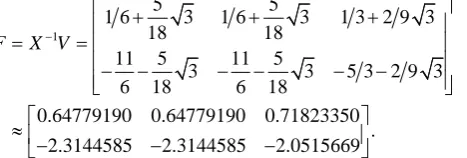
0.64779190 0.64779190 0.71823350 . 2.3144585 2.3144585 2.0515669
F X V−
+ + +
= =
− − − − − −
≈ − − −
[image:7.595.201.435.513.592.2]Finally, −1 is the unique eigenvalue of the matrix A+BF.
Figure 1 shows that, starting from two different and admissible controls, the corresponding trajectories, in the control space, converge to the origin without saturations.
3. Particular Cases
3.1. Case of Single Input Linear Systems
We discuss the particular case of single input linear systems, that is, when m=1. As described in the general case, we start by computing matrix V which is in case of m=1 a row vector that is orthogonal to s and is
Figure 1. Trajectories of the system u t
( )
=Hu t( )
from two dif- ferent initial controls in Ω.negative real number, Theorem 5 ensures that all matrices F (row vectors) are of the form KV where K−1 is a nonzero real solution to the simple “Sylvester equation”
(
)
1x xH VB x 1 H .
λ − = − = λ −
This equation has a nonzero solution if, and only if, the real number VB is nonzero. That is,
1
. VB x
H λ
=
− (17)
Formula VA=λ1V shows that V is a left eigenvector of A associated to the undesirable eigenvalue λ1
and then 1
k k
VA B=λ VB for every k∈. But pair
(
A B,)
is stabilizable, so(
)
1( )
1
1
ker Im .
n k
u n
k
A λ A B
−
=
= − ⊂
∑
If we suppose that VB=0, then we should have
(
)
{ }
1
1 1
Im 0
n k u
k
V λ VB
−
=
⊂
∑
=
and then Vu =
{ }
0 . We also have Vs ={ }
0 and nu s
= ⊕
. This shows that V =0 which is not true. As a consequence, we have the following result.
Proposition 3 For a given left eigenvector V of A associated to the unique eigenvalue λ1 and for a ne- gative real number h, we have VB≠0 and matrix F given by
1 . h
F V
VB λ −
= (18)
The spectrum of A+BF is then
{
h,λ2,,λn}
.3.2. Case Where the Matrix VB Is Nonsingular
We have seen in the last paragraph that, when m=1, a necessary and sufficient condition for Sylvester Equ- ation (15) to have nonsingular solution (nonzero real number in fact) is that the real VB is nonzero. We also have seen that this last condition; VB≠0, is equivalent to the fact that pair
(
A B,)
is stabilizable. In case of2
m≥ , it may happen that pair
(
A B,)
is stabilizable but matrix VB is singular as will show the following example.Consider System (1) with
4 0 1 1 1
4 1 5 and 4 1 .
4 0 0 1 1
A B
−
= − − = − −
− −
Eigenvalues of A are λ1 =λ2 =2 and λ = −3 1. The last desirable eigenvalue λ3 is associated to the ei- genvector
[
0 1 0]
T of A that spans the subspace s. Matrix V is then1 0 1 . 1 0 2
V =
Matrix VB is singular since it is
0 0
.
1 1
VB=
− −
Controllability matrix is given by
2
1 1 5 5 16 16
, , 4 1 13 10 13 10
1 1 4 4 20 20
B AB A B
= − − − −
− −
and is of full rank 3. This shows that pair
(
A B,)
is stabilizable since it is even controllable.The case of matrix VB is nonsingular can be seen as a general case of VB≠0 when m=1. So, it deserves a special study that will be the aim in the sequel of this paragraph. In the following theorem, we give a necessary and sufficient condition for matrix VB to be nonsingular.
Theorem 6
Matrix VB is nonsingular if, and only if, Im(B and ) s are complementary subspaces of n
; that is,
( )
Im
n
s
B
= ⊕
.
Proof.
The if part: Since VB is nonsingular, matrix B is of full rank m. To complete the proof of the if part, we shall show that
{ }
0 =Im( )
B s since the dimension of the subspace s is n − m. Recall that VX = 0 for anyvec-tor X in s. If now X is both in s and Im(B), then there is m
U∈ such that X = BU and then
0=VX =VBU.
This shows that U = 0 since VB is nonsingular and, then, X = 0.
The only if part: From the fact that VX = 0 for any vector X in s; that is Vs =
{ }
0 , V is of full rank m; thatis n m
V = . Moreover, from the fact that n=Im
( )
B ⊕s, we get( )
( )
Im Im
m n
s
V V B V VB
= = + =
since V is linear. This shows that the rank of VB is m and that it is nonsingular. The following theorem gives another method to get a partial pole assignment under the assumption that VB
is nonsingular. Theorem 7
Suppose that matrix VB is nonsingular and let matrix L∈m m× be such that
( ) {
L 1, , m}
σ = µ µ , σ
( ) {
L λ1,,λm}
= ∅ and L− Λ is nonsingular. Then,(
A BF) {
1, , m, m 1, , n}
σ + = µ µ λ + λ
where F =
( ) (
VB −1 L− Λ)
V. Proof.Let K=
( ) (
VB −1 L− Λ)
and H=KLK−1. Then,(
)
(
)(
)
1 1 1 1
1
.
K K H K HK K
L L VB
VB
− − − −
−
Λ − = Λ −
= Λ − − Λ
This shows that K−1=
(
L− Λ)
−1VBis a nonsingular solution to Sylvester Equation (16) and, by Theorem 5, that matrix F =
( ) (
VB −1 L− Λ)
V satisfies(
A BF) {
1, , m, m1, , n}
.σ + = µ µ λ + λ Example 3
Consider System (1) with
4 9 9 3 2
3 14 15 and 0 2 .
1 6 7 1 1
A B
− − −
= = −
− − −
Eigenvalues of A are λ1 =λ2 =2 and λ = −3 1. The last desirable eigenvalue λ3 is associated to the
eigenvector
[
0 −1 1]
T of A that spans the subspace s. Matrix V is then1 1 1 . 0 1 1
V=
Matrix 2 1
1 1
VB=
− −
is nonsingular and matrix Λ is given by
( )
1T T 0 1
. 4 4
VAV VV − −
Λ = =
Now choose µ1=µ2= −2 that are the eigenvalues of the matrix
6 4
4 2
H= − − . Then,
( ) (
1)
2
6 11 11
2 .
10 21 21
F= VB − − − Λ V = − − −
4. A Total Eigenstructure Problem
Note that, when m and n are equal, matrix V described in the last section is now any invertible matrix of n n× . That is why, we suppose V =n. Then matrix Λ is simply A and Sylvester Equation (15) becomes
AX−XH = −B (19) where H is a real n n× matrix with desirable spectrum. So, if the unique solution X of Equation (20) is invertible, then the spectrum of A+BF and the one of H are equal, where matrix F is X−1. Suppose now that
m<n. The technique of augmentation (see [5] and [6]) consists of augmenting the matrix B by adding zeros in order to get a new matrix 1
n n
B ∈× . One should also complete the control vector u by fictive real numbers to get 1
n
u ∈ . We also replace the assumption: “the pair
(
A B,)
is stabilizable” by “the pair(
A B,)
is con- trollable.” System (1) which becomes1 1
x=Ax+B u =Ax+Bu (20) does not change. The matrix H is now a real n×n matrix with some desirable spectrum S=
{
µ1,,µn}
which does not contain any eigenvalue of matrix A. If the unique solution X of Sylvester equation1
AX−XH = −B (21) is invertible, we let F= X−1. The matrices A+B F1 and H have the same spectrum S. If F1 is the ma-
trix of the first m rows of F, then A+B F1 = +A BF1 assigns the spectrum of A to S .
Example 4
Consider the problem of stabilization of the following double integrator system
( )
( )
( )
0 1 0 and
0 0 1
A= B=
subject to the constraint − ≤2 u t
( )
≤1.5. The matrix B and the vector u t( )
are respectively augmented to( )
( )
( )
1 1
1 0 and 0 0
u t
B u t
z t
= =
such that − ≤z1 z t
( )
≤z2 where z1 and z2 are fictive positive real numbers. Let, for example, z1=2 and 2 2.5z = to get the domain Ω in the Example 1. We choose the matrix
3 2 2 2 0.79289320 0.29289320
1
1.7071068 2.2071068
2 2 2 3 2
H= − + − ≈− − −
+ − −
for which the eigenvalues are µ1=µ2 = −1.5 and the inequality (13) is satisfied. Then, we solve the Sylvester
equation (20) and get
1
3 4
3
. 15
4 12 2 10 8 2
2 F X−
= = −
+ +
The feedback matrix F1, which represents the first row of F, is then
[
]
1
3 3 4 . 4 F = −
The spectrum of A+BF1 is then
{
−1.5, 1.5−}
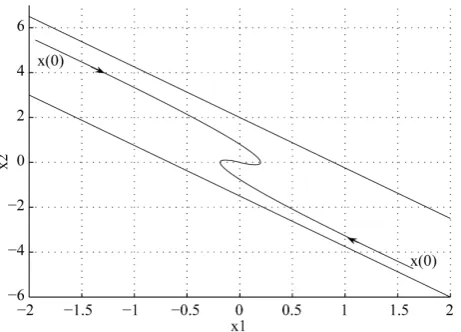
.As inFigure 1 but in the state space, Figure 2 plots two trajectories in the state space starting from two dif- ferent and admissible initial states and, thanks to the asymptotic stability of the system and the invariance po- sitive property, shows the state convergence to the origin without leaving the domain imposed by the con- straints.
5. Conclusion
[image:11.595.200.431.514.680.2]A method for partial or total eigenstructure assignment problem was presented and examples to illustrate the method were given. The method uses Sylvester equation to find the feedback matrix F when some matrix H is given with a desirable spectrum that will replace all the undesirable eigenvalues of the initial matrix A of System (1) in the closed-loop. This method generalizes the one proposed in [10] without additional conditions on Sys-
tem (5) and allows us to deal with the problem of asymmetrical constraints on the control vector. Examples to show its importance are presented.
References
[1] Ait Rami, M., El Faiz, S., Benzaouia, A. and Tadeo, F. (2009) Robust Exact Pole Placement via an LMI-Based Algo-rithm. IEEE Transactions on Automatic Control, 54, 394-398. http://dx.doi.org/10.1109/TAC.2008.2008358
[2] Bachelier, O., Bosche, J. and Mehdi, D. (2006) On Pole Placement via Eigenstructure Assignment Approach. IEEE Transactions on Automatic Control, 51, 1554-1558. http://dx.doi.org/10.1109/TAC.2006.880809
[3] Sussmann, H.J., Sontag, E. and Yang, Y. (1994) A General Result on Stabilization of Linear Systems Using Bounded Control. IEEE Transactions on Automatic Control, 39, 2411-2424. http://dx.doi.org/10.1109/9.362853
[4] Benzaouia, A. (1994) The Resolution of the Equation XA+XBX=HX and the Pole Assignment Problem. IEEE Tran- sactions on Automatic Control, 40, 2091-2095. http://dx.doi.org/10.1109/9.328817
[5] Benzaouia, A. and Burgat, C. (1988) Regulator Problem for Linear Discrete-Time Systems with Nonsymmetrical Con-strained Control. International Journal of Control, 48, 2441-2451. http://dx.doi.org/10.1080/00207178808906339
[6] Benzaouia, A. and Hmamed, A. (1993) Regulator Problem for Linear Continuous-Time Systems with Nonsymmetrical Constrained Control. IEEE Transactions on Automatic Control, 38, 1556-1560.
http://dx.doi.org/10.1109/9.241576
[7] Blanchini, F. (1999) Set Invariance in Control. Automatica, 35, 1747-1767.
http://dx.doi.org/10.1016/S0005-1098(99)00113-2
[8] Gutman, P.O. and Hagander, P. (1985) A New Design of Constrained Controllers for Linear Systems. IEEE Transac-tions on Automatic Control, 30.
[9] Lu, J., Chiang, H. and Thorp, J.S. (1991) Partial Eigenstructure Assignment and Its Application to Large Scale Systems.
IEEE Transactions on Automatic Control, 36.
[10] Baddou, A., Maarouf, H. and Benzaouia, A. (2013) Partial Eigenstructure Assignment Problem and Its Application to the Constrained Linear Problem. International Journal of Systems Science, 44, 908-915.
http://dx.doi.org/10.1080/00207721.2011.649364
[11] Maarouf, H. and Baddou, A. (2012) An Eigenstructure Assignment Method, Publication and Oral Presentation at the International Symposium on Security and Safety of Complex Systems, Agadir.
[12] Barlaw, J.B., Manahem, M.M. and O’Leary, D.P. (1992) Constrained Matrix Sylvester Equations. SIAM Journal on Matrix Analysis and Applications, 13, 1-9. http://dx.doi.org/10.1137/0613002
[13] Ding, F. and Chen, T. (2005) Iterative Least-Squares Solutions of Coupled Sylvester Matrix Equations. Systems and Control Letters, 54, 95-107. http://dx.doi.org/10.1016/j.sysconle.2004.06.008
[14] Gardiner, J.D., Laub, A.J., Amato, J.J. and Moler, C.B. (1992) Solution to the Sylvester Matrix Equation AXBT + CXDT = E. ACM Transactions on Mathematical Software, 18, 223-231. http://dx.doi.org/10.1145/146847.146929