University of Kentucky University of Kentucky
UKnowledge
UKnowledge
Theses and Dissertations--Finance and
Quantitative Methods Finance and Quantitative Methods
2018
ESSAYS ON SHARE REPURCHASES
ESSAYS ON SHARE REPURCHASES
David Moore
University of Kentucky, [email protected]
Digital Object Identifier: https://doi.org/10.13023/ETD.2018.136
Right click to open a feedback form in a new tab to let us know how this document benefits you. Right click to open a feedback form in a new tab to let us know how this document benefits you.
Recommended Citation Recommended Citation
Moore, David, "ESSAYS ON SHARE REPURCHASES" (2018). Theses and Dissertations--Finance and Quantitative Methods. 7.
https://uknowledge.uky.edu/finance_etds/7
STUDENT AGREEMENT: STUDENT AGREEMENT:
I represent that my thesis or dissertation and abstract are my original work. Proper attribution has been given to all outside sources. I understand that I am solely responsible for obtaining any needed copyright permissions. I have obtained needed written permission statement(s) from the owner(s) of each third-party copyrighted matter to be included in my work, allowing electronic distribution (if such use is not permitted by the fair use doctrine) which will be submitted to UKnowledge as Additional File.
I hereby grant to The University of Kentucky and its agents the irrevocable, non-exclusive, and royalty-free license to archive and make accessible my work in whole or in part in all forms of media, now or hereafter known. I agree that the document mentioned above may be made available immediately for worldwide access unless an embargo applies.
I retain all other ownership rights to the copyright of my work. I also retain the right to use in future works (such as articles or books) all or part of my work. I understand that I am free to register the copyright to my work.
REVIEW, APPROVAL AND ACCEPTANCE REVIEW, APPROVAL AND ACCEPTANCE
The document mentioned above has been reviewed and accepted by the student’s advisor, on behalf of the advisory committee, and by the Director of Graduate Studies (DGS), on behalf of the program; we verify that this is the final, approved version of the student’s thesis including all changes required by the advisory committee. The undersigned agree to abide by the statements above.
ESSAYS ON SHARE REPURCHASES
DISSERTATION
A dissertation submitted in partial fulfillment of the requirements for the degree of Doctor of Philosophy
in the College of Business and Economics at the University of
Kentucky
By David Moore Lexington, Kentucky
Director: Dr. Kristine Hankins, Professor of Finance
2018
ABSTRACT OF DISSERTATION
ESSAYS ON SHARE REPURCHASES
In my first chapter, we document and study the use of Rule 10b5 1 preset repurchase plans. We exploit this new and widespread form of payout to examine an issue at the core of payout decisionsthe tradeoff between commitment and financial flexibility. Relative to open market repurchases, preset plans provide an expanded repurchase window and increased legal cover, albeit at the cost of reducing repurchase flexibil-ity and the option to time repurchases. These costs and benefits are significantly associated with Rule 10b5-1 adoption. Consistent with preset plans signaling com-mitment, Rule 10b5-1 repurchase announcements are associated with greater and faster completion rates, with more positive market reactions, and with more dividend substitution than open market repurchases. Lastly, we find that preset repurchase plans represent a unique payout tool whose introduction encouraged a different set of firms to buy back stock and significantly altered the payout landscape. My second chapter examines the strategic use and timing of share repurchases by insiders for personal gain. Using grant level compensation data and a hand-collected sample of monthly repurchases, I find a positive relation between CEO equity sales and share repurchases. I identify the relationship by instrumenting equity sales with equity grant vesting schedules. This relation is persistent across firm characteristics and does not appear to be destroying shareholder value. The results indicate managerial self-interest motivates a subset of share repurchases.
KEYWORDS: Share repurchase; Rule 10b5-1; preset trading plan; payout policy; financial flexibility; CEO incentives
Author’s signature: David Moore
ESSAYS ON SHARE REPURCHASES
By David Moore
Director of Dissertation: Kristine Hankins
Director of Graduate Studies: Kenneth Troske
ACKNOWLEDGMENTS
I wish to thank the complete Dissertation Committee, and outside reader,
respec-tively: Alice Bonaim´e, Kristine Hankins, Leonce Bargeron, Mark Liu, Frank Scott,
and Hinh Khieu. Each individual provided insights that guided and challenged my
thinking, substantially improving the finished product. I would like to specifically
thank Alice Bonaim´e, Kristine Hankins, and Leonce Bargeron for their mentorship,
guidance, and endless devotion to my development as a researcher and scholar. Lastly,
I would like to extend my gratitude to the Department of Finance at the University
of Kentucky for their help and guidance.
Chapter 1 has benefited from comments and discussions with Chris Clifford, Igor
Cunha, Dave Denis, Murali Jagannathan, Brad Jordan, Kathy Kahle, Einer
Kjen-stad, Nathan Mauck, Roni Michaely, Lalitha Naveen and Donna Paul. I would also
like to thank seminar participants at the American Finance Association, the
North-ern Finance Association, the University of Arizona, the University of Kentucky, the
University of South Carolina and the Washington University Corporate Finance
Con-ference for their helpful comments.
Chapter 2 has benefited from comments and discussion with Igor Cunha,
Meng-ming Dong, and Tyson Van Alfen. I would also like to thank seminar participants
at Binghamton University SUNY, California State University Long Beach, Eastern
Finance Association, Florida International University, Loyola Marymount
Univer-sity, the University of Kentucky, the University of Mississippi, and the University of
Wisconsin-Whitewater for their valuable comments.
TABLE OF CONTENTS
Acknowledgments . . . iii
Table of Contents . . . iv
List of Tables . . . vi
List of Figures . . . vii
Chapter 1 Commitment versus Financial Flexibility in Payout Decisions: Ev-idence from 10b5-1 Preset Repurchase Plans . . . 1
1.1 Introduction . . . 1
1.2 Hypothesis Development . . . 4
1.2.1 Abandonment Options . . . 6
1.2.2 Timing. . . 7
1.2.3 Information Releases and Trading Blackouts . . . 7
1.2.4 Litigation Risk . . . 8
1.3 Sample formation and descriptive statistics . . . 9
1.3.1 Sample construction . . . 9
1.3.2 Rule 10b5-1 repurchase plan frequency . . . 10
1.3.3 Rule 10b5-1 repurchase plan details . . . 11
1.4 Rule 10b5-1 commitment . . . 12
1.5 The determinants of Rule 10b5-1 adoption . . . 14
1.5.1 Logit regressions of the decision to adopt a Rule 10b5-1 plan . 14 1.5.2 Rule 10b5-1 plan adoption: Robustness to excluding boilerplate announcements . . . 17
1.5.3 What determines the speed to first preset repurchase plan adop-tion? . . . 18
1.5.4 Shock to cost of adopting a preset repurchase plan. . . 18
1.6 Repurchase announcement returns. . . 19
1.7 Rule 10b5-1 repurchase plans and overall payout policy . . . 21
1.7.1 Do preset repurchases substitute for dividend increases?. . . . 21
1.7.2 Determinants of payout decision before and after Rule 10b5-1 enactment . . . 22
1.8 Conclusion . . . 23
Chapter 2 Managerial Self-Interest and Strategic Repurchases: Evidence from Equity Vesting Schedules . . . 41
2.1 Introduction . . . 41
2.2 Literature Review and Contribution. . . 45
2.3 Sample Selection . . . 47
2.5 Results . . . 51
2.5.1 Main results . . . 51
2.5.2 Dynamic analysis . . . 53
2.5.3 Alternative hypothesis . . . 54
2.5.4 Robustness . . . 54
2.5.5 Do these repurchases destroy shareholder value? . . . 56
2.6 Conclusion . . . 56
Appendices . . . 69
Appendix A: Variable Definitions for Chapter 1 . . . 69
Appendix B: Variable Definitions for Chapter 2 . . . 73
Internet Appendix . . . 76
References . . . 102
Vita . . . 108
LIST OF TABLES
1.1 Preset repurchase frequency and plan details . . . 24
1.1 Preset repurchase frequency and plan details,continued . . . 25
1.2 Do Rule 10b5-1 plans represent a greater commitment? . . . 26
1.2 Do Rule 10b5-1 plans represent a greater commitment?, continued . . . . 27
1.3 What firm characteristics are related to preset repurchase adoption? . . . 28
1.3 What firm characteristics are related to preset repurchase adoption?, con-tinued . . . 29
1.4 Robustness to excluding boilerplate Rule 10b5-1 plans . . . 30
1.4 Robustness to excluding boilerplate Rule 10b5-1 plans, continued . . . . 31
1.5 Hazard models of preset plan adoption . . . 32
1.5 Hazard models of preset plan adoption, continued . . . 33
1.6 Shock to cost of adopting a preset repurchase plan . . . 34
1.7 Univariate analysis - Abnormal returns around preset repurchase announce-ments . . . 35
1.8 Do Rule 10b5-1 repurchases substitute for dividend increases? . . . 36
1.9 How have preset repurchases changed payout decisions? . . . 37
1.9 How have preset repurchases changed payout decisions?, continued. . . . 38
2.1 Summary Statistics . . . 58
2.2 Repurchases and Equity Sales . . . 59
2.3 Does Vesting Predict Equity Sales? . . . 60
2.4 Does Vesting Predict Repurchases? . . . 61
2.5 Equity Sales and Share Repurchases: Instrumental Variable Analysis . . 62
2.6 Equity Sales and Share Repurchases: Instrumental Variable Analysis . . 63
2.7 Dynamic Analysis. . . 64
2.7 Dynamic Analysis, continued . . . 65
2.8 Equity Vesting: Restricted sample. . . 66
2.9 Robustness: Split Sample . . . 67
LIST OF FIGURES
1.1 Preset Repurchase Announcements . . . 39 1.2 Preset repurchase plans in payout initiations . . . 40
Chapter 1 Commitment versus Financial Flexibility in Payout Decisions: Evidence from 10b5-1 Preset Repurchase Plans
1.1 Introduction
Beginning with the SEC safe harbor provisions of 1982, payout policy has evolved dramatically over the past three decades. Share repurchases now represent the largest form of payout (Grullon and Michaely (2002) and Skinner (2008)), with more firms repurchasing than paying dividends and with aggregate repurchase volume outpacing aggregate dividend payments (Floyd, Li, and Skinner, 2015). One potential expla-nation for the expansion of repurchase activity is that managers view repurchases as being more flexible than dividends (Brav, Graham, Harvey, and Michaely,2005). The flexibility of repurchases allows firms to more easily respond to fluctuations in stock prices and investment opportunities. This flexibility comes with a price, however, as dividends send a stronger signal of commitment to investors (Farre-Mensa, Michaely, and Schmalz, 2014).
As the payout options available to managers have grown, so has their ability to trade-off flexibility with signaling commitment. As with any tradeoff, the optimal payout policy will differ across firms depending on the relative costs and benefits of each method. The relative benefits of financial flexibility are a function of the firm’s ability to access capital: a firm with ample financial slack and correctly priced, liquid stock should place less value on financial flexibility in payout policy. Further, man-agers must consider the value of the option to “time the market,” i.e., to increase repurchases if the firm’s stock is underpriced and to reduce them if the price is at or above fair value. In an efficient market, the value of this option clearly relates to the manager’s desire and ability to successfully exploit inside information. The primary benefit to signaling commitment is an increase in stock price when the firm announces payout decisions because payout announcement returns increase with expected pay-out levels (e.g., Comment and Jarrell, 1991). Managers have strong incentive to maximize stock prices: Higher stock prices imply greater compensation. Thus, while maintaining financial flexibility is important, signaling commitment adds firm value by increasing investors’ expected level of payouts and thereby increasing stock price. The tradeoff between signaling commitment and maintaining the ability to abandon payouts or time the market is at the core of payout policy.
with open market repurchase (OMR) programs. Further, when firms adopt a preset repurchase plan, they incur a real, costly commitment, which traditional open market repurchases lack. Prior to the introduction of preset repurchases, researchers exam-ining the signaling-flexibility tradeoff were forced to compare across payout methods (e.g. self-tenders, OMRs, and dividends). Comparing preset and traditional OMRs allows us to hold constant factors that often confound payout decision, such as taxes, or compensation-driven incentives (Fenn and Liang (2001) and Cheng, Harford, and Zhang(2015)), providing a clean setting within which we can examine this tradeoff in payout policy. Studying preset repurchases also provides insight into how an addition to the menu of payout options affects firms’ broader payout decisions.
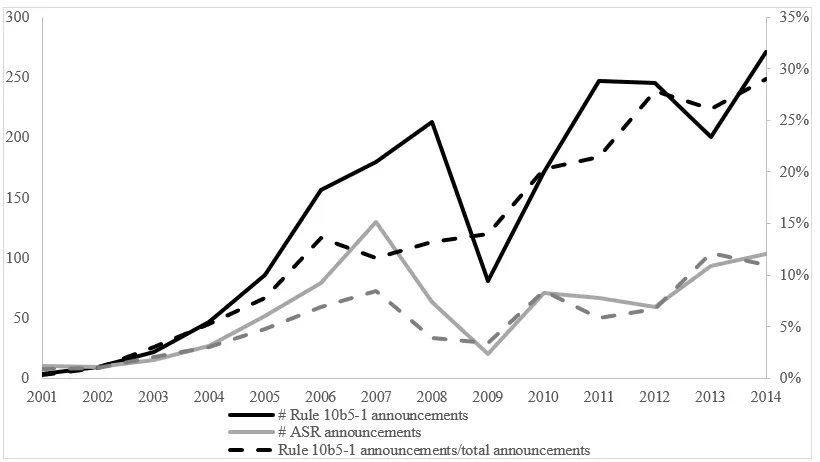
We hand-collect 1,933 repurchase announcements between 2001 and 2014 that reference Rule 10b5-1. The use of the Rule to repurchase shares has been increasing rapidly since its enactment: We document only four such announcements in 2001, compared to at least 200 announcements per year during 2011-2014. In recent years Rule 10b5-1 plans are more than twice as popular as accelerated share repurchases, and approximately one quarter of all repurchase announcements include a Rule 10b5-1 component.
We first establish that preset repurchase plans indeed represent a greater commit-ment than OMRs, the most prevalent form of share repurchase. Relative to matched OMR programs, Rule 10b5-1 plans are associated with faster completion, greater completion rates (the dollar amount repurchased relative to the announced dollar amount) and are more likely to be completed. Thus, Rule 10b5-1 programs are a stronger commitment to repurchase shares, and a commitment to repurchase them more quickly, than are OMRs.
We next study the determinants of the decision to adopt a Rule 10b5-1 preset repurchase program relative to an OMR. Because firms delegate repurchase respon-sibilities to a third party and because Rule 10b5-1 prohibits adjustments to plans during blackout windows, a preset plan reduces a firm’s ability to modify future re-purchases. We find that the likelihood of adopting a preset plan is greater for firms with more stable cash flows, no dividend payments, better recent stock performance, or more liquid stocks. These results are consistent with managers trading-off other sources of financial flexibility against financial flexibility in their repurchase program. We also draw from a growing literature that characterizes the 2008-2009 financial crisis as an unanticipated shock to credit supply (e.g.,Ivashina and Scharfstein,2010;
Cornett, McNutt, Strahan, and Tehranian, 2011; Bliss, Cheng, and Denis, 2015), which in turn increased the marginal benefits of financial flexibility. We find that 10b5-1 repurchase plan usage significantly stagnated during the crisis relative to es-timated expected growth patterns, consistent with preset repurchase plan adoption likelihood decreasing as the marginal benefit of financial flexibility increases.
Firms enter into a trading plan during an “open window” when they are not in possession of material, nonpublic information, limiting a firm’s ability to trade on information (i.e., “time their trades”). We find that firms with a record of worse repurchase timing are more likely to adopt a 10b5-1 plan, and smaller, younger, less financially sophisticated firms are among the first to adopt Rule 10b5-1 plans. These results are consistent with firms that are unable to or uninterested in making
information-based trades being more likely to adopt a preset plan.
By allowing a firm to continue repurchasing while in possession of material, non-public information, 10b5-1 plans expand a firm’s available repurchase window and provide legal cover for these trades. We find that firms that should be more con-strained by blackout windows, either due to longer reporting lags or more frequent releases of material information through 8-K reports, are more likely to adopt a 10b5-1 plan than an OMR. However, we find no evidence of firms at higher risk of litigation being more likely to adopt a preset repurchase plan.
We also show that firms without an active repurchase program when Rule 10b5-1 was enacted were more likely to choose 10b5-1 plans over OMRs. These results are consistent with preset repurchases facilitating buy backs within a different set of firms and occupying a unique space within the payout landscape.
Our data reveal that most firms that adopt a 10b5-1 plan continue to use a preset plan for future repurchases. Hence, adopting a 10b5-1 plan for the first time represents an important decision. We focus on first-time 10b5-1 plan adoption using a Cox proportional hazard model, which estimates how quickly firms adopt 10b5-1 plans. The hazard model generally corroborates our prior results and further shows that firms whose CEO’s bonus is tied to earnings per share and firms with more dilution or executive options adopt a 10b5-1 plan more quickly.
We next turn our attention to stock returns around Rule 10b5-1 repurchase announcements. On the one hand, 10b5-1 plans, by construction, should not be information-driven, potentially reducing their announcement effect. On the other hand, establishing a preset trading plan lessens the firm’s repurchasing flexibility and, on average, represents a stronger commitment to follow through on the an-nounced repurchase plan. Empirically, we find that 10b5-1 announcements are met with positive and significant cumulative abnormal returns, which are generally in-creasing in the expected portion of the plan to be effected under the Rule. In fact, after matching on firm characteristics associated with 10b5-1 adoption, returns as-sociated with repurchase announcements fully effected under Rule 10b5-1 are more than double returns to matched OMR announcements. The results are consistent with investors valuing the increased commitment of a preset repurchase plan, per-haps due to expected reductions in agency costs associated with free cash flow as in
Jensen (1986).
Our findings contribute to the payout policy literature along multiple dimensions. The literature focusing on how firms choose to distribute cash to shareholders has primarily examined the choice between dividends and share repurchases (e.g., Bren-nan and Thakor, 1990; Allen, Bernardo, and Welch, 2000; Jagannathan, Stephens, and Weisbach,2000;Guay and Harford,2000;Grullon and Michaely,2002;Grinstein and Michaely,2005). Our results also contribute to the research examining the choice of payout vehicle. For example, Brickley(1983) andDeAngelo, DeAngelo, and Skin-ner (2000) examine the choice between regular and special dividends, Comment and Jarrell (1991) compare the signaling strength of Dutch auctions, tender offers, and OMRs, and Bargeron, Kulchania, and Thomas (2011) examine the choice to repur-chase through accelerated share repurrepur-chases relative to OMRs. We contribute to this literature by documenting and examining the costs and benefits associated with a new form of payoutRule 10b5-1 preset repurchase plans. Further, we contribute to the literature examining market reactions to payout announcements, particularly their relation to completion rates (e.g.,Stephens and Weisbach,1998;Bonaim´e,2012). Fi-nally, we contribute to the discussion regarding payout “smoothing” (e.g.,Lambrecht and Myers,2012;Michaely and Roberts,2012;Leary and Michaely,2011), as we have identified a means by which firms can commit to regular repurchase transactions, un-encumbered by blackout windows.
Additionally, we contribute to a nascent literature examining SEC Rule 10b5-1, primarily with respect to its use for personal sales by insiders. Jagolinzer (2009) finds that executives trade strategically under the Rule: Insiders consistently sell before bad news and after good news, earning higher returns than non-Rule users.
Henderson, Jagolinzer, and Muller (2012) find the decision to disclose insider use of Rule 10b5-1 is positively correlated with firm level litigation risk. We find no evidence that litigation risk is associated with the firm’s use of the Rule to repurchase stock, indicating that the motives to adopt a preset plan to repurchase appear distinct from those associated with insider trading at the individual level. While trading by insiders using SEC Rule 10b5-1 plans has received much attention in the academic literature and popular press, we are the first paper, to our knowledge, documenting the prevalence, determinants, value, and payout policy impacts of the use of Rule 10b5-1 at the firm level to repurchase stock.
1.2 Hypothesis Development
Financing frictions result in the need to preserve financial flexibility in corporate finance decisions. Firms need to maintain sufficient financial slack to invest in positive net present value projects as they arise. One way to maintain financial flexibility is to build it into corporate payout policy. Managers state that flexibility is one of the most important reasons they choose share repurchases over dividends (Brav, Graham, Harvey, and Michaely, 2005). Empirical evidence corroborates managers’ views and shows that financial flexibility is related to both the level and form of corporate payout (e.g., Guay and Harford, 2000; Jagannathan, Stephens, and Weisbach, 2000;
Lie, 2005; DeAngelo and DeAngelo, 2007; Bonaim´e, Hankins, and Harford, 2014).
Clearly, maintaining sufficient flexibility is important to managers when choosing an optimal payout structure.
However, payout vehicles that provide firms with more discretion come at the cost of sending weaker signals of commitment. A long line of research (see Farre-Mensa, Michaely, and Schmalz (2014) for a review) documents positive abnormal returns around payout initiations and increases, consistent with investors generally viewing the benefits of cash distributions as outweighing the potential negative signal about profitable investments. For example, abnormal returns to repurchase announcements are increasing in the implied level of commitment, with returns to fixed-price tender offers being greatest, followed by Dutch auctions, then OMRs (Comment and Jarrell,
1991). Moreover, prior literature documents that announcement returns are increas-ing in a program’s size (e.g., Stephens and Weisbach, 1998) and prior completion rates (Bonaim´e,2012), consistent with investors’ (positive) reaction to repurchase an-nouncements increasing in their expected value of future repurchases. These findings all suggest that committing to distribute cash causes investors to positively reassess firm value, possibly because these distributions reduce agency costs associated with free cash flow as inJensen (1986).
We reexamine the flexibility-signaling tradeoff within the context of an important recent change in the payout choice set. On October 23, 2000, the Securities and Exchange Commission (SEC) enacted Rule 10b5-1, which for the first time allows insiders or the firm itself to trade company stock while in possession of material, non-public information. Prior to Rule 10b5-1 courts disagreed on when insider trading liability arises. The Rule was intended to clarify that liability arises when insiders trade while in “knowing possession” of material, non-public information and to es-tablish conditions under which insiders may legally trade in company stock. In an attempt to provide “appropriate flexibility” to insiders who wish to trade in company stock, the Rule specifies conditions that constitute an affirmative defense: that the insider establish a trading plan in advance with a third party, over whom they do not exert influence.1 Thus, while the Rule specifically targeted insider trading for
individuals, it also permitted firms to establish preset trading plans to repurchase shares.
Specifically, under Rule 10b5-1 firms enter into a trading plan during an “open window” when they are not in possession of material, nonpublic information, which provides an affirmative defense to any subsequent trading under the plan. The Rule states that a firm must either: (i) specify a written trading plan with either the amounts, dates, and prices to repurchase or a trading formula in a binding contract with a broker or dealer, or (ii) delegate the repurchase decisions to a broker or dealer (the company can have no further influence). The firm may modify the plan, but only during an open window. In addition, though early termination of a preset plan
1According to the SEC: “Taken as a whole, the revised defense is designed to cover situations in which
is legal, it jeopardizes the affirmative defense associated with 10b5-1 repurchases. Lastly, to maintain an affirmative defense at the motion to dismiss phase of litiga-tion, the firm must publicly announce the plan and enter into it under good faith (Henderson, Jagolinzer, and Muller, 2012). In sum, relative to OMRs, preset Rule 10b5-1 repurchases restrict a firm’s ability to ex post modify repurchase activity or to exploit inside information, but expand a firm’s available repurchase window and pro-vide additional legal coverage. These costs and benefits of preset repurchases relative to OMRs motivate our four hypotheses below.
1.2.1 Abandonment Options
Preset repurchase plans provide less flexibility since they reduce a firm’s ability to modify repurchases. Essentially, firms adopting a preset plan partially relinquish the abandonment option associated with OMRs, which leads to our first hypothesis, the Abandonment Option Hypothesis: Firms with more internal capital or easier access to external capital markets will value the abandonment option inherent in OMRs less and thus be more likely to adopt alternative payout strategies without abandonment options, specifically, preset Rule 10b5 1 repurchase plans. The empirical predictions of theAbandonment Option Hypothesisare that firms with greater cash and cash flow and firms with predictable cash flows should be more willing to adopt 10b5-1 plans to execute share repurchases. We also predict that firms that can easily access the debt market, i.e., those with excess debt capacity, or the equity market, i.e., firms with liquid stocks that are not trading below fair value, should be more likely to adopt preset trading plans.2
We also note that, consistent with firms facing a direct trade-off between flexibility and commitment, firms with lower or unstable internal reserves and limited access to external capital markets are likely to value flexibility the most and are likely the firms for which the commitment signal is most costly because these firms risk financial distress to fund payouts.3 Further, committing to payouts likely provides little benefit to these firms because agency costs should be low. Alternatively, firms with sufficient internal resources and easy access to external capital likely value flexibility the least and incur minimal costs to signaling commitment while also reducing agency costs surrounding the use of the capital.
2We summarize variables used to test each hypothesis in Table 1.3 and provide detailed definitions
in Appendix A.
3While it may seem counterintuitive for a firm to access external capital markets, particularly the
equity market, to fund distributions to shareholders, recent empirical evidence by Farre-Mensa, Michaely, and Schmalz (2016) suggests that firms rely on external capital to finance as much as one third of payouts, contradicting the pecking order theory ofMyers and Majluf(1984). Further, our argument does not hinge on firms accessing external capital to fund repurchasesper se; we simply argue that firms that diminish cash holdings by committing to payouts may be obliged to raise capital externally to fund future projects.
1.2.2 Timing
Next, preset plans differ from OMRs in that the firm must delegate repurchase re-sponsibility to a third party (without further influence) and thus the firm forfeits full control over the program, which reduces its ability to make information-based trades as inDittmar and Field(2015). A firm may be willing to forfeit the option of exploit-ing inside information because it prefers to allocate resources to its core business. We also acknowledge the possibility that managers still time repurchases executed under Rule 10b5-1, either by creating complex price matrices that reflect the firm’s private information regarding stock prices or by (illegally) exploiting alternative information channels to influence broker trades ex post. In either case, repurchasing under the Rule creates an additional barrier to timing repurchases because in the former situ-ation firms must commit to a price matrix, however complex, in the latter situsitu-ation they must risk accusations of insider trading.
Other firms may recognize that poor repurchase timing could lead to bad press. Many companies, including Viacom, Pfizer, C.R. Bard, Lowes, Exxon Mobil, Boeing, and EBay, have been accused of poor repurchase timing in the popular press.4 Just
as managers often cite preset 10b5-1 trading plans when asked about questionable personal transactions5, companies can use Rule 10b5-1 as a buffer against accusations
of poor timing. Companies less concerned about timing or with a reputation of poor timing would value this buffer more. We hypothesize that firms that value the timing option associated with OMRs the most will be less likely to adopt preset repurchase plans, which leads to our second hypothesis, the Timing Option Hypothesis: Firms that place more value on the timing option associated with OMR plans will be less likely to adopt preset Rule 10b5-1 repurchase plans.
The empirical implications of the Timing Option Hypothesis are that firms with a history of poor repurchase timing will be more willing and likely to outsource their repurchase program through a 10b5-1 plan either due to a lack of skill or an indifference to timing repurchases to correspond with low stock prices. We also expect that small firms, young firms, and those with less financially sophisticated treasury functions will be more likely to adopt preset plans.
1.2.3 Information Releases and Trading Blackouts
Rule 10b5-1 plans expand a firm’s available repurchase window, and repurchasing firms often cite avoiding blackout windows as the motivation for repurchasing under Rule 10b5-1. While the Securities and Exchange Commission (SEC) generally does not mandate blackout periods, most companies impose explicit blackout windows to minimize the costs associated with illegal insider trading (Bettis, Coles, and Lemmon,
2000). Blackout windows generally last from quarter end until the release of earnings,
4See “Hey, Big Spender!” (Barron’s on January 27, 2014) and “Apple Buybacks Pay Most Ever as
CEOs Spend $211 Billion” (Bloomberg on August 5, 2014).
5For example, in March of 2011 when Douglas Bergeron, CEO of VeriFone Systems Inc., was
as well as during other major corporate events that may result in insiders possessing material, nonpublic information. Firms with greater than $75 million in public float must release earnings within 35 days of fiscal quarter end and 60 days of fiscal year end; smaller companies must release earnings within 45 and 90 days. Though firms may choose to some extent when to report earnings, reporting lags are most likely driven by factors other than the desire to repurchase sooner. For example, Sengupta
(2004) finds that investor base, litigation risk, and accounting complexity are associ-ated with reporting lags. Hence, blackout windows may substantially constrain firms by preventing them from repurchasing for months at a time throughout the year. In fact, some firms report blackout windows prohibiting repurchasing during two-thirds of all trading days.6 Further, a firm with a large repurchase program may not be able
to execute the entire program in the desired time frame due to blackout windows and volume conditions, which limit repurchases to a maximum of 25% of the average daily trading volume. To summarize, we hypothesize that blackout windows are a real con-straint, but preset repurchases will circumvent this constraint. Thus, the Blackout Window Hypothesis states that firms that are more constrained by blackout windows are more likely to adopt a Rule 10b5-1 trading plan to circumvent blackout window restrictions. Empirically, this implies that firms with long reporting lags or frequent releases of material information will be more likely to adopt Rule 10b5-1 plans.
1.2.4 Litigation Risk
Finally, Rule 10b5-1 repurchases differ from OMRs in terms of legal cover. Firms may value additional legal cover as shareholders endure losses and managers suffer indi-vidual consequences when caught engaging in financial misrepresentation (Karpoff, Lee, and Martin,2008). In 1982 the SEC enacted Rule 10b-18 to provide safe harbor to firms that repurchase under the manner, timing, price, and volume conditions. However, even if the firm meets all Rule 10b-18 conditions, it cannot legally engage in repurchases while in possession of material, nonpublic information. Though the new Rule 10b5-1 does not provide safe harbor, it does provide the firm with an affir-mative defense. An affiraffir-mative defense differs from safe harbor in that a firm admits that its actions were a literal violation of the law against trading while in possession of material nonpublic information, but may introduce as evidence the existence of a preset Rule 10b5-1 trading plan establishing the trades when it was not in such possession, which, if found to be credible, will negate any criminal liability for insider trading.7 Therefore, 10b5-1 plans provide companies with an additional shield from
potential lawsuits related to repurchase activity. For example, during its July 25,
6In their August 3rd, 2006 Q2 Earnings Conference Call Captaris stated that Rule 10b5-1 plans
would allow them to repurchase during “blackout periods, which comprise about two-thirds of the trading days in each quarter.” Further, a July 1st, 2011 article “Corporate Buybacks on the Rise” inTraders Magazine stated: “Corporations have about eight months out of the year when insider trading rules create blackout periods. However, under the SEC’s 10b5-1 rule, companies can set up a system to perform automatic stock buybacks during those times.”
7“Rule 10b-18 confers no immunity from possible Rule 10b-5 liability where the issuer engages in
re-purchases while in possession of favorable, material, nonpublic material, and nonpublic information concerning its securities.” 1982 Adopting Release,supra note 4, at 47 FR 53333.
2014, conference call, Centene Corp. stated that “the only way to do it [repurchase] and be clean and above board is on a 10b5-1.” TheLitigation Risk Hypothesis states that firms that are more subject to litigation risk will be more likely to adopt a Rule 10b5-1 plan. The empirical predictions of the Litigation Risk Hypothesis are that firms with a high estimated probability of litigation are more likely to adopt a preset repurchase plan.
1.3 Sample formation and descriptive statistics
1.3.1 Sample construction
To construct our sample of preset repurchases, we search Factiva for announcements of Rule 10b5-1 repurchases and accelerated share repurchase (ASR), another type of preset repurchase, over the period 2001 to 2014. We verify all Factiva results to ensure that the use of Rule 10b5-1 corresponds to a repurchase and not an insider transaction. Our search identifies 1,933 announcements with a Rule 10b5-1 plan by 950 distinct firms and 832 announcements with an ASR by 430 firms. As most firms announce preset plans in conjunction with OMR announcements, we merge our hand-collected Rule 10b5-1 and ASR data with repurchase announcements from Thomson Financial’s Securities Data Company (SDC) Mergers & Acquisitions and Repurchases databases.8 We generally use non-preset OMRs (OMRs), i.e., OMRs
without a Rule 10b5-1 or ASR component, as our control group. We further exclude block transactions, tender offers, and any repurchase program with missing data on the size of the announced program. We reconcile slight discrepancies in dates between the two SDC databases by searching Factiva for the repurchase announcement and recording the first available announcement date. This merge yields 14,198 repurchase announcements documented between 2001 and 2014.
We merge our repurchase announcement sample with several databases to con-struct other variables of interest and control variables. Specifically, accounting data and data on actual repurchases are from Compustat quarterly or annual filings, stock price data from CRSP, institutional ownership data from Thomson Financial 13F filings, options data from Execucomp, and 8-K filings from Edgar.
Our analyses center around two samples. The first sample conditions on a repur-chase announcement and is used to compare preset repurrepur-chase plans to non-preset OMRs. We present repurchase plan details, completion rates, and announcement returns at the repurchase announcement level. When we use multivariate regressions to test our main hypotheses, we continue to use this conditional data but collapse it to the firm-year level. If a firm announces multiple types of repurchases within a year, we assign that firm-year observation the repurchase program with the highest commitment level. The second unconditional sample includes both repurchasing and non-repurchasing firm-years, over our sample period. We generate this sample from
8To present the most complete sample possible, we use the union of flagged repurchases within the
the same intersection of databases as the conditional sample and use it to test how the introduction of preset repurchases fits into the broader payout landscape.
1.3.2 Rule 10b5-1 repurchase plan frequency
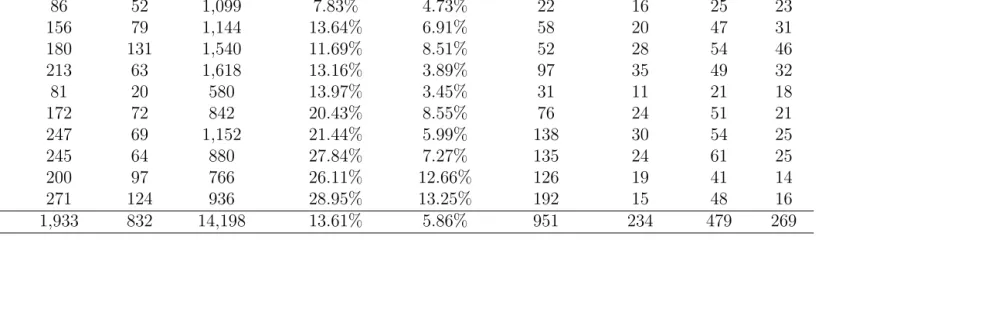
As shown in Figure 1.1 and Panel A of Table 1.1, the use of Rule 10b5-1 plans has grown rapidly. In 2001, the first year during which firms could adopt a Rule 10b5-1 plan, only four announcements contained such adoptions. These findings are consistent with a post-enactment learning period in which firms and investment banks confirmed the application of Rule 10b5-1 to repurchases over time.9 Yet during the last four years in our sample period (2011-2014), at least 200 announcements contained a Rule 10b5-1 adoption each year. In fact, in recent years over one-quarter of repurchase announcements in our sample included a preset component. Therefore, the growth in Rule 10b5-1 plans cannot be explained by the growth in repurchase announcements during our time period because 10b5-1 plan use is growing even as a percentage of total repurchase announcements.10
We also compare Rule 10b5-1 plans to accelerated share repurchases (ASRs), another type of preset plan. In an ASR, an investment bank immediately delivers borrowed shares to the firm, resulting in an instantaneous reduction in shares out-standing by the amount of the repurchase. The investment bank then conducts the repurchase over time at prevailing market prices. The difference between what the firm paid the investment bank for the shares and what the investment bank actually had to pay to purchase them on the open market is settled at the end of the contract. (SeeBargeron, Kulchania, and Thomas (2011) for an in-depth description of the me-chanics of ASRs.) In sum, along the commitment/flexibility spectrum, ASRs provide the greatest level of commitment or the least flexibility. The immediacy of ASRs makes them ideal for managerial motives, such as takeover defense and manipulation of EPS numbers, while the hands-off nature of 10b5-1 plans are the least compatible with managerial motives. Further, the SEC has ruled that ASRs do not qualify for safe harbor or affirmative defense status.11 Thus, ASRs and Rule 10b5-1 plans differ
from a structural and legal perspective, as well as in their likely motives.
While ASRs have become more common, Rule 10b5-1 plans are the preferred preset repurchase method, particularly in recent years. We observe 2.4 times as many 10b5-1 plans as ASRs during our sample period (2001-2014). In 2014 only 13% of repurchase announcements included an ASR whereas 29% included a 10b5-1 plan. These results are consistent with more firms preferring to maintain some level of flexibility in their repurchase programs.
9We observe a similar phenomenon following the introduction of the safe harbor provisions (Rule
10b-18) in 1982 (see, e.g.,Grullon and Ikenberry(2000)). Many managers took several years to see enough precedence and implement a new method of payout (open market repurchases).
10Some firms mention preset repurchase plans in other corporate announcements, e.g., earnings
reports and conference calls. While there is some overlap with our sample of preset repurchase announcements, we calculate that 377 of these mentions correspond to distinct firm-year observa-tions, implying that our original estimates of the use of preset plans are likely conservative.
11https://www.sec.gov/divisions/marketreg/r10b18faq0504.htm
Preset repurchase announcements vary significantly by the expected portion of the repurchase to be effected under a preset plan. Table 1.1 Panel A also presents Rule 10b5-1 announcements by type. We refer to announcements as “boilerplate” if the firm “may” adopt a preset plan or conduct the repurchase through other means such as open market purchases, privately negotiated transactions, or block transactions. The boilerplate group represents approximately half of all Rule 10b5-1 announce-ments. “Expected” plans indicate that the company “expects to” or “intends to” adopt a preset component. Firms often include a general description of preset plans in these announcements. Expected plans make up the smallest group of announce-ments at 234 announceannounce-ments or 12% of all 10b5-1 announceannounce-ments. “Partial” plans include a preset componentwith certainty. Partial plans use definitive language or provide specific institutional details about the preset component of the plan. Ap-proximately one quarter of Rule 10b5-1 announcements are partial. Finally, 269 or about 14% of plans are “pure,” i.e., cover the full repurchase program.12 We
gener-ally include all types of 10b5-1 plans in our analyses, though we often show results by type or without boilerplate plans. Firms announcing any type of 10b5-1 plans are important to study because they choose to include 10b5-1 plans as a potential repurchase mechanism.
1.3.3 Rule 10b5-1 repurchase plan details
We collect preset repurchase plan details regarding size, duration, motive and broker, if mentioned, and report summary statistics on Rule 10b5-1 plans in Panel B. We should note that these summary statistics apply to a small portion of the sample, ex-clude boilerplate plans by definition, and are skewed towards pure plans fully executed under the Rule. Therefore, these figures provide a glimpse inside these repurchase contracts, but do not represent the full sample. For the subset of firms that report the size of the preset repurchase, the average (median) Rule 10b5-1 program represents 5.2% (3.5%) of shares outstanding. While the size of Rule 10b5-1 programs appears smaller than that of other repurchase programs, we find that the total announced repurchase size is slightly larger for repurchases containing a preset component than for those that do not (8.08% versus 7.73%; p = 0.0625).
The dollar value of preset plans varies substantially from $2 million at the 10th percentile to $200 million at the 90th percentile for Rule 10b5-1 plans. The mean (median) dollar value is $82 million ($16 million). For firms that voluntarily disclose the size of their preset repurchase program, the mean (median) percentage of the total repurchase program under a Rule 10b5-1 plan is 94% (100%), and 87% will be conducted fully through a Rule 10b5-1 plan. We should note again, however, that these figures are biased upward because most firms that combine preset plans with other plans do not separately report the value of the preset component and are therefore not included in calculations for this table.
The mean time to commencement of a Rule 10b5-1 plan is 13 days, and 74 plans, or approximately one-third, begin within one day of the announcement. Rule 10b5-1
plans last 195 days on average, and the most frequently observed duration of one year is reported by approximately one in six (47 out of 299) firms. Other common time windows include one month (14 plans or 5%), two months (38 plans or 13%), three months (20 plans or 7%), and six months (22 plans or 7%). The figures are on par with the duration of OMR plans: 70% of OMR completion announcements occur within one year of the authorization, and the median duration for the subsample of firms that announce a completion is 223 days (Bargeron, Bonaim´e, and Thomas,
2017). In sum, the duration of the majority of preset plans is long enough to represent a real and costly commitment.13
1.4 Rule 10b5-1 commitment
Given that accelerated share repurchases are executed immediately and in full, they represent a firm commitment to repurchasing the entire announced amount of stock. Rule 10b5-1 plans, on the other hand, allow firms some flexibility in terms of their execution. Anecdotally, we observe firms establishing a “price matrix,” which implies repurchasing more (fewer) shares as the price decreases (increases).14 However, firms can only put into place or modify a 10b5-1 plan during an open window, thus creating a greater commitment for the firm than a fully flexible OMR. If 10b5-1 plans represent a greater commitment to follow through with the announced repurchase, we expect greater completion rates and more plans completed relative to OMRs.
To test whether completion rates differ across Rule 10b5-1 and OMRs, we limit the sample to the period from 2004 to 2014 since fewer than 5% of repurchases contained a Rule 10b5-1 component prior to 2004 when firms and investment banks were learning how to apply the Rule. Further, after 2003 firms are required to report detailed quarterly information on actual shares repurchased. We calculate completion rate beginning the quarter the firm announces the repurchase program through the following eight quarters. Completion rate is the dollar value of shares repurchased, i.e., the number of shares repurchased times the average repurchase price per share as reported in Compustat, divided by the dollar value of the announced repurchase from SDC. Following Stephens and Weisbach(1998), we truncate completion rate at 100%. We report average cumulative completion rates for Rule 10b5-1 plans along varying levels of commitment as well as for OMR announcements without a preset component.
Panel A of Table 1.2 shows average completion rates and the percent of plans completed by quarter and by level of commitment to the Rule. Rule 10b5-1 plans
13Internet Appendix Table IA1 shows plan details for pure 10b5-1 plans only. Pure plans represent
on average 6.51% of shares outstanding or $56.33 million worth of stock. Internet Appendix Table IA13 shows plan details and the breakdown by type for accelerated share repurchases. Approximately one-third of ASRs announcements are “pure,” one-third are “boilerplate,” and the remaining are partial (26%) and expected (6%). ASR plans represent on average 6.22% of shares outstanding or $604 million worth of stock.
14Firms do not report the price matrix itself in public disclosure; rather, several firms mentioned
that they set up a pricing matrix. We provide an example of a price matrix in Internet Appendix Figure IA1.
are associated with higher completion rates and a greater fraction of plans completed earlier in the program. Further, completion rates are generally increasing in the level of commitment to a Rule 10b5-1. For example, by quarter one, pure plans are on average 54% complete, compared to 40% complete for non-Rule programs. Similar patterns hold throughout the first year of the repurchase program and are especially strong when excluding boilerplate plans: When we exclude boilerplate plans, we find that completion rates are greater by 3 to 9 percentage points on average for Rule 10b5-1 repurchases than non-Rule repurchases during the first six quarters after the announcements. In addition, during the first year more preset repurchase plans are completed: By quarter four over half of partial and pure plans are complete, while only 38% of non-Rule 10b5-1 repurchases are complete. These results suggest a trend of completion rates increasing with the level of commitment to the Rule, specifically during the first year to year and a half of the repurchase program. By quarter seven completion rates stabilize across groups, indicating that executing a repurchase program through a Rule 10b5-1 plan may not increase the ultimate completion rate of the program but rather significantly increases thespeed of completion. By quarter eight we identify average completion rates ranging from 71% to 78% across all groups, similar to OMR completion rates documented in previous studies (e.g.,Stephens and Weisbach,1998;Bonaim´e, 2012; Babenko, Tserlukevich, and Vedrashko, 2012). It is interesting to note that even the adoption of a pure plan does not imply that the firm will repurchase 100% of authorized shares with certainty. These results point to the possibility that a non-trivial portion of firms establish a conservative price matrix or allow brokers some discretion over trades.
It is possible that firm characteristics correlated with adopting a preset repurchase program are driving completion rates. To address this issue, we identify control firms that strongly resemble Rule 10b5-1 announcers but do not repurchase under the Rule. We then examine differences in completion rates and percentage of plans completed between matched control firms and sample firms. To construct a control group of firms, we propensity score match to the five nearest neighbors using the logit model specifications presented in Panel A of Table IA3 in the Internet Appendix. We verify that none of the variables on which we match are statistically different between our sample and the matched sample, giving us confidence in our matching process.
Our results suggest preset plans are associated with greater completion rates, es-pecially earlier in the life of the repurchase program. These results point to firms completing preset plans more quickly, which we test directly in Panel C using the subsample of completed repurchase programs. We examine time to completion, de-fined as the number of quarters to completion (conditional on completion). Consistent with expectations, we find that time to completion is monotonically decreasing with the level of commitment to a Rule 10b5-1 plan. In other words, firms complete preset plans faster, and the greater the commitment to repurchasing under the Rule, the faster the completion. Conditional on completion, firms complete non-Rule 10b5-1 plans in 3.2 quarters on average, whereas firms complete partial and pure Rule 10b5-1 plans within 2.7 and 1.5 quarters, respectively. After excluding boilerplate plans and using propensity score matching to control for firm characteristics, we show these differences are significant at the 1% level.
Overall, these results are consistent with preset plans being associated with stronger commitments to repurchase previously announced shares. Firms buy back larger por-tions of the announced repurchase under Rule 10b5-1 earlier in the program. Further, we find that preset plans are strongly associated with an increase in the speed of com-pletion, and this speed of completion is increasing in the level of commitment to Rule 10b5-1. Significantly greater and faster preset plan completion rates are consistent with the Rule accomplishing one of the SEC’s original goals: providing firms with the flexibility and legal protection to repurchase shares during times they otherwise could not have.
1.5 The determinants of Rule 10b5-1 adoption
Understanding which firms choose preset plans and what motivates them to do so provides unique insights into the signaling-flexibility tradeoff. In this section we study the determinants of the decision to adopt a Rule 10b5-1 plan, relative to a non-preset OMR, the most common repurchase vehicle, which leaves the firm with full flexibility.
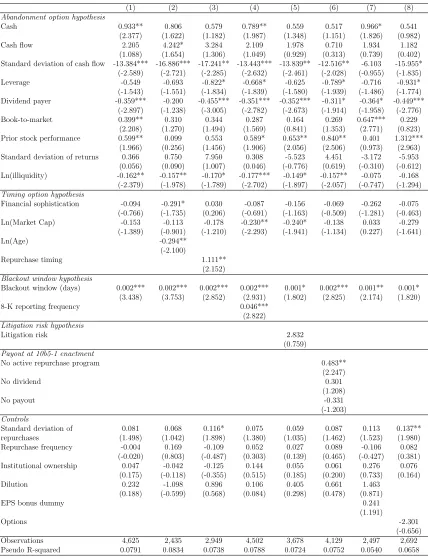
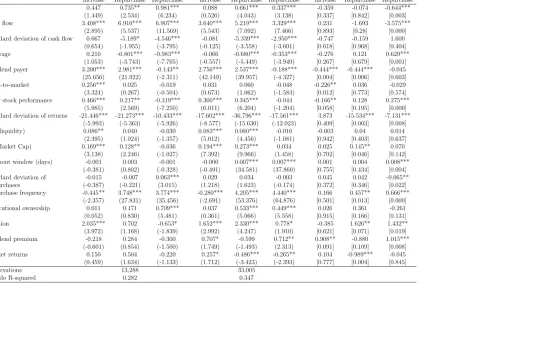
1.5.1 Logit regressions of the decision to adopt a Rule 10b5-1 plan Table 1.3 conditions on the sample of firms announcing a repurchase and presents logit regressions modeling the decision to adopt a Rule 10b5-1 plan relative to adopt-ing a non-preset OMR.15 We label firms that announce a Rule 10b5-1 plan during
the fiscal year “Rule 10b5-1 firms” that year; firms that announce open market re-purchases without a preset component are “OMR firms.” The dependent variable is a binary variable equal to one if the repurchase announcement includes a Rule 10b5-1 component. If a firm announces more than one repurchase in a fiscal year, we categorize the firm as a Rule 10b5-1 firm if at least one of the repurchase announce-ments includes a Rule 10b5-1 plan. When we condition on the availability of control variables and collapse our sample to the firm-year level, our sample consists of 1,014 Rule 10b5-1 firm-year observations, 3,611 non-preset OMR observations, and 25,342
15Summary statistics and difference in means tests are reported in Internet Appendix Table IA4.
non-repurchasing observations, unless otherwise noted. We match each repurchase announcement to prior fiscal year end accounting data from Compustat and stock price data from CRSP. Variable definitions are in Appendix A; continuous variables are winsorized at the 1st and 99th percentile to mitigate the effect of potential data errors and outliers. We report the coefficients on the independent variables along with their z-statistics calculated using robust standard errors clustered by firm. We include year dummies andFama and French(1997) 12 industry dummies in all specifications. The results in Table 1.3 support theAbandonment Option Hypothesis’ predictions that firms with large internal capital reserves and predictable cash flows will be more likely to commit to a preset Rule 10b5-1 plan. Similar in spirit to Chay and Suh
(2009), who find that cash flow uncertainty is negatively related to (inflexible) divi-dends, we find that the likelihood of adopting a Rule 10b5-1 plan as opposed to more flexible OMR decreases with cash flow volatility. The coefficient on the standard de-viation of cash flow in Model (1) indicates that a one standard dede-viation increase in cash flow volatility decreases the likelihood of adopting a preset repurchase relative to an OMR by 16%. These results are also consistent with agency costs driving firms with more cash on hand and more predictable cash flows to commit to distribute more to shareholders. We find further support of theAbandonment Option Hypothe-sis as firms with better prior stock performance and more liquid stocks are generally more likely to adopt a Rule 10b5-1 plan. These results are consistent with firms that have better access to external capital being more likely to adopt a preset repurchase program. In other words, firms that can raise external capital more easily are more likely to commit to future payouts, which expend internal resources. Finally, we find that firms that have already committed to dividend payouts are less likely to commit to a preset repurchase plan—specifically, dividend payers are 17% less likely to adopt a Rule 10b5-1 plan than non-payers.
The Timing Option Hypothesis predicts that firms with a history of poor re-purchase timing will be more likely to adopt a preset plan. Consistent with this prediction, we observe a significant and positive coefficient on our measure of repur-chase timing. A one standard deviation increase in repurrepur-chase timing (implying worse timing over the prior fiscal year) is associated with an 11% increase in the likelihood of adopting a preset plan. The coefficients on financial sophistication, firm size, and firm age are all negative, as predicted by the Timing Hypothesis; however, the co-efficients on financial sophistication and size fail to achieve statistical significance in most models.
10b5-1 repurchase plan.
Though Rule 10b5-1 provides additional legal protection unavailable in an OMR, we find no evidence that firms facing greater litigation risk are more likely to adopt a preset plan relative to an OMR. Our failure to achieve empirical support for the Litigation Risk Hypothesis is in line with the Rule’s initial intent to clarify enforce-ment of insider trading laws for individuals and with anecdotal evidence: We observe very few cases in the popular press of firms being accused of using inside informa-tion while repurchasing.16 However, this could simply reflect care taken not to run
afoul of the law while executing these plans. Overall, our initial multivariate results are consistent with theAbandonment Option, Timing Option, and Blackout Window Hypotheses, but we fail to find support for the Litigation Risk Hypothesis.17
Lastly, we study if and how firms modify payout policy when the menu of payout options expands by examining how pre-Rule payout behavior relates to Rule 10b5-1 adoption likelihood. To examine which types of firms are most likely to exploit the addition of Rule 10b5-1 plans to the menu of payout options, in Model (6) we add indicators to capture pre-enactment payout policy. Specifically, we include three indicators, which equal one if a firm has: (i) no repurchase announcement, (ii) no dividend payment, or (iii) no payout (i.e., no repurchase announcement or dividend payment) in the three years leading up to enactment (1998-2000). The no payout indicator is econometrically equivalent to an interaction term of the other two in-dicators. We find that firms without an active repurchase program in place when Rule 10b5-1 was enacted are significantly more likely to adopt a preset repurchase plan instead of an OMR. The no dividend and no payout indicators are statistically insignificant. These results are consistent with preset repurchases occupying a unique space within the payout landscape. Specifically, preset plans allowed a different set of firms who had not been repurchasing to begin buying back their shares.
We include several other control variables that may affect a firm’s choice of payout vehicle. Several models suggest that firms adopting 10b5-1 plans have more volatile prior repurchases, which may be correlated with blackout window constraints.18 We
16A notable exception is AOL, Inc., which received a securities class action complaint on behalf of
selling shareholders between August 11, 2011 and April 9, 2012. The lead plaintiff alleged that AOL deliberated kept their plan to monetize their legacy patents a secret in order to keep AOL stock at an artificially depressed price, which enabled them to exploit the information imbalance through a stock repurchase program. The court dismissed allegations based on lack of factual support for the secret patent deal.
17In Internet Appendix Table IA6 we investigate whether firms with greater agency concerns, more
employee stock options (ESOs), or higher turnover are more likely to adopt Rule 10b5-1 plans. The likelihood of adopting a Rule 10b5-1 plan is unrelated to the Bebchuk, Cohen, and Ferrell (2008) Entrenchment Index, to whether the CEO is also Chairman of the Board, or to whether an activist is present. However, firms with staggered boards, generally associated with worse corporate governance, are more likely to adopt preset repurchase plans. We do not identify a significant relation between the likelihood of adopting a Rule 10b5-1 plan and ESOs or turnover.
18We include repurchase frequency and standard deviation as controls to capture how regularly the
firm is in the market for its own stock. Firms with more regular repurchases (high frequency, lower standard deviation) may not need preset plans to circumvent blackout windows because they appear to already be able to be in the market consistently. On the other hand, regular repurchasers may prefer preset plans to ensure that they can be in the market frequently without
find that repurchase frequency, institutional ownership, share dilution, and executive compensation are not significant predictors of Rule 10b5-1 adoption.19
1.5.2 Rule 10b5-1 plan adoption: Robustness to excluding boilerplate announcements
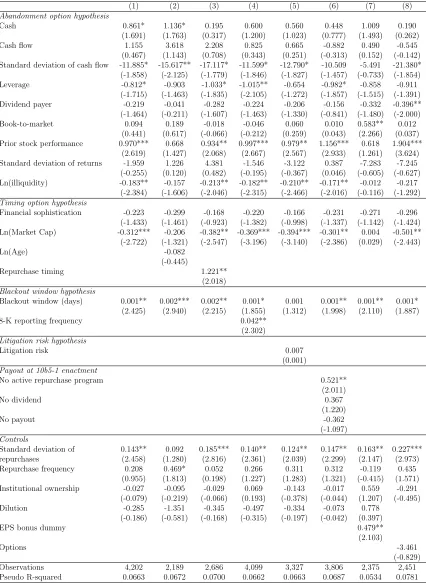
We next examine whether our above results regarding the decision to adopt a preset repurchase plan are sensitive to the exclusion of boilerplate announcements. Boiler-plate Rule 10b5-1 plan announcements represent the lowest level of commitment to repurchasing under the Rule and are most susceptible to false signaling, i.e., firms including a Rule 10b5-1 component in their announcement but never actually es-tablishing a preset plan. Table 1.4 reports the results of logit regressions modeling the decision to repurchase shares under Rule 10b5-1 excluding boilerplate announce-ments. In other words, Rule 10b5-1 firms are firms that announce a pure, partial, or expected Rule 10b5-1 plan. The base case is OMRs not containing any preset component. We report the coefficients along with their z-statistics. We include year and industry indicators in all specifications.
We gain several new insights into the decision to adopt a preset plan when we remove boilerplate plans. With a few caveats, our main results generally hold. We continue to find that flexibility is an important determinant of the decision to adopt a Rule 10b5-1 plan, consistent with theAbandonment Option Hypothesis. Firms with more stable cash flows, stronger prior stock performance, and more liquid stocks are generally more likely to adopt Rule 10b5-1 plans. Many of the cash and dividend payer coefficients lose statistical significance, although they maintain their expected sign in all cases. Given that our coefficients do not change drastically when we remove boilerplate plans, our loss of significance is likely due to reducing the power of our tests by cutting the sample size of Rule 10b5-1 plans by half. Poor repurchase timing is strongly related to adopting a non-boilerplate Rule 10b5-1 preset repurchase plan. Interestingly, when we exclude boilerplate plans, we discover that firm size is negatively related to Rule 10b5-1 adoption. Small firms and firms with a record of poor repurchase timing most likely lack the sophistication or desire to exercise the timing option associated with OMRs and thus are more likely to adopt a pure Rule 10b5-1 plan, supporting our Timing Option Hypothesis. We continue to find some support for the Blackout Window Hypothesis but no support of the Litigation Risk Hypothesis.20 Further, we continue to show that firms without an active repurchase
risk of regulatory scrutiny.
19We also model the decision to adopt a Rule 10b5-1 plan versus an ASR in Table IA13. Relative to
firms adopting ASRs, Rule 10b5-1 firms have greater, less volatile cash flows, consistent with firms with higher and more predictable cash flows being more willing to adopt Rule 10b5-1 plans, which are executed over time. Yet, Rule 10b5-1 firms have more volatile, less liquid stocks than ASR firms. These finding are consistent with firms with less predictable stock returns being less willing to accept ASR contracts, whose ultimate cost is a function of the volume-weighted stock price during the contract period, and with the immediate execution of ASRs being more problematic for firms with illiquid stocks.
20Interestingly, we lose significance on Blackout window when we include Litigation risk in the
program when Rule 10b5-1 was enacted are significantly more likely to adopt preset repurchase plans. Taken together, we conclude that our main findings generally hold within Rule 10b5-1 plans that represent a stronger commitment to the Rule.21
1.5.3 What determines the speed to first preset repurchase plan adop-tion?
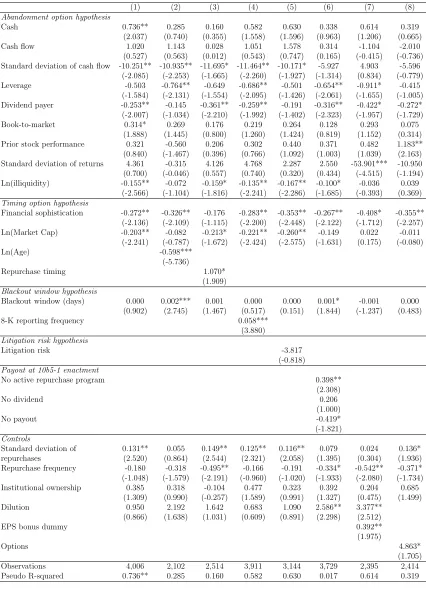
We observe that many firms adopting a preset repurchase plan continue to use a preset plan for future repurchases. In fact, only 199 firms that announce a preset repurchase plan subsequently announce an OMR without a Rule 10b5-1 component. Of these cases, 75% announced no further repurchase in the sample period, and the remaining 25% adopt another preset plan in their next repurchase announcement after the OMR. These findings suggest that a firm’s decision to adopt its first Rule 10b5-1 plan is quite important. Thus, we examine the time to first Rule 10b5-1 plan or “adoption speed” in Table 1.5 employing a Cox proportional hazard model using the sample of firms that announce a Rule 10b5-1 plan during our sample period. We measure the duration to adoption as the number of calendar days from the end of 2003 to the first time a firm adopts a preset plan.
The hazard models generally corroborate the results from our logit models and are consistent with theAbandonment Option, Timing Option, and Blackout Window Hypotheses: Firms that have yet to adopt a preset plan are more likely to adopt a preset plan at timet if they have more cash on hand, have more stable cash flows, carry less debt, do not pay a dividend, have more liquid stocks, are smaller, are younger, are less financially sophisticated, have a record of poor repurchase timing, and disclose material information more frequently. In addition, we find that firms adopt Rule 10b5-1 plans more quickly if they did not have an active repurchase program but paid a dividend at Rule enactment, they repurchased inconsistently in the past, their CEO’s bonus is tied to earnings per share, and they have more dilution or executive options.
1.5.4 Shock to cost of adopting a preset repurchase plan
Our results thus far suggest that firms for which financial flexibility is less valuable are more likely to adopt a Rule 10b5-1 plan over a traditional OMR plan. To claim a causal relation between financial flexibility and Rule 10b5-1 likelihood, we need to rule out endogeneity resulting from reverse causality or omitted variables. For reverse causality to be an issue, it must be the case that next year’s decision to repurchase under Rule 10b5-1 affects this year’s firm characteristics. We find this explanation improbable. A more reasonable concern is that we have failed to control for a variable that drives both financial flexibility and Rule 10b5-1 likelihood. While we take great care to control for an exhaustive list of observable variables, including
21Internet Appendix Table IA7 examines varying plan types in a multinomial logit setting, with a
base case of OMRs not containing a preset component. Overall, we observe that our results are not driven by one specific plan type.
firm-specific characteristics and industry and year fixed effects, our setting prevents us from completely ruling out omitted variables.
One potential solution is to identify an exogenous shock to the value of financial flexibility and examine changes in Rule 10b5-1 likelihood around this shock. Prior literature identifies the financial crisis of 2008 and 2009 as an unanticipated shock to the supply of credit available to firms (Ivashina and Scharfstein, 2010; Cornett, McNutt, Strahan, and Tehranian, 2011;Bliss, Cheng, and Denis,2015), and a credit supply shock should increase the marginal benefit of financial flexibility. Therefore, adopting a preset repurchase plan became more costly around the financial crisis, and so we expect to see fewer firms adopting these types of plans during the crisis. In this section we examine whether a shock to the marginal benefit of financial flexibility affects the likelihood of adopting a preset plan.
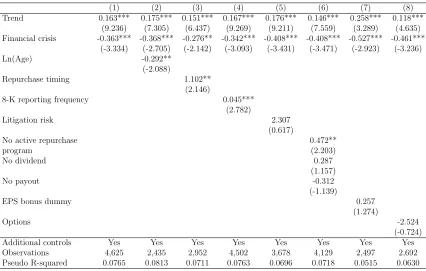
Table 1.6 presents results on the effect of the shock to the benefits of financial flexibility on the likelihood of adopting a Rule 10b5-1 plan. Mirroring our logit analysis in Table 1.4, we condense our sample to the firm-year level and estimate the probability of adopting a preset plan, conditional on announcing a repurchase. We include the same list of control variables (though we only show our variables of interest to conserve space), but we replace our year dummies with two variables: (1) a trend variable capturing the increasing tendency for firms to adopt preset plans over time and (2) an indicator variable to demarcate the financial crisis. The financial crisis indicator variable captures any shift in the probability of announcing a preset plan during the crisis.
As expected, we observe a significant upward trend in the likelihood of adopting a Rule 10b5-1 plan relative to adopting an OMR. Holding other variables constant at the mean, the coefficient on our trend variable implies that the likelihood of adopting a Rule 10b5-1 plan, conditional on announcing a repurchase, increases by approxi-mately 2.6% each year. However, the growth in preset repurchase plans significantly stagnates during the financial crisis. Repurchasing firms are 5.7% less likely to adopt a Rule 10b5-1 plan during the crisis.
In robustness tests, we run an “out-of-sample” logit model following Model (1) of Table 1.6 using the non-crisis period (2004-2007 and 2010-2013) and excluding the financial crisis indicator variable. We then predict the likelihood of announcing a preset plan during the financial crisis. The average predicted value during the financial crisis is 22.1%, significantly different at the 1% level from the actual value of 16.4%. This 5.7% difference is in line with our prior results. Overall, this evidence from an unanticipated positive shock to the marginal benefits of financial flexibility confirms our causal interpretation of the effect of flexibility concerns on the choice to adopt a 10b5-1 plan.
1.6 Repurchase announcement returns
represent a greater commitment to repurchase shares, causing announcement returns to be greater in response to this signal. The net effect is an empirical question.
Panel A of Table 1.7 reports five-day cumulative abnormal returns (CARs) from trading days -2 to +2 around the announcement by type of repurchase (Rule 10b5-1 and non-preset OMR) and by level of commitment to repurchasing under the preset plan. We remove observations with earnings announcements during this five-day win-dow. We estimate the parameters of the market model over 255 trading days, ending 46 days prior to the announcement. We use the Center for Research in Security and Prices (CRSP) value weighted index as the market portfolio and require a minimum of 100 trading days over the estimation window. We winsorize our returns measures at the 1st and 99th percentiles to mitigate the effect of outliers. Panel B presents difference in means tests, calculated using propensity score matching, which controls for observable firm characteristics likely to affect announcement returns. Control firms are the five nearest neighbors identified through our propensity score matching process based on logit regressions in Panel B of Table IA3 of the Internet Appendix. We find positive and significant five-day cumulative abnormal returns (CARs) to preset repurchase announcements. In the aggregate, Rule 10b5-1 plans are met with CARs of 1.5%, or 0.4% greater than non-preset OMR plans.22 This difference represents an increase of over 36% from the average non-preset CAR of 1.1%. An-nouncements with little commitment to a preset plan are associated with lower returns while announcements with a greater commitment are associated with higher returns. Boilerplate Rule 10b5-1 plans are associated with the lowest CARs of 1.1% while pure plans are associated with CARs of 2.4%; the returns to partial and expected plans fall in between. Thus, pure plans, which we know with certainty are executed fully under the Rule, are associated with CARs that are more than double the returns to non-preset OMR announcements. Further, when we control for firm characteristics likely to affect repurchase announcement returns, we find that announcement returns to pure Rule 10b5-1 announcements are 1.4% greater than and statistically different from abnormal returns to non-preset OMR announcements. These results are con-sistent with the benefit of the increased commitment and reduction in agency costs implied by preset plans outweighing the cost of being unable to exploit private in-formation fully.23,24 The current literature documents announcement returns of 1.3%
and 3.4% for dividend increases and initiations, respectively (Farre-Mensa, Michaely,
22Rule 10b5-1 announcement returns are on par with CARs around ASR announcements, which
equal 1.8% for all ASR plans and 1.7% for pure ASR plans. We present these figures in Internet Appendix Table IA14.
23In Internet Appendix Table IA8, we also regress announcement returns on a Rule 10b5-1 repurchase
plan indicator, the size of the repurchase program and our standard controls included in our base logit model (from Table 1.4, Panel A, Model (1)). These regressions corroborate our prior results.
24Given that previous studies document anomalous returns following repurchase announcements
(e.g.,Lakonishok and Vermaelen,1990;Ikenberry, Lakonishok, and Vermaelen,1995;Gong, Louis, and Sun, 2008; Peyer and Vermaelen, 2009), we estimate long-run (12-month) abnormal stock performance in Internet Appendix Table IA9. We document positive and significant long-run abnormal returns of 55 bps per month, but they are driven by the subsample of 10b5-1 plans that are concurrent with OMRs. Overall, our evidence on abnormal returns suggests that investors recognize and immediately respond to the increased commitment in preset repurchase plans.