T
IME MATTERS in forensic psychology. One of the few things that transcends the differences of our subdisciplines is a concern for understanding and shaping how events unfold over time. Clinical treatments use a series of interventions to promote incremental changes in patients’ behaviour. Risk assessments evaluate the trajectory of an offender’s personal development to predict his or her future conduct. Police investiga-tions unfold as a series of decisions and actions. Even serious crimes, the basis of much forensic work, comprise a sequence of actions and reactions between the offender and victim.Given the importance of time in forensic psychology, we might expect the field to be glutted with analyses of ‘forensic processes’. Unfortunately, the reality is very different. To examine the extent to which time has fea-tured in forensic research, we reviewed all articles published in the top 10 forensic psy-chology journals (as identified by Walters, 2006) between 2000 and 2007. An article was counted as analysing process if it considered data from at least three time points, using a methodology that retained the temporal relations between these time points. For example, a study measuring the impact of treatment on offender behaviour at delivery,
Analysing forensic processes: Taking time
into account
Paul J. Taylor, Karen Jacques, Ellen Giebels, Mark Levine,
Rachel Best, Jan Winter & Gina Rossi
Abstract
A great deal of forensic psychology concerns sequences of behaviours or events. In this paper, we review some recent efforts to examine forensic issues as sequences, discuss some of the contemporary methodologies involved, and highlight some of the lessons that emerge from this research. Specifically, we show: (i) how research on public violence has benefited from studying incidents as patterns of cues and responses among perpetrators and bystanders; (ii) how regularities in the histories of those who undertake suicide terrorism may be identified by mapping their life events on a graphical timeline; and (iii) how sequence-based corre-lation coefficients make it possible to test detailed theories about the ways perpetrators respond to the vari-ous influence attempts of police negotiators. We conclude by encouraging forensic psychologists to conceptualise their own areas of investigation as a sequence of events rather than a collection of variables.
1To be counted as analysing process, an article had to consider data from at least three time
points using a methodology that respected the temporal relations between the three points. Our decision not to include articles using two time points (e.g. the before–after designs preva-lent in recidivism research) was made because such designs speak effectively to what happens but say less about the process by which it happens. A list of the papers identified as examining process is available at: http://www.lancs.ac.uk/staff/taylorpj/ifp. Please get in touch if you think we have overlooked an article relevant to process.
6-month and 12-month follow-up would be counted as measuring process. So would a study using time-series analysis to examine the unfolding violent interaction between husband and wife in conflict. In total, we found just 16 papers that examined process as set out by our criteria.1This equates to just over two articles a year, and less than 1 per cent of all papers published by these journals over the seven years. By way of comparison, the British Journal of Social Psychology alone published seven articles on process within the same period.2
The absence of process in forensic publi-cations makes it difficult to draw any conclu-sion except that forensic psychology has not focused on process nearly as much as it should have (for a similar conclusion in soci-ology see Abbott, 1990). However, this state of affairs is arguably not without good rea-son. There continues to be a paucity of avail-able texts on sequence methodologies and their application (particularly compared to other methods such as general linear model-ling or qualitative analysis), which makes it difficult for researchers to identify and use available methods. There is also an overrid-ing tendency for researchers to organise their studies in terms of variables rather than events. A variable-centric approach is famil-iar and, when used appropriately, provides a rigorous way of testing theory. But it limits drastically what researchers can say about the importance of history and change to their phenomenon of interest. For example, the reason for an officer’s decision during a murder enquiry can only be understood in the context of previous decisions, evidence seen, and the order in which these decisions and evidence transpired. It is only by using sequence methods that we can begin to understand this decision because it is only sequence methods that examine the deci-sion within the context of an unfolding set of behaviours and events. In sum, methods that examine temporality open up ways of answering some of the questions that foren-sic psychologists really want to answer.
In the remainder of this paper we seek to
provide a flavour of what studying process can offer forensic psychology, and how it has already begun to reshape practice. We do so by examining three areas of research. Our point of departure is recent studies of vio-lence in the ‘night-time economy’. These studies demonstrate what can be learned about group violence simply by conceptualis-ing an incident as a sequence of actions and reactions, rather than as a collection of occurring variables. We then introduce a graphical approach to understanding process by examining a sequence of events that occur over a much larger time scale – that of an individual’s life. We review how examining the life histories of female suicide terrorists can provide important insights into the critical events, turning points, and processes of radicalisation that underlie their involvement. Finally, we review research on hostage negotiation, conceptu-alised as a sequence of cues and responses, and how sequence methods have made it possible to test hypotheses about differences in the effectiveness of influence strategies across cultures. Answers to these hypotheses have informed negotiation strategy.
One doesn’t have to look far
the social context in which drinking takes place, and by the cultural traditions that either inhibit or facilitate aggression in these contexts. Understanding when and why vio-lent episodes erupt therefore offers much to crime reduction initiatives.
To derive an initial understanding of night-time violence, Levine et al. (2007) col-lected 42 CCTV clips of violent episodes that did not include the intervention of the police or private security forces (e.g. bounc-ers). They then coded the observable behav-iour of those involved in the incidents as either escalating (e.g. punch, kick) or de-escalating acts (e.g. hold back), and noted both who acted, and to whom their behav-iour was directed. So, for example, a coded behaviour might be a protagonist acting aggressively towards the target (i.e. protago-nist–escalate–target), or a bystander acting to de-escalate another bystander (i.e. bystander–de-escalating–bystander). They then arranged these actor–action–target codes into time order. By analysing the resulting sequences of acts, Levine et al. were able identify certain features that lead to
severe violence rather than de-escalation, and to tell a compelling story about the pat-terns of behaviour that occur in night-time economy violence.
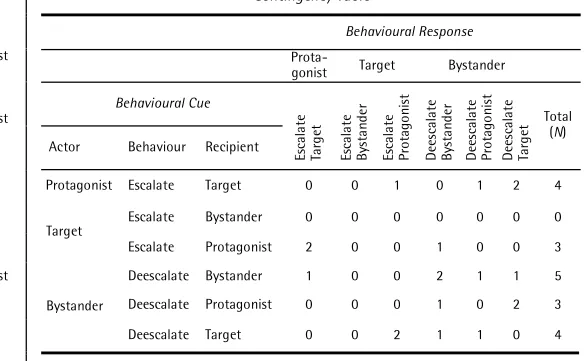
The first step in examining the night-time violence data was to look at the contin-gencies among the actor–action–target codes. In its simplest form, a contingency is a count of the number of occasions that one event (e.g. protagonist–escalate–target) is followed by a second event (e.g. bystander–de-escalating–bystander) over the sequence being examined.
Table 1 gives an example of contingen-cies in the night-time violence data. The left panel of Table 1 shows part of a sequence of behaviours and the right panel the counted contingencies. To derive the counts shown in the right panel, move from top to bottom of the sequence in the left panel and, on each occasion, note down the behaviour that immediately precedes the behaviour reached.3The results when tallied and put in tabular form should match the table shown in the right-hand side of Table 1. As can be seen from Table 1, some behaviours occur
Behaviour Sequence Contingency Table
Behavioural Response
Prota-
gonist Target Bystander
Behavioural Cue
Actor Behaviour Recipient
Es ca la te Ta rg et Es ca la te By st an de r Es ca la te Pro ta go ni st D ee sc al at e By st an de r D ee sc al at e Pro ta go ni st D ee sc al at e Ta rg
et Total (N)
Protagonist Escalate Target 0 0 1 0 1 2 4
Escalate Bystander 0 0 0 0 0 0 0
Target
Escalate Protagonist 2 0 0 1 0 0 3
Deescalate Bystander 1 0 0 2 1 1 5
Deescalate Protagonist 0 0 0 1 0 2 3
Bystander
Deescalate Target 0 0 2 1 1 0 4
NOTE—To conserve space, not all combination of Actor-Behaviour-Recipient codes are shown in this Table (e.g., Target-Deescalate-Protagonist) since they do not occur in the example sequence.
…
Protagonist Escalate Target Bystander Deescalate Protagonist Bystander Deescalate Target Target Escalate Protagonist Bystander Deescalate Bystander Bystander Deescalate Protagonist Bystander Deescalate Bystander Bystander Deescalate Target Bystander Deescalate Bystander Bystander Deescalate Bystander Bystander Deescalate Bystander Protagonist Escalate Target Target Escalate Protagonist Protagonist Escalate Target Bystander Deescalate Target Bystander Deescalate Protagonist Bystander Deescalate Target Target Escalate Protagonist Protagonist Escalate Target Bystander Deescalate Target
[image:3.488.150.442.400.581.2]…
Table 1: An example of a behaviour sequence from the night-time economy data and the resulting
time and time again regardless of the subse-quent behaviour (i.e. they have a higher baseline frequency of occurrence). This makes it more sensible to examine the pro-portion of occasions when the behaviour is followed by a particular second behaviour versus any other behaviour. Popular meth-ods of analysing contingencies tend to base their analyses on such proportions (e.g. lag analysis, Bakeman & Gottman, 1997; infor-mation theory, Taylor & Donald, 2003).
In the night-time economy data, an analy-sis of contingencies in this manner has helped reveal much of the dynamics of the violence. The first thing that is apparent when examining these sequences is that night-time economy violence is regulated by the behaviour of bystanders. Acts of violence by the protagonist or victim are typically met by interjections by one or more bystanders, and it is the valence of the bystander’s responses, rather than the behaviour of per-petrators or victims, which is most likely to shape the trajectory of violence. At the same time, and contrary to the popular stereotype, bystanders are far more likely to try to de-escalate than to de-escalate violence. Of the 42 clips examined by Levine et al., only 4 were characterised by bystanders who responded to perpetrator aggression with more escala-tion than de-escalaescala-tion. In 33 of the inci-dents, the only response of the bystanders was de-escalation, no matter how many times the perpetrator tried to escalate the situation (the average was 6.8 times).
A second finding to emerge from decom-posing the violent episode in this way relates to the severity of the incident. In contrast to de-individuation theory (Zimbardo, 1969), which suggests that increasing group size leads to a reduction in the controls of
per-sonal identity and thus a greater chance of antisocial behaviour, and in contrast to bystander research (Latané & Darley, 1970), which suggests that increased group size leads to greater diffusion of responsibility and thus less likelihood of bystander inter-vention, the contingency data suggest that increasing group size leads to more, not less, regulation. To be precise, as the number of bystanders involved in the incident increases, so too does the amount of escalat-ing behaviour. However, this increase is dwarfed by a far sharper increase in the number of de-escalation interventions made by bystanders, making the ratio between escalating and de-escalating behaviour firmly in favour of de-escalation with this effect becoming more dominant as group size increases. Group size and social identity interact in ways that can sometimes lead to the escalation of violence, but more often lead to the de-escalation of violence.
The findings that are beginning to emerge from Levine et al.’s research have implications for police understanding and management of night-time violence (cf. Drury et al., 2003). All of the findings point towards the importance of the role of bystanders in regulating violence, suggesting that efforts to design strategies to combat violence are likely to benefit from engaging with the bystander group. The findings sug-gest, for example, that intervention strate-gies should not necessarily seek to remove bystanders from the equation but, instead, work to facilitate their regulation of the inci-dent. Similarly, they suggest that messages encouraging group responsibility and regu-lation may be a valuable part of a wider crime reduction initiative focused on the night-time economy. Of course, Levine et
3There are many analogies that can help with understanding the different facets of an event
al.’s preliminary findings open up important questions that are best answered by studying the unfolding interaction among protago-nists and bystanders. One such question relates to the failing of bystander regulation during incidents in which violence escalates out of control. Identifying the behavioural dynamics that characterise these incidents, and comparing these to the dynamics found in incidents where bystanders successfully regulate behaviour, is likely to enhance our understanding of the factors that initiate and facilitate night-time economy violence.
A picture paints a thousand words One of the easiest and most rewarding ways to examine a process is to represent the con-tingencies among its constituent parts in a ‘state transition diagram’. These diagrams represent events within the process as nodes and contingencies as arrows between the var-ious nodes. The result is a ‘flow chart’ like diagram that allows us to begin to interpret the ways in which events come together over time. This interpretation is often made eas-ier by a shading of the arrows. Typically, thicker arrows are drawn for associations that occur far more frequently than would be expected by chance. This kind of
method-ology has been used for understanding rape interactions (Fossi et al., 2005), the use of accommodation in courtrooms (Gnisci, 2005), the interaction of husbands and wives (Gottman et al. 1977), and even the sequence of events that leads up to road-traf-fic accidents (Clarke et al., 1999).
One recent application of the method has been to understand the process by which individuals become involved (and later un-involved) in extremism. Karen Jacques (Jacques & Taylor, 2007) has explored the structure and development of female suicide terrorists’ life stories, as measured by the sequence of pertinent events that occurred in their lives. Specifically, she has collected biographies of female and male suicide ter-rorists from various open sources (e.g. biog-raphies, interviews and martyrdom videos), and coded these biographies for the occur-rence of life events ranging from changing employment to travelling abroad to partici-pating in jihad. These events can then be arranged chronologically, and the sequences examined using a state-transition diagram. By comparing across many sequences, this diagram provides a modelling that shows some of the most likely pathways into extremism and some of the most likely
[image:5.488.69.443.419.625.2]sequence of events in 23 female extremists’ lives prior to undertaking a suicide attack, as reported in Jacques and Taylor (2007). The state-transition diagram in Figure 1 repre-sents the females’ life histories schematically as arrows connecting ‘nodes’ of life events. An arrow is drawn between two nodes when the events associated with the nodes are found to occur next to one another in one or more of the females’ life histories. The direction of the arrow corresponds with the temporal order in which the events occurred. For example, since family prob-lems (e.g. arguments, parental violence) sometimes precede having an affair with another man, an arrow is drawn on Figure 1 from the node representing family problems to the node representing affair.
To capture the significance of the transi-tions, and to avoid presenting an overly com-plex web of arrows, Figure 1 shades the connections according to a standardised conditional probability. A standardised con-ditional probability is a z-score of a condi-tional probability derived using the mean and standard deviation of the sample of con-ditional probabilities that begin with the same initiating behaviour (i.e. behaviour a followed by any behaviour). The higher the resulting z-score for a contingency, the more common that particular sequence of events was in the lives of the females. A contingency that occurred fewer times than average (i.e. standardised conditional probability < 0.00) was removed from Figure 1 (i.e. made invisi-ble) on the basis that this was not a common pathway and might reflect error within the data. In contrast, a contingency that occurred more than average is represented in Figure 1 by a single line, while standard-ised conditional probabilities above 1.00 (p< .10) and 1.96 (p < .05) are identified with double and triple lines, respectively.
An examination of Figure 1 provides an efficient way of evaluating the ‘conceptual mire’ of theories about why people engage in terrorism (Silke, 2001). First, the diagram suggests that no common pathway of events exists for females prior to conducting an act
of suicide terrorism. This highlights the com-plexity of the issue and suggests that single motive explanations of involvement are not sufficient accounts of what occurs. However, while there is no common pathway to female involvement, the various pathways shown in Figure 1 share the characteristic of being predominantly linear. Events further along the sequence do not (re-)connect with previ-ous events in the sequence; no arrows move from right to left on the figure. This linear characteristic of Figure 1 suggests that it may be possible to ‘measure’ how far an individ-ual is through the process, which is some-thing that might support risk assessment and threat prioritisation.
Second, the diagram highlights the importance of several common key events to the lives of many females prior to their attack. Particularly prevalent in Figure 1 is the variable family problems, which appears to act as a ‘gate keeper’ to many of the sub-sequent events in the females’ lives. Thus, consistent with findings on other types of offender (Payne et al., 2007), an unsettled family life appears to lead to changes in cir-cumstances, which opens up – or facilitates existing – avenues into terrorism. A com-plete explanation for the central role of this event in the female pathways requires repli-cation and further qualitative analysis of each person’s life history, but it is possible to make some general observations. One important observation is that the centrality of family problems is consistent with recent evidence suggesting that females often become involved for personal motivations, rather than group or ideological motivations that are often associated with male involve-ment (Jacques & Taylor, 2008).
extremism for these females, and the experi-ences that this encapsulates, is arguably very different from those who engage over a longer sequence of events. Such a striking pathway towards the end point is quite com-mon on state-transition diagrams of criminal life histories, and might be thought of as a fast-track of particular concern to prevention efforts. Conversely, note that other events which we might predict to have a direct asso-ciation with engagement in suicide terrorism do not appear to have such a direct relation-ship. For example, as can be seen in Figure 1, membership of an extremist group (mem-ber group) does not set in motion a clear pathway of events towards committing an attack. This suggests that many females who engage in suicide terrorism did not engage with an extremist group in any formal way over a sustained period of time. Rather, at some point in this process, they decided to act to support the group’s cause.
On more complex state-transition dia-grams it is possible to find events or behav-iours that assume other roles not found on Figure 1. For example, in an analysis of the process of rehabilitation, a backwards link may concern an event that causes relapses in patients’ recovery. Similarly, in an analysis of investigative interviewing, a backward link may represent occasions where the inter-viewer returns to a previous line of question-ing. Another type of role concerns events or behaviours that represent ‘turning points’ in the overall pathway, with the behaviour that follows on from the event either leading to a new set of events further ‘downstream’ or leading back to a set of events encountered previously. The turning-point event there-fore represents a particularly critical point at which to intervene to influence the way a person moves through the process. Studies using state-transition diagrams will often then target such events for further analysis, in order to identify why the event is critical and how it might be possible to influence its relevance.
Dissecting a complex process
There are at least two reasons why state-tran-sition diagrams may not be sufficient for a researcher. The first is that they do not pro-vide an immediate means of making infer-ences about the differinfer-ences in process across two or more subgroups (e.g. across inde-pendent variables). While drawing separate state-transition diagrams for various sub-groups can prove useful, the visual compari-son they afford tells us less about the likelihood of a difference in contingency occurring by chance. This problem is partic-ularly pertinent when the events of interest occur rarely; they may not take a prominent position in the state-transition diagram but they may represent a critical event in the way the process unfolds in the subgroups. The second is that state-transition diagrams typi-cally focus on immediate contingencies, and in more complicated processes it is often the case that behaviours in the sequence are related, but only after one or more interme-diate behaviours. For example, a police interviewer’s line of persuasive questioning may lead to an immediate confession by a perpetrator, or it may lead to a confession following a number of intermittent exchanges. It may thus be important to cap-ture these less direct relationships between events, since it may be these delayed rela-tionships that are critical to how a process unfolds. History may take its time to affect the present (Taylor & Donald, 2003; Wat-zlawick et al., 1968, p.131).
data to ensure that relevant relationships are captured. Fortunately, a recent development in sequence analysis methods, known as the proximity coefficient (Taylor, 2006; Taylor & Donald, 2007), has gone a long way to resolv-ing this problem because it is derived from the intrinsic interrelationships between events.
The basis of the proximity coefficient is the notion that events contribute to the same part of a sequence and have more in com-mon when they occur close together within the sequence than when they occur far apart. Events over time occur in ways that are con-nected and organised rather than random and haphazard (Argyle, 1969; Gottman et al., 1977; Kelley, 1997). This is reflected concep-tually in the proximity approach by associat-ing less immediate relationships in a sequence with lower proximity. Specifically, the coefficient equals 0.00 if the events being considered occur only at the beginning and end of the sequence. It equals 1.00 if one event immediately precedes the second event whenever it occurs in the sequence without exception. Values between these two limits reflect differing amounts of proximity between the two events being examined. The proximity coefficient decreases monotoni-cally as more events are found (on average) to separate the two events being examined (i.e. proximity reduces). It does this in a manner that is independent of the length of the sequence, and independent of the number of times an event occurs in the sequence.
One area where the proximity coefficient has been valuable is in studying interactions between police and offenders. A good exam-ple of this is in hostage negotiation, where chains of cues and responses come together to form the interaction between police
nego-tiator and perpetrator. Ellen Giebels and her colleagues have used a range of sequence methods to understand the use and impact of influence strategies within this context (Giebels & Noelanders, 2004). Recent work (Giebels & Taylor, in press a; in press b) has considered differences in influence across cultures by comparing the interaction processes of negotiations where the perpe-trator originated from either low-context or high-context cultures.4As with all the exam-ples in this paper, the negotiations were examined by coding the behaviour as it occurred in the unfolding interaction. Specifically, transcripts of the dialogue between police negotiator and perpetrator were coded at the level of utterance using a framework of ten influence tactics (well-known in the field as the ‘Table of Ten’, see Giebels & Noelanders, 2004), which includes tactics such as being kind, intimidation and rational persuasion.
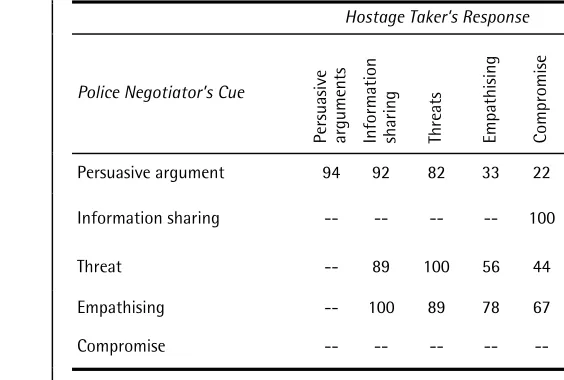
To further illustrate the data and how the coefficients are derived, Table 2 presents an excerpt of an interaction adapted from a negotiation with a high-context perpetrator. This table is divided in a similar way to Table 1. In the left-panel is a sequence of coded utterances as spoken by the police negotia-tor (PN) and the perpetranegotia-tor (HT). In the right-hand panel is the matrix of proximity coefficients derived from the behaviour sequence in the left panel. When laid out in this way it is possible to explore how interre-lationships among behaviours are reflected by different values of the proximity coeffi-cient. For example, instances of the perpe-trator sharing information (i.e. HT information sharing) always occur directly after a police negotiator expresses empathy (PN empathising). Consequently, the prox-imity of these behaviours is the maximum
4The theoretical and empirical background to the distinction between low- and high-context
possible. In contrast, the police negotiator’s persuasive arguments (PN persuasive argu-ments) occur towards the beginning of the sequence, while the hostage taker’s compro-mise (HT comprocompro-mise) occurs at the end, which means that the proximity of these behaviours is low. Consistent with these examples, the coefficient matrix reports a perfect association between PN empathising and HT information sharing (1.00) and a low proximity between PN persuasive argu-ments and HT compromise (.22). All of the other relationships in the example sequence fall between these two extremes and, accord-ingly, have coefficient values that depend on their distances apart in the sequence.
A few other aspects of the matrix in Table 2 are worth noting because they illustrate how the proximity approach helps examine process. One is the occurrence of missing coefficients (e.g. for PN empathising to HT persuasive argument). These reflect the dis-tribution of behaviours in the negotiation, with missing values in a variable row (or col-umn) indicating that most observations of the behaviour occur toward the end (or beginning) of the interaction (as is the case for compromise in Table 2). A second is the coefficients that appear on the diagonal of
the matrix. These provide a measure of reci-procity (Putnam & Jones, 1982) that quanti-fies the number of codes that occur before reciprocation, rather than simply the occur-rence of immediate reciprocation. A third is the asymmetric nature of the coefficient val-ues. For example, the coefficient for PN empathising preceding HT threats (i.e. .89) is higher than the coefficient for PN threats preceding HT empathising (i.e. .56). In gen-eral, proximity coefficients will be asymmet-rical, reflecting the possibility that one event occurs before the second on the majority of occasions. In such cases, the difference between two coefficient values may provide an indication of dominance between the behaviours.
One of the advantages of the proximity coefficient is that it is possible to derive a matrix of coefficients – similar to that in Table 2 – for each sequence in the data set. This is useful because it becomes possible to derive coefficients for the same cue–response relationship across a number of cases. This, in turn, makes it possible to both derive means and standard deviations for the coefficients, and make comparisons across subgroups of coefficients using stan-dard tests (e.g. ANOVA). In their hostage
Hostage Taker’s Response
Police Negotiator’s Cue
Pe
rs
ua
siv
e
ar
gu
me
nt
s
Infor
mation
sh
ar
in
g
Th
re
at
s
Empathis
ing
Co
m
pr
om
is
e
Persuasive argument 94 92 82 33 22
Information sharing -- -- -- -- 100
Threat -- 89 100 56 44
Empathising -- 100 89 78 67
Compromise -- -- -- --
--…
PN Persuasive Argument HT Threat
PN Persuasive Argument HT Persuasive Argument PN Persuasive Argument HT Information sharing PN Empathising HT Information sharing PN Threats
HT Threats
[image:9.488.162.444.56.246.2]PN Persuasive Argument HT Information sharing PN Empathising HT Information sharing PN Empathising HT Information sharing PN Empathising HT Empathising PN Information sharing HT Compromise …
negotiation analysis, Giebels and Taylor (in press a) used this approach to examine dis-tributions of coefficients calculated from incidents involving perpetrators from high-and low-context cultures.5 The results of their comparisons across cultural groups begin to offer insights for those interacting with perpetrators from low- or high-context cultures.
The first lesson to emerge from Giebels and Taylor’s research is that rational persua-sion, often considered the backbone of negotiation strategy, is typically more effec-tive with low-context than high-context per-petrators. For example, a comparison of responses to persuasive argument suggests that low-context perpetrators are more immediate to respond with compromises than their high-context counterparts (prox-imity coefficient = .86 compared to .65). Interestingly, this finding emerged irrespec-tive of whether analysis considered interac-tion from early ‘crisis’ periods (so-called because of their association with high-anxi-ety, emotionality, and cognitive deteriora-tion) or later ‘normative’ periods, where the extremes of the context have dissipated. Per-haps because logic and deductive thinking are valued in low-context cultures (Gelfand & Dyer, 2000), arguments elicited compro-mises from low-context negotiators regard-less of whether or not they were in crisis.
The second lesson to emerge from this research is that using threats to influence interaction often results in an escalation of conflict with high-context perpetrators. Specifically, while low-context perpetrators are found to be more likely to communicate threats, high-context perpetrators were more likely to reciprocate them. One
com-pelling explanation for this finding, which carries important lessons for practice, is that threats draw attention to the need to pre-serve face, and that this need is sufficiently important within high-context cultures for them to reciprocate the explicit challenge (Ting-Toomey & Oetzel, 2001). Threats are a confrontational way of handling an interac-tion and, while this is consistent with low-context interactions, it is generally more inappropriate in high-context cultures (Fu & Yukl, 2000). Thus, it is not surprising that threats are used more by low-context perpe-trators, but that high-context perpetrators are more likely to respond to them by ‘pun-ishing’ with counter-threats. This is likely to be particularly true in high-stakes criminal settings (e.g. police interviews) where estab-lishing dominance and saving face may become particularly salient factors (Adair & Brett, 2004).
Discussion
Sequence analysis holds great promise for forensic psychology. Most if not all of our classic theories and contemporary issues involve development or change over time. Our practices also comprise events that are sequential or interactional rather than static and variable-centric in nature. It is time our analyses reflected this. The methods we con-sider in this paper make it possible to address forensic issues as sequences. What the field needs are scholars and practitioners committed to advancing existing wisdom by uncovering the sequential regularities that lie behind forensic phenomena. These pio-neers will adopt cases not variables as the focus of their enquiries. They will talk about development and change, turning points
5In Giebels and Taylor (in press a), the comparisons of proximity coefficients are taken one
and critical pathways, life courses and phases, and facilitators and inhibitors.
There are of course many forensic and investigative processes that we have not con-sidered (for an overview see Donald & Tay-lor, 2007). One core area for investigative psychology is the problem of differentiating offenders on the basis of their behaviour at the crime scene (Canter, 2000; Nutch & Bloombaum, 1968). The intriguing aspect of this research is that, overwhelmingly, it has focused on the behaviour of the offender (rather than the interaction between offender and victim) using a methodology that takes absolutely no account of the order in which behaviours occur during the crime. Not only does this approach neglect the importance of interaction process, but it is at odds with what we know from interactionist theories of human behaviour (Mischel, 2004), which is that people do not act con-sistently in different situations. As others have acknowledged (Alison et al., 2002), we must assume either that victims provide a fairly uniform context (something shown to be false, see Ullman, 2007) or that the mod-els are robust enough to withstand context-based changes in behaviour. It would seem important, therefore, to test whether offend-ers’ behaviour is consistent when faced with changing behaviour from their victims. Or, if this is not the case, to ensure that existing models provide a robust measure of inter-personal style from which to develop infer-ences about offenders’ characteristics.
To test this possibility, Jan Winter is undertaking doctoral research that exam-ines whether or not existing typologies of criminal behaviour can capture actual con-sistencies in the way in which an offender behaves as observed in an unfolding interac-tion between offender and victim (Winter & Rossi, submitted; Winter & Taylor, 2006a, 2006b; see also Fossi et al., 2005). To achieve this, Winter is examining victims’ accounts of their sexual assaults and piecing together from these accounts the sequence of offender and victim behaviours as it occurred during the offence. The result is
event sequences that capture the interaction between offender and victim, which should allow for an analysis of the interpersonal style of the offender. Winter’s initial analyses reveal some important lessons for those in the business of making inferences from crime scene behaviour. First, when offenders are examined according to the similarities and differences in their interpersonal style (i.e. the ways in which they respond to their victim’s behaviour), it is not possible to repli-cate the typologies found previously when examining offender behaviour alone. Sec-ond, when an offender’s interpersonal style is viewed as a function of a number of con-text variables, then consistencies and differ-ences in behaviour begin to emerge in a form that is amenable to theoretically grounded classification. Thus, if this prelim-inary analysis stands up to further scrutiny, it suggests that offender differentiation should begin to focus on interaction processes and the context in which an offender behaves.
devel-opment, but also an assessment of when (i.e. at what point on the process) to target inter-vention and preinter-vention.
Conclusion
Criminal acts and investigative decisions occur not as variables to be counted but as events to be understood within a larger sequence of events. This is often acknowl-edged in forensic theory, but rarely exam-ined in forensic research. As we have explored, there are simple and more com-plex methods available for examining foren-sic processes that correspond well with the way the issue occurs in practice. It is, we believe, risky for researchers to draw conclu-sions about process when they use a method-ology that does not examine process. As we have explored in this paper, there are a range of simple and more complex methods for examining such sequences and it is time for forensic psychologists to take advantage of these methods. We therefore encourage research and practitioners alike to take the time to understand and apply sequence
methods in their own areas of work. To assist those willing to take up the challenge, we have made available a number of resources at: http://www.lancs.ac.uk/staff/taylorpj/ ifp.htm. Among other things, you can down-load from this website details of the material discussed in this article, a biography of forensic research that examines ‘process data’, and software to examine process in your own data.
Acknowledgement
The research we report was made possible by ESRC grants PTA-026-27-0044, PTA-030-2006-00351, and RES-000-23-1098 (awarded to Taylor, Jacques, and Levine, respectively), a British Council-NWO partnership in sci-ence grant (PS844), awarded to Giebels and Taylor, and an OZR grant (#1589) awarded to Winter and Rossi.
Address for correspondence
References
Abbott, A. (1990). A primer on sequence methods.
Organization Science, 4, 375–392.
Adair, W.L. & Brett, J.M. (2004). Culture and negotia-tion processes. In M.J. Gelfand & J.M. Brett (Eds.),
The handbook of negotiation and culture(pp. 158-176). Palo Alto, CA: Stanford University Press. Alison, L., Bennell, C., Mokros, A. & Ormerod, D.
(2002). The personality paradox in offender pro-filing: A theoretical review of the processes involved in deriving background characteristics
from crime scene actions.Psychology, Public Policy
& Law, 8, 115–135.
Argyle, M. (1969).Social interaction. New York:
Ather-ton Press.
Bakeman, R. & Gottman, J.M. (1997).Observing
interac-tion: An introduction to sequential analysis(2nd edn). New York: Cambridge University Press.
Canter, D.V. (2000). Offender profiling and criminal
differentiation. Legal and Criminological Psychology,
5, 23–46.
Clarke, D.D., Forsyth, R. & Wright, R. (1999). Junc-tion road accidents during cross-flow turns: A
sequence analysis of police case files. Accident
Analysis and Prevention, 31, 31–43.
Donald, I.J. & Taylor, P.J. (2007). Investigative
psy-chology. In D. Clark (Ed.), Encyclopedia of law and
society: American and global perspectives (pp. 821–824). New York: Sage.
Drury, J., Stott, C. & Farsides, T. (2003). The role of police perceptions and practices in the
develop-ment of ‘public disorder’. Journal of Applied Social
Psychology, 33, 1480–1500.
Dunlap, W.P., Burke, M.J. & Smith-Crowe, K. (2003). Accurate tests of statistical significance for r-sub(WG) and average deviation interrater
agree-ment indexes. Journal of Applied Psychology, 88,
356–362.
Edgington, E.S. (1995). Randomization tests. New
York: Marcel Deckker.
Fossi, J., Clarke, D.D. & Lawrence, C. (2005). Bed-room rape: Sequences of sexual behavior in stranger assaults. Journal of Interpersonal Violence,
20, 1444–1466.
Fu, P.P. & Yukl, G. (2000). Perceived effectiveness of influence tactics in the United States and China.
Leadership Quarterly, 11, 251–266.
Gelfand, M. & Dyer, N. (2000). A cultural perspective on negotiation: Progress, pitfalls, and prospects.
Applied Psychology: An International Review, 49, 62–99.
Netherlands: Universal Press.
Giebels, E. & Taylor, P. J. (in press a). Interaction pat-terns in crisis negotiations: Persuasive arguments
and cultural differences. Journal of Applied
Psy-chology.
Giebels, E. & Taylor, P.J. (in press b). Interaction pat-terns of social influence in crisis negotiation. In
R. Rogan & F. Lanceley (Eds.),Contemporary
the-ory and research in crisis negotiations. Westport, CT: Praeger.
Gottman, J.M., Markman, H. & Notarius, C. (1977). The topography of marital conflict: A sequential
analysis of verbal and non-verbal behavior.
Jour-nal of Marriage and the Family, 39, 461–477. Gnisci, A. (2005). Sequential strategies of
accommo-dation: A new method in courtroom. British
Jour-nal of Social Psychology, 4, 621–643.
Gnisci, A. & Bakeman, R. (2007). Sequential accom-modation of turn taking and turn length: A study
of courtroom interaction. Journal of Language and
Social Psychology, 26, 234–259.
Hall, E.T. (1976). Beyond culture. Garden City, NY:
Anchor Press.
Jacques, K. & Taylor P J. (September, 2007). Pathways to suicide terrorism: Do women follow in men’s footsteps? Poster presented at the BPS Division of Social Psychology conference. Kent.
Jacques, K. & Taylor, P. J. (2008). Male and female sui-cide bombers: Different sexes, different reasons?
Studies in Conflict and Terrorism, 31, 304–326. Kelley, H.H. (1997). Expanding the analysis of social
orientations by reference to the sequential-tem-poral structure of situations. European Journal of Social Psychology, 27, 373–404.
Latané, B. & Darley, J.M. (1970). The unresponsive bystander: Why doesn’t he help?New York: Meredith Corporation.
Levine, M., Best, R. & Taylor, P J. (September, 2007). Bystanders and the informal regulation of vio-lence in the night-time economy. Presentation given at the BPS Division of Social Psychology conference. Kent, UK.
Mischel, W. (2004). Toward an integrative science of
the person. Annual Review of Psychology, 55, 1–22.
Nicholas, S., Kershaw, C. & Walker, A.(2007). Crime in England and Wales 2006/07. Home Office Sta-tistical Bulletin 11/07. London: Home Office. Nutch, F.J. & Bloombaum, M. (1968). A smallest
space analysis of gang boy behaviors. Pacific
Socio-logical Review, 11, 116–122.
Olekalns, M. & Smith, P. (2000). Understanding opti-mal outcomes: The role of strategy sequences in
competitive negotiations. Human Communication
Research, 26, 527–557.
Payne, B.K., Gainey, R.R. & Carey, C.S. (2007). All in the family: Gender, family crimes, and later crim-inality. Women & Criminal Justice, 16, 73–89. Putnam, L.L. & Jones, T.S. (1982). Reciprocity in
nego-tiations: An analysis of bargaining interaction.
Com-munication Monographs, 49, 171–191.
Silke, A. (2001). The devil you know: Continuing
problems with research on terrorism. Terrorism
and Political Violence, 13, 1–14.
Taylor, P.J. (2002). A cylindrical model of
communi-cation behavior in crisis negotiations. Human
Communication Research, 28, 7–48.
Taylor, P.J. (2006). Proximity coefficients as a meas-ure of interrelationships in sequences of
behav-ior. Behavioral Research Methods, 38, 42–50.
Taylor, P.J. & Donald, I.J. (2003). Foundations and evidence for an interaction based approach to conflict. International Journal of Conflict Manage-ment, 14, 213–232.
Taylor, P.J. & Donald, I.J. (2004). The structure of communication behavior in simulated and actual
crisis negotiations. Human Communication
Research, 30, 443–478.
Taylor, P.J. & Donald, I.J. (2007). Testing the rela-tionship between local cue–response patterns and global dimensions of communication behav-ior. British Journal of Social Psychology, 46, 273–298.
Ting-Toomey, S. & Oetzel, J.G. (2001). Managing
intercultural conflict effectively. Thousand Oaks, CA: Sage.
Ullman, S. (2007). A 10-year update of ‘review and critique of empirical studies of rape avoidance’.
Criminal Justice and Behavior, 34, 411–429. Walters, G.D. (2006). Measuring the utility of
jour-nals in the crime-psychology field: Beyond the impact factor. Journal of the American Society for Information Science and Technology, 57, 1804–1813. Wareham, J. & Dembo, R. (2007). A longitudinal study of psychological functioning among juve-nile offenders: A latent growth model analysis.
Criminal Justice and Behavior, 34, 1241–1261. Watzlawick, P., Beavin, J.H. & Jackson, D.D. (1968).
Pragmatics of human communication: A study of inter-actional patterns, pathologies, and paradoxes. Lon-don: Faber.
Winter J. & Rossi, G. (submitted). Integrating inter-action: Capturing the dynamics of stranger sex-ual assault.
Winter, J. & Taylor, P.J. (June 2006a). Towards a typol-ogy of crime scene interaction. Presentation at the Sixteenth Conference of the European Asso-ciation of Psychology and Law, Liverpool. Winter, J. & Taylor, P.J. (July 2006b). The importance
of the offender-victim interaction in rape. Pres-entation given at the Second International Sum-mer conference: Research in Forensic Psychiatry. Regensburg, Germany.
Zimbardo, P.G. (1969). The human choice: Individu-ation, reason, and order vs. deindividuIndividu-ation, impulse and chaos. In W. J. Arnold & D. Levine
(Eds.), Nebraska Symposium on Motivation(Vol. 17,