Research article
Extending the research agenda on
diffusion: the case of public program
interventions for the adoption
of e-business systems in SMEs
Arturo Vega, Mike Chiasson, David Brown
Department of Management Science, Lancaster University, Lancaster, LA1 4YX, UK
Correspondence:
M Chiasson, Lancaster University Management School, Department of Management Science, Lancaster, LA1 4YX, UK. Tel: þ44 (0) 1524 594255;
Fax: þ44 (0) 1524 844885; E-mail: [email protected]
Abstract
Given the importance of contextual influences on the diffusion of innovations, the theories and methodologies that take context into account are increasingly relevant to research and practice. One such approach, the systems of innovation approach, considers context to be a cascading set of effects arising from various participants and innovations surrounding the production and diffusion of a focal innovation. Based on this approach, we focus on a public program involved in the diffusion of e-business systems to small and medium-sized enterprises (SMEs). E-business systems are complex innovations, and the contextual influences are particularly important here, because SMEs often lack the knowledge and resources to strategically adopt, modify, and use these innovations. Using the systems of innovation approach, we examined the contexts around public program interventions with an SME in order to explain their form and influence on e-business adoption processes. The empirical findings suggest that many public programs fail to effectively deliver interventions because program contexts restrict program personnel’s ability to completely assess and respond to the range of adopter needs. While some aspects of the program contexts can be altered by the program directors, others are further removed and are currently beyond our collective control at this point-in-time. The implications for diffusion research and practice are discussed.
Journal of Information Technology(2008)23,109–117. doi:10.1057/palgrave.jit.2000135
Keywords: research agenda; diffusion of e-business systems; institutional contexts; systems of innovation; SMEs; public programs
Introduction
A
review of the diffusion literature illustrates anincreasing need to study contextual influences on the diffusion of information technology and applications. Few attempts have been made to broaden the research agenda to include contextual influences such as supply-push and demand-pull, complementary innovations, cul-tural aspects, and government intervention (c.f. Attewell, 1992; Kinget al., 1994; Chiasson and Lovato, 2001; Mansell, 2001; Wolcottet al., 2001).
One approach to the study of context is the ‘systems of innovation approach’ (SIA), for example Freeman (1987), Lundvall (1992), Nelson (1993), Edquist (2005). The SIA
recasts context as a cascading set of effects arising from various participants and innovations, which affect the subsequent production and diffusion of a focal innovation. The SIA suggests an extended research agenda to examine these cascading effects, which can include university– industry links, consultancy accreditation, assessment of public assistance, perception of organizational decision-takers on systemic issues, professional and trade associa-tion roles, support centers, assistance brokerage, and online collaborative strategies, to name several.
Following this extended research agenda, we study one systemic issue: public programs and their influence
on e-business systems adoption by small and medium-sized enterprises (SMEs). Given the broad scope and resources consumed by such programs, which can include e-business awareness, SME training, coaching and mentoring, project management, and consultancy support, there is an increas-ing interest in the impact of these initiatives on the adoption and use of e-business applications (e.g., EU, 2001; OECD, 2004). The topic is relevant for both developed and emerging economies, which are involved in e-business diffusion (e.g., ECA, 2003; UNCTAD, 2006; ECLAC, 2007).
Academics have, however, given little attention thus far to the study of public programs for e-business adoption in SMEs. We have identified three studies that address conceptual bases in policy design and analysis (Lebre, 1996; Papazafeiropoulou, 2004; Taylor and Murphy, 2004). There are a further four that have examined factors of adoption and policy choices (Berkeley et al., 1996; Hira, 2002; Gengatharenet al., 2005; Al-Qirim, 2006). Addition-ally, there is one study that has reviewed program implementation issues (Locke, 2006), and another that has evaluated an information technology national program (Yap and Thong, 1997). To complement this, we report here a study of public program delivery in the United Kingdom, and its influence on e-business systems production and adoption by SMEs. Using the SIA, we focus on both the context produced by and the context around consultancy support programs.
The paper is organized as follows. The second section explores the relevance of the SIA to the study of adoption, and specifically e-business adoption by SMEs. The third section provides a theoretical model to study the role of public assistance in e-business adoption by SMEs. The research methodology is explained in the fourth section. The case study findings are provided and analyzed in the fifth and sixth sections, respectively. We conclude by examining the implications of the SIA and the applicability of the theoretical model to the contextual study of e-business systems diffusion.
Research agenda with the SIA
The ‘diffusion of innovations theory’ (DOI) of Rogers (2003: 5) defines diffusion as the ‘process in which an innovation is communicated through certain channels over time among the members of a social system’. For simple innovations, the DOI can be conceptualized as the transmission of information from change agents to adopters, and the use of incentives to increase the creation of critical mass. However, many technologies arecomplex, including e-business applications (e.g., Eveland and Tornatzky, 1990; Attewell, 1992). In these cases, the diffusion of complex innovations involves various contextual influ-ences and a range of participants around the adopter, in the production, diffusion, and infusion of innovations.
For example, an ‘online booking system’ for the lodging sector requires other intermediaries to support its adoption and use, such as an application service provider who hosts and manages the application. Any problems in the available bandwidth would fail to produce a usable and useful innovation. Similarly, the innovation’s value will depend on the trained and skilled use of the application by motels, restaurants, and museums to create joint tourist packages.
The personnel of these organizations will also contribute a range of marketing skills to communicate the innovation to potential clients. Finally, the innovation will depend on the development of data communication standards to process booking requests from multiple sources, such as partner systems and online exchanges.
One way of considering this contextual complexity is using the SIA. The SIA includes ‘all important economic, social, political, organizational, institutional, and other factors that influence the development, diffusion, and use of innovations’ (Edquist, 1997: 14). Under the SIA, innovation is defined as a learning process, which is affected by the capabilities (e.g., trust, power distribution, and cooperative relations) and the accumulated knowledge in organizations, firm networks, and the communities. Reciprocally, the capabilities and accumulated knowledge vary over time as a result of learning trajectories (Asheim and Isaken, 2000). So, these characteristics not only explain the context of a system at a specific time, but their influence on subsequent innovation choices (David, 1975).
The SIA considers an innovation’s success and failure to be shaped by a complex and emergent interaction of participants, producing knowledge and many intermediate innovations, which affect the diffusion of a focal innova-tion. According to the SIA, the failed diffusion of an innovation could be the result of missing or inappropriate activities, organizations, institutions,or linkages (Edquist, 2001). The SIA takes into account not only the proximal causes, as described in the example of the booking application, but also thecauses of these causes, in any part of the overall system. In many cases, policy intervention is required to correct any systemic failures that inhibit the effective production and diffusion of innovations (e.g., Metcalfe and Georghiou, 1998; Edquist, 2001; Nyholmet al., 2002; Lundvall and Borras, 2005).
The practical implications of the SIA suggest that chains of contexts around the SMEs affect the diffusion of e-business innovations. For instance, the ‘lack of marketing knowledge available for SMEs’ could affect the value of an online booking system. However, there could be numerous causes that contribute to inadequate resources. These can include an SME’s: poor marketing expertise and the lack of relevant consultants to draw upon for these skills; a lack of money to employ or contract these resources; an inability to trust and accept advice from external consultants; and an inability to find skilled marketing people.
ensure that the specific nature and form of public interventions are relevant to SMEs.
In terms of the specific literature on e-business adoption by SMEs, only a few systemic issues have been identified. These include, for example, industry consortiums for the development of e-business standards (Zhao et al., 2007), aggregation and trusted intermediaries for sector applica-tions (Brown and Lockett, 2006), resource gaps and technology use mediation (Davidson and Chiasson, 2005), consultancy accreditation (Morgan et al., 2006), training and information service centers in clusters (Oyelaran-Oyeyinka and Lal, 2006), web services and applications implementation (Ray and Ray, 2006), government influence in industry actors for the diffusion of sector applications (Dierckx and Stroeken, 1999), and technical facilities and support services in rural areas (Jansen, 1998).
In general, the systemic approach to innovation gives a broader research view not only on e-business systems and SMEs, but also on the contextual study of the diffusion of other complex innovations and types of adopters. We turn next to the theoretical model that guides our empirical study.
Theoretical model
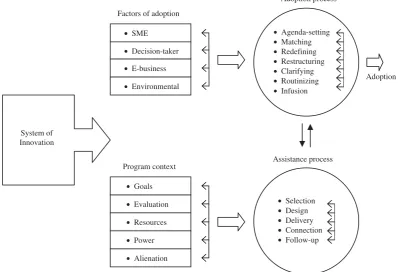
In the previous section, we discussed the implications of the SIA on the adoption of complex technologies. This section examines various complementary theories related to the SIA, which are concerned with organizational innovation, e-business adoption by SMEs, and program implementa-tion. Figure 1 shows the entire theoretical model.
Traditional DOI theory defines an adoption process as a sequence of stages (agenda-setting, matching, redefining,
restructuring, clarifying, and routinizing) through which decision-makers pass in evaluating, adopting, and using innovations. We will consider one further stage in the adoption process, infusion. Infusion measures the extent of use of an application in organizations by measuring the types of transactions and the quantity of transactions per type (Cooper and Zmud, 1990; McGowan and Madey, 1998). In turn, these adoption stages are affected by a set of contextual factors (external variables and structural char-acteristics of organizations), which regulate the rate and stages of diffusion. Despite its great value to us and others, the DOI is a general theory, and does not directly address the specific context of e-business applications and SMEs. After reviewing the literature on e-business adoption by SMEs, we decided to classify thefactors of adoptioninto four groups: SME, decision-taker, e-business, and environmental. In one way or another, most of the research is located within this classification (e.g., Thong, 1999; Jeyarajet al., 2006).
For instance, SMEs tend to be centralized in that the chief executive officer or owner makes the key decisions. As a result, the adoption of an application is strongly affected by the perceptions of this single person (e.g., Filliset al., 2004; Grandon and Pearson, 2004). In cases where a chief executive officer decides not to adopt an application during the matching stage of adoption, a barrier is created. On the other hand, if the decision-taker decides to adopt the innovation, the clarifying and routinizing stages could be favorably influenced by his or her authority, which would be anenablerfor faster adoption.
In addition to organizational and external characteristics, public interventions represent an important influence on SME adoption. Public service workers grant access to government initiatives and provide services through them
Program context
Adoption Factors of adoption
Adoption process
• Agenda-setting
• Matching
• Redefining
• Restructuring
• Clarifying
• Routinizing
• Infusion
Assistance process
• Selection
• Design
• Delivery
• Connection
• Follow-up System of
Innovation
• Evaluation
• Goals
• Resources
• Power
• Alienation
• SME
• Decision-taker
• E-business
[image:3.595.98.497.457.729.2]• Environmental
(e.g., program consultants and public assistance brokers). In terms of the assistance provided by public programs, program officers select recipients, design interventions, deliver services, connect their work with other programs, and follow up client processes. The various stages involved in the interaction of public programs with clients are called assistance processes.
Policy intervention, however, is an ‘on-going, socially constructed, and negotiated process, not simply the execution of an already-specified plan of action with expected outcomes’ (Long, 1999: 4). Public workers often exercise significant discretion to take decisions, given the fact that their work tends to be specific for each intervention, and based on observation and judgment (Argyris, 1964). Additionally, given the context in which they work, public workers have a considerable capacity to shape and resist policy directives that diverge from their interests (Van Meter and Van Horn, 1975). In this situation, policies tend to be made as much from the street-level by public workers, as from the heads of policy agencies (e.g., Lindblom, 1980; Lipsky, 1980; Juma and Clarke, 1995; Long, 1999; Maynard-Moody and Musheno, 2003).
However, the program contexts do affect the working
conditions and attitudes of program employees. For instance, bureaucratic routines can affect the implementa-tion of public programs, and the ability to assess and monitor program outcomes. Lipsky (1980) explains the characteristics of the contexts in which bureaucratic routines are created and the effects these have on the program outcomes. In general, the contexts around
program consultants are complex and tend to constrain
the shape and quality of their work.
For example, public workers operate in an environment in which there is a constant displacement of ambiguous and
competing goals (client-centered and program-centered
goals). In addition, program organizations often cannot be evaluatedby profitability or other market indicators, which complicates the definition of performance targets. This issue is more problematic given the fact that the political environment around public interventions emphasizes the measurement of the efficient use of resources rather than the assessment of the service quality.
The ambiguity of goals and politicized targets often produces inadequate and inconsistentresourcesto meet the quantity and quality of the demand, in terms of time, knowledge, information, and budgets. Program consultants also have relative power over clients because they control the benefits of their services, and have the capacity to deny or to constrain access. In many cases, the benefits of the programs cannot be found elsewhere. As a result, clients may manipulate or positively evaluate poor inter-ventions in order to have access to the program services in the future, adding to the difficulties of evaluating public programs.
A key issue in program delivery is workers’ alienation, which can reduce their motivation, and compromise the needs of the clients and the objectives of the program. One reason for alienation may be that the program services tend to be only a part of a wider client need (e.g., workshops to develop information technology strategies). In this case, public workers may believe that even good assistance will have a minimal impact on SME adoption processes. The
disconnection between the work of the program employee and the next adoption stages of the clients can also cause alienation. Any additional support needed for the SME may not be available from other sources. For example, after developing the information technology strategy, the deci-sion-taker of the SME may not have the knowledge and support to infuse the innovation into the organization. Finally, the pace of the program work is another dimension that can create alienation. Program workers may feel that they are ineffective given the limited and disrupted time they have to work with clients.
The SIA thus directs us toward the relevant contexts around the production and delivery of public programs, which affect the resources that support the various stages of SME innovation. Successful adoption of e-business systems in SMEs depends on an understanding of this broader diffusion context. We turn to this research and practical question next.
Research design
To investigate public programs and the adoption of e-business innovations in SMEs, we chose a case study methodology (Yin, 2003). We focused on the experiences of SME adopters and program employees in the implementa-tion of public programs. In doing so, we studied the phenomenon within its real context. The theoretical model was used as a way to organize our initial lines of inquiry and to provide an initial analytical framework (Miles and Huberman, 1994; Yin, 2003). As the focus of the research, the unit of analysis was the individual policy interventions in adoption processes.
We used process research (Mohr, 1982; Newman and Robey, 1992) to understand what key events occurred across time, with the purpose of exploring the causal order of assistance and adoption processes. We concur that ‘[d]ata-gathering methods for process research are less structured and might entail using in-depth personal interviewsyThe
data are typically more qualitative in nature than in variance research’ (Rogers, 2003: 196). For these reasons, we collected qualitative data, including semi-structured interviews, doc-umentary evidence, and internet information.
We interviewed decision-takers in the SMEs to determine key processes and outcomes during the adoption processes of e-business applications. We also interviewed program consultants and read assistance files to explore the nature of the public interventions in the SMEs. Finally, we interviewed program directors and examined program documents to understand the context around program workers. The interviews were tape recorded and transcribed. The empiri-cal work in this paper is based on the assistance of one program organization to one SME adoption process, extrac-ted from a larger study comprising of 6 program organiza-tions and 10 SME adoption processes. Both the SME and the program organization are located in England.
Empirical findings
The public program
e-learning techniques and traditional face-to-face methods. The range of time per assistance in the program was between two and five man-days, including any third-party service provision sub-contracted by the program. SMEserve was jointly funded by a public organization and a university. The program was run by the university management school, and employed an e-learning platform and several full-time employees to deliver the services. This department has been continuously providing public programs for SMEs since 1999.
The program assistance to a SME was evaluated typically 6 months after delivering each service, via a feedback form from the public organization. This form asks for basic information such as increase in sales, safeguarded sales, jobs created, and jobs safeguarded (i.e., program outputs or targets). The contract between the public organization and the university was signed one year after the beginning of the period to use the public funding. The delay was caused by the administrative procedures used by the public funding organization. A consequence of this was that the university recruited part of the program personnel after the signing of the contract. However, the targets of the program were not modified. In short, the program had major problems finding clients. The program director observed:
What we had a problem is getting enough good clients because you need clients who are going to grow the business and get the outputs y. The choice of who to
work with hasn’t always been the best choice y.
Anything was good.
The SME and the e-business initiative
The company assisted by the program was a ‘joint venture’ formed by the SMEs ‘Intech’ and ‘Archard’ (pseudonyms). The start-up was a third-party e-marketplace for the building supplies sector. Intech was an expert on internet information systems and Archard was a distributor of architectural hardware, a specific segment of the building supplies sector. The managing director of Intech was the managing director of the venture. The e-business model was to be based on resale agreements with traditional building supply shops. The gross profit of the operation was the difference between the selling price of the products to the online customers and the buying price from the supplying shops. The shopping basket of each client of the e-marketplace could include products from different shops. However, the delivery to the clients was to be made directly from the warehouses of the supplying shops. As a result, the delivery charges to the customers varied depending on the shop.
The development of the initiative
The partnership started in the middle of 2002. Once the application was developed and the company recruited eight shops, the venture conducted some initial market research. At that point, the results of the research were considered promising. In the middle of 2003, the venture received public support from SMEserve, and received loans from two financial institutions. At the beginning of 2004, the company used the loans to implement a marketing strategy.
Despite the recruitment of more supply shops, the sales results were less than expected. In response, during the summer of 2005, the venture employed a student on an MBA project to try to improve the competitive position of the company. Despite the development and implementation of the MBA advice, the venture remained unprofitable. The company could not cope with its financial situation and closed down in the middle of 2006.
In addition to the original SMEserve assistance, the company received two further public supports in the second quarter of 2005, from the same University depart-ment: a strategic counseling session and a marketing workshop. The most important recommendations were given in the strategic counseling session. One recommen-dation was the need to develop a trusted brand in order to produce competitive advantage in the building contractor segment, and the other was the possibility of selling the e-marketplace as a ready-to-use product to a company with better market prospects. According to the managing director, the collapse of the venture was caused by Archard’s lack of knowledge about the entire building supplies sector. He explained it this way:
[Archard] had knowledge of a very small part of the building industry [architectural hardware] y. It’s that
kind of marketing knowledge [building supplies sector knowledge] you can’t expect an advertising agency to have y. You [the venture] need to have the business
industry knowledge.
In the managing director’s opinion, a company with a well-established and diversified presence in the building supplies sector (e.g., with online sales, mail orders, and shop sales), and with a better financial position could have successfully worked with the e-business model and the technology. Accordingly, the venture was acquired and relaunched to the market by a company with these characteristics, at the end of 2006.
The assistance process
The joint venture contacted the program via the brokerage service for public support of SMEs. The aim of this service was to connect SMEs with other public services, according to the business needs of the SMEs. The University paid a fee to the brokerage organization for each SME found. Under the national brokerage system in operation at that time, third-party organizations like the University not only could contribute financially to the broker, but could also participate on the board of this service.
The requirements of the company were broad: to increase the web traffic, and the conversion and retention rates of the clients, based on modifications to the web presence. The company expected recommendations around the core e-business model, unless other expensive and important issues were immediately required. The consul-tant based his recommendations on the analysis of other e-marketplaces (e.g., Amazon.com) and on his personal experience. The total time employed for the entire assistance process was 5 days, including the definition of requirements, proposal, consultancy, customer report, presentation, and administrative tasks.
After delivering the services, the SME did not receive any recommendation for further support from the program personnel. The evaluation of this assistance indicates an increase in sales ofd67,000 and the creation of two full-time jobs, which are considered to be directly attributable to the assistance. Despite this, the consultant of the program was unsure about what advice was implemented by the company. He said:
They [the venture] were very very pleased with the report and the recommendationsy. We aren’t sure, but I guess
as it [the venture] wasn’t paying its way, he [the managing director] thought he wanted to spend on developing it [Intech] further, so, not many of the changes [program’s recommendations] happened, I don’t know.
The advice of the program
One recommendation was to use one set of conversion factors to standardize delivery charges based on the total weight of the products in the online shopping baskets. This advice was rejected by the managing director because he considered it impossible for the venture and the participat-ing shops to absorb differences in delivery charges. However, the consultant argued that the recommendation was good, but the venture did not have enough negotiation power to agree on a common delivery charge scheme with the shops. The managing director commented:
If I didn’t know anything about the business, I would say to you as well: oh definitely one delivery charge is what you should doy. The competitors we came across were
existing businesses, hardware houses, who’d gone into the Internety. There is no marketplace in this business y. They’re [SMEserve] looking at it theoretically and
they look at it from a usability point of view, and say: more than one delivery charge, not good news.
Another recommendation of the program was to display the e-marketplace to the online customers by shops (e.g., using logos). However, while initially accepted and implemented by the partners, it was later replaced with the presentation of product categories, based on a different MBA project’s recommendation. The managing director trusted the advice of the MBA student because it involved 8 weeks of work, was based on empirical data, and was clearly expressed in a comprehensive report. Other advice of the MBA project was also used to change the commercial name of the venture.
There were also recommendations on how to access password protected sub-sites oriented toward specific industrial sectors (e.g., health organizations). The recom-mendations were to access the sub-sites via independent easy-to-remember web addresses, and via small buttons located in the main site of the e-marketplace. In the end, the venture did not implement any sector specific sub-site. The final recommendations of the program were concerned with the usability of the application: how to improve the perception of users on the effectiveness and efficiency of the web interface. There were several pieces of advice on usability, most of them related to the look and feel of the buyer interface. These recommendations were implemented by the venture.
Analysis and discussion
This section uses the theoretical model to analyze and discuss the findings in the previous section. We start by identifying the barriers and enablers that affected the adoption process in the SME. Then we review the outcome of the public intervention, and give recommendations about the possible actions that could have improved the assistance process. Finally, we examine the context around the program in order to determine the factors that influenced the capabilities and decisions of the program personnel.
Barriers, enablers, and the adoption process
Four venture-related barriers were identified in the case. There was a lack of business know-how by Archard about the entire building supplies sector. There were restricted financial resources to sustain the initial period of the start-up, in which the sales were low and the operating costs were high. There was also missing business knowledge by the venture, which prevented the effective design of certain aspects of the web presence (presentation of the e-market-place and definition of the commercial name). In addition, the venture lacked a strong brand name to garner trust with building contractors.
On the other hand, the technical knowledge of Intech was an important enabler for the adoption of the application. These four barriers and the enabler were ‘SME factors’ affecting adoption. Although the barriers affected different stages of the ‘adoption process’ of the venture, in combination they caused the adoption to fail in theinfusion stage, because the venture was only able to sell a limited number of products to its customers. This eventual infusion of the e-business system depended on the diffusion of the e-marketplace to the customers of the venture. However, the attempts made to influence buyer adoption were unsuccessful.
Review of the assistance
The venture partners did not accept most of the advice provided by the program. The advice about delivery charges was not accepted, and the advice about presenting the e-marketplace products under each shop was reversed after a different recommendation was made by an MBA student. In addition, the rejected advice could have been inappropriate, given the negative opinion of the managing director about the intervention methodology, and the knowledge and experience of the consultant. The accepted advice was for the usability of the website. However, this advice was probably not required because the venture already had expert website design knowledge within Intech. It is also possible that the advice of the program was incomplete taking into account other important barriers for the venture, such as sector knowledge and branding. These important barriers were not addressed by SMEserve or by any other public or private organization.
Additionally, the venture never implemented its initiative of sector specific sub-sites. So, the program wasted resources working on the recommendations regarding the accessibility of these web pages. Finally, the assistance was given by a program that was created for another type of service. SMEserve was originally created to provide coaching and mentoring based on e-learning techniques and face-to-face methods, and not for traditional con-sultancy services.
Recommendations for the intervention
The revision of the intervention suggests various possibi-lities for a more actively engaged public program worker in the ‘assistance process’. For example, at theselectionstage, the program personnel could have rejected the venture because of potential limitations of the program to cover the venture needs, or because of the limited capabilities of the venture to accomplish its adoption process. Alternatively, the program personnel could have taken into account the other barriers that were affecting the adoption process of the client, anddesigned a particular set of services to meet those needs.
To address the gaps not covered by SMEserve, program personnel could haveconnectedthe SME with other public initiatives or contacted third-party service providers. Program workers could then have focused their interven-tion on those barriers for which they could havedelivered acceptable and practical advice. As a final step, an assessment of the assistance and any consideration for further support could have been done through afollow-up of the outcomes of the stages of the adoption process. Clearly, program personnel took decisions and behaved in ways that resulted in the blind application of funds, without full consideration of the SME needs and the capabilities of the program.
Now that we have analyzed the results of the intervention and suggested an alternative behavior in the assistance process, we turn to analyze the ‘program context’ that influenced the decisions and actions of the program personnel in this case.
The program context
The programevaluationdid little to thoroughly investigate the situated quality of the assistance. Particularly, the
quantitative information was difficult to measure. For example, an increase in sales of d67,000 could have been caused by favorable market conditions, unrelated to public assistance. We also suggest that clients may also respond positively to evaluation questionnaires in order to ensure the assistance of the program organization in thefuture. In fact, the venture received four different services from the University, and so the positive evaluation could be a manifestation of a relatively powerful position of the program workers over the client.
Both the lack of proper evaluation mechanisms and the relatively powerful position of program personnel left program workers free to choose the level and quality of the intervention. This situation can activate the conflicts
among client-centered and program-centered goals. As
highlighted above, the program personnel did little to provide a needed service for the client, and did not screen the suitability of the SME for the program in order to strategically allocate public funds towards an adoption process that would have moved the company towards an increased chance of success. These findings represent the substitution of client goals for program-centric goals. These suggest various contextual influences that encourage program workers to focus on program-centered goals, at the expense of clients, which we consider next.
Three resource factors could have played in favor of program-centered goals, in this case. The first is inadequate time. We believe that between 2 and 5 days is too short to correctly assess and deliver an effective program intervention. This may have contributed partially or solely to the managing director’s comment about a lack of information from the consultant to support the advice. In this case, the advice needs to be convincing, through primary data (e.g., surveys or focus groups), as was done in the MBA project. In addition, the consultant was very young at the time of the service, and appears to have
only had knowledge of web design and development.
Finally, any other needs of the venture could have been covered by contracting with third-party service providers, but the program budgetsare often restricted for this joint provision of services.
An important additional reason for program-centered goals was a scramble to find and spend funds with SMEs in order to meet program objectives. At the time of the assistance, the demand for SMEserve was insufficient to meet program objectives, and program workers may have felt the pressure to meet the targets. This was evident in a consultant’s delivery of services, which were not within the scope of the program activities. As a result, both inadequate resources and the low demand appear to have created a goal displacement of the client’s needs with the needs of the program.
unsure about which recommendations were implemented by the client. Without any formal procedure or measure-ment method for determining the extent of adoption or for cross-program collaboration, SMEserve also had little way of knowing what effect it did have on the SME’s process. To conclude, the availability of limited resources in SMEserve, especially time, can alienate workers, and affect the underlying purpose and effective delivery of program resources.
Conclusions
The research agenda on e-business adoption by SMEs is traditionally represented by the DOI. The learning process view of innovation of the SIA as well as the concepts of activities, organizations, institutions, and linkages depicts the real-life complexities of innovation production and diffusion. The SIA broadens the contextual study of the diffusion of complex innovations to an examination of the cascading effects arising from various participants and innovations surrounding a focal innovation. Accordingly, our study illustrates additional systemic issues that need to be researched, for example public funding administrative procedures, program targets definition and measurement methods, consultancy training, program demand genera-tion, public assistance brokerage, multiple adoption processes, and cross-program collaboration.
The study of public programs demonstrated that research on systemic issues has to rely on both the general SIA and specific theoretical models that ‘flesh out’ traditional DOI. To do so, we used concepts from SIA and policy implementation to explain the reciprocal relationship between programs and SME adoption of e-business applications. In fact, public assistance is explained by contextual concepts such as evaluation, power, goals, resources, and alienation. Much of this program context is determined by the systemic issues detected in the case study, which tend to be external to the program and thus restrict the possibility of program directors to plan and implement relevant services to clients.
To conclude, the research provides both theoretical and empirical contributions. For instance, the research can help policy-makers to consider and assess systemic contexts around the design of programs, to allow SME decision-takers to understand adoption processes, to support assistance brokers in identifying programs to address SME needs, to help program managers to select SMEs in the correct stage of adoption and contextual circumstance, and to assist program consultants to identify complemen-tary expertise and programs to work toward successful SME adoption of complex applications. However, while some aspects of the program contexts can be altered by the program directors, others are beyond the empirical scope of our study, and our collective control. To understand and influence these contexts, a range of research and practical work has to be conducted using the SIA. These future studies will explore the broader legislative, governmental and program construction and coordination work, that affects and are required to ensure the successful delivery of programs for the diffusion of IT into SMEs.
Acknowledgements
We thank Lancaster University Management School for the financial support of this Ph.D. research.
References
Al-Qirim,N.(2006). The Role of Government and E-Commerce Adoption in
Small Businesses in New Zealand,International Journal of Internet and Enterprise Management4(4): 293–313.
Argyris,C.(1964).Integrating the Individual and the Organization, New York:
John Wiley.
Asheim,B. and Isaken,A.(2000). Localized Knowledge, Interactive Learning
and Innovation: Between regional networks and global corporations, in E. Vatne and M. Taylor (eds.)The Networked Firm in a Global World: Small firms in new environments, Aldershot: Ashgate Publishing Group, pp. 163–198.
Attewell,P.(1992). Technology Diffusion and Organizational Learning: The
case of business computing,Organization Science3(1): 1–19.
Berkeley,N.,Clark,D. and Ilbery,B.(1996). Regional Variation in Business Use
of Information and Communication Technologies and the Implications for Policy: Case study evidence from rural England,Geoforum27(1): 75–86.
Brown,D. and Lockett,N.(2006). Aggregation and the Role of Trusted Third
Parties in SME E-Business Engagement: A regional policy issue,International Small Business Journal24(1): 379–404.
Chiasson,M. and Lovato,C.(2001). Factors Influencing the Formation of a
User’s Perceptions and Use of a DSS Software Innovation,The Database for Advances in Information Systems32(3): 16–35.
Cooper,R. and Zmud,R.(1990). Information Technology Implementation
Research: A technological diffusion approach,Management Science36(2): 83–102.
David,P.(1975).Technical Choice, Innovation and Economic Growth,
Cambridge: Cambridge University Press.
Davidson,E. and Chiasson,M.(2005). Contextual Influences on Technology
Use Mediation: A comparative analysis of electronic medical record systems, European Journal of Information Systems14: 6–18.
Dierckx,M. and Stroeken,J.(1999). Information Technology and Innovation in
Small and Medium-Sized Enterprises,Technological Forecasting and Social Change60(2): 149–166.
Economic Commission for Africa(2003). African Information Society Initiative
(AISI): An action framework to build Africa’s information and communication infrastructure [WWW document] http://www.uneca.org/ aisi/docs/AISIBrochure.pdf (accessed 5th June 2004).
Economic Commission for Latin America and the Caribbean(2007).
Monitoring eLAC2007: Progress and current state of development of the Latin American and Caribbean information societies [http://www.eclac.cl/ cgi-bin/getProd.asp?xml¼/publicaciones/xml/1/29951/P29951.xml&xsl¼/ ddpe/tpl-i/p9f.xsl&base¼/socinfo/tpl-i/top-bottom.xsl] (accessed 3rd October 2007).
Edquist,C.(1997). Systems of Innovation Approaches: Their emergence and
characteristics, in C. Edquist (ed.)Systems of Innovation: Technologies, institutions and organizations, London: Pinter, pp. 1–35.
Edquist,C.(2001). The Systems of Innovation Approach and Innovation
Policy: An account of the state of the art, in the Danish Research Unit for Industrial Dynamics Conference (Aalborg, Denmark, 2001) [WWW document] http://www.druid.dk/conferences/nw/paper1/edquist.pdf (accessed 4th September 2007).
Edquist,C.(2005). Systems of Innovation: Perspectives and challenges, in
J. Fagerberg, D. Mowery and R. Nelson (eds.)The Oxford Handbook of Innovation, Oxford: Oxford University Press, pp. 181–208.
European Union(2001). Helping SMEs to ‘‘Go Digital’’ [WWW document]
http://europa.eu/eur-lex/lex/LexUriServ/LexuriServ.do?uri¼COM:2001:0136: FIN:EN:PDF (accessed 2nd January 2005).
Eveland,J. and Tornatzky,L.(1990). The Deployment of Technology, in
L. Tornatzky and M. Fleischer (eds.)The Processes of Technological Innovation, Massachusetts: Lexington Books, pp. 117–148.
Fillis,I.,Johansson,U. and Wagner,B.(2004). A Qualitative Investigation of
Smaller Firm E-Business Development,Journal of Small Business and Enterprise Development11(3): 349–361.
Freeman,C.(1987).Technology Policy and Economic Performance: Lessons from
Gengatharen,D.,Craig,S. and Burn,J.(2005). Government-Supported Community Portal, Regional E-Marketplaces for SMEs: Evidence to support a staged approach,Electronic Markets15(4): 405–417.
Grandon,E. and Pearson,M.(2004). Electronic Commerce Adoption: An
empirical study of small and medium US businesses,Information & Management42(1): 197–216.
Hira,N.(2002). Electronic Commerce and Manufacturing Supply Chain Integration and Management: Approach to improve government policies, Ph.D. dissertation, George Mason University, Virginia, USA.
Jansen,A.(1998). Technology Diffusion and Adoption in Small, Rural Firms,
in J. Larsen and E. McGuire (eds.)Information Systems Innovation and Diffusion: Issues and Directions, London: Idea Group Publishing, pp. 345–372.
Jeyaraj,A.,Rottman,J. and Lacity,M.(2006). A Review of the Predictors,
Linkages and Biases in IT Innovation Adoption Research,Journal of Information Technology21(1): 1–23.
Juma,C. and Clarke,N.(1995). Policy Research in Sub-Saharan Africa: An
exploration,Public Administration and Development15(2): 121–137.
King,J.,Gurbaxani,V.,Kraemer,K.,McFarlan,F.,Raman,K. and Yap,C.
(1994). Institutional Factors in Information Technology Innovation, Information Systems Research5(2): 139–170.
Lebre,R.(1996). IT Diffusion in Small and Medium-Sized Enterprises:
Elements for policy definition,Information Technology for Development
7(4): 169–180.
Lindblom,C.(1980).The Policy-Making Process, New Jersey: Prentice-Hall.
Lipsky,M.(1980).Street-Level Bureaucracy: Dilemmas of the individual in
public services, New York: Russell Sage Foundation.
Locke,S.(2006). E-Local Government Strategies and Small Business,The
Journal of American Academy of Business10(1): 21–30.
Long,N.(1999). The Multiple Optic of Interface Analysis [WWW document] http://www.utexas.edu/cola/insts/llilas/content/claspo/PDF/workingpapers/ multipleoptic.pdf (accessed 5th October 2006).
Lundvall,B.(ed.) (1992).National Systems of Innovation: Towards a theory of
innovation and interactive learning, London: Pinter.
Lundvall,B. and Borras,S.(2005). Science, Technology and Innovation Policy,
in J. Fagerberg, D. Mowery and R. Nelson (eds.)The Oxford Handbook of Innovation, Oxford: Oxford University Press, pp. 599–631.
Mansell,R.(2001). Digital Opportunities and the Missing Link for Developing
Countries,Oxford Journal of Economic Policy17(2): 282–295.
Maynard-Moody,S. and Musheno,M.(2003).Cops, Teachers, Counselors:
Stories from the front lines of public service, Ann Arbor: University of Michigan Press.
McGowan,M. and Madey,G.(1998). Adoption and Implementation of
Electronic Data Interchange, in J. Larsen and E. McGuire (eds.)Information Systems Innovation and Diffusion: Issues and directions, London: Idea Group Publishing, pp. 116–140.
Metcalfe,S. and Georghiou,L.(1998). Equilibrium and Evolutionary
Foundations of Technology Policy, Science, Technology and Industry Review,Organization for Economic Co-operation and Development
22(1): 75–100.
Miles,M. and Huberman,A.(1994).Qualitative Data Analysis, California: Sage
Publications.
Mohr,L.(1982).Explaining Organizational Behavior: The limits and possibilities of theory and research, San Francisco: Jossey-Bass.
Morgan,A.,Colebourne,D. and Thomas,B.(2006). The Development of ICT
Advisers for SME Businesses: An innovative approach,Technovation26(8): 980–987.
Nelson,R.(ed.) (1993).National Systems of Innovation: A comparative study,
Oxford: Oxford University Press.
Newman,M. and Robey,D.(1992). A Social Process of User-Analyst
Relationships,MIS Quarterly16(2): 249–266.
Nyholm,J.,Normann,L.,Frelle-Petersen,C.,Riis,M. and Torstensen,P.
(2002). Innovation Policy in the Knowledge-Based Economy: Can theory guide policy-making?, in D. Archibugi and B. Lundvall (eds.)The Globalizing Learning Economy, Oxford: Oxford University Press, pp. 253–272.
Organization for Economic Co-operation and Development(2004). ICT,
E-Business and SMEs [WWW document] http://www.oecd.org/dataoecd/32/ 28/34228733.pdf (accessed 1st February 2005).
Oyelaran-Oyeyinka,B. and Lal,K.(2006). Institutional Support for Collective
Learning: Cluster development in Kenya and Ghana,African Development Review18(2): 258–278.
Papazafeiropoulou,A.(2004). A Framework for the Investigation of the
Institutional Layer of IT Diffusion: Using stakeholder theory to analyze electronic commerce diffusion, in J. Damsgaard and H. Zinner (eds.) Networked Information Technologies: Diffusion and adoption, Massachusetts: Kluwer Academic Publishers, pp. 167–179.
Ray,A. and Ray,J.(2006). Strategic Benefits to SMEs from Third Party Web
Services: An action research analysis,Journal of Strategic Information Systems15(4): 273–291.
Rogers,E.(2003).Diffusion of Innovations, New York: Free Press.
Taylor,M. and Murphy,A.(2004). SMEs and the Take-Up of E-Business,Urban
Geography25(4): 315–331.
Thong,J.(1999). An Integrated Model of Information Systems Adoption in
Small Businesses,Journal of Management Information Systems15(4): 187–214.
United Nations Conference on Trade and Development(2006). Information
Economy Report 2006: The development perspective [WWW document] http://www.unctad.org/en/docs/sdteecb20061_en.pdf (accessed 15th October 2007).
Van Meter,D. and Van Horn,C.(1975). The Policy Implementation Process:
A conceptual framework,Administration and Society6(4): 445–488.
Wolcott,P.,Press,L.,McHenry,W.,Goodman,S. and Foster,W.(2001).
A Framework for Assessing the Global Diffusion of the Internet,Journal of the Association of Information Systems2(6): 1–50.
Yap,C. and Thong,J.(1997). Program Evaluation of a Government Information
Technology Program for Small Business,Journal of Information Technology
12(2): 107–120.
Yin,R.(2003).Case Study Research: Design and methods, London: Sage Publications.
Zhao,K.,Xia,M. and Shaw,M.(2007). An Integrated Model of
Consortium-Based E-Business Standardization: Collaborative development and adoption with network externalities,Journal of Management Information Systems
23(4): 247–271.
About the authors
Arturo Vegais a doctoral candidate at Lancaster University Management School where he received his MBA. He earned his B.Eng. from Ricardo Palma University in Peru. He has 10 years of a varied international experience in local and multinational firms. His research interest is a mix of IT and systems, business strategy, innovation, and public policies.
Mike ChiassonPh.D. is an Advanced Institute for Manage-ment (AIM) Innovation Fellow, and a Senior Lecturer in the Department of Management Science at Lancaster Univer-sity. Mike’s research examines the relationships between institutional contexts and the development and implemen-tation of information systems (IS). His work includes action research, user involvement, IT diffusion, privacy, out-sourcing, and social foundations of IS development and use.